Psalms 123:4

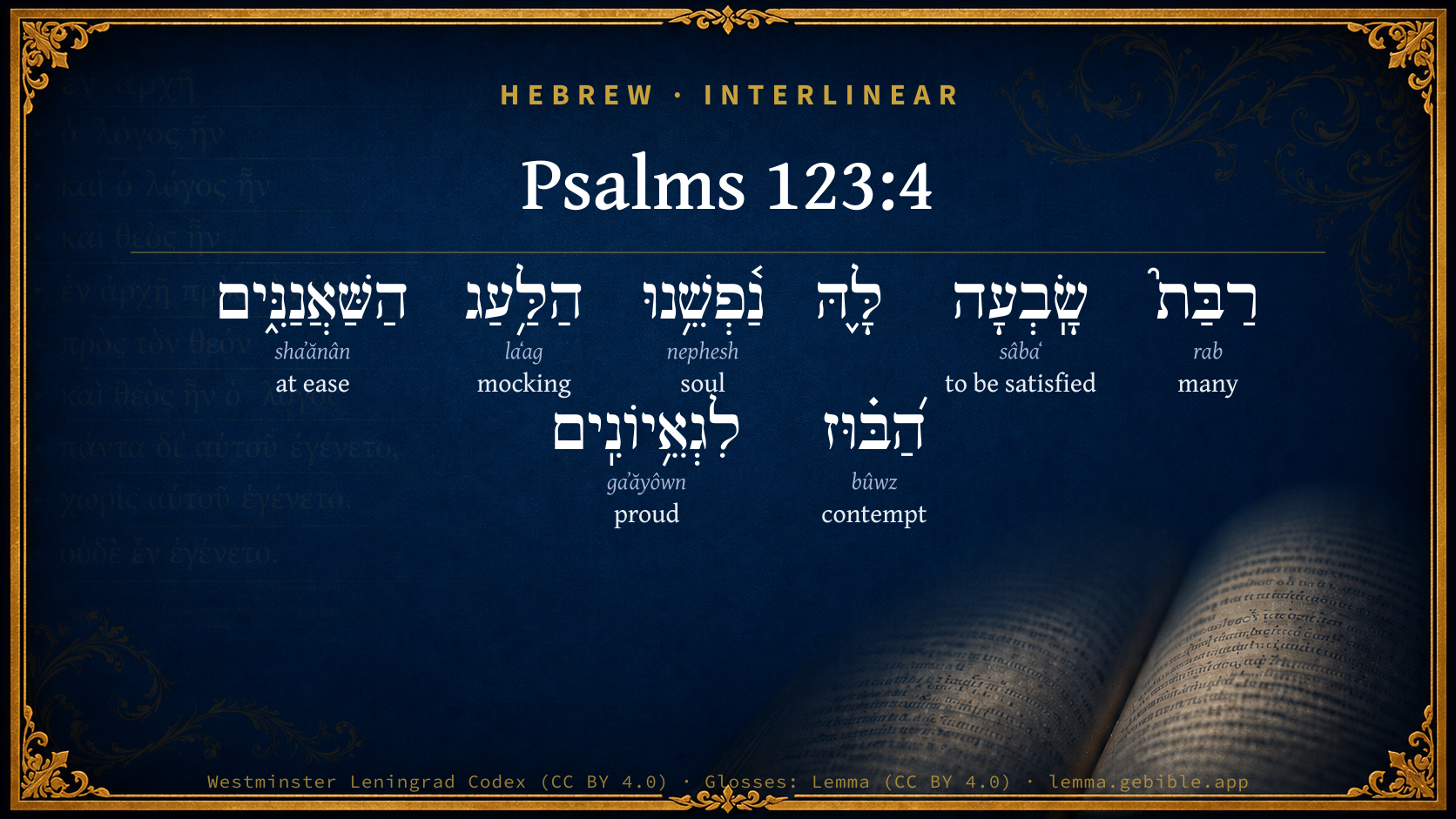
Hebrew (Westminster Leningrad Codex) Psalms 123:4 appears in the Hebrew Old Testament. The text above is from the Westminster Leningrad Codex. Each word links to its Strong’s number, a concise gloss, and parsing drawn from the Open Scriptures Hebrew Bible morphology. Click any word for its full Brown-Driver-Briggs (BDB) entry.
Download image
Cite this verse

Psalms 123:4 (World English Bible). Public Domain. Lemma interlinear Bible study tool, https://lemma.gebible.app/v/psalms/123/4.

Show BibTeX & RIS
BibTeX
RIS
English Translation
Our soul is exceedingly filled with the scoffing of those who are at ease, With the contempt of the proud.
World English Bible · Public Domain
Highlights
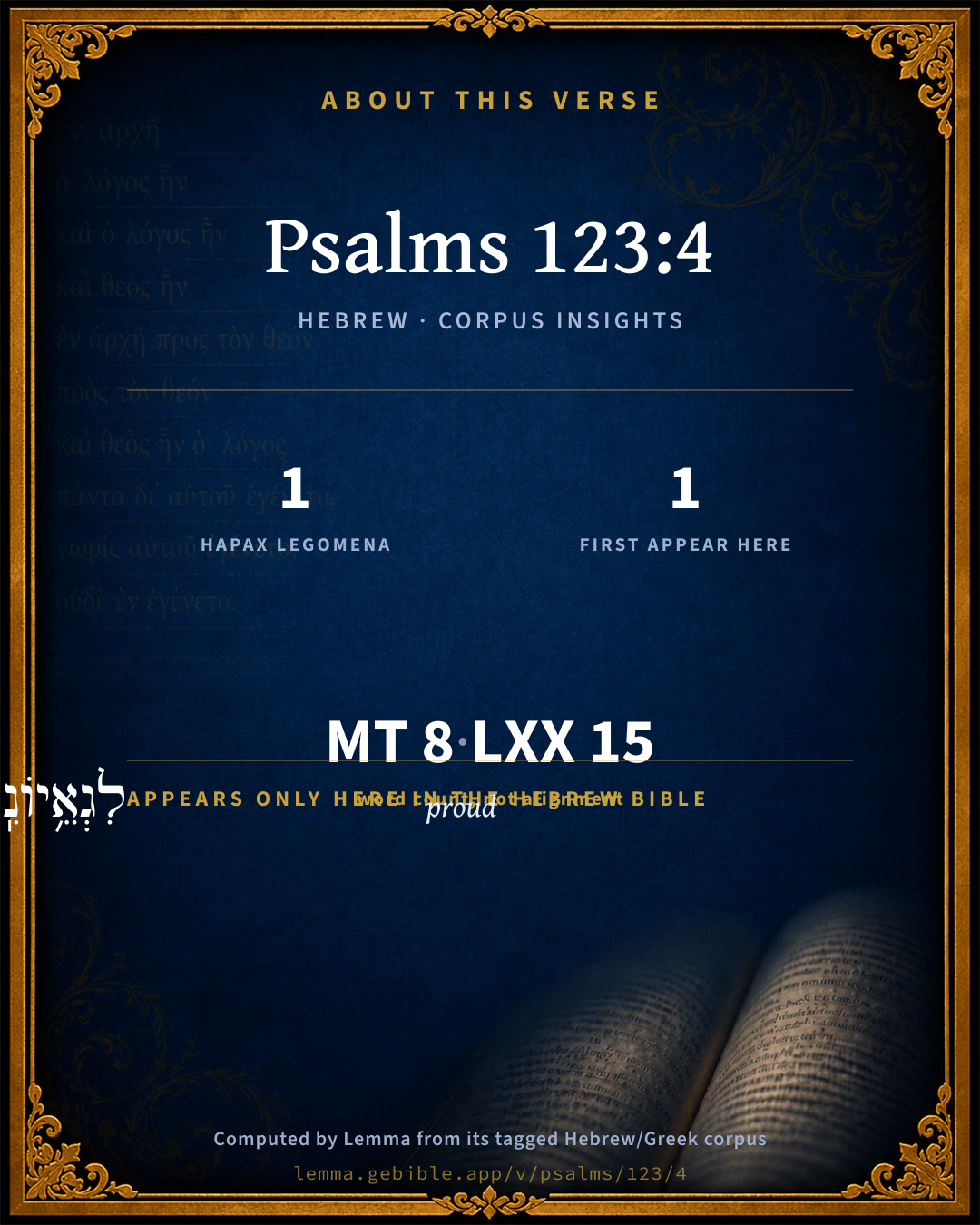
  • 1 hapax legomenon — only here in the Hebrew Bible
  • 1 first appearance in the Hebrew Bible
Full analysis ↓
Download a study sheet

One document with this verse’s original text, its word-by-word gloss line, the meaning frame, cross-references with their text, attributed commentary, and full source and license credits — printable, and it pastes into notes with its structure intact.

This verse Autodidact and up

Study sheet (.html) Plain text (.txt)

A passage Seminary Student

Up to 50 verses in one chapter. A passage sheet keeps up to 6 commentary sources and 12 cross-references per verse, in the order this page ranks them, and says so on the sheet whenever that leaves anything out. Ask for a single verse and you get the Autodidact verse sheet above.

Everything on this page stays free to read, with no account — the sheet is a download of what is already on screen, not access to it.

Want to remove ads? Support Godless Engineer
Compare translations 3

The same verse in 3 English versions, stacked beneath the original-language interlinear above. Click any original word for its lexicon entry.

Each is an independent rendering of the whole verse — the interlinear is not word-aligned to these translations.

Highlighted words mark where these versions differ — a whole-verse word diff, not a word-by-word alignment.

  • World English Bible Public Domain
    Our soul is exceedingly filled with the scoffing of those who are at ease, With the contempt of the proud.
  • King James Version Public Domain
    Our soul is exceedingly filled with the scorning of those that are at ease, and with the contempt of the proud.
  • unfoldingWord Literal Text CC BY-SA 4.0
    Greatly our soul is satiated with it, the scorn of the arrogant, the contempt of the proud.

unfoldingWord Literal Text — © unfoldingWord, licensed CC BY-SA 4.0. Word-aligned USFM3 via Door43 (git.door43.org/unfoldingWord/en_ult).

Versions to compare (up to 4)

3 of 4 selected

Show all 18 translations

Every available English version of this verse, each an independent rendering of the whole verse.

  • World English Bible Public Domain
    Our soul is exceedingly filled with the scoffing of those who are at ease, With the contempt of the proud.
  • Berean Standard Bible Public Domain
    We have endured much scorn from the arrogant, much contempt from the proud.
  • Majority Standard Bible Public Domain
    We have endured much scorn from the arrogant, much contempt from the proud.
  • King James Version Public Domain
    Our soul is exceedingly filled with the scorning of those that are at ease, and with the contempt of the proud.
  • American Standard Version (1901) Public Domain
    Our soul is exceedingly filled With the scoffing of those that are at ease, And with the contempt of the proud. Psalm 124 A Song of Ascents; of David.
  • Revised Version (1885) Public Domain
    Our soul is exceedingly filled with the scorning of those that are at ease, and with the contempt of the proud.
  • Geneva Bible (1599) Public Domain
    Our soule is filled too full of ye mocking of the wealthy, and of the despitefulnes of the proude.
  • Douay-Rheims (1899) Public Domain
    For thither did the tribes go up, the tribes of the Lord: the testimony of Israel, to praise the name of the Lord.
  • Young's Literal Translation Public Domain
    Greatly hath our soul been filled With the scorning of the easy ones, With the contempt of the arrogant!
  • Literal Standard Version CC BY-SA 4.0
    Our soul has been greatly filled || With the scorning of the easy ones, || With the contempt of the arrogant!
  • Unlocked Literal Bible CC BY-SA 4.0
    We are more than full of the scoffing of the insolent and with the contempt of the proud.
  • unfoldingWord Literal Text CC BY-SA 4.0
    Greatly our soul is satiated with it, the scorn of the arrogant, the contempt of the proud.
  • Darby Bible Public Domain
    Our soul is exceedingly filled with the scorning of those that are at ease, with the contempt of the proud.
  • World Messianic Bible Public Domain
    Our soul is exceedingly filled with the scoffing of those who are at ease, with the contempt of the proud.
  • Webster's Bible Public Domain
    Our soul is exceedingly filled with the scorning of those that are at ease, and with the contempt of the proud.
  • Free Bible Version CC BY-SA 4.0
    We've had more than enough of the scorn of the proud, and the contempt of the arrogant.
  • Bible in Basic English Public Domain
    For long enough have men of pride made sport of our soul.
  • JPS Tanakh (1917) Public Domain
    Our soul is full sated with the scorning of those that are at ease, and with the contempt of the proud oppressors.

Literal Standard Version (2020), Covenant Press — licensed CC BY-SA 4.0. Text via the HelloAO Bible API (eBible.org). Unlocked Literal Bible (unfoldingWord) — licensed CC BY-SA 4.0. Text via the HelloAO Bible API (eBible.org). unfoldingWord Literal Text — © unfoldingWord, licensed CC BY-SA 4.0. Word-aligned USFM3 via Door43 (git.door43.org/unfoldingWord/en_ult). Free Bible Version, Dr. Jonathan Gallagher — licensed CC BY-SA 4.0. Text via the HelloAO Bible API (eBible.org).

Word by word

More ways to search: Search by grammar → Find every occurrence → Compare this word →

Practice this passage: Drill this verse → Learn its vocabulary →

לִגְאֵ֥יוֹנִֽים
gaʼăyôwn
H1349
“to/for · proud”
Preposition + Adjective, Adjective, Masculine, Plural, Absolute
Part of Speech
Preposition + Adjective
Type
Adjective
Gender
Masculine
Number
Plural
State
Absolute
Full BDB Definition

Origin: from H1342

TWOT: 299g

proud
  1. רַבַּת֮ rab H7227 “many of” Adjective, Adjective, Feminine, Singular, Construct
  2. שָֽׂבְעָה sâbaʻ H7646 “to be satisfied” Verb, Qal, Perfect, 3rd Person, Feminine, Singular
  3. נַ֫פְשֵׁ֥נוּ nephesh H5315 “soul · our” Noun, Common, Both, Singular, Construct + Suffix, Personal, 1st Person, Common, Plural
  4. הַלַּ֥עַג laʻag H3933 “the · mocking” Particle, Definite Article + Noun, Common, Masculine, Singular, Absolute
  5. הַשַּׁאֲנַנִּ֑ים shaʼănân H7600 “the · at ease” Particle, Definite Article + Adjective, Adjective, Masculine, Plural, Absolute
  6. הַ֝בּ֗וּז bûwz H937 “the · contempt” Particle, Definite Article + Noun, Common, Masculine, Singular, Absolute

About this verse

These counts appear in no published source. They are computed here, from the morphology-tagged text and Lemma’s own curated glosses. What Lemma adds →

8
words
7
distinct lemmas
Wisdom
section

Notable vocabulary

1 hapax legomenon — a word that appears only here in the entire Hebrew Bible:

  • לִגְאֵ֥יוֹנִֽים proud H1349

First appearance in Scripture

This word makes its first canonical appearance in the Hebrew Bible here:

  • לִגְאֵ֥יוֹנִֽים proud H1349

Shared distinctive vocabulary

הַלַּ֥עַג mocking H3933 occurs in 7 verses of the Hebrew Bible. Also found in:

Grammatical profile

  • 1 verb
  • 3 nouns
  • 3 adjectives
  • 1 preposition

Verb forms

  • שָֽׂבְעָה Qal · Perfect

Hebrew & Septuagint length

In English translation the verse runs 20 words from the Hebrew and 24 from the Septuagint (LXX English) — closely comparable.

A rough comparison of the two English renderings, which tokenize alike — not a word-level alignment.

Word counts can differ between the Hebrew and the Greek without any difference in meaning — e.g. the Hebrew direct-object marker אֵת has no separate Greek word, and Greek often adds the article ὁ.

In the original languages it is 8 Hebrew tokens and 15 Greek tokens — but the two are counted differently (Hebrew bundles its prefixes and suffixes into one token; the Greek is in lemma form), so that isn’t a like-for-like length.

Cross-references

15

Topical passages linked to Psalms 123:4 in the Treasury of Scripture Knowledge — connected by theme and wording, ordered by reader-vote popularity; previews shown in the World English Bible.

  • Job 12:5 In the thought of him who is at ease there is contempt for misfortune, It is ready for them whose foot slips.
  • Psalms 119:51 The arrogant mock me excessively, But I don't swerve from your law.
  • Acts 17:32 Now when they heard of the resurrection of the dead, some mocked; but others said, "We want to hear you again concerning this."
  • Isaiah 32:11 Tremble, you women who are at ease; be troubled, you careless ones; strip yourselves, and make yourselves naked, and gird [sackcloth] on your loins.
  • 1 Corinthians 4:13 Being defamed, we entreat. We are made as the filth of the world, the dirt wiped off by all, even until now.
  • Nehemiah 2:19 But when Sanballat the Horonite, and Tobiah the servant, the Ammonite, and Geshem the Arabian, heard it, they ridiculed us, and despised us, and said, What is this thing that you do? will you rebel against the king?
  • Job 16:4 I also could speak as you do. If your soul were in my soul's place, I could join words together against you, And shake my head at you.
  • Psalms 73:5–9 They are free from burdens of men, Neither are they plagued like other men.
  • Isaiah 32:9 Rise up, you women who are at ease, [and] hear my voice; you careless daughters, give ear to my speech.
  • Jeremiah 48:11 Moab has been at ease from his youth, and he has settled on his lees, and has not been emptied from vessel to vessel, neither has he gone into captivity: therefore his taste remains in him, and his scent is not changed.
  • Jeremiah 48:29 We have heard of the pride of Moab, [that] he is very proud; his loftiness, and his pride, and his arrogance, and the haughtiness of his heart.
  • Amos 6:1 Woe to those who are at ease in Zion, And to those who are secure on the mountain of Samaria, The notable men of the chief of the nations, To whom the house of Israel come!
  • Acts 26:24 As he thus made his defense, Festus said with a loud voice, "Paul, you are crazy! Your great learning is driving you insane!"
  • Jeremiah 48:27 For wasn't Israel a derision to you? was he found among thieves? for as often as you speak of him, you wag the head.
  • Acts 17:21 Now all the Athenians and the strangers living there spent their time in nothing else, but either to tell or to hear some new thing.

Cross-references courtesy of OpenBible.info (CC BY 4.0).

Hebrew and Greek witnesses Masoretic Hebrew ↔ Greek Septuagint

The same verse in the two great witnesses to the Old Testament, shown verse-for-verse.

You’re reading Greek Psalm 122 (Hebrew Psalm 123). The Septuagint counts the superscription, so verse numbers can differ from the Hebrew — chapter-level alignment, not verse-by-verse. Numbering follows Rahlfs.

These are two independent witnesses, not word-aligned to each other, and the Septuagint is shown in lemma (dictionary) form.

Hebrew Psalms 123:4 Masoretic · Westminster Leningrad Codex

רַבַּת֮ שָֽׂבְעָה לָּ֪הּ נַ֫פְשֵׁ֥נוּ הַלַּ֥עַג הַשַּׁאֲנַנִּ֑ים הַ֝בּ֗וּז לִגְאֵ֥יוֹנִֽים

Our soul is exceedingly filled with the scoffing of those who are at ease, With the contempt of the proud.

World English Bible · Public Domain

Greek LXX Greek Psalm 122:4 Septuagint · lemma form

ἐπί πολύς πίμπλημι ὁ ψυχή ἐγώ ὁ ὄνειδος ὁ εὐθηνέω καί ὁ ἐξουδένωσις ὁ ὑπερήφανος

Yes, our soul has been exceedingly filled with it: let the reproach be to them that are at ease, and contempt to the proud.

LXX2012 (modern English Septuagint) · Public Domain

On this verse, Ellicott's Commentary for English Readers discusses the Septuagint’s reading. Read the note in Commentary ↓

Hebrew: Westminster Leningrad Codex (CC BY 4.0). Greek: Septuagint (public domain); English from LXX2012 (modern English Septuagint) (Public Domain). How the Septuagint differs from the Hebrew →

Commentary

Notes on Psalms 123:4 from classic Christian and Jewish commentators (each source and its license shown beneath its notes). The classic Christian expositions comment on the surrounding passage and are grouped to its opening verse, so a note may address several verses; the Jewish commentaries on the Tanakh (Rashi and others) are per-verse, so they appear only where the commentator wrote on this verse.

Lemma curates 59 commentaries, every one of them public domain or Creative Commons licensed, each selected and text-cleaned for this edition rather than reprinted as found. About our sources →

Trapp's Complete Commentary

John Trapp

Psa 123:4 Our soul is exceedingly filled with the scorning of those that are at ease, [and] with the contempt of the proud.

Ver. 4. Our soul is exceedingly filled with the scorning of those that are at ease] And therehence insolent and unsufferable, for κορος υβριν τικτει, ease breedeth forgetfulness, yea, it maketh men scornful and wrongful to others.

John Trapp, A Commentary or Exposition upon All the Books of the Old and New Testament (1647–1656) — public domain. Text from a community e-Sword module.

The Biblical Illustrator

Joseph S. Exell

Psa_123:4

Our soul is exceedingly filled With the scorning of those that are at ease.

Man disregarding man

I. Mans disregard for man explains the social sorrows of the world. Were all men lovingly interested in each other, would there be pauperism, fraud, oppression, persecution, war, etc.?

II. Mans disregard for man reveals the moral apostasy of mankind. The constitution of the soul, with its moral sense and social sympathies, as well as the Bible, assure us that man was made to love his brother, that no man should seek his own supremely, but each anothers weal. Sin has broken the social bond, shattered the social temple, unstrung the social harp.

III. Mans disregard for man proves the worlds need of a Redeemer. If men do not care for men, who is to help the world? There is only One who can do it, and that is Christ. He came for this purpose, He came to redeem men from all iniquity. (Homilist.)

Antagonism against Gods people

The quarrel is very old, and easily explained. It is the antagonism between darkness and light, between sin and holiness, between Satan and Christ, between hell and heaven. And though it may not be pleasant to be mocked and calumniated by these men, what a humiliation it would be to receive their praise! How low would you sink in your own esteem, were they to make flattering speeches, and tell you that you had done famously! That is a patronage from which one would instinctively recoil. Be thankful that they can use no other weapons than calumny and contempt. The Jews had to contend at the same time with open violence. Were their power equal to their will, they would deprive you of your civil rights, they would confiscate your property, they would confine you in dungeons, they would burn you at the stake. In Athens, they would have condemned Socrates, the greatest and best philosopher of antiquity, to drink the cup of hemlock; and they would have banished Aristides, because they were tired of hearing every one call him Aristides the Just. In Jerusalem, they would have goaded on the senseless rabble, and swelled the ferocious shout, Not this man, but Barabbas. In St. Andrews, they would have sat at the castle windows, and feasted their eyes when good Patrick Hamilton was consuming in the flames, and they, would have gone in afterwards, and dined with an unimpeachable appetite. In slave countries, they would tar and feather the missionaries, who proclaim to the degraded negroes the unsearchable riches of Christ. The same satanic spirit still reigns; and can we be too grateful that these enemies of the Cross are kept in chains! We live in a land of civil and religious freedom; and they cannot go beyond the boundaries of misrepresentation and scorn. They may show their teeth and growl, but they cannot bite. They may curse you, but they cannot lay a finger upon you. (N. McMichael.)

.

Psa_124:1-8

The Biblical Illustrator, edited by Joseph S. Exell (c. 1880s–1900s) — public domain. Text from a community e-Sword module.

Adam Clarke's Commentary

Verse 4. Those that are at ease] The Babylonians, who, having subdued all the people of the neighbouring nations, lived at ease, had none to contend with them, and now became luxurious, indolent, and insolent: they were contemptuous and proud.

ANALYSIS OF THE HUNDRED AND TWENTY-THIRD PSALM

The oppressed followers of God make application to him for mercy. In this application they express three things: -

I. Their confidence in God.

II. Prayer for mercy.

III. An account of their oppressors.

I. Their trust in God.

1. "Unto thee lift I up mine eyes." We trust in thee alone.

2. "O thou that dwellest in the heavens." Infinitely raised above us; but affected with our miserable condition, and always ready to help us.

This he shows by a double similitude: -

1. "As the eyes of servants," i.e., men-servants, "look unto the hand of their masters."

2. "As the eyes of a maiden unto the hand of her mistress:" both might be beaten; and here both beg to be saved from farther stripes.

3. "So our eyes," c. God's children are always looking up to him.

4. "Until that he have mercy" abate his stripes, and take off his hand.

II. Their prayer for mercy.

1. Before they lifted their eyes to God, but now they cry for mercy.

For this crying, they give the following reasons: -

1. "We are exceedingly filled with contempt." To suffer contempt is much; to be filled with it is more; and to be exceedingly filled with it is worst of all.

2. We are scorned: they join words and actions to show how much they despise us.

III. They give the character of those by whom they suffer.

1. They are at ease - loaded with wealth, and sunk in indolence.

2. They are proud - puffed up with a sense of their own importance; and this leads them to despise others. Proud men are for the most part empty, shallow-pated men: and contempt and scorn from such wounds deeply; especially if they rise, as they often do, from the dunghill. The sick lion in the fable found it extremely galling to be kicked by the foot of an ass.

Adam Clarke's Commentary on the Bible (1810–1826) — public domain. Text from a community e-Sword/MySword module.

Ellicott's Commentary for English Readers

(4) The scorning.—The Hebrew offers a rare use of the article—probably it should be reproduced by our demonstrative, this scorning. The LXX., however, have, “The scorn for those at ease, and the contempt for the proud,” which requires only the substitution of a letter, removes an anomaly in construction, and gives a better sense: “Let our desire be satisfied to the full with the scorn for those at ease, and the same contempt for the proud.” Notice how the figure is retained. The oppressors are the masters and mistresses, living in luxury, while the slaves wait. Gesenius quotes Sallust (secundis rebus ferox) in illustration of the wantonness of secure and luxurious power. As we read the verse, we seem to feel

“The whips and scorns of time,

The oppressor’s wrong, the proud man’s contumely.”

A Bible Commentary for English Readers, edited by Charles John Ellicott (1878–1897) — public domain. Text from a community e-Sword module.

The Cambridge Bible for Schools and Colleges

gen. ed. J. J. S. Perowne

4. Our soul is exceedingly filled] The close resemblance of this clause to Psa_120:6 a in the use of a rare form of the adverb (rabbath), and of the reflexive pronoun (lit. ‘filled for itself’), may indicate that both Psalms were written by the same author.

scorning] Or, jeers. The cognate verb is used in Neh_2:19; Neh_4:1, “they jeered at us” … “they jeered at the Jews.”

those that are at ease] Those who live in careless confident security, regardless alike of the judgements of God and the sufferings of men. Cp. Job_12:5; Amo_6:1; Zec_1:15.

the proud] So the K’thîbh: according to the Q’rç the consonants are to be read as two words, the proudest oppressors.

The Cambridge Bible for Schools and Colleges (gen. ed. J. J. S. Perowne; Cambridge University Press, 1878–1918) — public domain. Text from a community e-Sword module.

John Gill's Exposition

Our soul is exceedingly filled with the scorning of those that are at ease,.... That are in easy and affluent circumstances; abound in the things of this world, and have more than heart can wish; have no outward trouble, as other men, or as the saints have; nor any uneasiness of mind, on account of sin and their eternal state: they have been at ease from their youth; Satan, that has the possession of them, keeps the goods in peace; and their consciences are seared as with a red hot iron, and they are past feeling; though they are far from having any true solid peace of mind: and such persons are generally scorners of the saints, and load them with their gibes and jeers in a most insolent manner; which makes it very irksome and grievous to bear;

and with the contempt of the proud: who are proud of their natural abilities; of their wealth and riches, and of their honours and high places: and such are generally scorners, and deal in proud wrath; and, through their pride, persecute the poor saints with their reproaches, and by other ways; see Pro 21:24. Some understand by these characters, "that are at ease", or "quiet" (f), and are "proud", or "excellent" (g), as the phrases may be rendered, such described by them as are the objects, and not the authors, of scorn and contempt; even the saints, who are the quiet in the land, and the excellent in the earth; those precious sons of Zion, who are disesteemed by the men of the world, Psa 35:20.

(f) "pacatorum", Montanus; "tranquillorum", Piscator, Cocceius, Gejerus, Michaelis. (g) "excellentium", Hammond; a rad. "eminuit", Gejerus; so an eminent Rabbi with the Jews is called "Gaon", as R. Saadiah Gaon, &c.

Next: Psalms Chapter 124

John Gill's Exposition of the Whole Bible (1746–1763) — public domain (CC PDM 1.0). Text via the HelloAO Bible API.

Albert Barnes' Notes on the Bible

Our soul is exceedingly filled - Thoroughly sated. This verse states the nature and the source of the contempt which they were called to bear.

With the scorning of those that are at ease - According to one view of these “Psalms of Degrees” (see the Introduction to Psa 120:1-7) this would be an instance of an “ascent” in the sense, or of the going up of the thought, where in Psa 123:3 there was mention made in general of “contempt,” and in this verse the thought is carried onward and upward, or there is an additional idea which gives intensity to it. It is the scorn proceeding from those who are at ease; that is, the frivolous, the affluent, the proud. The word scorning means derision, mockery. The idea in the Hebrew is derived from stammering, which the word properly means; and then, mockery, as repeating over the words of another, or imitating the voice of one in derision. Compare Psa 2:4; Job 22:19. The phrase “those that are at ease” properly refers to those who are tranquil or quiet, Job 12:5; Isa 32:18; Isa 33:20; and then it is used of those who are living at ease; those who are living in self-indulgence and luxury, Amo 6:1; Isa 32:9, Isa 32:11. Here it would seem to refer to those who, in our language, are “in easy circumstances;” the affluent; those who are not compelled to toil: then, the frivolous, the fashionable, those in the upper walks of life. The contempt was aggravated by the fact that it came from that quarter; not from the low, the ignorant, the common, but from those who claimed to be refined, and who were distinguished in the world of gaiety, of rank, and of fashion. This, even for good people (such is human nature), is much more hard to bear than contempt is when it comes from those who are in the lower walks of life. In the latter case, perhaps, we feel that we can meet contempt with contempt; in the former we cannot. We disregard the opinions of those who are beneath us; there are few who are not affected by the opinions entertained of them by those who are above them.

And with the contempt of the proud - Those who are lifted up; either in rank, in condition, or in feeling. The essential idea is, that it was the contempt of those to whom mankind look up. Religious people have always had much of this to encounter, and often it is in fact a more severe test of the reality and power of religion than the loss of goods, or than bodily pains and penalties. We can bear much if we have the respect - the praise - of those above us; it is a very certain test of the reality and the power of our religion when we can bear the scorn of the great, the noble, the scientific, the frivolous, and the fashionable. Piety is more frequently checked and obscured by this than it is by persecution. It is more rare that piety shines brightly when the frivolous and the fashionable flown upon it than when princes attempt to crush it by power. The church has performed its duty better in the furnace of persecution than it has in the “happy” scenes of the world.

Albert Barnes' Notes on the Bible (1834–1885) — public domain. Text from a community e-Sword/MySword module.

Matthew Poole's English Annotations

With the scornful and contemptuous carriage of thine and our enemies, who live in great ease and glory, whilst we, thy people, are overwhelmed with manifold calamities.

Matthew Poole's English Annotations on the Holy Bible (1683–1685) — public domain. Text from a community e-Sword/MySword module.

The Treasury of David

Charles H. Spurgeon

Ver. 4. Our soul is exceedingly filled with the scorning of those that are at ease. Knowing no troubles of their own, the easy ones grow cruel and deride the people of the Lord. Having the godly already in secret contempt, they show it by openly scorning them. Note those who do this: they are not the poor, the humble, the troubled, but those who have a merry life of it, and are self content. They are in easy circumstances; they are easy in heart through a deadened conscience, and so they easily come to mock at holiness; they are easy from needing nothing, and from having no severe toil exacted from them; they are easy as to any anxiety to improve, for their conceit of themselves is boundless. Such men take things easily, and therefore they scorn the holy carefulness of those who watch the hand of the Lord. They say, Who is the Lord that we should obey his voice? and then they turn round with a contemptuous look and sneer at those who fear the Lord. Woe unto them that are at case in Zion; their contempt of the godly shall hasten and increase their misery. The injurious effect of freedom from affliction is singularly evident here. Place a man perfectly at case and he derides the suffering godly, and becomes himself proud in heart and conduct. "And with the contempt of the proud". The proud think so much of themselves that they must needs think all the less of those who are better than themselves. Pride is both contemptible and contemptuous. The contempt of the great ones of the earth is often peculiarly acrid: some of them, like a well known statesman, are "masters of gibes and flouts and sneers", and never do they seem so much at home in their acrimony as when a servant of the Lord is the victim of their venom. It is easy enough to write upon this subject, but to be selected as the target of contempt is quite another matter. Great hearts have been broken and brave spirits have been withered beneath the accursed power of falsehood, and the horrible blight of contempt. For our comfort we may remember that our divine Lord was despised and rejected of men, yet he ceased not from his perfect service till he was exalted to dwell in the heavens. Let us bear our share of this evil which still rages under the sun, and let us firmly believe that the contempt of the ungodly shall turn to our honour in the world to come: even now it serves as a certificate that we are not of the world, for if we were of the world the world would love us as its own.

Ver. 4. Exceedingly filled, or perhaps, "has long been filled." (Comp. Ps 120:6). This expression, together with the earnestness of the repeated prayer, "Be gracious unto us", shows that the "scorn" and "contempt" have long pressed upon the people, and their faith has accordingly been exposed to a severe trial. The more remarkable is the entire absence of anything like impatience in the language of the psalm. J.J. Stewart Perowne.

Ver. 4. The scorning of those that are at ease. When men go on prosperously, they are apt wrongfully to trouble others, and then to shout at them in their misery, and to despise the person and cause of God's people. This is the sure effect of great arrogancy and pride. They think they may do what they please; they have no changes, therefore they fear not God, but put forth their hands against such as be at peace with them (Ps 4:19, 20); whilst they go on prosperously and undisturbed, they cannot abstain from violence and oppression. This is certainly pride, for it is a lifting up of the heart above God and against God and without God. And they do not consider his providence, which alternately lifts up and eases down, that adversity may not be without a cordial, nor prosperity without a curb and bridle. When men sit fast, and are well at ease, they are apt to be insolent and scornful. Riches and worldly greatness make men insolent and despisers of others, and not to care what burdens they impose upon them; they are entrenched within a mass of wealth and power and greatness, and so think none can call them to an account. Thomas Manton.

Ver. 4. Those that are at ease. The word always means such as are recklessly at their ease, the careless ones, such as those whom Isaiah bids, "rise up, tremble, be troubled; "for "many days and years shall ye be troubled" (Ps 32:9-11). It is that luxury and ease which sensualise the soul, and make it dull, stupid, hard hearted. Edward Bonyerie Pusey (1800), in "The Minor Prophets".

Ver. 4. Those that are at ease, who are regardless of the troubles of others. and expect none of their own. James G. Murphy.

Ver. 4. Those that are at ease, who are regardless of the troubles of others, and expect none of their own. James G. Murphy.

Ver. 4. Those that are at ease.

1. Explain their state: "at ease."

2. Show their ordinary state of mind: "proud."

3. Denounce their frequent sin: scorn of the godly.

4. Exhibit their terrible danger.

Charles H. Spurgeon's The Treasury of David (1869–1885) — public domain. Psalms only. Text from a community e-Sword/MySword module.

The Pulpit Commentary

Our soul is exceedingly filled with the scorning of those that are at ease; i.e. the careless and irreligious. (comp. Isa_32:9, 11 Amo_6:1) And with the contempt of the proud. This clause is exegetical of the last, not additional. Translate, the seining of those that are at ease the contempt of the proud.

The Pulpit Commentary (1880–1919), ed. H.D.M. Spence-Jones & Joseph S. Exell — public domain. Text from a community e-Sword module.

Rashi

Rabbi Shlomo Yitzchaki (Rashi)

the ridicule of the complacent [With] the ridicule of the complacent heathens we are sated.

the contempt that they despised the valley of doves, which is Jerusalem.

the complacent Heb. לגאיונים. It is written as one word and read as two.

Rashi on the Tanakh — English translations: “The Judaica Press complete Tanach with Rashi, translated by A. J. Rosenberg” (CC BY 4.0); “Pentateuch with Rashi's commentary by M. Rosenbaum and A.M. Silbermann, 1929-1934” (public domain); “The Metsudah Tanach series, Lakewood, N.J” (CC BY 4.0); and “The Book of Joshua, Metsudah Publications, 1997” (CC BY 4.0). Text via Sefaria.

Lesson kit

Teaching starters — assembled from the data on this page, not authored interpretation. Every prompt links to the verse data it draws on. Edit before teaching.

Psalms, in the Wisdom, opens this verse with 8 words (7 distinct Hebrew lemmas). Its most distinctive word is gaʼăyôwn (“proud”). A historical commentator’s framing appears above. Read the whole chapter for the surrounding context.

Discussion questions

  1. The word gaʼăyôwn carries the sense “proud.” How does it shape the verse?
  2. This verse holds 1 word here found nowhere else in the Hebrew Bible. What might the rare word draw attention to?
  3. The word “proud” first appears here in Scripture. What is being introduced at this debut?
  4. Job 34:7 shares the word «mocking» with this verse. How do the two illuminate each other?
  5. These translations render this verse differently. What is at stake in choosing one wording over another?
  6. The verb «שָֽׂבְעָה» is Qal Perfect. How does its form color the action?
  7. Reading how Trapp's Complete Commentary and The Biblical Illustrator read this verse, where do the two commentators agree and where do they part?

Things to notice

Reading settings

Reading text

Shown beneath each verse's original-language words.

Old Testament
Old Testament edition

Read the OT as the Masoretic Hebrew (MT) or the Greek Septuagint (LXX).

English shown for the Greek Septuagint (in the Hebrew ↔ Greek comparison).

Comparing translations? Open the Compare panel on any verse page to stack up to four side by side.