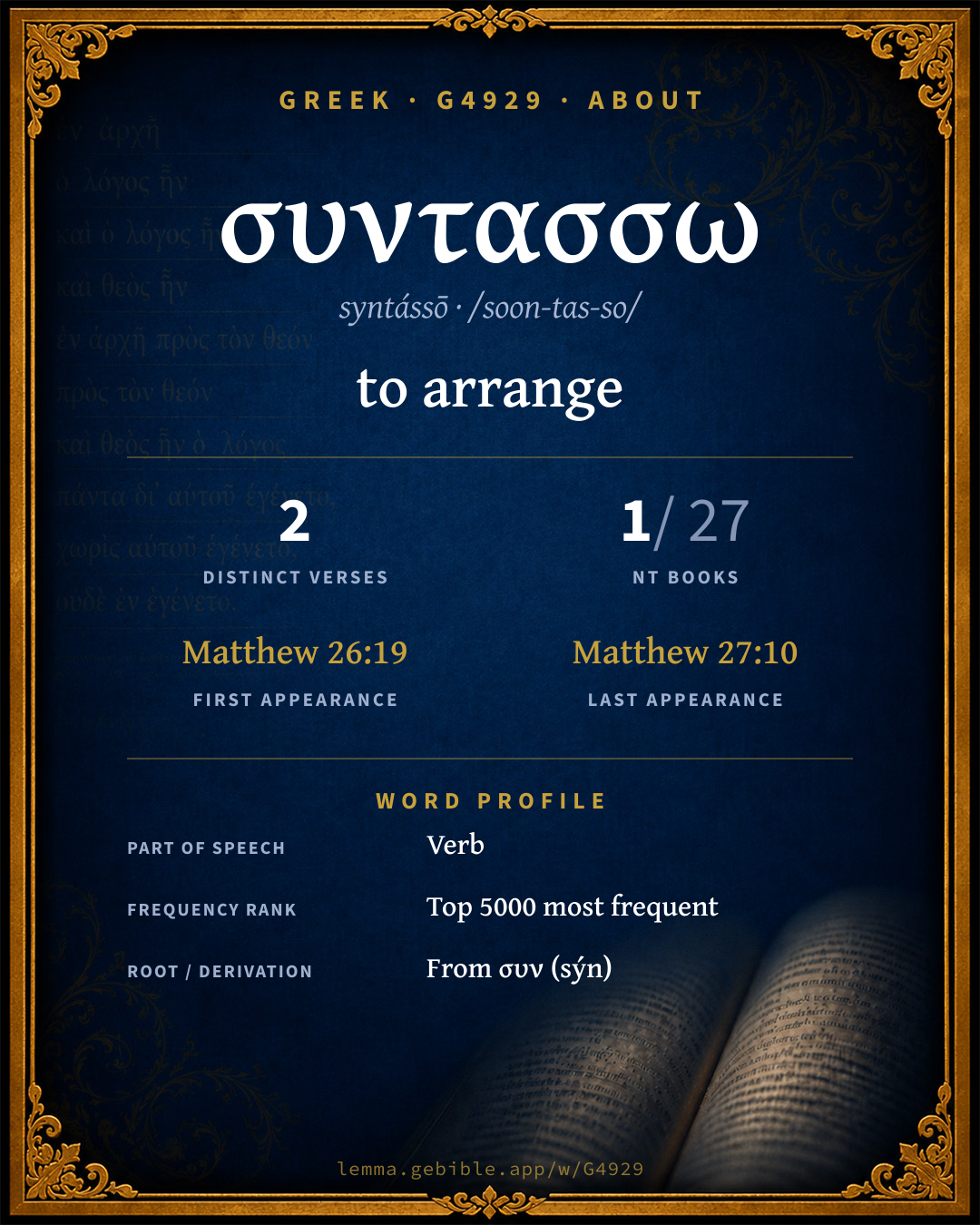
συντάσσω
to arrange
‘to arrange’ is one of 2 main senses fuller range ↓
Full lexicon entry — Thayer's Greek Lexicon
From Thayer's Greek Lexicon
Where this word appears
Grammar key — what these labels mean
Part of speech
- Verb
- An action or state-of-being word.
Tense
- Aorist
- Action viewed as a simple whole, without regard to duration — often past (perfective aspect).
Voice
- Active
- The subject performs the action.
Mood
- Indicative
- States a fact or asks a factual question (the mood of reality).
Person
- 3rd person
- The one spoken about (“he / she / it / they”).
Number
- Singular
- One.
Every verse where G4929 appears — 2 distinct verses across 1 book. Click any verse to open its interlinear word-by-word view. Verse text shown in the World English Bible for context — . Each verse’s Greek form is shown with its reference; the English is not keyword-highlighted, since the data carries no word-level English alignment. Use “Compare translations” on any verse to read it across multiple English versions. This concordance covers the Greek New Testament; Septuagint (Greek Old Testament) occurrences of this word are not indexed here.
Matthew 2 verses
About this entry
At a glance — auto-summarized from this page’s data, not written by a person. Every figure links to its source below. This summary describes the numbers; it doesn’t interpret them.
The Greek verb συντασσω centers on the idea of “to arrange.” It is rare — just 2 verses in the entire Greek New Testament. Matthew dominates its distribution — 2 of 2 verses. Debuting at Matthew 26:19, it then recurs through the corpus. Thayer's distinguishes 2 senses for it. For the data behind this summary, explore the sense tree and the renderings breakdown below.
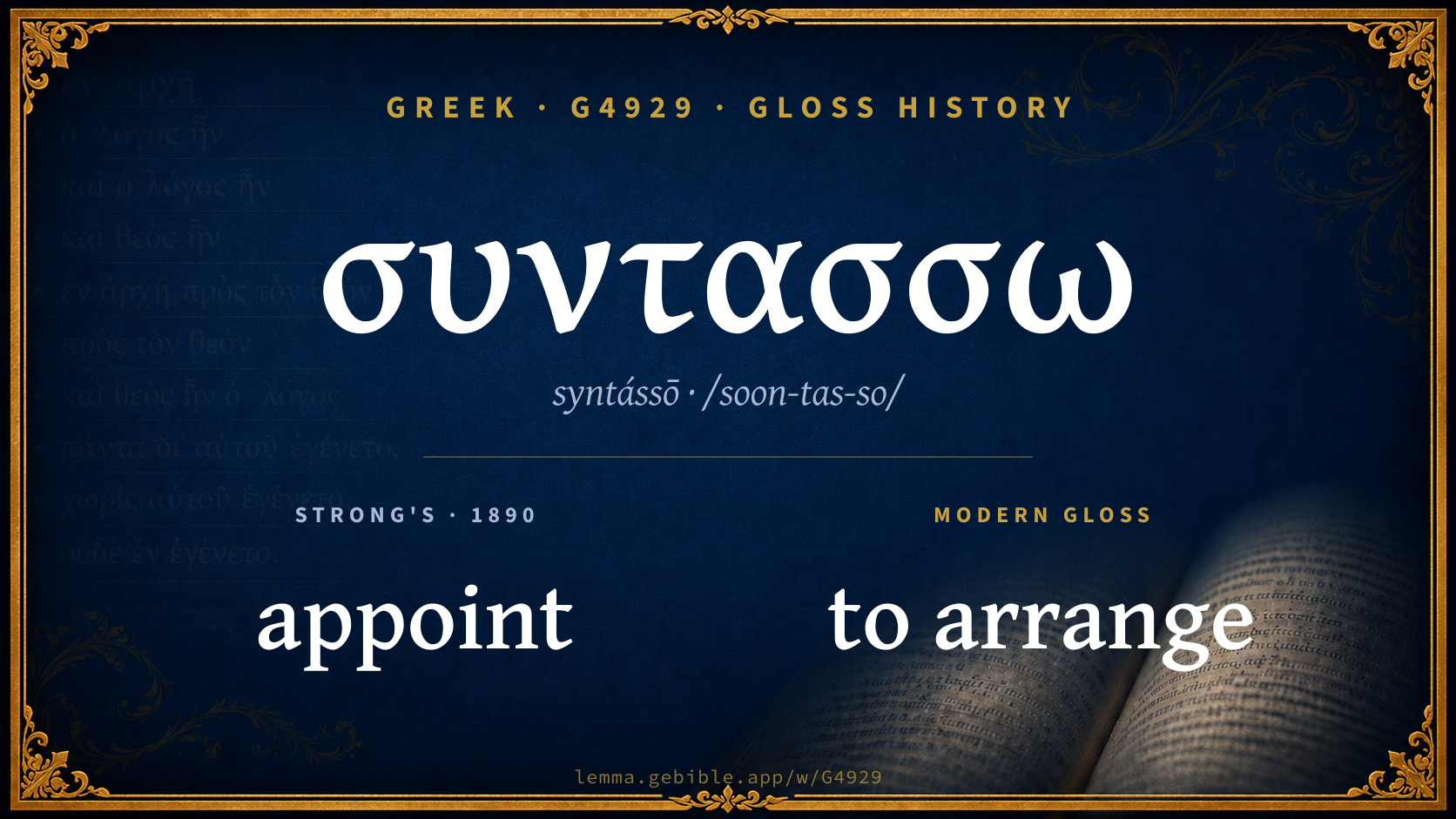
Gloss history
Strong's 1890 vs modern scholarship
About this word
Strong's G4929 catalogs a Greek word from the Greek New Testament.
These counts are not copied from any lexicon or concordance. They are computed here, from the morphology-tagged Greek New Testament. What Lemma adds →
- 2
- distinct verses
- The word appears in 2 distinct verses.
- 1 / 27
- NT books
- The word appears in 1 of 27 New Testament books.
- #2,678
- by frequency
- Top 5000 most frequent Greek words (rank 2,678 of 5,347 Greek words by occurrence).
View all 2 occurrences in the concordance →
Most concentrated in
- Matthew 2 verses 100%
By section of the New Testament
By traditional corpus
Conventional, traditional groupings — biblical authorship is debated, so this is a traditional corpus grouping, not an authorship claim. Some books belong to more than one corpus (Luke is in both the Gospels and the Lukan corpus, and so on), so these shares overlap and need not total 100%. Each figure is a share of the word’s 2 distinct verses.
- Gospels 2 verses · 100%
How translations render this word
Counts come from each version’s own published word-to-Strong’s tagging or interlinear alignment — an approximate guide to how each version renders this word, not a word-level alignment the data otherwise carries. Because each total is that version’s own tagged count, the per-version totals vary from one another and need not match the appearance or distinct-verse counts above. These counts may also differ from a printed concordance because Lemma counts each distinctly tagged rendering and does not collapse phrase taggings into a single head-word total. This is a fixed set of word-tagged versions (KJV, ASV, BSB, ULT) and does not change with the reading translation you choose elsewhere. Each version’s license is shown beside its name below (and on Sources).
- King James Version: Appointed 1×, Had appointed 1×
- American Standard Version: Appointed 2×
- Berean Standard Bible: Had directed 2×
- unfoldingWord Literal Text: Directed 2×
King James Version Public Domain
Renders G4929 across 2 tagged occurrences — most commonly:
American Standard Version Public Domain
Renders G4929 across 2 tagged occurrences — most commonly:
Berean Standard Bible Public Domain
Renders G4929 across 3 tagged occurrences — most commonly:
Plus 1 rendering that appears only once — usually multi-word phrases or single function words the recovered tagging swept in, not distinct renderings.
unfoldingWord Literal Text CC BY-SA 4.0
Renders G4929 across 3 tagged occurrences — most commonly:
Plus 1 rendering that appears only once — usually multi-word phrases or single function words the recovered tagging swept in, not distinct renderings.
Senses in Thayer's
The 2 senses Thayer's distinguishes for this word, in lexicon order (not ranked by frequency or importance). The full entry — with sub-senses — is in the Lexicon Entry tab.
- to put in order with or together, to arrange
- to (put together), constitute
Word origin
Derived from συν (sýn) (G4862) — with.
Forms in the corpus
The 2 distinct written forms G4929 takes in the Greek New Testament, most frequent first — each parse links to that tense’s occurrences in the concordance.
| Form | Parsing | Example | Uses |
|---|---|---|---|
| συνέταξέν synétaxén | Verb, Aorist, Active, Indicative, 3rd person, Singular | Matthew 27:10 | 1 |
| συνέταξεν synétaxen | Verb, Aorist, Active, Indicative, 3rd person, Singular | Matthew 26:19 | 1 |
Same root — word family
Other Thayer's entries built from the same root as G4929, grouped by Strong’s listed origin. These share a root / origin per the lexicon — not necessarily a shared meaning. Each links to that word’s own entry.
Derives from
Shares the same root
- κοινος koinós G2839 common
- συγγενης syngenḗs G4773 related by blood
- συγγνωμη syngnṓmē G4774 pardon
- συγκαθημαι synkáthēmai G4775 to sit together
- συγκαθιζω synkathízō G4776 to sit together
- συγκακοπαθεω synkakopathéō G4777 to suffer together
- συγκακουχεω synkakouchéō G4778 to be ill-treated together
- συγκαλεω synkaléō G4779 to call together
- συγκαλυπτω synkalýptō G4780 to cover completely
- συγκαμπτω synkámptō G4781 to bend together
- συγκαταβαινω synkatabaínō G4782 to go down with
- συγκατατιθεμαι synkatatíthemai G4784 to deposit together
- συγκαταψηφιζω synkatapsēphízō G4785 to vote against
- συγκεραννυμι synkeránnymi G4786 to mix together
- συγκλειω synkleíō G4788 to shut up
- συγκληρονομος synklēronómos G4789 joint heir
- συγκοινωνεω synkoinōnéō G4790 to share together
- συγκοινωνος synkoinōnós G4791 joint partner
- συγκομιζω synkomízō G4792 to collect together
- συγκρινω synkrínō G4793 to join together
- συγκυπτω synkýptō G4794 to bend together
- συγκυρια synkyría G4795 by chance
- συγχαιρω synchaírō G4796 to rejoice with
- συγχεω synchéō G4797 to disturb
+125 more words share this root (not shown).
Compare all same-root words → Showing 4 of 151 — not the complete family. They share a root, not necessarily a meaning.
Septuagint usage
The same Greek word συντασσω appears 110 times in the Greek Old Testament (Septuagint), across 108 verses in 11 books.
- 110
- LXX occurrences
- Tagged occurrences of this Greek word in the Septuagint.
- 108
- verses
- Distinct Septuagint verses containing this word.
- 11 / 39
- OT books
- The word appears in 11 of the 39 Old Testament books.
Sample Septuagint occurrences
- Genesis 18:19 συντάσσω
- Exodus 1:17 συντάσσω
- Leviticus 8:4 συντάσσω
- Numbers 1:19 συντάσσω
- Deuteronomy 4:23 συντάσσω
- Joshua 4:3 συντάσσω
- Job 25:5 συντάσσω
- Proverbs 30:8 συντάσσω
- Isaiah 10:6 συντάσσω
- Jeremiah 33:2 συντάσσω
- Daniel 11:23 συντάσσω
Septuagint occurrences (same lexeme)
Every verse where the same Strong’s number (G4929) appears in the Greek Septuagint — showing the first 50 of 108. Verse text shown in the World English Bible for context; the Greek form is the matched word — the English is not keyword-highlighted.
- Genesis 18:19 συντάσσω For I have known him, to the end that he may command his children and his household after him, that they may keep the way of Yahweh, to do righteousness and justice; to the end that Yahweh may bring on Abraham that which he has spoken of him."
- Genesis 26:11 συντάσσω Abimelech charged all the people, saying, "He who touches this man or his wife will surely be put to death."
- Exodus 1:17 συντάσσω But the midwives feared God, and didn't do what the king of Egypt commanded them, but saved the baby boys alive.
- Exodus 1:22 συντάσσω Pharaoh charged all his people, saying, "You shall cast every son who is born into the river, and every daughter you shall save alive."
- Exodus 5:6 συντάσσω The same day Pharaoh commanded the taskmasters of the people, and their officers, saying,
- Exodus 6:13 συντάσσω Yahweh spoke to Moses and to Aaron, and gave them a charge to the children of Israel, and to Pharaoh king of Egypt, to bring the children of Israel out of the land of Egypt.
- Exodus 9:12 συντάσσω Yahweh hardened the heart of Pharaoh, and he didn't listen to them, as Yahweh had spoken to Moses.
- Exodus 12:35 συντάσσω The children of Israel did according to the word of Moses; and they asked of the Egyptians jewels of silver, and jewels of gold, and clothing.
- Exodus 16:16 συντάσσω This is the thing which Yahweh has commanded: "Gather of it everyone according to his eating; an omer a head, according to the number of your persons, shall you take it, every man for those who are in his tent."
- Exodus 16:24 συντάσσω They laid it up until the morning, as Moses asked, and it didn't become foul, neither was there any worm in it.
- Exodus 16:32 συντάσσω Moses said, "This is the thing which Yahweh has commanded, 'Let an omer-full of it be kept throughout your generations, that they may see the bread with which I fed you in the wilderness, when I brought you forth from the land of Egypt."
- Exodus 16:34 συντάσσω As Yahweh commanded Moses, so Aaron laid it up before the Testimony, to be kept.
- Exodus 19:7 συντάσσω Moses came and called for the elders of the people, and set before them all these words which Yahweh commanded him.
- Exodus 27:20 συντάσσω "You shall command the children of Israel, that they bring to you pure olive oil beaten for the light, to cause a lamp to burn continually.
- Exodus 31:6 συντάσσω I, behold, I have appointed with him Oholiab, the son of Ahisamach, of the tribe of Dan; and in the heart of all who are wise-hearted I have put wisdom, that they may make all that I have commanded you:
- Exodus 31:13 συντάσσω "Speak also to the children of Israel, saying, 'Most assuredly you shall keep my Sabbaths: for it is a sign between me and you throughout your generations; that you may know that I am Yahweh who sanctifies you.
- Exodus 34:4 συντάσσω He chiseled two tablets of stone like the first; and Moses rose up early in the morning, and went up to Mount Sinai, as Yahweh had commanded him, and took in his hand two stone tablets.
- Exodus 35:4 συντάσσω Moses spoke to all the congregation of the children of Israel, saying, "This is the thing which Yahweh commanded, saying,
- Exodus 35:10 συντάσσω "Let every wise-hearted man among you come, and make all that Yahweh has commanded:
- Exodus 35:29 συντάσσω The children of Israel brought a freewill offering to Yahweh; every man and woman, whose heart made them willing to bring for all the work, which Yahweh had commanded to be made by Moses.
- Exodus 36:1 συντάσσω "Bezalel and Oholiab shall work with every wise-hearted man, in whom Yahweh has put wisdom and understanding to know how to work all the work for the service of the sanctuary, according to all that Yahweh has commanded."
- Exodus 36:5 συντάσσω They spoke to Moses, saying, "The people bring much more than enough for the service of the work which Yahweh commanded to make."
- Exodus 36:8 συντάσσω All the wise-hearted men among those who did the work made the tent with ten curtains; of fine twined linen, blue, purple, and scarlet, with cherubim, the work of the skillful workman, they made them.
- Exodus 36:12 συντάσσω He made fifty loops in the one curtain, and he made fifty loops in the edge of the curtain that was in the second coupling. The loops were opposite one to another.
- Exodus 36:14 συντάσσω He made curtains of goats' hair for a covering over the tent. He made them eleven curtains.
- Exodus 36:28 συντάσσω He made two boards for the corners of the tent in the far part.
- Exodus 36:33 συντάσσω He made the middle bar to pass through in the midst of the boards from the one end to the other.
- Exodus 36:36 συντάσσω He made four pillars of acacia for it, and overlaid them with gold. Their hooks were of gold. He cast four sockets of silver for them.
- Exodus 36:38 συντάσσω and the five pillars of it with their hooks. He overlaid their capitals and their fillets with gold, and their five sockets were of brass.
- Exodus 37:19 συντάσσω three cups made like almond-blossoms in one branch, a bud and a flower, and three cups made like almond-blossoms in the other branch, a bud and a flower: so for the six branches going out of the lampstand.
- Exodus 37:20 συντάσσω In the lampstand were four cups made like almond-blossoms, its buds and its flowers;
- Exodus 38:27 συντάσσω The one hundred talents of silver were for casting the sockets of the sanctuary, and the sockets of the veil; one hundred sockets for the one hundred talents, a talent for a socket.
- Exodus 39:10 συντάσσω They set in it four rows of stones. A row of ruby, topaz, and beryl was the first row;
- Exodus 39:22 συντάσσω He made the robe of the ephod of woven work, all of blue.
- Exodus 39:23 συντάσσω The opening of the robe in the midst of it was like the opening of a coat of mail, with a binding around its opening, that it should not be torn.
- Exodus 40:19 συντάσσω He spread the covering over the tent, and put the roof of the tent above on it, as Yahweh commanded Moses.
- Exodus 40:21 συντάσσω He brought the ark into the tent, and set up the veil of the screen, and screened the ark of the testimony, as Yahweh commanded Moses.
- Exodus 40:23 συντάσσω He set the bread in order on it before Yahweh, as Yahweh commanded Moses.
- Exodus 40:25 συντάσσω He lit the lamps before Yahweh, as Yahweh commanded Moses.
- Exodus 40:27 συντάσσω and he burnt incense of sweet spices on it, as Yahweh commanded Moses.
- Leviticus 8:4 συντάσσω Moses did as Yahweh commanded him; and the congregation was assembled at the door of the Tent of Meeting.
- Leviticus 8:9 συντάσσω He set the turban on his head; and on the turban, in front, he set the golden plate, the holy crown; as Yahweh commanded Moses.
- Leviticus 8:13 συντάσσω Moses brought Aaron's sons, and clothed them with coats, and tied sashes on them, and put headbands on them; as Yahweh commanded Moses.
- Leviticus 8:17 συντάσσω But the bull, and its skin, and its flesh, and its dung, he burned with fire outside the camp; as Yahweh commanded Moses.
- Leviticus 8:31 συντάσσω Moses said to Aaron and to his sons, "Boil the flesh at the door of the Tent of Meeting, and there eat it and the bread that is in the basket of consecration, as I commanded, saying, 'Aaron and his sons shall eat it.'
- Leviticus 8:36 συντάσσω Aaron and his sons did all the things which Yahweh commanded by Moses.
- Leviticus 9:21 συντάσσω and the breasts and the right thigh Aaron waved for a wave offering before Yahweh, as Moses commanded.
- Leviticus 10:15 συντάσσω The heaved thigh and the waved breast they shall bring with the offerings made by fire of the fat, to wave it for a wave offering before Yahweh: and it shall be yours, and your sons' with you, as a portion forever; as Yahweh has commanded."
- Leviticus 10:18 συντάσσω Behold, its blood was not brought into the inner part of the sanctuary: you certainly should have eaten it in the sanctuary, as I commanded."
- Leviticus 13:54 συντάσσω then the priest shall command that they wash the thing in which the plague is, and he shall isolate it seven more days.
These are occurrences of the same Greek lexeme (G4929) in the Septuagint — not a translation of any one Hebrew word. The store carries no word-level Hebrew↔Greek alignment, so no Hebrew original is asserted here. Counts come from the recovered LXX Strong's tagging — high-frequency vocabulary is well covered, while rare or late forms may be untagged — so they reflect tagged occurrences and may slightly undercount.