Leviticus 9:21

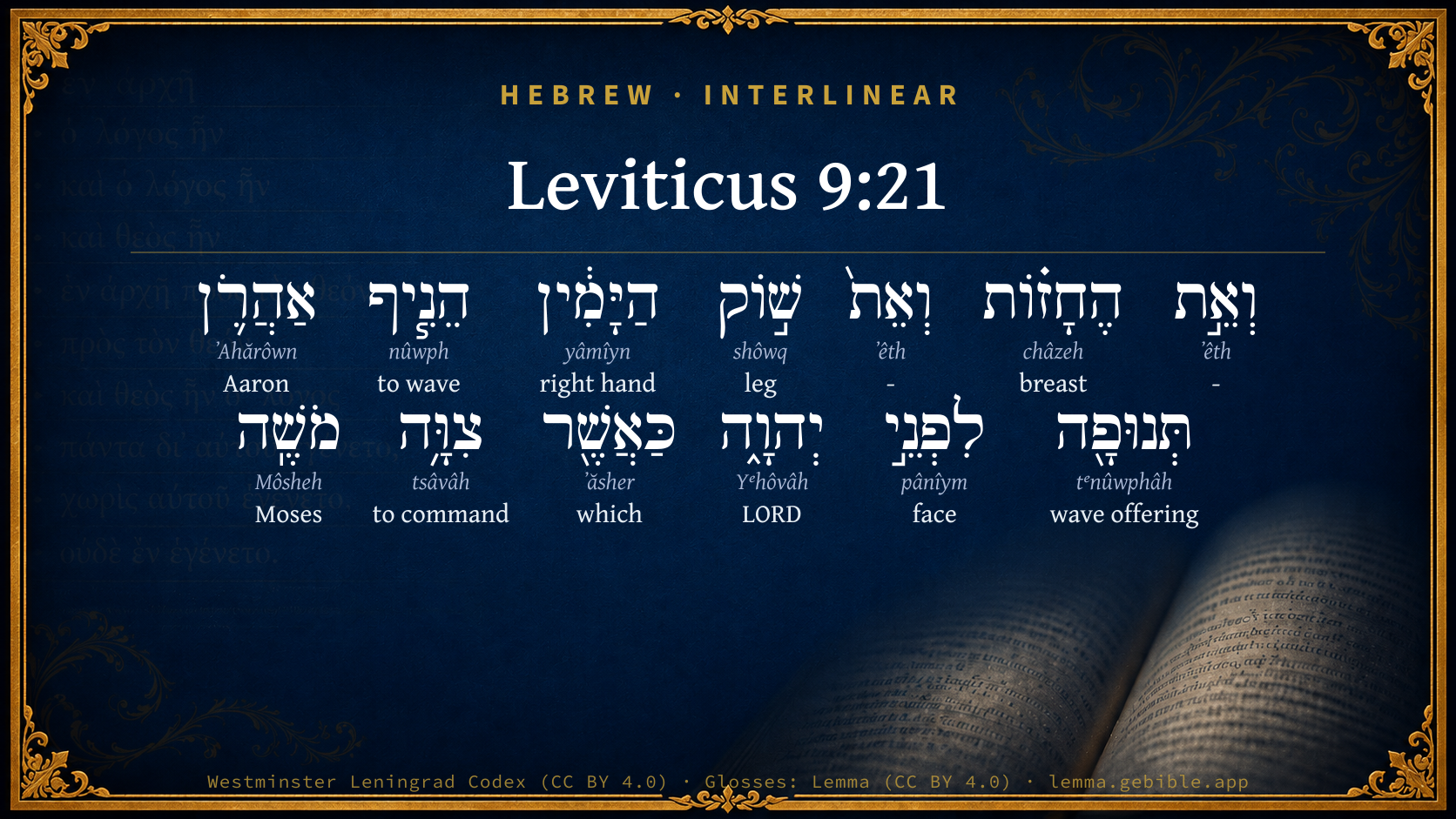
Hebrew (Westminster Leningrad Codex) Leviticus 9:21 appears in the Hebrew Old Testament. The text above is from the Westminster Leningrad Codex. Each word links to its Strong’s number, a concise gloss, and parsing drawn from the Open Scriptures Hebrew Bible morphology. Click any word for its full Brown-Driver-Briggs (BDB) entry.
Download image
Cite this verse

Leviticus 9:21 (World English Bible). Public Domain. Lemma interlinear Bible study tool, https://lemma.gebible.app/v/leviticus/9/21.

Show BibTeX & RIS
BibTeX
RIS
English Translation
and the breasts and the right thigh Aaron waved for a wave offering before Yahweh, as Moses commanded.
World English Bible · Public Domain
Download a study sheet

One document with this verse’s original text, its word-by-word gloss line, the meaning frame, cross-references with their text, attributed commentary, and full source and license credits — printable, and it pastes into notes with its structure intact.

This verse Autodidact and up

Study sheet (.html) Plain text (.txt)

A passage Seminary Student

Up to 50 verses in one chapter. A passage sheet keeps up to 6 commentary sources and 12 cross-references per verse, in the order this page ranks them, and says so on the sheet whenever that leaves anything out. Ask for a single verse and you get the Autodidact verse sheet above.

Everything on this page stays free to read, with no account — the sheet is a download of what is already on screen, not access to it.

Want to remove ads? Support Godless Engineer
Compare translations 3

The same verse in 3 English versions, stacked beneath the original-language interlinear above. Click any original word for its lexicon entry.

Each is an independent rendering of the whole verse — the interlinear is not word-aligned to these translations.

Highlighted words mark where these versions differ — a whole-verse word diff, not a word-by-word alignment.

  • World English Bible Public Domain
    and the breasts and the right thigh Aaron waved for a wave offering before Yahweh, as Moses commanded.
  • King James Version Public Domain
    And the breasts and the right shoulder Aaron waved for a wave offering before the LORD; as Moses commanded.
  • unfoldingWord Literal Text CC BY-SA 4.0
    And the breasts and the right thigh, Aaron raised a raised offering to the face of Yahweh, just as Moses had commanded.

unfoldingWord Literal Text — © unfoldingWord, licensed CC BY-SA 4.0. Word-aligned USFM3 via Door43 (git.door43.org/unfoldingWord/en_ult).

Versions to compare (up to 4)

3 of 4 selected

Show all 18 translations

Every available English version of this verse, each an independent rendering of the whole verse.

  • World English Bible Public Domain
    and the breasts and the right thigh Aaron waved for a wave offering before Yahweh, as Moses commanded.
  • Berean Standard Bible Public Domain
    but he waved the breasts and the right thigh as a wave offering before the LORD, as Moses had commanded.
  • Majority Standard Bible Public Domain
    but he waved the breasts and the right thigh as a wave offering before the LORD, as Moses had commanded.
  • King James Version Public Domain
    And the breasts and the right shoulder Aaron waved for a wave offering before the LORD; as Moses commanded.
  • American Standard Version (1901) Public Domain
    and the breasts and the right thigh Aaron waved for a wave-offering before Jehovah; as Moses commanded.
  • Revised Version (1885) Public Domain
    and the breasts and the right thigh Aaron waved for a wave offering before the LORD; as Moses commanded.
  • Geneva Bible (1599) Public Domain
    But the breastes and the right shoulder Aaron shooke to and from before the Lord, as the Lord had commanded Moses.
  • Douay-Rheims (1899) Public Domain
    Aaron separated their breasts, and the right shoulders, elevating them before the Lord, as Moses had commanded.
  • Young's Literal Translation Public Domain
    and the breasts, and the right leg hath Aaron waved -- a wave-offering before Jehovah, as He hath commanded Moses.
  • Literal Standard Version CC BY-SA 4.0
    and Aaron has waved the breasts and the right leg [as] a wave-offering before YHWH, as He has commanded Moses.
  • Unlocked Literal Bible CC BY-SA 4.0
    Aaron waved the breasts and the right thigh as a wave offering before Yahweh, as Moses had commanded.
  • unfoldingWord Literal Text CC BY-SA 4.0
    And the breasts and the right thigh, Aaron raised a raised offering to the face of Yahweh, just as Moses had commanded.
  • Darby Bible Public Domain
    and the breast-pieces and the right shoulder Aaron waved as a wave-offering before Jehovah, as Moses had commanded.
  • World Messianic Bible Public Domain
    Aaron waved the breasts and the right thigh for a wave offering before the LORD, as Moses commanded.
  • Webster's Bible Public Domain
    And the breasts and the right shoulder Aaron waved for a wave-offering before the LORD; as Moses commanded.
  • Free Bible Version CC BY-SA 4.0
    but he waved the breasts and the right thigh as a wave offering before the Lord, as Moses had ordered him to do.
  • Bible in Basic English Public Domain
    And Aaron took the breasts and the right leg, waving them for a wave offering before the Lord, as Moses gave orders.
  • JPS Tanakh (1917) Public Domain
    And the breasts and the right thigh Aaron waved for a wave-offering before the LORD; as Moses commanded.

Literal Standard Version (2020), Covenant Press — licensed CC BY-SA 4.0. Text via the HelloAO Bible API (eBible.org). Unlocked Literal Bible (unfoldingWord) — licensed CC BY-SA 4.0. Text via the HelloAO Bible API (eBible.org). unfoldingWord Literal Text — © unfoldingWord, licensed CC BY-SA 4.0. Word-aligned USFM3 via Door43 (git.door43.org/unfoldingWord/en_ult). Free Bible Version, Dr. Jonathan Gallagher — licensed CC BY-SA 4.0. Text via the HelloAO Bible API (eBible.org).

Word by word

More ways to search: Search by grammar → Find every occurrence → Compare this word →

Practice this passage: Drill this verse → Learn its vocabulary →

הֶחָז֗וֹת
châzeh
H2373
“the · breasts”
Particle, Definite Article + Noun, Common, Masculine, Plural, Absolute
Part of Speech
Particle + Noun
Type
Common
Gender
Masculine
Number
Plural
State
Absolute
Full BDB Definition

Origin: from H2372

TWOT: 634a

breast (of animals), breast of an animal sacrifice
  1. וְאֵ֣ת ʼêth H853 “and · -” Conjunction + Particle, Direct Object
  2. וְאֵת֙ ʼêth H853 “and · -” Conjunction + Particle, Direct Object
  3. שׁ֣וֹק shôwq H7785 “leg of” Noun, Common, Feminine, Singular, Construct
  4. הַיָּמִ֔ין yâmîyn H3225 “the · right hand” Particle, Definite Article + Noun, Common, Feminine, Singular, Absolute
  5. הֵנִ֧יף nûwph H5130 “to wave” Verb, Hiphil, Perfect, 3rd Person, Masculine, Singular
  6. אַהֲרֹ֛ן ʼAhărôwn H175 “Aaron” Noun, Proper
  7. תְּנוּפָ֖ה tᵉnûwphâh H8573 “wave offering” Noun, Common, Feminine, Singular, Absolute
  8. לִפְנֵ֣י pânîym H6440 “to/for · face(s) of” Preposition + Noun, Common, Both, Plural, Construct
  9. יְהוָ֑ה Yᵉhôvâh H3068 “LORD” Noun, Proper
  10. כַּאֲשֶׁ֖ר ʼăsher H834 “like/as · which” Preposition + Particle, Relative
  11. צִוָּ֥ה tsâvâh H6680 “to command” Verb, Piel, Perfect, 3rd Person, Masculine, Singular
  12. מֹשֶֽׁה Môsheh H4872 “Moses” Noun, Proper

About this verse

These counts appear in no published source. They are computed here, from the morphology-tagged text and Lemma’s own curated glosses. What Lemma adds →

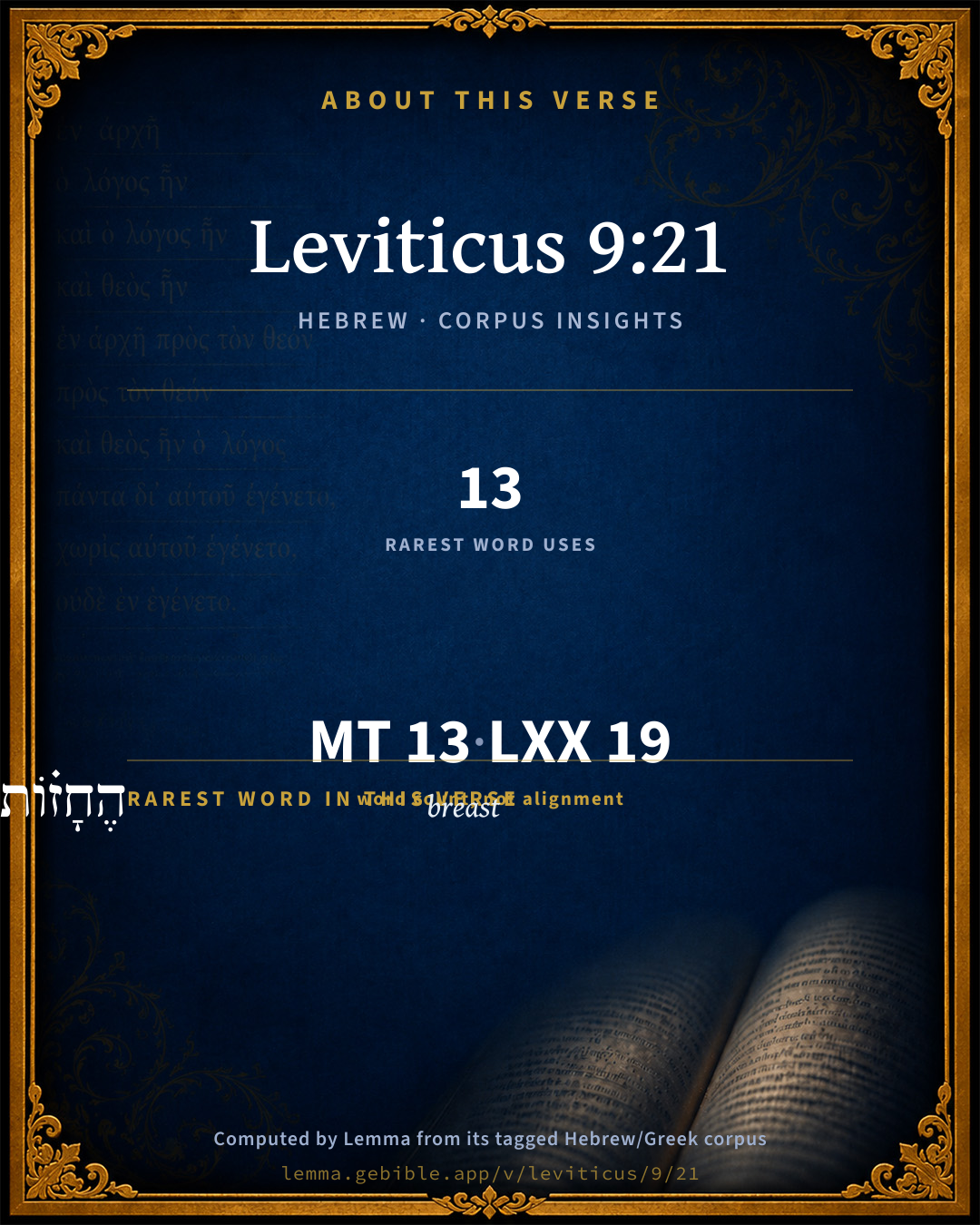
13
words
12
distinct lemmas
Pentateuch
section

Notable vocabulary

The rarest word here is הֶחָז֗וֹת breast H2373 — appearing just 13 times in the whole Hebrew Bible.

Shared distinctive vocabulary

הֶחָז֗וֹת breast H2373 occurs in 12 verses of the Hebrew Bible. Also found in:

Grammatical profile

  • 2 verbs
  • 8 nouns
  • 3 particles

Verb forms

  • הֵנִ֧יף Hiphil · Perfect
  • צִוָּ֥ה Piel · Perfect

Hebrew & Septuagint length

In English translation the verse runs 18 words from the Hebrew and 20 from the Septuagint (LXX English) — closely comparable.

A rough comparison of the two English renderings, which tokenize alike — not a word-level alignment.

Word counts can differ between the Hebrew and the Greek without any difference in meaning — e.g. the Hebrew direct-object marker אֵת has no separate Greek word, and Greek often adds the article ὁ.

In the original languages it is 13 Hebrew tokens and 19 Greek tokens — but the two are counted differently (Hebrew bundles its prefixes and suffixes into one token; the Greek is in lemma form), so that isn’t a like-for-like length.

Cross-references

8

Topical passages linked to Leviticus 9:21 in the Treasury of Scripture Knowledge — connected by theme and wording, ordered by reader-vote popularity; previews shown in the World English Bible.

  • Leviticus 7:30–34 With his own hands he shall bring the offerings of Yahweh made by fire. He shall bring the fat with the breast, that the breast may be waved for a wave offering before Yahweh.
  • Exodus 29:24 You shall put all of this in Aaron's hands, and in his sons' hands, and shall wave them for a wave-offering before Yahweh.
  • Exodus 29:26–28 "You shall take the breast of Aaron's ram of consecration, and wave it for a wave-offering before Yahweh: and it shall be your portion.
  • Leviticus 7:24 The fat of that which dies of itself, and the fat of that which is torn of animals, may be used for any other service, but you shall in no way eat of it.
  • Leviticus 7:26 You shall not eat any blood, whether it is of bird or of animal, in any of your dwellings.
  • Isaiah 49:3 and he said to me, You are my servant; Israel, in whom I will be glorified.
  • Luke 2:13 Suddenly, there was with the angel a multitude of the heavenly host praising God, and saying,
  • 1 Peter 4:11 If any man speaks, let it be as it were oracles of God. If any man serves, let it be as of the strength which God supplies, that in all things God may be glorified through Jesus Christ, to whom belong the glory and the dominion forever and ever. Amen.

Cross-references courtesy of OpenBible.info (CC BY 4.0).

Hebrew and Greek witnesses Masoretic Hebrew ↔ Greek Septuagint

The same verse in the two great witnesses to the Old Testament, shown verse-for-verse.

These are two independent witnesses, not word-aligned to each other, and the Septuagint is shown in lemma (dictionary) form.

Hebrew Leviticus 9:21 Masoretic · Westminster Leningrad Codex

וְאֵ֣ת הֶחָז֗וֹת וְאֵת֙ שׁ֣וֹק הַיָּמִ֔ין הֵנִ֧יף אַהֲרֹ֛ן תְּנוּפָ֖ה לִפְנֵ֣י יְהוָ֑ה כַּאֲשֶׁ֖ר צִוָּ֥ה מֹשֶֽׁה

and the breasts and the right thigh Aaron waved for a wave offering before Yahweh, as Moses commanded.

World English Bible · Public Domain

Greek LXX Leviticus 9:21 Septuagint · lemma form

καί ὁ στηθύνιον καί ὁ βραχίων ὁ δεξιός ἀποαἱρέω ἀαρών ἀφαίρεμα ἔναντι κύριος ὅς τρόπος συντάσσω κύριος ὁ μωυσῆς

And Aaron separated the breast and the right shoulder as a choice-offering before the Lord, as the Lord commanded Moses.

LXX2012 (modern English Septuagint) · Public Domain

Hebrew: Westminster Leningrad Codex (CC BY 4.0). Greek: Septuagint (public domain); English from LXX2012 (modern English Septuagint) (Public Domain). How the Septuagint differs from the Hebrew →

Targum (Aramaic paraphrase)

2

The Targum is the ancient Jewish Aramaic paraphrase of the Hebrew Scriptures — an interpretive translation, not the Hebrew text itself. Onkelos (literal) and Pseudo-Jonathan (expansive) render the Torah, and Jonathan the Prophets. Coverage is partial: where no permissively-licensed English translation exists for a verse, only the Aramaic is shown. This is verse-level text, not a word-by-word alignment to the Hebrew.

  1. Targum Onkelos Torah (Genesis–Deuteronomy)
    וְיָת חֶדְוָתָא וְיָת שׁוֹקָא דְיַמִינָא אֲרֵים אַהֲרֹן אֲרָמָא קֳדָם יְיָ כְּמָא דִי פַקִיד מֹשֶׁה

    (no public-domain English translation for this verse)

    Targum Onkelos — Aramaic: “Onkelos Genesis” (public domain); “Onkelos Exodus” (public domain); “Onkelos Leviticus” (public domain); “Onkelos Numbers” (public domain); “Onkelos Deuteronomy” (public domain). English: “Sefaria Community Translation” (CC0 1.0 (public-domain dedication)); “J.W. Etheridge. The Targums of Onkelos and Jonathan Ben Uzziel on the Pentateuch. London: Longmans, Green, 1862” (public domain). Text via Sefaria.

  2. Targum Pseudo-Jonathan Torah (Genesis–Deuteronomy)
    וְיַת חֶדְוָותָא וְיַת שׁוֹקָא דְיַמִינָא אָרֵים אַהֲרן אֲרָמָא קֳדָם יְיָ הֵיכְמָא דְפַקֵיד משֶׁה

    But the breast and the right shoulder Aharon uplifted, an elevation before the Lord, as the Lord commanded Mosheh.

    Targum Pseudo-Jonathan — Aramaic: “Targum Jonathan on Genesis” (public domain); “Targum Jonathan on Exodus” (public domain); “Targum Jonathan on Leviticus” (public domain); “Targum Jonathan on Numbers” (public domain); “Targum Jonathan on Deuteronomy” (public domain). English: “The Targum of Jonathan ben Uzziel, trans. J. W. Etheridge, London, 1862” (public domain). Text via Sefaria.

Commentary

Notes on Leviticus 9:21 from classic Christian and Jewish commentators (each source and its license shown beneath its notes). The classic Christian expositions comment on the surrounding passage and are grouped to its opening verse, so a note may address several verses; the Jewish commentaries on the Tanakh (Rashi and others) are per-verse, so they appear only where the commentator wrote on this verse.

Lemma curates 59 commentaries, every one of them public domain or Creative Commons licensed, each selected and text-cleaned for this edition rather than reprinted as found. About our sources →

Geneva Bible (1599)

Geneva Bible translators

Of the bullock and the ram.

Geneva Bible (1599) marginal notes — public domain. Text via Bolls.life.

John Gill's Exposition

And Aaron lifted up his hand towards the people, and blessed them,.... After he had offered the above sacrifices both for himself and them: the manner of the priests lifting up their hands when they blessed is thus described; in the provinces the priests lift up their hands to their shoulders, and in the sanctuary above their heads, excepting the high priest, who did not lift up his hands above the plate of gold: but R. Judah says, the high priest lift up his hands above the plate, as it is said Lev 9:22 (f); the modern Jews describe it thus (g), they lift up their hands to their shoulders, and they lift up the right hand somewhat higher than the left; then they stretch out their hands, and part their fingers, and frame them so as to make five airs; between two fingers and two fingers one air, and between the forefinger and the thumb, and between the two thumbs; they spread out their hands so, that the middle (or palm) of the hand may be towards the earth, and the back part of it towards heaven: Aaron lift his hands upwards, signifying from whence he implored the blessing, and towards the people on whom he desired it might descend; in this was a type of Christ, who, after he had offered himself a sacrifice for the sins of his people, when he was risen from the dead and about to ascend to heaven, blessed his disciples, Luk 24:50 in Christ the saints are blessed with all spiritual blessings; by him they are procured for them, through his blood, sacrifice, and satisfaction; and he ever lives to make intercession for the application of them to them, see Eph 1:3.

and came down from offering of the sin offering, and the burnt offering, and peace offerings; from the altar with joy, as the Targum of Jonathan; being glad he had done his service with acceptance; he is said to "come down", there being a rise or ascent to the altar, which, as Aben Ezra observes, was three cubits high, and therefore it is with propriety said he came down; which he did as soon as he had made an end of offering all the sacrifices.

(f) Misn. Sotah, c. 7. sect. 6. (g) Schulchan Aruch, par. 1. Orach Chayim, c. 128. sect. 12.

John Gill's Exposition of the Whole Bible (1746–1763) — public domain (CC PDM 1.0). Text via the HelloAO Bible API.

Haydock's Catholic Bible Commentary

Elevating them. After which they were used by the priest, chap. vii. 31. (Calmet) --- As. Samaritan and some Hebrew manuscripts read, "as the Lord had commanded Moses." (Kennicott)

George Leo Haydock (1774–1849), Haydock's Catholic Family Bible and Commentary, 1859 edition — public domain. Excludes Psalms (Douay-Rheims chapter numbering differs from Protestant) and Deuterocanonical books (Catholic canon only).

Whedon's Commentary on the Bible

Daniel D. Whedon

21. Shoulder — “Thigh,” (R.V.)

A wave offering — See Lev_7:30, note.

As Moses commanded — The Seventy, the Samaritan, the Arabic, and the Targum of Onkelos all agree in another reading, “as Jehovah commanded Moses.” This, harmonizing as it does with Lev_9:6-7; Lev_9:10, is doubtless the true reading. Even in the present reading there is no danger of taking Moses for the ultimate source of authority, since he is always represented as the mouth of Jehovah. Exo_4:12.

Daniel D. Whedon (gen. ed.), Commentary on the Old and New Testaments (1874–1909) — public domain. Text from a community e-Sword module.

Lesson kit

Teaching starters — assembled from the data on this page, not authored interpretation. Every prompt links to the verse data it draws on. Edit before teaching.

Leviticus, in the Pentateuch, opens this verse with 13 words (12 distinct Hebrew lemmas). Its most distinctive word is châzeh (“breast”). A historical commentator’s framing appears above. Read the whole chapter for the surrounding context.

Discussion questions

  1. What does “breast” (châzeh) contribute to the verse as a whole?
  2. Exodus 29:26 shares the word «breast» with this verse. How do the two illuminate each other?
  3. The translations on this page render this verse differently — a whole-verse word diff, not a word-by-word alignment. What might account for the different wordings?
  4. The verb «הֵנִ֧יף» is Hiphil Perfect. How does its form color the action?
  5. Reading how Geneva Bible (1599) and John Gill's Exposition read this verse, where do the two commentators agree and where do they part?

Things to notice

Reading settings

Reading text

Shown beneath each verse's original-language words.

Old Testament
Old Testament edition

Read the OT as the Masoretic Hebrew (MT) or the Greek Septuagint (LXX).

English shown for the Greek Septuagint (in the Hebrew ↔ Greek comparison).

Comparing translations? Open the Compare panel on any verse page to stack up to four side by side.