

Psalms 113:3

Hebrew (Westminster Leningrad Codex) Psalms 113:3 appears in the Hebrew Old Testament. The text above is from the Westminster Leningrad Codex. Each word links to its Strong’s number, a concise gloss, and parsing drawn from the Open Scriptures Hebrew Bible morphology. Click any word for its full Brown-Driver-Briggs (BDB) entry.
Download image
Cite this verse

Psalms 113:3 (World English Bible). Public Domain. Lemma interlinear Bible study tool, https://lemma.gebible.app/v/psalms/113/3.

Show BibTeX & RIS
BibTeX
RIS
English Translation
From the rising of the sun to the going down of the same, Yahweh's name is to be praised.
World English Bible · Public Domain
Download a study sheet

One document with this verse’s original text, its word-by-word gloss line, the meaning frame, cross-references with their text, attributed commentary, and full source and license credits — printable, and it pastes into notes with its structure intact.

This verse Autodidact and up

Study sheet (.html) Plain text (.txt)

A passage Seminary Student

Up to 50 verses in one chapter. A passage sheet keeps up to 6 commentary sources and 12 cross-references per verse, in the order this page ranks them, and says so on the sheet whenever that leaves anything out. Ask for a single verse and you get the Autodidact verse sheet above.

Everything on this page stays free to read, with no account — the sheet is a download of what is already on screen, not access to it.

Want to remove ads? Support Godless Engineer
Compare translations 3

The same verse in 3 English versions, stacked beneath the original-language interlinear above. Click any original word for its lexicon entry.

Each is an independent rendering of the whole verse — the interlinear is not word-aligned to these translations.

Highlighted words mark where these versions differ — a whole-verse word diff, not a word-by-word alignment.

  • World English Bible Public Domain
    From the rising of the sun to the going down of the same, Yahweh's name is to be praised.
  • King James Version Public Domain
    From the rising of the sun unto the going down of the same the LORD's name is to be praised.
  • unfoldingWord Literal Text CC BY-SA 4.0
    From the rising of the sun to its setting, may the name of Yahweh be praised.

unfoldingWord Literal Text — © unfoldingWord, licensed CC BY-SA 4.0. Word-aligned USFM3 via Door43 (git.door43.org/unfoldingWord/en_ult).

Versions to compare (up to 4)

3 of 4 selected

Show all 18 translations

Every available English version of this verse, each an independent rendering of the whole verse.

  • World English Bible Public Domain
    From the rising of the sun to the going down of the same, Yahweh's name is to be praised.
  • Berean Standard Bible Public Domain
    From where the sun rises to where it sets, the name of the LORD is praised.
  • Majority Standard Bible Public Domain
    From where the sun rises to where it sets, the name of the LORD is praised.
  • King James Version Public Domain
    From the rising of the sun unto the going down of the same the LORD's name is to be praised.
  • American Standard Version (1901) Public Domain
    From the rising of the sun unto the going down of the same Jehovah's name is to be praised.
  • Revised Version (1885) Public Domain
    From the rising of the sun unto the going down of the same the LORD’S name is to be praised.
  • Geneva Bible (1599) Public Domain
    The Lordes Name is praysed from the rising of ye sunne, vnto ye going downe of the same.
  • Douay-Rheims (1899) Public Domain
    From the rising of the sun unto the going down of the same, the name of the Lord is worthy of praise.
  • Young's Literal Translation Public Domain
    From the rising of the sun unto its going in, Praised `is' the name of Jehovah.
  • Literal Standard Version CC BY-SA 4.0
    From the rising of the sun to its going in, || The Name of YHWH [is] praised.
  • Unlocked Literal Bible CC BY-SA 4.0
    From the rising of the sun to its setting, Yahweh's name should be praised.
  • unfoldingWord Literal Text CC BY-SA 4.0
    From the rising of the sun to its setting, may the name of Yahweh be praised.
  • Darby Bible Public Domain
    From the rising of the sun unto the going down of the same, let Jehovah's name be praised.
  • World Messianic Bible Public Domain
    From the rising of the sun to its going down, the LORD’s name is to be praised.
  • Webster's Bible Public Domain
    From the rising of the sun to the going down of the same the LORD'S name is to be praised.
  • Free Bible Version CC BY-SA 4.0
    Let everyone everywhere, from the east to the west, praise the Lord as he is!
  • Bible in Basic English Public Domain
    From the coming up of the sun to its going down, the Lord's name is to be praised.
  • JPS Tanakh (1917) Public Domain
    From the rising of the sun unto the going down thereof the LORD'S name is to be praised.

Literal Standard Version (2020), Covenant Press — licensed CC BY-SA 4.0. Text via the HelloAO Bible API (eBible.org). Unlocked Literal Bible (unfoldingWord) — licensed CC BY-SA 4.0. Text via the HelloAO Bible API (eBible.org). unfoldingWord Literal Text — © unfoldingWord, licensed CC BY-SA 4.0. Word-aligned USFM3 via Door43 (git.door43.org/unfoldingWord/en_ult). Free Bible Version, Dr. Jonathan Gallagher — licensed CC BY-SA 4.0. Text via the HelloAO Bible API (eBible.org).

Word by word

More ways to search: Search by grammar → Find every occurrence → Compare this word →

Practice this passage: Drill this verse → Learn its vocabulary →

About this verse

These counts appear in no published source. They are computed here, from the morphology-tagged text and Lemma’s own curated glosses. What Lemma adds →

7
words
7
distinct lemmas
Wisdom
section

Notable vocabulary

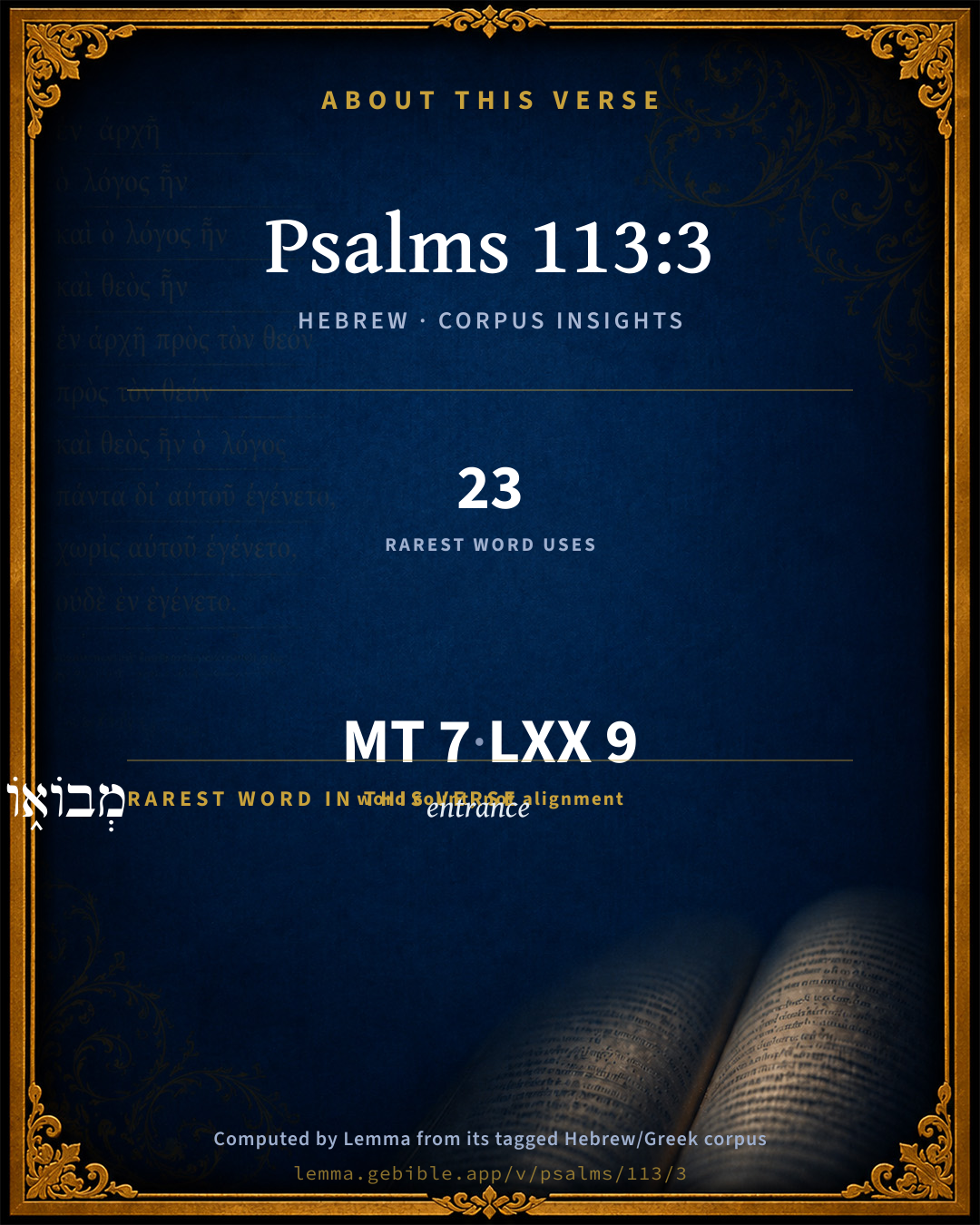
The rarest word here is מְבוֹא֑וֹ entrance H3996 — appearing just 23 times in the whole Hebrew Bible.

Shared distinctive vocabulary

מְבוֹא֑וֹ entrance H3996 occurs in 23 verses of the Hebrew Bible. Also found in:

Grammatical profile

  • 1 verb
  • 5 nouns
  • 1 preposition

Verb forms

  • מְ֝הֻלָּ֗ל Pual · Participle Passive

Hebrew & Septuagint length

In English translation the verse runs 19 words from the Hebrew and 18 from the Septuagint (LXX English) — closely comparable.

A rough comparison of the two English renderings, which tokenize alike — not a word-level alignment.

Word counts can differ between the Hebrew and the Greek without any difference in meaning — e.g. the Hebrew direct-object marker אֵת has no separate Greek word, and Greek often adds the article ὁ.

In the original languages it is 7 Hebrew tokens and 9 Greek tokens — but the two are counted differently (Hebrew bundles its prefixes and suffixes into one token; the Greek is in lemma form), so that isn’t a like-for-like length.

Cross-references

14

Topical passages linked to Psalms 113:3 in the Treasury of Scripture Knowledge — connected by theme and wording, ordered by reader-vote popularity; previews shown in the World English Bible.

  • Malachi 1:11 For from the rising of the sun even to the going down of the same, my name is great among the nations, and in every place incense will be offered to my name, and a pure offering: for my name is great among the nations," says Yahweh of Hosts.
  • Psalms 18:3 I call on Yahweh, who is worthy to be praised; And I am saved from my enemies.
  • Isaiah 59:19 So shall they fear the name of Yahweh from the west, and his glory from the rising of the sun; for he will come as a rushing stream, which the breath of Yahweh drives.
  • Psalms 86:9 All nations you have made will come and worship before you, Lord. They shall glorify your name.
  • Isaiah 49:13 Sing, heavens; and be joyful, earth; and break forth into singing, mountains: for Yahweh has comforted his people, and will have compassion on his afflicted.
  • Psalms 48:10 As is your name, God, So is your praise to the ends of the earth. Your right hand is full of righteousness.
  • Psalms 72:11 Yes, all kings shall fall down before him. All nations shall serve him.
  • Revelation 11:15 The seventh angel sounded, and great voices in heaven followed, saying, "The kingdom of the world has become the Kingdom of our Lord, and of his Christ. He will reign forever and ever!"
  • Psalms 72:17–19 His name endures forever. His name continues as long as the sun. Men shall be blessed by him. All nations will call him blessed.
  • Psalms 50:1 The Mighty One, God, Yahweh, speaks, And calls the earth from sunrise to sunset.
  • Habakkuk 2:14 For the earth will be filled with the knowledge of the glory of Yahweh, as the waters cover the sea.
  • Isaiah 24:16 From the uttermost part of the earth have we heard songs: Glory to the righteous. But I said, I pine away, I pine away, woe is me! the treacherous have dealt treacherously; yes, the treacherous have dealt very treacherously.
  • Isaiah 42:10–12 Sing to Yahweh a new song, and his praise from the end of the earth; you who go down to the sea, and all that is therein, the isles, and the inhabitants of it.
  • Romans 15:9–10 and that the Gentiles might glorify God for his mercy. As it is written, "Therefore will I give praise to you among the Gentiles, And sing to your name."

Cross-references courtesy of OpenBible.info (CC BY 4.0).

Hebrew and Greek witnesses Masoretic Hebrew ↔ Greek Septuagint

The same verse in the two great witnesses to the Old Testament, shown verse-for-verse.

You’re reading Greek Psalm 112 (Hebrew Psalm 113). The Septuagint counts the superscription, so verse numbers can differ from the Hebrew — chapter-level alignment, not verse-by-verse. Numbering follows Rahlfs.

These are two independent witnesses, not word-aligned to each other, and the Septuagint is shown in lemma (dictionary) form.

Hebrew Psalms 113:3 Masoretic · Westminster Leningrad Codex

מִמִּזְרַח שֶׁ֥מֶשׁ עַד מְבוֹא֑וֹ מְ֝הֻלָּ֗ל שֵׁ֣ם יְהוָֽה

From the rising of the sun to the going down of the same, Yahweh's name is to be praised.

World English Bible · Public Domain

Greek LXX Greek Psalm 112:3 Septuagint · lemma form

ἀπό ἀνατολή ἥλιος μέχρι δυσμή αἰνέω ὁ ὄνομα κύριος

From the rising of the sun to his setting, the name of the Lord is to be praised.

LXX2012 (modern English Septuagint) · Public Domain

Hebrew: Westminster Leningrad Codex (CC BY 4.0). Greek: Septuagint (public domain); English from LXX2012 (modern English Septuagint) (Public Domain). How the Septuagint differs from the Hebrew →

Commentary

Notes on Psalms 113:3 from classic Christian and Jewish commentators (each source and its license shown beneath its notes). The classic Christian expositions comment on the surrounding passage and are grouped to its opening verse, so a note may address several verses; the Jewish commentaries on the Tanakh (Rashi and others) are per-verse, so they appear only where the commentator wrote on this verse.

Lemma curates 59 commentaries, every one of them public domain or Creative Commons licensed, each selected and text-cleaned for this edition rather than reprinted as found. About our sources →

Trapp's Complete Commentary

John Trapp

Psa 113:3 From the rising of the sun unto the going down of the same the LORD’S name [is] to be praised.

Ver. 3. From the rising of the sun] i.e. All the world over, in all places and at all times. North and south are not mentioned (but included), because not so well peopled.

John Trapp, A Commentary or Exposition upon All the Books of the Old and New Testament (1647–1656) — public domain. Text from a community e-Sword module.

J. A. Alexander on Psalms

Joseph Addison Alexander

3. (Psa 113:3) From the rising of the sun even to its setting, (to be) praised (is the) name of Jehovah. With the first clause compare Psa 50:1. The last clause might be grammatically construed as a wish, like that in the preceding verse, praised (be the) name of Jehovah. It is more probable, however, that the passive participle (laudatus) was meant to have the force of a gerundive (laudandus). See above, on Psa 18:3.

Joseph Addison Alexander, The Psalms Translated and Explained (1850) — public domain. Text from a community e-Sword module.

Adam Clarke's Commentary

Verse 3. From the rising of the sun] From morning to evening be always employed in the work. Or it may be a call on all mankind to praise God for his innumerable mercies to the human race. Praise him from one end of the world unto the other. And therefore the psalmist adds,

Adam Clarke's Commentary on the Bible (1810–1826) — public domain. Text from a community e-Sword/MySword module.

The Cambridge Bible for Schools and Colleges

gen. ed. J. J. S. Perowne

3. From the rising of the sun unto the going down of the same] Throughout the world from east to west (Psa_50:1). Cp. Mal_1:11; Zep_3:9.

The Cambridge Bible for Schools and Colleges (gen. ed. J. J. S. Perowne; Cambridge University Press, 1878–1918) — public domain. Text from a community e-Sword module.

John Gill's Exposition

From the rising of the sun unto the going down of the same,.... Meaning not from morning tonight; for it designs not time, but place, even all the space from east to west, or that lies between the rising and setting sun; even all nations, and the inhabitants of them; and who ought to praise the Lord for the rising sun, and the benefit and advantages of it; and yet many of them have worshipped the sun, and served the creature more than and besides the Creator. All within this compass are the creatures of God, and the care of his providence, and therefore are bound to praise him and yet he has had this tribute due unto him but from a few. Here it respects Gospel times, when the Gospel should be sent into all the world; and many should be called from the east and west, from the north and south, and fear the Lord and worship him, and offer a pure offering of praise unto him; and his name be great among the Gentiles, from the rising of the sun to the going down of the same, Mal 1:11. For within this wide space

the Lord's name is to be praised; it ought to be, though it is not; and ere long it will be, when all nations shall come and worship before him, Rev 15:3.

John Gill's Exposition of the Whole Bible (1746–1763) — public domain (CC PDM 1.0). Text via the HelloAO Bible API.

Albert Barnes' Notes on the Bible

From the rising of the sun ... - From the farthest east to the farthest west - the sun in its rising and setting being the remotest object that we see in the horizon.

The Lord’s name is to be praised - This does not mean that it “will” be - though that is true; but that it “ought” to be - that it is worthy of universal praise. All people in the east and in the west - everywhere - “should” praise and adore that name.

Albert Barnes' Notes on the Bible (1834–1885) — public domain. Text from a community e-Sword/MySword module.

Matthew Poole's English Annotations

From the rising of the sun unto the going down of the same; from one end of the world to the other; from east to west, which he mentions rather than from north to south, because those parts of the world were at this time much uninhabited and unknown.

The Lord’s name is to be praised, for his glorious works of creation and providence, the benefit of which all nations enjoy; and for his gracious purpose and promise of bringing in all nations to the knowledge of his truth by the Messias.

Matthew Poole's English Annotations on the Holy Bible (1683–1685) — public domain. Text from a community e-Sword/MySword module.

The Treasury of David

Charles H. Spurgeon

Ver. 3. From the rising of the sun unto the going down of the same the LORD'S name is to be praised. From early morn till eve the ceaseless hymn should rise unto Jehovah's throne, and from east to west over the whole round earth pure worship should be rendered unto his glory. So ought it to be; and blessed be God, we are not without faith that so it shall be. We trust that ere the world's dread evening comes, the glorious name of the Lord will be proclaimed among all nations, and all people shall call him blessed. At the first proclamation of the gospel the name of the Lord was glorious throughout the whole earth; shall it not be much more so ere the end shall be? At any rate, this is the desire of our souls. Meanwhile, let us endeavour to sanctify every day with praise to God. At early dawn let us emulate the opening flowers and the singing birds,

"Chanting every day their lauds,

While the grove their song applauds;

Wake for shame my sluggish heart,

Wake and gladly sing thy part."

It is a marvel of mercy that the sun should rise on the rebellious sons of men, and prepare for the undeserving fruitful seasons and days of pleasantness; let us for this prodigy of goodness praise the Lord of all. From hour to hour let us renew the strain, for each moment brings its mercy; and when the sun sinks to his rest, let us not cease our music, but lift up the vesper hymn

"Father of heaven and earth!

I bless thee for the night,

The soft still night!

The holy pause of care and mirth,

Of sound and light.

Now far in glade and dell,

Flower cup, and bud, and bell

Have shut around the sleeping woodlark's nest,

The bee's long murmuring toils are done,

And I, the over wearied one,

Bless thee, O God, O Father of the oppressed!

With my last waking thought."

Ver. 3. From the rising of the sun unto the going down of the same. That is everywhere, from east to west. These western parts of the world are particularly prophesied of to enjoy the worship of God after the Jews which were in the east; and these islands of ours that lie in the sea, into which the sun is said to go down, which is an expression of the old Greek poets; and the prophet here useth such a word in the Hebrew, where the west is called, according to the vulgar conceit, the sunset, or the sun's going down, or going in. Samuel Torshell, 1641.

Ver. 3. God is to be praised.

1. All the day.

2. All the world over.

3. Publicly in the light.

4. Amidst daily duties.

5. Alwaysbecause it is always day somewhere.

Ver. 3.

1. Canonical hours abolished.

2. Holy places abolishedsince we cannot be always in them.

3. Every time and place consecrated.

Psalms 113:4*

Charles H. Spurgeon's The Treasury of David (1869–1885) — public domain. Psalms only. Text from a community e-Sword/MySword module.

Whedon's Commentary on the Bible

Daniel D. Whedon

3. From the rising of the sun—The rising and going down of the sun are not here simple notations of time, as if he would say, All the day long, but are to be taken geographically for extreme east and west, or the world over. See Psa_103:12; Mal_1:11.

The Lord’s name is to be praised—Or, Let the name of Jehovah be praised.

Daniel D. Whedon (gen. ed.), Commentary on the Old and New Testaments (1874–1909) — public domain. Text from a community e-Sword module.

The Pulpit Commentary

From the rising of the sun unto the going down of the same; (comp. Mal_1:3) i.e. all over the world, from the furthest east to the furthest west. The Lord"s Name is to be praised; or, "praised be the Name of the Lord" (Kay).

Universal praise.

"From the rising of the sun unto the going down of the same, the Lord"s Name is to be praised." These figures may be taken as representing two notes of universality.

1. From morning to evening, covering all time.

2. From east to west, covering all space. Note that the two conditions of human thought are "time" and "space." All space is filled with reasons for praise. All time should be filled with the spirit of praise.

I TIME FILLED WITH PRAISE. It cannot be expected that our whole days should be occupied with formal acts of worship; though such a pious soul as David will even envy the priests of the temple, who spend all their time in praise. We need to see clearly that "praise" is a cherished spirit of trustfulness, obedience, and holy joy in God; that this can be with us, abiding with us, while we are occupied with our commonplace, everyday avocations; and that this spirit of praise ever gladly seizes fitting opportunities for formal expression. In this sense the good man"s praise is universal; it covers all his time. It is cherished always; it is expressed often. And the relation of the frequent expression to the constant feeling may wisely be pointed out. Neglecting expression means fading feeling. Restraining the lips means losing the heart"s joy and gratitude. If a good man"s praise is not universal, as including all his time, it will soon become only weak impulse and sentiment.

II SPACE FILLED WITH PRAISE. East and west are broader, larger suggestions than north and south. They cover all the zones in which man, in his multitudes, can dwell. So they include all humanity. It may be noted that this was a strange conception for the exclusive Jew; but in the time of the restoration from the Captivity the diffusion of the knowledge of God among the heathen had already begun. God"s work is in all space. God"s appeal is made to every man. God"s goodness hallows every life. God therefore rightly claims universal praise. But there is an element in the redeemed man"s praise which makes him the fitting leader of the universal choir. All the world over, man, should

(1) extol his character;

(2) magnify every high and sacred attribute;

(3) glory in all his mighty and gracious works; and

(4) honor the Name by which he is known. R.T.

The Pulpit Commentary (1880–1919), ed. H.D.M. Spence-Jones & Joseph S. Exell — public domain. Text from a community e-Sword module.

unfoldingWord translationNotes

Door43 World Missions Community

From the rising of the sun to its setting

This phrase refers to the directions east, where the sun rises, and west, where the sun sets. The writer uses these two extremes to represent everywhere on earth. See how you translated this in Psalms 50:1. AT: "Everywhere on earth" (See: Merism)

Yahweh's name should be praised

Here the word "name" represents Yahweh, himself. This can be stated in active form. AT: "people should praise Yahweh" (See: Metonymy and Active or Passive)

his glory reaches above the skies

The glory of God is spoken of as if it was very high. AT: "his glory is higher than the skies" or "his glory is enormously great" (See: Metaphor)

translationWords

Yahweh

name

praise

exalt

nation

glory

heaven

unfoldingWord translationNotes — © Distant Shores Media and the Door43 World Missions Community, licensed CC BY-SA 4.0. Source: git.door43.org/Door43/en_tn.

Lesson kit

Teaching starters — assembled from the data on this page, not authored interpretation. Every prompt links to the verse data it draws on. Edit before teaching.

Psalms, in the Wisdom, opens this verse with 7 words (7 distinct Hebrew lemmas). Its most distinctive word is mâbôwʼ (“entrance”). A historical commentator’s framing appears above. Read the whole chapter for the surrounding context.

Discussion questions

  1. What does “entrance” (mâbôwʼ) contribute to the verse as a whole?
  2. Deuteronomy 11:30 shares the word «entrance» with this verse. How do the two illuminate each other?
  3. These translations render this verse differently; the difference is in the English rendering, not the original. What questions does that raise?
  4. The verb «מְ֝הֻלָּ֗ל» is Pual Participle Passive. How does its form color the action?
  5. Reading how Trapp's Complete Commentary and J. A. Alexander on Psalms read this verse, where do the two commentators agree and where do they part?

Things to notice

Reading settings

Reading text

Shown beneath each verse's original-language words.

Old Testament
Old Testament edition

Read the OT as the Masoretic Hebrew (MT) or the Greek Septuagint (LXX).

English shown for the Greek Septuagint (in the Hebrew ↔ Greek comparison).

Comparing translations? Open the Compare panel on any verse page to stack up to four side by side.