

Luke 9:55
Greek (Tischendorf 8th ed.) Luke 9:55 appears in the Greek New Testament. The text above is from the Tischendorf 8th edition. Each word links to its Strong’s number and a concise gloss. Click any word for its full Thayer’s Greek Lexicon entry.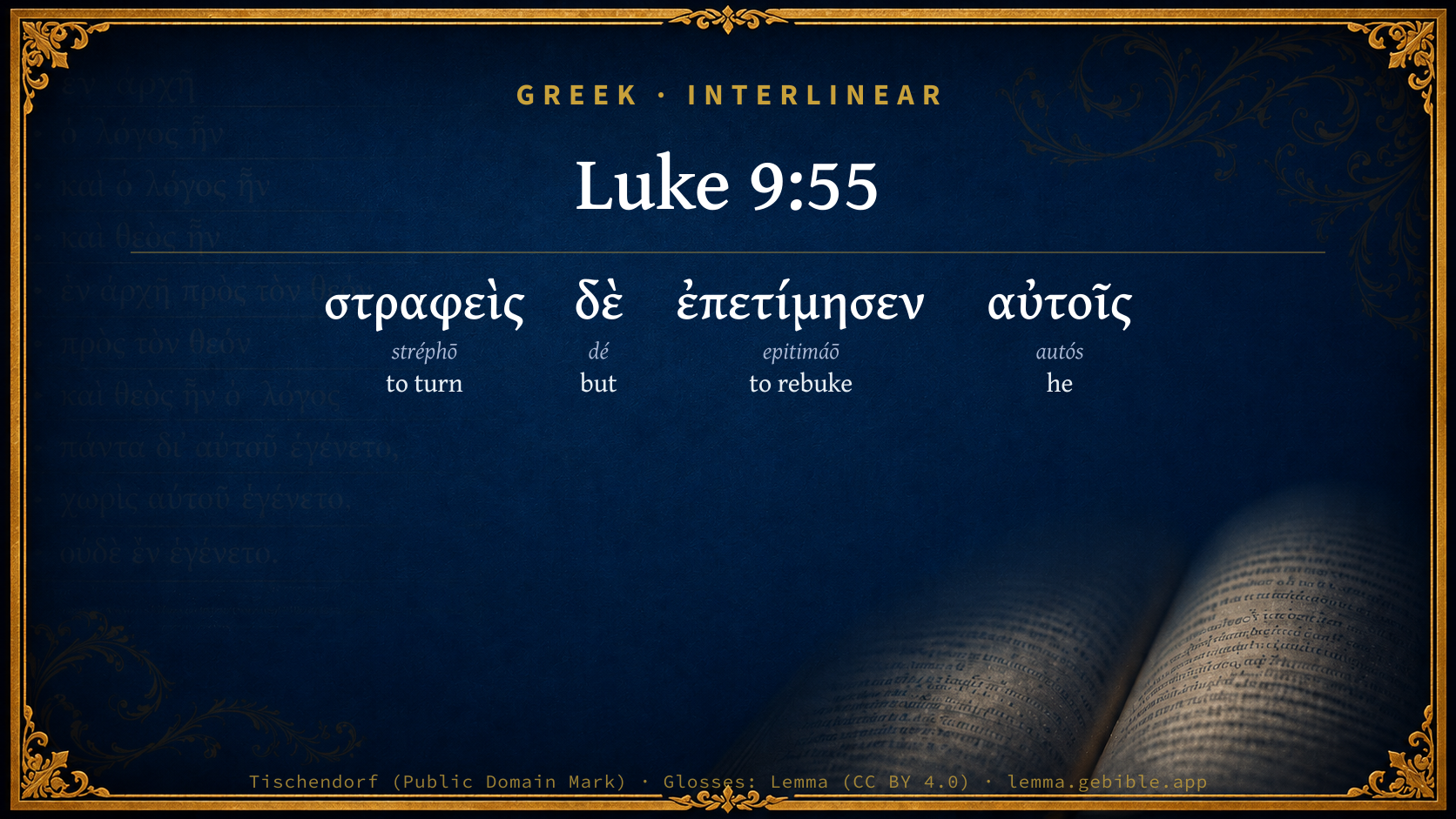
But he turned and rebuked them, "You don't know of what kind of spirit you are.
Download a study sheet
One document with this verse’s original text, its word-by-word gloss line, the meaning frame, cross-references with their text, attributed commentary, and full source and license credits — printable, and it pastes into notes with its structure intact.
This verse Autodidact and up
A passage Seminary Student
Up to 50 verses in one chapter. A passage sheet keeps up to 6 commentary sources and 12 cross-references per verse, in the order this page ranks them, and says so on the sheet whenever that leaves anything out. Ask for a single verse and you get the Autodidact verse sheet above.
Everything on this page stays free to read, with no account — the sheet is a download of what is already on screen, not access to it.
Compare translations 3
The same verse in 3 English versions, stacked beneath the original-language interlinear above. Click any original word for its lexicon entry.
Each is an independent rendering of the whole verse — the interlinear is not word-aligned to these translations.
Highlighted words mark where these versions differ — a whole-verse word diff, not a word-by-word alignment.
-
World English Bible Public Domain
But he turned and rebuked them, "You don't know of what kind of spirit you are.
-
King James Version Public Domain
But he turned, and rebuked them, and said, Ye know not what manner of spirit ye are of.
-
unfoldingWord Literal Text CC BY-SA 4.0
But having turned, he rebuked them,
unfoldingWord Literal Text — © unfoldingWord, licensed CC BY-SA 4.0. Word-aligned USFM3 via Door43 (git.door43.org/unfoldingWord/en_ult).
Show all 19 translations
Every available English version of this verse, each an independent rendering of the whole verse.
-
World English Bible Public Domain
But he turned and rebuked them, "You don't know of what kind of spirit you are.
-
Berean Standard Bible Public Domain
But Jesus turned and rebuked them.
-
Majority Standard Bible Public Domain
But Jesus turned and rebuked them and said, “You do not know what kind of spirit you are.
-
King James Version Public Domain
But he turned, and rebuked them, and said, Ye know not what manner of spirit ye are of.
-
American Standard Version (1901) Public Domain
But he turned, and rebuked them.
-
Revised Version (1885) Public Domain
But he turned, and rebuked them.
-
Geneva Bible (1599) Public Domain
But Iesus turned about, and rebuked them, and said, Ye knowe not of what spirit ye are.
-
Douay-Rheims (1899) Public Domain
And turning, he rebuked them, saying: You know not of what spirit you are.
-
Young's Literal Translation Public Domain
and having turned, he rebuked them, and said, `Ye have not known of what spirit ye are;
-
Literal Standard Version CC BY-SA 4.0
And having turned, He rebuked them and said, “You have not known of what spirit you are,
-
Unlocked Literal Bible CC BY-SA 4.0
But he turned and rebuked them,
-
unfoldingWord Literal Text CC BY-SA 4.0
But having turned, he rebuked them,
-
Darby Bible Public Domain
But turning he rebuked them [and said, Ye know not of what spirit ye are].
-
World Messianic Bible Public Domain
But he turned and rebuked them, “You don’t know of what kind of spirit you are.
-
Webster's Bible Public Domain
But he turned, and rebuked them, and said, Ye know not what manner of spirit ye are of.
-
Free Bible Version CC BY-SA 4.0
But Jesus turned, and reprimanded them.
-
Bible in Basic English Public Domain
But turning round he said sharp words to them.
-
Text-Critical English NT CC BY 4.0
But he turned and rebuked them, saying, “You do not know what kind of spirit you belong to.
-
Tyndale New Testament (1534) Public Domain
Iesus turned about and rebuked them sayinge: ye wote not what maner sprete ye are of.
Literal Standard Version (2020), Covenant Press — licensed CC BY-SA 4.0. Text via the HelloAO Bible API (eBible.org). Unlocked Literal Bible (unfoldingWord) — licensed CC BY-SA 4.0. Text via the HelloAO Bible API (eBible.org). unfoldingWord Literal Text — © unfoldingWord, licensed CC BY-SA 4.0. Word-aligned USFM3 via Door43 (git.door43.org/unfoldingWord/en_ult). Free Bible Version, Dr. Jonathan Gallagher — licensed CC BY-SA 4.0. Text via the HelloAO Bible API (eBible.org).
Word by word
More ways to search: Search by grammar → Find every occurrence → Compare this word →
Practice this passage: Drill this verse → Learn its vocabulary →
- Appears 22× in the Greek New Testament
- First appears at Matthew 5:39
- Part of Speech
- Verb
- Tense
- Aorist
- Voice
- Passive
- Mood
- Participle
- Case
- Nominative
- Number
- Singular
- Gender
- Masculine
Full Thayer's Definition
About this verse
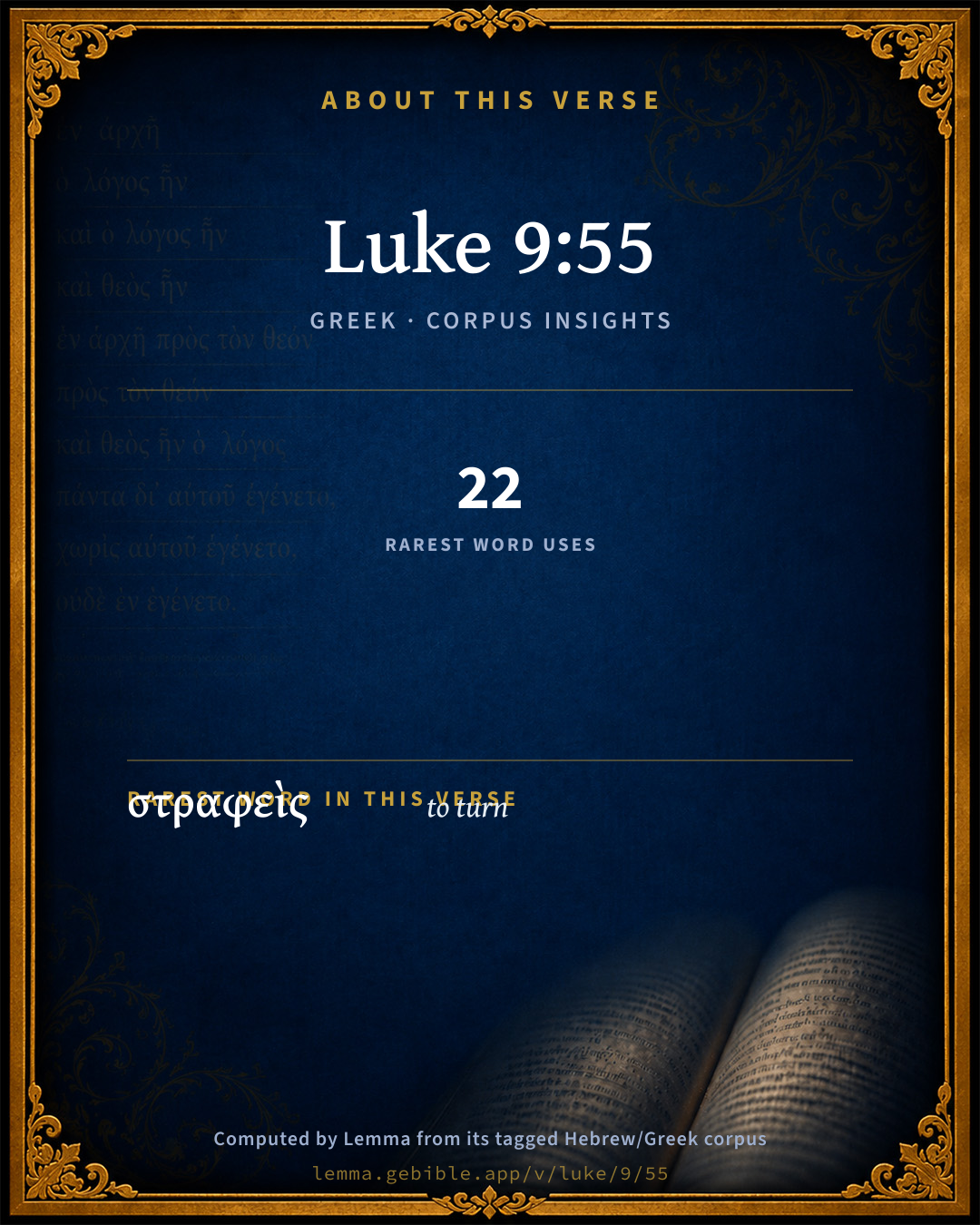
These counts appear in no published source. They are computed here, from the morphology-tagged text and Lemma’s own curated glosses. What Lemma adds →
- 4
- words
- 4
- distinct lemmas
- Gospels
- section
Cross-references
22Topical passages linked to Luke 9:55 in the Treasury of Scripture Knowledge — connected by theme and wording, ordered by reader-vote popularity; previews shown in the World English Bible.
- Job 2:10 But he said to her, "You speak as one of the foolish women would speak. What? Shall we receive good at the hand of God, and shall we not receive evil?" In all this Job didn't sin with his lips.
- Job 26:4 To whom have you uttered words? Whose spirit came forth from you?
- Matthew 16:23 But he turned, and said to Peter, "Get behind me, Satan! You are a stumbling-block to me, for you are not setting your mind on the things of God, but on the things of men."
- 1 Peter 3:9 not rendering evil for evil, or reviling for reviling; but instead blessing; knowing that to this were you called, that you may inherit a blessing.
- Revelation 3:19 As many as I love, I reprove and chasten. Be zealous therefore, and repent.
- Job 31:29–31 "If I have rejoiced at the destruction of him who hated me, Or lifted up myself when evil found him;
- Jeremiah 17:9 The heart is deceitful above all things, and it is exceedingly corrupt: who can know it?
- Matthew 26:51 Behold, one of those who were with Jesus stretched out his hand, and drew his sword, and struck the servant of the high priest, and struck off his ear.
- Numbers 20:10–12 Moses and Aaron gathered the assembly together before the rock, and he said to them, Hear now, you rebels; shall we bring you forth water out of this rock?
- 1 Samuel 24:4–7 The men of David said to him, Behold, the day of which Yahweh said to you, Behold, I will deliver your enemy into your hand, and you shall do to him as it shall seem good to you. Then David arose, and cut off the skirt of Saul's robe secretly.
- 1 Samuel 26:8–11 Then said Abishai to David, God has delivered up your enemy into your hand this day: now therefore please let me strike him with the spear to the earth at one stroke, and I will not strike him the second time.
- 2 Samuel 19:22 David said, What have I to do with you, you sons of Zeruiah, that you should this day be adversaries to me? shall there any man be put to death this day in Israel? for don't I know that I am this day king over Israel?
- Job 34:4–9 Let us choose for us that which is right. Let us know among ourselves what is good.
- Job 35:2–4 "Do you think this to be your right, Or do you say, 'My righteousness is more than God's,'
- Job 42:6 Therefore I abhor myself, And repent in dust and ashes."
- Matthew 26:33 But Peter answered him, "Even if all will be made to stumble because of you, I will never be made to stumble."
- Matthew 26:41 Watch and pray, that you don't enter into temptation. The spirit indeed is willing, but the flesh is weak."
- Acts 23:3–5 Then Paul said to him, "God will strike you, you whitewashed wall! Do you sit to judge me according to the law, and command me to be struck contrary to the law?"
- James 3:10 Out of the same mouth comes forth blessing and cursing. My brothers, these things ought not to be so.
- Proverbs 9:8 Don't reprove a scoffer, lest he hate you. Reprove a wise man, and he will love you.
- John 16:9 about sin, because they don't believe in me;
- Acts 26:9–11 "I myself most assuredly thought that I ought to do many things contrary to the name of Jesus of Nazareth.
Cross-references courtesy of OpenBible.info (CC BY 4.0).
Where the printed editions differ
1 variantPlaces in this verse where the major printed Greek editions disagree on the wording in a way that affects the translation — a comparison of editions, not a manuscript-by-manuscript collation. The editions are the modern critical texts (Nestlé-Aland 28/27, SBL, Westcott-Hort, Tregelles, Tyndale House) and the traditional texts behind the KJV (the Textus Receptus and the Byzantine/Majority text). It is not a claim about which reading is original.
-
Extra text
καὶ εἶπεν, οὐκ οἰδατε οἵου πνεύματός ἐστε ὑμεῖς.
“and said not you know such as spirit are you yourselves.”
In TRByz Not in NA28NA27TynSBLWHTregκαὶ εἶπεν, οὐκ οἰδατε οἵου πνεύματός ἐστε ὑμεῖς. (kai eipen ouk oidate oiou pneumatos este humeis) 'and said not you know such as spirit are you yourselves.' is only in traditional manuscripts (TR+Byz)
Textual data: Translators Amalgamated Greek New Testament (STEPBible TAGNT) · CC BY 4.0.
Lesson kit
Teaching starters — assembled from the data on this page, not authored interpretation. Every prompt links to the verse data it draws on. Edit before teaching.
Luke, in the Gospels, opens this verse with 4 words (4 distinct Greek lemmas). Its most distinctive word is stréphō (“to turn”). A historical commentator’s framing appears above. Read the whole chapter for the surrounding context.
Discussion questions
- The word stréphō carries the sense “to turn.” How does it shape the verse?
- Matthew 5:39 shares the word «to turn» with this verse. How do the two illuminate each other?
- These translations render this verse differently. What is at stake in choosing one wording over another?
- Reading how Bengel's Gnomon and Expositor's Greek Testament read this verse, where do the two commentators agree and where do they part?
Things to notice
- These translations choose different wording for 9 words in this verse.
- 4 distinct Greek lemmas span 4 words in this verse.
Commentary
Notes on Luke 9:55 from classic Christian and Jewish commentators (each source and its license shown beneath its notes). The classic Christian expositions comment on the surrounding passage and are grouped to its opening verse, so a note may address several verses; the Jewish commentaries on the Tanakh (Rashi and others) are per-verse, so they appear only where the commentator wrote on this verse.
Lemma curates 59 commentaries, every one of them public domain or Creative Commons licensed, each selected and text-cleaned for this edition rather than reprinted as found. About our sources →
Bengel's Gnomon
Johann Albrecht Bengel
Bengel's Gnomon of the New Testament — English translation (T&T Clark, Edinburgh, 1860) — public domain. Text from a community e-Sword module.
Expositor's Greek Testament
ed. W. Robertson Nicoll
The Expositor's Greek Testament, edited by W. Robertson Nicoll (1897–1910) — public domain. Text from a community e-Sword module.
Geneva Bible (1599)
Geneva Bible translators
Geneva Bible (1599) marginal notes — public domain. Text via Bolls.life.
Jamieson, Fausset & Brown
Robert Jamieson, A. R. Fausset & David Brown
Jamieson, Fausset & Brown — Commentary Critical and Explanatory on the Whole Bible (1871) — public domain (CC PDM 1.0). Text via the HelloAO Bible API.
Adam Clarke's Commentary
Adam Clarke's Commentary on the Bible (1810–1826) — public domain. Text from a community e-Sword/MySword module.
Ellicott's Commentary for English Readers
A Bible Commentary for English Readers, edited by Charles John Ellicott (1878–1897) — public domain. Text from a community e-Sword module.
The Cambridge Bible for Schools and Colleges
gen. ed. J. J. S. Perowne
The Cambridge Bible for Schools and Colleges (gen. ed. J. J. S. Perowne; Cambridge University Press, 1878–1918) — public domain. Text from a community e-Sword module.
John Gill's Exposition
John Gill's Exposition of the Whole Bible (1746–1763) — public domain (CC PDM 1.0). Text via the HelloAO Bible API.
Trapp's Complete Commentary
John Trapp
John Trapp, A Commentary or Exposition upon All the Books of the Old and New Testament (1647–1656) — public domain. Text from a community e-Sword module.
Albert Barnes' Notes on the Bible
Albert Barnes' Notes on the Bible (1834–1885) — public domain. Text from a community e-Sword/MySword module.
Haydock's Catholic Bible Commentary
George Leo Haydock (1774–1849), Haydock's Catholic Family Bible and Commentary, 1859 edition — public domain. Excludes Psalms (Douay-Rheims chapter numbering differs from Protestant) and Deuterocanonical books (Catholic canon only).
Matthew Poole's English Annotations
Matthew Poole's English Annotations on the Holy Bible (1683–1685) — public domain. Text from a community e-Sword/MySword module.
Whedon's Commentary on the Bible
Daniel D. Whedon
Daniel D. Whedon (gen. ed.), Commentary on the Old and New Testaments (1874–1909) — public domain. Text from a community e-Sword module.
The Pulpit Commentary
The Pulpit Commentary (1880–1919), ed. H.D.M. Spence-Jones & Joseph S. Exell — public domain. Text from a community e-Sword module.
John Wesley's Explanatory Notes
John Wesley, Explanatory Notes Upon the Whole Bible (1754–1765) — public domain. Text via the GEBible commentary corpus.
Burkitt's Expository Notes on the New Testament
William Burkitt
William Burkitt's Expository Notes on the New Testament (1700–1703) — public domain. Text from a community e-Sword module.
The People's New Testament
B. W. Johnson
B. W. Johnson's The People's New Testament with Notes (1889–1891) — public domain. Electronic text from the Christian Classics Ethereal Library (CCEL) ThML edition.
Cambridge Greek Testament for Schools and Colleges
Cambridge Greek Testament for Schools and Colleges (Cambridge University Press, 1896; 21 vols, various authors incl. Carr, Maclear, Plummer, Farrar, Lumby, Moule, M. R. James, Simcox) — public domain. Text from a community e-Sword module.
Alford’s Greek Testament
Henry Alford
Henry Alford, The Greek Testament (1849–1861) — public domain. Text from a community e-Sword module.
International Critical Commentary
International Critical Commentary — older volumes (1896–1929), various authors — public domain. Text from a community e-Sword module.