1 Peter 5:9

Greek (Tischendorf 8th ed.) 1 Peter 5:9 appears in the Greek New Testament. The text above is from the Tischendorf 8th edition. Each word links to its Strong’s number and a concise gloss. Click any word for its full Thayer’s Greek Lexicon entry.
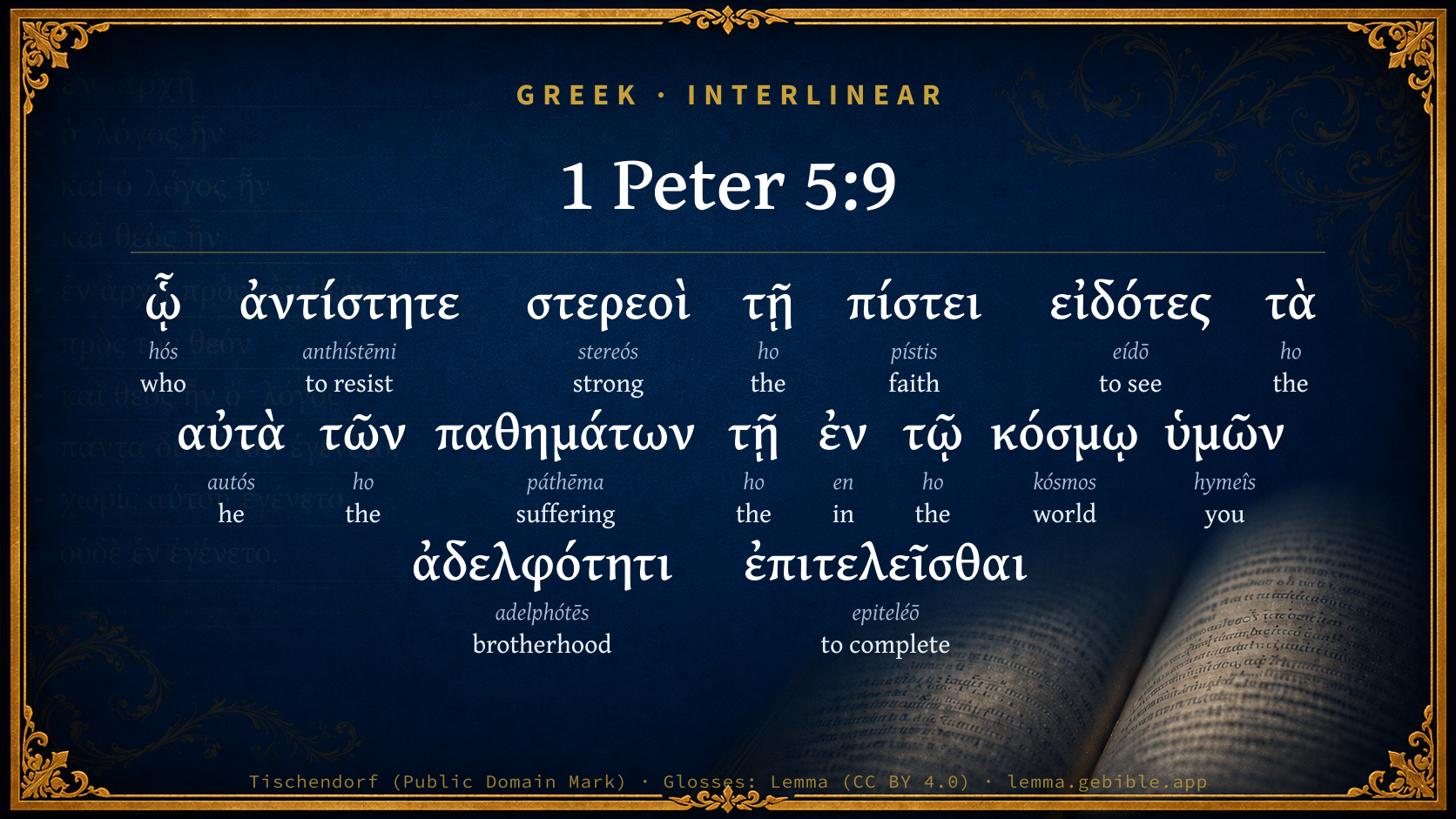
Download image
Cite this verse

1 Peter 5:9 (World English Bible). Public Domain. Lemma interlinear Bible study tool, https://lemma.gebible.app/v/1-peter/5/9.

Show BibTeX & RIS
BibTeX
RIS
English Translation
Withstand him steadfast in your faith, knowing that your brothers who are in the world are undergoing the same sufferings.
World English Bible · Public Domain
Download a study sheet

One document with this verse’s original text, its word-by-word gloss line, the meaning frame, cross-references with their text, attributed commentary, and full source and license credits — printable, and it pastes into notes with its structure intact.

This verse Autodidact and up

Study sheet (.html) Plain text (.txt)

A passage Seminary Student

Up to 50 verses in one chapter. A passage sheet keeps up to 6 commentary sources and 12 cross-references per verse, in the order this page ranks them, and says so on the sheet whenever that leaves anything out. Ask for a single verse and you get the Autodidact verse sheet above.

Everything on this page stays free to read, with no account — the sheet is a download of what is already on screen, not access to it.

Want to remove ads? Support Godless Engineer
Compare translations 3

The same verse in 3 English versions, stacked beneath the original-language interlinear above. Click any original word for its lexicon entry.

Each is an independent rendering of the whole verse — the interlinear is not word-aligned to these translations.

Highlighted words mark where these versions differ — a whole-verse word diff, not a word-by-word alignment.

  • World English Bible Public Domain
    Withstand him steadfast in your faith, knowing that your brothers who are in the world are undergoing the same sufferings.
  • King James Version Public Domain
    Whom resist stedfast in the faith, knowing that the same afflictions are accomplished in your brethren that are in the world.
  • unfoldingWord Literal Text CC BY-SA 4.0
    Resist him, firm in the faith, knowing the same kind of sufferings are being brought to completion in your brotherhood in the world.

unfoldingWord Literal Text — © unfoldingWord, licensed CC BY-SA 4.0. Word-aligned USFM3 via Door43 (git.door43.org/unfoldingWord/en_ult).

Versions to compare (up to 4)

3 of 4 selected

Show all 19 translations

Every available English version of this verse, each an independent rendering of the whole verse.

  • World English Bible Public Domain
    Withstand him steadfast in your faith, knowing that your brothers who are in the world are undergoing the same sufferings.
  • Berean Standard Bible Public Domain
    Resist him, standing firm in your faith and in the knowledge that your brothers throughout the world are undergoing the same kinds of suffering.
  • Majority Standard Bible Public Domain
    Resist him, standing firm in your faith and in the knowledge that your brothers throughout the world are undergoing the same kinds of suffering.
  • King James Version Public Domain
    Whom resist stedfast in the faith, knowing that the same afflictions are accomplished in your brethren that are in the world.
  • American Standard Version (1901) Public Domain
    whom withstand stedfast in your faith, knowing that the same sufferings are accomplished in your brethren who are in the world.
  • Revised Version (1885) Public Domain
    whom withstand stedfast in your faith, knowing that the same sufferings are accomplished in your brethren who are in the world.
  • Geneva Bible (1599) Public Domain
    Whom resist stedfast in the faith, knowing that the same afflictions are accomplished in your brethren which are in the world.
  • Douay-Rheims (1899) Public Domain
    Whom resist ye, strong in faith: knowing that the same affliction befalls your brethren who are in the world.
  • Young's Literal Translation Public Domain
    whom resist, stedfast in the faith, having known the same sufferings to your brotherhood in the world to be accomplished.
  • Literal Standard Version CC BY-SA 4.0
    whom you must resist, steadfast in the faith, having known the same sufferings of your brotherhood to be accomplished in the world.
  • Unlocked Literal Bible CC BY-SA 4.0
    Stand against him. Be strong in your faith. You know that your community of believers that is in the world is enduring the same sufferings.
  • unfoldingWord Literal Text CC BY-SA 4.0
    Resist him, firm in the faith, knowing the same kind of sufferings are being brought to completion in your brotherhood in the world.
  • Darby Bible Public Domain
    Whom resist, stedfast in faith, knowing that the selfsame sufferings are accomplished in your brotherhood which [is] in [the] world.
  • World Messianic Bible Public Domain
    Withstand him steadfast in your faith, knowing that your brothers who are in the world are undergoing the same sufferings.
  • Webster's Bible Public Domain
    Whom resist steadfast in the faith, knowing that the same afflictions are accomplished in your brethren that are in the world.
  • Free Bible Version CC BY-SA 4.0
    Stand firm against him, trusting in God. Remember that your fellow-believers around the world are going through similar troubles.
  • Bible in Basic English Public Domain
    Do not give way to him but be strong in your faith, in the knowledge that your brothers who are in the world undergo the same troubles.
  • Text-Critical English NT CC BY 4.0
    Resist him, standing firm in the faith, because you know that your brothers throughout the world are enduring the same kinds of suffering.
  • Tyndale New Testament (1534) Public Domain
    whom resist stedfust in the fayth remebrynge that ye do but fulfill the same affliccions which are apoynted to youre brethren that are in the worlde.

Literal Standard Version (2020), Covenant Press — licensed CC BY-SA 4.0. Text via the HelloAO Bible API (eBible.org). Unlocked Literal Bible (unfoldingWord) — licensed CC BY-SA 4.0. Text via the HelloAO Bible API (eBible.org). unfoldingWord Literal Text — © unfoldingWord, licensed CC BY-SA 4.0. Word-aligned USFM3 via Door43 (git.door43.org/unfoldingWord/en_ult). Free Bible Version, Dr. Jonathan Gallagher — licensed CC BY-SA 4.0. Text via the HelloAO Bible API (eBible.org).

Word by word

More ways to search: Search by grammar → Find every occurrence → Compare this word →

Practice this passage: Drill this verse → Learn its vocabulary →

ἀδελφότητι
adelphótēs
G81
“brotherhood”
Noun, Dative, Singular, Feminine
Part of Speech
Noun
Case
Dative
Number
Singular
Gender
Feminine
Full Thayer's Definition

Origin: from G80

TDNT: 03:24,2

1. brotherhood, brotherly kindness 2. a family of brothers, the brotherhood
  1. ᾧ hós G3739 “who” Relative pronoun, Dative, Singular, Masculine
  2. ἀντίστητε anthístēmi G436 “to resist” Verb, Aorist, Active, Imperative, 2nd person, Plural
  3. στερεοὶ stereós G4731 “strong” Adjective, Nominative, Plural, Masculine
  4. τῇ ho G3588 “the” Article, Dative, Singular, Feminine
  5. πίστει pístis G4102 “faith” Noun, Dative, Singular, Feminine
  6. εἰδότες eídō G1492 “to see” Verb, Perfect, Active, Participle, Nominative, Plural, Masculine
  7. τὰ ho G3588 “the” Article, Accusative, Plural, Neuter
  8. αὐτὰ autós G846 “he” Personal pronoun, Accusative, Plural, Neuter
  9. τῶν ho G3588 “the” Article, Genitive, Plural, Neuter
  10. παθημάτων páthēma G3804 “suffering” Noun, Genitive, Plural, Neuter
  11. τῇ ho G3588 “the” Article, Dative, Singular, Feminine
  12. ἐν en G1722 “in” Preposition
  13. τῷ ho G3588 “the” Article, Dative, Singular, Masculine
  14. κόσμῳ kósmos G2889 “world” Noun, Dative, Singular, Masculine
  15. ὑμῶν hymeîs G5210 “you” Personal pronoun, 2nd person, Genitive, Plural
  16. ἐπιτελεῖσθαι epiteléō G2005 “to complete” Verb, Present, Passive, Infinitive

About this verse

These counts appear in no published source. They are computed here, from the morphology-tagged text and Lemma’s own curated glosses. What Lemma adds →

17
words
13
distinct lemmas
General Epistles
section

Notable vocabulary

The rarest word here is ἀδελφότητι brotherhood G81 — appearing just 2 times in the whole Greek New Testament.

Shared distinctive vocabulary

ἀδελφότητι brotherhood G81 occurs in 2 verses of the Greek New Testament. Also found in:

Repetition

A word recurs within this verse:

Cross-references

23

Topical passages linked to 1 Peter 5:9 in the Treasury of Scripture Knowledge — connected by theme and wording, ordered by reader-vote popularity; previews shown in the World English Bible.

  • James 4:7 Be subject therefore to God. But resist the devil, and he will flee from you.
  • Acts 14:22 confirming the souls of the disciples, exhorting them to continue in the faith, and that through many afflictions we must enter into the Kingdom of God.
  • Ephesians 6:11–13 Put on the whole armor of God, that you may be able to stand against the wiles of the devil.
  • 1 Peter 2:21 For to this you were called, because Christ also suffered for us, leaving you an example, that you should follow his steps,
  • 1 Corinthians 10:13 No temptation has taken you except what is common to man. God is faithful, who will not allow you to be tempted above what you are able, but will with the temptation also make the way of escape, that you may be able to endure it.
  • Ephesians 6:16 above all, taking up the shield of faith, with which you will be able to quench all the fiery darts of the evil one.
  • 1 Timothy 6:12 Fight the good fight of faith. Lay hold of the eternal life to which you were called, and you confessed the good confession in the sight of many witnesses.
  • 2 Timothy 3:12 Yes, and all who desire to live godly in Christ Jesus will suffer persecution.
  • Hebrews 11:33 who, through faith subdued kingdoms, worked out righteousness, obtained promises, stopped the mouths of lions,
  • 1 Peter 3:14 But even if you should suffer for righteousness' sake, you are blessed. "Don't fear what they fear, neither be troubled."
  • Ephesians 4:27 neither give place to the devil.
  • 1 Thessalonians 3:3 that no one be moved by these afflictions. For you know that we are appointed to this task.
  • Luke 4:3–12 The devil said to him, "If you are the Son of God, command this stone to become bread."
  • John 16:33 I have told you these things, that in me you may have peace. In the world you have oppression; but cheer up! I have overcome the world."
  • Colossians 2:5 For though I am absent in the flesh, yet am I with you in the spirit, rejoicing and seeing your order, and the steadfastness of your faith in Christ.
  • 1 Peter 1:6 Wherein you greatly rejoice, though now for a little while, if need be, you have been put to grief in various trials,
  • 1 Peter 4:13 But because you are partakers of Christ's sufferings, rejoice; that at the revelation of his glory also you may rejoice with exceeding joy.
  • Revelation 6:11 A long white robe was given to each of them. They were told that they should rest yet for a while, until their fellow servants and their brothers, who would also be killed even as they were, should complete their course.
  • Luke 22:32 but I prayed for you, that your faith wouldn't fail. You, when once you have turned again, establish your brothers."
  • Revelation 7:14 I told him, "My lord, you know." He said to me, "These are those who came out of the great tribulation. They washed their robes, and made them white in the Lamb's blood.
  • 2 Timothy 4:7 I have fought the good fight. I have finished the course. I have kept the faith.
  • Revelation 1:9 I John, your brother and partner with you in oppression, Kingdom, and perseverance in Christ Jesus, was on the isle that is called Patmos because of God's Word and the testimony of Jesus Christ.
  • 1 Thessalonians 2:15–16 who killed both the Lord Jesus and their own prophets, and drove us out, and didn't please God, and are contrary to all men;

Cross-references courtesy of OpenBible.info (CC BY 4.0).

Commentary

Notes on 1 Peter 5:9 from classic Christian and Jewish commentators (each source and its license shown beneath its notes). The classic Christian expositions comment on the surrounding passage and are grouped to its opening verse, so a note may address several verses; the Jewish commentaries on the Tanakh (Rashi and others) are per-verse, so they appear only where the commentator wrote on this verse.

Lemma curates 59 commentaries, every one of them public domain or Creative Commons licensed, each selected and text-cleaned for this edition rather than reprinted as found. About our sources →

Tyndale Open Study Notes

Tyndale Open Resources

5:9 family of believers: Greek adelphoi, a term that refers to people, both male and female, who are members of the same family. • all over the world: Persecution was not confined to the churches of Asia Minor. In various forms and with varying intensity, Christians were persecuted almost everywhere the Good News about Jesus Christ was preached. Peter reminds his readers of this to console them and encourage them to emulate those who had successfully endured the test of suffering.

Tyndale Open Study Notes — © Tyndale Open Resources, licensed CC BY-SA 4.0. Text via the HelloAO Bible API.

Bengel's Gnomon

Johann Albrecht Bengel

1Pe 5:9. Τῇ πίστει, through or by the faith) Constructed with resist [not “stedfast in the faith,” as Engl. Vers.]—τὰ αὐτὰ τῶν παθημάτων, the very same sufferings) Not merely like sufferings, but the very same. The same governs the Dative ἀδελφότητι, brotherhood. Thus Lucretius: eadem aliis sopitus quiete est. Chrysost. de Sacerd., p. 202: εἰς τὴν αὐτὴν ἐκείνοις ἐκπίπτειν μανίαν, to fall into the same madness with them. The meaning of the apostle is: the same sufferings which happen to your brethren are also undergone by you. Comp. Mat 5:12; 2Co 1:6; Php 1:30. [Therefore it is not a bad sign in a person, if the devil harasses him with sufferings.—V. g.]—ἐν κόσμῳ) in the whole of this world, which lies in the evil one, the devil: 1Pe 5:8. It is antithetical to the eternal glory of God, 1Pe 5:10.—ὑμῶν ἀδελφότητι, to your brotherhood) of Jews and Gentiles.—ἐπιτελεῖσθαι, are accomplished) The measure of sufferings is gradually filled up.

Bengel's Gnomon of the New Testament — English translation (T&T Clark, Edinburgh, 1860) — public domain. Text from a community e-Sword module.

Meyer's Critical & Exegetical Commentary

Heinrich August Wilhelm Meyer

1Pe_5:9. ᾧ ἀντίστητε στερεοὶ τῇ πίστει] cf. Jam_4:7; Eph_6:11 ff. τῇ πίστει does not belong to ἀντίστητε (Bengel), but to στερεοί; not as the dat. instrum. (Beza, Hensler), but as the dative of nearer definition: firm in the faith; cf. Act_16:5; Col_2:7; cf. Winer, p. 202 [E. T. 270]. It is only a firm faith that can resist the devil.

εἰδότες τὰ αὐτὰ τῶν παθημάτων … ἐπιτελεῖσθαι] Almost all interpreters assume that the construction here is that of the accus. c. inf. Hofmann nevertheless denies this, remarking that in the N. T. εἰδότες (in the sense of knowing) never takes the accus. c. inf., but always the particle ὅτι, and that when εἰδότες is followed by the accus. c. inf., it signifies to understand how to do a thing.[278] If this be correct, ἘΠΙΤΕΛΕῖΣΘΑΙ must have an active meaning, ΤᾺ ΑὐΤᾺ ΤῶΝ ΠΑΘ. be the accusative after it, and the dative Τῇ … ἈΔΕΛΦΌΤΗΤΙ be dependent on ΤᾺ ΑὐΤΆ. Explaining ἘΠΙΤΕΛΕῖΣΘΑΙ on the analogy of the phrase: ΤᾺ ΤΟῦ ΓΉΡΩς ἘΠΙΤΕΛΕῖΣΘΑΙ (Xen. Mem. iv. 8. 8), and seeing in τὰ αὐτά the idea of measure expressed, Hofmann translates: knowing how to pay for your Christianity the same tribute of affliction as your brethren in the world. This explanation cannot be accepted without hesitation. For, on the one hand, from the fact that in other parts of the N. T. ΕἸΔΌΤΕς does not take the accus. c. inf., it cannot be concluded that here it does not do so either, the more especially that the construction of the accus. c. inf. occurs comparatively rarely in the N. T.; and, on the other hand, the phrase: ΤᾺ … ΤῶΝ ΠΑΘ. ἈΠΟΤΕΛ., is not analogous with the expression: ΤᾺ ΤΟῦ ΓΉΡΩς ἘΠΙΤΕΛ., since in the former there is no conception corresponding to ΤΟῦ ΓΉΡΩς. Hofmann inserts, indeed, as such, the idea of the Christian calling, but it is purely imported, and nowhere hinted at in the text. Accordingly, ἘΠΙΤΕΛΕῖΣΘΑΙgrammatically consideredcan have a passive signification, not, indeed, equivalent to: are completed (Thuc. 7:2; Php_1:6, and other passages), for this idea would not be suitable here, but rather: are being accomplished (thus Herod. 1:51, in connection with τὰ ἐπιτασσόμενα; 1:138: ἘΠΙΤΕΛΈΣΑΙ Ἃ ὙΠΈΣΧΕΤΟ). This idea is, in truth, not very appropriate either; it seems to be more fitting to take the verb in a middle sense, as equivalent to: are accomplishing themselves; and to translate: knowing (or better rather: considering) that the same sufferings are accomplishing themselves in the brethren. This rendering is to be preferred to all others. The Vulg. translates ἘΠΙΤΕΛ. by fieri; Luther by befall; both are too inexact renderings of the sense.[279] In the explanation above given, τὰ αὐτά is used as a substantive, as frequently happens with the neuter of adjectives (Winer, p. 220[280] [E.T. 294]), and is put here to emphasize the sameness of the sufferings (thus de Wette, Wiesinger); τῇ … ἀδελφότητι is to be taken as the more remote object; on no condition can the dative be understood as equivalent to ὙΠΌ in passives. With the idea ἈΔΕΛΦΌΤΗΤΙ, cf. chap. 1Pe_2:17.

The addition, ἘΝ ΚΌΣΜῼ, alludes to the reason of the afflictions (Steiger). Wiesinger justly remarks: in the world, the dominion of the Evil One, the Christian can and dare expect nothing else. Possibly it may contain at the same time a reference to the ἈΔΕΛΦΌΤΗς, which the Lord has already taken to Himself ἘΚ ΤΟῦ ΚΌΣΜΟΥ. The thought that the brethren have to bear the same afflictions, serves to give strength in resisting the devil, since the consciousness of bearing similar afflictions in common with all Christian brethren, encourages to patient endurance.

[278] Cf. the passages quoted by Hofmann: Mat_7:11; Luk_11:13; Luk_12:36; Jam_4:17; Php_4:12; 1Ti_3:5; 2Pe_2:9.

[279] The translation of Wichelhaus: to be laid upon, is entirely unjustifiable.

[280] Hofmann erroneously appeals to Hartungs Gr. II. p. 238, in support of the interpretation: the same measure of suffering.

Meyer — Critical and Exegetical Commentary on the New Testament — English translation by Peter Christie, edited by Frederick Crombie (T&T Clark, 1880) — public domain. Text from a community e-Sword module.

Expositor's Greek Testament

ed. W. Robertson Nicoll

1Pe 5:9 . ᾧ ἀντίστητε . St. James adds the same exhortation to his quotation of Prov. The connexion is not obvious but is perhaps due to the traditional exposition of לץ = ὑπερηφάνοις as referring to the Devil and his children. As God ranges Himself against scoffers, so must Christians resist the Devil who is working with their slanderous tempers. Oecumenius and Cramer’s Catena both appeal to an extract from Justin’s book against Marcion (?) which is preserved in Irenæsus and quoted by Eusebius. The main point of the passage is that before Christ came the devil did not dare to blaspheme against God, for the prophecies of his punishment were enigmatic; but Christ proclaimed it plainly and so he lost all hope and goes about eager to drag down all to his own destruction. στερεοὶ τῇ πίστει , rock like in your faith , abbreviation of ἐπιμένετε τῇ πίστει τεθεμελιωμένοι καὶ ἑδραῖοι , Col 1:23 ; cf. τὸ στερέωμα τῆς εἰς Χριστὸν πίστεως , Col 2:5 and Act 16:5 , αἱ … ἐκκλησίαι ἐστερεοῦντο τῇ πιστει . The metaphorical use of στ . in a good sense is not common. Peter perhaps thinks of the στερεὰ πέτρα ( צור ) of Isa 51:1 and warns them against his own failing. εἰδότες … ἐπιτελεῖσθαι . The rendering (first suggested by Hoffmann) knowing how to pay (that you are paying) the same tax of sufferings as the brotherhood in the world is paying seems preferable to the common knowing that the same kinds of sufferings are being accomplished for ( by ) … it assumes the proper idiomatic force of ἐπιτελεῖσθαι and accounts for τὰ αὐτά ( sc. τέλη ) followed by the genitive. Xenophon who is a good authority for Common Greek uses ἐ . thus twice: Mem. iv. 8. 8, “but if I shall live longer perhaps it will be necessary to pay the penalties of old age ( τὰ τοῦ γήρως ἐπιτελεῖσθαι ) and to see and hear worse …” Apol , 33 nor did he turn effeminate at death but cheerfully welcomed it and paid the penalty ( ἐπετελέσατο ). For the dative with τὰ αὐτά . same as , cf. 1Co 11:5 , ἓν καὶ τὸ αὐτὸ τῇ ἐξυρημένῃ .

The Expositor's Greek Testament, edited by W. Robertson Nicoll (1897–1910) — public domain. Text from a community e-Sword module.

Geneva Bible (1599)

Geneva Bible translators

The persecutions which Satan stirreth up are neither new nor proper to any one man, but from old and ancient time common to the whole Church, and therefore we must suffer that patiently wherein we have such and so many fellows of our conflicts and combats.

Amongst your brethren which are dispersed throughout the world.

Geneva Bible (1599) marginal notes — public domain. Text via Bolls.life.

Jamieson, Fausset & Brown

Robert Jamieson, A. R. Fausset & David Brown

(Luk 4:13; Eph 6:11-17; Jam 4:7.)

steadfast--Compare established in the truth," Pe2 1:12. Satan's power exists only in respect to the unbelieving; the faithful he cannot hurt (Jo1 5:18). Faith gives strength to prayer, the great instrument against the foe (Jam 1:6, &c.).

knowing, &c.--"encouragement not to faint in afflictions": your brethren suffer the same; nothing beyond the common lot of Christians befalls you (Co1 10:13). It is a sign of God's favor rather than displeasure, that Satan is allowed to harass you, as he did Job. Your fellow Christians have the same battle of faith and prayer against Satan.

are--are being accomplished according to the appointment of God.

in the world--lying in the wicked one, and therefore necessarily the scene of "tribulation" (Joh 16:33).

Jamieson, Fausset & Brown — Commentary Critical and Explanatory on the Whole Bible (1871) — public domain (CC PDM 1.0). Text via the HelloAO Bible API.

Adam Clarke's Commentary

Verse 9. Whom resist] Stand against him, αντιστητε. Though invulnerable, he is not unconquerable: the weakest follower of God can confound and overpower him, if he continue steadfast in the faith-believing on the Son of God, and walking uprightly before him. To a soul thus engaged he can do no damage.

The same afflictions are accomplished in your brethren] It is the lot of all the disciples of Christ to suffer persecution. The brotherhood, αδελφοτης, the Christian Church, everywhere is exposed to the assaults of men and devils; you are persecuted by the heathen among whom ye live, and from among whom ye are gathered into the fold of Christ: but even those who profess the same faith with you, and who are resident among the Jews, (for so I think ενκοσμω, in the world, is here to be understood,) are also persecuted, both heathens and Jews being equally opposed to the pure and holy doctrines of the Gospel. Any man who has read the Greek Testament with any attention must have observed a vast number of places in which the word κοσμος, which we translate world, means the Jewish people and the Jewish state, and nothing else.

Adam Clarke's Commentary on the Bible (1810–1826) — public domain. Text from a community e-Sword/MySword module.

John Calvin's Commentaries

9 Whom resist As the power of an enemy ought to stimulate us and make us more careful, so there would be danger lest our hearts failed through immoderate fear, except the hope of victory were given us. This then is what the Apostle speaks of; he shows that the issue of the war will be prosperous, if we indeed fight under the banner of Christ; for whosoever comes to this contest, endued with faith, he declares that he will certainly be a conqueror.

Resist, he says; but some one may ask, how? To this he answers, there is sufficient strength in faith. Paul, in the passage which I have already quoted, enumerates the various parts of our armor, but the meaning is the same, (Ephesians 6:13,) for John testifies that faith alone is our victory over the world.

Knowing that the same afflictions, or sufferings. It is another consolation, that we have a contest in common with all the children of God; for Satan dangerously tries us, when he separates us from the body of Christ. We have heard how he attempted to storm the courage of Job,

“Look to the saints, has any one of them suffered such a thing?” — Job 5:1.

The Apostle on the other hand, reminds us here that nothing happens to us but what we see does happen to other members of the Church. Moreover a fellowship, or a similar condition, with all the saints, ought by no means to be refused by us.

By saying that the same sufferings are accomplished, he means what Paul declares in Colossians 1:24, that what remains of the sufferings of Christ is daily fulfilled in the faithful.

The words, that are in the world, may be explained in two ways, either that God proves his faithful people indiscriminately everywhere in the world, or that the necessity of fighting awaits us as long as we are in the world. But we must observe that having said before that we are assailed by Satan, he then immediately refers to every kind of afflictions. We hence gather that we have always to do with our spiritual enemy, however adversities may come, or whatever they may be, whether diseases oppress us, or the barrenness of the land threatens us with famine, or men persecute us.

John Calvin's Commentaries (1540-1563) — public domain. Text from the Calvin Translation Society English edition (1840s-50s) via the Christian Classics Ethereal Library (ccel.org). Calvin's coverage is partial (roughly two-thirds of the Bible); uncommented books and verses are honest gaps, never fabricated. The 19th-century editor's footnotes and remarks are omitted so the notes are faithfully Calvin's own voice.

Ellicott's Commentary for English Readers

(9) Whom resist stedfast in the faith.—The expression is somewhat more picturesque in the Greek than in the English. “Stand and face him,” instead of running away from posts of duty (1Pe_5:2), or lying still and letting things take their course (1Pe_5:8). And the words for “stedfast in the faith” seem to mean not only that each individual is to stand firm, but that they are to present all together a solid front to the lion.

Knowing that the same afflictions are accomplished in your brethren that are in the world.—The phraseology of the original is very strange. The sameness of the sufferings is brought out by an expression which literally runs “the same things in the way of sufferings;” the fraternal unity, by the use of the same abstract word which we had in 1Pe_2:17. The verb rendered “to accomplish” sometimes denotes execution or infliction. So the whole will run, knowing that the very same things in the way of sufferings are being inflicted upon your brotherhood which is in the world. “There is one thing,” says Archbishop Leighton, “that much troubles the patience and weakens the faith of some Christians; they are ready to think there is none, yea, there was never any beloved of God in such a condition as theirs. Therefore the Apostle St. Paul breaks this conceit (1Co_10:13), ‘no temptation hath taken you but such as is common to man:’ and here is the same truth, ‘the same afflictions are accomplished in your brethren.’ This is the truth, and, taken altogether, is a most comfortable truth; the whole brotherhood go in this way, and our eldest Brother went first.” The addition, “that are in the world,” points the suffering Christians indirectly to solace themselves with the thought of that portion of the brotherhood which has got beyond the infliction. It would be possible to translate, though somewhat far-fetched in point of thought, “knowing that the same sufferings (or, the identity of the sufferings) is completed by your brotherhood in the world”—i.e., finds a consummation in making closer the bonds of brotherhood between you.

A Bible Commentary for English Readers, edited by Charles John Ellicott (1878–1897) — public domain. Text from a community e-Sword module.

The Cambridge Bible for Schools and Colleges

gen. ed. J. J. S. Perowne

9. whom resist stedfast in the faith] The word for “resist” is the same as that used in the parallel passage of Jas_4:7. “Faith” is probably used in its subjective rather than its objective sense, for unshaken trust in God rather than unwavering orthodoxy. Comp. the “shield of faith” in Eph_6:16.

knowing that the same afflictions are accomplished in your brethren] Better, that the same sufferings (as keeping up the continuity of thought with chaps. 1Pe_1:11, 1Pe_4:13, 1Pe_5:1) are being wrought out for your brotherhood (the same collective term as in chap. 1Pe_2:17) that are in the world. The Apostle appeals to the thought of sympathy with other sufferers as a ground of steadfastness. Those to whom he wrote were not isolated in their afflictions. Far and near there were comrades fighting the same battle. It was at once their duty and their privilege to follow all examples of steadfastness of which they heard elsewhere, and to set that example, so that others, cheered by it, might be strengthened to endure even to the end.

The Cambridge Bible for Schools and Colleges (gen. ed. J. J. S. Perowne; Cambridge University Press, 1878–1918) — public domain. Text from a community e-Sword module.

John Gill's Exposition

Whom resist,.... By no means give way to him, by indulging any sin, or yielding to any temptation, but oppose him, and stand against his wiles, his cunning and his power:

steadfast in the faith; both in the doctrine of faith, which Satan endeavours to remove from, or cause to stagger in; and in the grace of faith, exercising it on the promises of God, and his perfections, particularly his power and faithfulness concerned in them, and in the blood, righteousness, sacrifice, and person of Christ, which faith is capable of making use of, as a shield, to good purpose, against all the fiery darts of Satan; as also in a profession of faith, which, as it should be held fast without wavering, and which the devil is very busy to keep persons from making, or to cause them to drop it when they have made it, by violent suggestions, strong temptations, and a flood of reproaches and persecutions; all which should be disregarded:

knowing that the same afflictions are accomplished in your brethren that are in the world; and therefore should not be surprised and staggered by them, nor think them strange, but endure them without murmuring, and with patience and cheerfulness; since they are the "same afflictions" and trials which others have been exercised with in all ages: the same which the fraternity, or "brotherhood", as the word signifies, see Pe1 2:17 who stand in the same relation to God and Christ as they do, endure; yea, the same which Christ himself, who stands in this relation to them, has endured: and which must be expected while they are "in the world"; but this is the great mercy, that they are only endured in this world; there will be none in the world to come; they will be "accomplished" and finished here; and every believer has his measure, which must be filled up; and so has the whole of Christ, his church, and when they are fulfil they will be no more.

John Gill's Exposition of the Whole Bible (1746–1763) — public domain (CC PDM 1.0). Text via the HelloAO Bible API.

Trapp's Complete Commentary

John Trapp

9 Whom resist stedfast in the faith, knowing that the same afflictions are accomplished in your brethren that are in the world.

Ver. 9. Stedfast in the faith] Gr. στερεοι, stiff, solid, settled.

That the same afflictions] Art not thou glad to fare as Phocion? said he to one that was to die with him. (Plutarch.) Ignatius, going to suffer, triumphed in this, that his blood should be found among the mighty worthies, and that when the Lord maketh inquisition for blood, he will recount from the blood of righteous Abel not only to the blood of Zacharias, son of Barachias, but also to the blood of mean Ignatius.

John Trapp, A Commentary or Exposition upon All the Books of the Old and New Testament (1647–1656) — public domain. Text from a community e-Sword module.

Albert Barnes' Notes on the Bible

Whom resist - See the notes at Jam 4:7. You are in no instance to yield to him, but are in all forms to stand up and oppose him. Feeble in yourselves, you are to confide in the arm of God. No matter in what form of terror he approaches, you are to fight manfully the fight of faith. Compare the notes at Eph 6:10-17.

Steadfast in the faith - Confiding in God. You are to rely on him alone, and the means of successful resistance are to be found in the resources of faith. See the notes at Eph 6:16.

Knowing that the same afflictions are accomplished in your brethren that are in the world - Compare for a similar sentiment, 1Co 10:13. The meaning is, that you should be encouraged to endure your trials by the fact that your fellow-Christians suffer the same things. This consideration might furnish consolation to them in their trials in the following ways:

(1) They would feel that they were suffering only the common lot of Christians. There was no evidence that God was especially angry with them, or that he had in a special manner forsaken them.

(2) The fact that others were enabled to bear their trials should be an argument to prove to them that they would also be able. If they looked abroad, and saw that others were sustained, and were brought off triumphant, they might be assured that this would be the case with them.

(3) There would be the support derived from the fact that they were not alone in suffering. We can bear pain more easily if we feel that we are not alone - that it is the common lot - that we are in circumstances where we may have sympathy from others. This remark may be of great practical value to us in view of persecutions, trials, and death. The consideration suggested here by Peter to sustain those whom he addressed, in the trials of persecution, may be applied now to sustain and comfort us in every form of apprehended or real calamity. We are all liable to suffering. We are exposed to sickness, bereavement, death. We often feet as if we could not bear up under the sufferings that may be before us, and especially do we dread the great trial - death. It may furnish us some support and consolation to remember:

(1) That this is the common lot of people. There is nothing special in our case. It proves nothing as to the question whether we are accepted of God, and are beloved by him, that we suffer; for those whom he has loved most have been often among the greatest sufferers. We often think that our sufferings are unique; that there have been none like them. Yet, if we knew all, we should find that thousands - and among them the most wise, and pure, and good - have endured sufferings of the same kind as ours, and perhaps far more intense in degree.

(2) Others have been conveyed triumphantly through their trials. We have reason to hope and to believe that we shall also, for:

(a)Our trials have been no greater than theirs have been; and,

(b)Their natural strength was no greater than ours. Many of them were timid, and shrinking, and trembling, and felt that they had no strength, and that they should fail under the trial.

(3) The grace which sustained them can sustain us. The hand of God is not shortened that it cannot save; his ear is not heavy that it cannot hear. His power is as great, and his grace is as fresh, as it was when the first sufferer was supported by him; and that divine strength which supported David and Job in their afflictions, and the apostles and martyrs in theirs, is just as powerful as it was when they applied to God to be upheld in their sorrows.

(4) We are especially fearful of death - fearful that our faith will fail, and that we shall be left to die without support or consolation. Yet let us remember that death is the common lot of man. Let us remember who have died - tender females; children; the timid and the fearful; those, in immense multitudes, who had no more strength by nature than we have. Let us think of our own kindred who have died. A wife has died, and shall a husband be afraid to die? A child, and shall a father? A sister, and shall a brother? It does much to take away the dread of death, to remember that a mother has gone through the dark valley; that that gloomy vale has been trod by delicate, and timid, and beloved sisters. Shall I be afraid to go where they have gone? Shall I apprehend that I shall find no grace that is able to sustain me where they have found it? Must the valley of the shadow of death be dark and gloomy to me, when they found it to be illuminated with the opening light of heaven? Above all, it takes away the fear of death when I remember that my Saviour has experienced all the horrors which can ever be in death; that he has slept in the tomb, and made it a hallowed resting-place.

Albert Barnes' Notes on the Bible (1834–1885) — public domain. Text from a community e-Sword/MySword module.

Matthew Poole's English Annotations

Whom resist; by not yielding to his temptations, Eph 4:27, and by employing your spiritual armour against him, Eph 6:11-13, &c.: see Jam 4:7.

Stedfast in the faith; either:

1. Hold your faith, persevering in it, which the devil would fain bereave you of, (as soldiers used in war to look to their shields, it being dishonourable to lose them), and without which ye will never be able to stand out against the devil: or:

2. Stedfast or strong by faith; intimating, that faith is a Christian’s greatest strength, it being by faith that he engageth the power of God and grace of Christ on his side, whereby he comes to be victorious over all his enemies, 1Jo 5:4.

Knowing that the same afflictions; either:

1. The devil’s temptations, which here he calls afflictions, because believers are passive in them, and count them the greatest afflictions; or rather:

2. Persecutions, which though they come upon them immediately from the men of the world, yet it is by the instigation of the devil, the prince of the world, who hath a principal hand in them, and acts by men as his instruments: so that when men oppress them, they are to resist the devil, who thereby tempts them. They have a spiritual enemy to deal with even in temporal afflictions.

Are accomplished in your brethren; or, fulfilled, or perfected: either:

1. Others of your brethren are filling up the measure of sufferings God hath allotted them, for the mortifying of the flesh, and conforming them to Christ their Head, as well as you are filling up yours, Col 1:24; or:

2. He speaks of the community of their sufferings: q.d. What afflictions ye endure, others endure too, and therefore ye should not grudge to suffer, when ye have so good company in your sufferings.

That are in the world; either this notes the sufferings of the saints to be universal, so as to reach them all, wheresoever they are dispersed throughout the world; or, to be short, as being confined to the time only of their abode in the world.

Matthew Poole's English Annotations on the Holy Bible (1683–1685) — public domain. Text from a community e-Sword/MySword module.

Whedon's Commentary on the Bible

Daniel D. Whedon

9. Whom resist—Stand against him to the very last. Never surrender or compromise.

Steadfast—Solid and immovable in faith in Christ, the sure means of victory. Nor must they think their case an exception, for they knew that the same persecutions were carried on among their brethren throughout the world. The Christian name was everywhere hated.

Daniel D. Whedon (gen. ed.), Commentary on the Old and New Testaments (1874–1909) — public domain. Text from a community e-Sword module.

The Pulpit Commentary

Whom resist steadfast in the faith; comp. sthte, Jam_4:7, where the same word, ajnti is used; the close resemblance seems to indicate St. Peter"s knowledge of the Epistle of St. James; comp. also St. Paul in Eph_6:13, etc. The Greek word for "steadfast" steroi is emphatic; it implies solidity, rocklike firmness. Only faith can give that steadfastness faith in Christ, the one Foundation, the Rock on which the Christian"s house is built. Faith here is trustfulness rather than objective truth. Therefore the rendering of the Revised Version seems preferable, "in your faith," the article having, as often, a possessive meaning. Knowing that the same afflictions are accomplished in your brethren that are in the world; literally, the same (forms) of afflictions ta aujtatwn unusual construction with the pronoun, though common with adjectives, intended to give emphasis; the sufferings were the very same. The infinitive is present; it should therefore be rendered, "are being accomplished." The persecutions were now beginning to break out. The word for "brethren" is the collective, ajs\ brotherhood, which we met with in 1Pe_2:17. The dative is that of reference or "for" the brotherhood. (For the words, "in the world," comp. Joh_16:33, "In the world ye shall have tribulation: but be of good cheer; I have overcome the world. There is another way of taking the clause. The unusual construction (in the Greek Testament) of the accusative and infinitive, which, indeed, occurs nowhere else with eijdwv, has led Herman and others to take the verb ejpiteleisqai as middle, and to connect the dative, for the brotherhood," with ta, the same. Thus the translation will be, Knowing how to pay the same tribute of affliction as your brethren in the world." This seems forced and unnecessary. Huther gives another possible translation, which he thinks preferable to all others: Knowing or better rather, "considering that the same sufferings are accomplishing themselves in the brethren."

The Pulpit Commentary (1880–1919), ed. H.D.M. Spence-Jones & Joseph S. Exell — public domain. Text from a community e-Sword module.

John Wesley's Explanatory Notes

Be the more steadfast, as ye know the same kind of afflictions are accomplished in - That is, suffered by, your brethren, till the measure allotted them is filled up.

John Wesley, Explanatory Notes Upon the Whole Bible (1754–1765) — public domain. Text via the GEBible commentary corpus.

Scofield Reference Notes

C. I. Scofield

world

kosmos = mankind. (See Scofield "Mat 4:8").

The Scofield Reference Bible (1917 edition), notes by C. I. Scofield — public domain. Text from a community e-Sword module.

Burkitt's Expository Notes on the New Testament

William Burkitt

As if the apostle had said, "Resist Satan’s temptations, occasioned by your sufferings, remembering that it is not your case alone, but others also suffer with you, even all that will live godly in Christ Jesus."

Learn hence, That Christians should not desire, and cannot reasonably expect, a better condition in the world, with respect to freedom from sufferings, than the rest of their brethern, who have all a share of affliction to suffer, and a measure of hardship to endure, as well as ourselves: The same afflictions are accompolished in your brethren that are in the world.

William Burkitt's Expository Notes on the New Testament (1700–1703) — public domain. Text from a community e-Sword module.

The People's New Testament

B. W. Johnson

9. Whom resist. See James 4:7. When the devil is resisted he flees. Stedfast. Firm in the faith. Knowing that the same sufferings, etc. That your sufferings are not unusual, but that the brethren everywhere suffer as you do.

B. W. Johnson's The People's New Testament with Notes (1889–1891) — public domain. Electronic text from the Christian Classics Ethereal Library (CCEL) ThML edition.

Cambridge Greek Testament for Schools and Colleges

9. ᾧ ἀντίστητε, whom withstand, cf. Jas 4:7 and Eph 4:11; Eph 4:13.

στερεοί. The adjective means firm, solid, compact, so in Heb 5:12; Heb 5:14 it is used of “solid food” and in 2Ti 2:19 of a “firm foundation.” The verb is used in Act 16:5 of the churches being “consolidated in the faith,” and in Col 2:5 St Paul rejoices to see τὴν τάξιν καὶ τὸ στερέωμα τῆς εἰς Χριστὸν πίστεως on the part of his readers, where Lightfoot explains στερέωμα in a military sense “solid front” or “close phalanx” and compares 1Ma 9:14. So here St Peter urges his readers to face the foe with a solid front, shoulder to shoulder not merely with their fellow-Christians in Asia Minor but as part of one great brotherhood who are all engaged in the same conflict in the world.

τῇ πίστει may mean your faith as the R.V. or the faith R.V. marg. In the former case the meaning would be do not allow the bulwark of your faith and trust in God to be broken through, or standing firm in virtue of your faith. In the latter case the meaning is standing firm for the Faith, the cause of Christ. So Php 1:27 συναθλοῦντες τῇ πίστει τοῦ εὐαγγελίου = joining in the contest in which the Faith of the Gospel is engaged, cf. 1Ti 4:1 ἀποστήσονταί τινες τῆς πίστεως = some will desert from the Faith; 2Ti 4:7 τὸν καλὸν ἀγῶνα ἠγώνισμαι … τὴν πίστιν τετήρηκα, cf. 1Co 13:6; 2Ti 1:8; 3Jn 1:8.

εἰδότες. The thought that they are not alone, that their sufferings are not exceptional but are shared by the whole Christian brotherhood, is, on the one hand, a message of encouragement reminding them that, despite the insignificance of each detachment, they are part of one glorious army. On the other hand, it is a reminder of their responsibility not to weaken the cause of others by any cowardly surrender in their part of the field of battle.

τὰ αὐτὰ τῶν παθημάτων is an unusual and irregular construction, τὰ αὐτὰ being practically treated as a substantive, the same kinds of sufferings, the same “trial by fire.”

ἐν τῷ κόσμῳ might possibly mean in other parts of the world as contrasted with Asia Minor, but probably it means in the same worldly surroundings as yourselves, cf. Joh 16:33; Joh 17:11. The world is the battle-ground of the Church Militant.

ἐπιτελεῖσθαι, are being accomplished. In their case, as in your own, their sufferings are no chance but the working out to its completion of God’s loving purpose.

Usually εἰδέναι followed by an infinitive means to know how to do something (Luk 12:56; Php 4:12) and ὅτι or a participle is used of knowing that something is the case, but the accusative and infinitive are used in that sense in Luk 4:41 and so here.

Another rendering suggested (Hofman, see Bigg’s note) is knowing how to pay the same tax of suffering as your brethren in the world (cf. Xen. Mem. iv. 8, 8) but this meaning is improbable, as elsewhere (30 times in LXX., 10 in N.T.) ἐπιτελεῖν = to finish or accomplish. E. F. Brown (Journ. Theol. Stud. VIII. 450) quotes Lightfoot on Gal 3:3 for taking ἐπιτελεῖσθε in that passage as a middle voice, possibly in a sacrificial sense (cf. Hdt. II. 63, IV. 186). So here he renders knowing how to bring to (sacrificial) perfection, for (the benefit of) your (whole) brotherhood which is in the world, the same things in the way of sufferings (as they bear). For a share in Christ’s sufferings regarded as a contribution on behalf of the church cf. Col 1:24.

Cambridge Greek Testament for Schools and Colleges (Cambridge University Press, 1896; 21 vols, various authors incl. Carr, Maclear, Plummer, Farrar, Lumby, Moule, M. R. James, Simcox) — public domain. Text from a community e-Sword module.

Alford’s Greek Testament

Henry Alford

9.] Other necessary exhortations under their afflictions; and now with reference to the great spiritual adversary, as before to God and their own hearts. “Ne consolatione illa, quod Deo sit cura de vobis, ad securitatem abutamur, præmonet nos Apostolus de Satanæ insidiis,” gloss. interlin.

9.] whom resist (see ref. James) firm in the faith (dat. of reference, as σχήματι εὑρεθεὶς ὡς ἄνθρωπος Php 2:8, τέκνα φύσει ὀργῆς Eph 2:3, &c.), knowing (being aware: it is an encouragement against their giving way under Satan’s attacks, to remember that they do not stand alone against him; that others are, as Gerhard expresses it, not only παθημάτων συμμέτοχοι, but in “precibus et pugna contra Satanam σύμμαχοι”) that the very same sufferings (this construction, a gen. after ὁ αὐτός, is not elsewhere found in N. T. In it, as in the dat. construction in reff., the adj. is made into a subst. to express more completely the identity. It is (see Winer, § 34. 2) much as when an adj. is made into a subst. governing a gen.: e. g. τὸ ἀμετάθετον τῆς βουλῆς Heb 6:17, τὸ ὑπερέχον τῆς γνώσεως Php 3:8, τὸ πιστὸν τῆς πολιτείας Thuc. i. 68, τὸ ὑπερβάλλον τῆς λύπης Plato, Phædr. 240 a) are being accomplished in (the case of: the dat. of reference, as in γίνεσθαι ὑμῖν and similar phrases. Much unnecessary difficulty has been found in the word ἐπιτελεῖσθαι. It has its usual N. T. meaning of ‘accomplish,’ ‘complete,’ as in reff. and Php 1:6, al.; these sufferings were being accomplished, their full measure attained, according to the will of God, and by the appointment of God, in, with reference to, in the case of, the ἀδελφότης. The Dative must not be regarded as = a gen. with ὑπό: but there is another way of taking it, viz. as dependent on τὰ αὐτά, making ἐπιτελεῖσθαι middle: “knowing that ye are accomplishing the same sufferings with” &c. This is defended by Harless; but in this case we should certainly expect ὑμᾶς to be inserted, as αὐτόν in Luk 4:41, and σεαυτόν in Rom 2:19) your brotherhood (ref.) in the world (ἐν κόσμῳ, not to direct attention to another brotherhood not in the world, as Huther; but as identifying their state with yours: who, like yourselves, are in the world, and thence have, like yourselves, to expect such trials).

10,

Henry Alford, The Greek Testament (1849–1861) — public domain. Text from a community e-Sword module.

Vincent's Word Studies in the New Testament

Marvin R. Vincent

Resist [αντιστητε] . The Rev., very judiciously, substitutes withstand; resist having been already used in ver. 5 for ajntitassetai. Withstand is, moreover, the more accurate rendering; as the verb means rather to be firm against onset than to strive against it. With in withstand is the Saxon wid, against, which appears in the German wider.

Steadfast [στερεοι] . Compare 2Ti 2:19; and the kindred verb stereow, to strengthen (Act 3:7, 16; Act 16:5). Paul, in Col 2:5, uses a cognate noun, sterewma, evidently as a military metaphor : "Beholding your order (taxin, compare ajntitassetai, ver. 5) and your solid front or close phalanx" [στερεωμα] . It might be difficult to find, on the whole, a better rendering than steadfast, yet it falls a little short of the meaning. Steadfast is Anglo - Saxon, stede, a place, and faest, fast; and hence means firm in its place; but stereoi conveys also the sense of compactness, compact solidity, and is appropriate, since a number of individuals are addressed and exhorted to withstand the onset of Satan as one compacted body. Stereov implies solidity in the very mass and body of the thing itself; steadfastness, mere holding of place. A rock is stereov, firm, solid; but a flexible weed with its tough root resisting all efforts to pull it up, may be steadfast. The exhortation is appropriate from Peter, the Rock. The same afflictions [τα αυτα των παθηματων] . Rev., better, sufferings. A very peculiar construction, occurring nowhere else in the New Testament. Lit., the same things of sufferings, emphasizing the idea of identity.

Are accomplished [επιτελεισθαι] . More correctly, are being accomplished. The present infinitive denotes something in process of accomplishment.

Brethren [αδελφοτητι] . Lit., brotherhood. Only here and ch. 2 17.

Marvin R. Vincent, Word Studies in the New Testament (1887–1900) — public domain. Text from a community e-Sword/MySword module.

Lesson kit

Teaching starters — assembled from the data on this page, not authored interpretation. Every prompt links to the verse data it draws on. Edit before teaching.

1 Peter, in the General Epistles, opens this verse with 17 words (13 distinct Greek lemmas). Its most distinctive word is adelphótēs (“brotherhood”). A historical commentator’s framing appears above. Read the whole chapter for the surrounding context.

Discussion questions

  1. How does “brotherhood” (adelphótēs) shape what this verse is saying?
  2. How does 1 Peter 2:17, which shares the word «brotherhood», read alongside this verse?
  3. What does the repetition of “the” (5× in this one verse) do in this verse?
  4. These translations render this verse differently; the difference is in the English rendering, not the original. What questions does that raise?
  5. Compare how Tyndale Open Study Notes and Bengel's Gnomon read this verse. Where do they agree or differ?

Things to notice

Reading settings

Reading text

Shown beneath each verse's original-language words.

Old Testament
Old Testament edition

Read the OT as the Masoretic Hebrew (MT) or the Greek Septuagint (LXX).

English shown for the Greek Septuagint (in the Hebrew ↔ Greek comparison).

Comparing translations? Open the Compare panel on any verse page to stack up to four side by side.