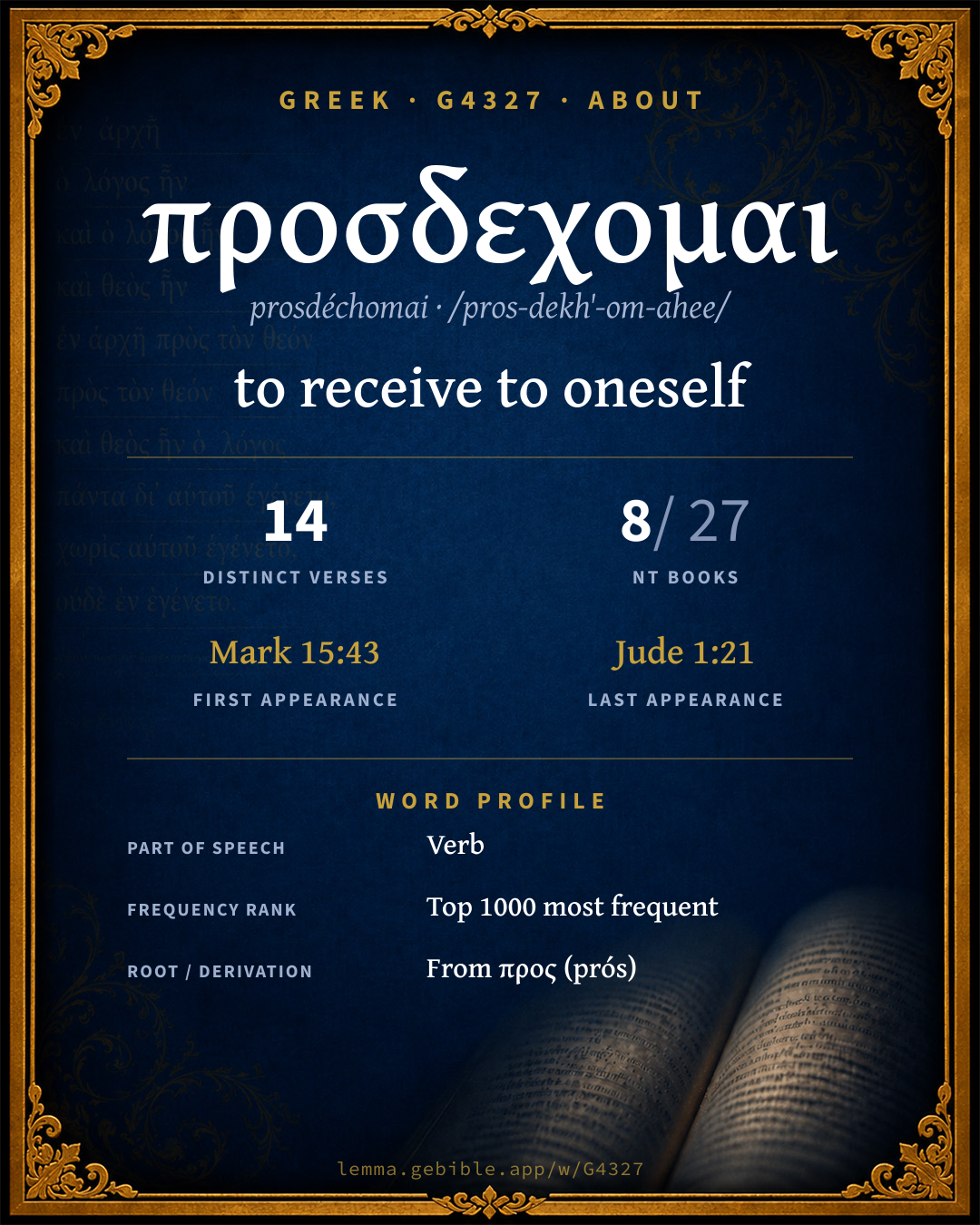
προσδέχομαι
to receive to oneself
‘to receive to oneself’ is one of 2 main senses fuller range ↓
Full lexicon entry — Thayer's Greek Lexicon
From Thayer's Greek Lexicon
Where this word appears
See every Present-tense verb in the Greek New Testament →
Grammar key — what these labels mean
Part of speech
- Verb
- An action or state-of-being word.
Tense
- Present
- Ongoing or general action in present time (imperfective aspect).
- Aorist
- Action viewed as a simple whole, without regard to duration — often past (perfective aspect).
- Imperfect
- Continuous or repeated action in past time (“was writing”).
Voice
- Middle or Passive deponent
- Middle/passive in form but active in meaning.
- Middle deponent
- Middle in form but active in meaning.
Mood
- Participle
- A verbal adjective (“writing,” “having written”).
- Indicative
- States a fact or asks a factual question (the mood of reality).
- Subjunctive
- Expresses probability, purpose, or possibility (the mood of contingency).
- Imperative
- Expresses a command or request.
Case
- Nominative
- The case of the subject (and the predicate nominative).
- Dative
- The case of the indirect object, means, or location — “to / for / with / in.”
Person
- 2nd person
- The one addressed (“you”).
- 3rd person
- The one spoken about (“he / she / it / they”).
Gender
- Masculine
- Grammatically masculine.
Number
- Plural
- More than one.
- Singular
- One.
Grammatical forms 10 distinct
- Verb, Present, Middle or Passive deponent, Participle, Nominative, Plural, Masculine 3 times (21%)
- Verb, Present, Middle or Passive deponent, Participle, Dative, Plural, Masculine 2 times (14%)
- Verb, Present, Middle or Passive deponent, Participle, Nominative, Singular, Masculine 2 times (14%)
- Verb, Aorist, Middle deponent, Indicative, 2nd person, Plural 1 time (7%)
- Verb, Aorist, Middle deponent, Participle, Nominative, Plural, Masculine 1 time (7%)
- Verb, Aorist, Middle deponent, Subjunctive, 2nd person, Plural 1 time (7%)
- Verb, Imperfect, Middle or Passive deponent, Indicative, 3rd person, Singular 1 time (7%)
- Verb, Present, Middle or Passive deponent, Indicative, 3rd person, Plural 1 time (7%)
+2 more forms (2 occurrences)
Parsed forms decoded from the imported morphology (Robinson–Tischendorf, public domain), counted across 14 parsed occurrences — not distinct verses.
Every verse where G4327 appears — 14 distinct verses across 8 books. Click any verse to open its interlinear word-by-word view. Verse text shown in the World English Bible for context — . Each verse’s Greek form is shown with its reference; the English is not keyword-highlighted, since the data carries no word-level English alignment. Use “Compare translations” on any verse to read it across multiple English versions. This concordance covers the Greek New Testament; Septuagint (Greek Old Testament) occurrences of this word are not indexed here.
Mark 1 verse
Luke 5 verses
- Luke 2:25 προσδεχόμενος pres mid/pass.dep ptcp nom sg masc Behold, there was a man in Jerusalem whose name was Simeon. This man was righteous and devout, looking for the consolation of Israel, and the Holy Spirit was on him.
- Luke 2:38 προσδεχομένοις pres mid/pass.dep ptcp dat pl masc Coming up at that very hour, she gave thanks to the Lord, and spoke of him to all those who were looking for redemption in Jerusalem.
- Luke 12:36 προσδεχομένοις pres mid/pass.dep ptcp dat pl masc Be like men watching for their lord, when he returns from the marriage feast; that, when he comes and knocks, they may immediately open to him.
- Luke 15:2 προσδέχεται pres mid/pass.dep ind 3sg The Pharisees and the scribes murmured, saying, "This man welcomes sinners, and eats with them."
- Luke 23:51 προσεδέχετο impf mid/pass.dep ind 3sg (he had not consented to their counsel and deed), from Arimathaea, a city of the Jews, who was also waiting for the Kingdom of God:
Acts 2 verses
- Acts 23:21 προσδεχόμενοι pres mid/pass.dep ptcp nom pl masc Therefore don't yield to them, for more than forty men lie in wait for him, who have bound themselves under a curse neither to eat nor to drink until they have killed him. Now they are ready, looking for the promise from you."
- Acts 24:15 προσδέχονται pres mid/pass.dep ind 3pl having hope toward God, which these also themselves look for, that there will be a resurrection of the dead, both of the just and unjust.
Romans 1 verse
Philippians 1 verse
Titus 1 verse
Hebrews 2 verses
- Hebrews 10:34 προσεδέξασθε aor mid.dep ind 2pl For you both had compassion on me in my chains, and joyfully accepted the plundering of your possessions, knowing that you have for yourselves a better possession and an enduring one in the heavens.
- Hebrews 11:35 προσδεξάμενοι aor mid.dep ptcp nom pl masc Women received their dead by resurrection. Others were tortured, not accepting their deliverance, that they might obtain a better resurrection.
Jude 1 verse
About this entry
At a glance — auto-summarized from this page’s data, not written by a person. Every figure links to its source below. This summary describes the numbers; it doesn’t interpret them.
“to receive to oneself” is the headline sense of the Greek verb προσδεχομαι (prosdéchomai). First canonically at Mark 15:43, it enters the text early. The Greek New Testament uses it across 14 verses — uncommon. More than a third of its appearances fall in Luke. Catalogued under 2 senses, its meaning is not single-sense. The sections below give every sense, occurrence, and version rendering.
Gloss history
Strong's 1890 vs modern scholarship

About this word
Strong's G4327 catalogs a Greek word from the Greek New Testament.
These counts are not copied from any lexicon or concordance. They are computed here, from the morphology-tagged Greek New Testament. What Lemma adds →
- 14
- distinct verses
- The word appears in 14 distinct verses.
- 8 / 27
- NT books
- The word appears in 8 of 27 New Testament books.
- #814
- by frequency
- Top 1000 most frequent Greek words (rank 814 of 5,347 Greek words by occurrence).
View all 14 occurrences in the concordance →
By section of the New Testament
By traditional corpus
Conventional, traditional groupings — biblical authorship is debated, so this is a traditional corpus grouping, not an authorship claim. Some books belong to more than one corpus (Luke is in both the Gospels and the Lukan corpus, and so on), so these shares overlap and need not total 100%. Each figure is a share of the word’s 14 distinct verses.
- Lukan (Luke–Acts) 7 verses · 50%
- Gospels 6 verses · 43%
- Pauline corpus 3 verses · 21%
- Hebrews 2 verses · 14%
- General (Catholic) Epistles 1 verse · 7%
How translations render this word
Counts come from each version’s own published word-to-Strong’s tagging or interlinear alignment — an approximate guide to how each version renders this word, not a word-level alignment the data otherwise carries. Because each total is that version’s own tagged count, the per-version totals vary from one another and need not match the appearance or distinct-verse counts above. These counts may also differ from a printed concordance because Lemma counts each distinctly tagged rendering and does not collapse phrase taggings into a single head-word total. This is a fixed set of word-tagged versions (KJV, ASV, BSB, ULT) and does not change with the reading translation you choose elsewhere. Each version’s license is shown beside its name below (and on Sources).
- King James Version: Looking for 3×
- American Standard Version: Looking for 3×, Looking 2×, Was looking 2×
- Berean Standard Bible: Waiting for 2×, Welcome 2×
- unfoldingWord Literal Text: Waiting for 6×
King James Version Public Domain
Renders G4327 across 14 tagged occurrences — most commonly:
Plus 11 renderings that appear only once — usually multi-word phrases or single function words the recovered tagging swept in, not distinct renderings.
American Standard Version Public Domain
Renders G4327 across 13 tagged occurrences — most commonly:
Plus 6 renderings that appear only once — usually multi-word phrases or single function words the recovered tagging swept in, not distinct renderings.
Berean Standard Bible Public Domain
Renders G4327 across 14 tagged occurrences — most commonly:
Plus 10 renderings that appear only once — usually multi-word phrases or single function words the recovered tagging swept in, not distinct renderings.
unfoldingWord Literal Text CC BY-SA 4.0
Renders G4327 across 14 tagged occurrences — most commonly:
Plus 8 renderings that appear only once — usually multi-word phrases or single function words the recovered tagging swept in, not distinct renderings.
Senses in Thayer's
The 2 senses Thayer's distinguishes for this word, in lexicon order (not ranked by frequency or importance). The full entry — with sub-senses — is in the Lexicon Entry tab.
- to receive to one's self, to admit, to give access to one's self
- to expect: the fulfilment of promises
Word origin
Derived from προς (prós) (G4314).
Forms in the corpus
The 10 distinct written forms G4327 takes in the Greek New Testament, most frequent first — each parse links to that tense’s occurrences in the concordance.
Same root — word family
Other Thayer's entries built from the same root as G4327, grouped by Strong’s listed origin. These share a root / origin per the lexicon — not necessarily a shared meaning. Each links to that word’s own entry.
Derives from
Shares the same root
- προσαγορευω prosagoreúō G4316 to address
- προσαγω proságō G4317 to bring
- προσαιτεω prosaitéō G4319 to ask alms
- προσαναβαινω prosanabaínō G4320 to go up higher
- προσαναλισκω prosanalískō G4321 to spend additionally
- προσαναπληροω prosanaplēróō G4322 to fill up
- προσανατιθημι prosanatíthēmi G4323 to lay upon
- προσαπειλεω prosapeiléō G4324 to threaten further
- προσδαπαναω prosdapanáō G4325 to spend besides
- προσδεομαι prosdéomai G4326 to need additionally
- προσδοκαω prosdokáō G4328 to expect
- προσεαω proseáō G4330 to permit approach
- προσεγγιζω prosengízō G4331 to approach
- προσεδρευω prosedreúō G4332 to sit near
- προσεργαζομαι prosergázomai G4333 to work besides
- προσερχομαι prosérchomai G4334 to draw near
- προσευχομαι proseúchomai G4336 to pray
- προσεχω proséchō G4337 to attend to
- προσηλοω prosēlóō G4338 to nail to
- προσκαιρος próskairos G4340 temporary
- προσκαλεομαι proskaléomai G4341 to call to
- προσκαρτερεω proskarteréō G4342 to adhere to
- προσκεφαλαιον proskephálaion G4344 pillow
- προσκληροω prosklēróō G4345 to allot
+27 more words share this root (not shown).
Compare all same-root words → Showing 4 of 53 — not the complete family. They share a root, not necessarily a meaning.
Septuagint usage
The same Greek word προσδεχομαι appears 35 times in the Greek Old Testament (Septuagint), across 33 verses in 17 books.
- 35
- LXX occurrences
- Tagged occurrences of this Greek word in the Septuagint.
- 33
- verses
- Distinct Septuagint verses containing this word.
- 17 / 39
- OT books
- The word appears in 17 of the 39 Old Testament books.
Sample Septuagint occurrences
- Genesis 32:21 προςδέχομαι
- Exodus 10:17 προςδέχομαι
- Leviticus 26:43 προςδέχομαι
- Ruth 1:13 προςδέχομαι
- 1 Chronicles 12:19 προςδέχομαι
- 2 Chronicles 36:21 προςδέχομαι
- Esther 9:23 προςδέχομαι
- Job 2:9 προςδέχομαι
- Psalms 6:10 προςδέχομαι
- Proverbs 15:15 προςδέχομαι
- Isaiah 28:10 προςδέχομαι
- Ezekiel 20:40 προςδέχομαι
Septuagint occurrences (same lexeme)
Every verse where the same Strong’s number (G4327) appears in the Greek Septuagint. Verse text shown in the World English Bible for context; the Greek form is the matched word — the English is not keyword-highlighted.
- Genesis 32:21 προςδέχομαι So the present passed over before him: and he himself lodged that night in the camp.
- Exodus 10:17 προςδέχομαι Now therefore please forgive my sin again, and pray to Yahweh your God, that he may also take away from me this death."
- Exodus 22:10 προςδέχομαι "If a man delivers to his neighbor a donkey, an ox, a sheep, or any animal to keep, and it dies or is injured, or driven away, no man seeing it;
- Exodus 36:3 προςδέχομαι and they received from Moses all the offering which the children of Israel had brought for the work of the service of the sanctuary, with which to make it. They brought yet to him freewill-offerings every morning.
- Leviticus 26:43 προςδέχομαι The land also will be left by them, and will enjoy its sabbaths while it lies desolate without them: and they will accept the punishment of their iniquity; because, even because they rejected my ordinances, and their soul abhorred my statutes.
- Ruth 1:13 προςδέχομαι would you therefore wait until they were grown? would you therefore stay from having husbands? nay, my daughters, for it grieves me much for your sakes, for the hand of Yahweh is gone forth against me.
- 1 Chronicles 12:19 προςδέχομαι Of Manasseh also there fell away some to David, when he came with the Philistines against Saul to battle: but they didn't help them; for the lords of the Philistines sent him away after consultation, saying, He will fall away to his master Saul to the jeopardy of our heads.
- 2 Chronicles 36:21 προςδέχομαι to fulfill the word of Yahweh by the mouth of Jeremiah, until the land had enjoyed its Sabbaths: [for] as long as it lay desolate it kept Sabbath, to fulfill seventy years.
- Esther 9:23 προςδέχομαι The Jews undertook to do as they had begun, and as Mordecai had written to them;
- Esther 9:27 προςδέχομαι the Jews ordained, and took on them, and on their seed, and on all such as joined themselves to them, so that it should not fail, that they would keep these two days according to the writing of it, and according to the appointed time of it, every year;
- Job 2:9 προςδέχομαι Then his wife said to him, "Do you still maintain your integrity? Renounce God, and die."
- Job 29:23 προςδέχομαι They waited for me as for the rain. Their mouths drank as with the spring rain.
- Job 33:20 προςδέχομαι So that his life abhors bread, And his soul dainty food.
- Psalms 6:10 προςδέχομαι May all my enemies be ashamed and dismayed. They shall turn back, they shall be disgraced suddenly.
- Psalms 54:9 προςδέχομαι
- Psalms 103:11 προςδέχομαι For as the heavens are high above the earth, So great is his loving kindness toward those who fear him.
- Proverbs 15:15 προςδέχομαι All the days of the afflicted are wretched, But one who has a cheerful heart enjoys a continual feast.
- Isaiah 28:10 προςδέχομαι For it is precept on precept, precept on precept; line on line, line on line; here a little, there a little.
- Isaiah 42:1 προςδέχομαι Behold, my servant, whom I uphold; my chosen, in whom my soul delights: I have put my Spirit on him; he will bring forth justice to the Gentiles.
- Isaiah 45:4 προςδέχομαι For Jacob my servant's sake, and Israel my chosen, I have called you by your name: I have surnamed you, though you have not known me.
- Isaiah 55:12 προςδέχομαι For you shall go out with joy, and be led forth with peace: the mountains and the hills shall break forth before you into singing; and all the trees of the fields shall clap their hands.
- Ezekiel 20:40 προςδέχομαι For in my holy mountain, in the mountain of the height of Israel, says the Lord Yahweh, there shall all the house of Israel, all of them, serve me in the land: there will I accept them, and there will I require your offerings, and the first fruits of your offerings, with all your holy things.
- Ezekiel 20:41 προςδέχομαι As a sweet savor will I accept you, when I bring you out from the peoples, and gather you out of the countries in which you have been scattered; and I will be sanctified in you in the sight of the nations.
- Ezekiel 32:10 προςδέχομαι Yes, I will make many peoples amazed at you, and their kings shall be horribly afraid for you, when I shall brandish my sword before them; and they shall tremble at every moment, every man for his own life, in the day of your fall.
- Ezekiel 43:27 προςδέχομαι When they have accomplished the days, it shall be that on the eighth day, and forward, the priests shall make your burnt offerings on the altar, and your peace-offerings; and I will accept you, says the Lord Yahweh.
- Daniel 3:39 προςδέχομαι
- Daniel 7:25 προςδέχομαι He shall speak words against the Most High, and shall wear out the saints of the Most High; and he shall think to change the times and the law; and they shall be given into his hand until a time and times and half a time.
- Hosea 8:13 προςδέχομαι As for the sacrifices of my offerings, they sacrifice flesh and eat it; But Yahweh doesn't accept them. Now he will remember their iniquity, And punish their sins. They will return to Egypt.
- Amos 5:22 προςδέχομαι Yes, though you offer me your burnt offerings and meal-offerings, I will not accept them; Neither will I regard the peace offerings of your fat animals.
- Micah 6:7 προςδέχομαι Will Yahweh be pleased with thousands of rams? With tens of thousands of rivers of oil? Shall I give my firstborn for my disobedience? The fruit of my body for the sin of my soul?
- Malachi 1:8 προςδέχομαι When you offer the blind for sacrifice, isn't that evil? And when you offer the lame and sick, isn't that evil? Present it now to your governor! Will he be pleased with you? Or will he accept your person?" says Yahweh of Hosts.
- Malachi 1:10 προςδέχομαι "Oh that there were one among you who would shut the doors, that you might not kindle fire on my altar in vain! I have no pleasure in you," says Yahweh of hosts, "neither will I accept an offering at your hand.
- Malachi 1:13 προςδέχομαι You say also, 'Behold, what a weariness it is!' and you have sniffed at it," says Yahweh of Hosts; "and you have brought that which was taken by violence, the lame, and the sick; thus you bring the offering. Should I accept this at your hand?" says Yahweh.
These are occurrences of the same Greek lexeme (G4327) in the Septuagint — not a translation of any one Hebrew word. The store carries no word-level Hebrew↔Greek alignment, so no Hebrew original is asserted here. Counts come from the recovered LXX Strong's tagging — high-frequency vocabulary is well covered, while rare or late forms may be untagged — so they reflect tagged occurrences and may slightly undercount.