
Isaiah 28:10

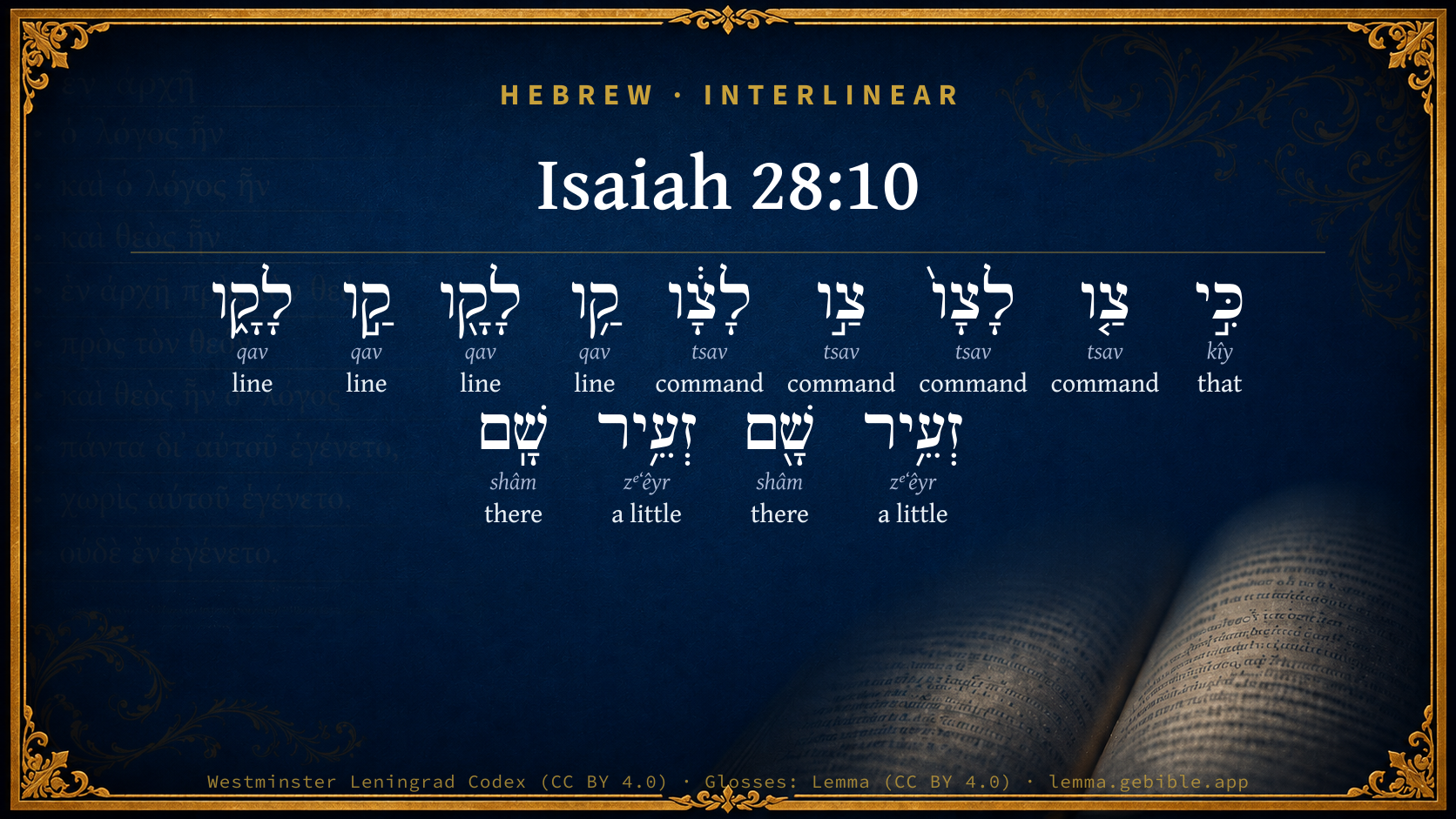
Hebrew (Westminster Leningrad Codex) Isaiah 28:10 appears in the Hebrew Old Testament. The text above is from the Westminster Leningrad Codex. Each word links to its Strong’s number, a concise gloss, and parsing drawn from the Open Scriptures Hebrew Bible morphology. Click any word for its full Brown-Driver-Briggs (BDB) entry.
Download image
Cite this verse

Isaiah 28:10 (World English Bible). Public Domain. Lemma interlinear Bible study tool, https://lemma.gebible.app/v/isaiah/28/10.

Show BibTeX & RIS
BibTeX
RIS
English Translation
For it is precept on precept, precept on precept; line on line, line on line; here a little, there a little.
World English Bible · Public Domain
Highlights Full analysis ↓
Download a study sheet

One document with this verse’s original text, its word-by-word gloss line, the meaning frame, cross-references with their text, attributed commentary, and full source and license credits — printable, and it pastes into notes with its structure intact.

This verse Autodidact and up

Study sheet (.html) Plain text (.txt)

A passage Seminary Student

Up to 50 verses in one chapter. A passage sheet keeps up to 6 commentary sources and 12 cross-references per verse, in the order this page ranks them, and says so on the sheet whenever that leaves anything out. Ask for a single verse and you get the Autodidact verse sheet above.

Everything on this page stays free to read, with no account — the sheet is a download of what is already on screen, not access to it.

Want to remove ads? Support Godless Engineer
Compare translations 3

The same verse in 3 English versions, stacked beneath the original-language interlinear above. Click any original word for its lexicon entry.

Each is an independent rendering of the whole verse — the interlinear is not word-aligned to these translations.

Highlighted words mark where these versions differ — a whole-verse word diff, not a word-by-word alignment.

  • World English Bible Public Domain
    For it is precept on precept, precept on precept; line on line, line on line; here a little, there a little.
  • King James Version Public Domain
    For precept must be upon precept, precept upon precept; line upon line, line upon line; here a little, and there a little:
  • unfoldingWord Literal Text CC BY-SA 4.0
    For command by command, command by command, line by line, line by line, a little here, a little there.” q1

unfoldingWord Literal Text — © unfoldingWord, licensed CC BY-SA 4.0. Word-aligned USFM3 via Door43 (git.door43.org/unfoldingWord/en_ult).

Versions to compare (up to 4)

3 of 4 selected

Show all 18 translations

Every available English version of this verse, each an independent rendering of the whole verse.

  • World English Bible Public Domain
    For it is precept on precept, precept on precept; line on line, line on line; here a little, there a little.
  • Berean Standard Bible Public Domain
    For they hear: “Order on order, order on order, line on line, line on line; a little here, a little there.”
  • Majority Standard Bible Public Domain
    For they hear: “Order on order, order on order, line on line, line on line; a little here, a little there.”
  • King James Version Public Domain
    For precept must be upon precept, precept upon precept; line upon line, line upon line; here a little, and there a little:
  • American Standard Version (1901) Public Domain
    For it is precept upon precept, precept upon precept; line upon line, line upon line; here a little, there a little.
  • Revised Version (1885) Public Domain
    For it is precept upon precept, precept upon precept; line upon line, line upon line; here a little, there a little.
  • Geneva Bible (1599) Public Domain
    For precept must be vpon precept, precept vpon precept, line vnto line, line vnto line, there a litle, and there a litle.
  • Douay-Rheims (1899) Public Domain
    For command, command again; command, command again; expect, expect again; expect, expect again: a little there, a little there.
  • Young's Literal Translation Public Domain
    For rule `is' on rule, rule on rule, line on line, line on line, A little here, a little there,
  • Literal Standard Version CC BY-SA 4.0
    For rule on rule, rule on rule, || Line on line, line on line, || A little here, a little there,
  • Unlocked Literal Bible CC BY-SA 4.0
    For it is command upon command, command upon command; rule upon rule, rule upon rule; here a little, there a little.
  • unfoldingWord Literal Text CC BY-SA 4.0
    For command by command, command by command, line by line, line by line, a little here, a little there.” q1
  • Darby Bible Public Domain
    For [it is] precept upon precept, precept upon precept; line upon line, line upon line; here a little, there a little....
  • World Messianic Bible Public Domain
    For it is precept on precept, precept on precept; line on line, line on line; here a little, there a little.
  • Webster's Bible Public Domain
    For precept must be upon precept, precept upon precept; line upon line, line upon line; here a little, and there a little:
  • Free Bible Version CC BY-SA 4.0
    He tells us this blah and that blah, blah upon blah, and again blah and blah, and even more blah and blah! It's a bit here and a bit there.”
  • Bible in Basic English Public Domain
    For it is one rule after another; one line after another; here a little, there a little.
  • JPS Tanakh (1917) Public Domain
    For it is precept by precept, precept by precept, line by line, line by line; here a little, there a little.

Literal Standard Version (2020), Covenant Press — licensed CC BY-SA 4.0. Text via the HelloAO Bible API (eBible.org). Unlocked Literal Bible (unfoldingWord) — licensed CC BY-SA 4.0. Text via the HelloAO Bible API (eBible.org). unfoldingWord Literal Text — © unfoldingWord, licensed CC BY-SA 4.0. Word-aligned USFM3 via Door43 (git.door43.org/unfoldingWord/en_ult). Free Bible Version, Dr. Jonathan Gallagher — licensed CC BY-SA 4.0. Text via the HelloAO Bible API (eBible.org).

Word by word

More ways to search: Search by grammar → Find every occurrence → Compare this word →

Practice this passage: Drill this verse → Learn its vocabulary →

זְעֵ֥יר
zᵉʻêyr
H2191
“a little”
Noun, Common, Masculine, Singular, Absolute
Part of Speech
Noun
Type
Common
Gender
Masculine
Number
Singular
State
Absolute
Full BDB Definition

Origin: from an unused root [akin (by permutation) to H6819 ], meaning to dwindle

TWOT: 571a

a little - of quantity - of time
  1. כִּ֣י kîy H3588 “that” Conjunction
  2. צַ֤ו tsav H6673 “command” Noun, Common, Masculine, Singular, Absolute
  3. לָצָו֙ tsav H6673 “to/for · command” Preposition + Noun, Common, Masculine, Singular, Absolute
  4. צַ֣ו tsav H6673 “command” Noun, Common, Masculine, Singular, Absolute
  5. לָצָ֔ו tsav H6673 “to/for · command” Preposition + Noun, Common, Masculine, Singular, Absolute
  6. קַ֥ו qav H6957 “line” Noun, Common, Masculine, Singular, Absolute
  7. לָקָ֖ו qav H6957 “to/for · line” Preposition + Noun, Common, Masculine, Singular, Absolute
  8. קַ֣ו qav H6957 “line” Noun, Common, Masculine, Singular, Absolute
  9. לָקָ֑ו qav H6957 “to/for · line” Preposition + Noun, Common, Masculine, Singular, Absolute
  10. שָׁ֖ם shâm H8033 “there” Adverb
  11. זְעֵ֥יר zᵉʻêyr H2191 “a little” Noun, Common, Masculine, Singular, Absolute
  12. שָֽׁם shâm H8033 “there” Adverb

About this verse

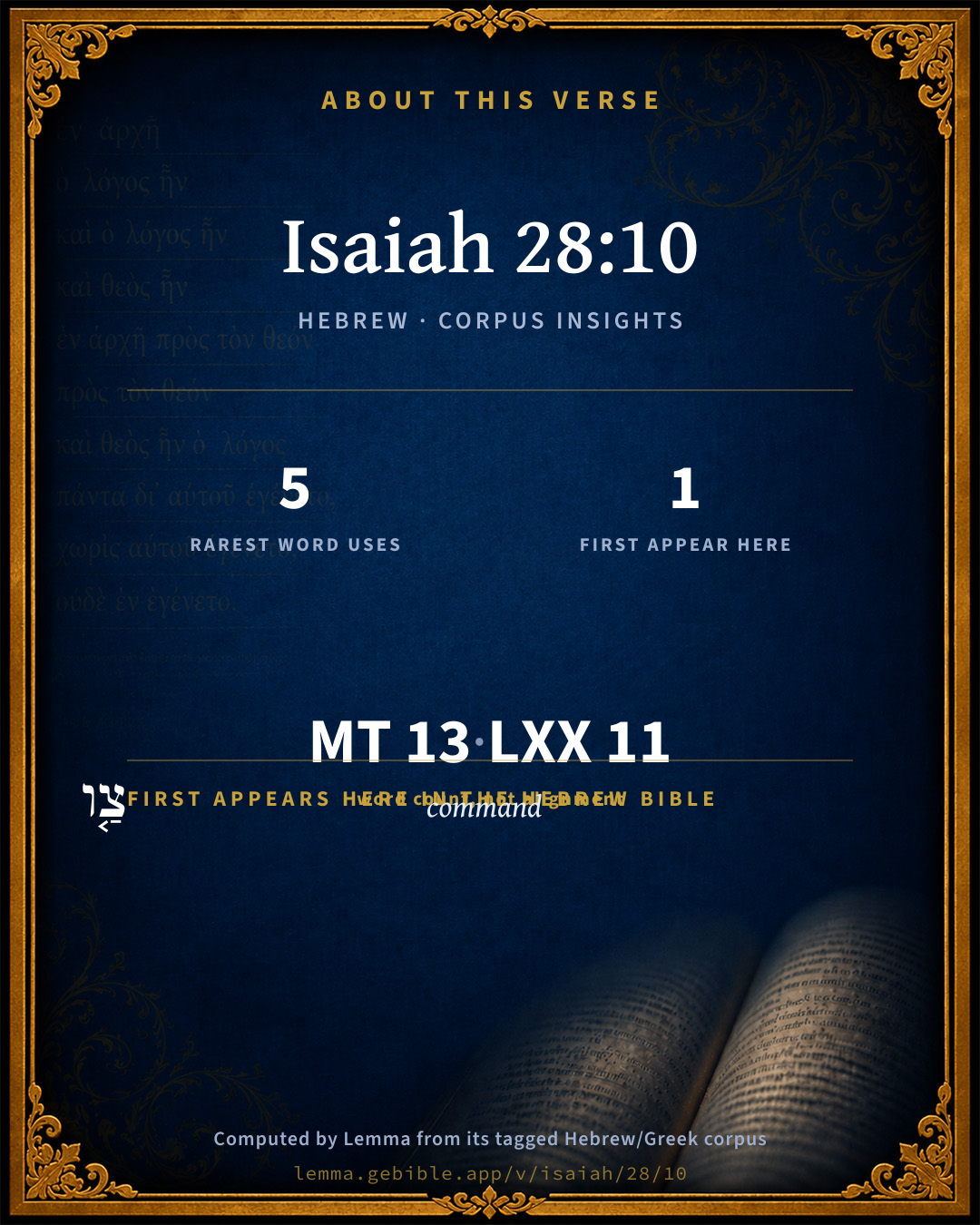
These counts appear in no published source. They are computed here, from the morphology-tagged text and Lemma’s own curated glosses. What Lemma adds →

13
words
5
distinct lemmas
Prophets
section

Notable vocabulary

The rarest word here is זְעֵ֥יר a little H2191 — appearing just 5 times in the whole Hebrew Bible.

First appearance in Scripture

This word makes its first canonical appearance in the Hebrew Bible here:

Shared distinctive vocabulary

זְעֵ֥יר a little H2191 occurs in 3 verses of the Hebrew Bible. Also found in:

Grammatical profile

  • 10 nouns
  • 1 conjunction
  • 2 adverbs

Repetition

Words recur within this verse — often emphatic in Hebrew:

  • צַ֤ו command H6673 ×4
  • קַ֥ו line H6957 ×4
  • זְעֵ֥יר a little H2191 ×2
  • שָׁ֖ם there H8033 ×2

Hebrew & Septuagint length

In English translation the verse runs 21 words from the Hebrew and 15 from the Septuagint (LXX English) — the Septuagint runs noticeably shorter here. See the side-by-side →

A rough comparison of the two English renderings, which tokenize alike — not a word-level alignment.

Word counts can differ between the Hebrew and the Greek without any difference in meaning — e.g. the Hebrew direct-object marker אֵת has no separate Greek word, and Greek often adds the article ὁ.

In the original languages it is 13 Hebrew tokens and 11 Greek tokens — but the two are counted differently (Hebrew bundles its prefixes and suffixes into one token; the Greek is in lemma form), so that isn’t a like-for-like length.

Cross-references

11

Topical passages linked to Isaiah 28:10 in the Treasury of Scripture Knowledge — connected by theme and wording, ordered by reader-vote popularity; previews shown in the World English Bible.

  • Isaiah 28:13 Therefore shall the word of Yahweh be to them precept on precept, precept on precept; line on line, line on line; here a little, there a little; that they may go, and fall backward, and be broken, and snared, and taken.
  • 2 Timothy 3:7 always learning, and never able to come to the knowledge of the truth.
  • Jeremiah 11:7 For I earnestly protested to your fathers in the day that I brought them up out of the land of Egypt, even to this day, rising early and protesting, saying, Obey my voice.
  • Jeremiah 25:3–7 From the thirteenth year of Josiah the son of Amon, king of Judah, even to this day, these twenty-three years, the word of Yahweh has come to me, and I have spoken to you, rising up early and speaking; but you have not listened.
  • Nehemiah 9:29–30 and testified against them, that you might bring them again to your law. Yet they dealt proudly, and didn't listen to your commandments, but sinned against your ordinances, (which if a man do, he shall live in them), and withdrew the shoulder, and hardened their neck, and would not hear.
  • Hebrews 5:12 For when by reason of the time you ought to be teachers, you again need to have someone teach you the rudiments of the first principles of the oracles of God. You have come to need milk, and not solid food.
  • Deuteronomy 6:1–6 Now this is the commandment, the statutes, and the ordinances, which Yahweh your God commanded to teach you, that you might do them in the land where you go over to possess it;
  • 2 Chronicles 36:15–16 Yahweh, the God of their fathers, sent to them by his messengers, rising up early and sending, because he had compassion on his people, and on his dwelling-place:
  • Isaiah 5:4 What could have been done more to my vineyard, that I have not done in it? Why, when I looked for it to yield grapes, did it yield wild grapes?
  • Matthew 21:34–41 When the season for the fruit drew near, he sent his servants to the farmers, to receive his fruit.
  • Philippians 3:1 Finally, my brothers, rejoice in the Lord. To write the same things to you, to me indeed is not tiresome, but for you it is safe.

Cross-references courtesy of OpenBible.info (CC BY 4.0).

Hebrew and Greek witnesses Masoretic Hebrew ↔ Greek Septuagint

The same verse in the two great witnesses to the Old Testament, shown verse-for-verse.

Here the Septuagint runs noticeably shorter than the Hebrew — LXX2012 (modern English Septuagint) 15 words vs World English Bible 21. A rough length comparison of the two English translations, not a word-level alignment — read both below.

These are two independent witnesses, not word-aligned to each other, and the Septuagint is shown in lemma (dictionary) form.

Hebrew Isaiah 28:10 Masoretic · Westminster Leningrad Codex

כִּ֣י צַ֤ו לָצָו֙ צַ֣ו לָצָ֔ו קַ֥ו לָקָ֖ו קַ֣ו לָקָ֑ו זְעֵ֥יר שָׁ֖ם זְעֵ֥יר שָֽׁם

For it is precept on precept, precept on precept; line on line, line on line; here a little, there a little.

World English Bible · Public Domain

Greek LXX Isaiah 28:10 Septuagint · lemma form

θλῖψις ἐπί θλῖψις προςδέχομαι ἐλπίς ἐπί ἐλπίς ἔτι μικρός ἔτι μικρός

Expect you affliction on affliction, hope upon hope: yet a little, and yet a little,

LXX2012 (modern English Septuagint) · Public Domain

Hebrew: Westminster Leningrad Codex (CC BY 4.0). Greek: Septuagint (public domain); English from LXX2012 (modern English Septuagint) (Public Domain). How the Septuagint differs from the Hebrew →

Targum (Aramaic paraphrase)

1

The Targum is the ancient Jewish Aramaic paraphrase of the Hebrew Scriptures — an interpretive translation, not the Hebrew text itself. Onkelos (literal) and Pseudo-Jonathan (expansive) render the Torah, and Jonathan the Prophets. Coverage is partial: where no permissively-licensed English translation exists for a verse, only the Aramaic is shown. This is verse-level text, not a word-by-word alignment to the Hebrew.

  1. Targum Jonathan Prophets (Joshua–Malachi)
    אֲרֵי אִתְפַּקַדוּ לְמֶעְבַּד אוֹרַיְתָא וּמָא דְאִתְפַּקַדוּ לָא צְבִיאוּ לְמֶעְבַּד וְאִתְנַבִּיאוּ עֲלֵיהוֹן נְבִיַיָא דְאִם יְתוּבוּן יִשְׁתְּבֵק לְהוֹן וּלְמִלֵי נְבִיַיָא לָא קַבִּילוּ הַלִיכוּ בַּרַעֲוַת נַפְשְׁהוֹן וְלָא חֲמִידוּ לְמֶעְבַּד אוֹרַיְתִי סְבָרוּ דְיִתְקַיֵים לְהוֹן פּוּלְחַן טַעֲוָתָא וְלָא סְבָרוּ לְפוּלְחַן בֵּית מַקְדְשִׁי כִּזְעֵר הֲוָה בְּעֵינֵיהוֹן בֵּית מַקְדָשִׁי לְמִפְלַח תַּמָן כִּזְעֵיר בְּעֵינֵיהוֹן שְׁכִנְתִּי תַּמָן:

    Surely, they were commanded to do the law; but what they were commanded, they were not willing to do. The prophets prophesied unto them, that if they would repent, it should be forgiven them; but they did not obey the words of the prophets: they walked after the desire of their soul, neither did they desire to do my law. They hoped to have idolatrous worship established among them, and they did not consider the worship of the house of my sanctuary: to worship in the house of my sanctuary was as a little thing in their eyes, my Shekinah was as a little thing in their eyes.

    Targum Jonathan — Aramaic: “Mikraot Gedolot” (public domain). English: “Sefaria Community Translation” (CC0 1.0 (public-domain dedication)); “London "Chaldee Paraphrase," 1871” (public domain). Text via Sefaria.

Commentary

Notes on Isaiah 28:10 from classic Christian and Jewish commentators (each source and its license shown beneath its notes). The classic Christian expositions comment on the surrounding passage and are grouped to its opening verse, so a note may address several verses; the Jewish commentaries on the Tanakh (Rashi and others) are per-verse, so they appear only where the commentator wrote on this verse.

Lemma curates 59 commentaries, every one of them public domain or Creative Commons licensed, each selected and text-cleaned for this edition rather than reprinted as found. About our sources →

Trapp's Complete Commentary

John Trapp

Isa 28:10 For precept [must be] upon precept, precept upon precept; line upon line, line upon line; here a little, [and] there a little:

Ver. 10. For precept must be upon precept.] Children are of weak understanding and of short memories, and, Hebraei dicunt hisce verbis infantilitatem signifieari, they must also have short words and sentences prescribed unto them (such as are kau and flau) and inculcated upon them, that something at least may stick. So must most of our hearers, or little good will be done. {Deu 6:7} Thou shalt teach them diligently unto thy children. Heb., ‘Thou shalt whet, or repeat them by often going over the same thing,’ as the knife goeth over the whetstone till it be sharp. But very many of our common hearers are not only unteachable, but untameable, deriding sound doctrine, and making a mocking stock of their godliest ministers. And so some very good expositors - haec ειρωνικως et μιμητικως a propheta dici tradunt - make these words here recited to be the scoffs and taunts of those profane mockers, {Isa 28:14; Isa 28:22} which they put upon the prophet; q.d., We have nothing but rule upon rule, precept upon precept, &c. Zau lazau, kau lakau; the very sound of the words carrieth a jeer, like as scornful people by the tone of their voice and rhyming words scorn at such as they despise. Thus this good prophet became the drunkard’s song. Any man may be witty in a biting way, and those that have the dullest brains have commonly the sharpest teeth to that purpose. Rightly said the comedian:

“ Homine imperito nunquam quicquam iniustius;

Qui, nisi quod ipse fecit, nihil rectum putat. ”

- Terent.

John Trapp, A Commentary or Exposition upon All the Books of the Old and New Testament (1647–1656) — public domain. Text from a community e-Sword module.

The Biblical Illustrator

Joseph S. Exell

Isa_28:10

For precept mast be upon precept . . . line upon line

A drunken jibe

The passage is commonly used in a sense the very opposite to that in which it was originally employed.

It is commonly taken as a grave description of the abundance and variety of the means of grace which God has vouchsafed to the Church; whereas it is, really, a drunken sneer at the poverty and simplicity of the means vouchsafed to the Church of Isaiahs time. No sooner do we turn to the original and study it than the case becomes clear; we see that, beyond a doubt, we not only have here a jibe at Isaiah from the lips of drunken men, but that the verse is so constructed as to imitate their thickened and difficult pronunciation. (S. Cox, D. D.)

The Divine method of instruction

Here a little, there a little. This, though it was said in scorn by the haughty revellers, is really the true, the Divine method of all instruction. What is the difference that distinguishes the musician or the painter from the mere amateur? What is it but the long-continued discipline of hand, of ear, of eye, which has made all the faculties of body and mind subservient to the purposes of the art? (F. Temple, D. D.)

The precept, the line and the little

I. THE LESSON OF THE PRECEPT is in order that we may be right and do right. God tells us the same thing over and over again. A precept is a warning, a command, which says, Take care, Mind, Keep in the way.

II. THE LESSON OF THE LINE. That is, in order that we may be right and do right, we must try over and over again. God helps all honest trying. An old proverb says, God helps those who help themselves; and another says, Practice makes perfect. Line upon line,--that is the way we all learn and have learnt all that we know or are able to do. It is so in learning to write. So it is in learning arithmetic. So in learning to draw.

III. THE LESSON OF THE LITTLE. That is, in order that we may be right and do right we must not be discouraged if we do not make great advances; we must remember that it is here a little and there a little. How slowly most great and valuable things grow! The harvest does not spring up in a field in a night. A step at a time mounts the tallest ladder at last, but it must be a step at a time. How long an oak is before it comes to its prime; yet if they could speak they would each say I am coming on. Here a little and there a little makes a learned man, a prosperous man, a useful and a good man. Here a little and there a little makes the perfect needle woman, and sets the most untidy house to rights at last. How great some ships are! What holds the mighty anchor which holds the ship in a storm? A cable. And what is a cable made of? Why, of ropes coiled over ropes, and every rope made out of little threads. So it is with the habits of life, good or bad; here a little and there a little, so trifling as they seemed at first, they become at last such mighty and unconquerable affairs. (Anon.)

Christian education

I. THE TRUE NATURE OF RELIGIOUS TEACHING.

1. As regards Christian doctrine, it will probably be within the recollection of meet of us that it formed the dullest part of our early instruction; and who can be surprised at it who recollects that, in addition to the natural repugnance of the human heart to all Divine things, the instruction was such as neither to enlighten the head, to touch the heart, or to interest the imagination? Let me express my profound conviction that the great human cause of the growth of error among our young people, and the falling off of many into perilous superstition, or no less perilous rationalism, is to be found here. Men have been contented to comprise in their religious knowledge only a few bald, bare truths, which perhaps they have received without personal inquiry from their parents, and have naturally thought it sufficient to hand down the same hereditary belief, the same bald truths, to their children after them. Truth consequently has had no aspect of reality, has been no living thing to them. Meanwhile times have changed, and the mental coldness of other days has given place to the intellectual activity of our own day.

2. Doctrinal truth is only one half, after all, if it be even that, of religious teaching. There remains the practical part of the faith; that by which, on the one side, it touches the conscience, and by which, on the other, it regulates the life.

II. THE EFFECTIVE MEANS OF CHRISTIAN INFLUENCE.

1. The influence of example.

2. The influence of love, and of that confidence which springs from love. (E. Garbett, M. A.)

Precept upon precept

Suppose you were walking from London to Brighton; well, as you go upon your way you meet with many fingerposts, or milestones, at distances not far apart, the fingerposts often at less than a mile apart; and they repeat the same thing--To Brighton--To Brighton; and the milestones, they say so many miles to Brighton or from Brighton. You do not feel angry at this; you do not say, Why ever did they put up so many fingerposts, or so many milestones? On the contrary, if you were in any doubt about the road, you would feel exceedingly thankful for such guides, and hardly think you could have too many. So God guides and warns. (Anon.)

Here a little and there a little

Here a little and there a little

We take this text because it seems to express with extraordinary conciseness a principle in Gods procedure and in His ways towards man.

1. Have you considered the manner of Gods revelation to His people in the olden time? Have you considered with what marvellous patience and consideration it was conducted? The will of God was not flashed, as in a moment, upon the minds of His people, but unfolded by degrees as they were able to receive it. And when through unbelief and disobedience they lost it, it was brought back to them by fresh messengers from God. Is not the Old Testament full of kind and various and gracious repetition? That is because it is the record of the Divine training and instruction of the people who were, alas! stiff-necked and, too often, proved themselves, as the martyr Stephen told them, uncircumcised in heart and ears.

2. Obviously the same principle runs through the New Testament also. Jesus Christ did not deliver His message, or doctrine, once for all, in a studied manner. He spoke to His followers as they were able to receive.

3. I have just said those things in regard to the two testaments and the construction of the Bible, desiring to go on and try, if I can, to show that this is a principle of God all through His works, and all through His training of His people. Shallow minds are apt to think much more of bold and rapid effects; but those who have observed most widely, and reflected most deeply, know this well--that Omnipotence works slowly. It is impotence that is in hurry. Now, what I want to put before you is that, it being so, it should be expected, and it turns out to be true, that the supreme wisdom of God will, on the very same principle, carry on the work of human enlightenment in the truth. Now take a lesson from this earth on which we dwell. The earth was not built up suddenly. In its history, as expressed in the records that science can decipher on its caves and its seashores, there have been some sudden changes, but, far more generally, long, long processes, small in detail, but working out immense effects. Lands, slowly sunk beneath the water, slowly rose again. Ice patiently rounded off our mountains and shaped our valleys. Great strata slowly formed themselves--deposited themselves--grain by grain, during prodigious periods of time. Innumerable plants and trees flourished and died, and, after death, prepared--how deliberately--those vast coal measures that make so much of Englands prosperity. Look at man. Look at that microcosm--that little world of man. How is a man built? Of body, and mind, and heart, and character. Is it not by little and little the frame grows from its first beginning? Take him after birth. See how he grows by repetitions of natural processes--repetitions--constant repetitions. A little sleep, a little food, a little exercise. Over again, a little sleep, a little food, a little exercise. And again, a little sleep, and so on.

Well, so grows his mind--by observation--by comparison of objects--by comparison of objects near him--by asking questions. What a thing it is to teach a child the letters, and to teach a child to read! What a business--little by little--repeating over, and over, and over again! Now, then,raise the subject a little. Take the question of moral culture, and then we will take the subject of spiritual advancement; but no otherwise than on this principle can moral culture or spiritual advancement be attained. There are some moral natures, if I may so speak, much stronger and healthier to start with than others, just as there are physical natures that are stronger; but it is not always the very strong child that grows up the very strongest man, is it? You see some poor delicate child grow fast; and so it is with the moral nature. They gain habits of self-control, and integrity becomes inseparable from their life. There is no real moral strength till that is reached--till integrity is wrought into the character so that it cannot be taken out of it. It is inseparable from the character and life, and thus, line upon line, precept upon precept, here a little and there a little, are needed to form an honest man, that noble work of God. And if it be so with moral progress, is it not also so with what we call spiritual advancement? Real spiritual qualities are given from heaven, but they are given upon the same principle upon which God gives moral strength, and upon which He even gives physical strength to His people. How is a Christian made? I say, by a process to which these words before me, here a little and there a little, may be very well applied. Let us just study this a little. Let us develop thin inquiry, for it is full of practical importance. And to be the clearer I will put four questions.

(1) How does a Christian receive the truth through the faith of which he is purified? And I answer, not by one lesson but by many lessons. He sees his sin. The Spirit of the Lord shows you the way of pardon and peace through the blood of Jesus crucified for our sin. By and by you see that more clearly. You get a glimpse; you get another glimpse; you get a longer look; you get a steadier vision of Christ crucified.

(2) How does a Christian get rid of indwelling sin? And my answer to that again is, by little and little.

(3) How is it that a Christian learns practical wisdom and sobriety of mind, so much needed in this intoxicating world? Not at a bound. It is not a miraculous infusion into him of another mind than his own. It is his own mind that must be made wise; and a man can never be made wise, I think, but by repeated exposures of his folly.

(4) How does a Christian gain likeness to Jesus Christ? By little and little. Have you seen a painter at work--a portrait painter, we will say? After the great outlines of the picture are placed upon the canvas, have you noticed how gradually and how minutely he produces the required likeness? A touch of the brush here, and then a pause. Then he looks at it, and looks at it; and then another touch, and then another touch. (D. Fraser, D. D.)

Here a little, and there a little

The application of the text is, first of all, to the impressions produced by the Word of God, and the efficacy of constant religious instruction. But it is in this same way, by little and little, that all great and lasting impressions are made, and the mightiest results accomplished. Habit, which is the strongest thing in nature, and which forms a second nature, is thus produced. So it is in the invisible growth of all things, gradual and imperceptible, yet constant and sure. So it is in all the processes of nature.

1. It is by little and little that every mans character is formed. Most persons guilty character is made of little sins. They may be scarcely noticed at the time, but a constant succession of them makes a great weight. Christian character, too, is made up of little things. The Christian spirit must enter into all things, and then all things become great in the light of Heaven. But the Christian character may be almost spoiled by little sins, or what are called such. Almost every important thing depends upon little things often repeated. It seems a very little thing to live near to God one day; it is a very great thing; but still, to do it for one day does not seem so great a task; not so great a thing but that the Christian, by the help of God, may easily accomplish it for one day. But if this little thing were accomplished every day, every one day in the year, then the whole would be infinitely glorious. On the other hand, to a man forgetful of God it seems but a very little evil which is wrought with the character in one day, perhaps none at all, if there be no marked crime. Nevertheless, a certain number of those imperceptible advancements bring him to his destiny, both of character and retribution, for eternity.

2. It is by little and little that in such a world as this we must do the greater part of the good that we ever accomplish. He that is faithful in great things is faithful also in the least; and if he be not faithful in small things, God will not give him the opportunity to be so in large ones. What is surer than Gods great promise in regard to children, that if you train them up faithfully for Him, He will take care of them and bless them and make them

His? But the result of good character and heavenly habit with them depends upon the daily, familiar, minute, but ever-recurring examples set before them, and influences brought to bear upon them. But, I say, Gods providence takes care of single little things also, and oftentimes makes much out of them, or hangs much upon them. Nothing can be lost that is done for God. (G. B. Cheever, D. D.)

Great results from a simple remark

It is said to have been a single remark of Rev. Chas. Simeon in regard to the blessings which had resulted from the labours of Dr. Carey in India that first arrested the attention of Henry Martyn to the cause of missions. His mind began to stir under the new thought, and a perusal of the Life of Brainerd fixed him in his resolution to give himself to his Redeemer in the service of preaching the Gospel to the dying heathen. (G. B. Cheever, D. D.)

Little ways and great service

Joseph Dunman kept a small seed shop in Lambeth Walk, in the midst of a crowded population of the poor. He was a faithful witness for Christ. He found many opportunities during business hours of testifying to the truth by word and by distributing tracts. He could not preach, but he felt he could invite others to hear. Every Sunday evening, for about an hour before and at the beginning o, service, he used to walk up and down in front of Christ Church (Revelation Newman Halls), and invite strangers to enter, offering them a seat and a hymn book. During the year hundreds have thus been brought under the sound of the Gospel, of whom several have testified that they have yielded their hearts to God through him. At the after prayer meeting he often addressed young men with simple and touching effect. His own conversion illustrated the good results of little efforts. He used to be a toll keeper on Waterloo Bridge. The minister of Surrey Chapel, on crossing the bridge, frequently gave him a little book, and exchanged a few words with him. When the toll was given up, and he was at liberty on Sunday, he went to hear the preacher who had thus become known to him, and so he was led to Christ. He was not fifty years old when, after a few days illness, he was called home; yet his life was long if reckoned by usefulness. (The Christian.)

The Biblical Illustrator, edited by Joseph S. Exell (c. 1880s–1900s) — public domain. Text from a community e-Sword module.

Geneva Bible (1599)

Geneva Bible translators

They must have one thing ofttimes told.

Geneva Bible (1599) marginal notes — public domain. Text via Bolls.life.

Adam Clarke's Commentary

Verse 10. For precept must be upon precept] The original is remarkably abrupt and sententious. The hemistichs are these: -

לצו צו לצו צו כי

latsav tsav latsav tsav ki

לקו קו לקו קו

lakav kav lakav kav

שם זעיר שם זעיר

sham zeeir sham zeeir

For, - Command to command, command to command.

Line to line, line to line.

A little there, a little there.

Kimchi says צו tsav, precept, is used here for מצוה mitsvah, command, and is used in no other place for it but here. צו tsav signifies a little precept, such as is suited to the capacity of a child; see Isa 28:9. קו kav signifies the line that a mason stretches out to build a layer of stones by. After one layer or course is placed, he raises the line and builds another; thus the building is by degrees regularly completed. This is the method of teaching children, giving them such information as their narrow capacities can receive; and thus the prophet dealt with the Israelites. See Kimchi in loc., and see a fine parallel passage, Heb 5:12-14, by which this may be well illustrated.

My old MS. Bible translates oddly: -

For sende efter sende, sende efter sende:

Abide efter abiide, abiide efter abiide:

Lytyl ther, lytyl ther.

Coverdale is also singular: -

Commande that may be commanded;

Byd that maye be bydden:

Foorbyd that maye be forbydden;

Kepe backe that maye be kepte backe:

Here a litle, there a litle.

Adam Clarke's Commentary on the Bible (1810–1826) — public domain. Text from a community e-Sword/MySword module.

The Cambridge Bible for Schools and Colleges

gen. ed. J. J. S. Perowne

10. The topers proceed to mock, in stammering drunken tones, the excited utterance and the wearisome iterations of the prophet’s teaching. Translate with R.V. (marg.) For it is precept upon precept … rule upon rule … here a little, there a little. The Hebr. is a series of monosyllables (çav lâ-çâv çav lâ-çâv qav lâ-qâv qav lâ-qâv z‘êr shâm z‘êr shâm); the sense is not quite certain, but the tones sufficiently represent at once the disgust of the speakers with the restless persistency of their monitor and their own inability to express themselves distinctly.

The Cambridge Bible for Schools and Colleges (gen. ed. J. J. S. Perowne; Cambridge University Press, 1878–1918) — public domain. Text from a community e-Sword module.

John Gill's Exposition

For with stammering lips and another tongue will he speak to this people. Or "hath spoken" (s); as parents and nurses, in a lisping manner, and in a language and tone different from what they use in common, speak unto their children, accommodating themselves according to their capacities and weakness; and so it is a continuation of the method to be used in instructing the Jews, as being like children: or else these words are to be considered as a reason why, since they refused instruction in this plain, easy, and gentle manner, by the ministry of the prophets of the Lord, he would speak to them in a more severe and in a rougher manner in his providences, and bring a people against them of a strange language they understood not, and so should not be able to treat and make peace with them, and who would carry them captive into a strange land; which was fulfilled by bringing the Chaldean army upon them, Jer 5:15 see Co1 14:21 and afterwards the Romans.

(s) So Gataker.

John Gill's Exposition of the Whole Bible (1746–1763) — public domain (CC PDM 1.0). Text via the HelloAO Bible API.

Albert Barnes' Notes on the Bible

For precept must be upon precept - This is probably designed to ridicule the concise and sententious manner of the prophets, and especially the fact that they dwelt much upon the same elementary truths of religion. In teaching children we are obliged to do it by often repeating the same simple lesson. So the profane and scoffing teachers of the people said it had been with the prophets of God. It had been precept upon precept, and line upon line, in the same way as children had been instructed. The meaning is, ‘there is a constant repetition of the command, without ornament, imagery, or illustration; without an appeal to our understanding, or respect for our reason; it is simply one mandate after another, just as lessons are inculcated upon children.’

Line upon line - This word (קו qav), properly means “a cord, a line;” particularly a measuring cord or line (2Ki 21:13; Eze 47:13; see the note at Isa 18:2). Here it seems to be used in the sense of “a rule,” “law,” or “precept.” Grotius thinks that the idea is taken from schoolmasters who instruct their pupils by making lines or marks for them which they are to trace or imitate. There is a repetition of similar sounds in the Hebrew in this verse which cannot be conveyed in a translation, and which shows their contempt in a much more striking manner than any version could do - לקו קו לקו קו לצו צו לצו צו כי kı̂y tsav lâtsâv tsav lâtsâv qav lâqâv qēv lâqâv.

Here a little and there a little - In the manner of instructing children, inculcating elementary lessons constantly. It may be observed here that God’s method of imparting religious truth has often appeared to a scoffing world to be undignified and foolish. Sinners suppose that he does not sufficiently respect their understanding, and pay a tribute to the dignity of their nature. The truths of God, and his modes of inculcating them, are said to be adapted to the understandings of childhood and of age; to imbecility of years, or to times when the mind is enfeebled by disease.

Albert Barnes' Notes on the Bible (1834–1885) — public domain. Text from a community e-Sword/MySword module.

Haydock's Catholic Bible Commentary

Command, &c. This is said in the person of the Jews, resisting the repeated commands of God, and still putting him off. (Challoner) --- They deride the prophets, speaking words of no meaning, as if their predictions were no better. (St. Jerome) --- Think they that we have to learn the first elements, or to join syllables together? (Calmet) --- Hebrew Tsau latsau, &c. (Haydock) --- The Nicholaites abused these words. (St. Epiphanius 25.) --- Why do they not speak plain? Sometimes terrible things are denounced, God will lead them into a country where they shall indeed have to learn the language, like children, chap. xxix. 11. (Calmet) --- Protestants, "for precept must be upon precept....line upon line....here a little, and there a little. For with stammering lips," &c. (Haydock)

George Leo Haydock (1774–1849), Haydock's Catholic Family Bible and Commentary, 1859 edition — public domain. Excludes Psalms (Douay-Rheims chapter numbering differs from Protestant) and Deuterocanonical books (Catholic canon only).

Matthew Poole's English Annotations

Precept must be upon precept; they must be taught, like little children, slowly, and by leisure; the same things being oft repeated, because of their great dulness.

Line upon line; one line of the book after another, as children are taught to read.

Matthew Poole's English Annotations on the Holy Bible (1683–1685) — public domain. Text from a community e-Sword/MySword module.

The Pulpit Commentary

For precept must be upon precept; rather, for it is precept upon precept (Lowth, Cheyne). The whole teaching is nothing but an accumulation of precept upon precept, rule upon rule, one little injunction followed up by another, here a little, there a little. The objectors profess to find in the prophet"s teaching nothing grand, nothing broad no enunciation of great leading principles; but a perpetual drizzling rain of petty maxims and rules, vexatious, cramping, confining; especially unsuitable to men Who had had the training of priests and prophets, and could have appreciated a grand theory, or a new religious standpoint, but were simply revolted at a teaching which seemed to them narrow, childish, and wearisome. It has been said that in the language of this passage "we may hear the heavy babbling utterance of the drunken scoffers" (Delitzsch); but in this we have perhaps an over-refinement. Isaiah probably gives us, not what his adversaries said of him over their cups, but the best arguments which they could hit on in their sober hours to depreciate his doe-trine. The arguments must be allowed to be clever.

Need for the reiteration of truth.

"Line upon line." It is not difficult to set forth the practical applications of this passage; but we cannot be quite sure that we know the exact original bearing of the words. Three suggestions have been made.

1. Ver. 9 may refer to God"s favor to the Jews; then ver. 10 describes the abundant revelation made to them, with rules and duties related to all the conditions and emergencies of life.

2. Ver. 9 may refer to the incapacity of the leaders and religious teachers of the Jews; then ver. 10 describes their puerile methods of instruction.

3. Ver. 9 may refer to the incapacity of the people for high attainment in spiritual knowledge; then ver. 10 describes the elementary methods of instruction which are found necessary for them. This may be regarded as the most probable explanation. The prophet is describing the effect of drunkenness, which was moral and intellectual weakening. Sin is represented as an enfeebling drunkenness. It is quite in Isaiah"s method to complain of the incapacity of the people for the reception of truth: Isa_53:1, "Who hath believed our report," etc.? Isa_6:9, "Hearye indeed, but understand not; and see ye indeed, but perceive not;" Isa_43:8, "Bring forth the blind people that have eyes, and the deaf that have ears;" Isa_43:17, "O Lord, why hast thou made us to err from thy ways, and hardened our heart from thy fear?" Out of this relation of the text comes the thought for present consideration. It is thisReligious truths, claims, and duties need to be constantly reiterated. The work of the Christian teacher can be put into two words and "repeat." Both observation and experience prove the necessity for such constant repetition. We inquire

I THE REASONS FOR THIS ARRANGEMENT. As a fact, it has been found an essential of effective teaching in every age. One generation only passes in a very limited degree into possession of the thought and knowledge of the previous generation. No one individual can make advances from the platform of attainment reached by another. Each one must reach the knowledge of truth, and the sense of duty, for himself. This makes the Bible and Christian teaching such ever-new things. Solomon tells us that there is no new thing under the sun; but he might with equal truth have said that there is no old thing. We can see that there must be reiteration:

1. Because moral completeness is never reached on this side the grave, and so there is always a sphere for the teacher, and a demand for the old truths. We are constantly asking for the renewal of the same good influences, and as we grow in experience we even care more for the simpler first principles.

2. Because the power of spiritual motives is always liable to weaken and fade. Christian teaching proposes no mere fashioning of life; it would nourish, revive, requicken the very springs of motive and feeling, ever seeking to make and to keep the heart and the will right. The physician not only removes suffering, he purifies the blood, and seeks to quicken the vitality. Just as the fountains and the streams, so our spiritual natures, tend to lose their volume, and even run dry; there must be the constant reiteration of the showers for their replenishing.

3. Because truth and duty-claims can only enter in as they find souls prepared for them; and therefore truth and duty must be always standing before men"s doors, waiting their opportunity. The human heart is closed to religion, and, when opened, its tendency is ever to close again. It is like a spring-door, and sin and self-love have put the spring on. When providences and sanctified influences open the door, the old, old truth, and the old, old gospel, must be waiting, ready to enter in.

II SOME THINGS CONNECTED WITH US IN WHICH THIS REITERATION IS EVIDENTLY NECESSARY. What a joy it would be to Christian pastors and teachers if none of their people needed!

1. To be urged to accept the offers of Divine mercy. But many a door is shut yet; so the message must be spoken again and again.

2. To be reminded of the duty of attending public worship, and the means of grace.

3. To be persuaded concerning the cultivation of Christian unity; the expression of a Christly forgiveness, forbearance, and charity in relations one with another.

4. To have enforced upon them the duty of watchfulness against the encroachments of the worldly spirit, and the loss of Christian zeal, fervour, and first love. What a joy it would be to Christian teachers if they could safely "leave these first principles, and go on unto perfection!" if they might lay down the minister"s commission, as it is now understood, because they could say, "Lord, thy people no longer need precept upon precept, and line upon line!" Plead, in conclusion, thus: "You often say of the ministry, "It is the same old story; there is nothing new." But the question is Have you accepted the message? Have you obeyed the command? It can never be old until you have, and then it will be so loved and so precious that you will never think it old; it will be ever fresh and ever new. R.T.

Mockers of religion.

A different explanation to that given in the previous homily is finding favor in modern times. The passage is supposed to represent the drunkards mocking Isaiah over their cups. "Does he not know what respectable persons he is dealing with, not like children who need leading-strings, but educated priests and prophets? They have caught up from Isaiah one of his favorite words (probably), and repeat it with a sneer. He is always interfering with moral and political recommendations; always finding some "little" point to censure and correct" (Cheyne). "Vers. 9, 10 contain the taunting language of the drunken priests and judges of the Jews, who repel with scorn the idea that they should require the plain and reiterated lessons which Jehovah taught by his messengers. Such elementary instruction was fit only for babes; it was an insult to their understanding to suppose that they stood in need of it" (Henderson). Dr. S. Cox puts this view of the passage in a very striking and forcible way: "In their private intercourse with each other, when, as Isaiah tells us, they "were swallowed up of wine"... in their shameless carousals, the false priests, and the prophets who backed them with "lying visions," made themselves great sport in jeering at Isaiah, in ridiculing the one prophet who cared more for the welfare of the people than for their applause, and loved the service of God more than the pleasure of the senses. They mocked at his incorrigible simplicity. They mimicked and burlesqued his manner of speech. "Whom would he teach knowledge?" they cried; "and to whom would he take a message intelligible? To weanlings from the milk, just withdrawn from the breast?" To them he seemed an intolerable moralist, forever schooling them as if they were babes, and needed the mere milk of instruction, and not strong men capable of digesting meat. "With him," they said, "it is always precept on precept, line on line, line on line, here a little, and there a little." Or, as we may, perhaps, better translate their words, they said," With him it is always "bid and bid, forbid and forbid, a little bit here, and a little bit there." What really angered these huffy scorners was that the prophet treated them as though they were children only just weaned, and not masters in Israel. They were weary of hearing him repeat the first rudiments of morality, and apply them to the sins and needs of the time." We may fix attention on this point Mocking at religion and religious teachers represents the last stage of apostasy. There is little hope for the mockers; they must go into the fires of judgment. But what stages do men pass through before they reach this point of decline? In answering this question we may keep our eye on the illustrations afforded by the apostasy of Jewish priests and rulers, and at the same time make due applications to the perils of apostasy, as we may ourselves be exposed to them.

I The religious man steps upon the sliding, downward road, when he begins to NEGLECT PERSONAL SOUL-CULTURE. As the Apostle John tells us, a man prospers-only as his soul prospers. The essential thing in the good man is not well-ordered conduct, but the regenerate life. The new life needs its care and its food continually. This neglect of soul-culture is the "grieving of the Holy Ghost," of which St. Paul warns us so earnestly. It is the "leaving of the first love" of which the risen and living Christ complains. A man goes wrong first in matters of private devotion and Christian habit.

II The next step is the ENTHRONING OF SELF-WILL IN THE PLACE OF GOD"S WILL. Lose the sacred humility and fear that comes with close relations to God, and self will be sure to grow big, and the rule of life comes to be the "devices and desires of our own hearts." Then mistakes, stumblings, and wanderings are easy; and "broad" ways are preferred to narrow.

III As soon as this condition is established, there arises the wish to SEE AND KNOW NOTHING THAT CAN POSSIBLY CONVICT AND HUMBLE; and the man lets the dust cover his Bible, the grass grow over his kneeling-place, and excuses keep him from the house of God. Like these priests and leaders, they are at heart afraid of what God"s Isaiah might say to them. May we not fear that this is the secret reason for modern neglect of God"s worship? Men do not wish to be warned. They fear lest they should be warned. They do not want to hear the truth about the degrading slavery in which idol self always holds its victims.

IV Then comes the beginning of the almost hopeless stages. A BLINDING AND HARDENING PROCESS GOES ON; and presently those who would not see cannot see. Then a man can hear all the terrors, and heed none of them; can listen to all the persuasions of the everlasting love, and be moved by none of them.

V And at last he CAN EVEN MOCK AT GOODNESS AND GOOD MEN; and in his foolish and wicked pride can scoff even at God"s Word and God"s prophet. Down low indeed that man must have fallen who once knew the "glory of the Lord," and waited for the Lord"s will, and now, in his rioting, can jeer at sacred things. Impress that those who neglect the culture of piety put from them all gracious influences, and become so possessed with the evil spirit of self that, like the demoniac in the Gospels, they say, even to the healing, saving Christ, What have we to do with thee? R.T.

The Pulpit Commentary (1880–1919), ed. H.D.M. Spence-Jones & Joseph S. Exell — public domain. Text from a community e-Sword module.

John Wesley's Explanatory Notes

For - They must be taught like little children, because of their great dullness. Line - One line of the book after another, as children are taught to read.

John Wesley, Explanatory Notes Upon the Whole Bible (1754–1765) — public domain. Text via the GEBible commentary corpus.

J. A. Alexander on Isaiah

Joseph Addison Alexander

“For (it is) rule upon rule, rule upon rule, line upon line, line upon line, a little here, a little there.” The interpretation of this verse varies of course with that of the one before it. As all the latest writers make v. 9 the language of the Jews themselves, complaining of the Prophet’s perpetual reproofs and teachings, they are equally agreed in making v. 10 a direct continuation of the same complaint. The construction in the English Version (precept upon precept) is good, except that the word precept is too long to represent the chosen monosyllables of the original. Here a little, there a little, is expressive of minuteness and perpetual repetition.

Joseph Addison Alexander, The Prophecies of Isaiah (1846–1847; New York: Scribner, 1870–1878) — public domain. Text from a community e-Sword module.

Rashi

Rabbi Shlomo Yitzchaki (Rashi)

For a precept for a precept, a precept for a precept The prophet commands them from the Holy One, blessed be He, but they - they have a precept of the idols, equal to this precept, and the prophet repeatedly admonishes them, and they always say, “We have a precept for the precept.” Ours is superior to yours.

a line for a line They have a plumb-line of wicked judgments equal to the plumb- line of justice.

a little there, a little there The prophet says to them, “In a short time evil will come upon you,” and they say, “A little there, let Him hurry, let Him hasten His deeds in a short time.”

Rashi on the Tanakh — English translations: “The Judaica Press complete Tanach with Rashi, translated by A. J. Rosenberg” (CC BY 4.0); “Pentateuch with Rashi's commentary by M. Rosenbaum and A.M. Silbermann, 1929-1934” (public domain); “The Metsudah Tanach series, Lakewood, N.J” (CC BY 4.0); and “The Book of Joshua, Metsudah Publications, 1997” (CC BY 4.0). Text via Sefaria.

Ibn Ezra

Rabbi Abraham ibn Ezra

For precept must be upon precept, etc. One must speak to them in the same way as the father speaks to his little child, that does not yet know much.

צו לצו Precept after precept, or precept joined to precept.

קו לקו Line after line. This is just the way how writing is taught.

Here a little and there a little. Little by little, gradually.

Ibn Ezra on the Tanakh — English translations: “Sefaria Community Translation” (CC0 1.0 (public-domain dedication)); “Yalkut, Sifsei Chachomim Chumash, Metsudah Publications, 2009” (CC BY 4.0); and “Commentary of Ibn Ezra on Isaiah - trans. by M. Friedlander, 1873” (public domain). Text via Sefaria.

Lesson kit

Teaching starters — assembled from the data on this page, not authored interpretation. Every prompt links to the verse data it draws on. Edit before teaching.

Isaiah, in the Prophets, opens this verse with 13 words (5 distinct Hebrew lemmas). Its most distinctive word is zᵉʻêyr (“a little”). The Greek Septuagint runs shorter here. A historical commentator’s framing appears above. Read the whole chapter for the surrounding context.

Discussion questions

  1. What does “a little” (zᵉʻêyr) contribute to the verse as a whole?
  2. The word “command” first appears here in Scripture. What is being introduced at this debut?
  3. Job 36:2 shares the word «a little» with this verse. How do the two illuminate each other?
  4. “command” occurs 4× in this one verse. What is the effect of the repetition?
  5. Compared with the Hebrew, the Septuagint runs shorter here. What questions does that raise?
  6. The translations on this page render this verse differently — a whole-verse word diff, not a word-by-word alignment. What might account for the different wordings?
  7. Reading how Trapp's Complete Commentary and The Biblical Illustrator read this verse, where do the two commentators agree and where do they part?

Things to notice

Reading settings

Reading text

Shown beneath each verse's original-language words.

Old Testament
Old Testament edition

Read the OT as the Masoretic Hebrew (MT) or the Greek Septuagint (LXX).

English shown for the Greek Septuagint (in the Hebrew ↔ Greek comparison).

Comparing translations? Open the Compare panel on any verse page to stack up to four side by side.