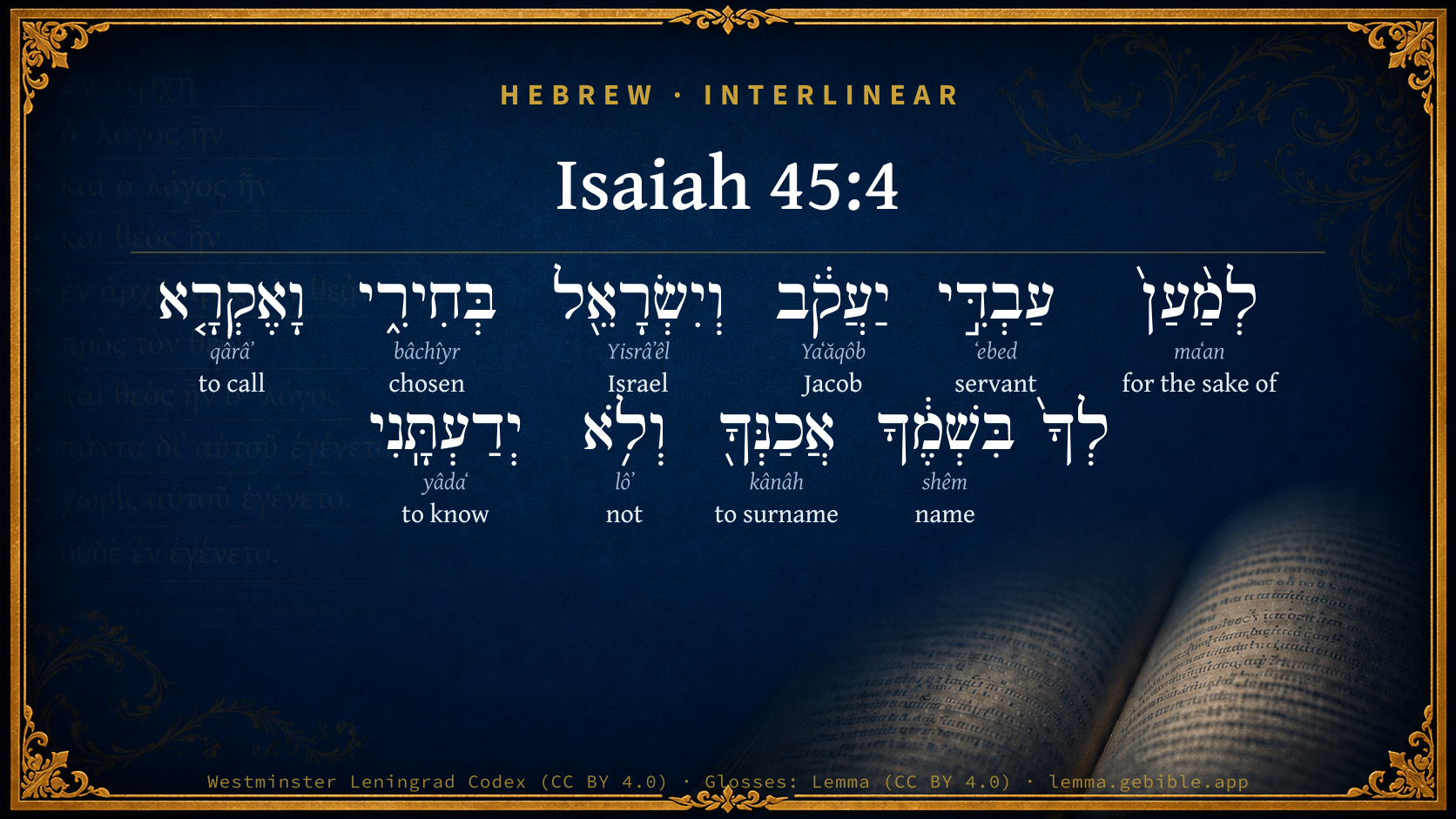
Isaiah 45:4

Hebrew (Westminster Leningrad Codex) Isaiah 45:4 appears in the Hebrew Old Testament. The text above is from the Westminster Leningrad Codex. Each word links to its Strong’s number, a concise gloss, and parsing drawn from the Open Scriptures Hebrew Bible morphology. Click any word for its full Brown-Driver-Briggs (BDB) entry.
Download image
Cite this verse

Isaiah 45:4 (World English Bible). Public Domain. Lemma interlinear Bible study tool, https://lemma.gebible.app/v/isaiah/45/4.

Show BibTeX & RIS
BibTeX
RIS
English Translation
For Jacob my servant's sake, and Israel my chosen, I have called you by your name: I have surnamed you, though you have not known me.
World English Bible · Public Domain
Download a study sheet

One document with this verse’s original text, its word-by-word gloss line, the meaning frame, cross-references with their text, attributed commentary, and full source and license credits — printable, and it pastes into notes with its structure intact.

This verse Autodidact and up

Study sheet (.html) Plain text (.txt)

A passage Seminary Student

Up to 50 verses in one chapter. A passage sheet keeps up to 6 commentary sources and 12 cross-references per verse, in the order this page ranks them, and says so on the sheet whenever that leaves anything out. Ask for a single verse and you get the Autodidact verse sheet above.

Everything on this page stays free to read, with no account — the sheet is a download of what is already on screen, not access to it.

Want to remove ads? Support Godless Engineer
Compare translations 3

The same verse in 3 English versions, stacked beneath the original-language interlinear above. Click any original word for its lexicon entry.

Each is an independent rendering of the whole verse — the interlinear is not word-aligned to these translations.

Highlighted words mark where these versions differ — a whole-verse word diff, not a word-by-word alignment.

  • World English Bible Public Domain
    For Jacob my servant's sake, and Israel my chosen, I have called you by your name: I have surnamed you, though you have not known me.
  • King James Version Public Domain
    For Jacob my servant's sake, and Israel mine elect, I have even called thee by thy name: I have surnamed thee, though thou hast not known me.
  • unfoldingWord Literal Text CC BY-SA 4.0
    For the sake of my servant Jacob, and Israel my chosen, I have called you by your name. I have surnamed you, though you have not known me.

unfoldingWord Literal Text — © unfoldingWord, licensed CC BY-SA 4.0. Word-aligned USFM3 via Door43 (git.door43.org/unfoldingWord/en_ult).

Versions to compare (up to 4)

3 of 4 selected

Show all 18 translations

Every available English version of this verse, each an independent rendering of the whole verse.

  • World English Bible Public Domain
    For Jacob my servant's sake, and Israel my chosen, I have called you by your name: I have surnamed you, though you have not known me.
  • Berean Standard Bible Public Domain
    For the sake of Jacob My servant and Israel My chosen one, I call you by name; I have given you a title of honor, though you have not known Me.
  • Majority Standard Bible Public Domain
    For the sake of Jacob My servant and Israel My chosen one, I call you by name; I have given you a title of honor, though you have not known Me.
  • King James Version Public Domain
    For Jacob my servant's sake, and Israel mine elect, I have even called thee by thy name: I have surnamed thee, though thou hast not known me.
  • American Standard Version (1901) Public Domain
    For Jacob my servant's sake, and Israel my chosen, I have called thee by thy name: I have surnamed thee, though thou hast not known me.
  • Revised Version (1885) Public Domain
    For Jacob my servant’s sake, and Israel my chosen, I have called thee by thy name: I have surnamed thee, though thou hast not known me.
  • Geneva Bible (1599) Public Domain
    For Iaakob my seruants sake, and Israel mine elect, I will euen call thee by thy name and name thee, though thou hast not knowen me.
  • Douay-Rheims (1899) Public Domain
    For the sake of my servant Jacob, and Israel my elect, I have even called thee by thy name: I have made a likeness of thee, and thou hast not known me.
  • Young's Literal Translation Public Domain
    For the sake of my servant Jacob, And of Israel My chosen, I call also thee by thy name, I surname thee, And thou hast not known Me.
  • Literal Standard Version CC BY-SA 4.0
    For the sake of My servant Jacob, || And of Israel My chosen, || I also call you by your name, I surname you, || And you have not known Me.
  • Unlocked Literal Bible CC BY-SA 4.0
    For Jacob my servant's sake, and Israel my chosen, I have called you by your name, giving you a title of honor, though you have not known me.
  • unfoldingWord Literal Text CC BY-SA 4.0
    For the sake of my servant Jacob, and Israel my chosen, I have called you by your name. I have surnamed you, though you have not known me.
  • Darby Bible Public Domain
    For Jacob my servant's sake, and Israel mine elect, I have called thee by thy name; I surnamed thee, though thou didst not know me;
  • World Messianic Bible Public Domain
    For Jacob my servant’s sake, and Israel my chosen, I have called you by your name. I have given you a title, though you have not known me.
  • Webster's Bible Public Domain
    For Jacob my servant's sake, and Israel my elect, I have even called thee by thy name: I have surnamed thee, though thou hast not known me:
  • Free Bible Version CC BY-SA 4.0
    I call you by name and I have given you a title of honor, for the sake of Jacob my servant, and Israel the one I chose, even though you don't know me.
  • Bible in Basic English Public Domain
    Because of Jacob my servant, and Israel whom I have taken for myself, I have sent for you by name, giving you a name of honour, though you had no knowledge of me.
  • JPS Tanakh (1917) Public Domain
    For the sake of Jacob My servant, and Israel Mine elect, I have called thee by thy name, I have surnamed thee, though thou hast not known Me.

Literal Standard Version (2020), Covenant Press — licensed CC BY-SA 4.0. Text via the HelloAO Bible API (eBible.org). Unlocked Literal Bible (unfoldingWord) — licensed CC BY-SA 4.0. Text via the HelloAO Bible API (eBible.org). unfoldingWord Literal Text — © unfoldingWord, licensed CC BY-SA 4.0. Word-aligned USFM3 via Door43 (git.door43.org/unfoldingWord/en_ult). Free Bible Version, Dr. Jonathan Gallagher — licensed CC BY-SA 4.0. Text via the HelloAO Bible API (eBible.org).

Word by word

More ways to search: Search by grammar → Find every occurrence → Compare this word →

Practice this passage: Drill this verse → Learn its vocabulary →

אֲכַנְּךָ֖
kânâh
H3655
“to surname · you”
Verb, Piel, Imperfect, 1st Person, Common, Singular + Suffix, Personal, 2nd Person, Masculine, Singular
Part of Speech
Verb
Stem
Piel
Form
Imperfect
Person
1st Person
Gender
Common
Number
Singular
Full BDB Definition

Origin: a primitive root

TWOT: 997

to title, surname, be surnamed, give an epithet or cognomen, give a flattering title - (Piel) to call by name, give a title, betitle
  1. לְמַ֨עַן֙ maʻan H4616 “for the sake of” Preposition
  2. עַבְדִּ֣י ʻebed H5650 “servant · my” Noun, Common, Masculine, Singular, Construct + Suffix, Personal, 1st Person, Common, Singular
  3. יַעֲקֹ֔ב Yaʻăqôb H3290 “Jacob” Noun, Proper
  4. וְיִשְׂרָאֵ֖ל Yisrâʼêl H3478 “and · Israel” Conjunction + Noun, Proper
  5. בְּחִירִ֑י bâchîyr H972 “chosen · my” Adjective, Adjective, Masculine, Singular, Construct + Suffix, Personal, 1st Person, Common, Singular
  6. וָאֶקְרָ֤א qârâʼ H7121 “and · to call” Conjunction + Verb, Qal, Sequential Imperfect, 1st Person, Common, Singular
  7. בִּשְׁמֶ֔ךָ shêm H8034 “in/at · name · your” Preposition + Noun, Common, Masculine, Singular, Construct + Suffix, Personal, 2nd Person, Masculine, Singular
  8. וְלֹ֥א lôʼ H3808 “and · not” Conjunction + Particle, Negative
  9. יְדַעְתָּֽנִי yâdaʻ H3045 “to know · me” Verb, Qal, Perfect, 2nd Person, Masculine, Singular + Suffix, Personal, 1st Person, Common, Singular

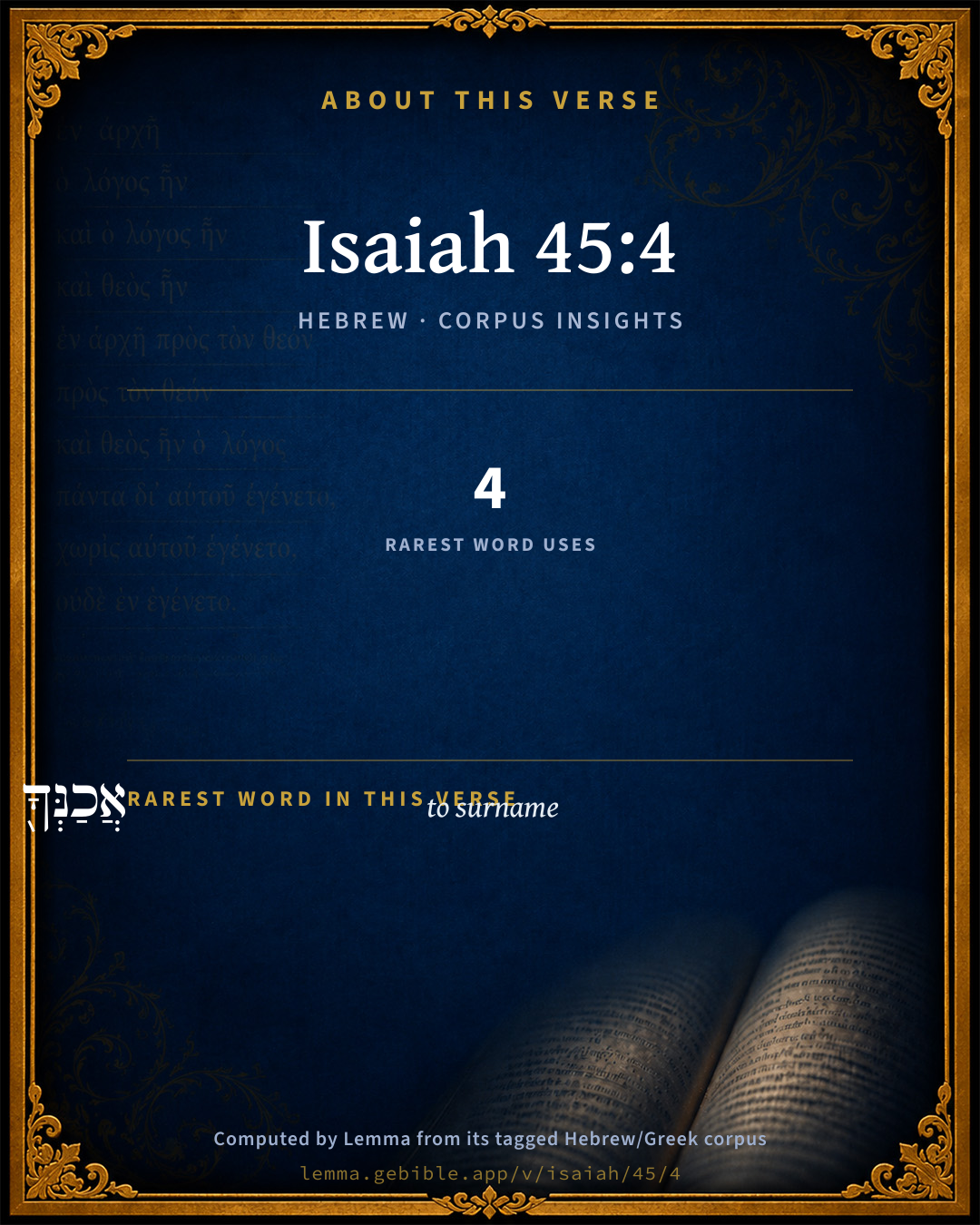
About this verse

These counts appear in no published source. They are computed here, from the morphology-tagged text and Lemma’s own curated glosses. What Lemma adds →

11
words
10
distinct lemmas
Prophets
section

Notable vocabulary

The rarest word here is אֲכַנְּךָ֖ to surname H3655 — appearing just 4 times in the whole Hebrew Bible.

Shared distinctive vocabulary

אֲכַנְּךָ֖ to surname H3655 occurs in 4 verses of the Hebrew Bible. Also found in:

Grammatical profile

  • 3 verbs
  • 4 nouns
  • 1 adjective
  • 2 prepositions
  • 1 particle

Verb forms

  • וָאֶקְרָ֤א Qal · Sequential Imperfect
  • אֲכַנְּךָ֖ Piel · Imperfect
  • יְדַעְתָּֽנִי Qal · Perfect

Hebrew & Septuagint length

In English translation the verse runs 26 words from the Hebrew and 27 from the Septuagint (LXX English) — closely comparable.

A rough comparison of the two English renderings, which tokenize alike — not a word-level alignment.

Word counts can differ between the Hebrew and the Greek without any difference in meaning — e.g. the Hebrew direct-object marker אֵת has no separate Greek word, and Greek often adds the article ὁ.

Cross-references

15

Topical passages linked to Isaiah 45:4 in the Treasury of Scripture Knowledge — connected by theme and wording, ordered by reader-vote popularity; previews shown in the World English Bible.

  • Isaiah 41:8–9 But you, Israel, my servant, Jacob whom I have chosen, the seed of Abraham my friend,
  • Exodus 19:5–6 Now therefore, if you will indeed obey my voice, and keep my covenant, then you shall be my own possession from among all peoples; for all the earth is mine;
  • Isaiah 44:1 Yet now hear, Jacob my servant, and Israel, who I have chosen:
  • Acts 17:23 For as I passed along, and observed the objects of your worship, I found also an altar with this inscription: 'TO AN UNKNOWN GOD.' What therefore you worship in ignorance, this I announce to you.
  • Romans 11:7 What then? That which Israel seeks for, that he didn't obtain, but the chosen ones obtained it, and the rest were hardened.
  • Isaiah 43:14 Thus says Yahweh, your Redeemer, the Holy One of Israel: For your sake I have sent to Babylon, and I will bring down all of them as fugitives, even the Chaldeans, in the ships of their rejoicing.
  • Isaiah 44:28–45:1 Who says of Cyrus, [He is] my shepherd, and shall perform all my pleasure, even saying of Jerusalem, She shall be built; and of the temple, Your foundation shall be laid.
  • Jeremiah 50:17–20 Israel is a hunted sheep; the lions have driven him away: first, the king of Assyria devoured him; and now at last Nebuchadrezzar king of Babylon has broken his bones.
  • Matthew 24:22 Unless those days had been shortened, no flesh would have been saved. But for the sake of the chosen ones, those days will be shortened.
  • Mark 13:20 Unless the Lord had shortened the days, no flesh would have been saved; but for the sake of the chosen ones, whom he picked out, he shortened the days.
  • Romans 9:6 But it is not as though the word of God has come to nothing. For they are not all Israel, that are of Israel.
  • Galatians 4:8–9 However at that time, not knowing God, you were in bondage to those who by nature are not gods.
  • Isaiah 43:3–4 For I am Yahweh your God, the Holy One of Israel, your Savior; I have given Egypt as your ransom, Ethiopia and Seba in your place.
  • Ephesians 2:12 that you were at that time separate from Christ, alienated from the commonwealth of Israel, and strangers from the covenants of the promise, having no hope and without God in the world.
  • 1 Thessalonians 4:5 not in the passion of lust, even as the Gentiles who don't know God;

Cross-references courtesy of OpenBible.info (CC BY 4.0).

Hebrew and Greek witnesses Masoretic Hebrew ↔ Greek Septuagint

The same verse in the two great witnesses to the Old Testament, shown verse-for-verse.

These are two independent witnesses, not word-aligned to each other, and the Septuagint is shown in lemma (dictionary) form.

Hebrew Isaiah 45:4 Masoretic · Westminster Leningrad Codex

לְמַ֨עַן֙ עַבְדִּ֣י יַעֲקֹ֔ב וְיִשְׂרָאֵ֖ל בְּחִירִ֑י וָאֶקְרָ֤א לְךָ֙ בִּשְׁמֶ֔ךָ אֲכַנְּךָ֖ וְלֹ֥א יְדַעְתָּֽנִי

For Jacob my servant's sake, and Israel my chosen, I have called you by your name: I have surnamed you, though you have not known me.

World English Bible · Public Domain

Greek LXX Isaiah 45:4 Septuagint · lemma form

ἕνεκεν ἰακώβ ὁ παῖς ἐγώ καί ἰσραήλ ὁ ἐκλεκτός ἐγώ ἐγώ καλέω σύ ὁ ὄνομα σύ καί προςδέχομαι σύ σύ δέ οὐ γιγνώσκω ἐγώ

For the sake of my servant Jacob, and Israel my elect, I will call you by your name, and accept you: but you have not known me.

LXX2012 (modern English Septuagint) · Public Domain

On this verse, Keil & Delitzsch discusses the Septuagint’s reading. Read the note in Commentary ↓

Hebrew: Westminster Leningrad Codex (CC BY 4.0). Greek: Septuagint (public domain); English from LXX2012 (modern English Septuagint) (Public Domain). How the Septuagint differs from the Hebrew →

Targum (Aramaic paraphrase)

1

The Targum is the ancient Jewish Aramaic paraphrase of the Hebrew Scriptures — an interpretive translation, not the Hebrew text itself. Onkelos (literal) and Pseudo-Jonathan (expansive) render the Torah, and Jonathan the Prophets. Coverage is partial: where no permissively-licensed English translation exists for a verse, only the Aramaic is shown. This is verse-level text, not a word-by-word alignment to the Hebrew.

  1. Targum Jonathan Prophets (Joshua–Malachi)
    בְּדִיל עַבְדִי יַעֲקֹב וְיִשְׂרָאֵל בְּחִירִי וּקְרֵית לָךְ בִּשְׁמָךְ אַתְקֵינְתָּךְ וְלָא יְדַעְתָּא לְמִדְחַל קֳדָמַי:

    For Jacob my servant's sake, and Israel my elect, yea, I have called thee by thy name; I have guided thee, though thou hast not known that thou shouldest fear me.

    Targum Jonathan — Aramaic: “Mikraot Gedolot” (public domain). English: “Sefaria Community Translation” (CC0 1.0 (public-domain dedication)); “London "Chaldee Paraphrase," 1871” (public domain). Text via Sefaria.

Commentary

Notes on Isaiah 45:4 from classic Christian and Jewish commentators (each source and its license shown beneath its notes). The classic Christian expositions comment on the surrounding passage and are grouped to its opening verse, so a note may address several verses; the Jewish commentaries on the Tanakh (Rashi and others) are per-verse, so they appear only where the commentator wrote on this verse.

Lemma curates 59 commentaries, every one of them public domain or Creative Commons licensed, each selected and text-cleaned for this edition rather than reprinted as found. About our sources →

The Cambridge Bible for Schools and Colleges

gen. ed. J. J. S. Perowne

4. The remainder of the section announces Jehovah’s purpose in raising up Cyrus, which is twofold: (1) the liberation and exaltation of His Servant Israel (Isa_45:4), and (2) that His Godhead may be acknowledged throughout the world (Isa_45:6). These two motives are inseparable, since it is only through Israel that the character of Jehovah can be made known to the nations. Hence great as the mission of Cyrus is, he is still but the instrument, while Israel is the goal of the Divine activity (Duhm).

I have surnamed thee] i.e. bestowed on thee such honourable appellations as “My Shepherd,” “My Anointed.” See on ch. Isa_44:5.

though thou hast not known me] Delitzsch and others somewhat strangely take this to mean “before thou hadst being.” But the words present no difficulty in their natural sense, which is that Cyrus entered on his career of conquest ignorant of the true God who made his way prosperous.

The Cambridge Bible for Schools and Colleges (gen. ed. J. J. S. Perowne; Cambridge University Press, 1878–1918) — public domain. Text from a community e-Sword module.

Trapp's Complete Commentary

John Trapp

Isa 45:4 For Jacob my servant’s sake, and Israel mine elect, I have even called thee by thy name: I have surnamed thee, though thou hast not known me.

Ver. 4. For Jacob my servant’s sake.] That the enemies of my people being subdued, they may have some breathing while, and liberty to live quietly in their own country. For which purpose also, it was the will of God that this prophecy of Isaiah should be made known to Cyrus, for the good of the Jews, that he might favour them; and so it was, as appeareth by Ezr 1:2, and by Josephus, Antiq., lib. xi. cap. 1.

I have even called thee by thy name.] Thy name of honour; {a} for Cyrus signifieth the "sun," saith Plutarch; "Lord," say others, in the Persian; as in Hebrew it seemeth to signify an heir, or possessor. Some derive our word sir from it. Cyrus was at first called Achzadat and Spaco, being the son of Cambyses, a noble Persian, and Mandane, the daughter of Astyages, king of Medes. The name of Cyrus he took when he entered upon the kingdom; and that from Cyrus, a river of Persia, as some hold. {b}

I have surnamed thee.] Or, I have entitled thee, scil., My shepherd, mine anointed, &c.

Though thou hast not known me,] scil., Savingly. For albeit he knew the true God in part, and acknowledged him to be great above other gods; yet he forsook not his idols, saith Jerome, and therefore perished miserably by the hands of the Scythians. Nevertheless, others {c} are of the opinion, that he was instructed by Daniel, and brought to a true belief, as was also Darius.

{a} H. Stephan.

{b} De Cyro fluvio scribit Strabo, lib. xv.

{c} Scultet.

John Trapp, A Commentary or Exposition upon All the Books of the Old and New Testament (1647–1656) — public domain. Text from a community e-Sword module.

The Biblical Illustrator

Joseph S. Exell

Isa_45:4-5

For Jacob My servants sake

Great men the servants of God

It appears from this prediction, taken in connection with its wonderful accomplishment, that God justly claims a sovereign right to make great men the instruments of executing His wise and benevolent designs.

God claims a supreme right to the services of great men, in almost every page of His Word. How often do we hear Him saying of this, of that, and of the other great character, He is My servant! How often do we meet with this sovereign language, My servant Moses; My servant Job; My servant Jacob; My servant Israel; My servant Isaiah; My servant Nebuchadnezzar! But He more fully displays this prerogative by publishing to the world what great men shall do, before they are brought into being. He claimed the services of Solomon, the wisest of men, and appointed the business of his life, before he was born (1Ch_22:9-10). In the prediction concerning Nebuchadnezzar, God claimed a sovereign right to employ him as the minister of His vengeance, in punishing the people of His wrath. He asserted His absolute Divinity and sovereignty, in His prophetic address to Cyrus. And He displayed the same sovereign right to the powers and influence of great men, in His predictions of Alexander the Great, of Augustus Caesar, of John the Baptist, of Constantine the Great, of Mohammed, and of the Man of Sin.

1. He gives men their superior natural capacity for doing good.

2. He presides over their education, and gives them the means of improving their superior talents, and forming themselves for eminent usefulness.

3. God gives them the disposition, which they at any time have, to employ their superior abilities in promoting the happiness of mankind.

4. God gives great men the opportunity of employing all their power and influence in executing His wise and benevolent designs.

5. It is God who succeeds their exertions for the benefit of the world. (N. Emmons, D. D.)

The Biblical Illustrator, edited by Joseph S. Exell (c. 1880s–1900s) — public domain. Text from a community e-Sword module.

Joseph Benson's Commentary

Isa 45:4-6. For Jacob my servant’s sake, &c. — The prophet here gives us the reasons why God showed such favour to a prince, who had been addicted to the superstition of his country, and ignorant of the true God, that he prospered all his undertakings, and gave success to all his endeavours. It was, 1st, For Israel’s sake: For Israel, mine elect, I have even called thee, &c. — I have called thee to this honour, and that by name; not for thy own sake, but for Israel’s sake: therefore, neither despise them, though a poor and despised people, nor be puffed up in a great opinion of thyself. I have surnamed thee, though thou hast not known me — I knew and called thee, when thou didst neither know nor think of me; nay, when thou hadst no being. I girded thee, &c. — I made thee strong and active, and fitted and disposed thee for these great and warlike enterprises. It was, 2d, For the sake of all nations; that they might be convinced of the true divinity and almighty power of the God of Israel. That they may know from the rising of the sun, &c., that I am the Lord, &c. — That all nations may know it by my foretelling these things so long before, and by the wonderful success that I shall give thee, and by my overruling thy heart and counsels, to the deliverance of my people. Or, as Lowth explains it, “My interposing so visibly in behalf of my own people, and returning their captivity by such unexpected means, will convince the heathen part of the world that I am the only true God.”

Joseph Benson's Commentary on the Old and New Testaments (1811–1818) — public domain. Text from a community e-Sword module.

Tyndale Open Study Notes

Tyndale Open Resources

45:4-5 I call you by name: Cyrus did not know the Lord, but the Lord knew him. Isaiah predicted the rescuer Cyrus by name 150 years in advance. This prophecy would prove to the exiles that the Lord is indeed God and that he knows the future.

Tyndale Open Study Notes — © Tyndale Open Resources, licensed CC BY-SA 4.0. Text via the HelloAO Bible API.

Geneva Bible (1599)

Geneva Bible translators

Not for any thing that is in thee, or for thy worthiness.

Geneva Bible (1599) marginal notes — public domain. Text via Bolls.life.

Jamieson, Fausset & Brown

Robert Jamieson, A. R. Fausset & David Brown

(See on Isa 41:8; Isa 43:14).

surnamed--that is, designated to carry out My design of restoring Judah (see on Isa 44:5; Isa 44:28; Isa 45:1). MAURER here, as in Isa 44:5, translates, "I have addressed thee by an honorable name."

hast not known me--previous to My calling thee to this office; after God's call, Cyrus did know Him in some degree (Ezr 1:1-3).

Jamieson, Fausset & Brown — Commentary Critical and Explanatory on the Whole Bible (1871) — public domain (CC PDM 1.0). Text via the HelloAO Bible API.

Ellicott's Commentary for English Readers

(4) For Jacob my servant . . .—The words “servant” and “elect” show that the prophet speaks of the ideal Israel, the true Ecclesia, rather than of the nation as such outwardly, though this also, as including the other, shared in the outward blessings of the election. Essentially, the words declare that the world’s history is ordered with a view to the true Eeclesia.

Called thee by thy name.—Either as predicting the actual name of Koresh, or as giving the titles of “Messiah” and “shepherd.” The surname clearly refers to these.

Though thou hast not known me.—Better, when thou didst not know me, either as referring to a time prior to the recognition by Cyrus of Jehovah as the God of heaven (Ezr_1:1-2), or, possibly, prior to his birth (comp. Isa_49:1; Jer_1:5).

A Bible Commentary for English Readers, edited by Charles John Ellicott (1878–1897) — public domain. Text from a community e-Sword module.

John Gill's Exposition

For Jacob my servant's sake, and Israel mine elect, I have even called thee by thy name,.... Not so much for the sake of Cyrus, and to do honour to him, was it that he so long before he was born called him by his name; but to assure the people of the Jews, the Lord's chosen people, and who were his servants, of the certainty of their deliverance, their deliverer being mentioned by name; and it was for their sakes, and not his, that he called him, and raised him up to do such great things as he did, that he might deliver them from their captivity: and it is for the sake of God's elect, whom he has chosen to holiness and happiness, to serve him, and be with him for ever, that he has called Christ, of whom Cyrus was a type, and sent him into the world, to be the Saviour and Redeemer of them:

I have surnamed thee; not only called him by his name, Cyrus, but surnamed him his "shepherd", and "his anointed", Isa 44:28,

though thou hast not known me; as yet not being born; and when he was, and was grown up, he was ignorant of the true God; and though, upon sight of the above prophecy, and under an immediate influence and impression, he acknowledged the God of Israel to be the God of heaven yet it does not appear that he left the Pagan idolatry; for Xenophon (k) relates, that when he found his end was near, he took sacrifices, and offered them to Jupiter, and the sun, and the rest of the gods; and gave them thanks for the care they had taken of him; and prayed them to grant happiness to his wife, children, friends, and country.

(k) Cyropaedia, l. 8. c. 45.

John Gill's Exposition of the Whole Bible (1746–1763) — public domain (CC PDM 1.0). Text via the HelloAO Bible API.

Albert Barnes' Notes on the Bible

For Jacob my servant’s sake - (see the note at Isa 42:19). The statement here is, that God had raised up Cyrus on account of his own people. The sentiment is common in the Bible, that kings and nations are in the hand of God; and that he overrules and directs their actions for the accomplishment of his own purposes, and especially to protect, defend, and deliver his people (see the note at Isa 10:5; compare Isa 47:6).

I have surnamed thee - On the meaning of the word ‘surname,’ see the notes at Isa 44:5. The reference here is to the fact that he had appointed him to accomplish important purposes, and had designated him as his ‘shepherd’ Isa 44:28, and his ‘anointed’ Isa 45:1.

Though thou hast not known me - Before he was called to accomplish these important services, he was a stranger to Yahweh, and it was only when he should have been so signally favored of heaven, and should be made acquainted with the divine will in regard to the deliverance of his people and the rebuilding of the temple Ezr 1:1-3, that he would be acquainted with the true God.

Albert Barnes' Notes on the Bible (1834–1885) — public domain. Text from a community e-Sword/MySword module.

Haydock's Catholic Bible Commentary

Likeness of Christ. --- Known me. Before the Jews had shewn Cyrus the prophecies, he did not attribute his success to the Lord, and even afterwards he seems not to have left the superstitions of his country, as his sacrifices to idols are described. He resembled Nabuchodonosor and the philosophers, who did not glorify God according to their knowledge, Daniel ii. 47., and Romans i. 21. Cyrus even revoked the decree for building the temple, 1 Esdras iv. 5. (Calmet) --- He believed there was one God; (1 Esdras i.) yet he did not embrace the truth entirely. (Worthington)

George Leo Haydock (1774–1849), Haydock's Catholic Family Bible and Commentary, 1859 edition — public domain. Excludes Psalms (Douay-Rheims chapter numbering differs from Protestant) and Deuterocanonical books (Catholic canon only).

Matthew Poole's English Annotations

I have even called thee by thy name; I have called thee to this honour, and that by name; not for thy sake, but for Israel’s sake; therefore do not despise them, thou wilt find them a poor and enslaved people, neither be puffed up into a great opinion of thyself.

I have surnamed thee, though thou hast not known me; I knew and called thee by thy name, when thou didst neither know nor think of me; nay, when thou hadst no being.

Matthew Poole's English Annotations on the Holy Bible (1683–1685) — public domain. Text from a community e-Sword/MySword module.

The Pulpit Commentary

For Jacob my servant"s sake. This second motive is, in a certain sense, the main one. Cyrus is raised up, especially, to perform God"s pleasure with respect to Judah and Jerusalem. (Isa_44:26-28)

Jacob, his Church, is more important in God"s eyes than any individual. No doubt his Church is maintained, in part, that it may be "a light to lighten the Gentiles;" but it is not maintained solely: or even mainly, for this end. Its welfare is an end in itself, and would be sought by God apart from any further consequence. Israel mine elect. (comp. Isa_41:8 Isa_44:1) I have surnamed thee; i.e. "given thee designations of honour," e.g. "my anointed" (ver. 1); "my shepherd"; (Isa_44:28) "he who shall do all my pleasure". (Isa_44:28) Though thou hast not known me; rather, though thou didst not know me. Cyrus"s honours, his titles, his mention by name, etc., were accumulated upon him before his birth, when he knew nothing of God, when, therefore, he had in no way merited them. Thus all was done, not for his sake, but lot the sake of Israel.

Vers. 4, 5. The Divine surnaming.

"I that call thee by thy name." "I have titled thee" (Cheyne"s translation). Some think the reference is to the name Cyrus, or Koresh, regarded as a new title for one who was originally known as Agradates." Others, with more probability, think the reference is to the honourable epithets, "my shepherd," "my anointed." Our knowledge of Cyrus has been modified, in some very important particulars, by recent discoveries of Babylonian inscriptions. Professor Sayce is of opinion that, "We must give up the belief that Cyrus was a monotheist, bent on destroying the idols of Babylon. On the contrary, from the time when we first hear of him, he is a worshipper of Bel-Merodach, the patron-god of Babylon; and the first care of himself and his son, after his conquest of Babylonia, is to restore the Babylonian gods to the shrines from which they had been impiously removed by Nabonidos." "The theory," he says, "which held that Cyrus had allowed the Jews to return to "their own land because, like them, he believed in but one supreme god the Ormazd, or good spirit, of the Zoroastrian creed must be abandoned. God consecrated Cyrus to be his instrument in restoring his chosen people to their land, not because the King of Elam was a monotheist, but because the period of Jewish trial and punishment had come to an end." It has been thought by some that this prophecy of Isaiah concerning Cyrus was brought to that king"s notice, and so helped to secure its own fulfilment. It is agreed that this Cyrus was a singularly just and noble monarch. Dr. H. Bushnell says, "So beautiful is the character and history of Cyrus, the person here addressed, that many have doubted whether the sketch given by Xenophon was not intended as an idealizing or merely romantic picture... And what should he be but a model of all princely beauty, of bravery, of justice, of impartial honour to the lowly, of greatness and true magnanimity in every form, when God has girded him, unseen, to be the minister of his own great and sovereign purposes to the nations of his time?" Dean Stanley says, "Though we know but little of the individual character of Cyrus, he first of the ancient conquerors, appears in other than a merely despotic and destructive aspect. It can hardly be without foundation that both in Greek and Hebrew literature he is represented as the type of a just and gentle prince." Three subjects are suggested.

I THE DISTINCT ENDOWMENTS OF MEN INDICATE DIVINE CALL TO DIVINE WORK, In the Divine sovereignty and wisdom there is a proportionate distribution of gifts among men. In the figure of our Lord"s parable, we may say, the master of the house calls together his servants, and delivers to each one some portion of his goods in trust. Very marked are the varieties of endowment and ability in a single family. We are often made to feel that God has given special gifts to some of our children; but we should see that these cases are only prominent illustrations of the truth that he has given some gifts to all. We all have some special work to do for God in the world, and so we all have some special endowments for the doing of it. Every man is called of God, girded by God, surnamed by God, and the moment when he clearly sees what his lifework is, is the moment when he becomes conscious of his call. Bushnell says, "What do the Scriptures show us but that God has a particular care for every man, a personal interest in him, and a sympathy with him and his trials, watching for the uses of his one talent as attentively and kindly, and approving him as heartily in the right employment of it, as if he had given him ten? and what is the giving out of the talents itself but an exhibition of the fact that God has a definite purpose, charge, and work, be it this or that, for every man?" "Every human soul has a complete and perfect plan cherished for it in the heart of God a Divine biography marked out, which it enters into life to live." The point on which we dwell is that the sense of power, the consciousness of power, is the witness to God"s call; and the responsibility of using the power to do God"s work comes with the consciousness. To say "I can" is to affirm that there is something God wants me to do.

II THE PRECISE TIME IN WHICH A MAN HAS TO LIVE INDICATES DIVINE CALL AND WORK. Each one comes into being at the "fulness of time" for him. It is sometimes said that great preachers and thought-leaders of the past would do little if they lived now. The saying is a foolish one. They belonged to their age, and were endowed for their age.

The Divine lead was as marked in the time of their appearing as in the gifts with which they were endowed. In each age God wants men

(1) who can represent the age, and find expression for the average thought of the age;

(2) men who are before the age, and can lead the age up towards the thoughts and things that are to be; and

(3) men who are behind the age, and zealously preserve the good things of the past that may seem to be imperilled. A man may say, "God has called me to live just now; then I may be quite sure that there is something which he wants me to do for him, and which he has fitted me to do, just now." Thus viewed, life grows solemn and holy for us all. We have our own work to do.

III THE PROVIDENTIAL CULTURE OF MEN FITS THEM FOE DOING GOD"S PRECISE WORK FOR THEM. This is often imperfectly apprehended. We are precisely endowed, and set forth in the world at just the right time; but it is important that we further trace how God cultures the gifts by the influences with which he surrounds us, and the providences he arranges for us. Often when men have found out what their life-work is to be, they gain the key to the meaning of the scenes and circumstances through which they have been led. R.T.

The Pulpit Commentary (1880–1919), ed. H.D.M. Spence-Jones & Joseph S. Exell — public domain. Text from a community e-Sword module.

John Wesley's Explanatory Notes

I have - I knew, and called thee by thy name, when thou didst neither know nor think of me; nay, when thou hadst no being.

John Wesley, Explanatory Notes Upon the Whole Bible (1754–1765) — public domain. Text via the GEBible commentary corpus.

Keil & Delitzsch

C. F. Keil & F. Delitzsch

A second and third object are introduced by a second and third למען. "For the sake of my servant Jacob, and Israel my chosen, I called thee hither by name, surnamed thee when thou knewest me not. I Jehovah, and there is none else, beside me no God: I equipped thee when thou knewest me not; that they may know from the rising of the sun, and its going down, that there is none without me: I Jehovah, and there is none else, former of the light, and creator of the darkness; founder of peace, and creator of evil: I Jehovah am He who worketh all this." The ואקרא which follows the second reason assigned like an apodosis, is construed doubly: "I called to thee, calling thee by name." The parallel אכנּך refers to such titles of honour as "my shepherd" and "my anointed," which had been given to him by Jehovah. This calling, distinguishing, and girding, i.e., this equipment of Cyrus, took place at a time when Cyrus knew nothing as yet of Jehovah, and by this very fact Jehovah made known His sole Deity. The meaning is, not that it occurred while he was still worshipping false gods, but, as the refrain-like repetition of the words "though thou hast not know me" affirms with strong emphasis, before he had been brought into existence, or could know anything of Jehovah. The passage is to be explained in the same way as Jer 1:5, "Before I formed thee in the womb, I knew thee" (see Psychol. pp. 36, 37, 39); and what the God of prophecy here claims for Himself, must not be questioned by false criticism, or weakened down by false apologetics (i.e., by giving up the proper name Cyrus as a gloss in Isa 44:28 and Isa 45:1; or generalizing it into a king's name, such as Pharaoh, Abimelech, or Agag). The third and last object of this predicted and realized success of the oppressor of nations and deliverer of Israel is the acknowledgement of Jehovah, spreading over the heathen world from the rising and setting of the sun, i.e., in every direction. The ah of וּממּערבה is not a feminine termination (lxx, Targ., Jer.), but a feminine suffix with He raphato pro mappic (Kimchi); compare Isa 23:17-18; Isa 34:17 (but not נצּה in Isa 18:5, or מוּסדה in Isa 30:32). Shemesh (the sun) is a feminine here, as in Gen 15:17, Nah 3:17, Mal 4:2, and always in Arabic; for the west is invariably called מערב (Arab. magrib). In Isa 45:7 we are led by the context to understand by darkness and evil the penal judgments, through which light and peace, or salvation, break forth for the people of God and the nations generally. But as the prophecy concerning Cyrus closes with this self-assertion of Jehovah, it is unquestionably a natural supposition that there is also a contrast implied to the dualistic system of Zarathustra, which divided the one nature of the Deity into two opposing powers (see Windischmann, Zoroastrische Studien, p. 135). The declaration is so bold, that Marcion appealed to this passage as a proof that the God of the Old Testament was a different being from the God of the New, and not the God of goodness only. The Valentinians and other gnostics also regarded the words "There is no God beside me" in Isaiah, as deceptive words of the Demiurugs. The early church met them with Tertullian's reply, "de his creator profitetur malis quae congruunt judici," and also made use of this self-attestation of the God of revelation as a weapon with which to attack Manicheesism. The meaning of the words is not exhausted by those who content themselves with the assertion, that by the evil (or darkness) we are not to understand the evil of guilt (malum culpae), but the evil of punishment (malum paenae). Undoubtedly, evil as an act is not the direct working of God, but the spontaneous work of a creature endowed with freedom. At the same time, evil, as well as good, has in this sense its origin in God - that He combines within Himself the first principles of love and wrath, the possibility of evil, the self-punishment of evil, and therefore the consciousness of guilt as well as the evil of punishment in the broadest sense. When the apostle celebrates the glory of free grace in Rom 9:11., he stands on that giddy height, to which few are able to follow him without falling headlong into the false conclusions of a decretum absolutum, and the denial of all creaturely freedom.

Keil & Delitzsch — Biblical Commentary on the Old Testament (1861–1891) — public domain (CC PDM 1.0). Text via the HelloAO Bible API. (Old Testament only.)

J. A. Alexander on Isaiah

Joseph Addison Alexander

“For the sake of my servant Jacob and Israel my chosen, therefore will I call thee by thy name, I will give thee a title, and thou hast not known me.” Not only for God’s glory in the general, but with a view to the promotion of His gracious purposes towards Israel. ‘Thou hast not known me’ may either mean that he was not a follower of the true religion, or that the name was given long before he did or could know anything of him who gave it. The verb expresses past time not in reference to the date of the prediction, but to that of the fulfillment.

Joseph Addison Alexander, The Prophecies of Isaiah (1846–1847; New York: Scribner, 1870–1878) — public domain. Text from a community e-Sword module.

unfoldingWord translationNotes

Door43 World Missions Community

General Information:

Yahweh continues speaking to Cyrus.

Jacob ... Israel

These both refer to the descendants of Israel. (See: Doublet and Metonymy)

I will arm you for battle

Possible meanings are 1) "I will strengthen you for battle" or 2) "I will equip you for battle."

from the rising of the sun, and from the west

Since the sun rises in the east, this phrase forms a merism and means everywhere on earth. AT: "from every place on earth" (See: Merism)

translationWords

Jacob

servant

Israel

chosen one

call

name

honor

know

Yahweh

God

people group

unfoldingWord translationNotes — © Distant Shores Media and the Door43 World Missions Community, licensed CC BY-SA 4.0. Source: git.door43.org/Door43/en_tn.

Rashi

Rabbi Shlomo Yitzchaki (Rashi)

For the sake of My servant Jacob that you take him out of Babylonian exile.

yet you have not known Me You did not do My will, for I said, (infra v. 13) “He shall build My city,” but he when he assumed the throne said, “Whoever among you is from all His people, may ascend.” He gave them permission to go, but he cast off all the trouble from upon his neck.

Rashi on the Tanakh — English translations: “The Judaica Press complete Tanach with Rashi, translated by A. J. Rosenberg” (CC BY 4.0); “Pentateuch with Rashi's commentary by M. Rosenbaum and A.M. Silbermann, 1929-1934” (public domain); “The Metsudah Tanach series, Lakewood, N.J” (CC BY 4.0); and “The Book of Joshua, Metsudah Publications, 1997” (CC BY 4.0). Text via Sefaria.

Ibn Ezra

Rabbi Abraham ibn Ezra

For Jacob my servant’s sake, etc. All this success is not granted to thee for thine own sake, but for Israel, that thou shouldst send back the captives of Israel and rebuild Jerusalem.

I have named thee. Comp. I have called thee by thy name, thou art mine (43:1)

Ibn Ezra on the Tanakh — English translations: “Sefaria Community Translation” (CC0 1.0 (public-domain dedication)); “Yalkut, Sifsei Chachomim Chumash, Metsudah Publications, 2009” (CC BY 4.0); and “Commentary of Ibn Ezra on Isaiah - trans. by M. Friedlander, 1873” (public domain). Text via Sefaria.

Lesson kit

Teaching starters — assembled from the data on this page, not authored interpretation. Every prompt links to the verse data it draws on. Edit before teaching.

Isaiah, in the Prophets, opens this verse with 11 words (10 distinct Hebrew lemmas). Its most distinctive word is kânâh (“to surname”). A historical commentator’s framing appears above. Read the whole chapter for the surrounding context.

Discussion questions

  1. What does “to surname” (kânâh) contribute to the verse as a whole?
  2. Job 32:21 shares the word «to surname» with this verse. How do the two illuminate each other?
  3. These translations render this verse differently. What is at stake in choosing one wording over another?
  4. The verb «וָאֶקְרָ֤א» is Qal Sequential Imperfect. How does its form color the action?
  5. Reading how The Cambridge Bible for Schools and Colleges and Trapp's Complete Commentary read this verse, where do the two commentators agree and where do they part?

Things to notice

Reading settings

Reading text

Shown beneath each verse's original-language words.

Old Testament
Old Testament edition

Read the OT as the Masoretic Hebrew (MT) or the Greek Septuagint (LXX).

English shown for the Greek Septuagint (in the Hebrew ↔ Greek comparison).

Comparing translations? Open the Compare panel on any verse page to stack up to four side by side.