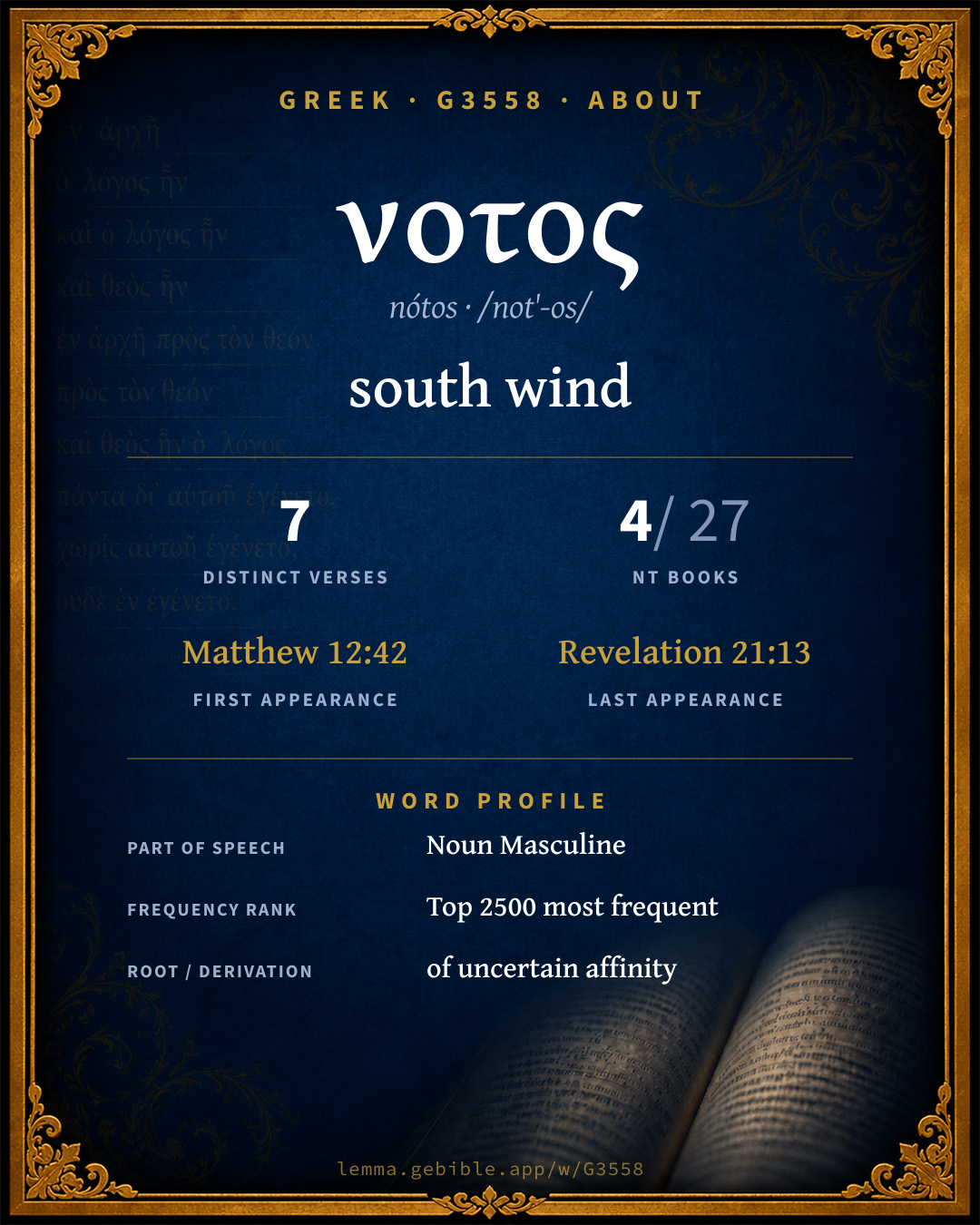
νότος
south wind
‘south wind’ is one of 2 main senses fuller range ↓
Full lexicon entry — Thayer's Greek Lexicon
From Thayer's Greek Lexicon
Where this word appears
See every Genitive-case word in the Greek New Testament →
Grammar key — what these labels mean
Part of speech
- Noun
- A naming word — a person, place, thing, or idea.
Case
- Genitive
- The case of source, possession, or “of” — answers “whose / from what.”
- Accusative
- The case of the direct object and of extent.
Gender
- Masculine
- Grammatically masculine.
Number
- Singular
- One.
Grammatical forms
- Noun, Genitive, Singular, Masculine 6 times (86%)
- Noun, Accusative, Singular, Masculine 1 time (14%)
Parsed forms decoded from the imported morphology (Robinson–Tischendorf, public domain), counted across 7 parsed occurrences — not distinct verses.
Every verse where G3558 appears — 7 distinct verses across 4 books. Click any verse to open its interlinear word-by-word view. Verse text shown in the World English Bible for context — . Each verse’s Greek form is shown with its reference; the English is not keyword-highlighted, since the data carries no word-level English alignment. Use “Compare translations” on any verse to read it across multiple English versions. This concordance covers the Greek New Testament; Septuagint (Greek Old Testament) occurrences of this word are not indexed here.
Matthew 1 verse
Luke 3 verses
- Luke 11:31 νότου n gen sg masc The Queen of the South will rise up in the judgment with the men of this generation, and will condemn them: for she came from the ends of the earth to hear the wisdom of Solomon; and behold, one greater than Solomon is here.
- Luke 12:55 νότον n acc sg masc When a south wind blows, you say, 'There will be a scorching heat,' and it happens.
- Luke 13:29 νότου n gen sg masc They will come from the east, west, north, and south, and will sit down in the Kingdom of God.
Acts 2 verses
- Acts 27:13 νότου n gen sg masc When the south wind blew softly, supposing that they had obtained their purpose, they weighed anchor and sailed along Crete, close to shore.
- Acts 28:13 νότου n gen sg masc From there we circled around and arrived at Rhegium. After one day, a south wind sprang up, and on the second day we came to Puteoli,
Revelation 1 verse
About this entry
At a glance — auto-summarized from this page’s data, not written by a person. Every figure links to its source below. This summary describes the numbers; it doesn’t interpret them.
νοτος (nótos) is a Greek noun most often rendered “south wind.” It first appears in Matthew 12:42. With 7 verses in 4 books, it is an uncommon word in the Greek New Testament. It concentrates in Luke, which alone accounts for 43% of its uses. Ranging over 2 senses, it is not a single-sense word. The sections below give every sense, occurrence, and version rendering.
Gloss history
Strong's 1890 vs modern scholarship
About this word
Strong's G3558 catalogs a Greek word from the Greek New Testament.
These counts are not copied from any lexicon or concordance. They are computed here, from the morphology-tagged Greek New Testament. What Lemma adds →
- 7
- distinct verses
- The word appears in 7 distinct verses.
- 4 / 27
- NT books
- The word appears in 4 of 27 New Testament books.
- #1,358
- by frequency
- Top 2500 most frequent Greek words (rank 1,358 of 5,347 Greek words by occurrence).
View all 7 occurrences in the concordance →
By section of the New Testament
By traditional corpus
Conventional, traditional groupings — biblical authorship is debated, so this is a traditional corpus grouping, not an authorship claim. Some books belong to more than one corpus (Luke is in both the Gospels and the Lukan corpus, and so on), so these shares overlap and need not total 100%. Each figure is a share of the word’s 7 distinct verses.
- Lukan (Luke–Acts) 5 verses · 71%
- Gospels 4 verses · 57%
- Johannine 1 verse · 14%
- Revelation 1 verse · 14%
How translations render this word
Counts come from each version’s own published word-to-Strong’s tagging or interlinear alignment — an approximate guide to how each version renders this word, not a word-level alignment the data otherwise carries. Because each total is that version’s own tagged count, the per-version totals vary from one another and need not match the appearance or distinct-verse counts above. These counts may also differ from a printed concordance because Lemma counts each distinctly tagged rendering and does not collapse phrase taggings into a single head-word total. This is a fixed set of word-tagged versions (KJV, ASV, BSB, ULT) and does not change with the reading translation you choose elsewhere. Each version’s license is shown beside its name below (and on Sources).
- King James Version: South 4×, South wind 2×
- American Standard Version: South 4×, South wind 2×
- Berean Standard Bible: South 4×, South wind 2×
- unfoldingWord Literal Text: South 4×, South wind 3×
King James Version Public Domain
Renders G3558 across 7 tagged occurrences — most commonly:
Plus 1 rendering that appears only once — usually multi-word phrases or single function words the recovered tagging swept in, not distinct renderings.
American Standard Version Public Domain
Renders G3558 across 7 tagged occurrences — most commonly:
Plus 1 rendering that appears only once — usually multi-word phrases or single function words the recovered tagging swept in, not distinct renderings.
Berean Standard Bible Public Domain
Renders G3558 across 7 tagged occurrences — most commonly:
Plus 1 rendering that appears only once — usually multi-word phrases or single function words the recovered tagging swept in, not distinct renderings.
unfoldingWord Literal Text CC BY-SA 4.0
Renders G3558 across 7 tagged occurrences — most commonly:
Senses in Thayer's
The 2 senses Thayer's distinguishes for this word, in lexicon order (not ranked by frequency or importance). The full entry — with sub-senses — is in the Lexicon Entry tab.
- the south wind
- the south, the southern quarter
Word origin
Origin: of uncertain affinity
Of uncertain affinity; the south ( southwest ) wind ; by extension the southern quarter itself : - south (wind).
— Strong’s Exhaustive Concordance (1890), public domain.
Forms in the corpus
The 2 distinct written forms G3558 takes in the Greek New Testament, most frequent first — each parse links to that case’s occurrences in the concordance.
| Form | Parsing | Example | Uses |
|---|---|---|---|
| νότου nótou | Noun, Genitive, Singular, Masculine | Matthew 12:42 | 6 |
| νότον nóton | Noun, Accusative, Singular, Masculine | Luke 12:55 | 1 |
Septuagint usage
The same Greek word νοτος appears 69 times in the Greek Old Testament (Septuagint), across 58 verses in 16 books.
- 69
- LXX occurrences
- Tagged occurrences of this Greek word in the Septuagint.
- 58
- verses
- Distinct Septuagint verses containing this word.
- 16 / 39
- OT books
- The word appears in 16 of the 39 Old Testament books.
Sample Septuagint occurrences
- Exodus 10:13 νότος
- Numbers 13:29 νότος
- Joshua 19:34 νότος
- Judges 1:9 νότος
- 1 Samuel 13:5 νότος
- 2 Samuel 24:7 νότος
- 1 Kings 7:13 νότος
- 1 Chronicles 9:24 νότος
- 2 Chronicles 4:4 νότος
- Job 9:9 νότος
- Psalms 77:26 νότος
- Ecclesiastes 1:6 νότος
Septuagint occurrences (same lexeme)
Every verse where the same Strong’s number (G3558) appears in the Greek Septuagint — showing the first 50 of 58. Verse text shown in the World English Bible for context; the Greek form is the matched word — the English is not keyword-highlighted.
- Exodus 10:13 νότος Moses stretched forth his rod over the land of Egypt, and Yahweh brought an east wind on the land all that day, and all the night; and when it was morning, the east wind brought the locusts.
- Exodus 14:21 νότος Moses stretched out his hand over the sea, and Yahweh caused the sea to go back by a strong east wind all the night, and made the sea dry land, and the waters were divided.
- Exodus 26:20 νότος For the second side of the tent, on the north side, twenty boards,
- Exodus 26:35 νότος You shall set the table outside the veil, and the lampstand over against the table on the side of the tent toward the south: and you shall put the table on the north side.
- Exodus 27:13 νότος The breadth of the court on the east side eastward shall be fifty cubits.
- Exodus 40:24 νότος He put the lampstand in the tent of meeting, opposite the table, on the side of the tent southward.
- Numbers 13:29 νότος Amalek dwells in the land of the South: and the Hittite, and the Jebusite, and the Amorite, dwell in the hill-country; and the Canaanite dwells by the sea, and along by the side of the Jordan.
- Numbers 34:15 νότος the two tribes and the half-tribe have received their inheritance beyond the Jordan at Jericho eastward, toward the sunrise.
- Joshua 19:34 νότος and the border turned westward to Aznoth Tabor, and went out from there to Hukkok; and it reached to Zebulun on the south, and reached to Asher on the west, and to Judah at the Jordan toward the sunrise.
- Judges 1:9 νότος Afterward the children of Judah went down to fight against the Canaanites who lived in the hill-country, and in the South, and in the lowland.
- Judges 1:14 νότος It happened, when she came [to him], that she moved him to ask of her father a field: and she alighted from off her donkey; and Caleb said to her, What would you?
- Judges 1:15 νότος She said to him, Give me a blessing; for that you have set me in the land of the South, give me also springs of water. Caleb gave her the upper springs and the lower springs.
- Judges 1:16 νότος The children of the Kenite, Moses' brother-in-law, went up out of the city of palm trees with the children of Judah into the wilderness of Judah, which is in the south of Arad; and they went and lived with the people.
- Judges 21:19 νότος They said, Behold, there is a feast of Yahweh from year to year in Shiloh, which is on the north of Bethel, on the east side of the highway that goes up from Bethel to Shechem, and on the south of Lebonah.
- 1 Samuel 13:5 νότος The Philistines assembled themselves together to fight with Israel, thirty thousand chariots, and six thousand horsemen, and people as the sand which is on the sea-shore in multitude: and they came up, and encamped in Michmash, eastward of Beth Aven.
- 1 Samuel 14:5 νότος The one crag rose up on the north in front of Michmash, and the other on the south in front of Geba.
- 1 Samuel 27:10 νότος Achish said, Against whom have you made a raid today? David said, Against the South of Judah, and against the South of the Jerahmeelites, and against the South of the Kenites.
- 1 Samuel 30:1 νότος It happened, when David and his men were come to Ziklag on the third day, that the Amalekites had made a raid on the South, and on Ziklag, and had struck Ziklag, and burned it with fire,
- 1 Samuel 30:14 νότος We made a raid on the South of the Cherethites, and on that which belongs to Judah, and on the South of Caleb; and we burned Ziklag with fire.
- 1 Samuel 30:27 νότος To those who were in Bethel, and to those who were in Ramoth of the South, and to those who were in Jattir,
- 2 Samuel 24:7 νότος and came to the stronghold of Tyre, and to all the cities of the Hivites, and of the Canaanites; and they went out to the south of Judah, at Beersheba.
- 1 Kings 7:13 νότος King Solomon sent and fetched Hiram out of Tyre.
- 1 Kings 7:25 νότος It stood on twelve oxen, three looking toward the north, and three looking toward the west, and three looking toward the south, and three looking toward the east; and the sea was set on them above, and all their hinder parts were inward.
- 1 Chronicles 9:24 νότος On the four sides were the porters, toward the east, west, north, and south.
- 1 Chronicles 26:15 νότος To Obed-edom southward; and to his sons the store-house.
- 1 Chronicles 26:17 νότος Eastward were six Levites, northward four a day, southward four a day, and for the store-house two and two.
- 2 Chronicles 4:4 νότος It stood on twelve oxen, three looking toward the north, and three looking toward the west, and three looking toward the south, and three looking toward the east: and the sea was set on them above, and all their hinder parts were inward.
- Job 9:9 νότος Who makes the Bear, Orion, and the Pleiades, And the chambers of the south;
- Job 38:24 νότος By what way is the lightning distributed, Or the east wind scattered on the earth?
- Job 39:26 νότος "Is it by your wisdom that the hawk soars, And stretches her wings toward the south?
- Psalms 77:26 νότος
- Psalms 125:4 νότος Do good, Yahweh, to those who are good, To those who are upright in their hearts.
- Ecclesiastes 1:6 νότος The wind goes toward the south, and turns around to the north. It turns around continually as it goes, and the wind returns again to its courses.
- Ecclesiastes 11:3 νότος If the clouds are full of rain, they empty themselves on the earth; And if a tree falls toward the south, or toward the north, In the place where the tree falls, there shall it be.
- Song of Solomon 4:16 νότος Awake, north wind; and come, you south; Blow on my garden, that its spices may flow out. Let my beloved come into his garden, And taste his precious fruits. Lover
- Jeremiah 13:19 νότος The cities of the South are shut up, and there is none to open them: Judah is carried away captive, all of it; it is wholly carried away captive.
- Jeremiah 17:26 νότος They shall come from the cities of Judah, and from the places round about Jerusalem, and from the land of Benjamin, and from the lowland, and from the hill-country, and from the South, bringing burnt offerings, and sacrifices, and meal-offerings, and frankincense, and bringing [sacrifices of] thanksgiving, to the house of Yahweh.
- Ezekiel 27:26 νότος Your rowers have brought you into great waters: the east wind has broken you in the heart of the seas.
- Ezekiel 40:24 νότος He led me toward the south; and, behold, a gate toward the south: and he measured the posts of it and the arches of it according to these measures.
- Ezekiel 40:27 νότος There was a gate to the inner court toward the south: and he measured from gate to gate toward the south a hundred cubits.
- Ezekiel 40:28 νότος Then he brought me to the inner court by the south gate: and he measured the south gate according to these measures;
- Ezekiel 40:44 νότος Outside of the inner gate were chambers for the singers in the inner court, which was at the side of the north gate; and their prospect was toward the south; one at the side of the east gate having the prospect toward the north.
- Ezekiel 40:45 νότος He said to me, This chamber, whose prospect is toward the south, is for the priests, the keepers of the charge of the house;
- Ezekiel 41:11 νότος The doors of the side-chambers were toward [the place] that was left, one door toward the north, and another door toward the south: and the breadth of the place that was left was five cubits round about.
- Ezekiel 42:10 νότος In the thickness of the wall of the court toward the east, before the separate place, and before the building, there were chambers.
- Ezekiel 42:12 νότος According to the doors of the chambers that were toward the south was a door at the head of the way, even the way directly before the wall toward the east, as one enters into them.
- Ezekiel 42:13 νότος Then said he to me, The north chambers and the south chambers, which are before the separate place, they are the holy chambers, where the priests who are near to Yahweh shall eat the most holy things: there shall they lay the most holy things, and the meal-offering, and the sin-offering, and the trespass-offering; for the place is holy.
- Ezekiel 42:19 νότος He turned about to the west side, and measured five hundred reeds with the measuring reed.
- Ezekiel 46:9 νότος But when the people of the land shall come before Yahweh in the appointed feasts, he who enters by the way of the north gate to worship shall go forth by the way of the south gate; and he who enters by the way of the south gate shall go forth by the way of the north gate: he shall not return by the way of the gate by which he came in, but shall go forth straight before him.
- Ezekiel 47:1 νότος He brought me back to the door of the house; and, behold, waters issued out from under the threshold of the house eastward; (for the forefront of the house was toward the east;) and the waters came down from under, from the right side of the house, on the south of the altar.
These are occurrences of the same Greek lexeme (G3558) in the Septuagint — not a translation of any one Hebrew word. The store carries no word-level Hebrew↔Greek alignment, so no Hebrew original is asserted here. Counts come from the recovered LXX Strong's tagging — high-frequency vocabulary is well covered, while rare or late forms may be untagged — so they reflect tagged occurrences and may slightly undercount.