Ezekiel 40:27

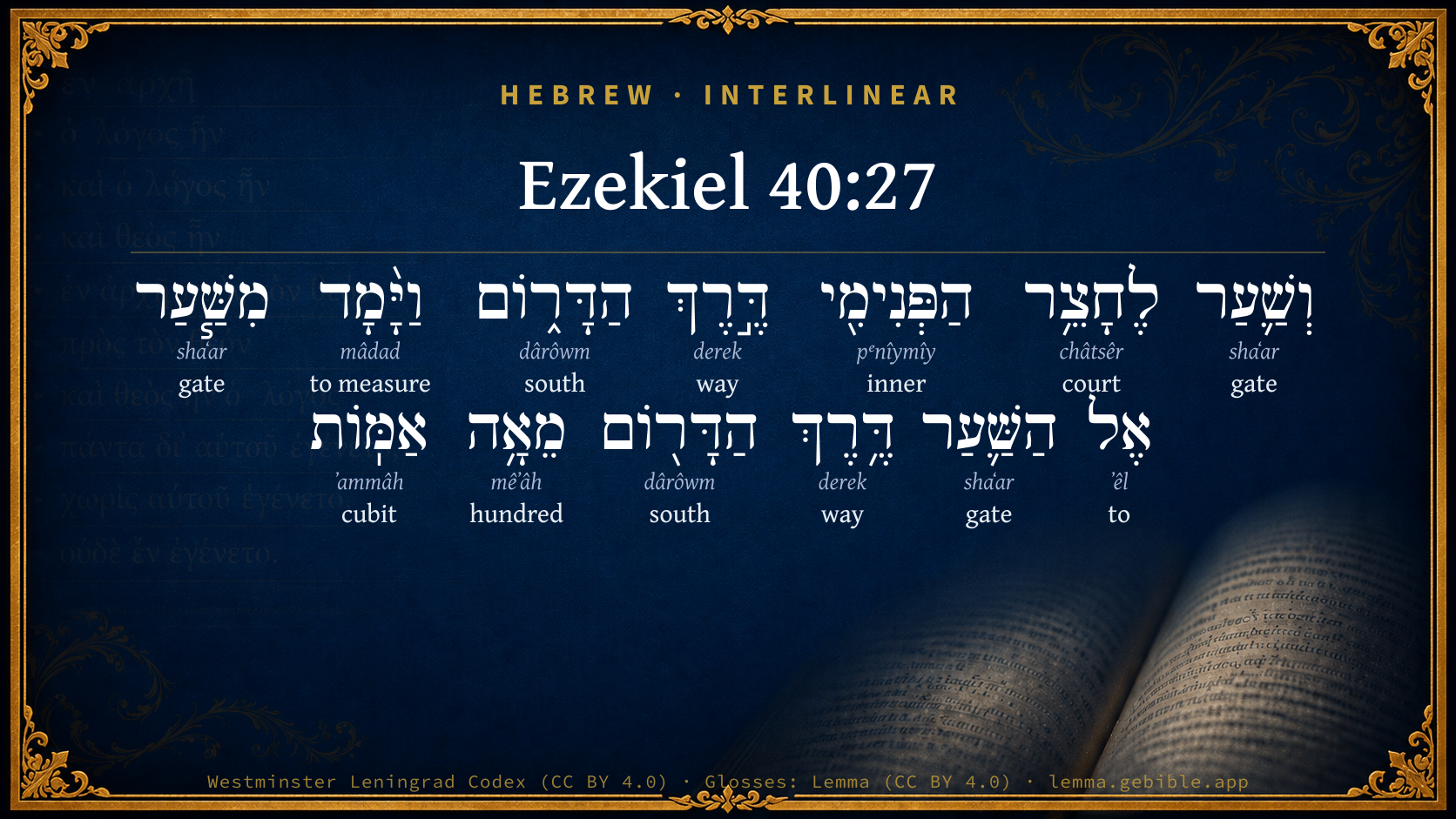
Hebrew (Westminster Leningrad Codex) Ezekiel 40:27 appears in the Hebrew Old Testament. The text above is from the Westminster Leningrad Codex. Each word links to its Strong’s number, a concise gloss, and parsing drawn from the Open Scriptures Hebrew Bible morphology. Click any word for its full Brown-Driver-Briggs (BDB) entry.
Download image
Cite this verse

Ezekiel 40:27 (World English Bible). Public Domain. Lemma interlinear Bible study tool, https://lemma.gebible.app/v/ezekiel/40/27.

Show BibTeX & RIS
BibTeX
RIS
English Translation
There was a gate to the inner court toward the south: and he measured from gate to gate toward the south a hundred cubits.
World English Bible · Public Domain
Download a study sheet

One document with this verse’s original text, its word-by-word gloss line, the meaning frame, cross-references with their text, attributed commentary, and full source and license credits — printable, and it pastes into notes with its structure intact.

This verse Autodidact and up

Study sheet (.html) Plain text (.txt)

A passage Seminary Student

Up to 50 verses in one chapter. A passage sheet keeps up to 6 commentary sources and 12 cross-references per verse, in the order this page ranks them, and says so on the sheet whenever that leaves anything out. Ask for a single verse and you get the Autodidact verse sheet above.

Everything on this page stays free to read, with no account — the sheet is a download of what is already on screen, not access to it.

Want to remove ads? Support Godless Engineer
Compare translations 3

The same verse in 3 English versions, stacked beneath the original-language interlinear above. Click any original word for its lexicon entry.

Each is an independent rendering of the whole verse — the interlinear is not word-aligned to these translations.

Highlighted words mark where these versions differ — a whole-verse word diff, not a word-by-word alignment.

  • World English Bible Public Domain
    There was a gate to the inner court toward the south: and he measured from gate to gate toward the south a hundred cubits.
  • King James Version Public Domain
    And there was a gate in the inner court toward the south: and he measured from gate to gate toward the south an hundred cubits.
  • unfoldingWord Literal Text CC BY-SA 4.0
    There was a gate to the inner courtyard on the southern side, and the man measured from that gate to the gate of the south entrance—one hundred cubits in distance.

unfoldingWord Literal Text — © unfoldingWord, licensed CC BY-SA 4.0. Word-aligned USFM3 via Door43 (git.door43.org/unfoldingWord/en_ult).

Versions to compare (up to 4)

3 of 4 selected

Show all 18 translations

Every available English version of this verse, each an independent rendering of the whole verse.

  • World English Bible Public Domain
    There was a gate to the inner court toward the south: and he measured from gate to gate toward the south a hundred cubits.
  • Berean Standard Bible Public Domain
    The inner court also had a gate facing south, and he measured the distance from gateway to gateway toward the south to be a hundred cubits.
  • Majority Standard Bible Public Domain
    The inner court also had a gate facing south, and he measured the distance from gateway to gateway toward the south to be a hundred cubits.
  • King James Version Public Domain
    And there was a gate in the inner court toward the south: and he measured from gate to gate toward the south an hundred cubits.
  • American Standard Version (1901) Public Domain
    And there was a gate to the inner court toward the south: and he measured from gate to gate toward the south a hundred cubits.
  • Revised Version (1885) Public Domain
    And there was a gate to the inner court toward the south: and he measured from gate to gate toward the south an hundred cubits.
  • Geneva Bible (1599) Public Domain
    And there was a gate in the inner court towarde the South, and he measured from gate to gate towarde the South an hundreth cubites.
  • Douay-Rheims (1899) Public Domain
    And there was a gate of the inner court towards the south: and he measured from gate to gate towards the south, a hundred cubits.
  • Young's Literal Translation Public Domain
    and the gate of the inner court `is' southward, and he measureth from gate unto gate southward, a hundred cubits.
  • Literal Standard Version CC BY-SA 4.0
    and the gate of the inner court [is] southward, and he measures from gate to gate southward, one hundred cubits.
  • Unlocked Literal Bible CC BY-SA 4.0
    There was a gate to the inner courtyard on the southern side, and the man measured from that gate to the gate of the south entrance—one hundred cubits in distance.
  • unfoldingWord Literal Text CC BY-SA 4.0
    There was a gate to the inner courtyard on the southern side, and the man measured from that gate to the gate of the south entrance—one hundred cubits in distance.
  • Darby Bible Public Domain
    And there was a gate to the inner court toward the south; and he measured from gate to gate toward the south, a hundred cubits.
  • World Messianic Bible Public Domain
    There was a gate to the inner court toward the south. He measured one hundred cubits from gate to gate toward the south.
  • Webster's Bible Public Domain
    And there was a gate in the inner court towards the south: and he measured from gate to gate towards the south a hundred cubits.
  • Free Bible Version CC BY-SA 4.0
    The inner courtyard also had an entrance facing south, and he measured the distance from the entrance to the south gate as a hundred cubits.
  • Bible in Basic English Public Domain
    And there was a doorway to the inner square looking to the south: he took the measure from doorway to doorway to the south, a hundred cubits.
  • JPS Tanakh (1917) Public Domain
    And there was a gate to the inner court toward the south; and he measured from gate to gate toward the south a hundred cubits.

Literal Standard Version (2020), Covenant Press — licensed CC BY-SA 4.0. Text via the HelloAO Bible API (eBible.org). Unlocked Literal Bible (unfoldingWord) — licensed CC BY-SA 4.0. Text via the HelloAO Bible API (eBible.org). unfoldingWord Literal Text — © unfoldingWord, licensed CC BY-SA 4.0. Word-aligned USFM3 via Door43 (git.door43.org/unfoldingWord/en_ult). Free Bible Version, Dr. Jonathan Gallagher — licensed CC BY-SA 4.0. Text via the HelloAO Bible API (eBible.org).

Word by word

More ways to search: Search by grammar → Find every occurrence → Compare this word →

Practice this passage: Drill this verse → Learn its vocabulary →

הַדָּר֑וֹם
dârôwm
H1864
“the · south”
Particle, Definite Article + Noun, Common, Masculine, Singular, Absolute
Part of Speech
Particle + Noun
Type
Common
Gender
Masculine
Number
Singular
State
Absolute
Full BDB Definition

Origin: of uncertain derivation

TWOT: 454d

south
  1. וְשַׁ֛עַר shaʻar H8179 “and · gate” Conjunction + Noun, Common, Masculine, Singular, Absolute
  2. לֶחָצֵ֥ר châtsêr H2691 “to/for the · court” Preposition, Determined + Noun, Common, Both, Singular, Absolute
  3. הַפְּנִימִ֖י pᵉnîymîy H6442 “the · inner” Particle, Definite Article + Adjective, Adjective, Masculine, Singular, Absolute
  4. דֶּ֣רֶךְ derek H1870 “way of” Noun, Common, Both, Singular, Construct
  5. וַיָּ֨מָד mâdad H4058 “and · to measure” Conjunction + Verb, Qal, Sequential Imperfect, 3rd Person, Masculine, Singular
  6. מִשַּׁ֧עַר shaʻar H8179 “from · gate” Preposition + Noun, Common, Masculine, Singular, Absolute
  7. אֶל ʼêl H413 “to” Preposition
  8. הַשַּׁ֛עַר shaʻar H8179 “the · gate” Particle, Definite Article + Noun, Common, Masculine, Singular, Absolute
  9. דֶּ֥רֶךְ derek H1870 “way of” Noun, Common, Both, Singular, Construct
  10. הַדָּר֖וֹם dârôwm H1864 “the · south” Particle, Definite Article + Noun, Common, Masculine, Singular, Absolute
  11. מֵאָ֥ה mêʼâh H3967 “hundred” Adjective, Cardinal number, Both, Singular, Absolute
  12. אַמּֽוֹת ʼammâh H520 “cubits” Noun, Common, Feminine, Plural, Absolute

About this verse

These counts appear in no published source. They are computed here, from the morphology-tagged text and Lemma’s own curated glosses. What Lemma adds →

13
words
9
distinct lemmas
Prophets
section

Notable vocabulary

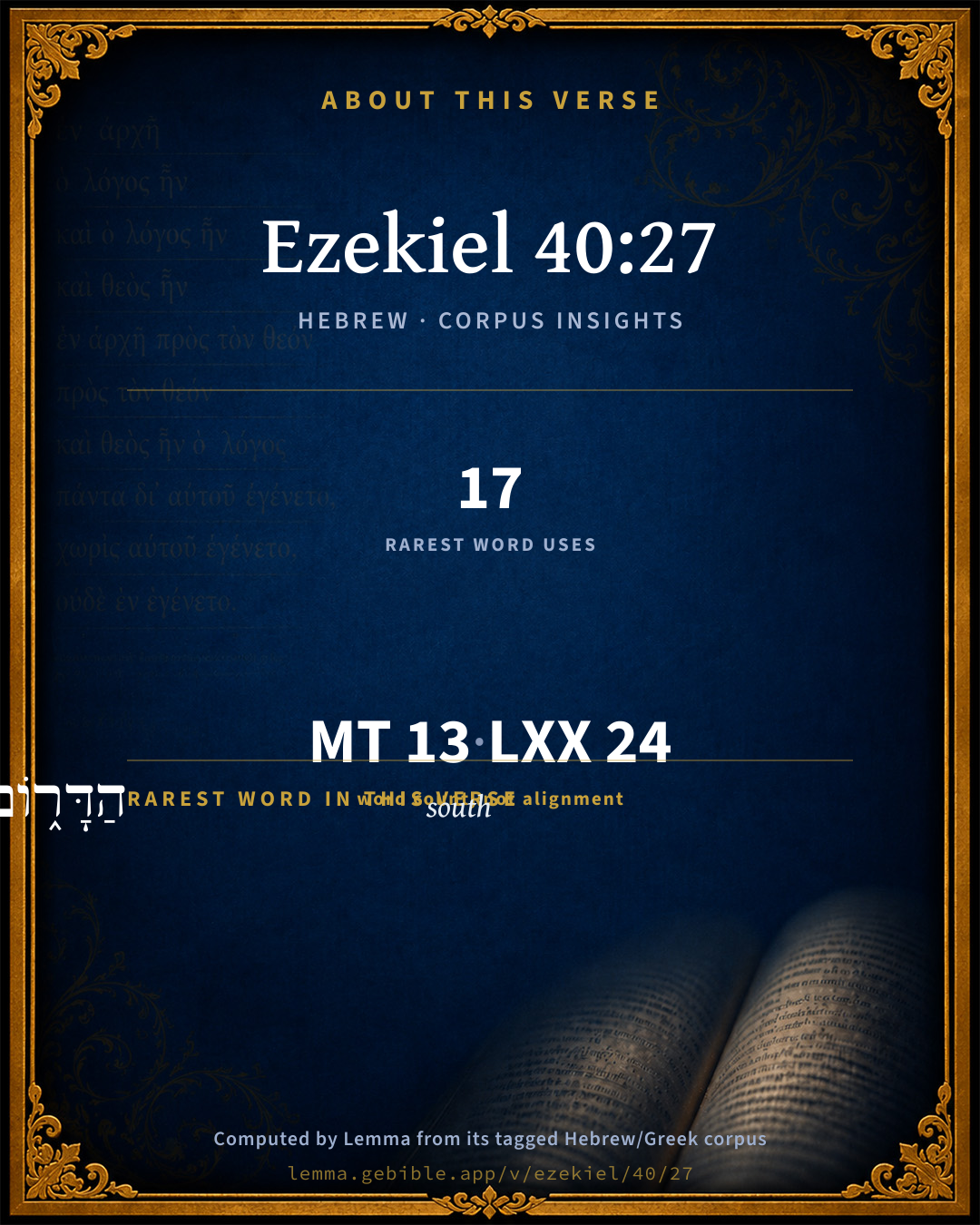
The rarest word here is הַדָּר֑וֹם south H1864 — appearing just 17 times in the whole Hebrew Bible.

Shared distinctive vocabulary

הַדָּר֑וֹם south H1864 occurs in 14 verses of the Hebrew Bible. Also found in:

Grammatical profile

  • 1 verb
  • 9 nouns
  • 2 adjectives
  • 1 preposition

Verb forms

  • וַיָּ֨מָד Qal · Sequential Imperfect

Repetition

Words recur within this verse — often emphatic in Hebrew:

  • וְשַׁ֛עַר gate H8179 ×3
  • דֶּ֣רֶךְ way H1870 ×2
  • הַדָּר֑וֹם south H1864 ×2

Hebrew & Septuagint length

In English translation the verse runs 24 words from the Hebrew and 28 from the Septuagint (LXX English) — closely comparable.

A rough comparison of the two English renderings, which tokenize alike — not a word-level alignment.

Word counts can differ between the Hebrew and the Greek without any difference in meaning — e.g. the Hebrew direct-object marker אֵת has no separate Greek word, and Greek often adds the article ὁ.

In the original languages it is 13 Hebrew tokens and 24 Greek tokens — but the two are counted differently (Hebrew bundles its prefixes and suffixes into one token; the Greek is in lemma form), so that isn’t a like-for-like length.

Cross-references

4

Topical passages linked to Ezekiel 40:27 in the Treasury of Scripture Knowledge — connected by theme and wording, ordered by reader-vote popularity; previews shown in the World English Bible.

  • Ezekiel 40:23 There was a gate to the inner court over against the [other] gate, [both] on the north and on the east; and he measured from gate to gate one hundred cubits.
  • Ezekiel 40:32 He brought me into the inner court toward the east: and he measured the gate according to these measures;
  • Ezekiel 40:19 Then he measured the breadth from the forefront of the lower gate to the forefront of the inner court outside, one hundred cubits, [both] on the east and on the north.
  • Ezekiel 40:47 He measured the court, one hundred cubits long, and a hundred cubits broad, foursquare; and the altar was before the house.

Cross-references courtesy of OpenBible.info (CC BY 4.0).

Hebrew and Greek witnesses Masoretic Hebrew ↔ Greek Septuagint

The same verse in the two great witnesses to the Old Testament, shown verse-for-verse.

These are two independent witnesses, not word-aligned to each other, and the Septuagint is shown in lemma (dictionary) form.

Hebrew Ezekiel 40:27 Masoretic · Westminster Leningrad Codex

וְשַׁ֛עַר לֶחָצֵ֥ר הַפְּנִימִ֖י דֶּ֣רֶךְ הַדָּר֑וֹם וַיָּ֨מָד מִשַּׁ֧עַר אֶל הַשַּׁ֛עַר דֶּ֥רֶךְ הַדָּר֖וֹם מֵאָ֥ה אַמּֽוֹת

There was a gate to the inner court toward the south: and he measured from gate to gate toward the south a hundred cubits.

World English Bible · Public Domain

Greek LXX Ezekiel 40:27 Septuagint · lemma form

καί πύλη κατέναντι πύλη ὁ αὐλή ὁ ἐσώτερος πρός νότος καί διαμετρέω ὁ αὐλή ἀπό πύλη ἐπί πύλη πῆχυς ἑκατόν ὁ εὖρος πρός νότος

And there was a gate opposite the gate of the inner court southward: and he measured the court from gate to gate, one hundred cubits in breadth southward.

LXX2012 (modern English Septuagint) · Public Domain

Hebrew: Westminster Leningrad Codex (CC BY 4.0). Greek: Septuagint (public domain); English from LXX2012 (modern English Septuagint) (Public Domain). How the Septuagint differs from the Hebrew →

Targum (Aramaic paraphrase)

1

The Targum is the ancient Jewish Aramaic paraphrase of the Hebrew Scriptures — an interpretive translation, not the Hebrew text itself. Onkelos (literal) and Pseudo-Jonathan (expansive) render the Torah, and Jonathan the Prophets. Coverage is partial: where no permissively-licensed English translation exists for a verse, only the Aramaic is shown. This is verse-level text, not a word-by-word alignment to the Hebrew.

  1. Targum Jonathan Prophets (Joshua–Malachi)
    וְתַרְעָא דְדַרְתָּא גַוִיתָא בְּאוֹרַח דְרוֹמָא וּמְשַׁח מִתְּרַע לִתְרַע בְּאוֹרַח דָרוֹמָא מְאָה אַמִין:

    (no public-domain English translation for this verse)

    Targum Jonathan — Aramaic: “Mikraot Gedolot” (public domain). English: “Sefaria Community Translation” (CC0 1.0 (public-domain dedication)); “London "Chaldee Paraphrase," 1871” (public domain). Text via Sefaria.

Commentary

Notes on Ezekiel 40:27 from classic Christian and Jewish commentators (each source and its license shown beneath its notes). The classic Christian expositions comment on the surrounding passage and are grouped to its opening verse, so a note may address several verses; the Jewish commentaries on the Tanakh (Rashi and others) are per-verse, so they appear only where the commentator wrote on this verse.

Lemma curates 59 commentaries, every one of them public domain or Creative Commons licensed, each selected and text-cleaned for this edition rather than reprinted as found. About our sources →

Matthew Henry's Commentary

In these verses we have a delineation of the inner court. The survey of the outer court ended with the south side of it. This of the inner court begins with the south side (Eze 40:27), proceeds to the east (Eze 40:32), and so to the north (Eze 40:35); for here is no gate either of the outer or inner court towards the west. It should seem that in Solomon's temple there were gates westward, for we find porters towards the west, Ch1 9:24; Ch1 26:8. But Josephus says that in the second temple there was no gate on the west side. Observe, 1. These gates into the inner court were exactly uniform with those into the outer court, the dimensions the same, the chambers adjoining the same, the galleries or rows round the court the same, and the very engravings on the posts the same. The work of grace, and its workings, are the same, for substance, in grown Christians that they are in young beginners, only that the former have got so much nearer their perfection. The faith of all the saints is alike precious, though it be not alike strong. There is a great resemblance between one child of God and another; for all they are brethren and bear the same image. 2. The ascent into the outer court at each gate was by seven steps, but the ascent into the inner court at each gate was by eight steps. This is expressly taken notice of (Eze 40:31, Eze 40:34, Eze 40:37), to signify that the nearer we approach to God the more we should rise above this world and the things of it. The people, who worshipped in the outer court, must rise seven steps above other people, but the priests, who attended in the inner court, must rise eight steps above them, must exceed them at least one step more than they exceed other people.

Matthew Henry's Commentary on the Whole Bible (1708–1710) — public domain (CC PDM 1.0). Text via the HelloAO Bible API.

Joseph Benson's Commentary

Eze 40:27-31. And there was a gate in the inner court toward the south — The south gate in the inner court was exactly parallel to the south gate in the outer court: see Eze 40:23. And he brought me to the inner court by the south gate — Those who maintain that the outer court enclosed the inner on the east, north, and south sides, explain these words in this sense, that the prophet was conducted from the south gate of the outer court, Eze 40:24, to the south gate of the inner court, which was over against it, and so into the inner court itself. And he measured the south gate, &c. — After he had measured the inner court, he took the dimensions of the south gate itself, and the chambers thereto belonging, and found them of the same dimensions with the former. The arches five and twenty cubits long, &c. — Length is here taken for height, as before, Eze 40:11. The words express the dimensions of those arches which were between the several little chambers, between each of which there was a space of five cubits, Eze 40:7. The arches were toward the outer court — Or, were like [those of] the outer court.

Joseph Benson's Commentary on the Old and New Testaments (1811–1818) — public domain. Text from a community e-Sword module.

John Gill's Exposition

And he brought me to the inner court by the south gate,.... Having done with the outer court, east, north, and south, the prophet is brought into the inner court by the south gate, which was nearest to enter by. No mention is made of a western gate, there was one in Solomon's temple; for there were porters appointed westward by David, and fixed by Solomon, Ch1 9:24, but Josephus (l) says, in the second temple the western part had no gate, but a continued wall; for those that came out of the captivity, as Kimchi on Eze 40:5 observes, built it (as much as they could) according to the form of what they saw in Ezekiel's temple, which shall be in time to come.

And he measured the south gate according to these measures; the gate which led into the inner court; for the south gate, which led to the outward court, he had measured before, Eze 40:21.

(l) De Bello Jud. l. 5. c. 5. sect. 2. Vid. Lipman, Tzurath Beth Hamikdash, sect. 12.

John Gill's Exposition of the Whole Bible (1746–1763) — public domain (CC PDM 1.0). Text via the HelloAO Bible API.

Matthew Poole's English Annotations

As before the east gate answered to east, and north to north, so here one south gate answers to the other in the confronting or parallel walls, and in all points exactly uniform. To prevent repetition, I refer you to the particular measures, &c. of the east gate.

Matthew Poole's English Annotations on the Holy Bible (1683–1685) — public domain. Text from a community e-Sword/MySword module.

Lesson kit

Teaching starters — assembled from the data on this page, not authored interpretation. Every prompt links to the verse data it draws on. Edit before teaching.

Ezekiel, in the Prophets, opens this verse with 13 words (9 distinct Hebrew lemmas). Its most distinctive word is dârôwm (“south”). A historical commentator’s framing appears above. Read the whole chapter for the surrounding context.

Discussion questions

  1. What does “south” (dârôwm) contribute to the verse as a whole?
  2. Deuteronomy 33:23 shares the word «south» with this verse. How do the two illuminate each other?
  3. “gate” occurs 3× in this one verse. What is the effect of the repetition?
  4. These translations render this verse differently; the difference is in the English rendering, not the original. What questions does that raise?
  5. The verb «וַיָּ֨מָד» is Qal Sequential Imperfect. How does its form color the action?
  6. Reading how Matthew Henry's Commentary and Joseph Benson's Commentary read this verse, where do the two commentators agree and where do they part?

Things to notice

Reading settings

Reading text

Shown beneath each verse's original-language words.

Old Testament
Old Testament edition

Read the OT as the Masoretic Hebrew (MT) or the Greek Septuagint (LXX).

English shown for the Greek Septuagint (in the Hebrew ↔ Greek comparison).

Comparing translations? Open the Compare panel on any verse page to stack up to four side by side.