Ezekiel 40:28

Hebrew (Westminster Leningrad Codex) Ezekiel 40:28 appears in the Hebrew Old Testament. The text above is from the Westminster Leningrad Codex. Each word links to its Strong’s number, a concise gloss, and parsing drawn from the Open Scriptures Hebrew Bible morphology. Click any word for its full Brown-Driver-Briggs (BDB) entry.
Download image
Cite this verse

Ezekiel 40:28 (World English Bible). Public Domain. Lemma interlinear Bible study tool, https://lemma.gebible.app/v/ezekiel/40/28.

Show BibTeX & RIS
BibTeX
RIS
English Translation
Then he brought me to the inner court by the south gate: and he measured the south gate according to these measures;
World English Bible · Public Domain
Download a study sheet

One document with this verse’s original text, its word-by-word gloss line, the meaning frame, cross-references with their text, attributed commentary, and full source and license credits — printable, and it pastes into notes with its structure intact.

This verse Autodidact and up

Study sheet (.html) Plain text (.txt)

A passage Seminary Student

Up to 50 verses in one chapter. A passage sheet keeps up to 6 commentary sources and 12 cross-references per verse, in the order this page ranks them, and says so on the sheet whenever that leaves anything out. Ask for a single verse and you get the Autodidact verse sheet above.

Everything on this page stays free to read, with no account — the sheet is a download of what is already on screen, not access to it.

Want to remove ads? Support Godless Engineer
Compare translations 3

The same verse in 3 English versions, stacked beneath the original-language interlinear above. Click any original word for its lexicon entry.

Each is an independent rendering of the whole verse — the interlinear is not word-aligned to these translations.

Highlighted words mark where these versions differ — a whole-verse word diff, not a word-by-word alignment.

  • World English Bible Public Domain
    Then he brought me to the inner court by the south gate: and he measured the south gate according to these measures;
  • King James Version Public Domain
    And he brought me to the inner court by the south gate: and he measured the south gate according to these measures;
  • unfoldingWord Literal Text CC BY-SA 4.0
    Then the man brought me to the inner courtyard by way of its southern gate, which had the same measurements as the other gates.

unfoldingWord Literal Text — © unfoldingWord, licensed CC BY-SA 4.0. Word-aligned USFM3 via Door43 (git.door43.org/unfoldingWord/en_ult).

Versions to compare (up to 4)

3 of 4 selected

Show all 18 translations

Every available English version of this verse, each an independent rendering of the whole verse.

  • World English Bible Public Domain
    Then he brought me to the inner court by the south gate: and he measured the south gate according to these measures;
  • Berean Standard Bible Public Domain
    Next he brought me into the inner court through the south gate, and he measured the south gate; it had the same measurements as the others.
  • Majority Standard Bible Public Domain
    Next he brought me into the inner court through the south gate, and he measured the south gate; it had the same measurements as the others.
  • King James Version Public Domain
    And he brought me to the inner court by the south gate: and he measured the south gate according to these measures;
  • American Standard Version (1901) Public Domain
    Then he brought me to the inner court by the south gate: and he measured the south gate according to these measures;
  • Revised Version (1885) Public Domain
    Then he brought me to the inner court by the south gate: and he measured the south gate according to these measures;
  • Geneva Bible (1599) Public Domain
    And he brought me into the inner court by the South gate, and he measured the South gate according to these measures,
  • Douay-Rheims (1899) Public Domain
    And he brought me into the inner court at the south gate: and he measured the gate according to the former measures.
  • Young's Literal Translation Public Domain
    And he bringeth me in unto the inner court by the south gate, and he measureth the south gate according to these measures;
  • Literal Standard Version CC BY-SA 4.0
    And he brings me into the inner court by the south gate, and he measures the south gate according to these measurements;
  • Unlocked Literal Bible CC BY-SA 4.0
    Then the man brought me to the inner courtyard by way of its southern gate, which had the same measurements as the other gates.
  • unfoldingWord Literal Text CC BY-SA 4.0
    Then the man brought me to the inner courtyard by way of its southern gate, which had the same measurements as the other gates.
  • Darby Bible Public Domain
    And he brought me into the inner court by the south gate; and he measured the south gate according to these measures:
  • World Messianic Bible Public Domain
    Then he brought me to the inner court by the south gate. He measured the south gate according to these measurements;
  • Webster's Bible Public Domain
    And he brought me to the inner court by the south gate; and he measured the south gate according to these measures;
  • Free Bible Version CC BY-SA 4.0
    He took me into the inner courtyard through the south gate, and he measured the south gate. It measured the same as those previously.
  • Bible in Basic English Public Domain
    Then he took me to the inner square by the south doorway: and he took the measure of the south doorway by these measures;
  • JPS Tanakh (1917) Public Domain
    Then he brought me to the inner court by the south gate; and he measured the south gate according to these measures;

Literal Standard Version (2020), Covenant Press — licensed CC BY-SA 4.0. Text via the HelloAO Bible API (eBible.org). Unlocked Literal Bible (unfoldingWord) — licensed CC BY-SA 4.0. Text via the HelloAO Bible API (eBible.org). unfoldingWord Literal Text — © unfoldingWord, licensed CC BY-SA 4.0. Word-aligned USFM3 via Door43 (git.door43.org/unfoldingWord/en_ult). Free Bible Version, Dr. Jonathan Gallagher — licensed CC BY-SA 4.0. Text via the HelloAO Bible API (eBible.org).

Word by word

More ways to search: Search by grammar → Find every occurrence → Compare this word →

Practice this passage: Drill this verse → Learn its vocabulary →

הַדָּר֑וֹם
dârôwm
H1864
“the · south”
Particle, Definite Article + Noun, Common, Masculine, Singular, Absolute
Part of Speech
Particle + Noun
Type
Common
Gender
Masculine
Number
Singular
State
Absolute
Full BDB Definition

Origin: of uncertain derivation

TWOT: 454d

south
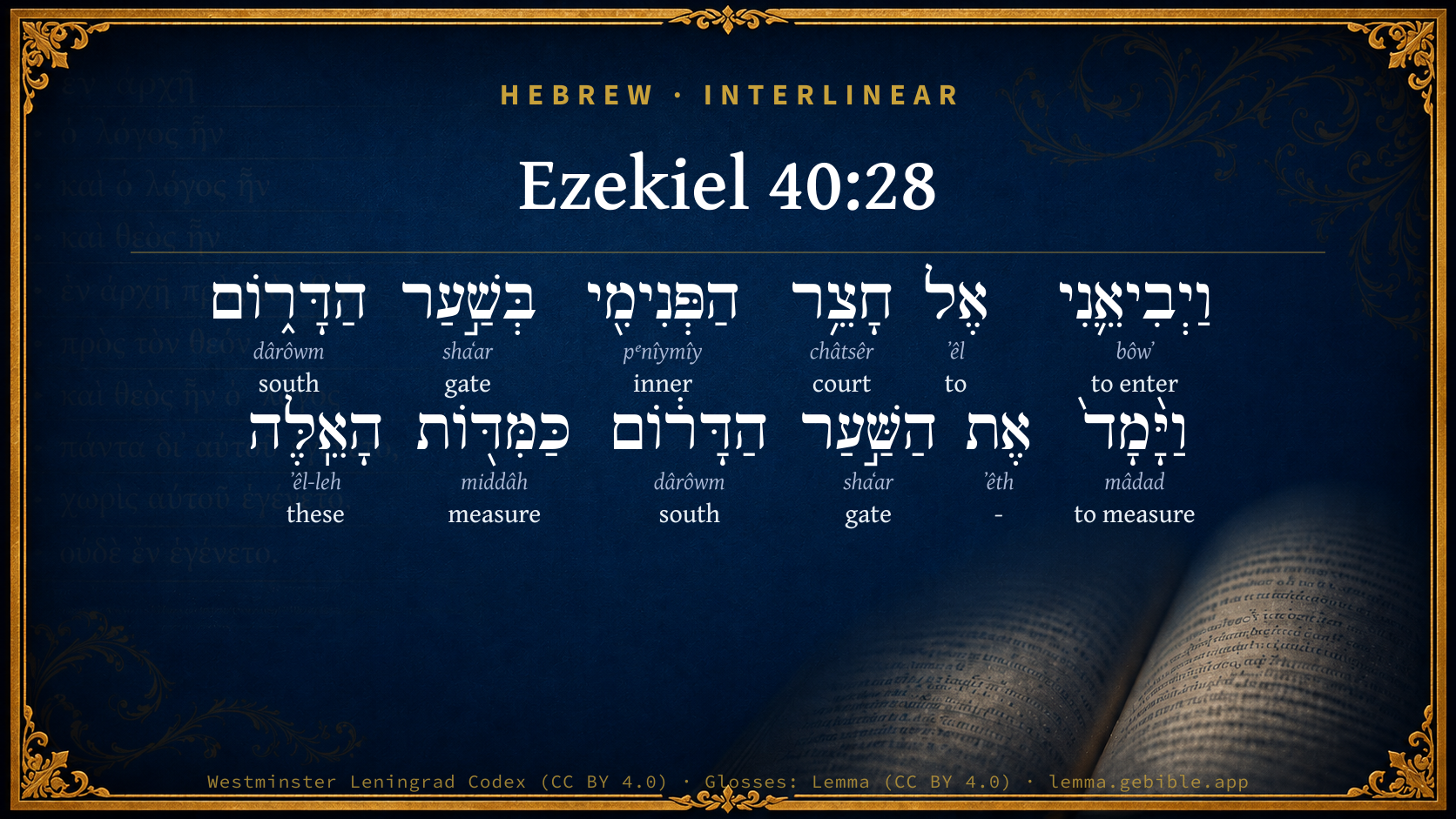
  1. וַיְבִיאֵ֛נִי bôwʼ H935 “and · to enter · me” Conjunction + Verb, Hiphil, Sequential Imperfect, 3rd Person, Masculine, Singular + Suffix, Personal, 1st Person, Common, Singular
  2. אֶל ʼêl H413 “to” Preposition
  3. חָצֵ֥ר châtsêr H2691 “court” Noun, Common, Both, Singular, Absolute
  4. הַפְּנִימִ֖י pᵉnîymîy H6442 “the · inner” Particle, Definite Article + Adjective, Adjective, Masculine, Singular, Absolute
  5. בְּשַׁ֣עַר shaʻar H8179 “in/at · gate of” Preposition + Noun, Common, Masculine, Singular, Construct
  6. וַיָּ֨מָד֙ mâdad H4058 “and · to measure” Conjunction + Verb, Qal, Sequential Imperfect, 3rd Person, Masculine, Singular
  7. אֶת ʼêth H853 “-” Particle, Direct Object
  8. הַשַּׁ֣עַר shaʻar H8179 “the · gate” Particle, Definite Article + Noun, Common, Masculine, Singular, Absolute
  9. הַדָּר֔וֹם dârôwm H1864 “the · south” Particle, Definite Article + Noun, Common, Masculine, Singular, Absolute
  10. כַּמִּדּ֖וֹת middâh H4060 “like/as the · measures” Preposition, Determined + Noun, Common, Feminine, Plural, Absolute
  11. הָאֵֽלֶּה ʼêl-leh H428 “the · these” Particle, Definite Article + Pronoun, Demonstrative, Common, Plural

About this verse

These counts appear in no published source. They are computed here, from the morphology-tagged text and Lemma’s own curated glosses. What Lemma adds →

12
words
10
distinct lemmas
Prophets
section

Notable vocabulary

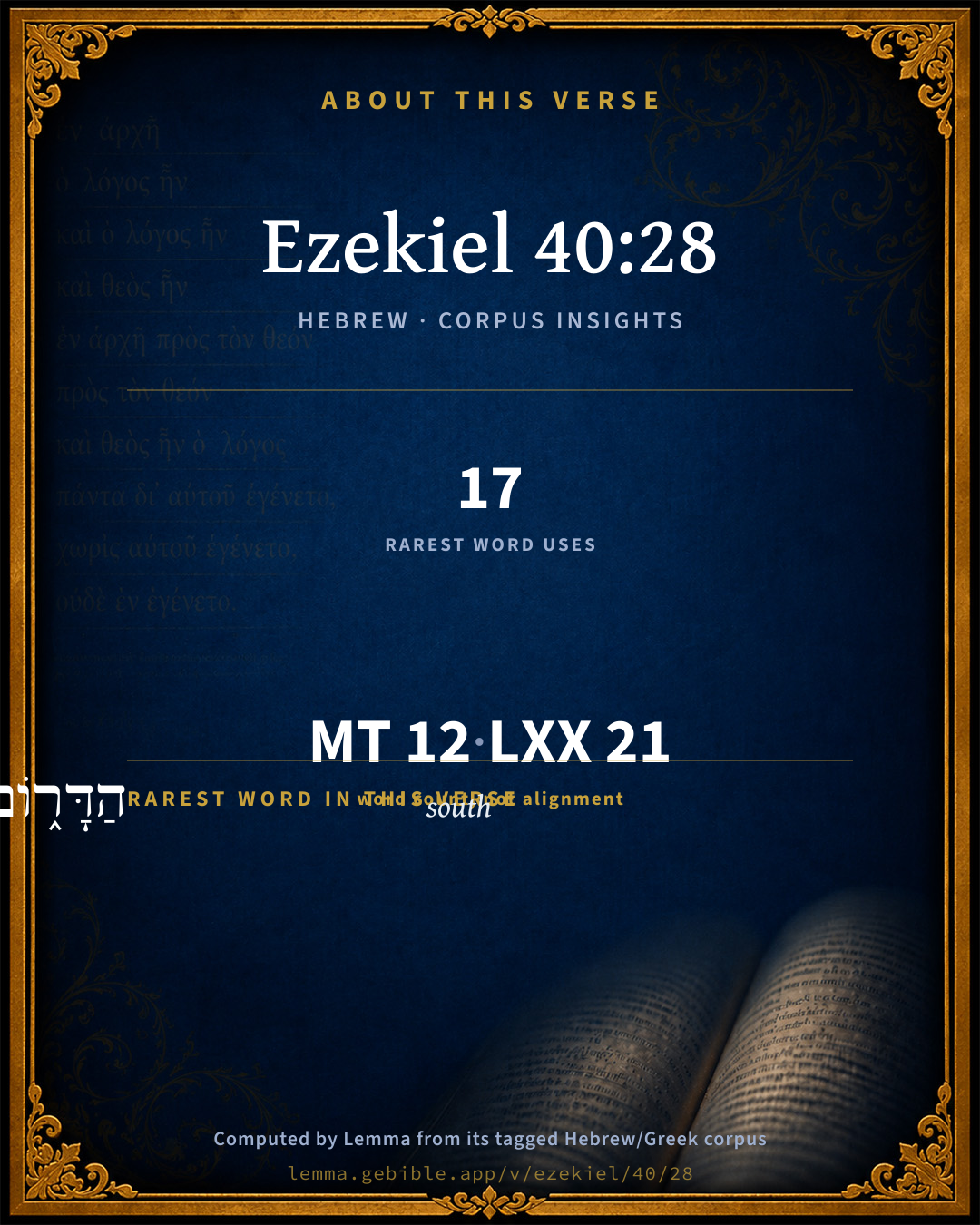
The rarest word here is הַדָּר֑וֹם south H1864 — appearing just 17 times in the whole Hebrew Bible.

Shared distinctive vocabulary

הַדָּר֑וֹם south H1864 occurs in 14 verses of the Hebrew Bible. Also found in:

Grammatical profile

  • 2 verbs
  • 6 nouns
  • 1 adjective
  • 1 pronoun
  • 1 preposition
  • 1 particle

Verb forms

  • וַיְבִיאֵ֛נִי Hiphil · Sequential Imperfect
  • וַיָּ֨מָד֙ Qal · Sequential Imperfect

Repetition

Words recur within this verse — often emphatic in Hebrew:

  • בְּשַׁ֣עַר gate H8179 ×2
  • הַדָּר֑וֹם south H1864 ×2

Hebrew & Septuagint length

In English translation the verse runs 22 words from the Hebrew and 21 from the Septuagint (LXX English) — closely comparable.

A rough comparison of the two English renderings, which tokenize alike — not a word-level alignment.

Word counts can differ between the Hebrew and the Greek without any difference in meaning — e.g. the Hebrew direct-object marker אֵת has no separate Greek word, and Greek often adds the article ὁ.

In the original languages it is 12 Hebrew tokens and 21 Greek tokens — but the two are counted differently (Hebrew bundles its prefixes and suffixes into one token; the Greek is in lemma form), so that isn’t a like-for-like length.

Cross-references

2

Topical passages linked to Ezekiel 40:28 in the Treasury of Scripture Knowledge — connected by theme and wording, ordered by reader-vote popularity; previews shown in the World English Bible.

  • Ezekiel 40:35 He brought me to the north gate: and he measured [it] according to these measures;
  • Ezekiel 40:32 He brought me into the inner court toward the east: and he measured the gate according to these measures;

Cross-references courtesy of OpenBible.info (CC BY 4.0).

Hebrew and Greek witnesses Masoretic Hebrew ↔ Greek Septuagint

The same verse in the two great witnesses to the Old Testament, shown verse-for-verse.

These are two independent witnesses, not word-aligned to each other, and the Septuagint is shown in lemma (dictionary) form.

Hebrew Ezekiel 40:28 Masoretic · Westminster Leningrad Codex

וַיְבִיאֵ֛נִי אֶל חָצֵ֥ר הַפְּנִימִ֖י בְּשַׁ֣עַר הַדָּר֑וֹם וַיָּ֨מָד֙ אֶת הַשַּׁ֣עַר הַדָּר֔וֹם כַּמִּדּ֖וֹת הָאֵֽלֶּה

Then he brought me to the inner court by the south gate: and he measured the south gate according to these measures;

World English Bible · Public Domain

Greek LXX Ezekiel 40:28 Septuagint · lemma form

καί εἰςἄγω ἐγώ εἰς ὁ αὐλή ὁ ἐσώτερος ὁ πύλη ὁ πρός νότος καί διαμετρέω ὁ πύλη κατά ὁ μέτρον οὗτος

And he brought me into the inner court of the south gate: and he measured the gate according to these measures;

LXX2012 (modern English Septuagint) · Public Domain

On this verse, Keil & Delitzsch discusses the Septuagint’s reading. Read the note in Commentary ↓

Hebrew: Westminster Leningrad Codex (CC BY 4.0). Greek: Septuagint (public domain); English from LXX2012 (modern English Septuagint) (Public Domain). How the Septuagint differs from the Hebrew →

Targum (Aramaic paraphrase)

1

The Targum is the ancient Jewish Aramaic paraphrase of the Hebrew Scriptures — an interpretive translation, not the Hebrew text itself. Onkelos (literal) and Pseudo-Jonathan (expansive) render the Torah, and Jonathan the Prophets. Coverage is partial: where no permissively-licensed English translation exists for a verse, only the Aramaic is shown. This is verse-level text, not a word-by-word alignment to the Hebrew.

  1. Targum Jonathan Prophets (Joshua–Malachi)
    וְאָעֵילְנִי לְדַרְתָּא גַוַיְתָא בִּתְרַע דָרוֹמָא וּמְשַׁח יַת תְּרַע דָרוֹמָא כְּמִשְׁחֲתָא הָאִלֵין:

    (no public-domain English translation for this verse)

    Targum Jonathan — Aramaic: “Mikraot Gedolot” (public domain). English: “Sefaria Community Translation” (CC0 1.0 (public-domain dedication)); “London "Chaldee Paraphrase," 1871” (public domain). Text via Sefaria.

Commentary

Notes on Ezekiel 40:28 from classic Christian and Jewish commentators (each source and its license shown beneath its notes). The classic Christian expositions comment on the surrounding passage and are grouped to its opening verse, so a note may address several verses; the Jewish commentaries on the Tanakh (Rashi and others) are per-verse, so they appear only where the commentator wrote on this verse.

Lemma curates 59 commentaries, every one of them public domain or Creative Commons licensed, each selected and text-cleaned for this edition rather than reprinted as found. About our sources →

Ellicott's Commentary for English Readers

(28) Brought me to the inner court.—The preposition should be translated into, being the same with that in Eze_40:32. The prophet having entered the inner court by the south gate, this is first described (Eze_40:28-31). This and the other gates of this court are essentially the same, and require the same changes of translation as in the case of the outer gates. The same plan will serve for both, remembering that it must be reversed, the porches of one set of gates facing the porches of the other set; of course the steps led to the porches of the inner gates instead of to the opposite end. The few points of difference between them will be noted as they occur.

A Bible Commentary for English Readers, edited by Charles John Ellicott (1878–1897) — public domain. Text from a community e-Sword module.

Whedon's Commentary on the Bible

Daniel D. Whedon

MEASUREMENTS OF THE INNER COURT WITH ITS GATES, ARRANGEMENTS FOR SACRIFICES, AND CELLS FOR PRIESTS, Eze_40:28-49.

28-37. “The construction and measurements correspond with those of the gates in the outer court, with only two points of difference; namely, that it possessed a flight of eight steps instead of seven, and that the arches or wall projections were toward the outer court. The difference in the number of steps was doubtless of symbolic significance, and pointed not only to the higher sanctity in general which attached to the inner court, but to the truth that, as one approached the dwelling place of Jehovah, an increasing measure and degree of holiness were demanded. The seven steps of the outer door, added to the eight steps of this, amount to fifteen, with which correspond the number of the pilgrim psalms (Psalms 120-134), which are supposed to have been sung one upon each step by the choir of Levites as they ascended first into the outer and then into the inner court.” — Plumptre.

Daniel D. Whedon (gen. ed.), Commentary on the Old and New Testaments (1874–1909) — public domain. Text from a community e-Sword module.

Keil & Delitzsch

C. F. Keil & F. Delitzsch

The Gates of the Inner Court

(Vid., Plate I B and Plate II II). - Eze 40:28. And he brought me into the inner court through the south gate, and measured the south gate according to the same measures; Eze 40:29. And its guard-rooms, and its pillars, and its wall-projections, according to the same measures; and there were windows in it and in its wall-projections round about: fifty cubits was the length, and the breadth five and twenty cubits. Eze 40:30. And wall-projections were round about, the length five and twenty cubits, and the breadth five cubits. Eze 40:31. And its wall-projections were toward the outer court; and there were palms on its pillars, and eight steps its ascendings. Eze 40:32. And he led me into the inner court toward the east, and measured the gate according to the same measures; Eze 40:33. And its guard-rooms, and its pillars, and its wall-projections, according to the same measures; and there were windows in it and its wall-projections round about: the length was fifty cubits, and the breadth five and twenty cubits. Eze 40:34. And its wall-projections were toward the outer court; and there were palms on its pillars on this side and on that side, and eight steps its ascent. Eze 40:35. And he brought me to the north gate, and measured it according to the same measures; Eze 40:36. Its guard-rooms, its pillars, and its wall-projections; and there were windows in it round about: the length was fifty cubits, and the breadth five and twenty cubits. Eze 40:37. And its pillars stood toward the outer court; and palms were upon its pillars on this side and on that; and its ascent was eight steps. - In Eze 40:27 the measuring man had measured the distance from the south gate of the outer court to the south gate of the inner court, which stood opposite to it. He then took the prophet through the latter (Eze 40:28) into the inner court, and measured it as he went through, and found the same measurements as he had found in the gates of the outer court. This was also the case with the measurements of the guard-rooms, pillars, and wall-projections, and with the position of the windows, and the length and breadth of the whole of the gate-building (Eze 40:29); from which it follows, as a matter of course, that this gate resembled the outer gate in construction, constituent parts, and dimensions. This also applied to both the east gate and north gate, the description of which in Eze 40:32-37 corresponds exactly to that of the south gate, with the exception of slight variations of expression. It is true that the porch is not mentioned in the case of either of these gates; but it is evident that this was not wanting, and is simply passed over in the description, as we may see from Eze 40:39, where the tables for the sacrifices are described as being in the porch (בּאוּלם). There are only two points of difference mentioned in Eze 40:31, Eze 40:34, and Eze 40:37, by which these inner gates were distinguished from the outer. In the first place, that the flights of steps to the entrances to these gates had eight steps according to the closing words of the verses just cited, whereas those of the outer gates had only seven (cf. Eze 40:22 and Eze 40:26); whilst the expression also varies. מעלו being constantly used here instead of עלותו (Eze 40:26). עלות, from עלה, the ascending, are literally ascents, i.e., places of mounting, for a flight of steps or staircase. מעלו, the plural of מללה, the ascent (not a singular, as Hitzig supposes), has the same meaning.

The second difference, which we find in the first clause of the verses mentioned, as of a more important character. It is contained in the words, "and its אלמּים (the projecting portions of the inner side-walls of the gateway) were directed toward the outer court" (אל and ל indicating the direction). The interpretation of this somewhat obscure statement is facilitated by the fact that in Eze 40:37 אילו stands in the place of אילמּו (Eze 40:31 and Eze 40:34). אילו are the two lofty gate-pillars by the porch of the gate, which formed the termination of the gate-building towards the inner court in the case of the outer gates. If, then, in the case of the inner gates, these pillars stood toward the outer court, the arrangement of these gates must have taken the reverse direction to that of the outer gates; so that a person entering the gate would not go from the flight of steps across the threshold to the guard-rooms, and then across the second threshold to the porch, but would first of all enter the porch by the pillars in front, and then go across the threshold to the guard-rooms, and, lastly, proceed across the second threshold, and so enter the inner court. But if this gate-building, when looked at from without, commenced with the porch-pillars and the front porch, this porch at any rate must have been situated outside the dividing wall of the two courts, that is to say, must have been within the limits of the outer court. And further, if the אילמּים, or wall-projections between the guard-rooms and by the thresholds, were also directed toward the outer court, the whole of the gate-building must have been built within the limits of that court. This is affirmed by the first clauses of Eze 40:31, Eze 40:34, and Eze 40:37, which have been so greatly misunderstood; and there is no necessity to alter ואילו in Eze 40:37 into ואלמּו, in accordance with Eze 40:31 and Eze 40:34. For what is stated in Eze 40:31 and Eze 40:34 concerning the position or direction of the אילמּים, also applies to the אילים; and they are probably mentioned in Eze 40:37 because of the intention to describe still further in Eze 40:38 what stood near the אילים. Kliefoth very properly finds it incomprehensible, "that not a few of the commentators have been able, in spite of these definite statements in Eze 40:13, Eze 40:34, and Eze 40:37, to adopt the conclusion that the gate-buildings of the inner gates were situated within the inner court, just as the gate-buildings of the outer gates were situated within the outer court. As the inner court measured only a hundred cubits square, if the inner gates had stood within the inner court, the north and south gates of the inner court would have met in the middle, and the porch of the east gate of the inner court would have stood close against the porches of the other two gates. It was self-evident that the gate-buildings of the inner gates stood within the more spacious outer court, like those of the outer gates. Nevertheless, the reason why the situation of the inner gates is so expressly mentioned in the text is evidently, that this made the position of the inner gates the reverse of that of the outer gates. In the case of the outer gates, the first threshold was in the surrounding wall of the outer court, and the steps stood in front of the wall; and thus the gate-building stretched into the outer court. In that of the inner gates, on the contrary the second threshold lay between the surrounding walls of the inner court, and the gate-building stretched thence into the outer court, and its steps stood in front of the porch of the gate. Moreover, in the case of the east gates, for example, the porch of the outer gate stood toward the west, and the porch of the inner gate toward the east, so that the two porches stood opposite to each other in the outer court, as described in Eze 40:23 and Eze 40:27."

In Eze 40:30 further particulars respecting the אילמּים are given, which are apparently unsuitable; and for this reason the verse has been omitted by the lxx, while J. D. Michaelis, Bttcher, Ewald, Hitzig, and Maurer, regard it as an untenable gloss. Hvernick has defended its genuineness; but inasmuch as he regards אילמּים as synonymous with אוּלם, he has explained it in a most marvellous and decidedly erroneous manner, as Kliefoth has already proved. The expression סביב סביב, and the length and breadth of the אלמּות here given, both appear strange. Neither of the length of the twenty-five cubits nor the breadth of the five cubits seems to tally with the other measures of the gate-building. So much may be regarded as certain, that the twenty-five cubits' length and the five cubits' breadth of the אלמּות cannot be in addition to the total length of the gate-building, namely fifty cubits, or its total breadth of twenty-five cubits, but must be included in them. For the אלמּות were simply separate portions of the side-enclosure of the gateway, since this enclosure of fifty cubits long consisted of wall-projections (אלמּות), three open guard-rooms, and a porch with pillars. The open space of the guard-rooms was 3 x 6 = 18 cubits, and the porch was six cubits broad in the clear (Eze 40:7 and Eze 40:8), and the pillars two cubits thick. If we deduct these 18 + 6 + 2 = 26 cubits from the fifty cubits of the entire length, there remain twenty-four cubits for the walls by the side of the thresholds and between the guard-rooms, namely, 2 x 5 = 10 cubits for the walls between the three guard-rooms, 2 x 6 = 12 cubits for the walls of the threshold, and 2 cubits for the walls of the porch; in all, therefore, twenty-four cubits for the אלמּות; so that only one cubit is wanting to give us the measurement stated, viz., twenty-five cubits. We obtain this missing cubit if we assume that the front of the wall-projections by the guard-rooms and thresholds was a handbreadth and a half, or six inches wider than the thickness of the walls, that is to say, that it projected three inches on each side in the form of a moulding. - The breadth of the אלמּות in question, namely five cubits, was the thickness of their wall-work, however, or the dimension of the intervening wall from the inside to the outside on either side of the gateway. That the intervening walls should be of such a thickness will not appear strange, if we consider that the surrounding wall of the court was six cubits thick, with a height of only six cubits (Eze 40:5). And even the striking expression סביב סביב becomes intelligible if we take into consideration the fact that the projecting walls bounded not only the entrance to the gate, and the passage through it on the two sides, but also the inner spaces of the gate-building (the guard-rooms and porch) on all sides, and, together with the gates, enclosed the gateway on every side. Consequently Eze 40:30 not only as a suitable meaning, but furnishes a definite measurement of no little value for the completion of the picture of the gate-buildings. The fact that this definite measure was not given in connection with the gates of the outer court, but was only supplemented in the case of the south gate of the inner court, cannot furnish any ground for suspecting its genuineness, as several particulars are supplemented in the same manner in this description. Thus, for example, the number of steps in front of the outer gates is first given in Eze 40:22, where the north gate is described. Still less is there to surprise us in the fact that these particulars are not repeated in the case of the following gates, in which some writers have also discovered a ground for suspecting the genuineness of the verse.

From the south gate the measuring man led the prophet (Eze 40:32) into the inner court toward the east, to measure for him the inner east gate, the description of which (Eze 40:33 and Eze 40:34) corresponds exactly to that of the south gate. Lastly, he led him (Eze 40:35) to the inner north gate for the same purpose; and this is also found to correspond to those previously mentioned, and is described in the same manner. The difficulty which Hitzig finds in אל־החצר in Eze 40:32, and which drives him into various conjectures, with the assistance of the lxx, vanishes, if instead of taking דּרך הקּדים along with החצר הפּנימי as a further definition of the latter, we connect it with ויביאני as an indication of the direction taken: he led me into the inner court, the way (or direction) toward the east, and measured the gate (situated there). The words, when taken in this sense, do not warrant the conclusion that he had gone out at the south gate again. - וּמדד in Eze 40:35 is an Aramaic form for ויּמד in Eze 40:32 and Eze 40:28.

Keil & Delitzsch — Biblical Commentary on the Old Testament (1861–1891) — public domain (CC PDM 1.0). Text via the HelloAO Bible API. (Old Testament only.)

Fairbairn on Ezekiel, Jonah & the Pastoral Epistles

Patrick Fairbairn

Having thus finished the boundary wall and the outer court, he comes to the inner court:

Eze 40:28. And he brought me to the inner court, by the south gate; and he measured the gate beyond the south according to these measures (the measures, namely, of the outer gate—the inner were of the same dimensions and general structure).

Eze 40:29. And its chambers, and its pillars, and its porch were according to these measures; and it had windows for it and for its porch round about: fifty cubits long, and twenty-five cubits broad.

Eze 40:30. And the porch round about was twenty-five cubits long, and five cubits broad. (This seems to contradict what has just been said, that the porch of this inner gate was of the same dimensions with the outer one; it is now made immensely larger. Michaelis, Böttcher, Ewald, Hitzig, etc., consequently reject the text in its present form; Hävernick understands what is said of another porch, one looking inwards towards the temple. It may be so, but there is nothing in the text to determine such to be the meaning.)

Eze 40:31. And its porch was toward the outer court; and palm-trees were on its pillars: and its ascent was by eight steps (the outer gate had only seven).

Eze 40:32. And he brought me to the inner court toward the east, and measured the gate according to these measures.

Eze 40:33. And its chambers, and its pillars, and its porch were according to these measures; and it had windows for it and for its porch round about: the length fifty cubits, and the breadth five-and-twenty cubits.

Eze 40:34. And its porch was toward the outer court; and palm trees were on its pillars on both sides: and its ascent was by eight steps.

Eze 40:35. And he brought me to the north gate, and measured according to these measures.

Eze 40:36. Its chambers, its pillars, and its porch, and its windows round about: the length fifty cubits, and the breadth twenty-five cubits.

Eze 40:37. And its pillars were toward the outer court (it seems rather odd that these merely ornamental parts should be mentioned here; we would rather have expected the porch itself, as in the other two cases; but so the text stands); and palm-trees were on the pillars on each side: and the ascent was by eight steps.

Eze 40:38. And there were chambers and doors (literally, a chamber or dwelling, and its doors—but it must be understood collectively as chamber at Eze 40:7 and elsewhere) by the pillars of the gates (that is immediately adjoining to these); there they washed the burnt-offering.

Eze 40:39. And in the porch of the gate were two tables on the one side, and two tables on the other, to slay on them the burnt-offering, and sin-offering, and trespass-offering.

Eze 40:40. And on the side without, where the ascent is to the gate-entrance northwards, were two tables; and on the other side, which was at the porch of the gate, two tables.

Eze 40:41. Four tables were on this side, and four tables on that, by the side of the gate; eight tables whereon they killed.

Eze 40:42. And the four tables for the burnt-offering were of hewn stone, a cubit and a half long, and a cubit and a half broad, and one cubit high; and on them they placed the instruments with which they killed the burnt-offering and the sacrifice.

Eze 40:43. And the boundaries (meaning probably the borders of the tables; this is the only ascertained meaning of the word: see Hengstenberg on Psa 68:14) were one handbreadth, set inwards round about; and on the tables was the flesh of the offering.

The provision here made for killing and washing the sacrifice appears evidently to have been connected with only one of the gates; and yet the passage at the commencement speaks of “the pillars of the gates,” as if it were something in common to them all. But by the original direction (Lev 1:11), the sacrifices were all to be killed on the north side of the altar; and there is no reason to think that that regulation was generally departed from in the ministrations of the old temple. It seems to have been with respect to that custom that Ezekiel himself (Eze 8:5) calls the north gate “the gate of the altar,” that gate being on the account of the sacrifices specially connected with the altar. Hence here it is in immediate connection with the north gate that the description is introduced about the preparation of the sacrifices; and the particular mention of the “north” in Eze 40:40 seems still more decisively to point out the north gate as the quarter to which these arrangements belonged. It appears quite arbitrary, therefore, to substitute (as Ewald and Hitzig here do) the east for the north gate; the more especially as the east gate was to be shut to the mass of worshippers, and must consequently have been the most unsuitable for such a purpose. The description itself, as to its general import, is of the same nature as the preceding. Everything connected even with the killing and preparing of victims must now be regulated by the word of God. Even there all is to have an impress of sacredness, such as has not hitherto been found, in consequence of the higher elevation to which the Divine kingdom was to attain.

Patrick Fairbairn — An Exposition of Ezekiel (1851), Jonah (1849), and The Pastoral Epistles (1874) — public domain. Text from a community e-Sword module.

Tyndale Open Study Notes

Tyndale Open Resources

40:28-34 The inner courtyard was separated from the outer courtyard by another series of substantial gateways, similar in scale and function to the gateways of the outer courtyard. These gateways had entry rooms facing outward toward the outer courtyard, rather than inward as at the outer gates.

Tyndale Open Study Notes — © Tyndale Open Resources, licensed CC BY-SA 4.0. Text via the HelloAO Bible API.

Jamieson, Fausset & Brown

Robert Jamieson, A. R. Fausset & David Brown

The inner court and its gates.

according to these measures--namely, the measures of the outer gate. The figure and proportions of the inner answered to the outer.

Jamieson, Fausset & Brown — Commentary Critical and Explanatory on the Whole Bible (1871) — public domain (CC PDM 1.0). Text via the HelloAO Bible API.

The Cambridge Bible for Schools and Colleges

gen. ed. J. J. S. Perowne

28–37. The inner court and its gateways

The measurement of the outer court was finished at the S. gate. Opposite to this was the S. gate of the inner court at a distance of 100 cubits (Eze_40:27), and the measurement of the inner court naturally begins with the S. gate. The gates of the inner court were similar in all respects to those of the outer court, except that in the former the “porch” lay at the outer end of the gateway, looking into the outer court (Eze_40:31; Eze_40:34; Eze_40:37).

The Cambridge Bible for Schools and Colleges (gen. ed. J. J. S. Perowne; Cambridge University Press, 1878–1918) — public domain. Text from a community e-Sword module.

John Gill's Exposition

And the little chambers thereof, and the posts thereof, and the arches thereof, according to these measures,.... These were at the gate of the inner court; and so they stand in Cocceius's tables; and were of the same measure with the little chambers, posts, and arches, that were at the several outward gates before described; and design the churches and members of them as spiritual worshippers, who, besides the outward form, have the power of godliness:

and there were windows in it, and in the arches thereof round about; these are not said to be narrow, as the other; which perhaps may denote the greater and more increasing light of the churches, ministers, and members:

it was fifty cubits long, and five and twenty cubits broad: that is, the space or portico where these chambers were; and this was the same measure with that where the other chambers were, Eze 40:13.

John Gill's Exposition of the Whole Bible (1746–1763) — public domain (CC PDM 1.0). Text via the HelloAO Bible API.

Haydock's Catholic Bible Commentary

CHAPTER XL.

George Leo Haydock (1774–1849), Haydock's Catholic Family Bible and Commentary, 1859 edition — public domain. Excludes Psalms (Douay-Rheims chapter numbering differs from Protestant) and Deuterocanonical books (Catholic canon only).

Matthew Poole's English Annotations

He brought me from the south gate of the outer court through the porch, and over the one hundred cubit pavement to the south gate of the inner court, which is he described by its harmony with the other gates, which were before measured, and to them are you referred, lest we needlessly repeat the same things.

Matthew Poole's English Annotations on the Holy Bible (1683–1685) — public domain. Text from a community e-Sword/MySword module.

The Pulpit Commentary

Vers. 28-47The inner court, with its gates, chambers and slaughtering-tables:

(1) the south gate (vers. 28-31);

(2) the cast gate (vers. 32-34);

(3) the north gate (vers. 35-37);

(4) the arrangements for sacrifice (vers. 38-43); and

(5) the chambers for the officiating priests (vers. 44-47).

Vers. 28-31The south gate of the inner court. The construction and measurements of this corresponded with those of the gates in the outer court, with only two points of difference, viz. that it possessed a flight of eight steps instead of seven, and that the arches, or wall-projections, were toward the outer court. The difference in the number of the steps was doubtless of symbolic significance, and pointed not only to the higher sanctity in general which attached to the inner court, but to the truth that, as one approached the dwelling-place of Jehovah, an increasing measure and degree of holiness were demanded what Plumptre styles "an ever-ascending sursum corda ." The seven steps of the outer door added to the eight steps of this amount to fifteen, with which corresponds the number of the pilgrim-psalms (Psalm 120-134), which are supposed to have been sung, one upon each step, by the choir of Levites as they ascended first into the outer and then into the inner court. The statement that the wall-projections were towards the outer court showed that, in walking through the inner gateway, one would reverse the order of the outer gate, i.e. would first pass through the porch, then cross the threshold to the guardrooms, next step upon the second threshold, and finally enter the inner court.

The Pulpit Commentary (1880–1919), ed. H.D.M. Spence-Jones & Joseph S. Exell — public domain. Text from a community e-Sword module.

John Wesley's Explanatory Notes

Brought me - From the south-gate of the outer court through the porch, and over the hundred cubit pavement, to the south-gate of the inner court.

John Wesley, Explanatory Notes Upon the Whole Bible (1754–1765) — public domain. Text via the GEBible commentary corpus.

Kretzmann's Popular Commentary

Paul E. Kretzmann

The Inner Court with its Gates, Cells, and Sacrificial Tables

v. 28. And He brought me to the inner court by the south gate, that is, through this gate, so that they were now within the holy court; and He measured the south gate according to these measures, those used for the other parts of the building,

v. 29. and the little chambers thereof, the guard-rooms, and the posts thereof and the arches thereof, according to these measures; and there were windows in it and in the arches thereof round about; it was fifty cubits long and five and twenty cubits broad.

v. 30. And the arches round about, the pediments, or galleries, were five and twenty cubits long and five cubits broad.

v. 31. And the arches thereof were toward the utter court, the wall projections extending into the outer court, and palm-trees were upon the posts thereof, as ornaments sculptured in relief, and the going up to it had eight steps, for the inner court rose higher above the outer court than the latter did above the exterior.

v. 32. And He brought me, as they continued their walk throughout the complex of Temple-buildings, into the inner court toward the east; and He measured the gate according to these measures, those employed in the other parts of the building.

v. 33. And the little chambers thereof and the posts thereof and the arches thereof were according to these measures; and there were windows therein and in the arches thereof round about; it was fifty cubits long and five and twenty cubits broad, the same dimensions as the other approaches.

v. 34. And the arches thereof were toward the outward court; and palm-trees were upon the posts thereof on this side and on that side; and the going up to it had eight steps, the symmetry of the entire structure thus being shown once more.

v. 35. And He brought me to the north gate and measured it according to these measures:

v. 36. the little chambers thereof, the posts thereof, and the arches thereof, and the windows to it round about; the length was fifty cubits and the breadth five and twenty cubits.

v. 37. And the posts thereof, the pillars bearing the special pediments, were toward the utter court; and palm-trees were upon the posts thereof on this side and on that side; and the going up to it had eight steps.

v. 38. And the chambers and the entries thereof were by the posts of the gates, literally, "And a cell with its entry was at either pillar at the gates," or at pillars at the gates, for the cell seems to have had a door leading to each of the three interior gates, where they washed the burnt offering, a rite which, in the old Temple, had been performed in the Priests’ Court only.

v. 39. And in the porch of the gate were two tables on this side and two tables on that side to slay thereon the burnt offering and the sin-offering and the trespass-offering, that is, to cut up the carcasses of the slain animals according to the rules observed by the priests from olden times.

v. 40. And at the side without, as one goeth up to the entry of the north gate, on the outside of the Temple-hall, were two tables; and on the other side, which was at the porch of the gate, against the wall of the left side, were two tables.

v. 41. Four tables were on this side and four tables on that side, by the side of the gate, on either side of the approach to the inner hail; eight tables whereupon they slew their sacrifices, cutting them up according to the prescribed formulas. These tables were evidently of wood, as the next sentence indicates.

v. 42. And the four tables were of hewn stone for the burnt offering, rather, "and four tables at the ascent," the stairway, "of hewn stone," of a cubit and an half long and a cubit and an half broad and one cubit high, apparently lower than the wooden tables, whereupon also they laid the instruments wherewith they slew the burnt offering and the sacrifice, the knives and cleavers which they used for dividing the carcasses.

v. 43. And within were hooks, double staples or forked hooks, an hand broad, fastened round about, for the purpose of suspending the slain animals; and upon the tables was the flesh of the offering, placed upon them for the purpose indicated.

v. 44. And without the inner gate were the chambers of the singers in the inner court, these two cells being immediately at the entrance of the court, which was at the side of the north gate, and their prospect was toward the south, that is, the one faced in that direction; one at the side of the east gate having the prospect toward the north, so that the two faced each other.

v. 45. And He said unto me, This chamber, whose prospect is toward the south, is for the priests, the keepers of the charge of the house, that is, in charge of the Temple-buildings, superintendents of the entire Temple area. "That the singers are here so prominent is explained by the fact that in the state of exaltation of the community of God more ample material will be given them for new songs, so that in the worship of the new Temple the singing must play a chief part. " (Hengstenberg. )

v. 46. And the chamber whose prospect is toward the north is for the priests, the keepers of the charge of the altar, the superintendents of the sacrificial part of the Temple-worship; these are the Sons of Zadok among the sons of Levi, for in this line the priesthood was to continue, 1Ki 2:35, which come near to the Lord to minister unto Him, and the priests were also active in the liturgical part of the Temple-worship.

v. 47. So He measured the court, an hundred cubits long and an hundred cubits broad, four-square, and the altar, namely, that of burnt offering, that was before the house, out before the entrance of the Holy Place.

v. 48. And He brought me to the porch of the house, the large portico which was before the Sanctuary proper, and measured each post, or pillar, of the porch, five cubits on this side and five cubits on that side; and the breadth of the gate was three cubits on this side and three cubits on that side.

v. 49. The length of the porch was twenty cubits and the breadth eleven cubits; and He brought me by the steps whereby they went up to it, ten in number; and there were pillars by the posts, one on this side and another on that side, like the towers Jachin and Boaz in the Temple of Solomon. Cf 1 Kings 7. The effort of some commentators to find exact parallels and to draw minute pictures of the new Temple according to this description are bound to be futile. It is evident throughout that an ideal structure is here pictured, one whose exact dimensions may he expounded only with a per-feet understanding of the essence of the Church.

Paul E. Kretzmann, Popular Commentary of the Bible (1921–1924) — public domain. Text from a community e-Sword module.

unfoldingWord translationNotes

Door43 World Missions Community

inner courtyard

See how you translated this in Ezekiel 8:16.

by way of its southern gate

"through its southern gate"

chambers

See how you translated this in Ezekiel 40:7.

porticos

See how you translated this in Ezekiel 8:16.

measured the same

"had the same measurements"

cubits

See how you translated these "long" cubits in Ezekiel 40:05.

fifty cubits

about 27 meters (See: Biblical Distance)

twenty-five cubits

about 13.5 meters

five cubits

about 2.7 meters

This portico faced the outer courtyard

"The portico's entrance was towards the outer courtyard"

with carved palm trees

"and it had carvings of palm trees"

translationWords

court

gate

face

unfoldingWord translationNotes — © Distant Shores Media and the Door43 World Missions Community, licensed CC BY-SA 4.0. Source: git.door43.org/Door43/en_tn.

Rashi

Rabbi Shlomo Yitzchaki (Rashi)

and he measured the Southern Gate of the Inner Court.

Rashi on the Tanakh — English translations: “The Judaica Press complete Tanach with Rashi, translated by A. J. Rosenberg” (CC BY 4.0); “Pentateuch with Rashi's commentary by M. Rosenbaum and A.M. Silbermann, 1929-1934” (public domain); “The Metsudah Tanach series, Lakewood, N.J” (CC BY 4.0); and “The Book of Joshua, Metsudah Publications, 1997” (CC BY 4.0). Text via Sefaria.

Lesson kit

Teaching starters — assembled from the data on this page, not authored interpretation. Every prompt links to the verse data it draws on. Edit before teaching.

Ezekiel, in the Prophets, opens this verse with 12 words (10 distinct Hebrew lemmas). Its most distinctive word is dârôwm (“south”). A historical commentator’s framing appears above. Read the whole chapter for the surrounding context.

Discussion questions

  1. How does “south” (dârôwm) shape what this verse is saying?
  2. How does Deuteronomy 33:23, which shares the word «south», read alongside this verse?
  3. What does the repetition of “gate” (2× in this one verse) do in this verse?
  4. These translations render this verse differently; the difference is in the English rendering, not the original. What questions does that raise?
  5. «וַיְבִיאֵ֛נִי» is a Hiphil Sequential Imperfect verb. How does that grammatical form shape the action described?
  6. Compare how Ellicott's Commentary for English Readers and Whedon's Commentary on the Bible read this verse. Where do they agree or differ?

Things to notice

Reading settings

Reading text

Shown beneath each verse's original-language words.

Old Testament
Old Testament edition

Read the OT as the Masoretic Hebrew (MT) or the Greek Septuagint (LXX).

English shown for the Greek Septuagint (in the Hebrew ↔ Greek comparison).

Comparing translations? Open the Compare panel on any verse page to stack up to four side by side.