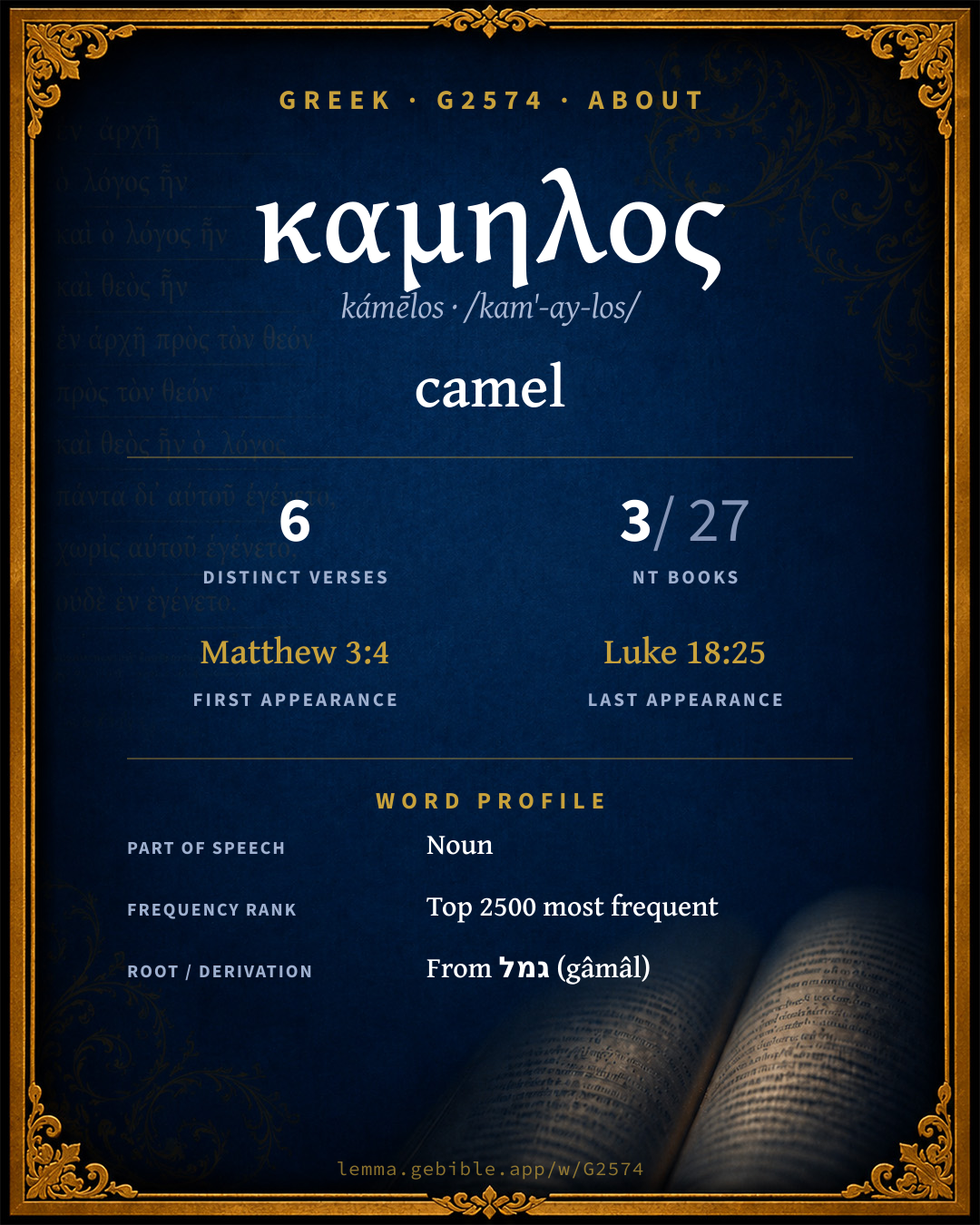
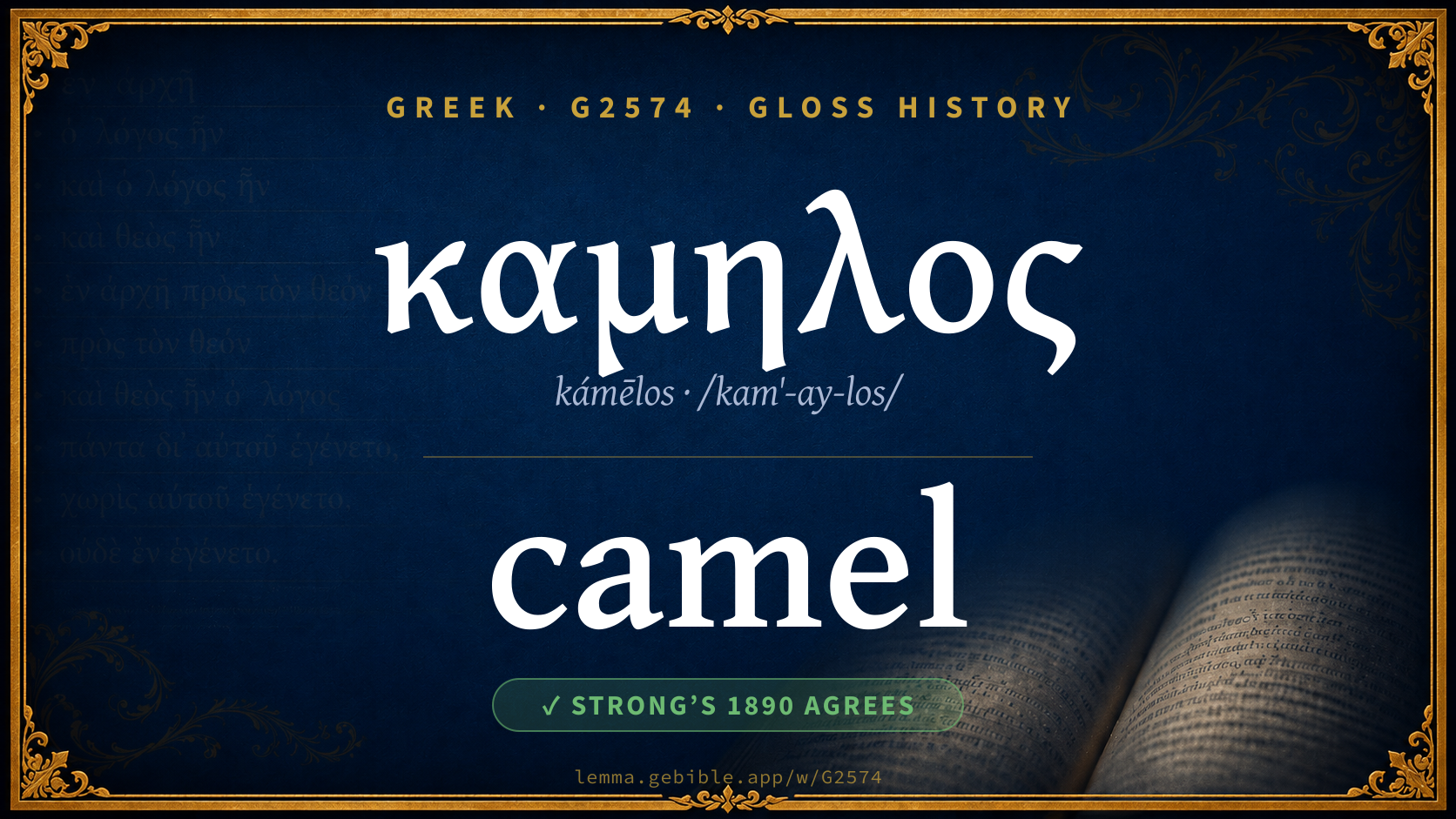
κάμηλος
camel
Full lexicon entry — Thayer's Greek Lexicon
From Thayer's Greek Lexicon
Where this word appears
See every Accusative-case word in the Greek New Testament →
Grammar key — what these labels mean
Part of speech
- Noun
- A naming word — a person, place, thing, or idea.
Case
- Accusative
- The case of the direct object and of extent.
- Genitive
- The case of source, possession, or “of” — answers “whose / from what.”
Gender
- Masculine
- Grammatically masculine.
Number
- Singular
- One.
Every verse where G2574 appears in the Book of Matthew — 3 distinct verses. Click any verse to open its interlinear word-by-word view. Verse text shown in the World English Bible for context — . Each verse’s Greek form is shown with its reference; the English is not keyword-highlighted, since the data carries no word-level English alignment. Use “Compare translations” on any verse to read it across multiple English versions. This concordance covers the Greek New Testament; Septuagint (Greek Old Testament) occurrences of this word are not indexed here.
Matthew
- Matthew 3:4 καμήλου n gen sg masc Now John himself wore clothing made of camel's hair, with a leather belt around his waist. His food was locusts and wild honey.
- Matthew 19:24 κάμηλον n acc sg masc Again I tell you, it is easier for a camel to go through a needle's eye, than for a rich man to enter into the Kingdom of God."
- Matthew 23:24 κάμηλον n acc sg masc You blind guides, who strain out a gnat, and swallow a camel!
About this entry
At a glance — auto-summarized from this page’s data, not written by a person. Every figure links to its source below. This summary describes the numbers; it doesn’t interpret them.
καμηλος (kámēlos) is a Greek noun most often rendered “camel.” It clusters heavily in Matthew, which alone accounts for 50% of its uses. It turns up in 6 verses across 3 books, an uncommon footprint. It first appears in Matthew 3:4. From the same root come גמל and גמלי. For the data behind this summary, explore the sense tree and the renderings breakdown below.
Gloss history
Strong's 1890 vs modern scholarship
About this word
Strong's G2574 catalogs a Greek word from the Greek New Testament.
These counts are not copied from any lexicon or concordance. They are computed here, from the morphology-tagged Greek New Testament. What Lemma adds →
- 6
- distinct verses
- The word appears in 6 distinct verses.
- 3 / 27
- NT books
- The word appears in 3 of 27 New Testament books.
- #1,476
- by frequency
- Top 2500 most frequent Greek words (rank 1,476 of 5,347 Greek words by occurrence).
View all 6 occurrences in the concordance →
By section of the New Testament
By traditional corpus
Conventional, traditional groupings — biblical authorship is debated, so this is a traditional corpus grouping, not an authorship claim. Some books belong to more than one corpus (Luke is in both the Gospels and the Lukan corpus, and so on), so these shares overlap and need not total 100%. Each figure is a share of the word’s 6 distinct verses.
- Gospels 6 verses · 100%
- Lukan (Luke–Acts) 1 verse · 17%
How translations render this word
Counts come from each version’s own published word-to-Strong’s tagging or interlinear alignment — an approximate guide to how each version renders this word, not a word-level alignment the data otherwise carries. Because each total is that version’s own tagged count, the per-version totals vary from one another and need not match the appearance or distinct-verse counts above. These counts may also differ from a printed concordance because Lemma counts each distinctly tagged rendering and does not collapse phrase taggings into a single head-word total. This is a fixed set of word-tagged versions (KJV, ASV, BSB, ULT) and does not change with the reading translation you choose elsewhere. Each version’s license is shown beside its name below (and on Sources).
- King James Version: Camel 4×, Camel's 2×
- American Standard Version: Camel 6×
- Berean Standard Bible: Camel 4×, Camel’s 2×
- unfoldingWord Literal Text: Camel 6×
King James Version Public Domain
Renders G2574 across 6 tagged occurrences — most commonly:
American Standard Version Public Domain
Renders G2574 across 6 tagged occurrences — most commonly:
Berean Standard Bible Public Domain
Renders G2574 across 6 tagged occurrences — most commonly:
unfoldingWord Literal Text CC BY-SA 4.0
Renders G2574 across 6 tagged occurrences — most commonly:
Senses in Thayer's
The 1 sense Thayer's distinguishes for this word, in lexicon order (not ranked by frequency or importance). The full entry — with sub-senses — is in the Lexicon Entry tab.
- camel
Word origin
Derived from גמל (gâmâl) (H1581) — camel.
Of hebrew origin [ H1581 ]; a camel : - camel.
— Strong’s Exhaustive Concordance (1890), public domain.
Forms in the corpus
The 2 distinct written forms G2574 takes in the Greek New Testament, most frequent first — each parse links to that case’s occurrences in the concordance.
| Form | Parsing | Example | Uses |
|---|---|---|---|
| κάμηλον kámēlon | Noun, Accusative, Singular, Masculine | Matthew 19:24 | 4 |
| καμήλου kamḗlou | Noun, Genitive, Singular, Masculine | Matthew 3:4 | 2 |
Same root — word family
Other Thayer's entries built from the same root as G2574, grouped by Strong’s listed origin. These share a root / origin per the lexicon — not necessarily a shared meaning. Each links to that word’s own entry.
Derives from
Proper names from this root
People and places named from this root — a name, not an additional meaning of the word.
Compare all same-root words → 1 of the same-root words is a proper name (a person or place). They share a root, not necessarily a meaning.
Septuagint usage
The same Greek word καμηλος appears 55 times in the Greek Old Testament (Septuagint), across 51 verses in 16 books.
- 55
- LXX occurrences
- Tagged occurrences of this Greek word in the Septuagint.
- 51
- verses
- Distinct Septuagint verses containing this word.
- 16 / 39
- OT books
- The word appears in 16 of the 39 Old Testament books.
Sample Septuagint occurrences
- Genesis 12:16 κάμηλος
- Exodus 9:3 κάμηλος
- Leviticus 11:4 κάμηλος
- Deuteronomy 14:7 κάμηλος
- Judges 6:5 κάμηλος
- 1 Samuel 15:3 κάμηλος
- 1 Kings 10:2 κάμηλος
- 2 Kings 8:9 κάμηλος
- 1 Chronicles 5:21 κάμηλος
- 2 Chronicles 9:1 κάμηλος
- Ezra 2:67 κάμηλος
- Job 1:3 κάμηλος
Septuagint occurrences (same lexeme)
Every verse where the same Strong’s number (G2574) appears in the Greek Septuagint — showing the first 50 of 51. Verse text shown in the World English Bible for context; the Greek form is the matched word — the English is not keyword-highlighted.
- Genesis 12:16 κάμηλος He dealt well with Abram for her sake. He had sheep, and oxen, and male donkeys, and men-servants, and maid-servants, and female donkeys, and camels.
- Genesis 24:10 κάμηλος The servant took ten camels, of his master's camels, and departed, having all goodly things of his master's in his hand. He arose, and went to Mesopotamia, to the city of Nahor.
- Genesis 24:11 κάμηλος He made the camels kneel down outside the city by the well of water at the time of evening, the time that women go out to draw water.
- Genesis 24:14 κάμηλος Let it happen, that the young lady to whom I will say, 'Please let down your pitcher, that I may drink.' She will say, 'Drink, and I will also give your camels a drink.' Let the same be she who you have appointed for your servant Isaac. Thereby will I know that you have shown kindness to my master."
- Genesis 24:19 κάμηλος When she had done giving him drink, she said, "I will also draw for your camels, until they have done drinking."
- Genesis 24:20 κάμηλος She hurried, and emptied her pitcher into the trough, and ran again to the well to draw, and drew for all his camels.
- Genesis 24:22 κάμηλος It happened, as the camels had done drinking, that the man took a golden ring of half a shekel weight, and two bracelets for her hands of ten shekels weight of gold,
- Genesis 24:30 κάμηλος It happened, when he saw the ring, and the bracelets on his sister's hands, and when he heard the words of Rebekah his sister, saying, "This is what the man said to me," that he came to the man. Behold, he was standing by the camels at the spring.
- Genesis 24:31 κάμηλος He said, "Come in, you blessed of Yahweh. Why do you stand outside? For I have prepared the house, and room for the camels."
- Genesis 24:32 κάμηλος The man came into the house, and he unloaded the camels. He gave straw and provender for the camels, and water to wash his feet and the feet of the men who were with him.
- Genesis 24:35 κάμηλος Yahweh has blessed my master greatly. He has become great. He has given him flocks and herds, silver and gold, men-servants and maid-servants, and camels and donkeys.
- Genesis 24:44 κάμηλος She will tell me, "Drink, and I will also draw for your camels." Let the same be the woman whom Yahweh has appointed for my master's son.'
- Genesis 24:46 κάμηλος She hurried and let down her pitcher from her shoulder, and said, 'Drink, and I will also give your camels a drink.' So I drank, and she made the camels drink also.
- Genesis 24:61 κάμηλος Rebekah arose with her ladies. They rode on the camels, and followed the man. The servant took Rebekah, and went his way.
- Genesis 24:63 κάμηλος Isaac went out to meditate in the field at the evening. He lifted up his eyes, and saw, and, behold, there were camels coming.
- Genesis 24:64 κάμηλος Rebekah lifted up her eyes, and when she saw Isaac, she dismounted from the camel.
- Genesis 30:43 κάμηλος The man increased exceedingly, and had large flocks, maid-servants and men-servants, and camels and donkeys.
- Genesis 31:17 κάμηλος Then Jacob rose up, and set his sons and his wives on the camels,
- Genesis 31:34 κάμηλος Now Rachel had taken the teraphim, put them in the camel's saddle, and sat on them. Laban felt about all the tent, but didn't find them.
- Genesis 32:16 κάμηλος He delivered them into the hands of his servants, every herd by itself, and said to his servants, "Pass over before me, and put a space between herd and herd."
- Genesis 37:25 κάμηλος They sat down to eat bread, and they lifted up their eyes and looked, and saw a caravan of Ishmaelites was coming from Gilead, with their camels bearing spices and balm and myrrh, going to carry it down to Egypt.
- Exodus 9:3 κάμηλος behold, the hand of Yahweh is on your cattle which are in the field, on the horses, on the donkeys, on the camels, on the herds, and on the flocks with a very grievous pestilence.
- Leviticus 11:4 κάμηλος "'Nevertheless these you shall not eat of those that chew the cud, or of those who part the hoof: the camel, because he chews the cud but doesn't have a parted hoof, he is unclean to you.
- Deuteronomy 14:7 κάμηλος Nevertheless these you shall not eat of them that chew the cud, or of those who have the hoof cloven: the camel, and the hare, and the rabbit; because they chew the cud but don't part the hoof, they are unclean to you.
- Judges 6:5 κάμηλος For they came up with their cattle and their tents; they came in as locusts for multitude; both they and their camels were without number: and they came into the land to destroy it.
- Judges 7:12 κάμηλος The Midianites and the Amalekites and all the children of the east lay along in the valley like locusts for multitude; and their camels were without number, as the sand which is on the sea-shore for multitude.
- Judges 8:21 κάμηλος Then Zebah and Zalmunna said, Rise you, and fall on us; for as the man is, so is his strength. Gideon arose, and killed Zebah and Zalmunna, and took the crescents that were on their camels' necks.
- Judges 8:26 κάμηλος The weight of the golden ear-rings that he requested was one thousand and seven hundred [shekels] of gold, besides the crescents, and the pendants, and the purple clothing that was on the kings of Midian, and besides the chains that were about their camels' necks.
- 1 Samuel 15:3 κάμηλος Now go and strike Amalek, and utterly destroy all that they have, and don't spare them; but kill both man and woman, infant and suckling, ox and sheep, camel and donkey.
- 1 Samuel 27:9 κάμηλος David struck the land, and saved neither man nor woman alive, and took away the sheep, and the oxen, and the donkeys, and the camels, and the clothing; and he returned, and came to Achish.
- 1 Samuel 30:17 κάμηλος David struck them from the twilight even to the evening of the next day: and there not a man of them escaped, except four hundred young men, who rode on camels and fled.
- 1 Kings 10:2 κάμηλος She came to Jerusalem with a very great train, with camels that bore spices, and very much gold, and precious stones; and when she was come to Solomon, she talked with him of all that was in her heart.
- 2 Kings 8:9 κάμηλος So Hazael went to meet him, and took a present with him, even of every good thing of Damascus, forty camels' burden, and came and stood before him, and said, Your son Benhadad king of Syria has sent me to you, saying, Shall I recover of this sickness?
- 1 Chronicles 5:21 κάμηλος They took away their cattle; of their camels fifty thousand, and of sheep two hundred fifty thousand, and of donkeys two thousand, and of men one hundred thousand.
- 1 Chronicles 12:41 κάμηλος
- 1 Chronicles 27:30 κάμηλος and over the camels was Obil the Ishmaelite: and over the donkeys was Jehdeiah the Meronothite: and over the flocks was Jaziz the Hagrite.
- 2 Chronicles 9:1 κάμηλος When the queen of Sheba heard of the fame of Solomon, she came to prove Solomon with hard questions at Jerusalem, with a very great train, and camels that bore spices, and gold in abundance, and precious stones: and when she was come to Solomon, she talked with him of all that was in her heart.
- 2 Chronicles 14:14 κάμηλος They struck all the cities round about Gerar; for the fear of Yahweh came on them: and they despoiled all the cities; for there was much spoil in them.
- Ezra 2:67 κάμηλος their camels, four hundred thirty-five; [their] donkeys, six thousand seven hundred and twenty.
- Ezra 17:69 κάμηλος
- Job 1:3 κάμηλος His possessions also were seven thousand sheep, three thousand camels, five hundred yoke of oxen, five hundred she-donkeys, and a very great household; so that this man was the greatest of all the children of the east.
- Job 1:17 κάμηλος While he was still speaking, there came also another, and said, "The Chaldeans made three bands, and swept down on the camels, and have taken them away, yes, and killed the servants with the edge of the sword; and I alone have escaped to tell you."
- Job 42:12 κάμηλος So Yahweh blessed the latter end of Job more than his beginning. He had fourteen thousand sheep, six thousand camels, one thousand yoke of oxen, and a thousand female donkeys.
- Isaiah 21:7 κάμηλος and when he sees a troop, horsemen in pairs, a troop of donkeys, a troop of camels, he shall listen diligently with much heed.
- Isaiah 30:6 κάμηλος The burden of the animals of the South. Through the land of trouble and anguish, from whence come the lioness and the lion, the viper and fiery flying serpent, they carry their riches on the shoulders of young donkeys, and their treasures on the humps of camels, to a people that shall not profit [them].
- Isaiah 60:6 κάμηλος The multitude of camels shall cover you, the dromedaries of Midian and Ephah; all they from Sheba shall come; they shall bring gold and frankincense, and shall proclaim the praises of Yahweh.
- Jeremiah 30:24 κάμηλος The fierce anger of Yahweh shall not return, until he has executed, and until he have performed the intents of his heart: in the latter days you shall understand it.
- Jeremiah 30:27 κάμηλος
- Ezekiel 25:5 κάμηλος I will make Rabbah a stable for camels, and the children of Ammon a couching-place for flocks: and you shall know that I am Yahweh.
- Ezekiel 27:21 κάμηλος Arabia, and all the princes of Kedar, they were the merchants of your hand; in lambs, and rams, and goats, in these were they your merchants.
These are occurrences of the same Greek lexeme (G2574) in the Septuagint — not a translation of any one Hebrew word. The store carries no word-level Hebrew↔Greek alignment, so no Hebrew original is asserted here. Counts come from the recovered LXX Strong's tagging — high-frequency vocabulary is well covered, while rare or late forms may be untagged — so they reflect tagged occurrences and may slightly undercount.