
Proverbs 25:16

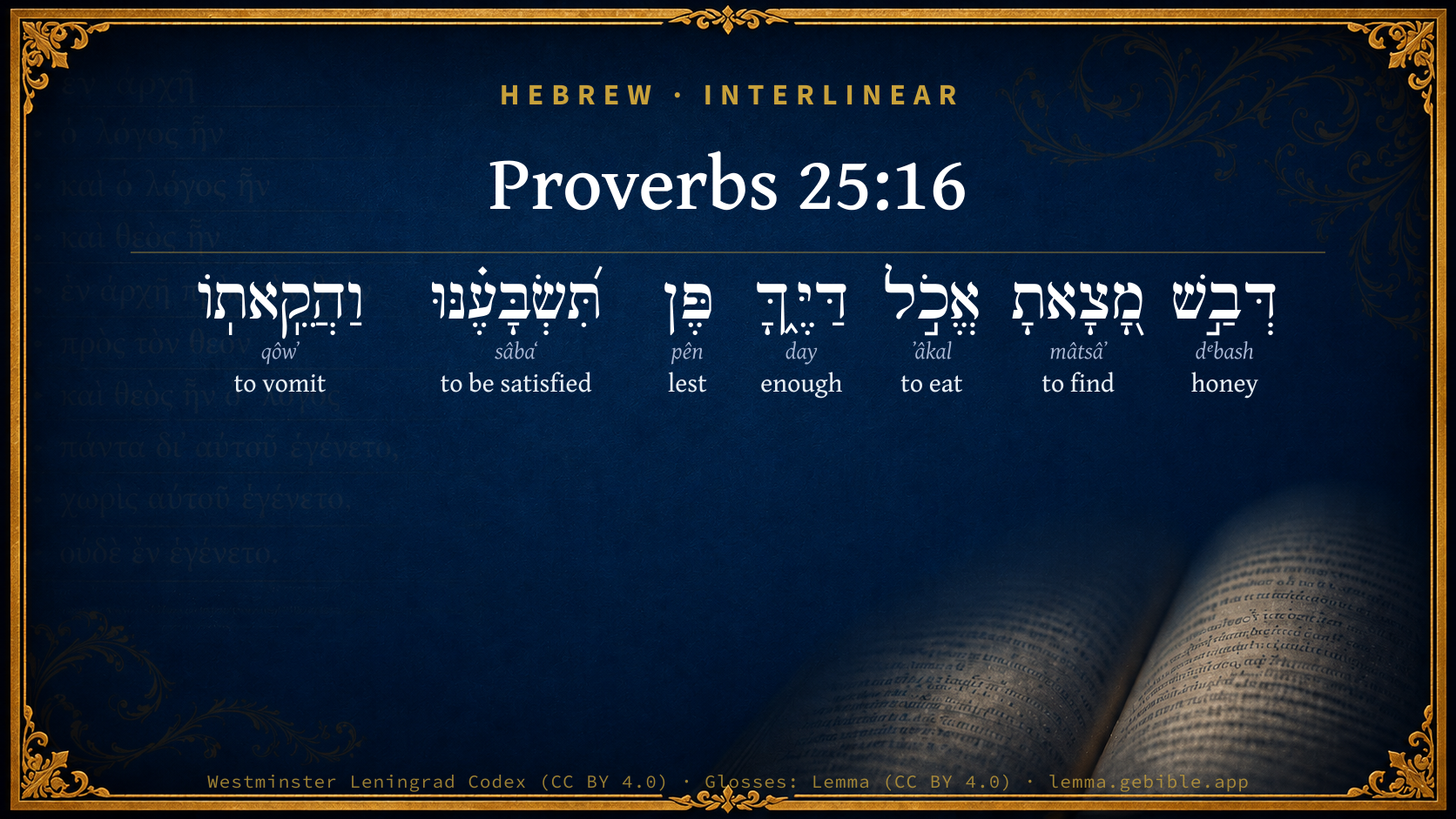
Hebrew (Westminster Leningrad Codex) Proverbs 25:16 appears in the Hebrew Old Testament. The text above is from the Westminster Leningrad Codex. Each word links to its Strong’s number, a concise gloss, and parsing drawn from the Open Scriptures Hebrew Bible morphology. Click any word for its full Brown-Driver-Briggs (BDB) entry.
Download image
Cite this verse

Proverbs 25:16 (World English Bible). Public Domain. Lemma interlinear Bible study tool, https://lemma.gebible.app/v/proverbs/25/16.

Show BibTeX & RIS
BibTeX
RIS
English Translation
Have you found honey? Eat as much as is sufficient for you, Lest you eat too much, and vomit it.
World English Bible · Public Domain
Download a study sheet

One document with this verse’s original text, its word-by-word gloss line, the meaning frame, cross-references with their text, attributed commentary, and full source and license credits — printable, and it pastes into notes with its structure intact.

This verse Autodidact and up

Study sheet (.html) Plain text (.txt)

A passage Seminary Student

Up to 50 verses in one chapter. A passage sheet keeps up to 6 commentary sources and 12 cross-references per verse, in the order this page ranks them, and says so on the sheet whenever that leaves anything out. Ask for a single verse and you get the Autodidact verse sheet above.

Everything on this page stays free to read, with no account — the sheet is a download of what is already on screen, not access to it.

Want to remove ads? Support Godless Engineer
Compare translations 3

The same verse in 3 English versions, stacked beneath the original-language interlinear above. Click any original word for its lexicon entry.

Each is an independent rendering of the whole verse — the interlinear is not word-aligned to these translations.

Highlighted words mark where these versions differ — a whole-verse word diff, not a word-by-word alignment.

  • World English Bible Public Domain
    Have you found honey? Eat as much as is sufficient for you, Lest you eat too much, and vomit it.
  • King James Version Public Domain
    Hast thou found honey? eat so much as is sufficient for thee, lest thou be filled therewith, and vomit it.
  • unfoldingWord Literal Text CC BY-SA 4.0
    you find honey, eat enough you, lest you become satiated with it and you vomit it up.

unfoldingWord Literal Text — © unfoldingWord, licensed CC BY-SA 4.0. Word-aligned USFM3 via Door43 (git.door43.org/unfoldingWord/en_ult).

Versions to compare (up to 4)

3 of 4 selected

Show all 18 translations

Every available English version of this verse, each an independent rendering of the whole verse.

  • World English Bible Public Domain
    Have you found honey? Eat as much as is sufficient for you, Lest you eat too much, and vomit it.
  • Berean Standard Bible Public Domain
    If you find honey, eat just what you need, lest you have too much and vomit it up.
  • Majority Standard Bible Public Domain
    If you find honey, eat just what you need, lest you have too much and vomit it up.
  • King James Version Public Domain
    Hast thou found honey? eat so much as is sufficient for thee, lest thou be filled therewith, and vomit it.
  • American Standard Version (1901) Public Domain
    Hast thou found honey? eat so much as is sufficient for thee, Lest thou be filled therewith, and vomit it.
  • Revised Version (1885) Public Domain
    Hast thou found honey? eat so much as is sufficient for thee; lest thou be filled therewith, and vomit it.
  • Geneva Bible (1599) Public Domain
    If thou haue found hony, eate that is sufficient for thee, least thou be ouerfull, and vomit it.
  • Douay-Rheims (1899) Public Domain
    Thou hast found honey, eat what is sufficient for thee, lest being glutted therewith thou vomit it up.
  • Young's Literal Translation Public Domain
    Honey thou hast found -- eat thy sufficiency, Lest thou be satiated `with' it, and hast vomited it.
  • Literal Standard Version CC BY-SA 4.0
    You have found honey—eat your sufficiency, || Lest you are satiated [with] it, and have vomited it.
  • Unlocked Literal Bible CC BY-SA 4.0
    If you find honey, eat just enough— otherwise, having too much of it, you vomit it up.
  • unfoldingWord Literal Text CC BY-SA 4.0
    you find honey, eat enough you, lest you become satiated with it and you vomit it up.
  • Darby Bible Public Domain
    Hast thou found honey? Eat so much as is sufficient for thee, lest thou be surfeited therewith, and vomit it.
  • World Messianic Bible Public Domain
    Have you found honey? Eat as much as is sufficient for you, lest you eat too much, and vomit it.
  • Webster's Bible Public Domain
    Hast thou found honey? eat so much as is sufficient for thee, lest thou be filled with it, and vomit it.
  • Free Bible Version CC BY-SA 4.0
    If you find honey, eat just enough, for if you eat too much, you'll be sick.
  • Bible in Basic English Public Domain
    If you have honey, take only as much as is enough for you; for fear that, being full of it, you may not be able to keep it down.
  • JPS Tanakh (1917) Public Domain
    Hast thou found honey? eat so much as is sufficient for thee, lest thou be filled therewith, and vomit it.

Literal Standard Version (2020), Covenant Press — licensed CC BY-SA 4.0. Text via the HelloAO Bible API (eBible.org). Unlocked Literal Bible (unfoldingWord) — licensed CC BY-SA 4.0. Text via the HelloAO Bible API (eBible.org). unfoldingWord Literal Text — © unfoldingWord, licensed CC BY-SA 4.0. Word-aligned USFM3 via Door43 (git.door43.org/unfoldingWord/en_ult). Free Bible Version, Dr. Jonathan Gallagher — licensed CC BY-SA 4.0. Text via the HelloAO Bible API (eBible.org).

Word by word

More ways to search: Search by grammar → Find every occurrence → Compare this word →

Practice this passage: Drill this verse → Learn its vocabulary →

וַהֲקֵֽאתֽוֹ
qôwʼ
H6958
“and · to vomit · him”
Conjunction + Verb, Hiphil, Perfect, 2nd Person, Masculine, Singular + Suffix, Personal, 3rd Person, Masculine, Singular
Part of Speech
Conjunction + Verb
Stem
Hiphil
Form
Perfect
Person
2nd Person
Gender
Masculine
Number
Singular
Full BDB Definition

Origin: a primitive root

TWOT: 2014

to vomit up, spue out, disgorge - (Qal) to vomit - (Hiphil) to vomit up - of land spewing out its inhabitants (figuratively) - vomiting, disgorging
  1. דְּבַ֣שׁ dᵉbash H1706 “honey” Noun, Common, Masculine, Singular, Absolute
  2. מָ֭צָאתָ mâtsâʼ H4672 “to find” Verb, Qal, Perfect, 2nd Person, Masculine, Singular
  3. אֱכֹ֣ל ʼâkal H398 “eat” Verb, Qal, Imperative, 2nd Person, Masculine, Singular
  4. דַּיֶּ֑ךָּ day H1767 “enough · your” Noun, Common, Masculine, Singular, Construct + Suffix, Personal, 2nd Person, Masculine, Singular
  5. פֶּן pên H6435 “lest” Conjunction
  6. תִּ֝שְׂבָּעֶ֗נּוּ sâbaʻ H7646 “to be satisfied · him” Verb, Qal, Imperfect, 2nd Person, Masculine, Singular + Suffix, Personal, 3rd Person, Masculine, Singular

About this verse

These counts appear in no published source. They are computed here, from the morphology-tagged text and Lemma’s own curated glosses. What Lemma adds →

7
words
7
distinct lemmas
Wisdom
section

Notable vocabulary

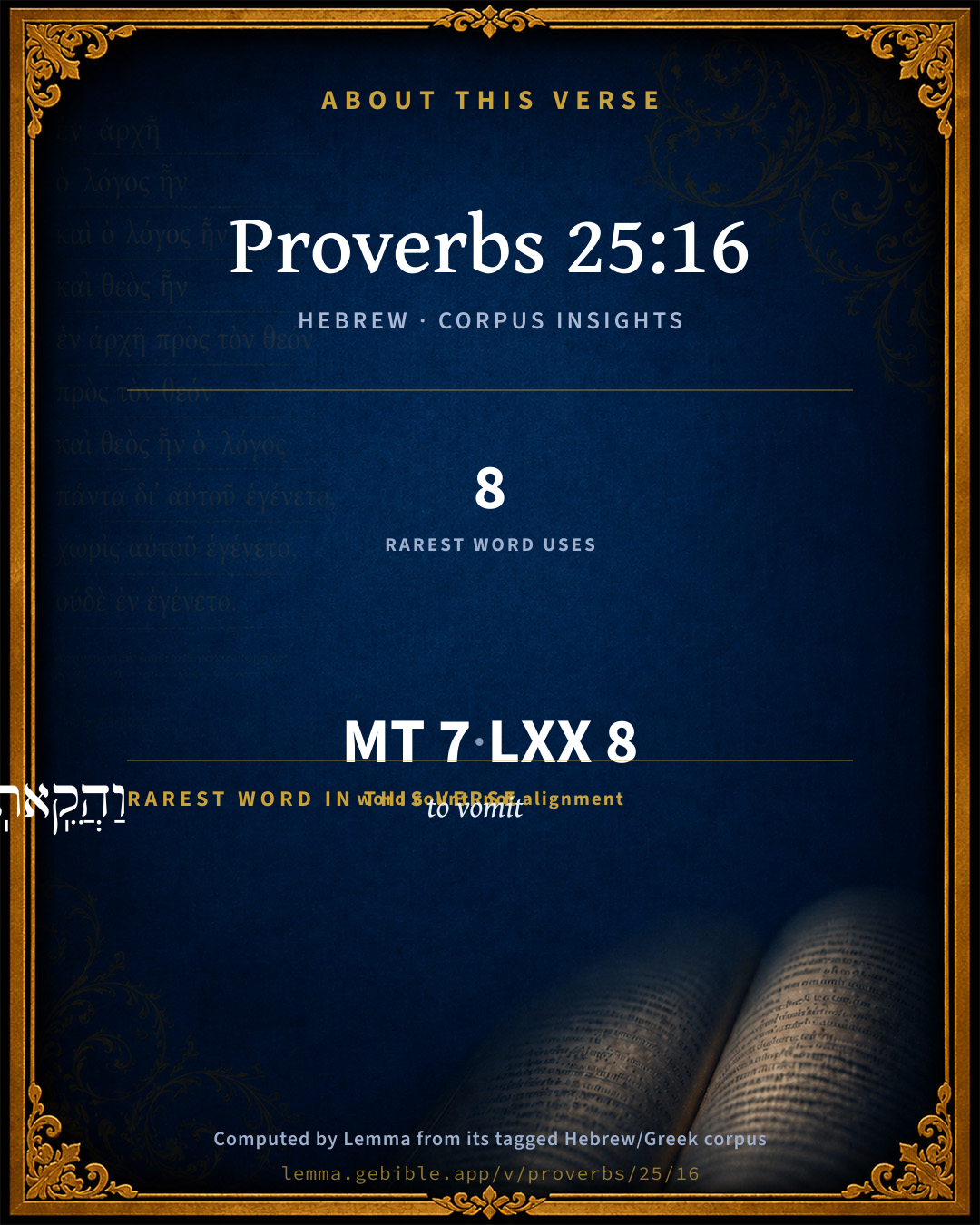
The rarest word here is וַהֲקֵֽאתֽוֹ to vomit H6958 — appearing just 8 times in the whole Hebrew Bible.

Shared distinctive vocabulary

וַהֲקֵֽאתֽוֹ to vomit H6958 occurs in 7 verses of the Hebrew Bible. Also found in:

Grammatical profile

  • 4 verbs
  • 2 nouns
  • 1 conjunction

Verb forms

  • מָ֭צָאתָ Qal · Perfect
  • אֱכֹ֣ל Qal · Imperative
  • תִּ֝שְׂבָּעֶ֗נּוּ Qal · Imperfect
  • וַהֲקֵֽאתֽוֹ Hiphil · Perfect

Hebrew & Septuagint length

In English translation the verse runs 20 words from the Hebrew and 17 from the Septuagint (LXX English) — closely comparable.

A rough comparison of the two English renderings, which tokenize alike — not a word-level alignment.

Word counts can differ between the Hebrew and the Greek without any difference in meaning — e.g. the Hebrew direct-object marker אֵת has no separate Greek word, and Greek often adds the article ὁ.

In the original languages it is 7 Hebrew tokens and 8 Greek tokens — but the two are counted differently (Hebrew bundles its prefixes and suffixes into one token; the Greek is in lemma form), so that isn’t a like-for-like length.

Cross-references

7

Topical passages linked to Proverbs 25:16 in the Treasury of Scripture Knowledge — connected by theme and wording, ordered by reader-vote popularity; previews shown in the World English Bible.

  • Proverbs 25:27 It is not good to eat much honey; Nor is it honorable to seek one's own honor.
  • Ephesians 5:18 Don't be drunken with wine, in which is dissipation, but be filled with the Spirit,
  • Proverbs 24:13–14 My son, eat honey, for it is good; The droppings of the honeycomb, which are sweet to your taste:
  • 1 Samuel 14:25–27 All the people came into the forest; and there was honey on the ground.
  • Isaiah 7:15 He shall eat butter and honey when he knows to refuse the evil, and choose the good.
  • Judges 14:8–9 After a while he returned to take her; and he turned aside to see the carcass of the lion: and, behold, there was a swarm of bees in the body of the lion, and honey.
  • Luke 21:34 "So be careful, or your hearts will be loaded down with carousing, drunkenness, and cares of this life, and that day will come on you suddenly.

Cross-references courtesy of OpenBible.info (CC BY 4.0).

Hebrew and Greek witnesses Masoretic Hebrew ↔ Greek Septuagint

The same verse in the two great witnesses to the Old Testament, shown verse-for-verse.

These are two independent witnesses, not word-aligned to each other, and the Septuagint is shown in lemma (dictionary) form.

Hebrew Proverbs 25:16 Masoretic · Westminster Leningrad Codex

דְּבַ֣שׁ מָ֭צָאתָ אֱכֹ֣ל דַּיֶּ֑ךָּ פֶּן תִּ֝שְׂבָּעֶ֗נּוּ וַהֲקֵֽאתֽוֹ

Have you found honey? Eat as much as is sufficient for you, Lest you eat too much, and vomit it.

World English Bible · Public Domain

Greek LXX Proverbs 25:16 Septuagint · lemma form

μέλι εὑρίσκω ἐσθίω ὁ ἱκανός μήποτε πίμπλημι ἐκἐμεσέω

Having found honey, eat only what is enough, lest haply you be filled, and vomit it up.

LXX2012 (modern English Septuagint) · Public Domain

On this verse, Keil & Delitzsch discusses the Septuagint’s reading. Read the note in Commentary ↓

Hebrew: Westminster Leningrad Codex (CC BY 4.0). Greek: Septuagint (public domain); English from LXX2012 (modern English Septuagint) (Public Domain). How the Septuagint differs from the Hebrew →

Commentary

Notes on Proverbs 25:16 from classic Christian and Jewish commentators (each source and its license shown beneath its notes). The classic Christian expositions comment on the surrounding passage and are grouped to its opening verse, so a note may address several verses; the Jewish commentaries on the Tanakh (Rashi and others) are per-verse, so they appear only where the commentator wrote on this verse.

Lemma curates 59 commentaries, every one of them public domain or Creative Commons licensed, each selected and text-cleaned for this edition rather than reprinted as found. About our sources →

Trapp's Complete Commentary

John Trapp

Pro 25:16 Hast thou found honey? eat so much as is sufficient for thee, lest thou be filled therewith, and vomit it.

Ver. 16. Hast thou found honey? eat so much as is sufficient,] i.e., Be moderate in the use of all lawful comforts and contentments. Aπαντων γαρ η πλησμονη, saith the orator, {a} for there is a satiety of all things, and by excess the sweetest comforts will be dissweetened, as Epictetus also observed. It is therefore excellent counsel that the holy apostle giveth, that "those that have wives be as if they had none," &c.; {1Co 7:29} that we hang loose to all creature comforts, and be weanedly affected towards them, considering that licitis perimus omnes. We generally most of all overshoot ourselves in the use of things lawful, as those recusant guests did, {Mat 22:2-7} and the old world. {Luk 17:26-27}

{a} Isoc.

John Trapp, A Commentary or Exposition upon All the Books of the Old and New Testament (1647–1656) — public domain. Text from a community e-Sword module.

The Biblical Illustrator

Joseph S. Exell

Pro_25:16

Hast thou found honey?

eat so much as is sufficient for thee, lest thou be filled therewith, and vomit it.

Religion and pleasure

It is a mistaken notion that religion is a melancholy business, and the enemy of pleasure. Christianity is supposed to be synonymous with inanity, and to impose a weariness alike on flesh and spirit that stifles the freedom, represses the elasticity, and dulls the brightness which are the natural and precious heritage of youth. But this is as false as the devil who coined it. I stand here as the messenger of God, as the champion of pleasure, the advocate of hilarity, the apostle of enjoyment, the prophet of light-heartedness. Pleasure is a necessity of our nature. The goodness of God has made bountiful provision for full satisfaction and delight. The body is endowed with senses capable of exquisite sensations of delight. When you talk of the melancholy of religion you become the Pharisaic boaster, and not

I. You thank your God that you are not as other men. If the intellect seeks pleasure in the study of the physical universe, does the Christian philosopher discover less to charm his mind than do his scientific comrades of less assured belief? But ours is a triple manhood. There is the moral and spiritual man. Surely there is honey in doing right; there is pleasure in goodness and truth. As to the honey of life to be found in a good conscience, in doing right, in walking uprightly, according to the universally recognised laws of morality, surely the Christian has a better chance than the ordinary man. What does religion allow, or rather enjoin, in the way of pleasant recreations?

1. They must do me no harm; neither enfeeble my body, rob my brain of its vital energy, or disturb my inward sense of right.

2. They must recreate my body; brace it up, and leave me readier for after-service.

3. They must refresh my mind; not make it sluggish, heavy, depressed, and ill at ease.

4. They must cheer my heart--in their present influence, in their results, and in their memory. (J. Jackson Wray.)

The use of honey

1. The Bible does not prohibit pleasure. It does not say to the man who has found honey, Eat it not! but Eat so much as is sufficient for thee. What the Bible forbids is excess.

2. In prohibiting such pleasures, the Bible proceeds upon a principle of benevolence. Eat no more than is sufficient for thee! Why? Not because pleasure is grudged, but because pain is deprecated.

3. The principle upon which the Bible proceeds in this matter is a benevolent one, because it accords with the constitution of our nature. There is a point at which pleasure becomes pain. It is the law of our being, that if pleasure is to remain pleasure, it must be enjoyed moderately and intermittently. (Homiletic Review.)

Pleasure

I. The permission.

1. Pleasure is a necessity of our nature.

(1) A necessity of its complex constitution. We are made to enjoy. We have capacity for

(a) Animal pleasure;

(b) intellectual pleasure;

(c) moral pleasure;

(d) religious pleasure;

(e) social pleasure.

(2) A necessity of its instinctive desires. We have an intense craving for enjoyment. Who will show us any good? This yearning for enjoyment, found alike amid the refinements of civilisation as amid the rudeness of barbarism, alike in the mansion of the rich as in the cottage of the poor, alike by the learned philosopher as by the illiterate peasant.

(3) A necessity of its perfect development.

2. Pleasure is a possibility of our condition. God, the all-wise and all-kind, has not only made us for pleasure and given us a strong desire for it, but has also bountifully surrounded us with its sources.

(1) For the animal faculties. There is light for the eye, music for the ear, fragrance for the smell.

(2) For the intellectual. The universe is a problem for our study.

(3) For the moral. The true and good are around us, in the character of God, the actions of the good, etc.

(4) For the religious. God in Christ is revealed as the Object of worship.

(5) For the social. There is society, with its varied life.

3. Pleasure is an element of our religion. Christianity is not a morbid, ascetic system. Rejoice in the Lord alway.

II. The limitation: Eat so much as is sufficient for thee. Pleasure is not to be indulged indiscriminately and unlimitedly. We must indulge in such pleasures only as are--

1. Dignified in their nature. We must remember the spirituality of our nature and the immortality of our being. We are not animals. Let us not make the mistake of the rich fool. We are made in Gods image, and are capable of high and noble joys.

2. Beneficial in their influence. Pleasure must not be sought and indulged in on its own account, but as a means toward the attainment of a higher end. The objects of pleasure are--to recreate the body; to refresh the mind; to cheer the heart; to fit us for the work of life.

3. Christian in their sanction.

4. Proportionate in their degree. Pleasure must not be the end of life. It must not be pastime. Time is too valuable to be frittered away. (Thomas Baron.)

The worlds honey

I. The world has its honey.

1. It has a gastric honey. What pleasures can be derived from a participation in the precious fruits of the earth!

2. It has a gregarious honey. How great the pleasure men have in mingling with their kind, merely as social animals; the pleasure of mates, parents, children.

3. It has a secular honey. Pursuit, accumulation, and use of wealth.

4. It has aesthetic honey. The beautiful in nature, art, music.

5. It has intellectual honey. Inquiry into, and discovery of, the Divine ideas that underlie all the forms, and ring through all the sounds of nature.

II. The worlds honey may be abused.

1. Some eat too much of the gastric honey, and become gourmands, epicures, voluptuaries.

2. Some eat too much of the gregarious honey, and become profligate debauchees, bloated animals.

3. Some eat too much of the secular honey, and become wretched misers, haunted with a thousand suspicions.

4. Some eat too much of the aesthetic honey, and grow indifferent to everything but what they consider the beautiful and harmonious.

5. Some eat too much of the intellectual honey, and they have no life but in that of observatories, laboratories, and libraries.

III. The worlds honey abused produces nausea. Over-indulgence in any worldly pleasure issues in a moral sickness and disgust. There is what the French call the ennui that comes out of it--that awful yawn, says Byron, which sleep cannot abate. The intemperate use of this honey often makes life an intolerable burden. Conclusion: Take care how you use the world. You may have too much of a good thing. There is a honey, thank God! of which you cannot take too much, which will never surfeit or sicken--that is, the honey of spiritual enjoyment; the enjoyment of studying, imitating, worshipping Him in whose presence there is fulness of joy, etc. (D. Thomas, D.D.)

The Biblical Illustrator, edited by Joseph S. Exell (c. 1880s–1900s) — public domain. Text from a community e-Sword module.

Joseph Benson's Commentary

Pro 25:16. Hast thou found honey? — Which, in those parts, was often found in woods or fields. By honey, he understands not only all delicious meats, but all present and worldly delights, which we are here taught to use with moderation: for as honey, moderately taken, strengthens the body and prolongs life, but, if taken to excess, disturbs the stomach, and turns the pleasure into pain; so it is with earthly satisfactions and pursuits. Moderately used they are refreshing and useful; immoderately, they produce disgust, or are accompanied with guilt and followed by trouble.

Joseph Benson's Commentary on the Old and New Testaments (1811–1818) — public domain. Text from a community e-Sword module.

The Preacher's Complete Homiletical Commentary

Joseph S. Exell (gen. ed.)

CRITICAL NOTES.—

Pro_25:16. Filled. Rather “Surfeited.”

MAIN HOMILETICS OF Pro_25:16

USE AND ABUSE

I. The good gifts of God are to be enjoyed by men. “Every creature of God is good,” says the apostle, “and nothing to be refused, if it be received with thanksgiving” (1Ti_4:4). God has filled the world with gifts to minister pleasure to the bodily senses as well as to the spiritual aspirations, and the first are given to us “richly to enjoy” (1Ti_6:17), as much as the last. Our Great and Beneficent Father, has not omitted to provide even for the gratification of our palate, but has furnished us with an almost infinite variety of natural productions, pleasant to the taste. His kindness in this matter is not to be overlooked, and these good gifts are not to be treated as though they were beneath our grateful appreciation. The asceticism which refuses to partake of them is not in accordance with the spirit of either the Old or New Testament.

II. There is no material and temporal good which cannot be misused by man. Honey may here stand for any or all the lower sweets of life—for every blessing which is not of a purely spiritual nature—and the greatest temptation to misuse of these lies in the direction of over-use—of indulging in them to the neglect of other and more precious good, and so to the injury of the higher nature. Honey is a delicious article of food, and wholesome and nutritious to a certain extent, but if a man attempted to live upon it to the exclusion of plainer fare he would find that his bodily health would suffer. In like manner is there danger to spiritual health from an undue indulgence of even the gifts of God, which minister only or chiefly to the senses, or which belong to this life alone.

III. The misuse of what is good in itself puts an end to all real enjoyment of it. If a man eats immoderately of honey it soon ceases to be pleasant to his taste, and the very sweetness that at first attracted him produces loathing. The same nausea of spirit follows immoderate indulgence in any merely temporal or material good—that which, used lawfully, would always afford true and real enjoyment, cloys upon the man who abuses it by over-use.

OUTLINES AND SUGGESTIVE COMMENTS

The figure varies. In a former sentence we are commanded to eat honey because it is good (chap. Pro_24:13), and that was very carefully explained. It meant that piety was itself good, and we were to taste and see (Psa_34:8) that before we could be Christians. But now the figure varies. There is a sweetness of eternal hope, even when we have not got down to the sweetness of a saving piety. We are to put on the helmet of hope. So the Apostle tells us (1Th_5:8). But Solomon cautions us that we are to put on no more than is “sufficient.” We are eating more than enough honey when we have no right to eat any, and so we may be eating too much when we ought to be getting more. There is such a thing as having more hope than evidence. And if a man has too much confident hope of heaven for the amount he has of piety, there certainly is a case of eating more than is sufficient.… Blessed is the man that has “found honey.” Let him eat so much as is sufficient for him in this dismal pilgrimage. But, when he is once refreshed like Jonathan, let him sound for an advance.—Miller.

The Preacher's Complete Homiletical Commentary (gen. ed. Joseph S. Exell; Funk & Wagnalls, c. 1892) — public domain (pre-1929). A full-Bible homiletical/sermon-outline anthology covering 65 of 66 books (2 John is absent from the source module). Text from a community e-Sword module.

Keil & Delitzsch

C. F. Keil & F. Delitzsch

Another way of showing self-control:

Hast thou found honey? eat thy enough,

Lest thou be surfeited with it, and vomit it up.

Honey is pleasant, salutary, and thus to be eaten sparingly, Pro 24:13, but ne quid nimis. Too much is unwholesome, 27a: αὐτοῦ καὶ μέλιτος τὸ πλέον ἐστὶ χολή, i.e., even honey enjoyed immoderately is as bitter as gall; or, as Freidank says: des honges seze erdruizet s mans ze viel geniuzet [the sweetness of honey offends when one partakes too much of it]. Eat if thou hast found any in the forest or the mountains, דּיּךּ, thy enough (lxx τὸ ἱκανόν; the Venet. τὸ ἀρκοῦν σοι), i.e., as much as appeases thine appetite, that thou mayest not become surfeited and vomit it out (והקאתו with Tsere, and א quiesc., as at Sa2 14:10; vid., Michlol 116a, and Parchon under קוא). Fleischer, Ewald, Hitzig, and others, place Pro 25:16 and Pro 25:17 together, so as to form an emblematic tetrastich; but he who is surfeited is certainly, in Pro 25:16, he who willingly enjoys, and in 17, he to whom it is given to enjoy without his will; and is not, then, Pro 25:16 a sentence complete in itself in meaning? That it is not to be understood in a purely dietetic sense (although thus interpreted it is a rule not to be despised), is self-evident. As one can suffer injury from the noblest of food if he overload his stomach therewith, so in the sphere of science, instruction, edification, there is an injurious overloading of the mind; we ought to measure what we receive by our spiritual want, the right distribution of enjoyment and labour, and the degree of our ability to change it in succum et sanguinem, - else it at last awakens in us dislike, and becomes an evil to us.

Keil & Delitzsch — Biblical Commentary on the Old Testament (1861–1891) — public domain (CC PDM 1.0). Text via the HelloAO Bible API. (Old Testament only.)

Tyndale Open Study Notes

Tyndale Open Resources

25:16-17 Honey in moderation is tasty and healthy (24:13-14); too much will cause vomiting. This principle can be applied to other areas of life; for example, it is good to visit your neighbors, but not too often.

Tyndale Open Study Notes — © Tyndale Open Resources, licensed CC BY-SA 4.0. Text via the HelloAO Bible API.

Geneva Bible (1599)

Geneva Bible translators

Use moderately the pleasures of this world.

Geneva Bible (1599) marginal notes — public domain. Text via Bolls.life.

Matthew Henry's Commentary

Here, 1. We are allowed a sober and moderate use of the delights of sense: Hast thou found honey? It is not forbidden fruit to thee, as it was to Jonathan; thou mayest eat of it with thanksgiving to God, who, having created things grateful to our senses, has given us leave to make use of them. Eat as much as is sufficient, and no more. Enough is as good as a feast. 2. We are cautioned to take heed of excess. We must use all pleasures as we do honey, with a check upon our appetite, lest we take more than does us good and make ourselves sick with it. We are most in danger of surfeiting upon that which is most sweet, and therefore those that fare sumptuously every day have need to watch over themselves, lest their hearts be at any time overcharged. The pleasures of sense lose their sweetness by the excessive use of them and become nauseous, as honey, which turns sour in the stomach; it is therefore our interest, as well as our duty, to use them with sobriety.

Matthew Henry's Commentary on the Whole Bible (1708–1710) — public domain (CC PDM 1.0). Text via the HelloAO Bible API.

Jamieson, Fausset & Brown

Robert Jamieson, A. R. Fausset & David Brown

A comparison, as a surfeit of honey produces physical disgust, so your company, however agreeable in moderation, may, if excessive, lead your friend to hate you.

Jamieson, Fausset & Brown — Commentary Critical and Explanatory on the Whole Bible (1871) — public domain (CC PDM 1.0). Text via the HelloAO Bible API.

Adam Clarke's Commentary

Verse 16. Hast thou found honey?] Make a moderate use of all thy enjoyments. "Let thy moderation be known unto all, and appear in all things."

Adam Clarke's Commentary on the Bible (1810–1826) — public domain. Text from a community e-Sword/MySword module.

Ellicott's Commentary for English Readers

(16) Hast thou found honey?—A common occurrence in Palestine, where swarms of wild bees abounded in the woods. (Comp. Jdg_14:8; 1Sa_14:27.) Hence came the expression of a “land flowing with (milk and) honey.”

A Bible Commentary for English Readers, edited by Charles John Ellicott (1878–1897) — public domain. Text from a community e-Sword module.

John Gill's Exposition

Hast thou found honey?.... Of which there was great plenty in Judea; and was to be found in fields and woods, Sa1 14:25;

eat so much as is sufficient for thee; to satisfy appetite, without overcharging the stomach; what may be conducive to health, and no more;

lest thou be filled therewith, and vomit it; that is, overfilled; filled to a loathing of it, so as to cause a casting of it up this is not merely to be understood in a literal sense; something more is intended, as in Pro 24:13; and according to the sense there, that which Maimonides (l) gives of this seems agreeable; that it respects the getting of wisdom and knowledge, which, like honey, is sweet and desirable, and excellent, and nourishing, moderately used: but then persons should take care to keep within due bounds, and not seek to be too wise; or to exercise themselves in things too high for them, and aim at that which is above their capacity; but should content themselves with what is within their reach and compass: and so Gersom understands it. Some think that moderation in the use of worldly things and lawful pleasures is here recommended: and others that the words refer to what follow; that when a man has got a pleasant and delightful friend, he should not visit him too often; lest, too much familiarity bringing contempt, he should lose his friend: so Jarchi connects the words,

(l) Moreh. Nevochim, par. 1. c. 32, p. 41.

John Gill's Exposition of the Whole Bible (1746–1763) — public domain (CC PDM 1.0). Text via the HelloAO Bible API.

Albert Barnes' Notes on the Bible

Hast thou found honey? - Compare Jdg 14:8; 1Sa 14:27. The precept extends to the pleasure of which honey is the symbol.

Albert Barnes' Notes on the Bible (1834–1885) — public domain. Text from a community e-Sword/MySword module.

Haydock's Catholic Bible Commentary

Up. We must moderate the sensual appetite, (Menochius) and even the study of wisdom, which is compared to honey, chap. xxiv. 13., Romans xii. 3., and Ecclesiastes vii. 17. (Calmet) --- We must not be too familiar, ver. 17. (Ven. Bede) (Cajetan)

George Leo Haydock (1774–1849), Haydock's Catholic Family Bible and Commentary, 1859 edition — public domain. Excludes Psalms (Douay-Rheims chapter numbering differs from Protestant) and Deuterocanonical books (Catholic canon only).

Matthew Poole's English Annotations

Honey in those parts was oft found in woods or fields, as Jdg 14:8, &c.; 1Sa 14:25. By honey he understands, not only all delicious meats, but all present and worldly delights, which we are here taught to use with moderation. Honey excessively taken disposeth a man to vomiting.

Matthew Poole's English Annotations on the Holy Bible (1683–1685) — public domain. Text from a community e-Sword/MySword module.

Whedon's Commentary on the Bible

Daniel D. Whedon

16. Hast… found honey — Which in the East is frequently found in large quantities in the cavities of trees, rocks, and the like.

So much — That is, only so much as shall satisfy. The proverb inculcates temperance and moderation in the enjoyment of sensual pleasures. “Let your moderation be known unto all men.” Php_4:5. For examples of honey-finding, comp. Jdg_14:8, et seq.; 1Sa_14:26.

Daniel D. Whedon (gen. ed.), Commentary on the Old and New Testaments (1874–1909) — public domain. Text from a community e-Sword module.

The Pulpit Commentary

Hast thou found honey? Honey would be found in crevices of rocks, in hollow trees, (1Sa_14:27) or in more unlikely situations, (Jud_1:14:8) and was extensively used as an article of food. All travellers in Palestine note the great abundance of bees therein, and how well it answers to its description as "a land flowing with milk and honey." Eat so much as is sufficient for thee. The agreeable sweetness of honey might lead the finder to eat too much of it. Against such excess the moralist warns: Lest thou be filled therewith, and vomit it. Thus wrote Pindar, "Nem.," 7:51 Alla gapausiv en panti glukeia ergwkoron d ecei Kai meli kai ta terpn anye Afrodisia ..

Mhde , Ne quid nimis, is a maxim continually urged by those who wished to teach moderation. Says Homer, "Iliad," 13:636"Men are with all things sated sleep, and love, Sweet sounds of music, and the joyous dance. (Lord Derby)

Says Horace, "Sat.," 1:1, 106"Est modus in rebus, sunt certi denique fines, Quos ultra citraque nequit consistere rectum?

The honey is a figure of all that pleases the senses; but the maxim is to be extended beyond physical matters, though referring primarily to such pleasures. The mind may be overloaded as well as the body: only such instruction as can be digested and assimilated is serviceable to the spiritual nature; injudicious cramming produces satiety and disgust. Again, "To "find honey, says St. Gregory ("Moral.," 16:8), "is to taste the sweetness of holy intelligence, which is eaten enough of then when our perception, according to the measure of our faculty, is held tight under control. For he is "filled with honey, and vomits it" who, in seeking to dive deeper than he has capacity for, loses that too from whence he might have derived nourishment." And in another place (ibid., 20:18), "The sweetness of spiritual meaning he who seeks to eat beyond what he contains, even what he had eaten he "vomiteth;" because, whilst he seeks to make out things above, beyond his powers, even the things that he had made out aright, he forfeits" (Oxford transl.).

Vers. 16-20. Excesses and errors.

I WARNING AGAINST SATIETY. (Vers. 16, 17) The stories of Samson and of Jonathan may be read in illustration of the saying. (Jud_1:14:8, 9 1Sa_14:26) Ver. 27 points the warning against incurring the pain of satiety, "Honey, too, hath satiety," says Pindar"A surfeit of the sweetest things, The deepest loathing to the stomach brings.

1. We should beware of a too frequent repetition of even innocent pleasures. "If a man will not allow himself leisure to be thirsty, he can never know the true pleasure of drinking." Self-indulgence far more than suffering unnerves the soul. It may well be asked How can men bear the ills of life, if its very pleasures fatigue them?

2. A special application of the warning. Do not weary your friends. There should be a sacred reserve of a delicate mutual respect even in the most intimate relations of friendship. To invade a busy privacy, with a view to enjoy a snatch of gossip or secure some paltry convenience, is an offence against the minor morals. Defect in manners is usually owing to want of delicacy of perception. Kindly utterance must rest on the conscientious observance of peat Christian principles; let daily life be evangelized by their all-pervading power. Let us make our "foot precious" to our neighbour by not intruding it too often in his home. Better that our visits should be like angels", few and far between, than frequent and wearisome as those of a beggar or a dun.

II THE TONGUE OF THE FALSE WITNESS. (Ver. 15) Compared to destructive weapons. (comp. Psa_52:4 Psa_57:4 Psa_64:4 Psa_120:4) "The slanderer wounds three at once himself, him he speaks of, and him that hears" (Leighton). Not only falsehood, but the perverse and distorted way of telling the truth, comes under this ban. "In the case of the witness against our Lord, the words were true, the evidence false; while they reported the words, they misrepresented the sense; and thus swore a true falsehood, and were truly foresworn" (Mat_26:60) (Bishop Hall).

III MISPLACED CONFIDENCE. (Ver. 19) Compared to a broken tooth and a disjointed foot. It is a too common experience, and suggests the counsel to select as confidants only good men. "Be continually with a godly man, whom thou knowest to keep the commandments of the Lord, whose mind is according to thy mind, and will sorrow with thee, if thou shalt miscarry; ... and above all, pray to the Most High, that he will direct thy way in truth" (Ecc 37:12-15). Above all, "let God be true, and every man a liar.

IV INAPT AND UNREASONABLE MIRTH. (Ver. 20) It is like the mixture of acid with soda, by which the latter is destroyed; while the combination with oil, etc., produces a useful compound. It is like laying aside a garment in cold weather. Discordant behaviour, the words or the manner out of tune with the occasion, is the fault pointed at. It springs from thoughtlessness and want of sympathy. The Spirit of Christ teaches us to cultivate imagination and sympathy with others. "Rejoice with them that do rejoice, and weep with them that weep. J.

Vers. 16, 27. The wisdom of moderation.

We can only eat a small quantity of honey; it we go beyond the limit we find out our mistake. Of this, as of all very sweet things, the words of the great dramatist are true, that "a little more than enough is by much too much." This is particularly applicable to that to which it is here referred.

I SELF-PRAISE. We may go a little way in that direction, but not far. If we transgress the narrow bounds allowed, we shall soon find that we have done ourselves harm in the estimation of our neighbour. And even to talk, without praise, of ourselves is a habit to be held well in check, or it will run into an offensive and injurious egotism. (see homily on Pro_17:2)

II SELF-EXAMINATION. TO "search out our own glory" is not glorious, but rather inglorious. It is allowable enough for a man sometimes to recall what he has been to others, and what he has done for others; but he may not practise this beyond a very circumscribed limit. To hold up his own achievements before his own eyes is to beget a very perilous complacency; to find them out for other people"s edification is quite as dangerous. And, on the other hand, for men to be searching their hearts or their lives to discover what is evil in them, to be instituting a constant examination of their souls to ascertain whereabouts they stand, this is open to grave mistake, and may soon become unwise and hurtful. Self-examination is very good up to a certain point; beyond that point it becomes morbid and is a serious mistake.

III BODILY EXERCISE AND INDULGENCE. This is very pleasant and (the latter) very "sweet," like the eating of honey. And to go some way in both of these is good and wise. But let the athlete beware lest his very love of bodily exercise betrays him into excesses which undermine his strength and bring on premature decline and death. And as to bodily indulgence, let us be often reminding ourselves that only in the cup of strict moderation whatever that cup may be is real pleasure or lasting health to be found. All excess here is as foolish as it is sinful.

IV SPIRITUAL NOURISHMENT. Can we have too much of this? Undoubtedly we can. Those who are perpetually partaking of one particular kind of religious nourishment, however good that may be in its way and measure, are over-eating of one kind of food, and they will suffer for so doing. They will not grow as God meant them to grow, proportionately and symmetrically; there will be a lopsidedness about their mind or character which is very noticeable and very ugly. Whether it be the contemplative, or the poetical, or the speculative, or the evangelistic, or the didactic, or any other side of truth in which men surfeit their souls, they make a mistake in so doing. They should understand that Divine truth has many sides and aspects, that there is not any one of them that constitutes wisdom or is sufficient to fill the mind and build up the character of a man. Our wisdom is to partake of the various dishes which are on the table our bountiful Host has provided for us; for as the body is the better for eating of many "meats," so is the soul all the stronger and all the fairer for partaking in moderation of all the various sources of spiritual nutrition that are within its reach. C.

The Pulpit Commentary (1880–1919), ed. H.D.M. Spence-Jones & Joseph S. Exell — public domain. Text from a community e-Sword module.

John Wesley's Explanatory Notes

Honey - By honey he understands, not only all delicious meats, but all worldly delights, which we are here taught to use with moderation.

John Wesley, Explanatory Notes Upon the Whole Bible (1754–1765) — public domain. Text via the GEBible commentary corpus.

Bridges on Proverbs

Charles Bridges

Solomon lately had invited us warmly to eat honey. (Pro 24:13 .) Here, however, he imposes a restraint. The old proverb applies: ’Too much of a good thing.’ Eat so much as is sufficient. So far it is sweet. Beyond this it is nauseating. Cultivate in all things the wisdom of sobriety, directing to a thankful, but temperate enjoyment of our earthly blessings. "Every creature of God is good, and nothing to be refused, if it be received with thanksgiving." (1Ti 4:4 .) But as a needful balance to this universal privilege — "Let your moderation be known unto all men."†1 Satisfy the wants, but mortify the lusts, of the flesh.†2 Then the gifts of God become blessings to us, and we glorify him in them, and by them. But the most elevated pleasures of earth become in the excess, distasteful and injurious; fraught with disappointment, when separated from the great end. (Ecc 2:10-11 .) Our affections can never safely flow out to any object, unless they are primarily fixed on God. ’Then we may be sure not to offend, either in the object or measure. No man can in God love whom he should not; nor immediately love whom he would. This holy respect doth both direct and limit him, and shuts up his delights in the conscience of a lawful fruition.’†3 In earthly pleasure, however, we can never forget, how slight the boundary line is between the lawful and the forbidden path. Sin and danger begin on the extremity of virtue. For does not the legitimate indulgence of appetite to its utmost point bring us to the brink, and often hurry us to the allowance, of gluttony? Does not the undisciplined flow of earthly affections endanger idolatry? Nay, even spiritual luxury may need self-control; lest it be excitement without deep principle, which must eventually prove unsubstantial and delusive.

But in eating the real honey of the Gospel there is no danger of excess. Never shall we know satiety in this delight. The increasing desire will be fully satisfied only in eternity. ’O God, let me but taste and see how sweet the Lord Jesus is in all his gracious promises; in all his merciful and real performances. I shall want no more to make me happy. This is not the honey, whereof I am bidden not to eat too much. No, Lord, I can never eat enough of this celestial honey. Here I cannot surfeit: or if I could, this surfeit would be my health.’†4

Footnotes:

†1 Php 4:5. 1Co 7:29-31 .

†2 Rom 13:14. Col 3:5 . Luk 21:34 .

†3 Bp. Hall’s Works — Select Thoughts, II.

†4 Bp. Hall’s Works — Soliloquies, liv.

Charles Bridges, An Exposition of the Book of Proverbs (1846) — public domain. Text from a community e-Sword module.

unfoldingWord translationNotes

Door43 World Missions Community

General Information:

Verse 16 states a general principle, and verse 17 gives one specific example. The idea of eating too much honey and then vomiting it up is a metaphor for taking too much of any good thing and regretting it later. (See: Metaphor)

translationWords

honey

neighbor

unfoldingWord translationNotes — © Distant Shores Media and the Door43 World Missions Community, licensed CC BY-SA 4.0. Source: git.door43.org/Door43/en_tn.

Rashi

Rabbi Shlomo Yitzchaki (Rashi)

If you have found honey, etc....

Rashi on the Tanakh — English translations: “The Judaica Press complete Tanach with Rashi, translated by A. J. Rosenberg” (CC BY 4.0); “Pentateuch with Rashi's commentary by M. Rosenbaum and A.M. Silbermann, 1929-1934” (public domain); “The Metsudah Tanach series, Lakewood, N.J” (CC BY 4.0); and “The Book of Joshua, Metsudah Publications, 1997” (CC BY 4.0). Text via Sefaria.

Lesson kit

Teaching starters — assembled from the data on this page, not authored interpretation. Every prompt links to the verse data it draws on. Edit before teaching.

Proverbs, in the Wisdom, opens this verse with 7 words (7 distinct Hebrew lemmas). Its most distinctive word is qôwʼ (“to vomit”). A historical commentator’s framing appears above. Read the whole chapter for the surrounding context.

Discussion questions

  1. The word qôwʼ carries the sense “to vomit.” How does it shape the verse?
  2. How does Leviticus 18:25, which shares the word «to vomit», read alongside this verse?
  3. These translations render this verse differently; the difference is in the English rendering, not the original. What questions does that raise?
  4. «מָ֭צָאתָ» is a Qal Perfect verb. How does that grammatical form shape the action described?
  5. Compare how Trapp's Complete Commentary and The Biblical Illustrator read this verse. Where do they agree or differ?

Things to notice

Reading settings

Reading text

Shown beneath each verse's original-language words.

Old Testament
Old Testament edition

Read the OT as the Masoretic Hebrew (MT) or the Greek Septuagint (LXX).

English shown for the Greek Septuagint (in the Hebrew ↔ Greek comparison).

Comparing translations? Open the Compare panel on any verse page to stack up to four side by side.