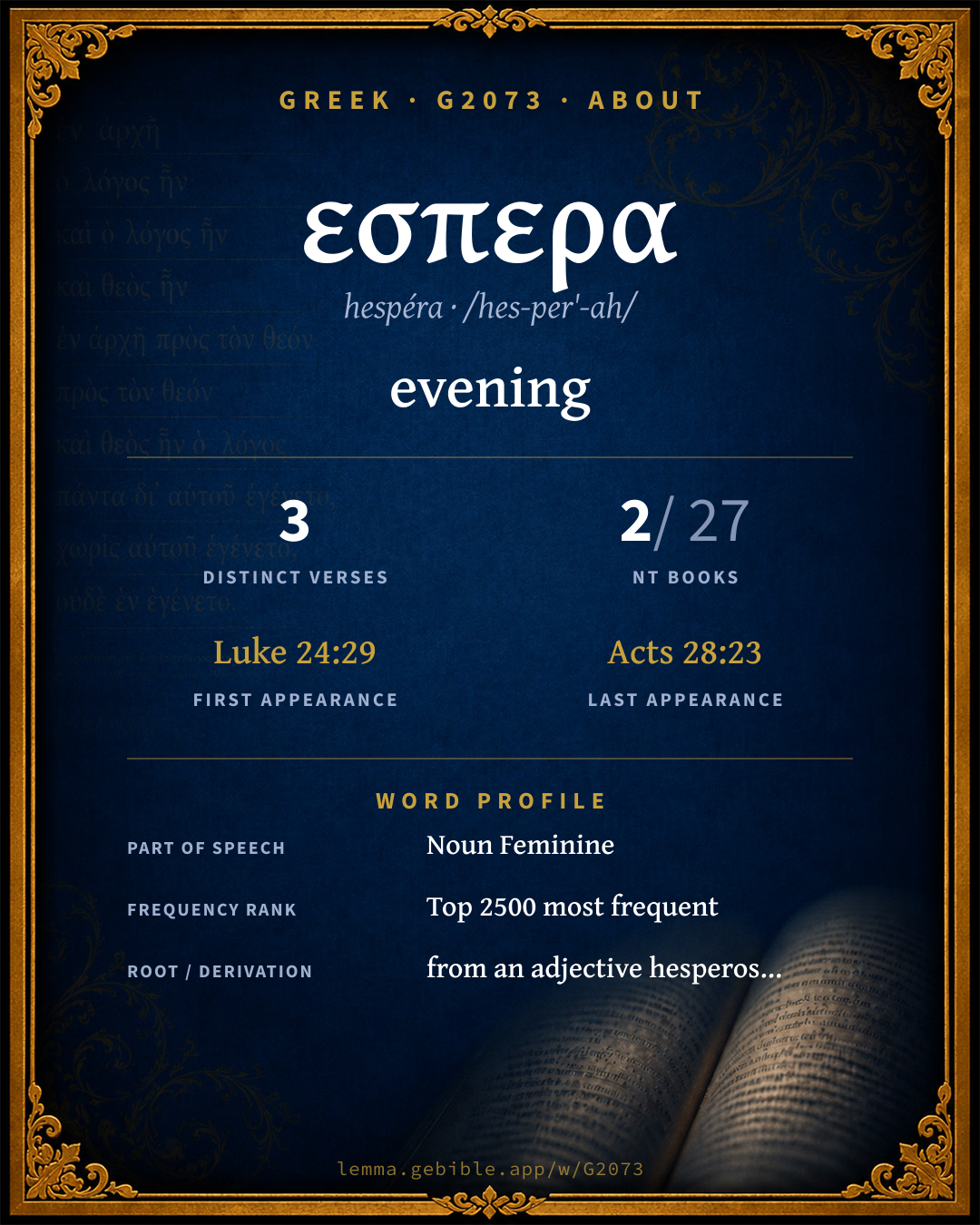
ἑσπέρα
evening
Full lexicon entry — Thayer's Greek Lexicon
From Thayer's Greek Lexicon
Where this word appears
See every Genitive-case word in the Greek New Testament →
Grammar key — what these labels mean
Part of speech
- Noun
- A naming word — a person, place, thing, or idea.
Case
- Accusative
- The case of the direct object and of extent.
- Genitive
- The case of source, possession, or “of” — answers “whose / from what.”
- Nominative
- The case of the subject (and the predicate nominative).
Gender
- Feminine
- Grammatically feminine.
Number
- Singular
- One.
1 verse where G2073 appears in the Genitive case in the Book of Acts. Filtered view — show all forms. Click any verse to open its interlinear word-by-word view. Verse text shown in the World English Bible for context — . Each verse’s Greek form is shown with its reference; the English is not keyword-highlighted, since the data carries no word-level English alignment. Use “Compare translations” on any verse to read it across multiple English versions. This concordance covers the Greek New Testament; Septuagint (Greek Old Testament) occurrences of this word are not indexed here.
Acts
About this entry
At a glance — auto-summarized from this page’s data, not written by a person. Every figure links to its source below. This summary describes the numbers; it doesn’t interpret them.
εσπερα — transliterated hespéra — is a Greek noun carrying the sense “evening.” The Greek New Testament uses it only 3 verses. More than two-thirds of its appearances fall in Acts. Debuting at Luke 24:29, it then recurs through the corpus. See the sense tree, 3-verse concordance, and the renderings breakdown below.
Gloss history
Strong's 1890 vs modern scholarship
About this word
Strong's G2073 catalogs a Greek word from the Greek New Testament.
These counts are not copied from any lexicon or concordance. They are computed here, from the morphology-tagged Greek New Testament. What Lemma adds →
- 3
- distinct verses
- The word appears in 3 distinct verses.
- 2 / 27
- NT books
- The word appears in 2 of 27 New Testament books.
- #2,203
- by frequency
- Top 2500 most frequent Greek words (rank 2,203 of 5,347 Greek words by occurrence).
View all 3 occurrences in the concordance →
By traditional corpus
Conventional, traditional groupings — biblical authorship is debated, so this is a traditional corpus grouping, not an authorship claim. Some books belong to more than one corpus (Luke is in both the Gospels and the Lukan corpus, and so on), so these shares overlap and need not total 100%. Each figure is a share of the word’s 3 distinct verses.
- Lukan (Luke–Acts) 3 verses · 100%
- Gospels 1 verse · 33%
How translations render this word
Counts come from each version’s own published word-to-Strong’s tagging or interlinear alignment — an approximate guide to how each version renders this word, not a word-level alignment the data otherwise carries. Because each total is that version’s own tagged count, the per-version totals vary from one another and need not match the appearance or distinct-verse counts above. These counts may also differ from a printed concordance because Lemma counts each distinctly tagged rendering and does not collapse phrase taggings into a single head-word total. This is a fixed set of word-tagged versions (KJV, ASV, BSB, ULT) and does not change with the reading translation you choose elsewhere. Each version’s license is shown beside its name below (and on Sources).
- King James Version: Evening 2×
- American Standard Version: Evening 2×
- Berean Standard Bible: Evening 3×
- unfoldingWord Literal Text: Evening 3×
King James Version Public Domain
Renders G2073 across 3 tagged occurrences — most commonly:
Plus 1 rendering that appears only once — usually multi-word phrases or single function words the recovered tagging swept in, not distinct renderings.
American Standard Version Public Domain
Renders G2073 across 3 tagged occurrences — most commonly:
Plus 1 rendering that appears only once — usually multi-word phrases or single function words the recovered tagging swept in, not distinct renderings.
Berean Standard Bible Public Domain
Renders G2073 across 3 tagged occurrences — most commonly:
unfoldingWord Literal Text CC BY-SA 4.0
Renders G2073 across 3 tagged occurrences — most commonly:
Senses in Thayer's
The 1 sense Thayer's distinguishes for this word, in lexicon order (not ranked by frequency or importance). The full entry — with sub-senses — is in the Lexicon Entry tab.
- evening, eventide
Word origin
Origin: from an adjective hesperos (evening)
Feminine of an adjective ἑσπερός hesperos ( evening ); the eve (G5610 being implied): - evening (-tide).
— Strong’s Exhaustive Concordance (1890), public domain.
Forms in the corpus
The 3 distinct written forms G2073 takes in the Greek New Testament, most frequent first — each parse links to that case’s occurrences in the concordance.
| Form | Parsing | Example | Uses |
|---|---|---|---|
| ἑσπέρα hespéra | Noun, Nominative, Singular, Feminine | Acts 4:3 | 1 |
| ἑσπέραν hespéran | Noun, Accusative, Singular, Feminine | Luke 24:29 | 1 |
| ἑσπέρας hespéras | Noun, Genitive, Singular, Feminine | Acts 28:23 | 1 |
Septuagint usage
The same Greek word εσπερα appears 115 times in the Greek Old Testament (Septuagint), across 107 verses in 22 books.
- 115
- LXX occurrences
- Tagged occurrences of this Greek word in the Septuagint.
- 107
- verses
- Distinct Septuagint verses containing this word.
- 22 / 39
- OT books
- The word appears in 22 of the 39 Old Testament books.
Sample Septuagint occurrences
- Genesis 1:5 ἑσπέρα
- Exodus 12:6 ἑσπέρα
- Leviticus 11:24 ἑσπέρα
- Numbers 9:3 ἑσπέρα
- Deuteronomy 16:4 ἑσπέρα
- Joshua 5:10 ἑσπέρα
- Judges 19:9 ἑσπέρα
- Ruth 2:7 ἑσπέρα
- 1 Samuel 14:24 ἑσπέρα
- 2 Samuel 11:2 ἑσπέρα
- 1 Kings 22:35 ἑσπέρα
- 1 Chronicles 16:40 ἑσπέρα
Septuagint occurrences (same lexeme)
Every verse where the same Strong’s number (G2073) appears in the Greek Septuagint — showing the first 50 of 107. Verse text shown in the World English Bible for context; the Greek form is the matched word — the English is not keyword-highlighted.
- Genesis 1:5 ἑσπέρα God called the light Day, and the darkness he called Night. There was evening and there was morning, one day.
- Genesis 1:8 ἑσπέρα God called the expanse sky. There was evening and there was morning, a second day.
- Genesis 1:13 ἑσπέρα There was evening and there was morning, a third day.
- Genesis 1:19 ἑσπέρα There was evening and there was morning, a fourth day.
- Genesis 1:23 ἑσπέρα There was evening and there was morning, a fifth day.
- Genesis 1:31 ἑσπέρα God saw everything that he had made, and, behold, it was very good. There was evening and there was morning, the sixth day.
- Genesis 8:11 ἑσπέρα The dove came back to him at evening, and, behold, in her mouth was an olive leaf plucked off. So Noah knew that the waters were abated from off the earth.
- Genesis 19:1 ἑσπέρα The two angels came to Sodom at evening. Lot sat in the gate of Sodom. Lot saw them, and rose up to meet them. He bowed himself with his face to the earth,
- Genesis 29:23 ἑσπέρα It happened in the evening, that he took Leah his daughter, and brought her to him. He went in to her.
- Genesis 30:16 ἑσπέρα Jacob came from the field in the evening, and Leah went out to meet him, and said, "You must come in to me; for I have surely hired you with my son's mandrakes." He lay with her that night.
- Genesis 49:27 ἑσπέρα "Benjamin is a ravenous wolf. In the morning he will devour the prey. At evening he will divide the spoil."
- Exodus 12:6 ἑσπέρα and you shall keep it until the fourteenth day of the same month; and the whole assembly of the congregation of Israel shall kill it at evening.
- Exodus 12:18 ἑσπέρα In the first month, on the fourteenth day of the month at evening, you shall eat unleavened bread, until the twenty first day of the month at evening.
- Exodus 16:6 ἑσπέρα Moses and Aaron said to all the children of Israel, "At evening, then you shall know that Yahweh has brought you out from the land of Egypt;
- Exodus 16:8 ἑσπέρα Moses said, "Now Yahweh shall give you meat to eat in the evening, and in the morning bread to satisfy you; because Yahweh hears your murmurings which you murmur against him. And who are we? Your murmurings are not against us, but against Yahweh."
- Exodus 16:12 ἑσπέρα "I have heard the murmurings of the children of Israel. Speak to them, saying, 'At evening you shall eat meat, and in the morning you shall be filled with bread: and you shall know that I am Yahweh your God.'"
- Exodus 16:13 ἑσπέρα It happened at evening that quail came up and covered the camp; and in the morning the dew lay around the camp.
- Exodus 18:13 ἑσπέρα It happened on the next day, that Moses sat to judge the people, and the people stood around Moses from the morning to the evening.
- Exodus 27:21 ἑσπέρα In the tent of meeting, outside the veil which is before the testimony, Aaron and his sons shall keep it in order from evening to morning before Yahweh: it shall be a statute forever throughout their generations on the behalf of the children of Israel.
- Leviticus 11:24 ἑσπέρα "'By these you will become unclean: whoever touches the carcass of them shall be unclean until the evening.
- Leviticus 11:25 ἑσπέρα Whoever carries any part of their carcass shall wash his clothes, and be unclean until the evening.
- Leviticus 11:26 ἑσπέρα "'Every animal which parts the hoof, and is not cloven-footed, nor chews the cud, is unclean to you. Everyone who touches them shall be unclean.
- Leviticus 11:27 ἑσπέρα Whatever goes on its paws, among all animals that go on all fours, they are unclean to you. Whoever touches their carcass shall be unclean until the evening.
- Leviticus 11:28 ἑσπέρα He who carries their carcass shall wash his clothes, and be unclean until the evening. They are unclean to you.
- Leviticus 11:31 ἑσπέρα These are they which are unclean to you among all that creep. Whoever touches them when they are dead, shall be unclean until the evening.
- Leviticus 11:32 ἑσπέρα On whatever any of them falls when they are dead, it shall be unclean; whether it is any vessel of wood, or clothing, or skin, or sack, whatever vessel it is, with which any work is done, it must be put into water, and it shall be unclean until the evening; then it will be clean.
- Leviticus 11:39 ἑσπέρα "'If any animal, of which you may eat, dies; he who touches its carcass shall be unclean until the evening.
- Leviticus 11:40 ἑσπέρα He who eats of its carcass shall wash his clothes, and be unclean until the evening. He also who carries its carcass shall wash his clothes, and be unclean until the evening.
- Leviticus 14:46 ἑσπέρα "Moreover he who goes into the house while it is shut up shall be unclean until the evening.
- Leviticus 14:47 ἑσπέρα He who lies down in the house shall wash his clothes; and he who eats in the house shall wash his clothes.
- Leviticus 15:5 ἑσπέρα Whoever touches his bed shall wash his clothes, and bathe himself in water, and be unclean until the evening.
- Leviticus 15:6 ἑσπέρα He who sits on anything whereon the man who has the discharge sat shall wash his clothes, and bathe himself in water, and be unclean until the evening.
- Leviticus 15:7 ἑσπέρα "'He who touches the body of him who has the discharge shall wash his clothes, and bathe himself in water, and be unclean until the evening.
- Leviticus 15:8 ἑσπέρα "'If he who has the discharge spits on him who is clean, then he shall wash his clothes, and bathe himself in water, and be unclean until the evening.
- Leviticus 15:9 ἑσπέρα "'Whatever saddle he who has the discharge rides on shall be unclean.
- Leviticus 15:10 ἑσπέρα Whoever touches anything that was under him shall be unclean until the evening. He who carries those things shall wash his clothes, and bathe himself in water, and be unclean until the evening.
- Leviticus 15:11 ἑσπέρα "'Whoever he who has the discharge touches, without having rinsed his hands in water, he shall wash his clothes, and bathe himself in water, and be unclean until the evening.
- Leviticus 15:16 ἑσπέρα "'If any man has an emission of semen, then he shall bathe all his flesh in water, and be unclean until the evening.
- Leviticus 15:17 ἑσπέρα Every garment, and every skin, whereon the semen is, shall be washed with water, and be unclean until the evening.
- Leviticus 15:18 ἑσπέρα If a man lies with a woman and there is an emission of semen, they shall both bathe themselves in water, and be unclean until the evening.
- Leviticus 15:19 ἑσπέρα "'If a woman has a discharge, and her discharge in her flesh is blood, she shall be in her impurity seven days: and whoever touches her shall be unclean until the evening.
- Leviticus 15:21 ἑσπέρα Whoever touches her bed shall wash his clothes, and bathe himself in water, and be unclean until the evening.
- Leviticus 15:22 ἑσπέρα Whoever touches anything that she sits on shall wash his clothes, and bathe himself in water, and be unclean until the evening.
- Leviticus 15:23 ἑσπέρα If it is on the bed, or on anything whereon she sits, when he touches it, he shall be unclean until the evening.
- Leviticus 15:27 ἑσπέρα Whoever touches these things shall be unclean, and shall wash his clothes, and bathe himself in water, and be unclean until the evening.
- Leviticus 17:15 ἑσπέρα "'Every person that eats what dies of itself, or that which is torn by animals, whether he is native-born or a foreigner, he shall wash his clothes, and bathe himself in water, and be unclean until the evening: then he shall be clean.
- Leviticus 22:6 ἑσπέρα the person that touches any such shall be unclean until the evening, and shall not eat of the holy things, unless he bathe his body in water.
- Leviticus 23:32 ἑσπέρα It shall be a Sabbath of solemn rest for you, and you shall deny yourselves. In the ninth day of the month at evening, from evening to evening, you shall keep your Sabbath."
- Leviticus 24:3 ἑσπέρα Outside of the veil of the Testimony, in the Tent of Meeting, shall Aaron keep it in order from evening to morning before Yahweh continually: it shall be a statute forever throughout your generations.
- Numbers 9:3 ἑσπέρα On the fourteenth day of this month, at evening, you shall keep it in its appointed season-- according to all its statutes, and according to all its ordinances, you shall keep it."
These are occurrences of the same Greek lexeme (G2073) in the Septuagint — not a translation of any one Hebrew word. The store carries no word-level Hebrew↔Greek alignment, so no Hebrew original is asserted here. Counts come from the recovered LXX Strong's tagging — high-frequency vocabulary is well covered, while rare or late forms may be untagged — so they reflect tagged occurrences and may slightly undercount.