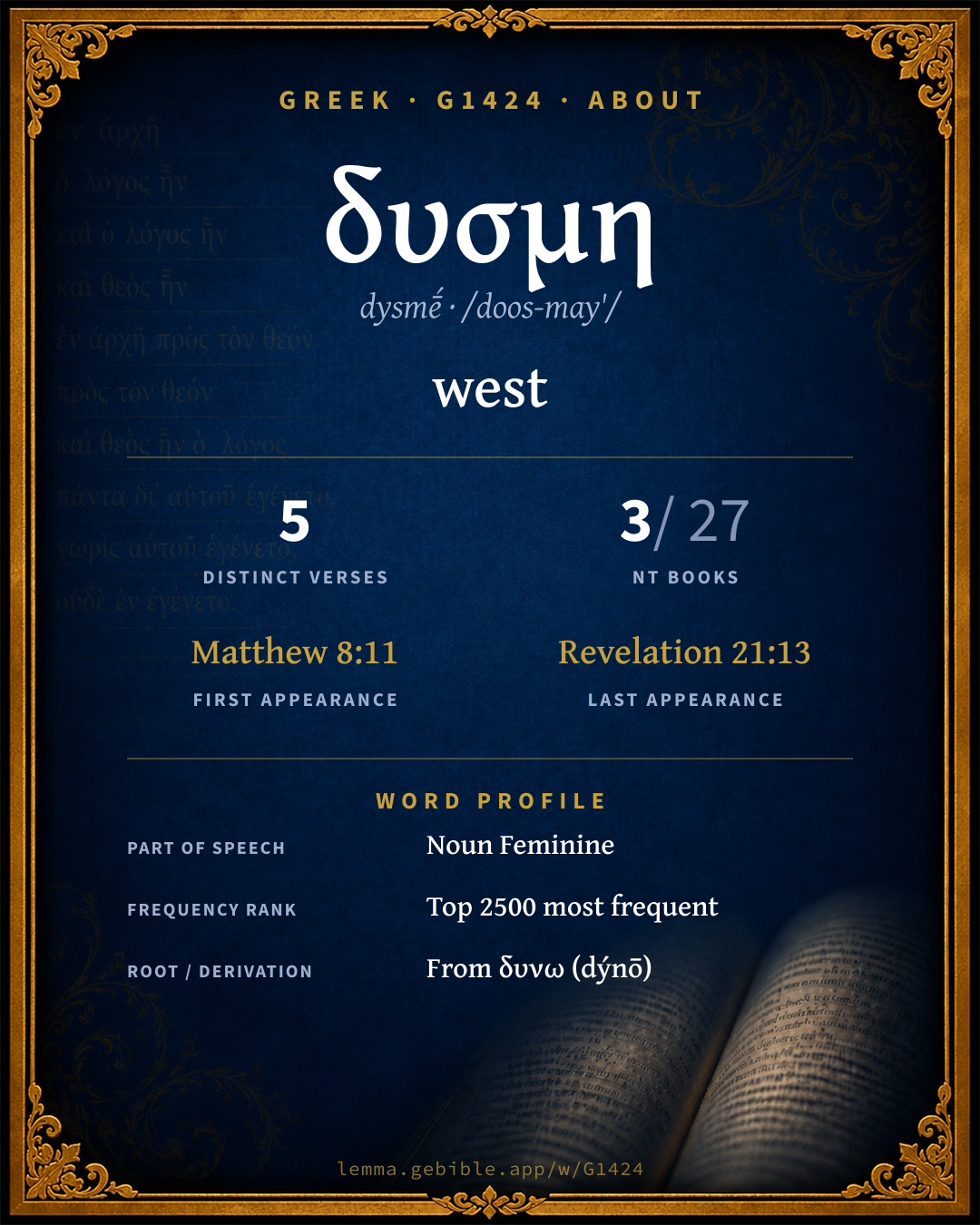
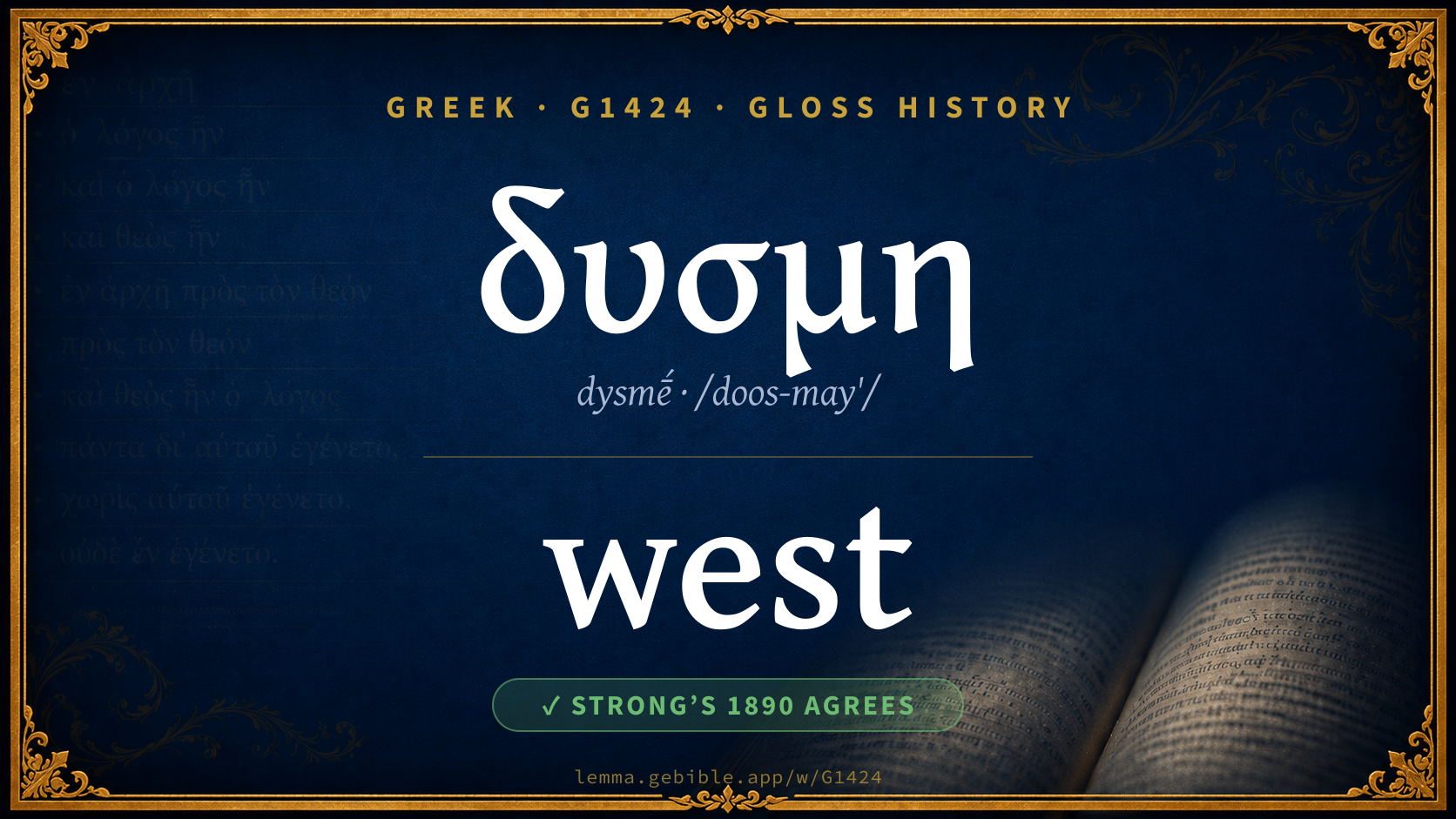
δυσμή
west
‘west’ is one of 2 main senses fuller range ↓
Full lexicon entry — Thayer's Greek Lexicon
From Thayer's Greek Lexicon
Where this word appears
Grammar key — what these labels mean
Part of speech
- Noun
- A naming word — a person, place, thing, or idea.
Case
- Genitive
- The case of source, possession, or “of” — answers “whose / from what.”
Gender
- Feminine
- Grammatically feminine.
Number
- Plural
- More than one.
Every verse where G1424 appears in the Book of Revelation — 1 distinct verse. Click any verse to open its interlinear word-by-word view. Verse text shown in the World English Bible for context — . Each verse’s Greek form is shown with its reference; the English is not keyword-highlighted, since the data carries no word-level English alignment. Use “Compare translations” on any verse to read it across multiple English versions. This concordance covers the Greek New Testament; Septuagint (Greek Old Testament) occurrences of this word are not indexed here.
Revelation
About this entry
At a glance — auto-summarized from this page’s data, not written by a person. Every figure links to its source below. This summary describes the numbers; it doesn’t interpret them.
δυσμη — transliterated dysmḗ — is a Greek noun carrying the sense “west.” The Greek New Testament uses it only 5 verses. More than a third of its appearances fall in Matthew. Its earliest occurrence is Matthew 8:11. Thayer's distinguishes 2 senses for it. See the sense tree, 5-verse concordance, and the renderings breakdown below.
Gloss history
Strong's 1890 vs modern scholarship
About this word
Strong's G1424 catalogs a Greek word from the Greek New Testament.
These counts are not copied from any lexicon or concordance. They are computed here, from the morphology-tagged Greek New Testament. What Lemma adds →
- 5
- distinct verses
- The word appears in 5 distinct verses.
- 3 / 27
- NT books
- The word appears in 3 of 27 New Testament books.
- #1,648
- by frequency
- Top 2500 most frequent Greek words (rank 1,648 of 5,347 Greek words by occurrence).
View all 5 occurrences in the concordance →
Most concentrated in
- Matthew 2 verses 40%
- Luke 2 verses 40%
- Revelation 1 verse 20%
By section of the New Testament
By traditional corpus
Conventional, traditional groupings — biblical authorship is debated, so this is a traditional corpus grouping, not an authorship claim. Some books belong to more than one corpus (Luke is in both the Gospels and the Lukan corpus, and so on), so these shares overlap and need not total 100%. Each figure is a share of the word’s 5 distinct verses.
- Gospels 4 verses · 80%
- Lukan (Luke–Acts) 2 verses · 40%
- Johannine 1 verse · 20%
- Revelation 1 verse · 20%
How translations render this word
Counts come from each version’s own published word-to-Strong’s tagging or interlinear alignment — an approximate guide to how each version renders this word, not a word-level alignment the data otherwise carries. Because each total is that version’s own tagged count, the per-version totals vary from one another and need not match the appearance or distinct-verse counts above. These counts may also differ from a printed concordance because Lemma counts each distinctly tagged rendering and does not collapse phrase taggings into a single head-word total. This is a fixed set of word-tagged versions (KJV, ASV, BSB, ULT) and does not change with the reading translation you choose elsewhere. Each version’s license is shown beside its name below (and on Sources).
- King James Version: West 5×
- American Standard Version: West 5×
- Berean Standard Bible: West 5×
- unfoldingWord Literal Text: West 5×
King James Version Public Domain
Renders G1424 across 5 tagged occurrences — most commonly:
American Standard Version Public Domain
Renders G1424 across 5 tagged occurrences — most commonly:
Berean Standard Bible Public Domain
Renders G1424 across 5 tagged occurrences — most commonly:
unfoldingWord Literal Text CC BY-SA 4.0
Renders G1424 across 5 tagged occurrences — most commonly:
Senses in Thayer's
The 2 senses Thayer's distinguishes for this word, in lexicon order (not ranked by frequency or importance). The full entry — with sub-senses — is in the Lexicon Entry tab.
- the setting of the sun
- the region of the sunset, the west
Word origin
Derived from δυνω (dýnō) (G1416) — to enter.
From G1416 ; the sun set that is (by implication) the western region : - west.
— Strong’s Exhaustive Concordance (1890), public domain.
Same root — word family
Other Thayer's entries built from the same root as G1424, grouped by Strong’s listed origin. These share a root / origin per the lexicon — not necessarily a shared meaning. Each links to that word’s own entry.
Derives from
Shares the same root
Compare all same-root words → They share a root, not necessarily a meaning.
Septuagint usage
The same Greek word δυσμη appears 51 times in the Greek Old Testament (Septuagint), across 49 verses in 15 books.
- 51
- LXX occurrences
- Tagged occurrences of this Greek word in the Septuagint.
- 49
- verses
- Distinct Septuagint verses containing this word.
- 15 / 39
- OT books
- The word appears in 15 of the 39 Old Testament books.
Sample Septuagint occurrences
- Genesis 15:12 δυσμή
- Exodus 17:12 δυσμή
- Numbers 22:1 δυσμή
- Deuteronomy 1:1 δυσμή
- Joshua 1:4 δυσμή
- 2 Samuel 2:29 δυσμή
- 1 Chronicles 6:63 δυσμή
- 2 Chronicles 4:4 δυσμή
- Psalms 49:1 δυσμή
- Isaiah 9:11 δυσμή
- Ezekiel 27:9 δυσμή
- Daniel 6:15 δυσμή
Septuagint occurrences (same lexeme)
Every verse where the same Strong’s number (G1424) appears in the Greek Septuagint. Verse text shown in the World English Bible for context; the Greek form is the matched word — the English is not keyword-highlighted.
- Genesis 15:12 δυσμή When the sun was going down, a deep sleep fell on Abram. Now terror and great darkness fell on him.
- Genesis 15:17 δυσμή It came to pass that, when the sun went down, and it was dark, behold, a smoking furnace, and a flaming torch passed between these pieces.
- Exodus 17:12 δυσμή But Moses' hands were heavy; and they took a stone, and put it under him, and he sat on it. Aaron and Hur held up his hands, the one on the one side, and the other on the other side. His hands were steady until sunset.
- Exodus 22:25 δυσμή "If you lend money to any of my people with you who is poor, you shall not be to him as a creditor; neither shall you charge him interest.
- Numbers 22:1 δυσμή The children of Israel traveled, and encamped in the plains of Moab beyond the Jordan at Jericho.
- Numbers 33:48 δυσμή They traveled from the mountains of Abarim, and encamped in the plains of Moab by the Jordan at Jericho.
- Numbers 33:49 δυσμή They encamped by the Jordan, from Beth-jeshimoth even to Abel Shittim in the plains of Moab.
- Numbers 33:50 δυσμή Yahweh spoke to Moses in the plains of Moab by the Jordan at Jericho, saying,
- Numbers 35:1 δυσμή Yahweh spoke to Moses in the plains of Moab by the Jordan at Jericho, saying,
- Numbers 36:13 δυσμή These are the commandments and the ordinances which Yahweh commanded by Moses to the children of Israel in the plains of Moab by the Jordan at Jericho.
- Deuteronomy 1:1 δυσμή These are the words which Moses spoke to all Israel beyond the Jordan in the wilderness, in the Arabah over against Suph, between Paran, and Tophel, and Laban, and Hazeroth, and Dizahab.
- Deuteronomy 11:24 δυσμή Every place whereon the sole of your foot shall tread shall be yours: from the wilderness, and Lebanon, from the river, the river Euphrates, even to the hinder sea shall be your border.
- Deuteronomy 11:30 δυσμή Aren't they beyond the Jordan, behind the way of the going down of the sun, in the land of the Canaanites who dwell in the Arabah, over against Gilgal, beside the oaks of Moreh?
- Deuteronomy 16:6 δυσμή but at the place which Yahweh your God shall choose, to cause his name to dwell in, there you shall sacrifice the Passover at even, at the going down of the sun, at the season that you came forth out of Egypt.
- Deuteronomy 24:13 δυσμή you shall surely restore to him the pledge when the sun goes down, that he may sleep in his garment, and bless you: and it shall be righteousness to you before Yahweh your God.
- Joshua 1:4 δυσμή From the wilderness, and this Lebanon, even to the great river, the river Euphrates, all the land of the Hittites, and to the great sea toward the going down of the sun, shall be your border.
- Joshua 5:10 δυσμή The children of Israel encamped in Gilgal; and they kept the Passover on the fourteenth day of the month at even in the plains of Jericho.
- Joshua 10:13 δυσμή The sun stood still, and the moon stayed, Until the nation had avenged themselves of their enemies. Isn't this written in the book of Jashar? The sun stayed in the midst of the sky, and didn't hurry to go down about a whole day.
- Joshua 10:27 δυσμή It happened at the time of the going down of the sun, that Joshua commanded, and they took them down off the trees, and cast them into the cave in which they had hidden themselves, and laid great stones on the mouth of the cave, to this very day.
- Joshua 11:16 δυσμή So Joshua took all that land, the hill-country, and all the South, and all the land of Goshen, and the lowland, and the Arabah, and the hill-country of Israel, and the lowland of the same;
- Joshua 13:7 δυσμή Now therefore divide this land for an inheritance to the nine tribes, and the half-tribe of Manasseh.
- Joshua 15:3 δυσμή and it went out southward of the ascent of Akrabbim, and passed along to Zin, and went up by the south of Kadesh-barnea, and passed along by Hezron, and went up to Addar, and turned about to Karka;
- Joshua 23:4 δυσμή Behold, I have allotted to you these nations that remain, to be an inheritance for your tribes, from the Jordan, with all the nations that I have cut off, even to the great sea toward the going down of the sun.
- 2 Samuel 2:29 δυσμή Abner and his men went all that night through the Arabah; and they passed over the Jordan, and went through all Bithron, and came to Mahanaim.
- 2 Samuel 4:7 δυσμή Now when they came into the house, as he lay on his bed in his bedchamber, they struck him, and killed him, and beheaded him, and took his head, and went by the way of the Arabah all night.
- 1 Chronicles 6:63 δυσμή To the sons of Merari [were given] by lot, according to their families, out of the tribe of Reuben, and out of the tribe of Gad, and out of the tribe of Zebulun, twelve cities.
- 1 Chronicles 7:28 δυσμή Their possessions and habitations were Bethel and the towns of it, and eastward Naaran, and westward Gezer, with the towns of it; Shechem also and the towns of it, to Azzah and the towns of it;
- 1 Chronicles 12:16 δυσμή There came of the children of Benjamin and Judah to the stronghold to David.
- 1 Chronicles 26:16 δυσμή To Shuppim and Hosah westward, by the gate of Shallecheth, at the causeway that goes up, watch against watch.
- 1 Chronicles 26:18 δυσμή For Parbar westward, four at the causeway, and two at Parbar.
- 1 Chronicles 26:30 δυσμή Of the Hebronites, Hashabiah and his brothers, men of valor, one thousand seven hundred, had the oversight of Israel beyond the Jordan westward, for all the business of Yahweh, and for the service of the king.
- 2 Chronicles 4:4 δυσμή It stood on twelve oxen, three looking toward the north, and three looking toward the west, and three looking toward the south, and three looking toward the east: and the sea was set on them above, and all their hinder parts were inward.
- Psalms 49:1 δυσμή Hear this, all you peoples. Listen, all you inhabitants of the world,
- Psalms 67:5 δυσμή Let the peoples praise you, God. Let all the peoples praise you.
- Psalms 74:7 δυσμή They have burned your sanctuary to the ground. They have profaned the dwelling-place of your Name.
- Psalms 102:12 δυσμή But you, Yahweh, will abide forever; Your renown endures to all generations.
- Psalms 106:3 δυσμή Blessed are those who keep justice. Blessed is one who does what is right at all times.
- Psalms 112:3 δυσμή Wealth and riches are in his house. His righteousness endures forever.
- Isaiah 9:11 δυσμή Therefore Yahweh will set up on high against him the adversaries of Rezin, and will stir up his enemies,
- Isaiah 43:5 δυσμή Don't be afraid; for I am with you: I will bring your seed from the east, and gather you from the west;
- Isaiah 45:6 δυσμή that they may know from the rising of the sun, and from the west, that there is none besides me: I am Yahweh, and there is no one else.
- Isaiah 59:19 δυσμή So shall they fear the name of Yahweh from the west, and his glory from the rising of the sun; for he will come as a rushing stream, which the breath of Yahweh drives.
- Ezekiel 27:9 δυσμή The old men of Gebal and the wise men of it were in you your repairers of ship seams: all the ships of the sea with their mariners were in you to deal in your merchandise.
- Daniel 6:15 δυσμή Then these men assembled together to the king, and said to the king, Know, O king, that it is a law of the Medes and Persians, that no interdict nor statute which the king establishes may be changed.
- Daniel 8:4 δυσμή I saw the ram pushing westward, and northward, and southward; and no animals could stand before him, neither was there any who could deliver out of his hand; but he did according to his will, and magnified himself.
- Daniel 8:5 δυσμή As I was considering, behold, a male goat came from the west over the surface of the whole earth, and didn't touch the ground: and the goat had a notable horn between his eyes.
- Amos 6:14 δυσμή For, behold, I will raise up against you a nation, house of Israel," Says Yahweh, the God of hosts; "And they will afflict you from the entrance of Hamath to the brook of the Arabah."
- Zechariah 8:7 δυσμή Thus says Yahweh of Hosts: "Behold, I will save my people from the east country, and from the west country;
- Malachi 1:11 δυσμή For from the rising of the sun even to the going down of the same, my name is great among the nations, and in every place incense will be offered to my name, and a pure offering: for my name is great among the nations," says Yahweh of Hosts.
These are occurrences of the same Greek lexeme (G1424) in the Septuagint — not a translation of any one Hebrew word. The store carries no word-level Hebrew↔Greek alignment, so no Hebrew original is asserted here. Counts come from the recovered LXX Strong's tagging — high-frequency vocabulary is well covered, while rare or late forms may be untagged — so they reflect tagged occurrences and may slightly undercount.