
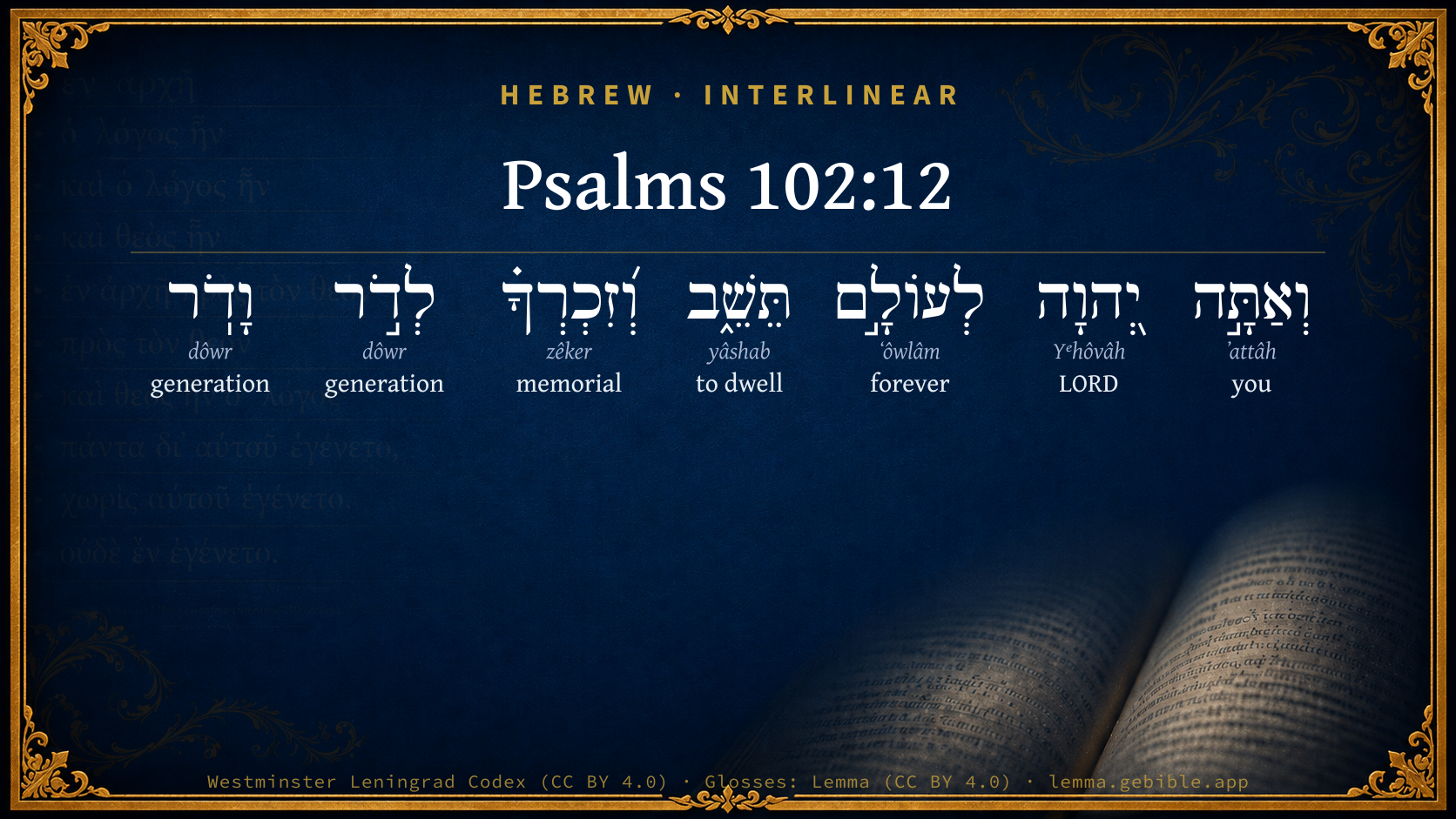
Psalms 102:12

Hebrew (Westminster Leningrad Codex) Psalms 102:12 appears in the Hebrew Old Testament. The text above is from the Westminster Leningrad Codex. Each word links to its Strong’s number, a concise gloss, and parsing drawn from the Open Scriptures Hebrew Bible morphology. Click any word for its full Brown-Driver-Briggs (BDB) entry.
Download image
Cite this verse

Psalms 102:12 (World English Bible). Public Domain. Lemma interlinear Bible study tool, https://lemma.gebible.app/v/psalms/102/12.

Show BibTeX & RIS
BibTeX
RIS
English Translation
But you, Yahweh, will abide forever; Your renown endures to all generations.
World English Bible · Public Domain
Download a study sheet

One document with this verse’s original text, its word-by-word gloss line, the meaning frame, cross-references with their text, attributed commentary, and full source and license credits — printable, and it pastes into notes with its structure intact.

This verse Autodidact and up

Study sheet (.html) Plain text (.txt)

A passage Seminary Student

Up to 50 verses in one chapter. A passage sheet keeps up to 6 commentary sources and 12 cross-references per verse, in the order this page ranks them, and says so on the sheet whenever that leaves anything out. Ask for a single verse and you get the Autodidact verse sheet above.

Everything on this page stays free to read, with no account — the sheet is a download of what is already on screen, not access to it.

Want to remove ads? Support Godless Engineer
Compare translations 3

The same verse in 3 English versions, stacked beneath the original-language interlinear above. Click any original word for its lexicon entry.

Each is an independent rendering of the whole verse — the interlinear is not word-aligned to these translations.

Highlighted words mark where these versions differ — a whole-verse word diff, not a word-by-word alignment.

  • World English Bible Public Domain
    But you, Yahweh, will abide forever; Your renown endures to all generations.
  • King James Version Public Domain
    But thou, O LORD, shall endure for ever; and thy remembrance unto all generations.
  • unfoldingWord Literal Text CC BY-SA 4.0
    But you, Yahweh, sit forever, and your remembrance to generation and generation.

unfoldingWord Literal Text — © unfoldingWord, licensed CC BY-SA 4.0. Word-aligned USFM3 via Door43 (git.door43.org/unfoldingWord/en_ult).

Versions to compare (up to 4)

3 of 4 selected

Show all 18 translations

Every available English version of this verse, each an independent rendering of the whole verse.

  • World English Bible Public Domain
    But you, Yahweh, will abide forever; Your renown endures to all generations.
  • Berean Standard Bible Public Domain
    But You, O LORD, sit enthroned forever; Your renown endures to all generations.
  • Majority Standard Bible Public Domain
    But You, O LORD, sit enthroned forever; Your renown endures to all generations.
  • King James Version Public Domain
    But thou, O LORD, shall endure for ever; and thy remembrance unto all generations.
  • American Standard Version (1901) Public Domain
    But thou, O Jehovah, wilt abide for ever; And thy memorial `name' unto all generations.
  • Revised Version (1885) Public Domain
    But thou, O LORD, shalt abide for ever; and thy memorial unto all generations.
  • Geneva Bible (1599) Public Domain
    But thou, O Lord, doest remaine for euer, and thy remembrance from generation to generation.
  • Douay-Rheims (1899) Public Domain
    My days have declined like a shadow, and I am withered like grass.
  • Young's Literal Translation Public Domain
    And Thou, O Jehovah, to the age abidest, And Thy memorial to all generations.
  • Literal Standard Version CC BY-SA 4.0
    And You, O YHWH, abide for all time, || And Your memorial from generation to generation.
  • Unlocked Literal Bible CC BY-SA 4.0
    But you, Yahweh, live forever, and your fame is for all generations.
  • unfoldingWord Literal Text CC BY-SA 4.0
    But you, Yahweh, sit forever, and your remembrance to generation and generation.
  • Darby Bible Public Domain
    But thou, Jehovah, abidest for ever, and thy memorial from generation to generation.
  • World Messianic Bible Public Domain
    But you, LORD, will remain forever; your renown endures to all generations.
  • Webster's Bible Public Domain
    \\102:11\\My days are like a shadow that declineth; and I am withered like grass.
  • Free Bible Version CC BY-SA 4.0
    But you, Lord, reign forever, your fame will last for all generations.
  • Bible in Basic English Public Domain
    But you, O Lord, are eternal; and your name will never come to an end.
  • JPS Tanakh (1917) Public Domain
    (102-13) But Thou, O LORD, sittest enthroned for ever; and Thy name is unto all generations.

Literal Standard Version (2020), Covenant Press — licensed CC BY-SA 4.0. Text via the HelloAO Bible API (eBible.org). Unlocked Literal Bible (unfoldingWord) — licensed CC BY-SA 4.0. Text via the HelloAO Bible API (eBible.org). unfoldingWord Literal Text — © unfoldingWord, licensed CC BY-SA 4.0. Word-aligned USFM3 via Door43 (git.door43.org/unfoldingWord/en_ult). Free Bible Version, Dr. Jonathan Gallagher — licensed CC BY-SA 4.0. Text via the HelloAO Bible API (eBible.org).

Word by word

More ways to search: Search by grammar → Find every occurrence → Compare this word →

Practice this passage: Drill this verse → Learn its vocabulary →

About this verse

These counts appear in no published source. They are computed here, from the morphology-tagged text and Lemma’s own curated glosses. What Lemma adds →

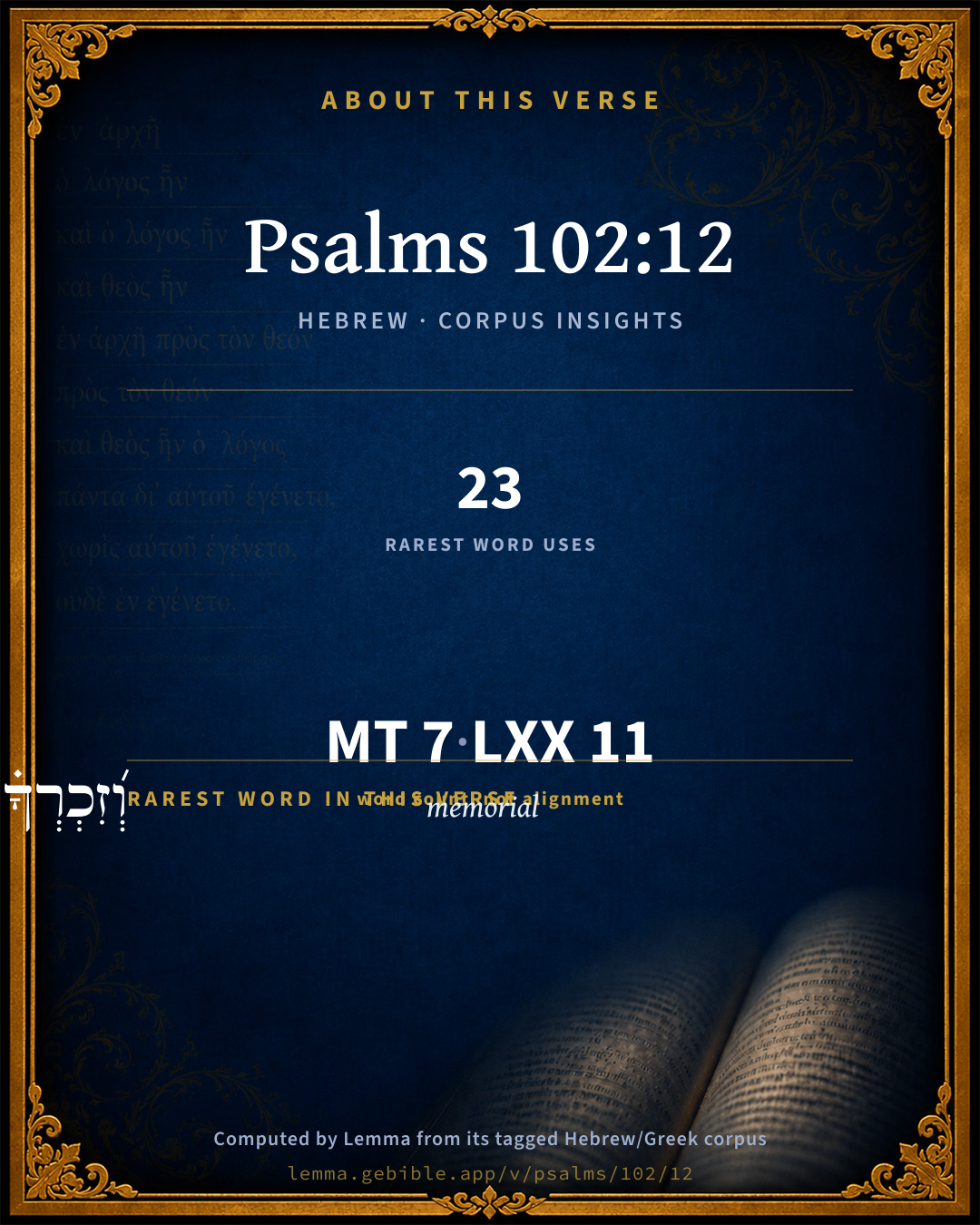
7
words
6
distinct lemmas
Wisdom
section

Notable vocabulary

The rarest word here is וְ֝זִכְרְךָ֗ memorial H2143 — appearing just 23 times in the whole Hebrew Bible.

Shared distinctive vocabulary

וְ֝זִכְרְךָ֗ memorial H2143 occurs in 23 verses of the Hebrew Bible. Also found in:

Grammatical profile

  • 1 verb
  • 5 nouns
  • 1 pronoun

Verb forms

  • תֵּשֵׁ֑ב Qal · Imperfect

Repetition

A word recurs within this verse — often emphatic in Hebrew:

  • לְדֹ֣ר generation H1755 ×2

Hebrew & Septuagint length

In English translation the verse runs 12 words from the Hebrew and 13 from the Septuagint (LXX English) — closely comparable.

A rough comparison of the two English renderings, which tokenize alike — not a word-level alignment.

Word counts can differ between the Hebrew and the Greek without any difference in meaning — e.g. the Hebrew direct-object marker אֵת has no separate Greek word, and Greek often adds the article ὁ.

In the original languages it is 7 Hebrew tokens and 11 Greek tokens — but the two are counted differently (Hebrew bundles its prefixes and suffixes into one token; the Greek is in lemma form), so that isn’t a like-for-like length.

Cross-references

10

Topical passages linked to Psalms 102:12 in the Treasury of Scripture Knowledge — connected by theme and wording, ordered by reader-vote popularity; previews shown in the World English Bible.

  • Psalms 135:13 Your name, Yahweh, endures forever; Your renown, Yahweh, throughout all generations.
  • Exodus 3:15 God said moreover to Moses, "You shall tell the children of Israel this, 'Yahweh, the God of your fathers, the God of Abraham, the God of Isaac, and the God of Jacob, has sent me to you.' This is my name forever, and this is my memorial to all generations.
  • Lamentations 5:19 You, Yahweh, abide forever; Your throne is from generation to generation.
  • Hebrews 13:8 Jesus Christ is the same yesterday, today, and forever.
  • Psalms 9:7 But Yahweh reigns forever. He has prepared his throne for judgment.
  • Revelation 1:17–18 When I saw him, I fell at his feet like a dead man. He laid his right hand on me, saying, "Don't be afraid. I am the first and the last,
  • Isaiah 44:6 Thus says Yahweh, the King of Israel, and his Redeemer, Yahweh of Hosts: I am the first, and I am the last; and besides me there is no God.
  • Isaiah 60:15 Whereas you have been forsaken and hated, so that no man passed through you, I will make you an eternal excellency, a joy of many generations.
  • Psalms 90:1–2 Lord, you have been our dwelling place for all generations.
  • Psalms 102:24–27 I said, "My God, don't take me away in the midst of my days. Your years are throughout all generations.

Cross-references courtesy of OpenBible.info (CC BY 4.0).

Hebrew and Greek witnesses Masoretic Hebrew ↔ Greek Septuagint

The same verse in the two great witnesses to the Old Testament, shown verse-for-verse.

You’re reading Greek Psalm 101 (Hebrew Psalm 102). The Septuagint counts the superscription, so verse numbers can differ from the Hebrew — chapter-level alignment, not verse-by-verse. Numbering follows Rahlfs.

These are two independent witnesses, not word-aligned to each other, and the Septuagint is shown in lemma (dictionary) form.

Hebrew Psalms 102:12 Masoretic · Westminster Leningrad Codex

וְאַתָּ֣ה יְ֭הוָה לְעוֹלָ֣ם תֵּשֵׁ֑ב וְ֝זִכְרְךָ֗ לְדֹ֣ר וָדֹֽר

But you, Yahweh, will abide forever; Your renown endures to all generations.

World English Bible · Public Domain

Greek LXX Greek Psalm 101:12 Septuagint · lemma form

ὁ ἡμέρα ἐγώ ὡσεί σκιά κλίνω καί ἐγώ ὡσεί χόρτος ξηραίνω

But you, Lord, endure for ever, and your memorial to generation and generation.

LXX2012 (modern English Septuagint) · Public Domain

Hebrew: Westminster Leningrad Codex (CC BY 4.0). Greek: Septuagint (public domain); English from LXX2012 (modern English Septuagint) (Public Domain). How the Septuagint differs from the Hebrew →

Commentary

Notes on Psalms 102:12 from classic Christian and Jewish commentators (each source and its license shown beneath its notes). The classic Christian expositions comment on the surrounding passage and are grouped to its opening verse, so a note may address several verses; the Jewish commentaries on the Tanakh (Rashi and others) are per-verse, so they appear only where the commentator wrote on this verse.

Lemma curates 59 commentaries, every one of them public domain or Creative Commons licensed, each selected and text-cleaned for this edition rather than reprinted as found. About our sources →

Matthew Henry's Commentary

Many exceedingly great and precious comforts are here thought of, and mustered up, to balance the foregoing complaints; for unto the upright there arises light in the darkness, so that, though they are cast down, they are not in despair. It is bad with the psalmist himself, bad with the people of God; but he has many considerations to revive himself with.

I. We are dying creatures, and our interests and comforts are dying, but God is an everliving everlasting God (Psa 102:12): "My days are like a shadow; there is no remedy; night is coming upon me; but, thou, O Lord! shalt endure for ever. Our life is transient, but thine is permanent; our friends die, but thou our God diest not; what threatened us cannot touch thee; our names will be written in the dust and buried in oblivion, but thy remembrance shall be unto all generations; to the end of time, nay, to eternity, thou shalt be known and honoured." A good man loves God better than himself, and therefore can balance his own sorrow and death with the pleasing thought of the unchangeable blessedness of the Eternal Mind. God endures for ever, his church's faithful patron and protector; and, his honour and perpetual remembrance being very much bound up in her interests, we may be confident that they shall not be neglected.

II. Poor Zion is now in distress, but there will come a time for her relief and succour (Psa 102:13): Thou shalt arise and have mercy upon Zion. The hope of deliverance is built upon the goodness of God - "Thou wilt have mercy upon Zion, for she has become an object of thy pity;" and upon the power of God - "Thou shalt arise and have mercy, shalt stir up thyself to do it, shalt do it in contempt of all the opposition made by the church's enemies." The zeal of the Lord of hosts shall do this. That which is very encouraging is that there is a time set for the deliverance of the church, which not only will come some time, but will come at the time appointed, the time which Infinite Wisdom has appointed (and therefore it is the best time) and which Eternal Truth has fixed it to, and therefore it is a certain time, and shall not be forgotten nor further adjourned. At the end of seventy years, the time to favour Zion, by delivering her from the daughter of Babylon, was to come, and at length it did come. Zion was now in ruins, that is, the temple that was built in the city of David: the favouring of Zion is the building of the temple up again, as it is explained, Psa 102:16. This is expected from the favour of God; that will set all to rights, and nothing but that, and therefore Daniel prays (Dan 9:17), Cause thy face to shine upon thy sanctuary, which is desolate. The building up of Zion is as great a favour to any people as they can desire. No blessing more desirable to a ruined state than the restoring and re-establishing of their church-privileges. Now this is here wished for and longed for, 1. Because it would be a great rejoicing to Zion's friends (Psa 102:14): Thy servants take pleasure even in the stones of the temple, though they were thrown down and scattered, and favour the dust, the very rubbish and ruins of it. Observe here, When the temple was ruined, yet the stones of it were to be had for a new building, and there were those who encouraged themselves with that, for they had a favour even for the dust of it. Those who truly love the church of God love it when it is in affliction as well as when it is in prosperity; and it is a good ground to hope that God will favour the ruins of Zion when he puts it into the heart of his people to favour them, and to show that they do so by their prayers and by their endeavours; as it is also a good plea with God for mercy for Zion that there are those who are so affectionately concerned for her, and are waiting for the salvation of the Lord. 2. Because it would have a good influence upon Zion's neighbours, Psa 102:15. It will be a happy means perhaps of their conversion, at least of their conviction; for so the heathen shall fear the name of the Lord, shall have high thoughts of him and his people, and even the kings of the earth shall be affected with his glory. They shall have better thoughts of the church of God than they have had, when God by his providence thus puts an honour upon it; they shall be afraid of doing any thing against it when they see God taking its part; nay, they shall say, We will go with you, for we have seen that God is with you, Zac 8:23. Thus it is said (Est 8:17) that many of the people of the land became Jews, for the fear of the Jews fell upon them. 3. Because it would redound to the honour of Zion's God (Psa 102:16): When the Lord shall build up Zion. They take it for granted it will be done, for God himself has undertaken it, and he shall then appear in his glory; and for that reason all that have made his glory their highest end desire it and pray for it. Note, The edifying of the church will be the glorifying of God, and therefore we may be assured it will be done in the set time. Those that pray in faith, Father, glorify thy name, may receive the same answer to that prayer which was given to Christ himself by a voice from heaven, I have both glorified it and I will glorify it yet again, though now for a time it may be eclipsed.

III. The prayers of God's people now seem to be slighted and no notice taken of them, but they will be reviewed and greatly encouraged (Psa 102:17): He will regard the prayer of the destitute. It was said (Psa 102:16) that God will appear in his glory, such a glory as kings themselves shall stand in awe of, Psa 102:15. When great men appear in their glory they are apt to look with disdain upon the poor that apply to them; but the great God will not do so. Observe, 1. The meanness of the petitioners; they are the destitute. It is an elegant word that is here used, which signifies the heath in the wilderness, a low shrub, or bush, like the hyssop of the wall. They are supposed to be in a low and broken state, enriched with spiritual blessings, but destitute of temporal good things - the poor, the weak, the desolate, the stripped; thus variously is the word rendered; or it may signify that low and broken spirit which God looks for in all that draw nigh to him and which he will graciously look upon. This will bring them to their knees. Destitute people should be praying people, Ti1 5:5. 2. The favour of God to them, notwithstanding their meanness: He will regard their prayer, and will look at it, will peruse their petition (Ch2 6:40), and he will not despise their prayer. More is implied than is expressed: he will value it and be well pleased with it, and will return an answer of peace to it, which is the greatest honour that can be put upon it. But it is thus expressed because others despise their praying, they themselves fear God will despise it, and he was thought to despise it while their affliction was prolonged and their prayers lay unanswered. When we consider our own meanness and vileness, our darkness and deadness, and the manifold defects in our prayers, we have cause to suspect that our prayers will be received with disdain in heaven; but we are here assured of the contrary, for we have an advocate with the Father, and are under grace, not under the law. This instance of God's favour to his praying people, though they are destitute, will be a lasting encouragement to prayer (Psa 102:18): This shall be written for the generation to come, that none may despair, though they be destitute, nor think their prayers forgotten because they have not an answer to them immediately. The experiences of others should be our encouragements to seek unto God and trust in him. And, if we have the comfort of the experiences of others, it is fit that we should give God the glory of them: The people who shall be created shall praise the Lord for what he has done both for them and for their predecessors. Many that are now unborn shall, by reading the history of the church, be wrought upon to turn proselytes. The people that shall be created anew by divine grace, that are a kind of first-fruits of his creatures, shall praise the Lord for his answers to their prayers when they were more destitute.

IV. The prisoners under condemnation unjustly seem as sheep appointed for the slaughter, but care shall be taken for their discharge (Psa 102:19, Psa 102:20): God has looked down from the height of his sanctuary, from heaven, where he has prepared his throne, that high place, that holy place; thence did the Lord behold the earth, for it is a place of prospect, and nothing on this earth is or can be hidden from his all-seeing eye; he looks down, not to take a view of the kingdoms of the world and the glory of them, but to do acts of grace, to hear the groaning of the prisoners (which we desire to be out of the hearing of), and not only to hear them, but to help them, to loose those that are appointed to death, then when there is but a step between them and it. Some understand it of the release of the Jews out of their captivity in Babylon. God heard their groaning there as he did when they were in Egypt (Exo 3:7, Exo 3:9) and came down to deliver them. God takes notice not only of the prayers of his afflicted people, which are the language of grace, but even of their groans, which are the language of nature. See the divine pity in hearing the prisoner's groans, and the divine power in loosing the prisoner's bonds, even when they are appointed to death and are pinioned and double-shackled. We have an instance in Peter, Act 12:6. Such instances as these of the divine condescension and compassion will help, 1. To declare the name of the Lord in Zion, and to make it appear that he answers to his name, which he himself proclaimed, The Lord God, gracious and merciful; and this declaration of his name in Zion shall be the matter of his praise in Jerusalem, Psa 102:21. If God by his providences declare his name, we must by our acknowledgments of them declare his praise, which ought to be the echo of his name. God will discharge his people that were prisoners and captives in Babylon, that they may declare his name in Zion, the place he has chosen to put his name there, and his praise in Jerusalem, at their return thither; in the land of their captivity they could not sing the songs of Zion (Psa 137:3, Psa 137:4), and God brought them again to Jerusalem in order that they might sing them there. For this end God gives liberty from bondage (Bring my soul out of prison, that I may praise thy name, Psa 142:7), and life from the dead. Let my soul live, and it shall praise thee, Psa 119:175. 2. They will help to draw in others to the worship of God (Psa 102:22): When the people of God are gathered together at Jerusalem (as they were after their return out of Babylon) many out of the kingdoms joined with them to serve the Lord. This was fulfilled Ezr 6:21, where we find that not only the children of Israel that had come out of captivity, but many that had separated themselves from them among the heathen, did keep the feast of unleavened bread with joy. But it may look further, at the conversion of the Gentiles to the faith of Christ in the latter days. Christ has proclaimed liberty to the captives, and the opening of the prison to those that were bound, that they may declare the name of the Lord in the gospel-church, in which Jews and Gentiles shall unite.

Matthew Henry's Commentary on the Whole Bible (1708–1710) — public domain (CC PDM 1.0). Text via the HelloAO Bible API.

Trapp's Complete Commentary

John Trapp

Psa 102:12 But thou, O LORD, shalt endure for ever; and thy remembrance unto all generations.

Ver. 12. But thou, O Lord, shalt endure for ever] And therefore we, thy covenanters, shall be restored, Lam 5:19.

And thy remembrance] Which thou hast of us, and we of thee.

John Trapp, A Commentary or Exposition upon All the Books of the Old and New Testament (1647–1656) — public domain. Text from a community e-Sword module.

J. A. Alexander on Psalms

Joseph Addison Alexander

13. (Psa 102:12) And thou Jehovah, to eternity shall sit, and thy memory (shall endure) to generation and generation. Here again the pronoun is emphatic, and exhibits a strong contrast between God's eternity and human frailty. While I wither like the grass, thou endurest for ever, and not only so, but reignest, sittest on the throne. See above, on Psa 9:7; Psa 29:10; Psa 55:19. The word memory seems here to be employed for the sake of the antithesis which it implies. While I perish and am utterly forgotten, thy existence and thy memory shall last for ever. It may, however, have the same sense as in Psa 30:4, namely, the divine perfection, associated in our memory with the name of God. Thou shalt not only reign for ever, but be worthy, as an infinitely perfect being, so to do.

Joseph Addison Alexander, The Psalms Translated and Explained (1850) — public domain. Text from a community e-Sword module.

Tyndale Open Study Notes

Tyndale Open Resources

102:12-17 The topic changes from the psalmist’s miseries to the Lord’s glory. A vision of the Lord’s compassionate kingship gives him confidence in Zion’s future.

102:12 forever . . . to every generation: The frailty of humans (102:3-11) contrasts with the permanence of the Lord.

Tyndale Open Study Notes — © Tyndale Open Resources, licensed CC BY-SA 4.0. Text via the HelloAO Bible API.

Geneva Bible (1599)

Geneva Bible translators

Howsoever we be frail, yet thy promise is sure, and the remembrance thereof shall confirm us forever.

Geneva Bible (1599) marginal notes — public domain. Text via Bolls.life.

Adam Clarke's Commentary

Verse 12. But thou, O Lord, shalt endure for ever] Our life is a shadow; we can scarcely be called beings when compared with thee, for thou art eternal. Have mercy upon us, creatures of a day, and thy kindness shall be a memorial in all our generations.

Adam Clarke's Commentary on the Bible (1810–1826) — public domain. Text from a community e-Sword/MySword module.

John Calvin's Commentaries

12. And thou, O Jehovah! shalt dwell for ever When the prophet, for his own encouragement, sets before himself the eternity of God, it seems, at first sight, to be a far-fetched consolation; for what benefit will accrue to us from the fact that God sits immutable on his heavenly throne, when, at the same time, our frail and perishing condition does not permit us to continue unmoved for a single moment? And, what is more, this knowledge of the blessed repose enjoyed by God enables us the better to perceive that our life is a mere illusion. But the inspired writer, calling to remembrance the promises by which God had declared that he would make the Church the object of his special care, and particularly that remarkable article of the covenant, “I will dwell in the midst of you,” (Exodus 25:8) and, trusting to that sacred and indissoluble bond, has no hesitation in representing all the godly languishing, though they were in a state of suffering and wretchedness, as partakers of this celestial glory in which God dwells. The word memorial is also to be viewed in the same light. What advantage would we derive from this eternity and immutability of God’s being, unless we had in our hearts the knowledge of him, which, produced by his gracious covenant, begets in us the confidence arising from a mutual relationship between him and us? The meaning then is, “We are like withered grass, we are decaying every moment, we are not far from death, yea rather, we are, as it were, already dwelling in the grave; but since thou, O God! hast made a covenant with us, by which thou hast promised to protect and defend thine own people, and hast brought thyself into a gracious relation to us, giving us the fullest assurance that thou wilt always dwell in the midst of us, instead of desponding, we must be of good courage; and although we may see only ground for despair if we depend upon ourselves, we ought nevertheless to lift up our minds to the heavenly throne, from which thou wilt at length stretch forth thy hand to help us.” Whoever is in a moderate degree acquainted with the sacred writings, will readily acknowledge that whenever we are besieged with death, in a variety of forms, we should reason thus: As God continues unchangeably the same — “without variableness or shadow of turning” — nothing can hinder him from aiding us; and this he will do, because we have his word, by which he has laid himself under obligation to us, and because he has deposited with us his own memorial, which contains in it a sacred and indissoluble bond of fellowship.

John Calvin's Commentaries (1540-1563) — public domain. Text from the Calvin Translation Society English edition (1840s-50s) via the Christian Classics Ethereal Library (ccel.org). Calvin's coverage is partial (roughly two-thirds of the Bible); uncommented books and verses are honest gaps, never fabricated. The 19th-century editor's footnotes and remarks are omitted so the notes are faithfully Calvin's own voice.

Ellicott's Commentary for English Readers

(12) For ever.—The eternity of God, which must survive the world itself, is a pledge of the truth of the national hopes, in spite of the vicissitudes of individuals, and the swift succession of generations. For the word “remembrance,” see Psa_30:4. It is explained by Exo_3:15, “This is my name for ever, and this is my memorial through all generations.” The generations come and go, and the memory of man perishes, but the name “Jehovah” endures still, the object of adoration and praise.

A Bible Commentary for English Readers, edited by Charles John Ellicott (1878–1897) — public domain. Text from a community e-Sword module.

The Cambridge Bible for Schools and Colleges

gen. ed. J. J. S. Perowne

12. But thou, Jehovah, shalt sit enthroned for ever;

And thy memorial shall be for generation after generation.

The verse is taken from Lam_5:19, with the substitution of memorial for throne. The thought in which the Psalmist takes refuge is not merely Jehovah’s eternity (‘shalt abide’), but Jehovah’s eternal sovereignty (Psa_9:7). The name which is His memorial to one generation after another (Exo_3:15) is the pledge and expression of that sovereign rule. “I will be that I will be,” ever revealing Myself as the Living God, working out My plan in the history of the world. Such as He revealed Himself to be in the Exodus, He must continue to be for all time.

12–22. From the thought of his own frailty and transitoriness he turns to the eternal sovereignty of Jehovah, which is the sure pledge for Zion’s restoration.

The Cambridge Bible for Schools and Colleges (gen. ed. J. J. S. Perowne; Cambridge University Press, 1878–1918) — public domain. Text from a community e-Sword module.

John Gill's Exposition

Thou shalt arise, and have mercy on Zion,.... Exert his power, and display the riches of his grace and mercy; not by delivering the Jews from the Babylonish captivity, to which some restrain it; but by redeeming his church and people by power and price; or rather by raising up and restoring them to great glory and prosperity in the latter day:

for the time to favour her, yea, the set time, is come; not the seventy years of the captivity made known to the prophet Jeremiah; rather the seventy weeks of Daniel fixed for the Messiah's coming; or the fulness of time agreed upon, between Christ and his Father, for him to come and redeem his people; but it may best of all design the end of the forty two months, or the 1260 days, or years, fixed for the treading under foot the holy city, for the witnesses prophesying in sackcloth, and for the reign of antichrist; which when come will usher in glorious times in favour of Zion, the church of God, Rev 11:2.

John Gill's Exposition of the Whole Bible (1746–1763) — public domain (CC PDM 1.0). Text via the HelloAO Bible API.

Albert Barnes' Notes on the Bible

But thou, O Lord, shalt endure for ever - Though my condition has been changed, though I have been cast down from an exalted position, though kingdoms rise and fall, yet thou art unchanged. Thy purposes will abide. Thy promises will be fulfilled. Thy character is the same. As thou hast been the hearer of prayer in past times, so thou art now. As thou hast interposed in behalf of thy people in other ages, so thou wilt now. As thy people in affliction have been permitted to come to thee, so they may come to thee now. The psalmist here brings to his own mind, as an encouragement in trouble, as we may at all times, the fact that God is an unchanging God; that he always lives; that he is ever the same. We could have no ground of hope if God changed; if he formed purposes only to abandon them; if he made promises only to disregard them; if today he were a Being of mercy and goodness, and tomorrow would be merely a Being of justice and wrath. This argument is enlarged upon in Psa 102:25-28.

And thy remembrance unto all generations - Thy memory; or, the remembrance of thee. My days are like a shadow. I shall pass away, and be forgotten. No one will recollect me; no one will feel any interest in remembering that I have ever lived (see the notes at Psa 31:12). But while one knows that this must be so in regard to himself and to all other people - that he and they are alike to be forgotten - he may also feel that there is One who will never be forgotten. God will never pass away. He will be always the same. All the hopes of the church - of the world - are based on this. It is not on man - on any one individual - on any number of people - for they will all alike pass away and be forgotten; but one generation of people after another, to the end of time, may call on God, and find him an ever-living, an unchanged and unchangeable protector and friend.

Albert Barnes' Notes on the Bible (1834–1885) — public domain. Text from a community e-Sword/MySword module.

Matthew Poole's English Annotations

But this is my comfort, although we die and our hopes vanish, yet our God is everlasting and unchangeable, and therefore invincible by all his and our enemies, constant in his counsels and purposes of mercy to his church, stedfast and faithful in the performance of all his promises; and therefore he both can and will deliver his people.

Thy remembrance; either,

1. The fame and memory of thy wonderful works. Or rather,

2. Thy name, Jehovah, mentioned in the former clause, which is called by this very word, God’s

remembrance or memorial, and that unto all generations, Exo 3:15. Thus this clause exactly answers to the former; and both of them describe the eternity of God’s existence, whereby the psalmist relieves and supports himself under the consideration of his own and his people’s frailty and vanity.

Matthew Poole's English Annotations on the Holy Bible (1683–1685) — public domain. Text from a community e-Sword/MySword module.

The Treasury of David

Charles H. Spurgeon

Ver. 12. Now the writer's mind is turned away from his personal and relative troubles to the true source of all consolation, namely, the Lord himself, and his gracious purposes towards his own people.

But thou, O Lord, shalt endure for ever. I perish, but thou wilt not, my nation has become almost extinct, but thou art altogether unchanged. The original has the word "sit, ""thou, Jehovah, to eternity shalt sit:" that is to say, thou reignest on, thy throne is still secure even when thy chosen city lies in ruins, and thy peculiar people are carried into captivity. The sovereignty of God in all things is an unfailing ground for consolation; he rules and reigns whatever happens, and therefore all is well.

Firm as his throne his promise stands,

And he can well secure,

What I have committed to his hands.

Till the decisive hour.

And thy remmeberance unto all generations. Men will forget me, but as for thee, O God, the constant tokens of thy presence will keep the race of man in mind of thee from age to age. What God is now he always will be, that which our forefathers told us of the Lord we find to be true at this present time, and what our experience enables us to record will be confirmed by our children and their children's children. All things else are vanishing like smoke, and withering like grass, but over all the one eternal, immutable light shines on, and will shine on when all these shadows have declined into nothingness.

Psalms 102:13*

Charles H. Spurgeon's The Treasury of David (1869–1885) — public domain. Psalms only. Text from a community e-Sword/MySword module.

Whedon's Commentary on the Bible

Daniel D. Whedon

12. But thou, O Lord—The complaint is ended. Faith lifts the curtain and opens a new scene. The remainder of the psalm is illumined with the joy of hope.

Shalt endure for ever—The word rendered “endure,” here, would be better translated enthrone, as in Psa_2:4; Psa_9:7; Isa_14:13; Lam_5:19; Zec_6:13. “But thou, Jehovah, shall for ever sit [enthroned].” It was this doctrine of the everlasting dominion of Jehovah which sustained faith, and gave comfort and the joy of hope in the darkest adversity.

Daniel D. Whedon (gen. ed.), Commentary on the Old and New Testaments (1874–1909) — public domain. Text from a community e-Sword module.

The Pulpit Commentary

The second part of the psalm here begins. Against the complaint is to be set the confident hope and consolation. But thou, O Lord, shalt endure forever. God does not "wither" or decay God and God"s purposes "endure forever." It matters not that Israel is brought so low, and seems at the last gasp; God can raise up his people, and will do so in his own good time (vers. 13-17). And thy remembrance unto all generations; or, thy memorial (Revised Version); see Exo_3:15. God"s "remembrance," or "memorial," consists in the recollection, that his faithful ones have, of his historically manifested attributes. If this recollection is never to pass away, his faithful ones must remain also, to keep it up.

Vers. 12, 25-27. Changing self; changing world; unchanging God.

A very favourite contrast with psalmists and poets.

I A CONTRAST BASED ON A FACT. The fact is that man"s life is changeable and brief. This is true of a man"s bodily life, intellectual life, and life of relations. It is impressed on a man in his times of sickness, especially when sickness comes breaking into and breaking up his plans, as in the case of king Hezekiah. Here the psalmist puts the fact into two figures the passing shadow, the quickly withered grass. Precisely the metaphor is taken from the lengthening, that is, the evening shadow, which Rashi thus explains: "When it is the time of evening the shadows lengthen, but when it is dark they are no longer discernible, but come to an end and go." The figure of the short-lived grass is one of the most familiar in the Bible. It is more striking in the hot Eastern countries, where blasting winds come, than with us. The contrast is the Divine continuity and persistency. The cedars outlive the storms of many winters, but die at last. They endure through some generations, but fall at last. God survives all kinds of winters, and lasts through all generations. The successions of the afflicted have always the Divine Healthy One to whom they can look. They may comfort themselves with the assurance that what he was, he is, and ever will be.

II A CONTRAST BASED ON AN IMAGINATION. Nobody really knows anything about the earth perishing, and the heavens being folded up, though scientific men venture now to calculate the actual number of years that the earth may be expected to last. Ver. 25 is poetry, and based on Eastern knowledge and ideas of the form of earth and heaven. We can imagine all material things changing and passing. We know that nothing created retains its form long. And yet certain things of creation seem permanent and immovable. We speak of the "everlasting mountains," the solid earth," the "infinite heavens." But think of the mountains shaken down, the earth shifted from its place, and the heavens folded up, and then God is the same, unaffected; nay, he is the supreme force that crumbles the mountains, refashions the earth, and rolls up the heavens that he "spread abroad.

God stands in absolute contrast with

(1) all our experiences, and

(2) with all our imaginations.

The flux and reflux characteristic of material things never affect him "whose years are throughout all generations. R.T.

The Pulpit Commentary (1880–1919), ed. H.D.M. Spence-Jones & Joseph S. Exell — public domain. Text from a community e-Sword module.

John Wesley's Explanatory Notes

Remembrance - Thy name, Jehovah, which is called by this very word, God's remembrance, or memorial, and that unto all generations, Exod. iii, 15.

John Wesley, Explanatory Notes Upon the Whole Bible (1754–1765) — public domain. Text via the GEBible commentary corpus.

Keil & Delitzsch

C. F. Keil & F. Delitzsch

When the church in its individual members dies off on a foreign soil, still its God, the unchangeable One, remains, and therein the promise has the guarantee of its fulfilment. Faith lays hold upon this guarantee as in Ps 90. It becomes clear from Psa 9:8 and Lam 5:19 how תּשׁב is to be understood. The Name which Jahve makes Himself by self-attestation never falls a prey to the dead past, it is His ever-living memorial (זכר, Exo 3:15). Thus, too, will He restore Jerusalem; the limit, or appointed time, to which the promise points is, as his longing tells the poet, now come. מועד, according to Psa 75:3; Hab 2:3, is the juncture, when the redemption by means of the judgment on the enemies of Israel shall dawn. לחננהּ, from the infinitive חנן, has ĕ, flattened from ă, in an entirely closed syllable. רצה seq. acc. signifies to have pleasure in anything, to cling to it with delight; and חנן, according to Pro 14:21, affirms a compassionate, tender love of the object. The servants of God do not feel at home in Babylon, but their loving yearning lingers over the ruins, the stones and the heaps of the rubbish (Neh 4:2), of Jerusalem.

Keil & Delitzsch — Biblical Commentary on the Old Testament (1861–1891) — public domain (CC PDM 1.0). Text via the HelloAO Bible API. (Old Testament only.)

Rashi

Rabbi Shlomo Yitzchaki (Rashi)

Like a lengthening shadow At eventide, when the shadows lengthen, and when it becomes dark, they are not recognizable, but progressively disappear.

Rashi on the Tanakh — English translations: “The Judaica Press complete Tanach with Rashi, translated by A. J. Rosenberg” (CC BY 4.0); “Pentateuch with Rashi's commentary by M. Rosenbaum and A.M. Silbermann, 1929-1934” (public domain); “The Metsudah Tanach series, Lakewood, N.J” (CC BY 4.0); and “The Book of Joshua, Metsudah Publications, 1997” (CC BY 4.0). Text via Sefaria.

Lesson kit

Teaching starters — assembled from the data on this page, not authored interpretation. Every prompt links to the verse data it draws on. Edit before teaching.

Psalms, in the Wisdom, opens this verse with 7 words (6 distinct Hebrew lemmas). Its most distinctive word is zêker (“memorial”). A historical commentator’s framing appears above. Read the whole chapter for the surrounding context.

Discussion questions

  1. What does “memorial” (zêker) contribute to the verse as a whole?
  2. Exodus 3:15 shares the word «memorial» with this verse. How do the two illuminate each other?
  3. “generation” occurs 2× in this one verse. What is the effect of the repetition?
  4. The translations on this page render this verse differently — a whole-verse word diff, not a word-by-word alignment. What might account for the different wordings?
  5. The verb «תֵּשֵׁ֑ב» is Qal Imperfect. How does its form color the action?
  6. Reading how Matthew Henry's Commentary and Trapp's Complete Commentary read this verse, where do the two commentators agree and where do they part?

Things to notice

Reading settings

Reading text

Shown beneath each verse's original-language words.

Old Testament
Old Testament edition

Read the OT as the Masoretic Hebrew (MT) or the Greek Septuagint (LXX).

English shown for the Greek Septuagint (in the Hebrew ↔ Greek comparison).

Comparing translations? Open the Compare panel on any verse page to stack up to four side by side.