
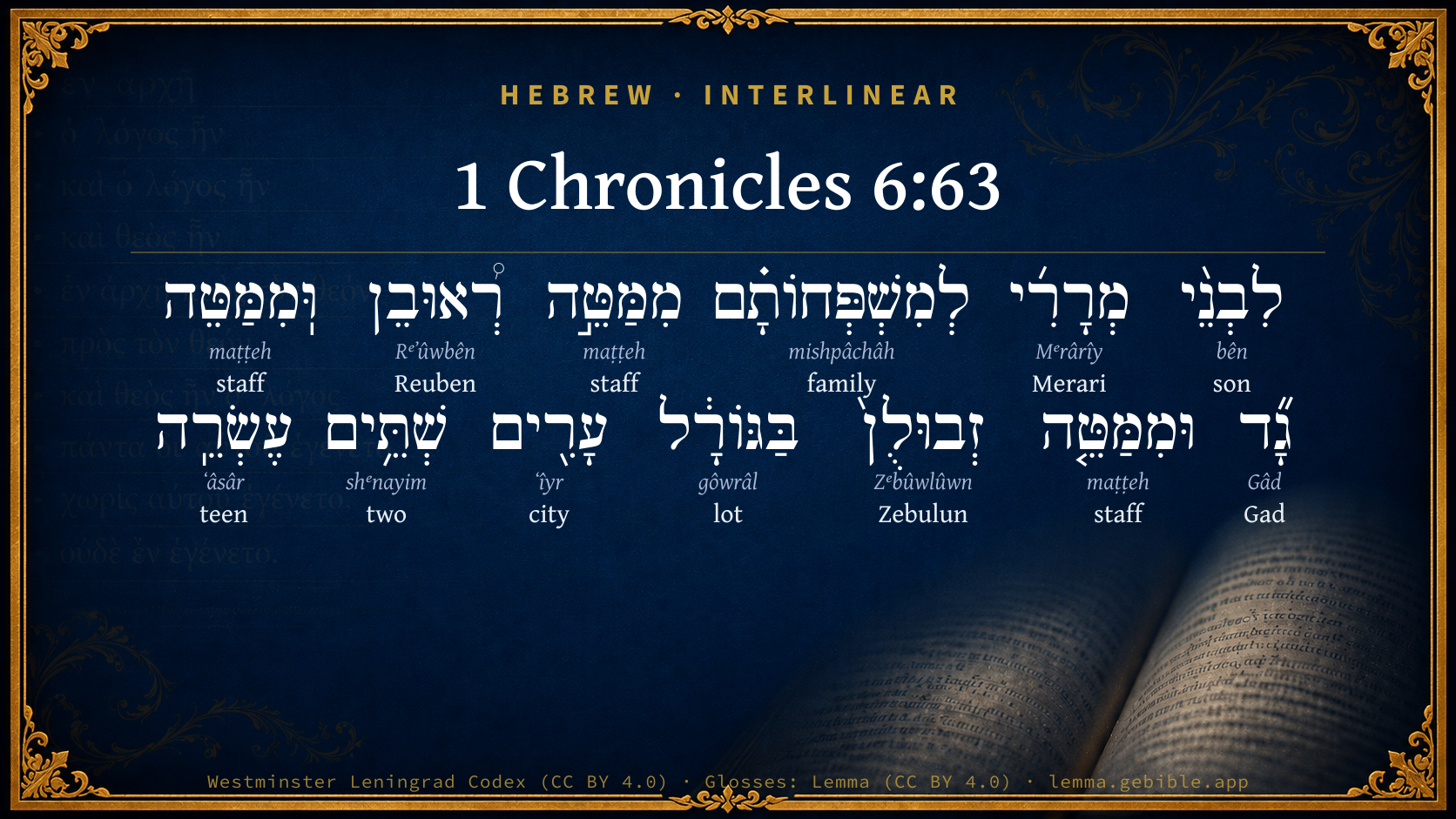
1 Chronicles 6:63

Hebrew (Westminster Leningrad Codex) 1 Chronicles 6:63 appears in the Hebrew Old Testament. The text above is from the Westminster Leningrad Codex. Each word links to its Strong’s number, a concise gloss, and parsing drawn from the Open Scriptures Hebrew Bible morphology. Click any word for its full Brown-Driver-Briggs (BDB) entry.
Download image
Cite this verse

1 Chronicles 6:63 (World English Bible). Public Domain. Lemma interlinear Bible study tool, https://lemma.gebible.app/v/1-chronicles/6/63.

Show BibTeX & RIS
BibTeX
RIS
English Translation
To the sons of Merari [were given] by lot, according to their families, out of the tribe of Reuben, and out of the tribe of Gad, and out of the tribe of Zebulun, twelve cities.
World English Bible · Public Domain
Download a study sheet

One document with this verse’s original text, its word-by-word gloss line, the meaning frame, cross-references with their text, attributed commentary, and full source and license credits — printable, and it pastes into notes with its structure intact.

This verse Autodidact and up

Study sheet (.html) Plain text (.txt)

A passage Seminary Student

Up to 50 verses in one chapter. A passage sheet keeps up to 6 commentary sources and 12 cross-references per verse, in the order this page ranks them, and says so on the sheet whenever that leaves anything out. Ask for a single verse and you get the Autodidact verse sheet above.

Everything on this page stays free to read, with no account — the sheet is a download of what is already on screen, not access to it.

Want to remove ads? Support Godless Engineer
Compare translations 3

The same verse in 3 English versions, stacked beneath the original-language interlinear above. Click any original word for its lexicon entry.

Each is an independent rendering of the whole verse — the interlinear is not word-aligned to these translations.

Highlighted words mark where these versions differ — a whole-verse word diff, not a word-by-word alignment.

  • World English Bible Public Domain
    To the sons of Merari [were given] by lot, according to their families, out of the tribe of Reuben, and out of the tribe of Gad, and out of the tribe of Zebulun, twelve cities.
  • King James Version Public Domain
    Unto the sons of Merari were given by lot, throughout their families, out of the tribe of Reuben, and out of the tribe of Gad, and out of the tribe of Zebulun, twelve cities.
  • unfoldingWord Literal Text CC BY-SA 4.0
    To the sons of Merari, for their clans, from the tribe of Reuben and from the tribe of Gad and from the tribe of Zebulun 12 cities by lot.

unfoldingWord Literal Text — © unfoldingWord, licensed CC BY-SA 4.0. Word-aligned USFM3 via Door43 (git.door43.org/unfoldingWord/en_ult).

Versions to compare (up to 4)

3 of 4 selected

Show all 18 translations

Every available English version of this verse, each an independent rendering of the whole verse.

  • World English Bible Public Domain
    To the sons of Merari [were given] by lot, according to their families, out of the tribe of Reuben, and out of the tribe of Gad, and out of the tribe of Zebulun, twelve cities.
  • Berean Standard Bible Public Domain
    The Merarites, according to their families, were allotted twelve cities from the tribes of Reuben, Gad, and Zebulun.
  • Majority Standard Bible Public Domain
    The Merarites, according to their clans, were allotted twelve cities from the tribes of Reuben, Gad, and Zebulun.
  • King James Version Public Domain
    Unto the sons of Merari were given by lot, throughout their families, out of the tribe of Reuben, and out of the tribe of Gad, and out of the tribe of Zebulun, twelve cities.
  • American Standard Version (1901) Public Domain
    Unto the sons of Merari `were given' by lot, according to their families, out of the tribe of Reuben, and out of the tribe of Gad, and out of the tribe of Zebulun, twelve cities.
  • Revised Version (1885) Public Domain
    Unto the sons of Merari were given by lot, according to their families, out of the tribe of Reuben, and out of the tribe of Gad, and out of the tribe of Zebulun, twelve cities.
  • Geneva Bible (1599) Public Domain
    Vnto the sonnes of Merari according to their families out of the tribe of Reuben, and out of the tribe of Gad, and out of the tribe of Zebulun, by lot twelue cities.
  • Douay-Rheims (1899) Public Domain
    And to the sons of Merari by families out of the tribe of Ruben, and out of the tribe of Gad, and out of the tribe of Zabulon, they gave by lot twelve cities.
  • Young's Literal Translation Public Domain
    To the sons of Merari, for their families, from the tribe of Reuben, and from the tribe of Gad, and from the tribe of Zebulun, by lot, twelve cities.
  • Literal Standard Version CC BY-SA 4.0
    To the sons of Merari, for their families, from the tribe of Reuben, and from the tribe of Gad, and from the tribe of Zebulun, by lot, [are] twelve cities.
  • Unlocked Literal Bible CC BY-SA 4.0
    To Merari's descendants they gave twelve cities, clan by clan, from the tribes of Reuben, Gad, and Zebulun.
  • unfoldingWord Literal Text CC BY-SA 4.0
    To the sons of Merari, for their clans, from the tribe of Reuben and from the tribe of Gad and from the tribe of Zebulun 12 cities by lot.
  • Darby Bible Public Domain
    To the children of Merari [were given] by lot, according to their families, out of the tribe of Reuben, and out of the tribe of Gad, and out of the tribe of Zebulun, twelve cities.
  • World Messianic Bible Public Domain
    To the sons of Merari were given by lot, according to their families, out of the tribe of Reuben, and out of the tribe of Gad, and out of the tribe of Zebulun, twelve cities.
  • Webster's Bible Public Domain
    To the sons of Merari were given by lot, throughout their families, out of the tribe of Reuben, and out of the tribe of Gad, and out of the tribe of Zebulun, twelve cities.
  • Free Bible Version CC BY-SA 4.0
    The descendants of Merari, by family, received twelve towns from the tribes of Reuben, Gad, and Zebulun.
  • Bible in Basic English Public Domain
    And to the sons of Merari, by their families, twelve towns were given by the Lord's decision, out of the tribe of Reuben, and out of the tribe of Gad, and out of the tribe of Zebulun.
  • JPS Tanakh (1917) Public Domain
    (6-48) Unto the sons of Merari were given by lot, according to their families, out of the tribe of Reuben, and out of the tribe of Gad, and out of the tribe of Zebulun, twelve cities.

Literal Standard Version (2020), Covenant Press — licensed CC BY-SA 4.0. Text via the HelloAO Bible API (eBible.org). Unlocked Literal Bible (unfoldingWord) — licensed CC BY-SA 4.0. Text via the HelloAO Bible API (eBible.org). unfoldingWord Literal Text — © unfoldingWord, licensed CC BY-SA 4.0. Word-aligned USFM3 via Door43 (git.door43.org/unfoldingWord/en_ult). Free Bible Version, Dr. Jonathan Gallagher — licensed CC BY-SA 4.0. Text via the HelloAO Bible API (eBible.org).

Word by word

More ways to search: Search by grammar → Find every occurrence → Compare this word →

Practice this passage: Drill this verse → Learn its vocabulary →

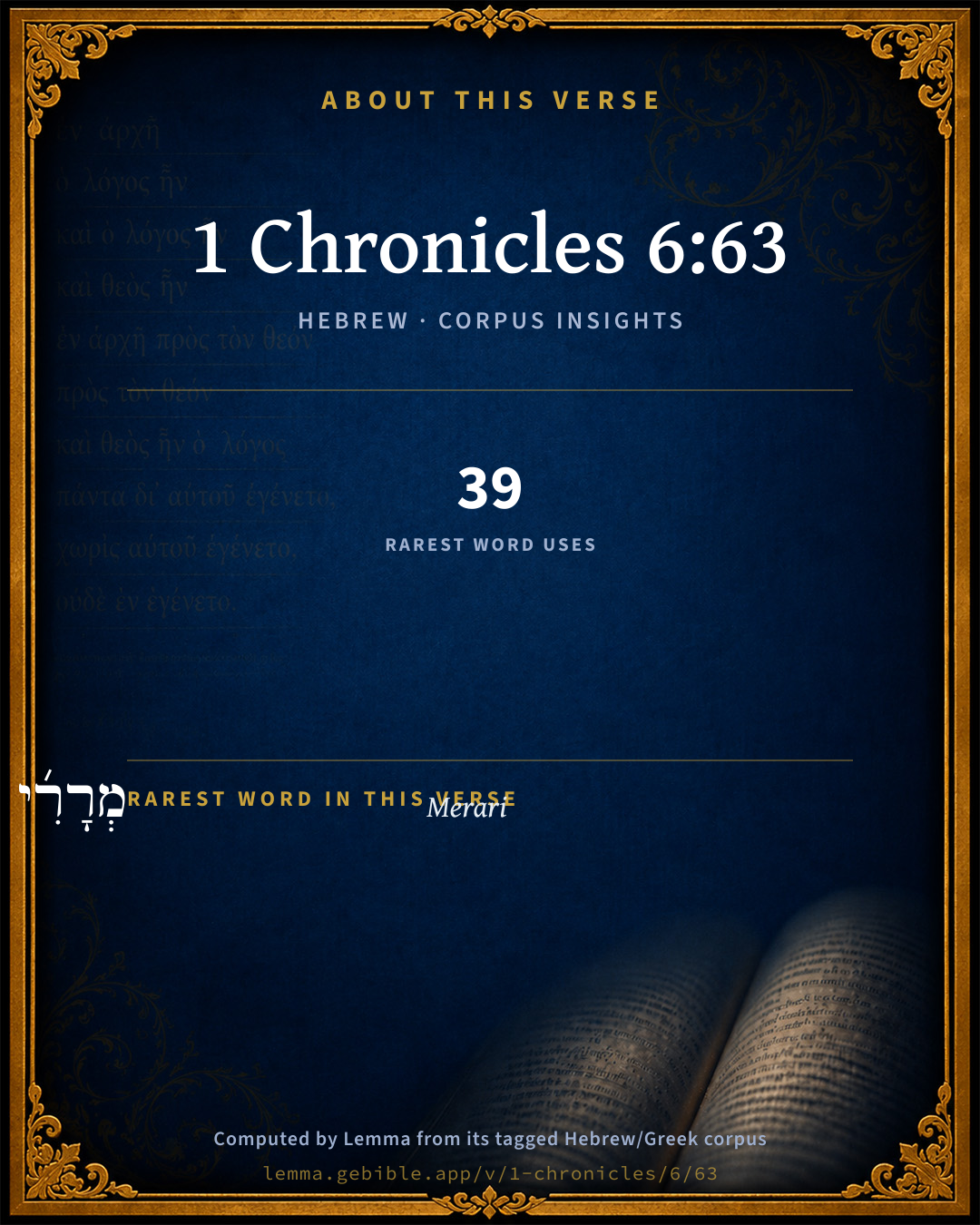
מְרָרִ֜י
Mᵉrârîy
H4847
“Merari”
Noun, Proper
Part of Speech
Noun
Type
Proper
Full BDB Definition

Origin: from H4843

TWOT: None

Merari = "bitter" - the 3rd son of Levi and head of a Levitical family
  1. לִבְנֵ֨י bên H1121 “to/for · sons of” Preposition + Noun, Common, Masculine, Plural, Construct
  2. לְמִשְׁפְּחוֹתָ֗ם mishpâchâh H4940 “to/for · families · their” Preposition + Noun, Common, Feminine, Plural, Construct + Suffix, Personal, 3rd Person, Masculine, Plural
  3. מִמַּטֵּ֣ה maṭṭeh H4294 “from · staff of” Preposition + Noun, Common, Masculine, Singular, Construct
  4. רְ֠אוּבֵן Rᵉʼûwbên H7205 “Reuben” Noun, Proper
  5. וּֽמִמַּטֵּה maṭṭeh H4294 “and · from · staff of” Conjunction + Preposition + Noun, Common, Masculine, Singular, Construct
  6. גָ֞ד Gâd H1410 “Gad” Noun, Proper
  7. וּמִמַּטֵּ֤ה maṭṭeh H4294 “and · from · staff of” Conjunction + Preposition + Noun, Common, Masculine, Singular, Construct
  8. זְבוּלֻן֙ Zᵉbûwlûwn H2074 “Zebulun” Noun, Proper
  9. בַּגּוֹרָ֔ל gôwrâl H1486 “in/at the · lot” Preposition, Determined + Noun, Common, Masculine, Singular, Absolute
  10. עָרִ֖ים ʻîyr H5892 “cities” Noun, Common, Feminine, Plural, Absolute
  11. שְׁתֵּ֥ים shᵉnayim H8147 “two” Adjective, Cardinal number, Feminine, Dual, Absolute
  12. עֶשְׂרֵֽה ʻâsâr H6240 “teen” Adjective, Cardinal number, Feminine, Singular, Absolute

About this verse

These counts appear in no published source. They are computed here, from the morphology-tagged text and Lemma’s own curated glosses. What Lemma adds →

13
words
11
distinct lemmas
Historical
section

Shared distinctive vocabulary

מְרָרִ֜י Merari H4847 occurs in 38 verses of the Hebrew Bible. Also found in:

Grammatical profile

  • 11 nouns
  • 2 adjectives

Repetition

A word recurs within this verse — often emphatic in Hebrew:

  • מִמַּטֵּ֣ה staff H4294 ×3

Hebrew & Septuagint length

In English translation the verse runs 35 words from the Hebrew and 33 from the Septuagint (LXX English) — closely comparable.

A rough comparison of the two English renderings, which tokenize alike — not a word-level alignment.

Word counts can differ between the Hebrew and the Greek without any difference in meaning — e.g. the Hebrew direct-object marker אֵת has no separate Greek word, and Greek often adds the article ὁ.

Cross-references

5

Topical passages linked to 1 Chronicles 6:63 in the Treasury of Scripture Knowledge — connected by theme and wording, ordered by reader-vote popularity; previews shown in the World English Bible.

  • Joshua 21:7 The children of Merari according to their families had out of the tribe of Reuben, and out of the tribe of Gad, and out of the tribe of Zebulun, twelve cities.
  • Joshua 21:34–40 To the families of the children of Merari, the rest of the Levites, out of the tribe of Zebulun, Jokneam with its suburbs, and Kartah with its suburbs,
  • Genesis 46:11 The sons of Levi: Gershon, Kohath, and Merari.
  • Numbers 3:20 The sons of Merari by their families: Mahli and Mushi. These are the families of the Levites according to their fathers' houses.
  • 1 Chronicles 6:77–81 To the rest of [the Levites], the sons of Merari, [were given], out of the tribe of Zebulun, Rimmono with its suburbs, Tabor with its suburbs;

Cross-references courtesy of OpenBible.info (CC BY 4.0).

Hebrew and Greek witnesses Masoretic Hebrew ↔ Greek Septuagint

The same verse in the two great witnesses to the Old Testament, shown verse-for-verse.

These are two independent witnesses, not word-aligned to each other, and the Septuagint is shown in lemma (dictionary) form.

Hebrew 1 Chronicles 6:63 Masoretic · Westminster Leningrad Codex

לִבְנֵ֨י מְרָרִ֜י לְמִשְׁפְּחוֹתָ֗ם מִמַּטֵּ֣ה רְ֠אוּבֵן וּֽמִמַּטֵּה גָ֞ד וּמִמַּטֵּ֤ה זְבוּלֻן֙ בַּגּוֹרָ֔ל עָרִ֖ים שְׁתֵּ֥ים עֶשְׂרֵֽה

To the sons of Merari [were given] by lot, according to their families, out of the tribe of Reuben, and out of the tribe of Gad, and out of the tribe of Zebulun, twelve cities.

World English Bible · Public Domain

Greek LXX 1 Chronicles 6:63 Septuagint · lemma form

καί ἐκ ὁ πέραν ὁ ἰορδάνης ιεριχω κατά δυσμή ὁ ἰορδάνης ἐκ φυλή ρουβην ὁ βοσορ ἐν ὁ ἔρημος καί ὁ περισπόριον αὐτός καί ὁ ιασα καί ὁ περισπόριον αὐτός

And to the sons of Merari according to their families there were given, by lot, twelve cities of the tribe of Ruben, of the tribe of Gad, and of the tribe of Zabulon.

LXX2012 (modern English Septuagint) · Public Domain

Hebrew: Westminster Leningrad Codex (CC BY 4.0). Greek: Septuagint (public domain); English from LXX2012 (modern English Septuagint) (Public Domain). How the Septuagint differs from the Hebrew →

Commentary

Notes on 1 Chronicles 6:63 from classic Christian and Jewish commentators (each source and its license shown beneath its notes). The classic Christian expositions comment on the surrounding passage and are grouped to its opening verse, so a note may address several verses; the Jewish commentaries on the Tanakh (Rashi and others) are per-verse, so they appear only where the commentator wrote on this verse.

Lemma curates 59 commentaries, every one of them public domain or Creative Commons licensed, each selected and text-cleaned for this edition rather than reprinted as found. About our sources →

The Cambridge Bible for Schools and Colleges

gen. ed. J. J. S. Perowne

63. twelve cities] The total number of Levitic cities (1Ch_6:60 thirteen, 1Ch_6:61 ten, 1Ch_6:62 thirteen, 1Ch_6:63 twelve) was forty-eight (so Jos_21:41), of which the Kohathites, as the largest division (cp. 1Ch_15:5, note), received twenty-three or nearly half.

The Cambridge Bible for Schools and Colleges (gen. ed. J. J. S. Perowne; Cambridge University Press, 1878–1918) — public domain. Text from a community e-Sword module.

Ellicott's Commentary for English Readers

(63) This verse is word for word the same as Jos_21:7, omitting the one term “by lot.”

A Bible Commentary for English Readers, edited by Charles John Ellicott (1878–1897) — public domain. Text from a community e-Sword module.

The Pulpit Commentary

The distribution of cities to the third branch of Levi"s family, that of Merari, now follows. They are selected, four from each of the tribes of Reuben, Gad, Zebulun. (Jos_21:7, Jos_21:34-40)

The Pulpit Commentary (1880–1919), ed. H.D.M. Spence-Jones & Joseph S. Exell — public domain. Text from a community e-Sword module.

unfoldingWord translationNotes

Door43 World Missions Community

Merari

See how you translated this man's name in 1 Chronicles 6:1.

their pasturelands

the land with grass for animals to eat. See how you translated this in 1 Chronicles 5:16.

the towns mentioned earlier

The towns mentioned in 1 Chronicles 6:55 and 1 Chronicles 6:60.

translationWords

Reuben

Gad

Zebulun

Israel

Levi

assign

Judah

Simeon

unfoldingWord translationNotes — © Distant Shores Media and the Door43 World Missions Community, licensed CC BY-SA 4.0. Source: git.door43.org/Door43/en_tn.

Lesson kit

Teaching starters — assembled from the data on this page, not authored interpretation. Every prompt links to the verse data it draws on. Edit before teaching.

1 Chronicles, in the Historical, opens this verse with 13 words (11 distinct Hebrew lemmas). Its most distinctive word is Mᵉrârîy (“Merari”). A historical commentator’s framing appears above. Read the whole chapter for the surrounding context.

Discussion questions

  1. The word Mᵉrârîy carries the sense “Merari.” How does it shape the verse?
  2. Genesis 46:11 shares the word «Merari» with this verse. How do the two illuminate each other?
  3. “staff” occurs 3× in this one verse. What is the effect of the repetition?
  4. These translations render this verse differently; the difference is in the English rendering, not the original. What questions does that raise?
  5. Reading how The Cambridge Bible for Schools and Colleges and Ellicott's Commentary for English Readers read this verse, where do the two commentators agree and where do they part?

Things to notice

Reading settings

Reading text

Shown beneath each verse's original-language words.

Old Testament
Old Testament edition

Read the OT as the Masoretic Hebrew (MT) or the Greek Septuagint (LXX).

English shown for the Greek Septuagint (in the Hebrew ↔ Greek comparison).

Comparing translations? Open the Compare panel on any verse page to stack up to four side by side.