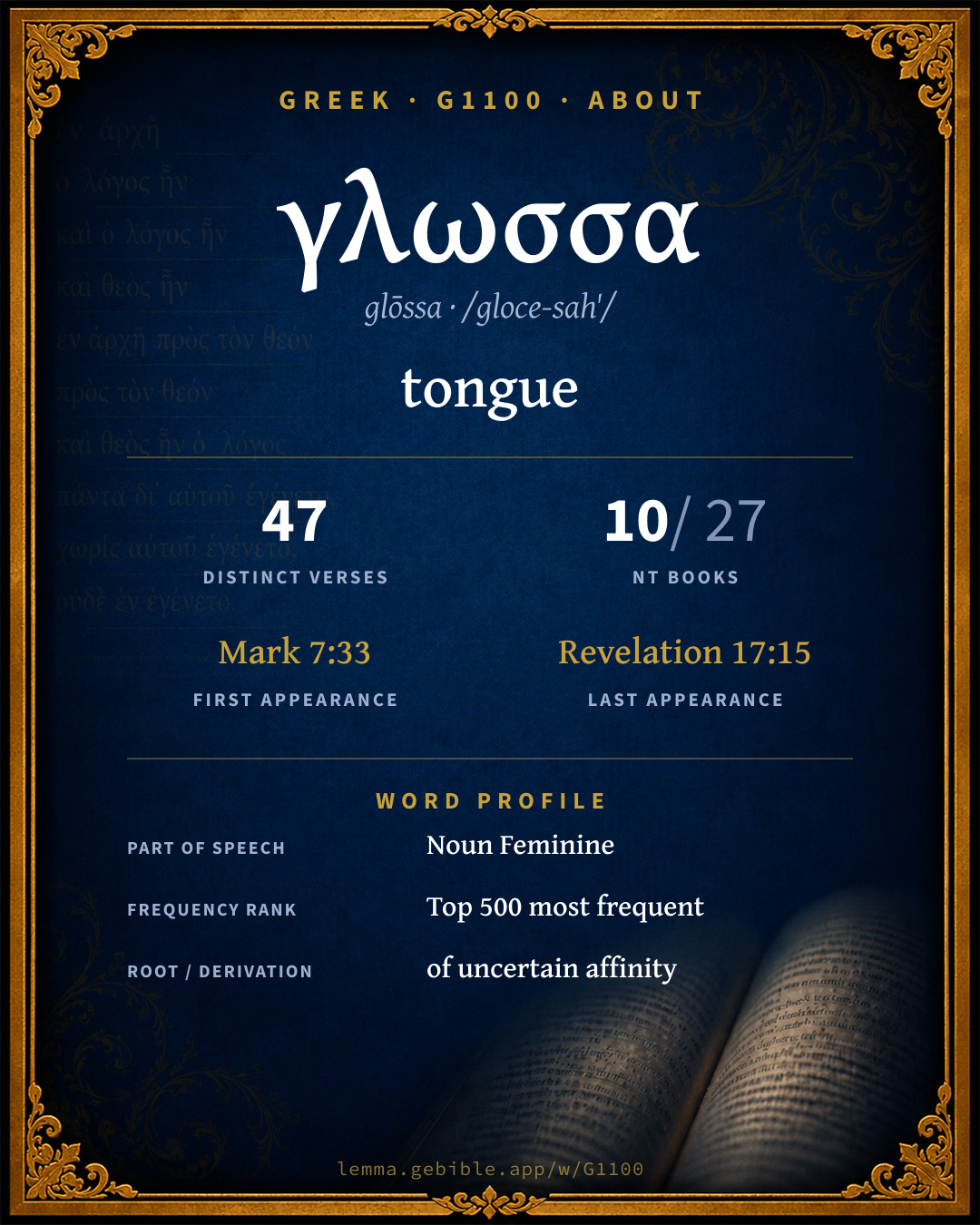
γλῶσσα
tongue
‘tongue’ is one of 2 main senses fuller range ↓
Full lexicon entry — Thayer's Greek Lexicon
From Thayer's Greek Lexicon
Where this word appears
See every Dative-case word in the Greek New Testament →
Grammar key — what these labels mean
Part of speech
- Noun
- A naming word — a person, place, thing, or idea.
Case
- Dative
- The case of the indirect object, means, or location — “to / for / with / in.”
- Accusative
- The case of the direct object and of extent.
- Nominative
- The case of the subject (and the predicate nominative).
- Genitive
- The case of source, possession, or “of” — answers “whose / from what.”
Gender
- Feminine
- Grammatically feminine.
Number
- Plural
- More than one.
- Singular
- One.
2 verses where G1100 appears in the Nominative case in the Book of Acts. Filtered view — show all forms. Click any verse to open its interlinear word-by-word view. Verse text shown in the World English Bible for context — . Each verse’s Greek form is shown with its reference; the English is not keyword-highlighted, since the data carries no word-level English alignment. Use “Compare translations” on any verse to read it across multiple English versions. This concordance covers the Greek New Testament; Septuagint (Greek Old Testament) occurrences of this word are not indexed here.
Acts
About this entry
At a glance — auto-summarized from this page’s data, not written by a person. Every figure links to its source below. This summary describes the numbers; it doesn’t interpret them.
At its core, γλωσσα (glōssa) means “tongue.” First canonically at Mark 7:33, it enters the text early. It appears 47 verses across 10 books of the Greek New Testament, among its moderately common vocabulary. The word gravitates to 1 Corinthians (40%), then Revelation and Acts. Catalogued under 2 senses, its meaning is not single-sense. Dig into 47-verse concordance and the renderings breakdown below.
Gloss history
Strong's 1890 vs modern scholarship
About this word
Strong's G1100 catalogs a Greek word from the Greek New Testament.
These counts are not copied from any lexicon or concordance. They are computed here, from the morphology-tagged Greek New Testament. What Lemma adds →
- 47
- distinct verses
- The word appears in 47 distinct verses.
- 10 / 27
- NT books
- The word appears in 10 of 27 New Testament books.
- #310
- by frequency
- Top 500 most frequent Greek words (rank 310 of 5,347 Greek words by occurrence).
View all 47 occurrences in the concordance →
Most concentrated in
- 1 Corinthians 19 verses 40%
- Revelation 8 verses 17%
- Acts 6 verses 13%
By section of the New Testament
By traditional corpus
Conventional, traditional groupings — biblical authorship is debated, so this is a traditional corpus grouping, not an authorship claim. Some books belong to more than one corpus (Luke is in both the Gospels and the Lukan corpus, and so on), so these shares overlap and need not total 100%. Each figure is a share of the word’s 47 distinct verses.
- Pauline corpus 22 verses · 47%
- Johannine 9 verses · 19%
- Lukan (Luke–Acts) 8 verses · 17%
- Revelation 8 verses · 17%
- General (Catholic) Epistles 6 verses · 13%
- Gospels 5 verses · 11%
How translations render this word
Counts come from each version’s own published word-to-Strong’s tagging or interlinear alignment — an approximate guide to how each version renders this word, not a word-level alignment the data otherwise carries. Because each total is that version’s own tagged count, the per-version totals vary from one another and need not match the appearance or distinct-verse counts above. These counts may also differ from a printed concordance because Lemma counts each distinctly tagged rendering and does not collapse phrase taggings into a single head-word total. This is a fixed set of word-tagged versions (KJV, ASV, BSB, ULT) and does not change with the reading translation you choose elsewhere. Each version’s license is shown beside its name below (and on Sources).
- King James Version: Tongues 25×, Tongue 18×, Unknown tongue 6×
- American Standard Version: Tongue 25×, Tongues 24×
- Berean Standard Bible: Tongue 24×, Tongues 23×
- unfoldingWord Literal Text: Tongue 22×, Tongues 17×, Languages 6×
King James Version Public Domain
Renders G1100 across 50 tagged occurrences — most commonly:
Plus 1 rendering that appears only once — usually multi-word phrases or single function words the recovered tagging swept in, not distinct renderings.
American Standard Version Public Domain
Renders G1100 across 52 tagged occurrences — most commonly:
Plus 3 renderings that appear only once — usually multi-word phrases or single function words the recovered tagging swept in, not distinct renderings.
Berean Standard Bible Public Domain
Renders G1100 across 49 tagged occurrences — most commonly:
Plus 2 renderings that appear only once — usually multi-word phrases or single function words the recovered tagging swept in, not distinct renderings. Not rendered by a distinct English word in 1 further occurrence.
unfoldingWord Literal Text CC BY-SA 4.0
Renders G1100 across 55 tagged occurrences — most commonly:
Plus 2 renderings that appear only once — usually multi-word phrases or single function words the recovered tagging swept in, not distinct renderings.
Senses in Thayer's
The 2 senses Thayer's distinguishes for this word, in lexicon order (not ranked by frequency or importance). The full entry — with sub-senses — is in the Lexicon Entry tab.
- the tongue, a member of the body, an organ of speech
- the language or dialect used by a particular people distinct from that of other nations
Word origin
Origin: of uncertain affinity
Of uncertain affinity; the tongue ; by implication a language (specifically one naturally unacquired): - tongue.
— Strong’s Exhaustive Concordance (1890), public domain.
Forms in the corpus
The 10 distinct written forms G1100 takes in the Greek New Testament, most frequent first — each parse links to that case’s occurrences in the concordance.
| Form | Parsing | Example | Uses |
|---|---|---|---|
| γλώσσαις glṓssais | Noun, Dative, Plural, Feminine | Mark 16:17 | 14 |
| γλώσσῃ glṓssē | Noun, Dative, Singular, Feminine | 1 Corinthians 14:2 | 8 |
| γλῶσσα glō̂ssa | Noun, Nominative, Singular, Feminine | Luke 1:64 | 6 |
| γλῶσσαν glō̂ssan | Noun, Accusative, Singular, Feminine | 1 Corinthians 14:26 | 6 |
| γλωσσῶν glōssō̂n | Noun, Genitive, Plural, Feminine | 1 Corinthians 12:10 | 5 |
| γλώσσης glṓssēs | Noun, Genitive, Singular, Feminine | Mark 7:33 | 4 |
| γλῶσσαι glō̂ssai | Noun, Nominative, Plural, Feminine | Acts 2:3 | 4 |
| γλώσσας glṓssas | Noun, Accusative, Plural, Feminine | Revelation 16:10 | 1 |
| γλῶσσά glō̂ssá | Noun, Nominative, Singular, Feminine | Acts 2:26 | 1 |
| γλῶσσάν glō̂ssán | Noun, Accusative, Singular, Feminine | Luke 16:24 | 1 |
Same root — word family
Other Thayer's entries built from the same root as G1100, grouped by Strong’s listed origin. These share a root / origin per the lexicon — not necessarily a shared meaning. Each links to that word’s own entry.
Derived from this word
Compare all same-root words → They share a root, not necessarily a meaning.
Septuagint usage
The same Greek word γλωσσα appears 111 times in the Greek Old Testament (Septuagint), across 109 verses in 18 books.
- 111
- LXX occurrences
- Tagged occurrences of this Greek word in the Septuagint.
- 109
- verses
- Distinct Septuagint verses containing this word.
- 18 / 39
- OT books
- The word appears in 18 of the 39 Old Testament books.
Sample Septuagint occurrences
- Genesis 10:5 γλῶσσα
- Exodus 11:7 γλῶσσα
- Joshua 7:21 γλῶσσα
- Judges 7:5 γλῶσσα
- 2 Samuel 23:2 γλῶσσα
- Job 5:21 γλῶσσα
- Psalms 5:10 γλῶσσα
- Proverbs 3:16 γλῶσσα
- Song of Solomon 4:11 γλῶσσα
- Isaiah 3:8 γλῶσσα
- Jeremiah 5:15 γλῶσσα
- Lamentations 4:4 γλῶσσα
Septuagint occurrences (same lexeme)
Every verse where the same Strong’s number (G1100) appears in the Greek Septuagint — showing the first 50 of 109. Verse text shown in the World English Bible for context; the Greek form is the matched word — the English is not keyword-highlighted.
- Genesis 10:5 γλῶσσα Of these were the isles of the nations divided in their lands, everyone after his language, after their families, in their nations.
- Genesis 10:20 γλῶσσα These are the sons of Ham, after their families, after their languages, in their lands, in their nations.
- Genesis 10:31 γλῶσσα These are the sons of Shem, after their families, after their languages, in their lands, after their nations.
- Genesis 11:7 γλῶσσα Come, let's go down, and there confuse their language, that they may not understand one another's speech."
- Exodus 11:7 γλῶσσα But against any of the children of Israel a dog won't even bark or move its tongue, against man or animal; that you may know that Yahweh makes a distinction between the Egyptians and Israel.
- Joshua 7:21 γλῶσσα when I saw among the spoil a goodly Babylonian mantle, and two hundred shekels of silver, and a wedge of gold of fifty shekels weight, then I coveted them, and took them; and, behold, they are hid in the earth in the midst of my tent, and the silver under it.
- Joshua 10:21 γλῶσσα that all the people returned to the camp to Joshua at Makkedah in peace: none moved his tongue against any of the children of Israel.
- Judges 7:5 γλῶσσα So he brought down the people to the water: and Yahweh said to Gideon, Everyone who laps of the water with his tongue, as a dog laps, him shall you set by himself; likewise everyone who bows down on his knees to drink.
- 2 Samuel 23:2 γλῶσσα The Spirit of Yahweh spoke by me, His word was on my tongue.
- Job 5:21 γλῶσσα You shall be hidden from the scourge of the tongue, Neither shall you be afraid of destruction when it comes.
- Job 6:30 γλῶσσα Is there injustice on my tongue? Can't my taste discern mischievous things?
- Job 20:12 γλῶσσα "Though wickedness is sweet in his mouth, Though he hide it under his tongue,
- Job 20:16 γλῶσσα He shall suck cobra venom. The viper's tongue shall kill him.
- Job 29:10 γλῶσσα The voice of the nobles was hushed, And their tongue stuck to the roof of their mouth.
- Job 33:2 γλῶσσα See now, I have opened my mouth. My tongue has spoken in my mouth.
- Psalms 5:10 γλῶσσα Hold them guilty, God. Let them fall by their own counsels; Thrust them out in the multitude of their transgressions, For they have rebelled against you.
- Psalms 9:28 γλῶσσα
- Psalms 11:4 γλῶσσα Yahweh is in his holy temple. Yahweh is on his throne in heaven. His eyes observe. His eyes examine the children of men.
- Psalms 11:5 γλῶσσα Yahweh examines the righteous, But the wicked and him who loves violence his soul hates.
- Psalms 13:3 γλῶσσα Behold, and answer me, Yahweh, my God. Give light to my eyes, lest I sleep in death;
- Psalms 14:3 γλῶσσα They have all gone aside. They have together become corrupt. There is none who does good, no, not one.
- Psalms 15:9 γλῶσσα
- Psalms 21:16 γλῶσσα
- Psalms 30:21 γλῶσσα
- Psalms 33:14 γλῶσσα From the place of his habitation he looks out on all the inhabitants of the earth,
- Psalms 34:28 γλῶσσα
- Psalms 36:30 γλῶσσα
- Psalms 38:2 γλῶσσα For your arrows have pierced me, Your hand presses hard on me.
- Psalms 38:4 γλῶσσα For my iniquities have gone over my head. As a heavy burden, they are too heavy for me.
- Psalms 44:2 γλῶσσα You drove out the nations with your hand, But you planted them. You afflicted the peoples, But you spread them abroad.
- Psalms 49:19 γλῶσσα He shall go to the generation of his fathers. They shall never see the light.
- Psalms 50:16 γλῶσσα But to the wicked God says, "What right do you have to declare my statutes, That you have taken my covenant on your lips,
- Psalms 51:4 γλῶσσα Against you, and you only, have I sinned, And done that which is evil in your sight; That you may be proved right when you speak, And justified when you judge.
- Psalms 51:6 γλῶσσα Behold, you desire truth in the inward parts. You teach me wisdom in the inmost place.
- Psalms 54:10 γλῶσσα
- Psalms 56:5 γλῶσσα All day long they twist my words. All their thoughts are against me for evil.
- Psalms 63:4 γλῶσσα So I will bless you while I live. I will lift up my hands in your name.
- Psalms 63:9 γλῶσσα But those who seek my soul, to destroy it, Shall go into the lower parts of the earth.
- Psalms 65:17 γλῶσσα
- Psalms 67:24 γλῶσσα
- Psalms 70:24 γλῶσσα
- Psalms 72:9 γλῶσσα Those who dwell in the wilderness shall bow before him. His enemies shall lick the dust.
- Psalms 77:36 γλῶσσα
- Psalms 80:6 γλῶσσα You make us a source of contention to our neighbors. Our enemies laugh among themselves.
- Psalms 108:2 γλῶσσα Wake up, harp and lyre! I will wake up the dawn.
- Psalms 118:172 γλῶσσα
- Psalms 119:2 γλῶσσα Blessed are those who keep his statutes, Who seek him with their whole heart.
- Psalms 119:3 γλῶσσα Yes, they do nothing wrong. They walk in his ways.
- Psalms 125:2 γλῶσσα As the mountains surround Jerusalem, So Yahweh surrounds his people from this time forth and forevermore.
- Psalms 136:6 γλῶσσα To him who spread out the earth above the waters; For his loving kindness endures forever:
These are occurrences of the same Greek lexeme (G1100) in the Septuagint — not a translation of any one Hebrew word. The store carries no word-level Hebrew↔Greek alignment, so no Hebrew original is asserted here. Counts come from the recovered LXX Strong's tagging — high-frequency vocabulary is well covered, while rare or late forms may be untagged — so they reflect tagged occurrences and may slightly undercount.