
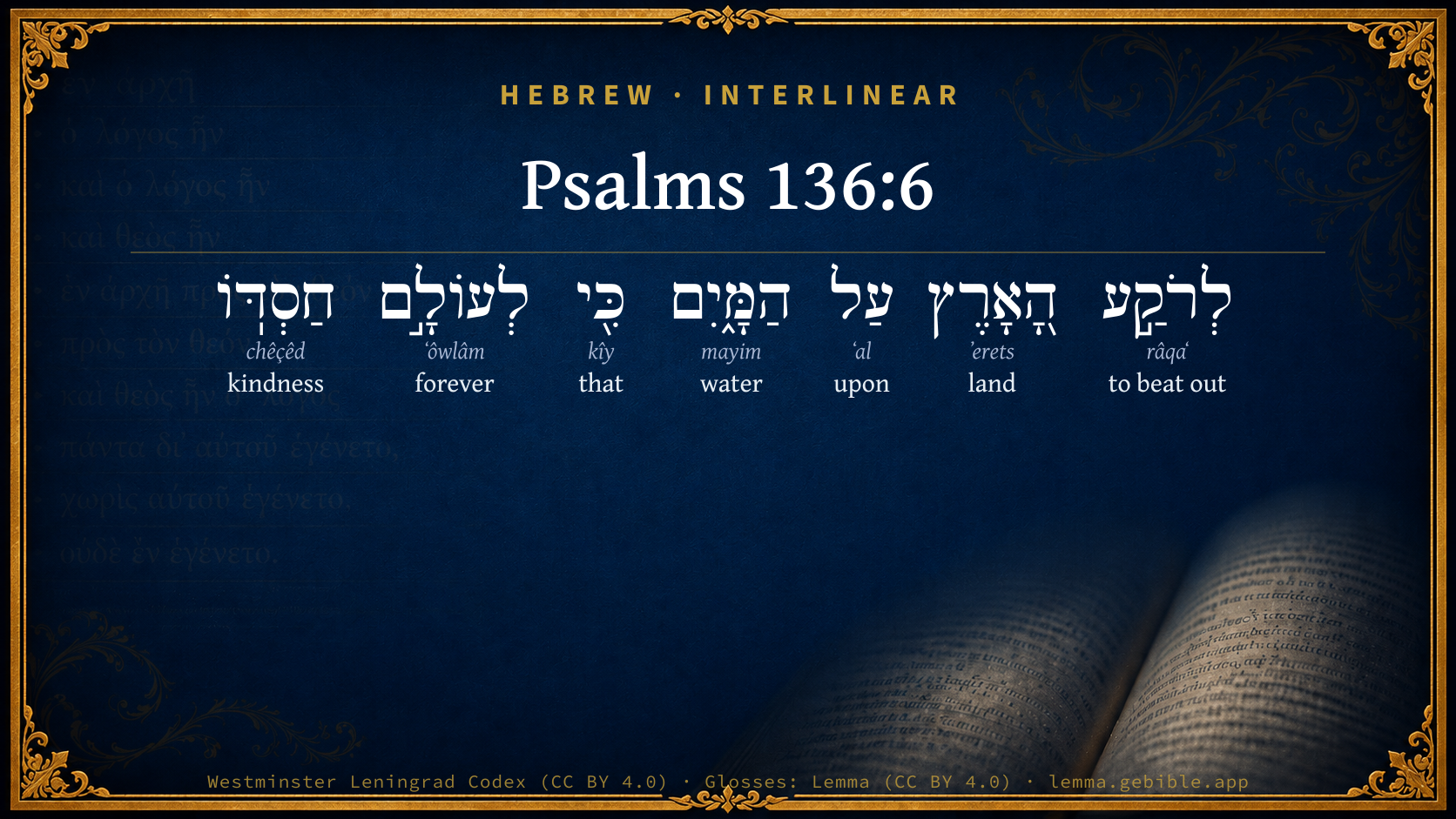
Psalms 136:6

Hebrew (Westminster Leningrad Codex) Psalms 136:6 appears in the Hebrew Old Testament. The text above is from the Westminster Leningrad Codex. Each word links to its Strong’s number, a concise gloss, and parsing drawn from the Open Scriptures Hebrew Bible morphology. Click any word for its full Brown-Driver-Briggs (BDB) entry.
Download image
Cite this verse

Psalms 136:6 (World English Bible). Public Domain. Lemma interlinear Bible study tool, https://lemma.gebible.app/v/psalms/136/6.

Show BibTeX & RIS
BibTeX
RIS
English Translation
To him who spread out the earth above the waters; For his loving kindness endures forever:
World English Bible · Public Domain
Download a study sheet

One document with this verse’s original text, its word-by-word gloss line, the meaning frame, cross-references with their text, attributed commentary, and full source and license credits — printable, and it pastes into notes with its structure intact.

This verse Autodidact and up

Study sheet (.html) Plain text (.txt)

A passage Seminary Student

Up to 50 verses in one chapter. A passage sheet keeps up to 6 commentary sources and 12 cross-references per verse, in the order this page ranks them, and says so on the sheet whenever that leaves anything out. Ask for a single verse and you get the Autodidact verse sheet above.

Everything on this page stays free to read, with no account — the sheet is a download of what is already on screen, not access to it.

Want to remove ads? Support Godless Engineer
Compare translations 3

The same verse in 3 English versions, stacked beneath the original-language interlinear above. Click any original word for its lexicon entry.

Each is an independent rendering of the whole verse — the interlinear is not word-aligned to these translations.

Highlighted words mark where these versions differ — a whole-verse word diff, not a word-by-word alignment.

  • World English Bible Public Domain
    To him who spread out the earth above the waters; For his loving kindness endures forever:
  • King James Version Public Domain
    To him that stretched out the earth above the waters: for his mercy endureth for ever.
  • unfoldingWord Literal Text CC BY-SA 4.0
    To the one spreading out the earth over the waters, for his covenant faithfulness to forever.

unfoldingWord Literal Text — © unfoldingWord, licensed CC BY-SA 4.0. Word-aligned USFM3 via Door43 (git.door43.org/unfoldingWord/en_ult).

Versions to compare (up to 4)

3 of 4 selected

Show all 18 translations

Every available English version of this verse, each an independent rendering of the whole verse.

  • World English Bible Public Domain
    To him who spread out the earth above the waters; For his loving kindness endures forever:
  • Berean Standard Bible Public Domain
    He spread out the earth upon the waters. His loving devotion endures forever.
  • Majority Standard Bible Public Domain
    He spread out the earth upon the waters. His loving devotion endures forever.
  • King James Version Public Domain
    To him that stretched out the earth above the waters: for his mercy endureth for ever.
  • American Standard Version (1901) Public Domain
    To him that spread forth the earth above the waters; For his lovingkindness `endureth' for ever:
  • Revised Version (1885) Public Domain
    To him that spread forth the earth above the waters: for his mercy endureth for ever.
  • Geneva Bible (1599) Public Domain
    Which hath stretched out the earth vpon the waters: for his mercie endureth for euer:
  • Douay-Rheims (1899) Public Domain
    Whatsoever the Lord hath pleased he hath done, in heaven, in earth, in the sea, and in all the deeps.
  • Young's Literal Translation Public Domain
    To Him spreading the earth over the waters, For to the age `is' His kindness.
  • Literal Standard Version CC BY-SA 4.0
    To Him spreading the earth over the waters, || For His kindness [is] for all time.
  • Unlocked Literal Bible CC BY-SA 4.0
    Give thanks to him who spread out the earth above the waters, for his covenant faithfulness endures forever—
  • unfoldingWord Literal Text CC BY-SA 4.0
    To the one spreading out the earth over the waters, for his covenant faithfulness to forever.
  • Darby Bible Public Domain
    To him that stretched out the earth above the waters, for his loving-kindness [endureth] for ever;
  • World Messianic Bible Public Domain
    to him who spread out the earth above the waters, for his loving kindness endures forever;
  • Webster's Bible Public Domain
    To him that stretched out the earth above the waters: for his mercy endureth for ever.
  • Free Bible Version CC BY-SA 4.0
    To him who spread out the earth over the waters. For his trustworthy love lasts forever.
  • Bible in Basic English Public Domain
    To him by whom the earth was stretched out over the waters: for his mercy is unchanging for ever.
  • JPS Tanakh (1917) Public Domain
    To Him that spread forth the earth above the waters, for His mercy endureth for ever.

Literal Standard Version (2020), Covenant Press — licensed CC BY-SA 4.0. Text via the HelloAO Bible API (eBible.org). Unlocked Literal Bible (unfoldingWord) — licensed CC BY-SA 4.0. Text via the HelloAO Bible API (eBible.org). unfoldingWord Literal Text — © unfoldingWord, licensed CC BY-SA 4.0. Word-aligned USFM3 via Door43 (git.door43.org/unfoldingWord/en_ult). Free Bible Version, Dr. Jonathan Gallagher — licensed CC BY-SA 4.0. Text via the HelloAO Bible API (eBible.org).

Word by word

More ways to search: Search by grammar → Find every occurrence → Compare this word →

Practice this passage: Drill this verse → Learn its vocabulary →

לְרֹקַ֣ע
râqaʻ
H7554
“to/for · beating out”
Preposition + Verb, Qal, Participle Active, Masculine, Singular, Construct
Part of Speech
Preposition + Verb
Stem
Qal
Form
Participle Active
Gender
Masculine
Number
Singular
State
Construct
Full BDB Definition

Origin: a primitive root

TWOT: 2217

to beat, stamp, beat out, spread out, stretch - (Qal) - to stamp, beat out - one who beats out (participle) - (Piel) to overlay, beat out (for plating) - (Pual) beaten out (participle) - (Hiphil) to make a spreading (of clouds)
  1. הָ֭אָרֶץ ʼerets H776 “the · land” Particle, Definite Article + Noun, Common, Both, Singular, Absolute
  2. עַל ʻal H5921 “upon” Preposition
  3. הַמָּ֑יִם mayim H4325 “the · water(s)” Particle, Definite Article + Noun, Common, Masculine, Plural, Absolute
  4. כִּ֖י kîy H3588 “that” Conjunction
  5. לְעוֹלָ֣ם ʻôwlâm H5769 “to/for · forever” Preposition + Noun, Common, Masculine, Singular, Absolute
  6. חַסְדּֽוֹ chêçêd H2617 “kindness · his” Noun, Common, Masculine, Singular, Construct + Suffix, Personal, 3rd Person, Masculine, Singular

About this verse

These counts appear in no published source. They are computed here, from the morphology-tagged text and Lemma’s own curated glosses. What Lemma adds →

7
words
7
distinct lemmas
Wisdom
section

Notable vocabulary

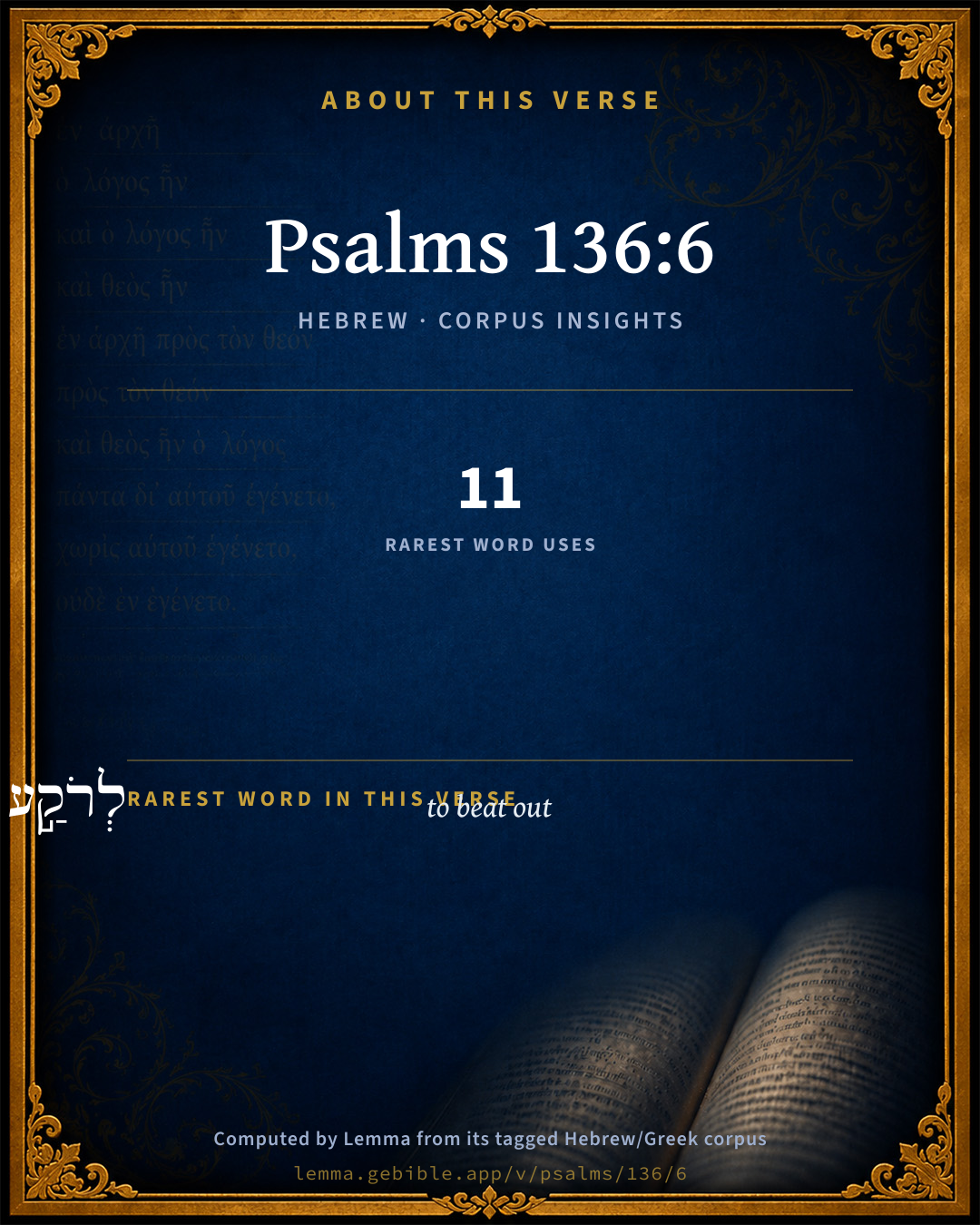
The rarest word here is לְרֹקַ֣ע to beat out H7554 — appearing just 11 times in the whole Hebrew Bible.

Shared distinctive vocabulary

לְרֹקַ֣ע to beat out H7554 occurs in 11 verses of the Hebrew Bible. Also found in:

Grammatical profile

  • 1 verb
  • 4 nouns
  • 1 preposition
  • 1 conjunction

Verb forms

  • לְרֹקַ֣ע Qal · Participle Active

Hebrew & Septuagint length

In English translation the verse runs 16 words from the Hebrew and 15 from the Septuagint (LXX English) — closely comparable.

A rough comparison of the two English renderings, which tokenize alike — not a word-level alignment.

Word counts can differ between the Hebrew and the Greek without any difference in meaning — e.g. the Hebrew direct-object marker אֵת has no separate Greek word, and Greek often adds the article ὁ.

Cross-references

11

Topical passages linked to Psalms 136:6 in the Treasury of Scripture Knowledge — connected by theme and wording, ordered by reader-vote popularity; previews shown in the World English Bible.

  • Psalms 24:2 For he has founded it on the seas, And established it on the floods.
  • Genesis 1:9 God said, "Let the waters under the sky be gathered together to one place, and let the dry land appear," and it was so.
  • Jeremiah 10:12 He has made the earth by his power, he has established the world by his wisdom, and by his understanding has he stretched out the heavens:
  • Job 26:7 He stretches out the north over empty space, And hangs the earth on nothing.
  • Psalms 104:2–3 He covers himself with light as with a garment. He stretches out the heavens like a curtain.
  • Isaiah 42:5 Thus says God Yahweh, he who created the heavens, and stretched them forth; he who spread abroad the earth and that which comes out of it; he who gives breath to the people on it, and spirit to those who walk therein:
  • Isaiah 44:24 Thus says Yahweh, your Redeemer, and he who formed you from the womb: I am Yahweh, who makes all things; who stretches forth the heavens alone; who spreads abroad the earth (who is with me?);
  • Zechariah 12:1 An oracle. The word of Yahweh concerning Israel. Yahweh, who stretches out the heavens, and lays the foundation of the earth, and forms the spirit of man within him says:
  • 2 Peter 3:5–7 For this they willfully forget, that there were heavens from of old, and an earth formed out of water and amid water, by the word of God;
  • Job 37:18 Can you, with him, spread out the sky, Which is strong as a cast metal mirror?
  • Isaiah 40:22 [It is] he who sits above the circle of the earth, and the inhabitants of it are as grasshoppers; who stretches out the heavens as a curtain, and spreads them out as a tent to dwell in;

Cross-references courtesy of OpenBible.info (CC BY 4.0).

Hebrew and Greek witnesses Masoretic Hebrew ↔ Greek Septuagint

The same verse in the two great witnesses to the Old Testament, shown verse-for-verse.

You’re reading Greek Psalm 135 (Hebrew Psalm 136). The Septuagint counts the superscription, so verse numbers can differ from the Hebrew — chapter-level alignment, not verse-by-verse. Numbering follows Rahlfs.

These are two independent witnesses, not word-aligned to each other, and the Septuagint is shown in lemma (dictionary) form.

Hebrew Psalms 136:6 Masoretic · Westminster Leningrad Codex

לְרֹקַ֣ע הָ֭אָרֶץ עַל הַמָּ֑יִם כִּ֖י לְעוֹלָ֣ם חַסְדּֽוֹ

To him who spread out the earth above the waters; For his loving kindness endures forever:

World English Bible · Public Domain

Greek LXX Greek Psalm 135:6 Septuagint · lemma form

ὁ στερεόω ὁ γῆ ἐπί ὁ ὕδωρ ὅτι εἰς ὁ αἰών ὁ ἔλεος αὐτός

To him who established the earth on the waters; for his mercy endures for ever.

LXX2012 (modern English Septuagint) · Public Domain

Hebrew: Westminster Leningrad Codex (CC BY 4.0). Greek: Septuagint (public domain); English from LXX2012 (modern English Septuagint) (Public Domain). How the Septuagint differs from the Hebrew →

Commentary

Notes on Psalms 136:6 from classic Christian and Jewish commentators (each source and its license shown beneath its notes). The classic Christian expositions comment on the surrounding passage and are grouped to its opening verse, so a note may address several verses; the Jewish commentaries on the Tanakh (Rashi and others) are per-verse, so they appear only where the commentator wrote on this verse.

Lemma curates 59 commentaries, every one of them public domain or Creative Commons licensed, each selected and text-cleaned for this edition rather than reprinted as found. About our sources →

Trapp's Complete Commentary

John Trapp

Psa 136:6 To him that stretched out the earth above the waters: for his mercy [endureth] for ever.

Ver. 6. To him that stretched out the earth, &c.] A perpetual mercy to all earthly creatures, as is elsewhere set forth, Gen 1:9 Psa 24:2.

John Trapp, A Commentary or Exposition upon All the Books of the Old and New Testament (1647–1656) — public domain. Text from a community e-Sword module.

Whedon's Commentary on the Bible

Daniel D. Whedon

6. Stretched out the earth above the waters—Another instance wherein external nature is described, not scientifically, but popularly, as it appears to the senses. So the scriptures speak of the sun’s rising and going down; and so philosophers themselves still speak, despite the philosophical absurdity of the expression. Psa_136:6-9 follow the record of Gen_1:8.

Daniel D. Whedon (gen. ed.), Commentary on the Old and New Testaments (1874–1909) — public domain. Text from a community e-Sword module.

J. A. Alexander on Psalms

Joseph Addison Alexander

6. (Psa 136:6) To him that spread the earth above the waters--for unto eternity (is) his mercy. That spread, literally spreading, as in ver. 5. Above (not upon, but higher than) the waters. See above, on Psa 24:2.

Joseph Addison Alexander, The Psalms Translated and Explained (1850) — public domain. Text from a community e-Sword module.

Geneva Bible (1599)

Geneva Bible translators

This was a common kind of thanksgiving, which the whole people used, when they had received any benefit of God, as 2 Chron. 7:6 and 20:21, meaning, that God was not only merciful to their fathers, but also continued the same to their posterity.

Geneva Bible (1599) marginal notes — public domain. Text via Bolls.life.

Adam Clarke's Commentary

Verse 6. Stretched out the earth above the waters] Or, upon the waters. This seems to refer to a central abyss of waters, the existence of which has not been yet disproved.

Adam Clarke's Commentary on the Bible (1810–1826) — public domain. Text from a community e-Sword/MySword module.

Ellicott's Commentary for English Readers

(6) While this section in many points recalls the account of creation in Genesis, it employs terms from other parts of Scripture.

Stretched out.—A word and idea peculiar to Isaiah and this psalm (Isa_42:5; Isa_44:24); properly to beat out with the feet, then to overlay with a plate of metal (Isa_40:12). The earth is regarded as a flat plate that has been beaten out and spread on the face of the waters, whereas in Genesis it is pictured as emerging out of the waters.

A Bible Commentary for English Readers, edited by Charles John Ellicott (1878–1897) — public domain. Text from a community e-Sword module.

The Cambridge Bible for Schools and Colleges

gen. ed. J. J. S. Perowne

6. O give thanks unto him that gathereth the outcasts of Israel (Psa_147:2 b; cp. Isa_11:12; Isa_56:8), for &c.

6. that spread forth the earth upon the waters] Cp. Psa_135:6, note; Isa_42:5; Isa_44:24; Psa_24:2.

The Cambridge Bible for Schools and Colleges (gen. ed. J. J. S. Perowne; Cambridge University Press, 1878–1918) — public domain. Text from a community e-Sword module.

John Gill's Exposition

To him that stretcheth out the earth above the waters,.... Or, "besides the waters" (t), close by them, and yet secures the earth from being covered with them; see Psa 24:2;

for his mercy endureth for ever; it was in mercy he caused the waters to go off the earth which first covered it; that trees, plants, and herbs, might spring up out of it, and that it might be a fit habitation for man; and though for the sins of the old world these waters were let in upon it, which drowned it, and destroyed man and beast upon it, except a few that were in mercy preserved; yet the Lord has promised and swore to it, that these waters shall no more go over the earth to destroy it; he has set a bound for the sea that it cannot pass, by a decree of his; even the sand on the shore, which, as weak as it may seem to be, is a bound unpassable; though they may toss and rage and roar, they shall not prevail, nor pass over it, which is a perpetual miracle of mercy, Jer 5:22.

(t) "juxta aquas", Tirinus, Gejerus, Michaelis.

John Gill's Exposition of the Whole Bible (1746–1763) — public domain (CC PDM 1.0). Text via the HelloAO Bible API.

Albert Barnes' Notes on the Bible

To him that stretched out the earth above the waters - Gen 1:1, Gen 1:9; see the notes at Psa 24:2.

For his mercy ... - As an illustration of his benignity and kindness in preparing an abode for man, and for other creatures in the world. Whatever there is of life or happiness, on the continents and islands, has resulted from that act of God when “he made the dry land appear.”

Albert Barnes' Notes on the Bible (1834–1885) — public domain. Text from a community e-Sword/MySword module.

Matthew Poole's English Annotations

Stretched out the earth above the waters; of which See Poole "Gen 1:9"; See Poole "Psa 24:2".

Matthew Poole's English Annotations on the Holy Bible (1683–1685) — public domain. Text from a community e-Sword/MySword module.

The Treasury of David

Charles H. Spurgeon

Ver. 6. To him that stretched out the earth above the waters. Lifting it up from the mingled mass, the dank morass, the bottomless bog, of mixed land and sea; and so fitting it to be the abode of man. Who but the Lord could have wrought this marvel? Few even think of the divine wisdom and power which performed all this of old; yet, if a continent can be proved to have risen or fallen an inch within historic memory, the fact is recorded in the "transactions" of learned societies, and discussed at every gathering of philosophers.

For his mercy endureth for ever, as is seen in the original upheaval and perpetual upstanding of the habitable land, so that no deluge drowns the race. By his strength he sets fast the mountains and consolidates the land upon which we sojourn.

From the flood he lifts the land:

Firm his mercies ever stand.

Ver. 6. Stretched out the earth above the waters. The waters of the great deep (Ge 7:11) are meant; above which the crust of the earth is outspread. In Pr 8:27 the great deep encircles the earth. Speaker's Commentary.

Psalms 136:7*

Charles H. Spurgeon's The Treasury of David (1869–1885) — public domain. Psalms only. Text from a community e-Sword/MySword module.

The Pulpit Commentary

To him that stretched out the earth above the waters. (comp. Isa_42:5 Isa_44:24 Psa_24:2) For his mercy, etc.

The Pulpit Commentary (1880–1919), ed. H.D.M. Spence-Jones & Joseph S. Exell — public domain. Text from a community e-Sword module.

unfoldingWord translationNotes

Door43 World Missions Community

spread out the earth above the waters

The ancient Israelites thought that the earth's dry land was on top of the sea. AT: "placed the earth over the waters"

for his covenant faithfulness endures forever

The abstract noun "faithfulness" can be translated with an adjective. See how you translated this in Psalms 136:1. AT: "because he remains faithful to his covenant forever" (See: Abstract Nouns)

great lights

This is a reference to the sources of light for the earth, especially the sun and the moon. AT: "the sun and the moon and the stars"

translationWords

earth

water

light

unfoldingWord translationNotes — © Distant Shores Media and the Door43 World Missions Community, licensed CC BY-SA 4.0. Source: git.door43.org/Door43/en_tn.

Lesson kit

Teaching starters — assembled from the data on this page, not authored interpretation. Every prompt links to the verse data it draws on. Edit before teaching.

Psalms, in the Wisdom, opens this verse with 7 words (7 distinct Hebrew lemmas). Its most distinctive word is râqaʻ (“to beat out”). A historical commentator’s framing appears above. Read the whole chapter for the surrounding context.

Discussion questions

  1. What does “to beat out” (râqaʻ) contribute to the verse as a whole?
  2. Exodus 39:3 shares the word «to beat out» with this verse. How do the two illuminate each other?
  3. The translations on this page render this verse differently — a whole-verse word diff, not a word-by-word alignment. What might account for the different wordings?
  4. The verb «לְרֹקַ֣ע» is Qal Participle Active. How does its form color the action?
  5. Reading how Trapp's Complete Commentary and Whedon's Commentary on the Bible read this verse, where do the two commentators agree and where do they part?

Things to notice

Reading settings

Reading text

Shown beneath each verse's original-language words.

Old Testament
Old Testament edition

Read the OT as the Masoretic Hebrew (MT) or the Greek Septuagint (LXX).

English shown for the Greek Septuagint (in the Hebrew ↔ Greek comparison).

Comparing translations? Open the Compare panel on any verse page to stack up to four side by side.