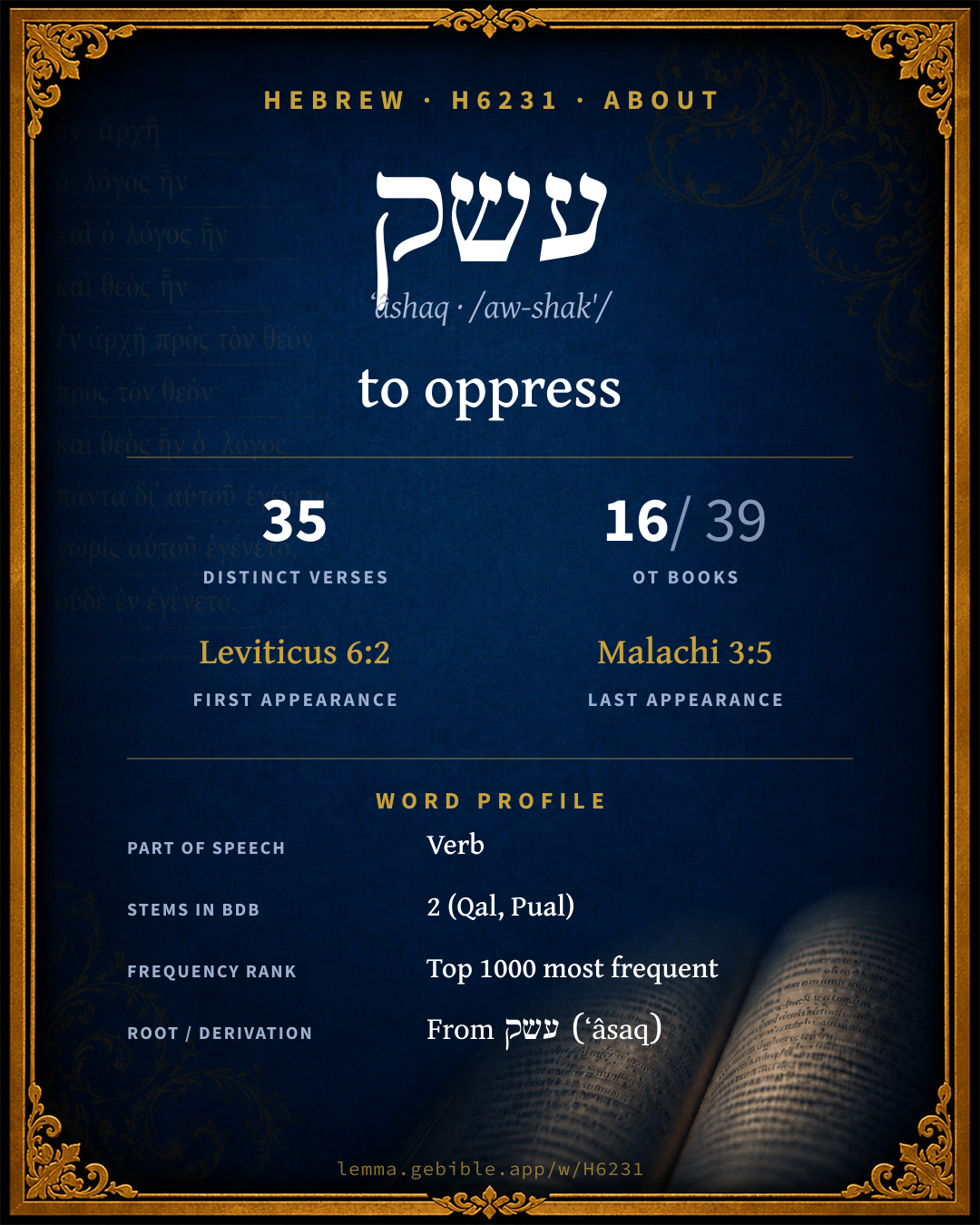
עָשַׁק
to oppress
‘to oppress’ is one of 2 main senses fuller range ↓
Full lexicon entry — Brown-Driver-Briggs (BDB)
From Brown-Driver-Briggs (BDB)
Where this word appears
See every Qal verb in the Hebrew Bible →
Grammar key — what these labels mean
Part of speech
- Verb
- An action or state-of-being word.
Stem
- Qal
- The basic, simple active stem — the plain form of the verb (“he wrote”). Here: ‘oppress’
- Pual
- The passive counterpart of the Piel.
Form
- Participle Active
- A verbal adjective expressing ongoing or characteristic action (“writing / one who writes”).
- Participle Passive
- A verbal adjective expressing action received (“written”).
- Imperfect
- An incomplete, ongoing, or future action (“he will / would write”).
- Perfect
- A completed action or state — Hebrew marks aspect (completeness) more than strict tense (“he wrote”).
- Infinitive Construct
- A bound verbal noun, frequently with prepositions (“to write / in writing”).
- Sequential Perfect
- A perfect with prefixed waw continuing a preceding imperfect or command (waw-consecutive perfect).
- Jussive
- A third- or second-person volitional form expressing wish or command (“let him write”).
State
- Absolute
- The independent form of a noun, not bound to a following word.
- Construct
- A noun bound to a following noun in a possessive / “of” relationship (the construct chain).
Person
- 2nd Person
- The one addressed (“you”).
- 3rd Person
- The one spoken about (“he / she / it / they”).
- 1st Person
- The speaker (“I / we”).
Gender
- Masculine
- Grammatically masculine.
- Common
- Either gender — not distinguished for this form.
- Feminine
- Grammatically feminine.
Number
- Singular
- One.
- Plural
- More than one (in Hebrew, generally three or more).
Grammatical forms 17 distinct
- Verb, Qal, Participle Active, Masculine, Singular, Absolute 5 times (14%)
- Verb, Qal, Participle Passive, Masculine, Singular, Absolute 4 times (11%)
- Verb, Qal, Perfect, 3rd Person, Masculine, Singular 4 times (11%)
- Verb, Qal, Imperfect, 2nd Person, Masculine, Singular 3 times (8%)
- Verb, Qal, Infinitive Construct 3 times (8%)
- Verb, Qal, Participle Passive, Masculine, Plural, Absolute 3 times (8%)
- Verb, Qal, Participle Active, Masculine, Plural, Construct 3 times (8%)
- Verb, Qal, Perfect, 3rd Person, Common, Plural 2 times (6%)
+9 more forms (9 occurrences)
Parsed forms decoded from the imported morphology (morphhb / Westminster Leningrad Codex — WLC text public domain, morphhb tagging CC BY 4.0), counted across 36 parsed occurrences — not distinct verses.
Every verse where H6231 appears — 35 distinct verses across 16 books. Click any verse to open its interlinear word-by-word view. Verse text shown in the World English Bible for context — . Each verse’s Hebrew form is shown with its reference; the English is not keyword-highlighted, since the data carries no word-level English alignment. Use “Compare translations” on any verse to read it across multiple English versions. This concordance covers the Hebrew Bible; Septuagint (Greek Old Testament) occurrences are not indexed here.
Leviticus 3 verses
- Leviticus 6:2 עָשַׁ֥ק Qal pf 3ms "If anyone sins, and commits a trespass against Yahweh, and deals falsely with his neighbor in a matter of deposit, or of bargain, or of robbery, or has oppressed his neighbor,
- Leviticus 6:4 עָשָׁ֔ק Qal pf 3ms then it shall be, if he has sinned, and is guilty, he shall restore that which he took by robbery, or the thing which he has gotten by oppression, or the deposit which was committed to him, or the lost thing which he found,
- Leviticus 19:13 תַעֲשֹׁ֥ק Qal impf 2ms "'You shall not oppress your neighbor, nor rob him. The wages of a hired servant shall not remain with you all night until the morning.
Deuteronomy 3 verses
- Deuteronomy 24:14 תַעֲשֹׁ֥ק Qal impf 2ms You shall not oppress a hired servant who is poor and needy, whether he be of your brothers, or of your foreigners who are in your land within your gates:
- Deuteronomy 28:29 עָשׁ֧וּק Qal ptcp.pass ms and you shall grope at noonday, as the blind gropes in darkness, and you shall not prosper in your ways: and you shall be only oppressed and robbed always, and there shall be none to save you.
- Deuteronomy 28:33 עָשׁ֥וּק Qal ptcp.pass ms The fruit of your ground, and all your labors, shall a nation which you don't know eat up; and you shall be only oppressed and crushed always;
1 Samuel 2 verses
- 1 Samuel 12:3 עָשַׁ֨קְתִּי֙ Qal pf 1cs Here I am: witness against me before Yahweh, and before his anointed: whose ox have I taken? or whose donkey have I taken? or whom have I defrauded? whom have I oppressed? or of whose hand have I taken a ransom to blind my eyes therewith? and I will restore it you.
- 1 Samuel 12:4 עֲשַׁקְתָּ֖/נוּ Qal pf 2ms + sfx pers 1cp They said, You have not defrauded us, nor oppressed us, neither have you taken anything of any man's hand.
1 Chronicles 1 verse
Job 2 verses
- Job 10:3 תַעֲשֹׁ֗ק Qal impf 2ms Is it good to you that you should oppress, That you should despise the work of your hands, And smile on the counsel of the wicked?
- Job 40:23 יַעֲשֹׁ֣ק Qal impf 3ms Behold, if a river overflows, he doesn't tremble. He is confident, though the Jordan swells even to his mouth.
Psalms 6 verses
- Psalms 72:4 עוֹשֵֽׁק Qal ptcp.act ms He will judge the poor of the people. He will save the children of the needy, And will break the oppressor in pieces.
- Psalms 103:6 עֲשׁוּקִֽים Qal ptcp.pass mp Yahweh executes righteous acts, And justice for all who are oppressed.
- Psalms 105:14 לְ/עָשְׁקָ֑/ם prep + Qal inf.cs + sfx pers 3mp He allowed no one to do them wrong. Yes, he reproved kings for their sakes,
- Psalms 119:121 לְ/עֹֽשְׁקָֽ/י prep + Qal ptcp.act mp cs + sfx pers 1cs I have done what is just and righteous. Don't leave me to my oppressors.
- Psalms 119:122 יַעַשְׁקֻ֥/נִי Qal juss 3mp + sfx pers 1cs Ensure your servant's well-being. Don't let the proud oppress me.
- Psalms 146:7 לָ/עֲשׁוּקִ֗ים prep det + Qal ptcp.pass mp Who executes justice for the oppressed; Who gives food to the hungry. Yahweh frees the prisoners.
Proverbs 4 verses
- Proverbs 14:31 עֹ֣שֵֽׁק Qal ptcp.act ms He who oppresses the poor shows contempt for his Maker, But he who is kind to the needy honors him.
- Proverbs 22:16 עֹ֣שֵֽׁק Qal ptcp.act ms Whoever oppresses the poor for his own increase and whoever gives to the rich, Both come to poverty.
- Proverbs 28:3 וְ/עֹשֵׁ֣ק conj + Qal ptcp.act ms A needy man who oppresses the poor Is like a driving rain which leaves no crops.
- Proverbs 28:17 עָשֻׁ֣ק Qal ptcp.pass ms A man who is tormented by life blood will be a fugitive until death; No one will support him.
Ecclesiastes 1 verse
Isaiah 2 verses
- Isaiah 23:12 הַֽ/מְעֻשָּׁקָ֞ה ptcl def.art + Pual ptcp.pass fs He said, You shall no more rejoice, you oppressed virgin daughter of Sidon: arise, pass over to Kittim; even there shall you have no rest.
- Isaiah 52:4 עֲשָׁקֽ/וֹ Qal pf 3ms + sfx pers 3ms For thus says the Lord Yahweh, My people went down at the first into Egypt to sojourn there: and the Assyrian has oppressed them without cause.
Jeremiah 3 verses
- Jeremiah 7:6 תַֽעֲשֹׁ֔קוּ Qal impf 2mp if you don't oppress the foreigner, the fatherless, and the widow, and don't shed innocent blood in this place, neither walk after other gods to your own hurt:
- Jeremiah 21:12 עוֹשֵׁ֑ק Qal ptcp.act ms House of David, thus says Yahweh, Execute justice in the morning, and deliver him who is robbed out of the hand of the oppressor, lest my wrath go forth like fire, and burn so that none can quench it, because of the evil of your doings.
- Jeremiah 50:33 עֲשׁוּקִ֛ים Qal ptcp.pass mp Thus says Yahweh of hosts: The children of Israel and the children of Judah are oppressed together; and all who took them captive hold them fast; they refuse to let them go.
Ezekiel 2 verses
- Ezekiel 18:18 עָ֣שַׁק Qal pf 3ms As for his father, because he cruelly oppressed, robbed his brother, and did that which is not good among his people, behold, he shall die in his iniquity.
- Ezekiel 22:29 עָ֣שְׁקוּ עָשְׁק֖וּ Qal pf 3cp Qal pf 3cp The people of the land have used oppression, and exercised robbery; yes, they have vexed the poor and needy, and have oppressed the foreigner wrongfully.
Hosea 2 verses
Amos 1 verse
Micah 1 verse
Zechariah 1 verse
Malachi 1 verse
About this entry
At a glance — auto-summarized from this page’s data, not written by a person. Every figure links to its source below. This summary describes the numbers; it doesn’t interpret them.
At its core, עשק (ʻâshaq) means “to oppress.” Scripture first uses it in Leviticus 6:2. It turns up in 35 verses across 16 books, a moderately common footprint. The verb spans 2 stems, from Qal to Pual. It shares a root with עשק, מעשקה and עשוק. Each statement above links to its evidence; the full detail follows below.
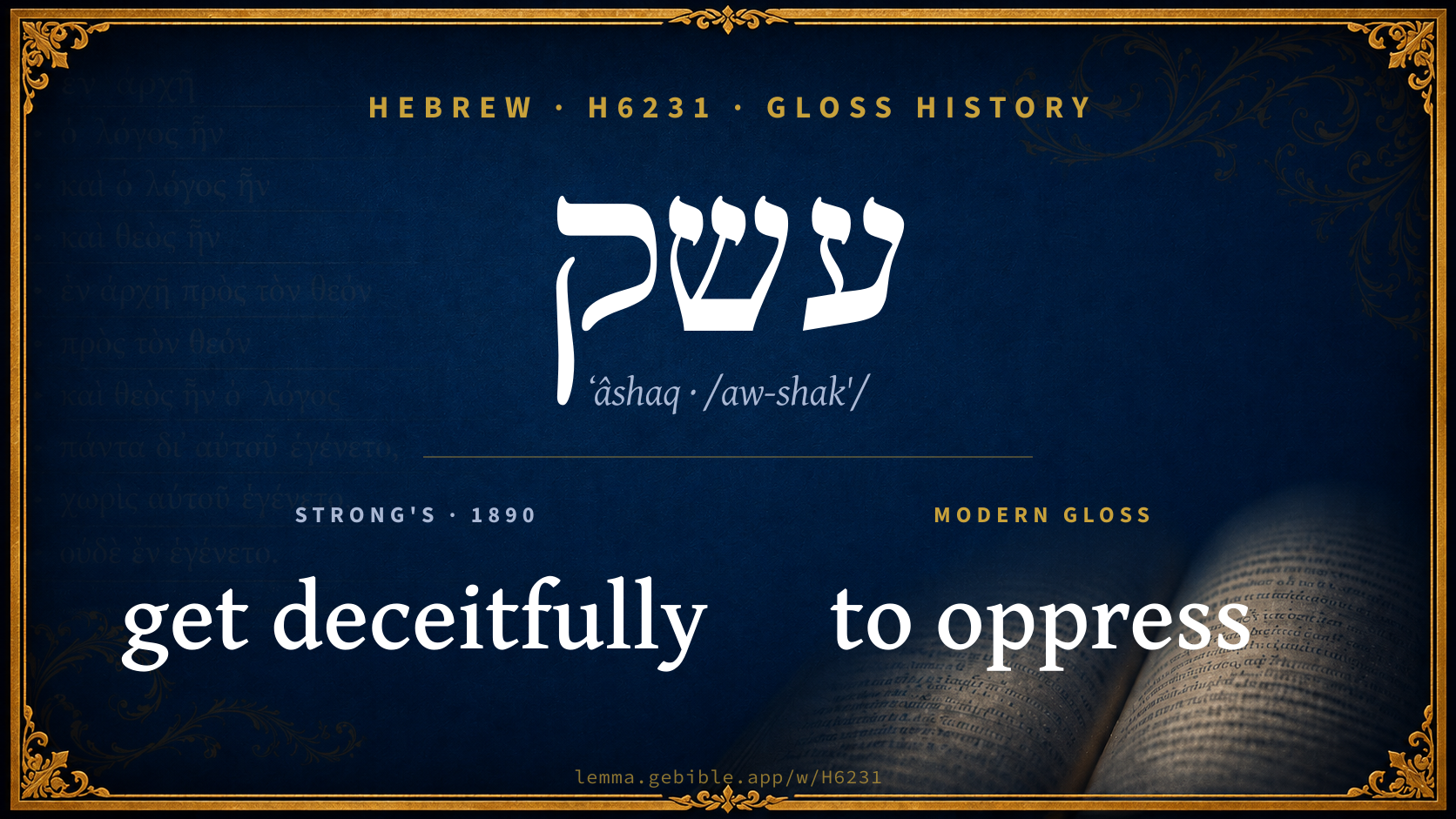
Gloss history
Strong's 1890 vs modern scholarship
About this word
Strong's H6231 catalogs a Hebrew word from the Hebrew Old Testament.
These counts are not copied from any lexicon or concordance. They are computed here, from the morphology-tagged Hebrew Old Testament. What Lemma adds →
- 35
- distinct verses
- The word appears in 35 distinct verses.
- 16 / 39
- OT books
- The word appears in 16 of 39 Old Testament books.
- #990
- by frequency
- Top 1000 most frequent Hebrew words (rank 990 of 8,640 Hebrew words by occurrence).
View all 35 occurrences in the concordance →
By section of the Old Testament
By traditional corpus
Conventional, traditional groupings — biblical authorship is debated, so this is a traditional corpus grouping, not an authorship claim. Each share is this word’s portion of its verses in that division of the Hebrew canon. Each figure is a share of the word’s 35 distinct verses.
- Prophets (Nevi'im) 15 verses · 43%
- Writings (Ketuvim) 14 verses · 40%
- Torah (Pentateuch) 6 verses · 17%
How translations render this word
Counts come from each version’s own published word-to-Strong’s tagging or interlinear alignment — an approximate guide to how each version renders this word, not a word-level alignment the data otherwise carries. Because each total is that version’s own tagged count, the per-version totals vary from one another and need not match the appearance or distinct-verse counts above. These counts may also differ from a printed concordance because Lemma counts each distinctly tagged rendering and does not collapse phrase taggings into a single head-word total. This is a fixed set of word-tagged versions (KJV, ASV, BSB, ULT) and does not change with the reading translation you choose elsewhere. Each version’s license is shown beside its name below (and on Sources).
- King James Version: Oppress 4×, Oppressed 3×, Do them wrong 2×
- American Standard Version: Oppress 3×, Do them wrong 2×, He that oppresseth 2×
- Berean Standard Bible: Oppressed 5×, Defraud 2×, Oppress 2×
- unfoldingWord Literal Text: Oppress 5×, Oppressed 4×, Oppress them 2×
King James Version Public Domain
Renders H6231 across 37 tagged occurrences — most commonly:
Plus 18 renderings that appear only once — usually multi-word phrases or single function words the recovered tagging swept in, not distinct renderings.
American Standard Version Public Domain
Renders H6231 across 36 tagged occurrences — most commonly:
Plus 19 renderings that appear only once — usually multi-word phrases or single function words the recovered tagging swept in, not distinct renderings.
Berean Standard Bible Public Domain
Renders H6231 across 36 tagged occurrences — most commonly:
Plus 19 renderings that appear only once — usually multi-word phrases or single function words the recovered tagging swept in, not distinct renderings.
unfoldingWord Literal Text CC BY-SA 4.0
Renders H6231 across 42 tagged occurrences — most commonly:
Plus 27 renderings that appear only once — usually multi-word phrases or single function words the recovered tagging swept in, not distinct renderings.
Senses in the full BDB
Hebrew verbs can shift meaning by stem (binyan): Qal is the basic action, Niphal is often passive or reflexive, Piel often intensifies or makes it factitive, and Hiphil is typically causative. The senses below are grouped under the stem BDB assigns to each. This entry also uses Pual (the passive of Piel).
What do BDB’s symbols mean?
BDB uses these scholarly abbreviations:
| Symbol | Meaning |
|---|---|
| 𝔊 | the Septuagint (the ancient Greek translation, LXX) |
| 𝔙 | the Vulgate (the Latin translation) |
| 𝔖 | the Syriac version (the Peshitta) |
| 𝔗 | the Targum (the Aramaic translation) |
| ψ | the Psalms |
| √ | root (the underlying root or stem) |
| ‖ | parallel passage (a synonymous or contrasted parallel) |
| † | the dagger: every passage where the word occurs is cited |
The 5 senses and sub-senses the full Brown-Driver-Briggs lexicon distinguishes for this word, in lexicon order (not ranked by frequency), with BDB’s own verbatim wording and sub-sense lettering. Shown in Hebrew script with BDB’s own scholarly abbreviations. The condensed entry is in the Lexicon Entry tab. See also the Forms in the corpus table below.
Qal
- Pf. ע׳ Lv 5:21; Ez 18:18; 2 ms. sf. עֲשַׁקְתָּ֫נוּ 1 S 12:4, etc.; Impf. 3 ms. sf. יַעַשְׁקֻנִי ψ 119:122; 2 ms. תַּעֲשֹׁק Lv 19:13 +, etc.; Inf. cstr. עֲשֹׁק Ho 12:8, sf. עָשְׁקָם 1 Ch 16:21 ψ 105:14; Pt. act. עֹשֵׁק Pr 14:31 +, fpl. הָעשְׁקוֹת Am 4:1, etc.; pass. עָשׁוּק Dt 28:29 +, etc.;— e.g. Leviticus 5:21
- 1. oppress, wrong (often by extortion, ‖ גָּזַל), c. acc. pers. 1 S 12:3, 4 Mi 2:2 Lv 5:21; 19:13; especially the poor and helpless Am 4:1 Dt 24:14 Je 7:6 Ez 22:29 Zc 7:10 Pr 14:31; 22:16; 28:3 Ec 4:1; also c. acc. cogn. ע׳ עשֶׁק (וְ)גָזַל גָּזֵל Ez 18:18 practise extortion, 22:29, take by extortion Lv 5:23 and (c. acc. rei) Mal 3:5; abs. Ho 12:8 practise extortion; Jb 10:3 deal tyrannically (of God); pt. oppressor, extortioner Je 21:12 ψ 72:4 Ec 4:1; pt. pass. as subst. the oppressed ψ 103:6; 146:7. e.g. 1 Samuel 12:3
- 2. oppress a nation Is 52:4, cf. ψ 105:14 = 1 Ch 16:21, ψ 119:122, pt. act. oppressor v 121, pt. pass. oppressed Je 50:33, in predict. ע׳ וְגָזוּל Dt 28:29, ע׳ וְרָצוּץ v 33 Ho 5:11. e.g. Isaiah 52:4
- 3. dub. are: יַעְשֹׁק נָהָר Jb 40:23 a river oppresses him, i.e. rushes violently upon him (sc.; the hippopot.; Du יָשֹׁק, from שׁוּק; > Gunk Bu יִשְׁקַע fails, sinks); עָשֻׁק בְּדַם נֶפֶשׁ Pr 28:17 oppressed (? burdened) with the blood of a person. e.g. Job 40:23
Pual
- Pt. f. הַמְּעֻשָּׁקָה Is 23:12 crushed (of conquered Sidon under fig. of woman). e.g. Isaiah 23:12
Senses from the full Brown-Driver-Briggs lexicon (Brown, Driver, Briggs; Oxford 1906 — public domain), digitized via Sefaria, supplemented by the OpenScriptures HebrewLexicon (CC BY 4.0). Full attribution on Sources.
Word origin
vb. oppress, wrong, extort (𝔗 עֲשַׁק = BH, so Old Aramaic עשק; Syriac ܥܫܰܩ accuse, slander; Assyrian adj. ešḳu, strong; Arabic عَسَقٌ roughness, injustice);—
— Brown-Driver-Briggs (Oxford 1906, public domain), digitized via Sefaria, supplemented by the OpenScriptures HebrewLexicon (CC BY 4.0). See Sources.
Derived from עשק (ʻâsaq) (H6229) — to quarrel.
Jastrow Dictionary
A second Hebrew/Aramaic lexicon for comparison, covering Aramaic and post-biblical (Talmudic, Targumic, Midrashic) usage that the biblical-Hebrew BDB does not. Matched by lemma rather than by Strong’s number, so a lemma may carry more than one Jastrow headword (shown separately below), and the entries cover usage well beyond the Bible.
עוֹשֶׁק
- withholding what is due to one’s neighbor, oppression. Sifra K’dosh., ch. III, Par. 2 (ref. to Lev. XIX, 13) אף ע׳ דבר של ממון ‘osheḳ likewise (like גזל) refers to money matters (not to personal injury). B. Mets. 111ᵃ (interch. with עשק) לך ושוב … זהו ע׳ וכ׳ saying, go and come again (for thy wages &c.), that is ‘osheḳ; I have what is due to thee, but I will not give it thee, that is gazel (robbery). Ib. איזהו ע׳ שחייבה וכ׳ what withholding is it for which the Law requires a sacrifice (Lev. V, 21 sq.)? דכפר ליה ממונא when one denies owing money. Ib. זהו ע׳ זהו גזל ‘osheḳ and gazel are the same; Yalk. Lev. 605. B. Mets. 48ᵃ יחד לו כלי לעשקו he assigned to him an object (as security) for the wages withheld from him; Yalk. Lev. 479 לעושקו; a. fr. e.g. Leviticus 19:13
עָשַׁק
- (b. h.) [to press, twist,] to wrong, esp. to withhold what is due to a fellowman; to deny a debt. B. Mets. 111ᵃ (ref. to Lev. V, 21) או עשק כתיב שעֲשָׁקוֹ כבר we read, ‘or if he have withheld’, which means that he had wronged him ere this (when he denied his indebtedness). Koh. R. to IV, 6 טוב … גוזל וחומס ועוֹשֵׁק ועושה וכ׳ better is he who does a little good with what is his own, than he who robs and does violence and oppresses, and does much good with what belongs to others. Succ. 29ᵇ עוֹשְׁקֵי שכר שכיר those who withhold the hired man’s wages, different from כובשי וכ׳ (v. כָּבַשׁ) who defer paying &c.; a. e. e.g. Leviticus 5:21
עֲשַׁק
- 1. same. Targ. O. Lev. V, 21 עשק ed. Berl. (oth. ed. אנס). Ib. 23. Targ. Am. IV, 1; a. fr.—Part. pass. עָשִׁיק.
- 2. to pervert, v. עָשִׁיק I. I.
- 3. (cmp. יקר) to be outrageously dear, v. עָשִׁיק II.
עשֶׁק
- , v. עוֹשֶׁק, עוּשְׁקָא.
A Dictionary of the Targumim, the Talmud Babli and Yerushalmi, and the Midrashic Literature (Marcus Jastrow; London, Luzac, 1903) — Public Domain. Digitized via Sefaria. Digitized via Sefaria. Full attribution on Sources.
Forms in the corpus
The 33 distinct written forms H6231 takes in the Hebrew Bible, most frequent first — each parse links to that stem’s occurrences in the concordance. Hebrew forms include their vowel points and cantillation, so a single lemma takes many written forms.
Same root — word family
Other BDB entries built from the same root as H6231, grouped by Strong’s listed origin. These share a root / origin per the lexicon — not necessarily a shared meaning. Each links to that word’s own entry.
Derives from
Derived from this word
- מעשקה maʻăshaqqâh H4642 extortion
- עשוק ʻâshôwq H6216 oppressor
- עשוק ʻâshûwq H6217 oppression
- עשק ʻâsaq H6229 to quarrel
- עשק ʻôsheq H6233 oppression
Proper names from this root
People and places named from this root — a name, not an additional meaning of the word.
Compare all same-root words → Showing 4 of 8 — not the complete family. 2 of the same-root words are proper names (people or places). They share a root, not necessarily a meaning.
Septuagint verse parallels
This word appears in 32 verses that also exist in the Greek Old Testament (Septuagint), out of the 35 Hebrew verses it occurs in. You can read those verses in Greek by switching the Old Testament edition to the Septuagint.
Read these verses in the Septuagint
- Leviticus 6:2
- Deuteronomy 24:14
- 1 Samuel 12:3
- 1 Chronicles 16:21
- Job 10:3
- Psalms 72:4
- Proverbs 14:31
- Ecclesiastes 4:1
- Isaiah 23:12
- Jeremiah 7:6
- Ezekiel 18:18
- Hosea 5:11
This is a verse-level parallel only — the same verses exist in both the Hebrew and Greek Old Testaments. No word-level Hebrew↔Greek correspondence is claimed: the data carries no such alignment, so no Greek word is shown as this Hebrew word’s translation. Coverage is not total — the Septuagint omits the deuterocanon and renumbers the Psalms, so some Hebrew verses have no direct Greek parallel.