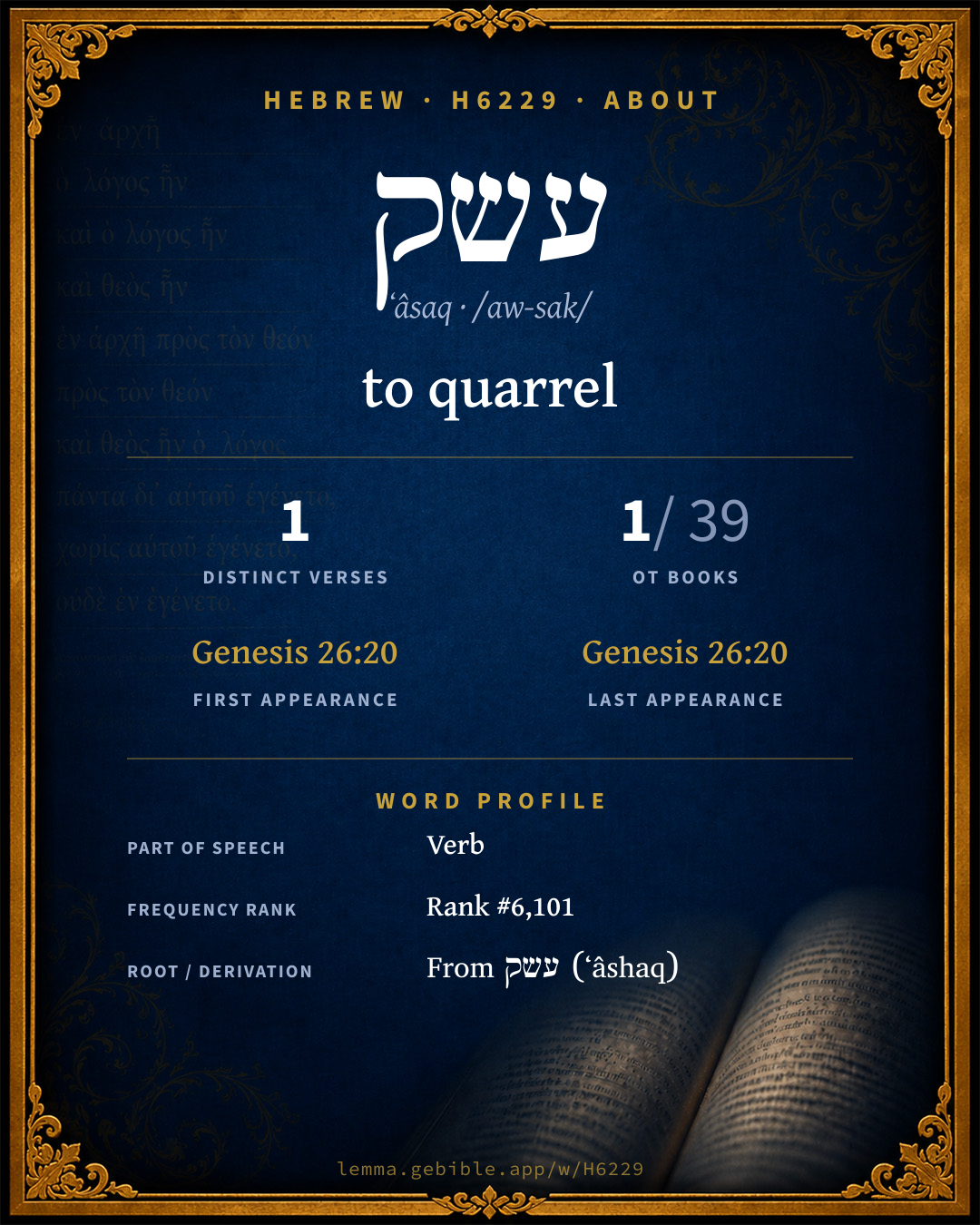
עָשַׂק
to quarrel
Full lexicon entry — Brown-Driver-Briggs (BDB)
From Brown-Driver-Briggs (BDB)
Where this word appears
Grammar key — what these labels mean
Part of speech
- Verb
- An action or state-of-being word.
Stem
- Hithpael
- The reflexive or reciprocal stem (the subject acts on itself).
Form
- Perfect
- A completed action or state — Hebrew marks aspect (completeness) more than strict tense (“he wrote”).
Person
- 3rd Person
- The one spoken about (“he / she / it / they”).
Gender
- Common
- Either gender — not distinguished for this form.
Number
- Plural
- More than one (in Hebrew, generally three or more).
Every verse where H6229 appears — 1 distinct verse across 1 book. Click any verse to open its interlinear word-by-word view. Verse text shown in the World English Bible for context — . Each verse’s Hebrew form is shown with its reference; the English is not keyword-highlighted, since the data carries no word-level English alignment. Use “Compare translations” on any verse to read it across multiple English versions. This concordance covers the Hebrew Bible; Septuagint (Greek Old Testament) occurrences are not indexed here.
Genesis 1 verse
About this entry
At a glance — auto-summarized from this page’s data, not written by a person. Every figure links to its source below. This summary describes the numbers; it doesn’t interpret them.
עשק (ʻâsaq) is a Hebrew verb most often rendered “to quarrel.” The Hebrew Bible uses it only 1 verse. Genesis dominates its distribution — 1 of 1 verses. Scripture uses it exactly once, at Genesis 26:20. Related forms include עשק, מעשקה and עשוק. For the data behind this summary, explore the sense tree and the renderings breakdown below.
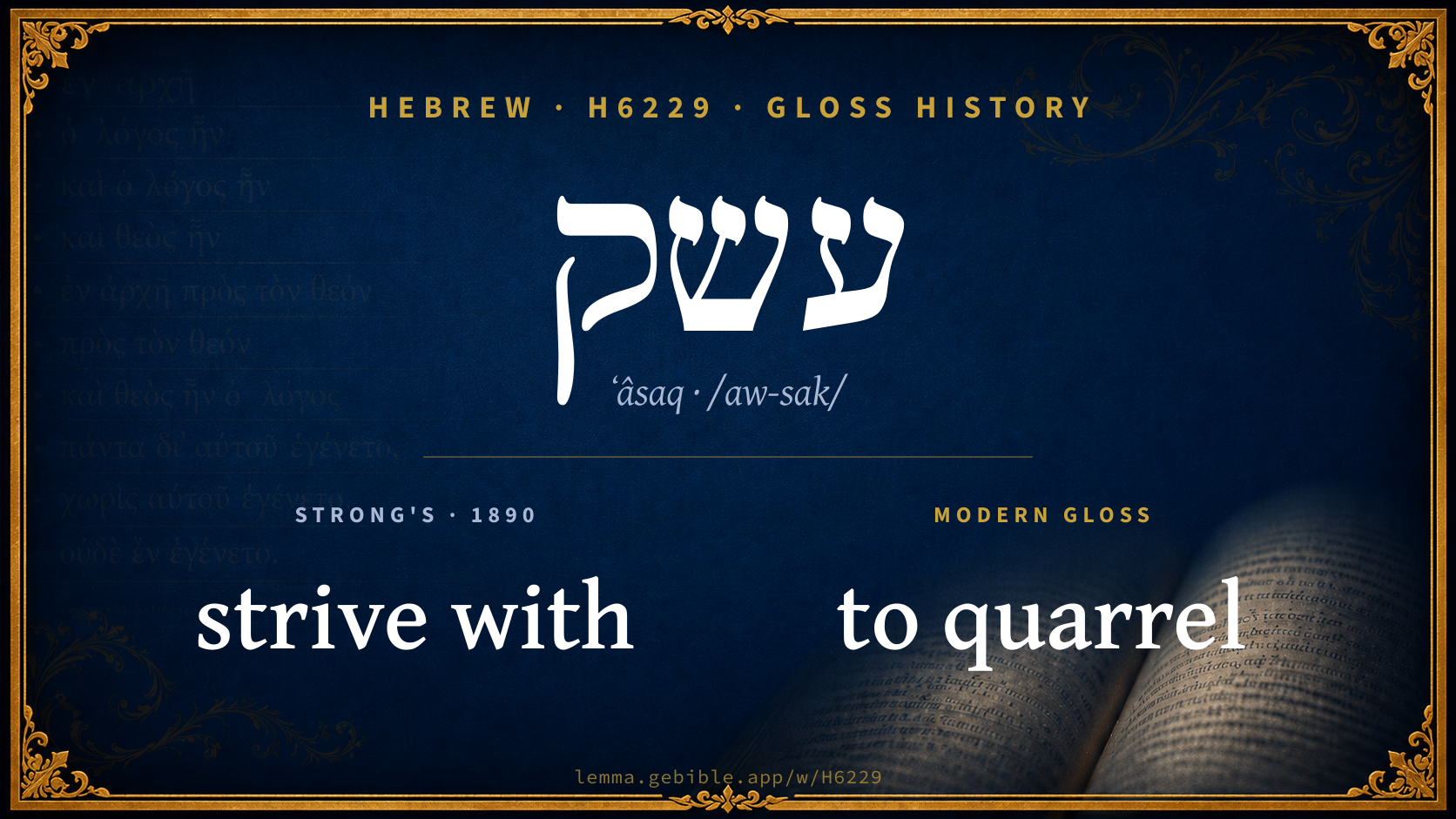
Gloss history
Strong's 1890 vs modern scholarship
About this word
Strong's H6229 catalogs a Hebrew word from the Hebrew Old Testament.
These counts are not copied from any lexicon or concordance. They are computed here, from the morphology-tagged Hebrew Old Testament. What Lemma adds →
- 1
- distinct verses
- The word appears in 1 distinct verse.
- 1 / 39
- OT books
- The word appears in 1 of 39 Old Testament books.
- #6,101
- by frequency
- Rank #6,101 (rank 6,101 of 8,640 Hebrew words by occurrence).
View all 1 occurrence in the concordance →
Most concentrated in
- Genesis 1 verse 100%
By section of the Old Testament
By traditional corpus
Conventional, traditional groupings — biblical authorship is debated, so this is a traditional corpus grouping, not an authorship claim. Each share is this word’s portion of its verses in that division of the Hebrew canon. Each figure is a share of the word’s 1 distinct verse.
- Torah (Pentateuch) 1 verse · 100%
How translations render this word
Counts come from each version’s own published word-to-Strong’s tagging or interlinear alignment — an approximate guide to how each version renders this word, not a word-level alignment the data otherwise carries. Because each total is that version’s own tagged count, the per-version totals vary from one another and need not match the appearance or distinct-verse counts above. These counts may also differ from a printed concordance because Lemma counts each distinctly tagged rendering and does not collapse phrase taggings into a single head-word total. This is a fixed set of word-tagged versions (KJV, ASV, BSB, ULT) and does not change with the reading translation you choose elsewhere. Each version’s license is shown beside its name below (and on Sources).
- King James Version: They strove 1×
- American Standard Version: They contended with him 1×
- Berean Standard Bible: They contended 1×
- unfoldingWord Literal Text: They disputed 1×
King James Version Public Domain
Renders H6229 across 1 tagged occurrence — most commonly:
American Standard Version Public Domain
Renders H6229 across 1 tagged occurrence — most commonly:
Berean Standard Bible Public Domain
Renders H6229 across 1 tagged occurrence — most commonly:
unfoldingWord Literal Text CC BY-SA 4.0
Renders H6229 across 1 tagged occurrence — most commonly:
Senses in BDB
The 1 sense BDB distinguishes for this word, in lexicon order (not ranked by frequency or importance). The full entry — with sub-senses — is in the Lexicon Entry tab.
- (Hithpael) to strive, contend, quarrel
Word origin
[ עָשַׂק ] vb. Hithp. contend;— Gn 26:20
— Brown-Driver-Briggs (Oxford 1906, public domain), digitized via Sefaria, supplemented by the OpenScriptures HebrewLexicon (CC BY 4.0). See Sources.
Derived from עשק (ʻâshaq) (H6231) — to oppress.
Jastrow Dictionary
A second Hebrew/Aramaic lexicon for comparison, covering Aramaic and post-biblical (Talmudic, Targumic, Midrashic) usage that the biblical-Hebrew BDB does not. Matched by lemma rather than by Strong’s number, so a lemma may carry more than one Jastrow headword (shown separately below), and the entries cover usage well beyond the Bible.
עוֹשֶׁק
- withholding what is due to one’s neighbor, oppression. Sifra K’dosh., ch. III, Par. 2 (ref. to Lev. XIX, 13) אף ע׳ דבר של ממון ‘osheḳ likewise (like גזל) refers to money matters (not to personal injury). B. Mets. 111ᵃ (interch. with עשק) לך ושוב … זהו ע׳ וכ׳ saying, go and come again (for thy wages &c.), that is ‘osheḳ; I have what is due to thee, but I will not give it thee, that is gazel (robbery). Ib. איזהו ע׳ שחייבה וכ׳ what withholding is it for which the Law requires a sacrifice (Lev. V, 21 sq.)? דכפר ליה ממונא when one denies owing money. Ib. זהו ע׳ זהו גזל ‘osheḳ and gazel are the same; Yalk. Lev. 605. B. Mets. 48ᵃ יחד לו כלי לעשקו he assigned to him an object (as security) for the wages withheld from him; Yalk. Lev. 479 לעושקו; a. fr. e.g. Leviticus 19:13
עָשַׁק
- (b. h.) [to press, twist,] to wrong, esp. to withhold what is due to a fellowman; to deny a debt. B. Mets. 111ᵃ (ref. to Lev. V, 21) או עשק כתיב שעֲשָׁקוֹ כבר we read, ‘or if he have withheld’, which means that he had wronged him ere this (when he denied his indebtedness). Koh. R. to IV, 6 טוב … גוזל וחומס ועוֹשֵׁק ועושה וכ׳ better is he who does a little good with what is his own, than he who robs and does violence and oppresses, and does much good with what belongs to others. Succ. 29ᵇ עוֹשְׁקֵי שכר שכיר those who withhold the hired man’s wages, different from כובשי וכ׳ (v. כָּבַשׁ) who defer paying &c.; a. e. e.g. Leviticus 5:21
עֲשַׁק
- 1. same. Targ. O. Lev. V, 21 עשק ed. Berl. (oth. ed. אנס). Ib. 23. Targ. Am. IV, 1; a. fr.—Part. pass. עָשִׁיק.
- 2. to pervert, v. עָשִׁיק I. I.
- 3. (cmp. יקר) to be outrageously dear, v. עָשִׁיק II.
עשֶׁק
- , v. עוֹשֶׁק, עוּשְׁקָא.
A Dictionary of the Targumim, the Talmud Babli and Yerushalmi, and the Midrashic Literature (Marcus Jastrow; London, Luzac, 1903) — Public Domain. Digitized via Sefaria. Digitized via Sefaria. Full attribution on Sources.
Same root — word family
Other BDB entries built from the same root as H6229, grouped by Strong’s listed origin. These share a root / origin per the lexicon — not necessarily a shared meaning. Each links to that word’s own entry.
Derives from
Shares the same root
- מעשקה maʻăshaqqâh H4642 extortion
- עשוק ʻâshôwq H6216 oppressor
- עשוק ʻâshûwq H6217 oppression
- עשק ʻôsheq H6233 oppression
Derived from this word
Proper names from this root
People and places named from this root — a name, not an additional meaning of the word.
Compare all same-root words → Showing 4 of 8 — not the complete family. 2 of the same-root words are proper names (people or places). They share a root, not necessarily a meaning.
Septuagint verse parallels
This word appears in 1 verse that also exists in the Greek Old Testament (Septuagint), out of the 1 Hebrew verse it occurs in. You can read those verses in Greek by switching the Old Testament edition to the Septuagint.
Read these verses in the Septuagint
This is a verse-level parallel only — the same verses exist in both the Hebrew and Greek Old Testaments. No word-level Hebrew↔Greek correspondence is claimed: the data carries no such alignment, so no Greek word is shown as this Hebrew word’s translation. Coverage is not total — the Septuagint omits the deuterocanon and renumbers the Psalms, so some Hebrew verses have no direct Greek parallel.