
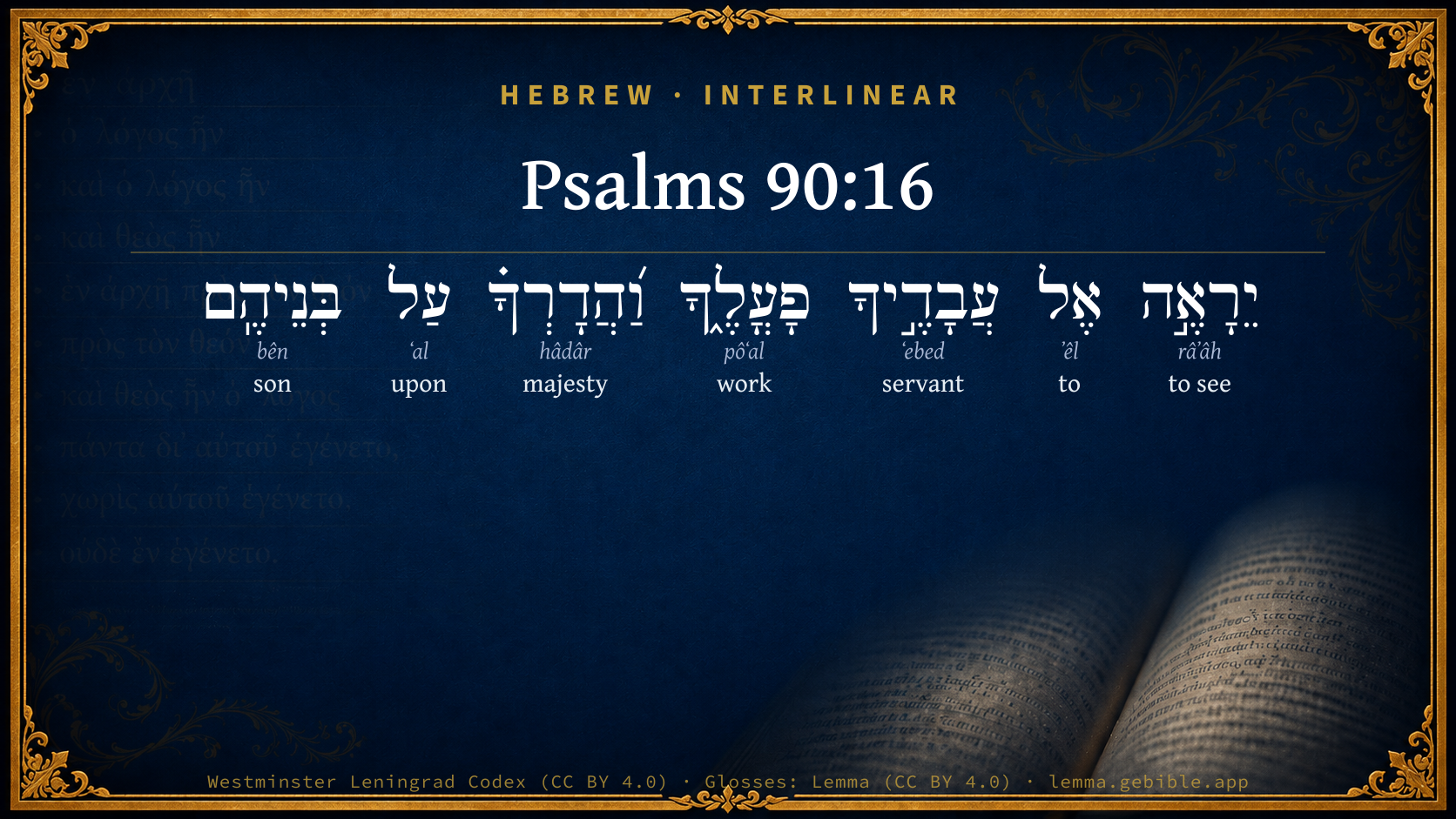
Psalms 90:16

Hebrew (Westminster Leningrad Codex) Psalms 90:16 appears in the Hebrew Old Testament. The text above is from the Westminster Leningrad Codex. Each word links to its Strong’s number, a concise gloss, and parsing drawn from the Open Scriptures Hebrew Bible morphology. Click any word for its full Brown-Driver-Briggs (BDB) entry.
Download image
Cite this verse

Psalms 90:16 (World English Bible). Public Domain. Lemma interlinear Bible study tool, https://lemma.gebible.app/v/psalms/90/16.

Show BibTeX & RIS
BibTeX
RIS
English Translation
Let your work appear to your servants; Your glory to their children.
World English Bible · Public Domain
Download a study sheet

One document with this verse’s original text, its word-by-word gloss line, the meaning frame, cross-references with their text, attributed commentary, and full source and license credits — printable, and it pastes into notes with its structure intact.

This verse Autodidact and up

Study sheet (.html) Plain text (.txt)

A passage Seminary Student

Up to 50 verses in one chapter. A passage sheet keeps up to 6 commentary sources and 12 cross-references per verse, in the order this page ranks them, and says so on the sheet whenever that leaves anything out. Ask for a single verse and you get the Autodidact verse sheet above.

Everything on this page stays free to read, with no account — the sheet is a download of what is already on screen, not access to it.

Want to remove ads? Support Godless Engineer
Compare translations 3

The same verse in 3 English versions, stacked beneath the original-language interlinear above. Click any original word for its lexicon entry.

Each is an independent rendering of the whole verse — the interlinear is not word-aligned to these translations.

Highlighted words mark where these versions differ — a whole-verse word diff, not a word-by-word alignment.

  • World English Bible Public Domain
    Let your work appear to your servants; Your glory to their children.
  • King James Version Public Domain
    Let thy work appear unto thy servants, and thy glory unto their children.
  • unfoldingWord Literal Text CC BY-SA 4.0
    May your work be seen by your servants, and your majesty by their sons.

unfoldingWord Literal Text — © unfoldingWord, licensed CC BY-SA 4.0. Word-aligned USFM3 via Door43 (git.door43.org/unfoldingWord/en_ult).

Versions to compare (up to 4)

3 of 4 selected

Show all 18 translations

Every available English version of this verse, each an independent rendering of the whole verse.

  • World English Bible Public Domain
    Let your work appear to your servants; Your glory to their children.
  • Berean Standard Bible Public Domain
    May Your work be shown to Your servants, and Your splendor to their children.
  • Majority Standard Bible Public Domain
    May Your work be shown to Your servants, and Your splendor to their children.
  • King James Version Public Domain
    Let thy work appear unto thy servants, and thy glory unto their children.
  • American Standard Version (1901) Public Domain
    Let thy work appear unto thy servants, And thy glory upon their children.
  • Revised Version (1885) Public Domain
    Let thy work appear unto thy servants, and thy glory upon their children.
  • Geneva Bible (1599) Public Domain
    Let thy worke bee seene towarde thy seruants, and thy glory vpon their children.
  • Douay-Rheims (1899) Public Domain
    Look upon thy servants and upon their works: and direct their children.
  • Young's Literal Translation Public Domain
    Let Thy work appear unto Thy servants, And Thine honour on their sons.
  • Literal Standard Version CC BY-SA 4.0
    Let Your work appear to Your servants, || And Your honor on their sons.
  • Unlocked Literal Bible CC BY-SA 4.0
    Let your servants see your work, and let our children see your majesty.
  • unfoldingWord Literal Text CC BY-SA 4.0
    May your work be seen by your servants, and your majesty by their sons.
  • Darby Bible Public Domain
    Let thy work appear unto thy servants, and thy majesty unto their sons.
  • World Messianic Bible Public Domain
    Let your work appear to your servants, your glory to their children.
  • Webster's Bible Public Domain
    Let thy work appear to thy servants, and thy glory to their children.
  • Free Bible Version CC BY-SA 4.0
    May we, your servants, see you at work for us again; may our children see your glory.
  • Bible in Basic English Public Domain
    Make your work clear to your servants, and your glory to their children.
  • JPS Tanakh (1917) Public Domain
    Let Thy work appear unto Thy servants, and Thy glory upon their children.

Literal Standard Version (2020), Covenant Press — licensed CC BY-SA 4.0. Text via the HelloAO Bible API (eBible.org). Unlocked Literal Bible (unfoldingWord) — licensed CC BY-SA 4.0. Text via the HelloAO Bible API (eBible.org). unfoldingWord Literal Text — © unfoldingWord, licensed CC BY-SA 4.0. Word-aligned USFM3 via Door43 (git.door43.org/unfoldingWord/en_ult). Free Bible Version, Dr. Jonathan Gallagher — licensed CC BY-SA 4.0. Text via the HelloAO Bible API (eBible.org).

Word by word

More ways to search: Search by grammar → Find every occurrence → Compare this word →

Practice this passage: Drill this verse → Learn its vocabulary →

About this verse

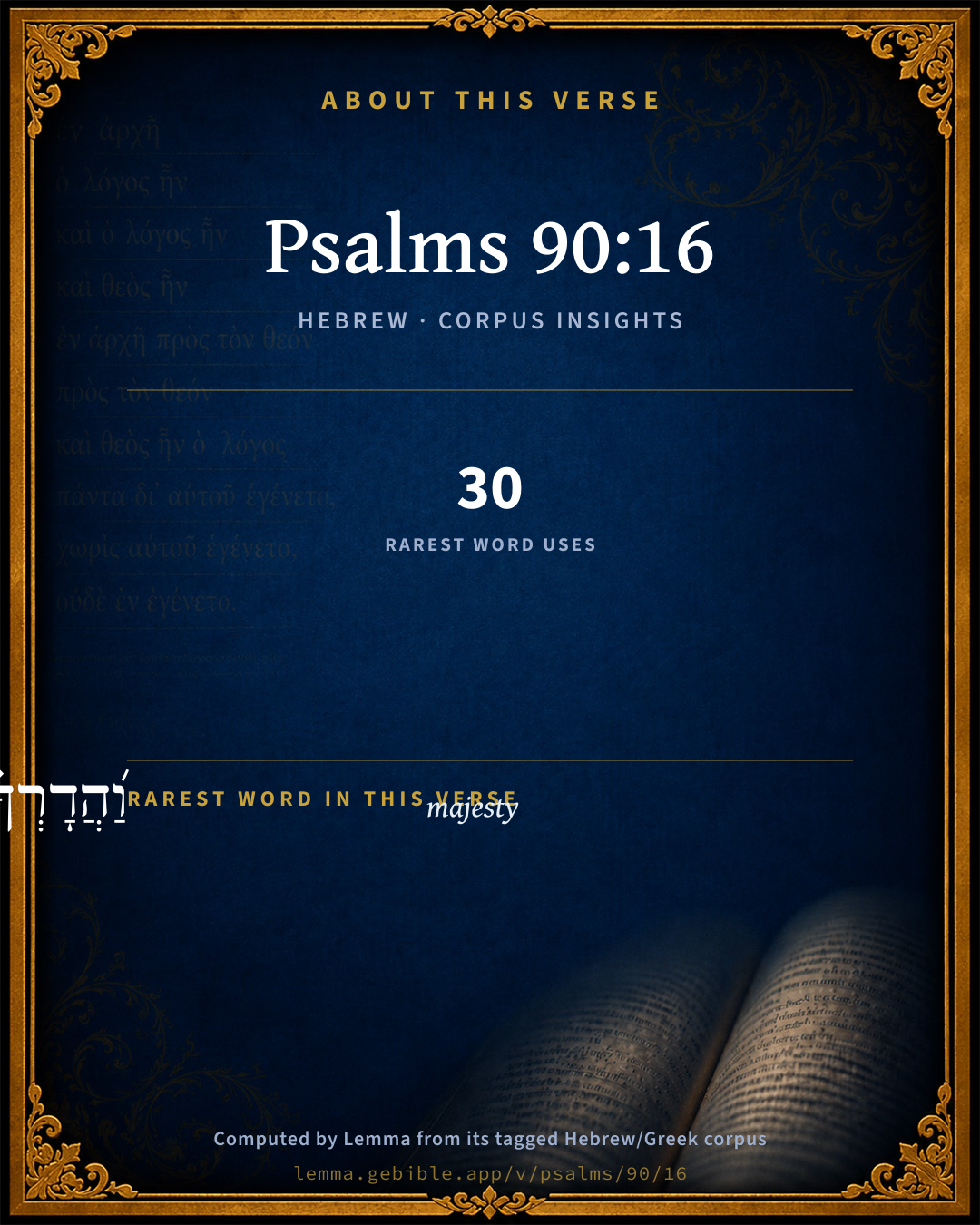
These counts appear in no published source. They are computed here, from the morphology-tagged text and Lemma’s own curated glosses. What Lemma adds →

7
words
7
distinct lemmas
Wisdom
section

Shared distinctive vocabulary

וַ֝הֲדָרְךָ֗ majesty H1926 occurs in 29 verses of the Hebrew Bible. Also found in:

Grammatical profile

  • 1 verb
  • 4 nouns
  • 2 prepositions

Verb forms

  • יֵרָאֶ֣ה Niphal · Imperfect

Hebrew & Septuagint length

In English translation the verse runs 12 words from the Hebrew and 13 from the Septuagint (LXX English) — closely comparable.

A rough comparison of the two English renderings, which tokenize alike — not a word-level alignment.

Word counts can differ between the Hebrew and the Greek without any difference in meaning — e.g. the Hebrew direct-object marker אֵת has no separate Greek word, and Greek often adds the article ὁ.

Cross-references

10

Topical passages linked to Psalms 90:16 in the Treasury of Scripture Knowledge — connected by theme and wording, ordered by reader-vote popularity; previews shown in the World English Bible.

  • Habakkuk 3:2 Yahweh, I have heard of your fame. I stand in awe of your deeds, Yahweh. Renew your work in the midst of the years. In the midst of the years make it known. In wrath, you remember mercy.
  • Psalms 44:1 We have heard with our ears, God; Our fathers have told us, What work you did in their days, In the days of old.
  • Deuteronomy 32:4 The Rock, his work is perfect; For all his ways are justice: A God of faithfulness and without iniquity, Just and right is he.
  • Numbers 14:15–24 Now if you shall kill this people as one man, then the nations which have heard the fame of you will speak, saying,
  • Deuteronomy 1:39 Moreover your little ones, whom you said should be a prey, and your children, who this day have no knowledge of good or evil, they shall go in there, and to them will I give it, and they shall possess it.
  • Numbers 14:30–31 surely you shall not come into the land, concerning which I swore that I would make you dwell therein, save Caleb the son of Jephunneh, and Joshua the son of Nun.
  • Joshua 4:22–24 Then you shall let your children know, saying, Israel came over this Jordan on dry land.
  • Joshua 23:14 Behold, this day I am going the way of all the earth: and you know in all your hearts and in all your souls, that not one thing has failed of all the good things which Yahweh your God spoke concerning you; all are happen to you, not one thing has failed of it.
  • Psalms 77:12 I will also meditate on all your work, And consider your doings.
  • Psalms 92:4 For you, Yahweh, have made me glad through your work. I will triumph in the works of your hands.

Cross-references courtesy of OpenBible.info (CC BY 4.0).

Hebrew and Greek witnesses Masoretic Hebrew ↔ Greek Septuagint

The same verse in the two great witnesses to the Old Testament, shown verse-for-verse.

You’re reading Greek Psalm 89 (Hebrew Psalm 90). The Septuagint counts the superscription, so verse numbers can differ from the Hebrew — chapter-level alignment, not verse-by-verse. Numbering follows Rahlfs.

These are two independent witnesses, not word-aligned to each other, and the Septuagint is shown in lemma (dictionary) form.

Hebrew Psalms 90:16 Masoretic · Westminster Leningrad Codex

יֵרָאֶ֣ה אֶל עֲבָדֶ֣יךָ פָעֳלֶ֑ךָ וַ֝הֲדָרְךָ֗ עַל בְּנֵיהֶֽם

Let your work appear to your servants; Your glory to their children.

World English Bible · Public Domain

Greek LXX Greek Psalm 89:16 Septuagint · lemma form

καί ὁράω ἐπί ὁ δοῦλος σύ καί ὁ ἔργον σύ καί ὁδηγέω ὁ υἱός αὐτός

And look upon your servants, and upon your works; and guide their children.

LXX2012 (modern English Septuagint) · Public Domain

Hebrew: Westminster Leningrad Codex (CC BY 4.0). Greek: Septuagint (public domain); English from LXX2012 (modern English Septuagint) (Public Domain). How the Septuagint differs from the Hebrew →

Commentary

Notes on Psalms 90:16 from classic Christian and Jewish commentators (each source and its license shown beneath its notes). The classic Christian expositions comment on the surrounding passage and are grouped to its opening verse, so a note may address several verses; the Jewish commentaries on the Tanakh (Rashi and others) are per-verse, so they appear only where the commentator wrote on this verse.

Lemma curates 59 commentaries, every one of them public domain or Creative Commons licensed, each selected and text-cleaned for this edition rather than reprinted as found. About our sources →

Trapp's Complete Commentary

John Trapp

Psa 90:16 Let thy work appear unto thy servants, and thy glory unto their children.

Ver. 16. Let thy work appear] Thy proper work, which is to show mercy; for to do justice is thy work, thy strange work, Isa 28:21.

And thy glory unto their children] That they at least may enter into the land of Canaan, according to Num 14:31.

John Trapp, A Commentary or Exposition upon All the Books of the Old and New Testament (1647–1656) — public domain. Text from a community e-Sword module.

The Biblical Illustrator

Joseph S. Exell

Psa_90:16

Let Thy work appear unto Thy servants, and Thy glory unto their children.

The religious consecration of our households

I. Truths suggested in this prayer.

1. That real religion, wherever it exists, is a Divine production in the human mind. Thy works, etc. It is a work, and a work of God. God begins it.

2. That they who have experienced its power and preciousness themselves are anxious for its prevalence among those most dear to them. Their children.

3. That the preservation of religion in families is a leading object of Gods dispensations.

4. That it becomes the young, as they rise to years of consciousness and maturity, to unite their prayers with the prayers that are offered on their behalf. O satisfy us with Thy mercy.

II. Encouragements to present this prayer.

1. It is a point in which Gods glory, and mans good, are found to meet and centre. You do not run counter to the tide of Divine designs, but in unison. It is Gods work, and Gods glory.

2. It is a subject to which the richest promises are made.

3. It has been amply answered in every age.

III. Practical hints for our own conduct.

1. Aim to be the instrument of fulfilling your own prayer. Show them Gods glory.

2. Take heed there is nothing in your conduct to counteract your instruction.

3. Ascribe to God all the glory of success. (Evangelist.)

Desire that God would let His work appear

I. The work of God, as mentioned here, denotes, primarily, the establishment of Israel in the promised land of Canaan; ultimately, the preparation of the way for the Messiah and His Church.

II. When this work may be said to appear. It may be described as appearing anew in different periods; as a work, delayed at times, yet revived in the midst of the years. Often, after seeming to have let alone His work, has the Divine Being awoke, laid bare His arm, and set His hand a second time to His unfinished work. The degree of piety prevailing at any time is the gauge by which we may measure that progress of this work in the prosperity of Israel.

III. Why it is so desirable that this prayer should be accomplished. The first concern of a Christian is, that his own life may be given to him as a prey; that He who has begun may perform the good work of His grace in his own soul: the second is, that the same good work may extend to others; that they also may be sharers with ourselves of the same salvation.

1. This desire is the dictate of piety,--of a regard to the glory of God.

2. It is equally the dictate of benevolence,--of a regard for the happiness of others. (R. Hall, M.A.)

Work and glory

This psalm has the threefold interest of subject, of authorship, and of association. Of subject, because it contrasts and combines God and man in the most thrilling and yet most natural way. All the greatness of God and all the weakness of man, and this so as to draw man to God in the longing cry, Let Thy work appear to us, let the beauty, etc. And this interest is enhanced by the bare possibility that we read in this psalm, a prayer of Moses, the man of God. How wonderful was his history, second only in interest to that of our Lord. And then the associations of this psalm--read as it is over the grave of our beloved departed ones. Therefore our attention is aroused when we come to consider the teachings of such a psalm.

I. Show thy servants thy work God worketh everywhere and always. Above all in Christ, in the Holy Ghost, and in all the operations of His grace. But man sees it not. Many things hide it. God must show it to him. And here Moses prays that his people may be made to see Gods work. Let us, as we need to, make the prayer our own.

II. and their children thy glory. The glory spoken of is the self-manifestation of God. There might, in conception at least, have been God and no glory. But it pleased Him not thus to be. He came forth to communicate, to recreate, to redeem. That forthcoming was outshining. And Moses prayed not only for the generation then living, but for their children. What better prayer can parents offer for their children than this? What better defence against the anxiety on their behalf which they feel so often and so keenly? And God has, in large degree, answered for us this prayer. Let us be grateful for the blessing, and let us hand it on. Never consent that your children should receive a Godless education. The prayer of the patriot, like that of the saint, must be, Show the children Thy glory. (Dean Vaughan.)

The Biblical Illustrator, edited by Joseph S. Exell (c. 1880s–1900s) — public domain. Text from a community e-Sword module.

J. A. Alexander on Psalms

Joseph Addison Alexander

16. (Psa 90:16) Let appear unto thy servants thy doing, and thy glory on their sons (or children). He prays that even to the elder generation there may be vouchsafed a token for good (Psa 86:17), i.e. some assurance of the favours to be actually bestowed upon their children. Thus understood, the use of the two prepositions, to and on, is not unmeaning or fortuitous. God's work or doing is the course of his providential dealings, as in Psa 92:4 below; his glory, the manifestation of his divine perfections in external act. See above, on Psa 8:5; Psa 45:3. This was to appear not only to but on the younger race, i. e. in their own experience.

Joseph Addison Alexander, The Psalms Translated and Explained (1850) — public domain. Text from a community e-Sword module.

Tyndale Open Study Notes

Tyndale Open Resources

90:16 The children represent future generations in contrast to the generations past (90:1).

Tyndale Open Study Notes — © Tyndale Open Resources, licensed CC BY-SA 4.0. Text via the HelloAO Bible API.

Geneva Bible (1599)

Geneva Bible translators

As God’s promises appertained as well to their posterity, as to them, so Moses prayeth for the posterity.

Even thy mercy, which is the chiefest work.

Geneva Bible (1599) marginal notes — public domain. Text via Bolls.life.

Adam Clarke's Commentary

Verse 16. Let thy work appear unto thy servants] That thou art working for us we know; but O, let thy work appear! Let us now see, in our deliverance, that thy thoughts towards us were mercy and love.

And thy glory] Thy pure worship be established among our children for ever.

Adam Clarke's Commentary on the Bible (1810–1826) — public domain. Text from a community e-Sword/MySword module.

John Calvin's Commentaries

16 Let thy work appear towards thy servants. As God, when he forsakes his Church, puts on as it were a character different from his own, Moses, with much propriety, calls the blessing of protection which had been divinely promised to the children of Abraham God’s proper work. Although, therefore, God’s work was manifest in all the instances in which he had punished the perfidiousness, ingratitude, obstinacy, unruly lusts, and unhallowed desires of his people, yet Moses, by way of eminence, prefers before all other proofs of God’s power, that care which he exercised in maintaining the welfare of the people, by which it was his will that he should be principally known. This is the reason why Paul, in Romans 9:23, especially applies to the Divine goodness the honorable title of “glory.” God indeed maintains his glory by judging the world; but as nothing is more natural to him than to show himself gracious, his glory on that account is said to shine forth chiefly in his benefits. With respect to the present passage, God had then only begun to deliver his people; for they had still to be put in possession of the land of Canaan. Accordingly, had they gone no farther than the wilderness, the lustre of their deliverance would have been obscured. Besides, Moses estimates the work of God according to the Divine promise; and doing this he affirms that it will be imperfect and incomplete, unless he continue his grace even to the end. This is expressed still more plainly in the second clause of the verse, in which he prays not only for the welfare of his own age, but also for the welfare of the generation yet unborn. His exercise thus corresponds with the form of the covenant,

“And I will establish my covenant between me and thee, and thy seed after thee, in their generations, for an everlasting covenants to be a God unto thee, and to thy seed after thee,” (Genesis 17:7.)

By this example we are taught, that in our prayers we ought to extend our care to those who are to come after us. As God has promised that the Church will be perpetuated even to the end of the world, — a subject which was brought under our notice in the preceding psalm, — this ought, in a special manner, to lead us in all the prayers by which we commend the welfare of the Church to him, to include, at the same time, our posterity who are yet unborn. Farther, the words glory and beauty are to be particularly noticed: from which we learn that the love which God bears towards us is unparalleled. Although, in enriching us with his gifts he gains nothing for himself; yet he would have the splendor and beauty of his character manifested in dealing bountifully with us, as if his beauty were obscured when he ceases to do us good. In the clause immediately succeeding, Direct the work of our hands upon us, Moses intimates that we cannot undertake or attempt anything with the prospect of success, unless God become our guide and counsellor, and govern us by his Spirit. Whence it follows, that the reason why the enterprises and efforts of worldly men have a disastrous issue is, because, in not following God, they pervert all order and throw everything into confusion. Nor is the word עלינו, alenu, upon us, superfluous; for although God converts to good in the end whatever Satan and the reprobate plot and practice against him or his people; yet the Church, in which God rules with undisturbed sway, has in this respect a special privilege. By his providence, which to us is incomprehensible, he directs his work in regard to the reprobate externally; but he governs his believing people internally by his Holy Spirit; and therefore he is properly said to order or direct the work of their hands. The repetition shows that a continual course of perseverance in the grace of God is required. It would not be enough for us to be brought to the midst of our journey. He must enable us to complete the whole course. Some translate, confirm or establish; and this sense may be admitted. I have, however, followed that translation which was more agreeable to the context, conceiving the prayer to be that God would direct to a prosperous issue all the actions and undertakings of his people.

John Calvin's Commentaries (1540-1563) — public domain. Text from the Calvin Translation Society English edition (1840s-50s) via the Christian Classics Ethereal Library (ccel.org). Calvin's coverage is partial (roughly two-thirds of the Bible); uncommented books and verses are honest gaps, never fabricated. The 19th-century editor's footnotes and remarks are omitted so the notes are faithfully Calvin's own voice.

The Cambridge Bible for Schools and Colleges

gen. ed. J. J. S. Perowne

16. Let thy work appear] Manifest Thy power on their behalf. God’s work denotes especially the exertion of His saving Providence. Cp. Psa_92:4; Deu_32:4; Hab_3:2.

thy glory] Thy majesty, manifested in their deliverance. Cp. Psa_111:3; Isa_40:5. The division of the clauses is of course purely rhythmical. The sense of the whole verse is, Let Thy working and Thy majesty appear unto Thy servants and abide upon their children.

The Cambridge Bible for Schools and Colleges (gen. ed. J. J. S. Perowne; Cambridge University Press, 1878–1918) — public domain. Text from a community e-Sword module.

John Gill's Exposition

Let thy work appear unto thy servants,.... Either the work of Providence, in conducting the people of Israel through the wilderness, and bringing them into the land of Canaan; which God had promised to do for them, especially for their posterity, and therefore their "children" are particularly mentioned in the next clause; or the work of salvation, as Kimchi; even the great work of redemption by the Messiah, which is the work of God, which he determined should be done, appointed his Son to do, and gave it him for that purpose now this was spoken of, and promised, as what should be done; but as yet it did not appear; wherefore it is prayed for, that it might; that the Redeemer might be sent, and the work be done: or else the work of grace upon the heart, which is God's work, and an internal one, and not so obvious to view; and hence it is entreated, that, being wrought by him, he would shine upon it, bear witness to it, and make it manifest that it was really wrought, and a genuine and true work; and moreover this may reach to and include the great work of God, to be brought about in the latter day, respecting the conversion of the Jews, the bringing in the fulness of the Gentiles, the destruction of antichrist, and the establishment and glory of the kingdom of Christ:

and thy glory unto their children; the glory of God, displayed in the above works of providence and grace, particularly in the work of redemption, in which all the divine perfections are glorified; or Christ himself, who is the brightness of his Father's glory, that he would appear to them in human nature, and dwell among them; and they behold his glory, as they afterwards did, Joh 1:14, or else the sense is, that the glorious grace of God might appear unto them, and upon them, by which they would be made all glorious within, and be changed into the image of Christ, from glory to glory; or that the Shechinah, the glorious majesty and presence of God, might be among them, and be seen by them in his sanctuary, Psa 63:2.

John Gill's Exposition of the Whole Bible (1746–1763) — public domain (CC PDM 1.0). Text via the HelloAO Bible API.

Albert Barnes' Notes on the Bible

Let thy work appear unto thy servants - That is, thy gracious work of interposition. Let us see thy power displayed in removing these calamities, and in restoring to us the days of health and prosperity.

And thy glory unto their children - The manifestation of thy character; the display of thy goodness, of thy power, and thy grace. Let this spreading and wasting evil be checked and removed, so that our children may live, and may have occasion to celebrate thy goodness, and to record the wonders of thy love.

Albert Barnes' Notes on the Bible (1834–1885) — public domain. Text from a community e-Sword/MySword module.

Matthew Poole's English Annotations

Let that great and glorious work of giving thy people a complete deliverance, which thou hast long since designed and promised, be at last accomplished and manifested unto us, and in the sight of the world.

Matthew Poole's English Annotations on the Holy Bible (1683–1685) — public domain. Text from a community e-Sword/MySword module.

The Treasury of David

Charles H. Spurgeon

Ver. 16. Let thy work appear unto thy servants. See how he dwells upon that word servants. It is as far as the law can go, and Moses goes to the full length permitted him henceforth Jesus calls us not servants but friends, and if we are wise we shall make full use of our wider liberty. Moses asks for displays of divine power and providence conspicuously wrought, that all the people might be cheered thereby. They could find no solace in their own faulty works, but in the work of God they would find comfort.

And thy glory unto their children. While their sons were growing up around them, they desired to see some outshinings of the promised glory gleaming upon them. Their Sons were to inherit the land which had been given them by covenant, and therefore they sought on their behalf some tokens of the coming good, some morning dawnings of the approaching noonday. How eagerly do good men plead for their children. They can bear very much personal affliction if they may but be sure that their children will know the glory of God, and thereby be led to serve him. We are content with the work if our children may but see the glory which will result from it: we sow joyfully if they may reap.

Ver. 16. And thy glory unto their children. That is to say, that our children may see the glorious fruit of this affliction in us, that so they may not be discouraged thereby to serve thee, but rather the more heartened, when they shall see what a glorious work thou hast wrought in and upon us by afflicting us. —William Bradshaw.

Ver. 16-17. "Thy work." "The work of our hands." You will observe a beautiful parallelism between two things which are sometimes confounded and sometimes too jealously sundered: I mean God's agency and man's instrumentality, between man's personal activity and that power of God which actuates and animates, and gives it a vital efficacy. For forty years it had been the business of Moses to bring Israel into a right state politically, morally, religiously: that had been his work, And yet, in so far as it was to have any success or enduringness, it must be God's work. "The work of our hands" do thou establish; and this God does when, in answer to prayer, he adopts the work of his servants, and makes it his own "work", his own "glory", his own "beauty." —James Hamilton.

Ver. 16-17. There is a twofold Rabbinical tradition respecting this verse and the preceding one; that they were the original prayer recited by Moses as a blessing on the work of making the Tabernacle and its ornaments, and that subsequently he employed them as the usual formula of benediction for any newly undertaken task, whenever God's glorious Majesty was to be consulted for an answer by Urim and Thummim. —Lyranus, R. Shelomo, and Genebrardus, quoted by Neale.

Ver. 16-17. —They were content to live and to die as pilgrims, provided only they could feel that in his sterner dealings with them, God was, however slowly, preparing the way for that display of glorious blessedness which should be the lot of their descendants. In a similar spirit they ask God to establish the work of their hands, though they reckoned not that they should behold its results. Their comfort in sowing was the belief that their children would reap. —Joseph Francis Thrupp.

Ver. 16-17. It is worthy of notice that this prayer was answered. Though the first generation fell in the wilderness, yet the labours of Moses and his companions were blessed to the second. These were the most devoted to God of any generation that Israel ever saw. It was of them that the Lord said, "I remember thee, the kindness of thy youth, the love of thine espousals, when thou wentest after me in the wilderness, in a land that was not sown. Israel was holiness unto the Lord, and the first fruits of his increase." It was then that Balaam could not curse, but, though desirous of the wages of unrighteousness, was compelled to forego them, and his curse was turned into a blessing. We are taught by this case, amidst temporal calamities and judgments, in which our earthly hopes may be in a manner extinguished, to seek to have the loss repaired by spiritual blessings. If God's work does but appear to us, and our posterity after us, we need not be dismayed at the evils which afflict the earth. —Andrew Fuller.

Ver. 16.

1. Our duty—"work", and our desire about it.

2. Our children's portion—"glory", and our prayer in reference to it.

Psalms 90:17*

Charles H. Spurgeon's The Treasury of David (1869–1885) — public domain. Psalms only. Text from a community e-Sword/MySword module.

Whedon's Commentary on the Bible

Daniel D. Whedon

16. Let thy work appear unto thy servants—By causing them to see the reasons of thy judgments, which seem to contradict the purpose and plan of salvation as promised to Abraham, and also by witnessing thy returning mercy. “The work of Jehovah is his realized salvation.”—Delitzsch.

And thy glory—Thy works, whether of judgment or mercy, which, when understood, are the glory of thy character. “Glory,” here, is parallel to “work” in the previous member.

Unto their children—The coming generation, who are to inherit Canaan after their fathers shall have died in the wilderness. See Num_14:29; Num_14:31. The children should become acquainted with the glorious acts of God toward his covenant people; and they did, during the last days of Moses and the lives of Joshua and the Elders. But alas! for want of childhood culture the following generation “knew not the Lord,” and served Baalim. Jdg_2:7-12

Daniel D. Whedon (gen. ed.), Commentary on the Old and New Testaments (1874–1909) — public domain. Text from a community e-Sword module.

The Pulpit Commentary

Let thy work appear ante thy servants, end thy glory unto their children. The "work" and the "glory" are the same thing some vast exertion of the Divine power and majesty, which will result in great good to his people. If we accept the Mosaic authorship of the psalm, the establishment of Israel in the laud of Canaan may reasonably be taken as the "work" spoken of.

Vers. 16, 17. Prayer for Divine revealing of the mystery of life.

This prayer, as referable to the Israelites, is a presage of the end of their pilgrimage, of their forgiveness, and of their settlement in Canaan. The issue of present Divine dealings was a glory which could only come to the children of the Mosaic generation. But Moses could properly pray that what God was actually then doing his work by his disciplinary dispensations might at once be revealed to his servants. To know what God is doing with us is our best help in bearing what burdens God lays upon us. And when we do know, we can even pray God to keep on his corrective work, whatever it may cost us, and let our children realize the issues. The "beauty" of the Lord may be taken as the Divine favour; or it may be a figure for the glory of the Divine presence. The prayer seems to embrace two things.

I THAT GOD"S PURPOSE SHOULD BE MADE TO APPEAR. "Thy work." That prayer is constantly rising from the hearts of men. We are always wanting to know the meaning of life; the meaning of our lives; the meaning of our lives at particular times. What is God doing with us? Unto what, into what, is God leading us? This is only made known in answer to prayer, which reveals to God an attitude of mind and feeling to which his purpose and his work can be explained. God holds the key to every life story.

II THAT MAN"S WORK SHOULD BE ESTABLISHED. This is the prayer of those who feel the uncertainty of life, and fear that they will be unable to complete what they have begun. The prayer may take two forms.

1. Permit me to finish the work I have started.

2. Let my children carry on to completion my work. Do not let it be lost and useless, as an unfinished thing. "Establish thou the work of our hands upon us" "When Moses prays that the "children" of the present generation may see God"s glory, he perhaps has in mind the exclusion of the latter from entrance into the land of Canaan. It was only to their children that this, the culminating and most glorious blessing, was to be vouchsafed. R.T.

The Pulpit Commentary (1880–1919), ed. H.D.M. Spence-Jones & Joseph S. Exell — public domain. Text from a community e-Sword module.

Lesson kit

Teaching starters — assembled from the data on this page, not authored interpretation. Every prompt links to the verse data it draws on. Edit before teaching.

Psalms, in the Wisdom, opens this verse with 7 words (7 distinct Hebrew lemmas). Its most distinctive word is hâdâr (“majesty”). A historical commentator’s framing appears above. Read the whole chapter for the surrounding context.

Discussion questions

  1. What does “majesty” (hâdâr) contribute to the verse as a whole?
  2. Leviticus 23:40 shares the word «majesty» with this verse. How do the two illuminate each other?
  3. These translations render this verse differently; the difference is in the English rendering, not the original. What questions does that raise?
  4. The verb «יֵרָאֶ֣ה» is Niphal Imperfect. How does its form color the action?
  5. Reading how Trapp's Complete Commentary and The Biblical Illustrator read this verse, where do the two commentators agree and where do they part?

Things to notice

Reading settings

Reading text

Shown beneath each verse's original-language words.

Old Testament
Old Testament edition

Read the OT as the Masoretic Hebrew (MT) or the Greek Septuagint (LXX).

English shown for the Greek Septuagint (in the Hebrew ↔ Greek comparison).

Comparing translations? Open the Compare panel on any verse page to stack up to four side by side.