Galatians 4:5

Greek (Tischendorf 8th ed.) Galatians 4:5 appears in the Greek New Testament. The text above is from the Tischendorf 8th edition. Each word links to its Strong’s number and a concise gloss. Click any word for its full Thayer’s Greek Lexicon entry.
Download image
Cite this verse

Galatians 4:5 (World English Bible). Public Domain. Lemma interlinear Bible study tool, https://lemma.gebible.app/v/galatians/4/5.

Show BibTeX & RIS
BibTeX
RIS
English Translation
that he might redeem those who were under the law, that we might receive the adoption of children.
World English Bible · Public Domain
Download a study sheet

One document with this verse’s original text, its word-by-word gloss line, the meaning frame, cross-references with their text, attributed commentary, and full source and license credits — printable, and it pastes into notes with its structure intact.

This verse Autodidact and up

Study sheet (.html) Plain text (.txt)

A passage Seminary Student

Up to 50 verses in one chapter. A passage sheet keeps up to 6 commentary sources and 12 cross-references per verse, in the order this page ranks them, and says so on the sheet whenever that leaves anything out. Ask for a single verse and you get the Autodidact verse sheet above.

Everything on this page stays free to read, with no account — the sheet is a download of what is already on screen, not access to it.

Want to remove ads? Support Godless Engineer
Compare translations 3

The same verse in 3 English versions, stacked beneath the original-language interlinear above. Click any original word for its lexicon entry.

Each is an independent rendering of the whole verse — the interlinear is not word-aligned to these translations.

Highlighted words mark where these versions differ — a whole-verse word diff, not a word-by-word alignment.

  • World English Bible Public Domain
    that he might redeem those who were under the law, that we might receive the adoption of children.
  • King James Version Public Domain
    To redeem them that were under the law, that we might receive the adoption of sons.
  • unfoldingWord Literal Text CC BY-SA 4.0
    in order that he might redeem the ones under the law, so that we might receive the adoption as sons.

unfoldingWord Literal Text — © unfoldingWord, licensed CC BY-SA 4.0. Word-aligned USFM3 via Door43 (git.door43.org/unfoldingWord/en_ult).

Versions to compare (up to 4)

3 of 4 selected

Show all 19 translations

Every available English version of this verse, each an independent rendering of the whole verse.

  • World English Bible Public Domain
    that he might redeem those who were under the law, that we might receive the adoption of children.
  • Berean Standard Bible Public Domain
    to redeem those under the law, that we might receive our adoption as sons.
  • Majority Standard Bible Public Domain
    to redeem those under the law, that we might receive our adoption as sons.
  • King James Version Public Domain
    To redeem them that were under the law, that we might receive the adoption of sons.
  • American Standard Version (1901) Public Domain
    that he might redeem them that were under the law, that we might receive the adoption of sons.
  • Revised Version (1885) Public Domain
    that he might redeem them which were under the law, that we might receive the adoption of sons.
  • Geneva Bible (1599) Public Domain
    That hee might redeeme them which were vnder the Law, that we might receiue the adoption of the sonnes.
  • Douay-Rheims (1899) Public Domain
    That he might redeem them who were under the law: that we might receive the adoption of sons.
  • Young's Literal Translation Public Domain
    that those under law he may redeem, that the adoption of sons we may receive;
  • Literal Standard Version CC BY-SA 4.0
    that He may redeem those under law, that we may receive the adoption as sons;
  • Unlocked Literal Bible CC BY-SA 4.0
    He did this to redeem those under the law, so that we might receive adoption as sons.
  • unfoldingWord Literal Text CC BY-SA 4.0
    in order that he might redeem the ones under the law, so that we might receive the adoption as sons.
  • Darby Bible Public Domain
    that he might redeem those under law, that we might receive sonship.
  • World Messianic Bible Public Domain
    that he might redeem those who were under the law, that we might receive the adoption as children.
  • Webster's Bible Public Domain
    To redeem them that were under the law, that we might receive the adoption of sons.
  • Free Bible Version CC BY-SA 4.0
    so that he could rescue those who were kept under the rule of law, so that we could receive the inheritance of adopted children.
  • Bible in Basic English Public Domain
    That he might make them free who were under the law, and that we might be given the place of sons.
  • Text-Critical English NT CC BY 4.0
    to redeem those who were under the law, so that we might receive adoption as sons.
  • Tyndale New Testament (1534) Public Domain
    to redeme the which were vnder the lawe: that we thorow eleccion myght receave the inheritaunce that belongeth vnto the naturall sonnes.

Literal Standard Version (2020), Covenant Press — licensed CC BY-SA 4.0. Text via the HelloAO Bible API (eBible.org). Unlocked Literal Bible (unfoldingWord) — licensed CC BY-SA 4.0. Text via the HelloAO Bible API (eBible.org). unfoldingWord Literal Text — © unfoldingWord, licensed CC BY-SA 4.0. Word-aligned USFM3 via Door43 (git.door43.org/unfoldingWord/en_ult). Free Bible Version, Dr. Jonathan Gallagher — licensed CC BY-SA 4.0. Text via the HelloAO Bible API (eBible.org).

Word by word

More ways to search: Search by grammar → Find every occurrence → Compare this word →

Practice this passage: Drill this verse → Learn its vocabulary →

ἐξαγοράσῃ
exagorázō
G1805
“to redeem”
Verb, Aorist, Active, Subjunctive, 3rd person, Singular
Part of Speech
Verb
Tense
Aorist
Voice
Active
Mood
Subjunctive
Person
3rd person
Number
Singular
Full Thayer's Definition

Origin: from G1537 and G59

TDNT: 03:04,2

1. to redeem a. by payment of a price to recover from the power of another, to ransom, buy off b. metaph. of Christ freeing the elect from the dominion of the Mosaic Law at the price of his vicarious death 2. to buy up, to buy up for one's self, for one's use a. to make wise and sacred use of every opportunity for doing good, so that zeal and well doing are as it were the purchase money by which we make the time our own
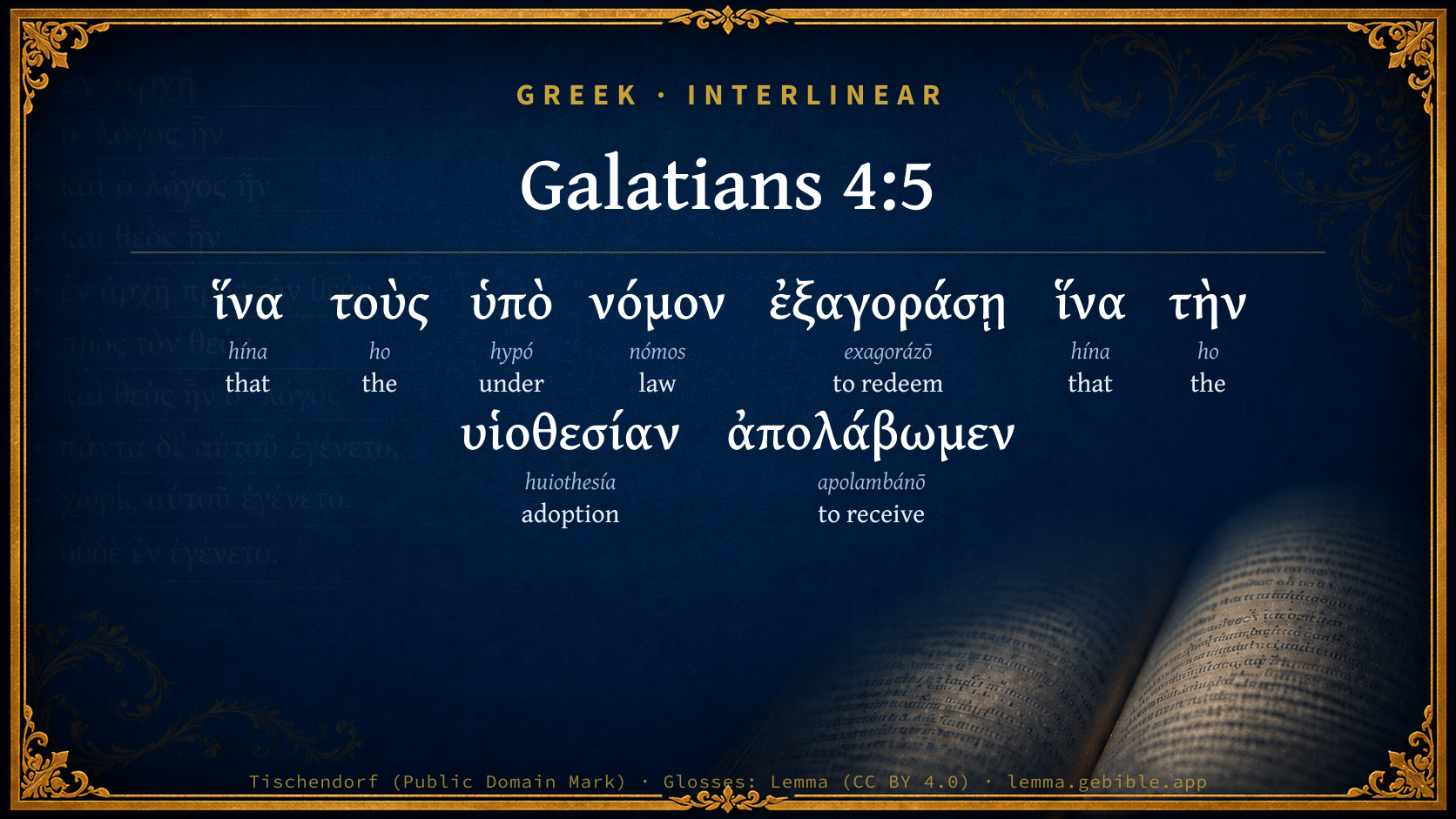
  1. ἵνα hína G2443 “that” Conjunction
  2. τοὺς ho G3588 “the” Article, Accusative, Plural, Masculine
  3. ὑπὸ hypó G5259 “under” Preposition
  4. νόμον nómos G3551 “law” Noun, Accusative, Singular, Masculine
  5. ἵνα hína G2443 “that” Conjunction
  6. τὴν ho G3588 “the” Article, Accusative, Singular, Feminine
  7. υἱοθεσίαν huiothesía G5206 “adoption” Noun, Accusative, Singular, Feminine
  8. ἀπολάβωμεν apolambánō G618 “to receive” Verb, Aorist, Active, Subjunctive, 1st person, Plural

About this verse

These counts appear in no published source. They are computed here, from the morphology-tagged text and Lemma’s own curated glosses. What Lemma adds →

9
words
7
distinct lemmas
Pauline Epistles
section

Notable vocabulary

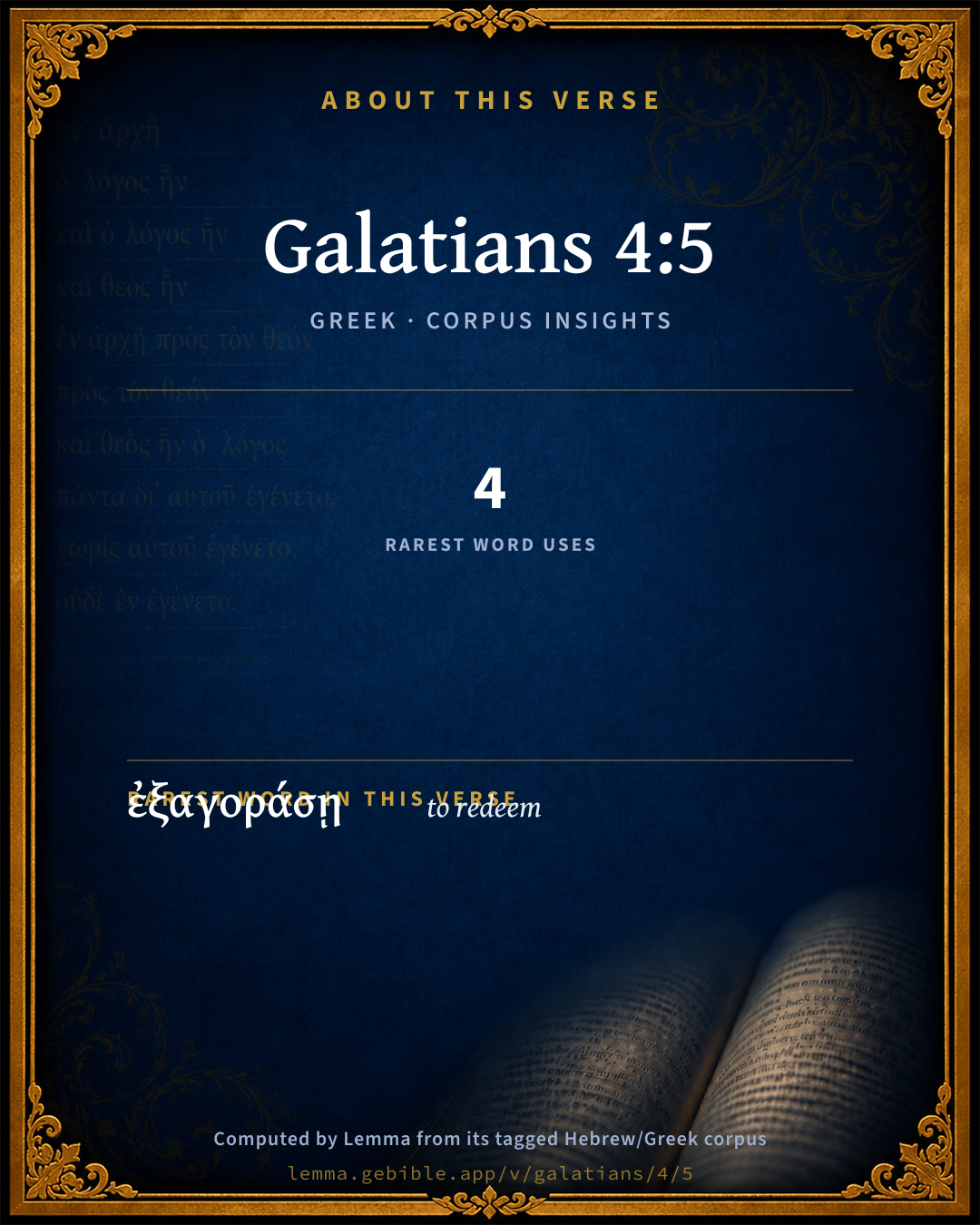
The rarest word here is ἐξαγοράσῃ to redeem G1805 — appearing just 4 times in the whole Greek New Testament.

Shared distinctive vocabulary

ἐξαγοράσῃ to redeem G1805 occurs in 4 verses of the Greek New Testament. Also found in:

Repetition

Words recur within this verse:

Cross-references

21

Topical passages linked to Galatians 4:5 in the Treasury of Scripture Knowledge — connected by theme and wording, ordered by reader-vote popularity; previews shown in the World English Bible.

  • Hebrews 9:15 For this reason he is the mediator of a new covenant, since a death has occurred for the redemption of the transgressions that were under the first covenant, that those who have been called may receive the promise of the eternal inheritance.
  • Ephesians 1:5 having predestined us for adoption as children through Jesus Christ to himself, according to the good pleasure of his desire,
  • 1 Peter 1:18–20 knowing that you were redeemed, not with corruptible things, with silver or gold, from the useless way of life handed down from your fathers,
  • Ephesians 1:7 in whom we have our redemption through his blood, the forgiveness of our trespasses, according to the riches of his grace,
  • Galatians 3:13 Christ redeemed us from the curse of the law, having become a curse for us. For it is written, "Cursed is everyone who hangs on a tree,"
  • Hebrews 9:12 nor yet through the blood of goats and calves, but through his own blood, entered in once for all into the Holy Place, having obtained eternal redemption.
  • Revelation 5:9 They sang a new song, saying, "You are worthy to take the book, And to open its seals: For you were killed, And bought us for God with your blood, Out of every tribe, language, people, and nation,
  • Romans 8:23 Not only so, but ourselves also, who have the first fruits of the Spirit, even we ourselves groan within ourselves, waiting for adoption, the redemption of our body.
  • Galatians 3:26 For you are all children of God, through faith in Christ Jesus.
  • Galatians 4:7 So you are no longer a bondservant, but a son; and if a son, then an heir of God through Christ.
  • John 1:12 But as many as received him, to them he gave the right to become God's children, to those who believe in his name:
  • Romans 9:4 who are Israelites; whose is the adoption, the glory, the covenants, the giving of the law, the service, and the promises;
  • Colossians 1:13–20 who delivered us out of the power of darkness, and translated us into the Kingdom of the Son of his love;
  • Titus 2:14 who gave himself for us, that he might redeem us from all iniquity, and purify for himself a people for his own possession, zealous for good works.
  • Romans 8:19 For the creation waits with eager expectation for the children of God to be revealed.
  • Ephesians 5:2 Walk in love, even as Christ also loved you, and gave himself up for us, an offering and a sacrifice to God for a sweet-smelling fragrance.
  • Luke 1:68 "Blessed be the Lord, the God of Israel, For he has visited and worked redemption for his people;
  • Galatians 4:21 Tell me, you that desire to be under the law, don't you listen to the law?
  • Matthew 20:28 even as the Son of Man came not to be served, but to serve, and to give his life as a ransom for many."
  • Hebrews 1:3 His Son is the radiance of his glory, the very image of his substance, and upholding all things by the word of his power, when he had by himself made purification for our sins, sat down on the right hand of the Majesty on high;
  • Acts 20:28 Take heed, therefore, to yourselves, and to all the flock, in which the Holy Spirit has made you overseers, to shepherd the assembly of the Lord and God which he purchased with his own blood.

Cross-references courtesy of OpenBible.info (CC BY 4.0).

Commentary

Notes on Galatians 4:5 from classic Christian and Jewish commentators (each source and its license shown beneath its notes). The classic Christian expositions comment on the surrounding passage and are grouped to its opening verse, so a note may address several verses; the Jewish commentaries on the Tanakh (Rashi and others) are per-verse, so they appear only where the commentator wrote on this verse.

Lemma curates 59 commentaries, every one of them public domain or Creative Commons licensed, each selected and text-cleaned for this edition rather than reprinted as found. About our sources →

Bengel's Gnomon

Johann Albrecht Bengel

Gal 4:5. Ἵνα τοὺς, κ.τ.λ.—ἵνα τὴν, that—that) An Anaphora.[33] The first that is to be referred to made under the law: therefore the second has respect to born of a woman. There is a Chiasmus very much resembling this, at Eph 3:16; Eph 5:25-26, which see with the annot. Christ, in the similitude of our condition, made our condition good; in the similitude of our nature, He made us the sons of God: γενόμενον is repeated, giving force to the meaning, He might have been born of a woman (γενέσθαι ἐκ γυναικὸς), and yet not have been made under the law (γενέσθαι ὑπὸ νόμον); but yet He was born of a woman (ἐγένετο ὲκ γυναικὸς), that He might be made under the law. The first γενόμενον, made, with the addition of ἐκ γυναικὸς, of a woman, takes (adopts) the meaning, being born.—ἐξαγοράσῃ, might redeem) from slavery to liberty.—τὴν υἱοθεσίαν, the adoption) the dignity of sons, a privilege in which those who are of age delight, along with the actual enjoyment [usufructu] of the inheritance.—ἀπολάβωμεν) we might receive; ἀπὸ shows the suitableness[34] of the thing, which has been long ago predestined by God.

[33] Append. The frequent repetition of the same words to mark beginnings.—ED.

[34] Ἀπὸ in the compound expresses often something appropriate or due.—ED.

Bengel's Gnomon of the New Testament — English translation (T&T Clark, Edinburgh, 1860) — public domain. Text from a community e-Sword module.

Meyer's Critical & Exegetical Commentary

Heinrich August Wilhelm Meyer

Gal_4:5. The object for which God sent forth His Son, and sent Him indeed γενόμ. ἐκ γυναικ., γενόμ. ὑπὸ νόμον.

τοὺς ὑ̔πὸ νόμον] The Israelites are thus designated in systematic correspondence to the previous γενόμ. ὑπὸ νόμον. Comp. Gal_3:25, Gal_4:21, Gal_5:18; Rom_6:14.

ἐξαγοράσῃ] Namely, as follows from τοὺς ὑπὸ νόμον, from the dominion of the law, Gal_4:1-3 (in which its curse, Gal_3:11, is included), and that through His death, Gal_3:13. Erasmus well says: dato pretio assereret in libertatem.

ἵνα τὴν υἱοθεσ. ἀπολάβ.] The aim of this redemption; for of this negative benefit the υἱοθεσία was the immediate positive consequence. But Paul could not again express himself in the third person, because the υἱοθεσία had been imparted to the Gentiles also, whereas that redemption referred merely to the Jews; but now both, Jews and Gentiles, after having attained the υἱοθεσία no longer ὑπὸ τὰ στοιχεῖα τοῦ κόσμου ἦσαν δεδουλωμένοι (Gal_4:3): hence Paul, in the first person of the second sentence of purpose, speaks from the consciousness of the common faith which embraced both the Jewish and the Gentile portions of the Christian body, not merely from the Jewish-Christian consciousness, as Hofmann holds on account of ἐστέ in Gal_4:6. Comp. the change of persons in Gal_3:14.

The υἱοθεσία is here, as it always is, adoption (see on Eph_1:5; Rom_8:15; and Fritzsche, in loc.),a meaning which is wrongly denied by Usteri, as the signification of the word allows no other interpretation, and the context requires no other. Previously not different from slaves (Gal_4:1-3), as they were in the state of νηπιότης, believers have now entered into the entirely different legal relation towards God of their being adopted by Him as children. Comp. Weiss, bibl. Theol. p. 338 f. The divine begetting (to which Hofmann refers) is a Johannean view; see on Joh_1:12. In the divine economy of salvation the gracious gift of the υἱοθεσία was needed in order to attain the κληρονομία; while in the human economy, which serves as the figure, the heir-apparent becomes at length heir as a matter of course. Accordingly Paul has not given up (Wieseler) the figure on which Gal_4:1 ff. was baseda view at variance with the express application in Gal_4:3, and the uninterrupted continuation of the same in Gal_4:4; but he has merely had recourse to such a free modification in the application, as was suggested to him by the certainly partial difference between the real circumstances of the case and the figure set forth in Gal_4:1-2. Comp. Gal_4:7.

ἀπολάβ.] not: that we might again receive, as is the meaning of ἀπολαμβ. very often in Greek authors (see especially Dem. 78. 3; 162. 17), and in Luk_15:27; for before Christ men never possessed the υἱοθεσία here referred to (although the old theocratic adoption of the Jews was never lost, Rom_9:4): hence Augustine and others are in error when they look back to the sonship that was lost in Adam. Nor must we assume with Chrysostom, Theophylact, Bengel, and others, including Baumgarten-Crusius, Hofmann, and Reithmayr, that, because the υἱοθεσία is promised, it is denoted by ἀπολάβ. as ὀφειλομένη,a sense which is often conveyed by the context in Greek authors and also in the N.T. (Luk_6:34; Luk_23:41; Rom_1:27; Col_3:24; 2Jn_1:8), but not here, because it is not the υἱοθεσία expressly, but the κληρονομία (Gal_3:29, Gal_4:7), which is the object of the promise. As little can we say, with Rückert and Schott, that the sonship is designated as fruit (ἀπο = inde) of the work of redemption, or, with Wieseler, as fruit of the death of Jesus apprehended by faith: for while it certainly is so in point of fact, the verb could not lead to it without some more precise indication in the text than that given by the mere ἐξαγορ. On the contrary, ἀπολάβ. simply denotes: to take at the hands of any one, to receive, as Luk_16:25; Plat. Legg. xii p. 956 D, and very frequently in Greek authors.

Meyer — Critical and Exegetical Commentary on the New Testament — English translation by Peter Christie, edited by Frederick Crombie (T&T Clark, 1880) — public domain. Text from a community e-Sword module.

Expositor's Greek Testament

ed. W. Robertson Nicoll

Gal 4:5 . ἵνα … ἵνα . These two final clauses couple together two gracious purposes of God in the scheme of redemption, (1) the obliteration of a guilty past, (2) divine adoption with the blessings which sonship entails. The description under Law includes Gentiles as well as Jews: for though they had not the Law , they were not without Law to God ( cf. Rom 2:14 …): they have indeed been expressly specified in Gal 3:14 as included in the redemption from the curse of the Law. ἀπολάβωμεν . This verb denotes receiving back , as ἀποδιδόναι does giving back ( cf. Luk 19:8 ): accordingly it describes the adoption in Christ as a restoration of the original birthright, withheld throughout many generations for the sake of necessary discipline.

The Expositor's Greek Testament, edited by W. Robertson Nicoll (1897–1910) — public domain. Text from a community e-Sword module.

Geneva Bible (1599)

Geneva Bible translators

The adoption of the sons of God, is from everlasting, but is revealed and showed in the time appointed for it.

Geneva Bible (1599) marginal notes — public domain. Text via Bolls.life.

Jamieson, Fausset & Brown

Robert Jamieson, A. R. Fausset & David Brown

To--Greek, "That He might redeem."

them . . . under the law--primarily the Jews: but as these were the representative people of the world, the Gentiles, too, are included in the redemption (Gal 3:13).

receive--The Greek implies the suitableness of the thing as long ago predestined by God. "Receive as something destined or due" (Luk 23:41; Jo2 1:8). Herein God makes of sons of men sons of God, inasmuch as God made of the Son of God the Son of man [AUGUSTINE on Psalm 52].

Jamieson, Fausset & Brown — Commentary Critical and Explanatory on the Whole Bible (1871) — public domain (CC PDM 1.0). Text via the HelloAO Bible API.

Adam Clarke's Commentary

Verse 5. To redeem them] εξαγοραση. To pay down a price for them, and thus buy them off from the necessity of observing circumcision, offering brute sacrifices, performing different ablutions, c., &c.

That we might receive the adoption of sons.] Which adoption we could not obtain by the law for it is the Gospel only that puts us among the children, and gives us a place in the heavenly family. On the nature of adoption See Clarke on Ro 8:15.

Adam Clarke's Commentary on the Bible (1810–1826) — public domain. Text from a community e-Sword/MySword module.

John Calvin's Commentaries

5. That we might receive the adoption. The fathers, under the Old Testament, were certain of their adoption, but did not so fully as yet enjoy their privilege. Adoption, like the phrase, “the redemption of our body,” (Romans 8:23,) is here put for actual possession. As, at the last day, we receive the fruit of our redemption, so now we receive the fruit of adoption, of which the holy fathers did not partake before the coming of Christ; and therefore those who now burden the church with an excess of ceremonies, defraud her of the just right of adoption.

John Calvin's Commentaries (1540-1563) — public domain. Text from the Calvin Translation Society English edition (1840s-50s) via the Christian Classics Ethereal Library (ccel.org). Calvin's coverage is partial (roughly two-thirds of the Bible); uncommented books and verses are honest gaps, never fabricated. The 19th-century editor's footnotes and remarks are omitted so the notes are faithfully Calvin's own voice.

Ellicott's Commentary for English Readers

(5) To redeem them that were under the law.—To redeem, or ransom, at the price of His death, both Jew and Gentile at once from the condemnation under which the law, to which they were severally subject, placed them, and also from the bondage and constraint which its severe discipline involved.

That we might receive the adoption of sons.—Redemption is followed by adoption. The admission of the believer into the Messianic kingdom, with its immunities from sin and from law, implies an admission into the Messianic family, of which God is the Father and Christ the Eldest Son, “first born amongst many brethren.”

A Bible Commentary for English Readers, edited by Charles John Ellicott (1878–1897) — public domain. Text from a community e-Sword module.

The Cambridge Bible for Schools and Colleges

gen. ed. J. J. S. Perowne

5. Born under the law, our Blessed Lord not only in His most holy life fulfilled all the commandments of the law, but in His death He satisfied its conditions by bearing its penalty, and redeeming us from its curse; born of a woman, He became the Head and representative of the human race, that in Him we might become sons of God. Possibly the wider rendering ‘under law’ may be correct, in which case the redemption includes expressly what it does by implication—all mankind.

the adoption of sons] Men become sons of God by adoption; Christ is the Son of God by eternal generation.

The Cambridge Bible for Schools and Colleges (gen. ed. J. J. S. Perowne; Cambridge University Press, 1878–1918) — public domain. Text from a community e-Sword module.

John Gill's Exposition

To redeem them that were under the law,.... By whom are meant chiefly the Jews, who are elsewhere represented as in and under the law, in distinction from the Gentiles who were without it; see Rom 2:12 the Gentiles indeed, though they were not under the law of Moses, yet were not without law to God, they were under the law of nature. The law was given to Adam as a covenant of works, and not to him as a single person, but as a federal head to all his posterity; hence he sinning, and they in him, they all came under its sentence of condemnation and death, God's elect not excepted, and who are the persons said to be redeemed; for Christ was not sent to redeem all that were under the law; for as all mankind were included in it as a covenant of works made with Adam, and all are transgressors of it, the whole world is pronounced guilty before God by it, and liable to the curse of it; but not all mankind, only some out of every kindred, tongue, people, and nation, are redeemed by Christ, even all the elect, whether among Jews or Gentiles. The chosen among the Jews seem to be here principally designed; the redemption of them, which is the end of Christ's being sent, intends not only a deliverance of them from sin and Satan, and the world, to whom they were in bondage, but from the law under which they were; from the bondage of the ceremonial, and from the curse and condemnation of the moral law:

that we might receive the adoption of children; by which may be meant, both the grace, blessing, and privilege of adoption, and the inheritance adopted to; both are received, and that in consequence of redemption by Christ; and such as receive the one will also receive the other. Adoption, as a blessing of grace, exists before it is received; nor does the reception of it add anything to the thing itself; it was in God's designation from all eternity, who predestinated his chosen ones unto it by Christ, according to the good pleasure of his will; it was provided, laid up, and secured for them in the everlasting covenant; and is part of that grace given them in Christ before the world began; but sin intervening, whereby the law was broken, obstacles were thrown in the way of God's elect receiving and enjoying this privilege in their own persons; wherefore Christ was sent to redeem them from sin and the law, and by so doing remove these obstructions, that so they might receive this privilege in a way consistent with the righteousness and holiness of God, as well as with his grace and goodness: receiving of it shows it to be a gift, a free grace gift, and not owing to any merit of the creature; faith is the hand which receives it, as it does all other blessings, as Christ himself, grace out of his fulness, righteousness, pardon, &c. and has no more causal influence on this than on any of these; faith does not make any the sons of God, or put them among the children; but receives the power, the authority, the privilege from God through Christ, under the witnessings of the spirit of adoption; whereby they become such, and have a right to the heavenly inheritance, which they shall hereafter enjoy.

John Gill's Exposition of the Whole Bible (1746–1763) — public domain (CC PDM 1.0). Text via the HelloAO Bible API.

Trapp's Complete Commentary

John Trapp

5 To redeem them that were under the law, that we might receive the adoption of sons.

Ver. 5. To redeem them, &c.] To buy them off, who were in worse case than the Turkish galley slaves chained to an oar.

That we might receive the adoption] That is, the possession of our adoption, the full enjoyment of our inheritance.

John Trapp, A Commentary or Exposition upon All the Books of the Old and New Testament (1647–1656) — public domain. Text from a community e-Sword module.

Albert Barnes' Notes on the Bible

To redeem them - By his death as an atoning sacrifice; see the note at Gal 3:13.

Them that were under the law - Sinners, who had violated the Law, and who were exposed to its dread penalty.

That we might receive the adoption of sons - Be adopted as the sons or the children of God; see Joh 1:12, note; Rom 8:15, note.

Albert Barnes' Notes on the Bible (1834–1885) — public domain. Text from a community e-Sword/MySword module.

Matthew Poole's English Annotations

This makes it appear, that Christ’s being under the law must be understood as well of the moral as of the ceremonial law, that is, subject to the precepts of it, as well as to the curse of it; for if the end of this being born under the law, was to redeem those that were under it, that he had not reached by being merely under the ceremonial law; for the Gentiles were not under that law, but only under the moral law; and they also were to be redeemed, and to receive the great privilege of

adoption, or rather, the rights of adopted children; which (some think) is to be understood here, rather than what is strictly to be understood by the term of adoption, viz. a right to be called and to be the sons of God. Others, by adoption, understand that full state of liberty of which the apostle had been before speaking, in opposition to that state of childhood and nonage in which believers were until the times of the gospel; for, Gal 5:1, we shall find that that was a liberty wherewith Christ made us free: and indeed this last sense seemeth best to agree with what the apostle had before said, Gal 4:1-3, though the other senses are not to be excluded.

Matthew Poole's English Annotations on the Holy Bible (1683–1685) — public domain. Text from a community e-Sword/MySword module.

Whedon's Commentary on the Bible

Daniel D. Whedon

5. Them—The we of Gal_4:3.

Receive the adoption of sons—Parallel to the emancipating the child from his servile minor state as a servant into his free sonship and inheritance.

Daniel D. Whedon (gen. ed.), Commentary on the Old and New Testaments (1874–1909) — public domain. Text from a community e-Sword module.

The Pulpit Commentary

To redeem them that were under the Law (ina touv uJpomon ejxagorash); that he might redeem (Greek, buy off) them which were under the Law. In what way Christ bought God"s people off, not only from the curse, but also from the dominion of the Law, has been stated by the apostle above, at Gal_3:13, "Christ bought us off (Cristorasen) from the curse of the Law by being made on our behalf a curse" (see note). But why, in order to effect this object, was it prerequisite, as it is here implied that it was, that he should be himself "brought under the Law"? The directions which the Law in Deu_21:22, 23 gave with respect to those "hanged on a tree" were apparently held by Joshua (Jos_8:29 Jos_10:26, Jos_10:27) to apply also to the case of persons so hanged who were not Israelites. If so, does it not follow (an objector may say) that Jesus, even if not an Israelite under the Law, would, however, by being crucified, have fallen under the curse of the Law, and thereby annihilated the Law for all who by faith should become partakers with him, whether Jews or Gentiles? why, then, should be have been brought under the Law? The objection is met by the consideration that, in order that Christ might abrogate the Law by becoming subject to its curse, it was necessary that he should himself be perfectly acceptable to God, not only as being the eternal "Son of his love," but also in the entire completeness of his life as a man, and, therefore, by perfect obedience to the will of God as declared in the Law, under which it had pleased God to place his people. The Law, whatever the degradation which its ceremonial institute inferred for "the sons of God" subjected to it, was, nevertheless, for the time, God"s manifest ordinance, to which all who sought to serve him were bound to submit them selves. They could not be righteous before him unless they walked in all the commandments and ordinances of the Lord blameless. (Luk_1:6) That we might receive the adoption of sons (ina than ajpolabwmen); that is, that our adoptive sonship might be actually and in full measure made over to us. The" we" recites God"s people; the same persons as those indicated by the preceding phrase, "those which were under the Law," which phrase was not meant to define one particular class among God"s people, but to describe the condition in which God"s people had been placed. Their Father had put them under the Law with the view of their being at his appointed time bought off from the Law and admitted to the full enjoyment of their filial privileges. This purpose of their Father, signified beforehand in the promises to Abraham, explains the article before uiJoqesian: it was the adoptive sonship which had been guaranteed to them. Hence the use here of the verb ajpolabwmen instead of labwmen: for the prepositional prefix of this compound verb has always its force; generally denoting our receiving a thing in some way due to us, answering to its force in the verb ajpodidwmi, repay: sometimes our receiving a thing in full measure. (comp. Luk_6:34, 35 16:25 18:30 23:41; Rom_1:27; Col_3:24 2Jn_1:8) Ina Luk_15:27 it is receiving back one lost. The second ina is subordinate to the first; the deliverance of God"s people from the Law was in order to their introduction into their complete state of sonship. The noun uiJoqesi does not appear to occur in any Greek writer except St. Paul; though qesqai uiJon uiJov, uiJoqetov oJ katasin pathr, are found in various authors. After the analogy of other compound verbal nouns with a similar termination (oJrkwmosia ajgwnoqesia qesmoqesia, etc.), it means first the act of adoption, as, perhaps, Rom_8:23; Eph_1:5; and then, quite naturally, the consequent condition of the adopted child, as in Rom_8:15 Rom_9:4; and this seems its more prominent sense here. Rom_9:4 suggests the surmise that the term had been in use before among Palestinian Jews, with reference to Israel"s state under the theocracy, and that St. Paul borrowed it thence with reference to the Christian Church, in which it found a more complete realization.

The Pulpit Commentary (1880–1919), ed. H.D.M. Spence-Jones & Joseph S. Exell — public domain. Text from a community e-Sword module.

John Wesley's Explanatory Notes

To redeem those under the law - From the curse of it, and from that low, servile state. That we - Jews who believe. Might receive the adoption - All the privileges of adult sons.

John Wesley, Explanatory Notes Upon the Whole Bible (1754–1765) — public domain. Text via the GEBible commentary corpus.

Luther on Galatians

Martin Luther

VERSE 5. That we might receive the adoption of sons.

Paul still has for his text Gen 22:18, "In thy seed shall all the nations of the earth be blessed." In the course of his Epistle he calls this promise of the blessing righteousness, life, deliverance from the Law, the testament, etc. Now he also calls the promise of blessing "the adoption of sons," the inheritance of everlasting life.

What ever induced God to adopt us for His children and heirs? What claim can men who are subservient to sin, subject to the curse of the Law, and worthy of everlasting death, have on God and eternal life? That God adopted us is due to the merit of Jesus Christ, the Son of God, who humbled Himself under the Law and redeemed us law-ridden sinners.

Martin Luther — Commentary on the Epistle to the Galatians (1535), English translation by Theodore Graebner (Zondervan, 1939) — public domain (U.S. copyright not renewed). Text from a community e-Sword module.

McGarvey & Pendleton's Commentaries

J. W. McGarvey

that he might redeem them that were under the law, that we might receive the adoption of sons. [In this paragraph Paul resumes the metaphor begun at Gal_3:24 ; but from a slightly different point of view. There, law, or the tutor, was prominent; here, the son, or pupil, is the chief object of consideration. The point now illustrated is the reason why the bondage of the law preceded the liberty of the gospel. It was for purposes of development, similar to those by which youth is trained to manhood. The child in this instance is regarded as wholly subject to the terms of a will (though that of a living father, as appears later). Though the will provides that the son shall eventually be heir of all things, yet for the present he is so hampered, governed and restricted by the inflexible terms of the will that his condition differs, so far as comfort and freedom are concerned, in no respect from that of a bondservant, or slave. His person is under the care of guardians, and his estate is under the direction of stewards, and he can in no way expect to have his affairs bettered until the time has elapsed which is fixed by the will as the period of his subserviency, or minority. Thus, says the apostle, both Jews and Gentiles, as one common, congregate body, or heirs in God's sight, were held in bondage either to the law of Moses or some other form of law, which laws are collectively described as the rudiments of the world. But when the time arrived which was stipulated in the will for the termination of this period of tutelage, then God took the steps for the liberation of the ward (which steps were also outlined beforehand in the promise to Abraham, and referred to in the types of the will as recorded by Moses), and sent forth his Son to effect the liberation of the ward. At Gal_3:13 the apostle has already suggested that this liberation was to be effected by the son taking the place of the ward, etc. He shows, therefore, the steps by which the Son took upon him this wardship. He took upon him the nature of the ward by becoming flesh, being born of a woman ( Joh_1:14 ), and he assumed the state of the ward, for he was born under the law and thus came under the wardship. And his gracious purpose in all this was to redeem all those under ward and bring them to the estate of sons ( 2Co_8:9 )--adopted sons.]

J. W. McGarvey (with Philip Y. Pendleton), Commentaries on the New Testament (The Fourfold Gospel, 1914; Acts; and the epistles) — public domain. Text from a community e-Sword/MySword module.

The People's New Testament

B. W. Johnson

5. To redeem them that were under the law. Those under bondage need redemption in order to secure freedom. Paul has shown that those under the law were in bondage. From this bondage Christ came to redeem us. How the redemption was wrought is shown in 3:13. That we might receive. This “adoption of sons” is bestowed as a gift. We cannot have it, and still be in bondage.

B. W. Johnson's The People's New Testament with Notes (1889–1891) — public domain. Electronic text from the Christian Classics Ethereal Library (CCEL) ThML edition.

Cambridge Greek Testament for Schools and Colleges

5. ἵνα. Probably to be taken with the whole of the preceding words from ἐξαπέστειλεν, of which indeed γενόμ.… νόμον are in a sense epexegetic.

τοὺς ὑπὸ νόμον, i.e. Jews, and, if them, much more others who were not under the same strict discipline. There may also be the further thought that if Jews were set free from the Law, much more were Gentiles not to be brought under it. “Tantum abest, ut eos, quibus lex lata non fuit, jugo legis subjecerit, ut et ipsos Judaeos liberatum venerit” (Wetstein).

ἐξαγοράσῃ, Gal 3:13; cf. 1Co 6:20; 1Co 7:23. St Paul and his readers cannot have been ignorant of the method by which slaves were often set free, viz. that of the master receiving from a temple the sale-price of his slave, who has himself deposited the sum with the temple authorities for that purpose. The slave is nominally bought to become the slave of the god, but he is in reality free, with the god for his protector.

An inscription of 200/199 B.C. at Delphi runs ἐπρίατο δʼ Ἀπόλλων ὁ Πύθιος παρὰ Σωσιβίου Ἀμφισσέος ἐ πʼ ἐλευθερίαι σῶμ[α] γυναικεῖον, ἇι ὄνομα Νίκαια … τιμᾶς ἀργυρίου … τὴν τιμὰν ἀπέχει. τὰν δὲ ὠνὰν ἐπίστευσε Νίκαια τῶι Ἀπόλλωνι ἐπʼ ἐλευθερίαι (Deissmann, Licht vom Osten, p. 234). For ἐπʼ ἐλευθερίᾳ see the notes on Gal 5:1; Gal 5:13. It is less probable that St Paul was thinking of one Roman method of adoption in which the transference was made from the power of the natural father to that of the adoptive father by a series of fictitious sales (see Appendix, Note C).

ἵνα. Dependent on ἐξαγοράσῃ. Observe that by “Chiasmus” the clause of the first ἵνα answers to γενόμενος ὑπὸ νόμον, and that of the second to γενόμενος ἐκ γυναικός.

τὴν υἱοθεσίαν. The article = that νίοθ. of which we all know, or perhaps “our” νίοθ. νίοθ., Rom 8:15; Rom 8:23; Rom 9:4; Eph 1:5[119]. Before, we were only potentially sons (Gal 4:1), and were in fact enslaved (Gal 4:3), but now are both recognized as sons officially and enjoy the privileges of the position. Observe “adoption,” for strictly we have no claim. It is of God’s grace that we become members of His family in the truest sense. See Appendix, Note C.

[119] Is affixed it means that all the passages are mentioned where the word occurs in the Greek Bible.

ἀπολάβωμεν. Col 3:24. “we” = all believers. ἀπο = as due, Luk 6:34, i.e. corresponding to the promises. καὶ τὴν ἐτηγγελμένην ἡμῖν υἱοθεσίαν ἐδωρήσατο (Theodoret). Hardly “as children were always sons, and only receive back what was originally designed for us” (Jowett).

Cambridge Greek Testament for Schools and Colleges (Cambridge University Press, 1896; 21 vols, various authors incl. Carr, Maclear, Plummer, Farrar, Lumby, Moule, M. R. James, Simcox) — public domain. Text from a community e-Sword module.

Alford’s Greek Testament

Henry Alford

5.] See above. Christ, being born under the law, a Jewish child, subject to its ordinances, by His perfect fulfilment of it, and by enduring, as the Head and in the root of our nature, its curse on the tree, bought off (from its curse and power, but see on ch. 3:13) those who were under the law: and if them, then the rest of mankind, whose nature He had upon Him. Thus in buying off τοὺς ὑπὸ νόμον, He effected that ἡμεῖς, all men, τὴν υἱοθεσίαν ἀπολάβωμεν—should receive (not ‘recover,’ as Aug., al., and Jowett (‘receive back’): there is no allusion to the innocence which we lost in Adam, nor was redemption by Christ in any sense a recovery of the state before the fall, but a far more glorious thing, the bestowal of an adoption which Adam never had. Nor is it, as Chrys., καλῶς εἶπεν, ἀπολάβωμεν, δεικνὺς ὀφειλομένην: it is true, it was the subject of promise, but it is the mere act of reception, not how or why it was received, which is here put forward. Nor again, with Rückert and Schött., must we render ἀπο—‘therefrom,’ as a fruit of the redemption. This again it is, but it is not expressed in the word) the adoption (the place, and privileges) of sons. The word υἱοθεσία occurs only in the N. T. In Herod. vi. 57 we have θετὸν παῖδα ποιέεσθαι, and the same expression in Diod. Sic. iv. 39.

Henry Alford, The Greek Testament (1849–1861) — public domain. Text from a community e-Sword module.

International Critical Commentary

5. ἵνα τοὺς ὑπο νόμον ἐξαγοράσῃ, “that he might deliver those that were under law.” The phrase ὑπὸ νόμον is, doubtless, to be taken in the same sense as in v. 4 and 3:23, viz.: “under law” legalistically understood. But while in those cases the context shows that the law actually referred to is the O. T. law, the context here (see above on the inclusiveness of ἡμεῖς in v. 3 and note the second person in v. 6, with its unambiguous inclusion of the Galatian Gentiles) implies that τοὺς ὑπὸ νόμον includes both Jews and Gentiles. That Paul conceived the Gentiles to possess a law, and that of divine origin, appears from Rom 2:14, Rom 2:15 (cf. 1:19, 20); and though the phrase ὑπὸ νόμον is usually employed with reference to the legalism that grew up on Jewish soil, yet that Paul was aware that the law whose work is written in the heart might also be externalised and made legalistic is intrinsically probable and is confirmed by 1Co 9:20, where τοῖς ὑπὸ νόμον, standing as a middle term between Ἰουδαίις and τοῖς ἀνόμοις, seems to designate those, whether Jew or Gentile, who were living under a system of legalism. On the use of ἐξαγοράζω, see on 3:13, p. 168. That the deliverance referred to is from the law, is implied in τοὺς ὑπὸ νόμον and the absence of any other phrase to suggest another enslaving power. That it is from subjection to law, i. e., (a) from the obligation to obey legal ordinances, and (b) from the conception of God which legalism implies, is shown as respects the former (a) by v. 10 and 5:1-4, and as respects the latter (b) by the following clause and vv. 6, 7. The whole clause expresses the purpose not of the participle γενόμενον only and probably not of ἐξαπέστειλεν only, but of the whole assertion ἐξαπέστειλεν, with its modifiers, wherein is implied that his human birth and subjection to law were contributory to the achievement of the redemption.

And this in turn conveys an intimation that Paul already had a thought akin to that expressed in Heb 5:7-9 with reference to the relation between the limitations of the earthly life of Jesus and his redemptive work. Yet how he conceived that the deliverance was accomplished, whether as in 3:13 through his death, or through his life experience reaching its climax in his death (cf. Php 2:7, Php 2:8), this verse in no way decides. That the apostle conceived that Jesus himself had passed through an experience like that of Paul, referred to by him in 2:19, in that he also had discovered that one does not come into the enjoyment of a filial relation to God through obedience to statutes, and that this was embodied in the teaching of Jesus, is not in itself improbable, but is not intimated either here or elsewhere in his letters.

ἵνα τὴν υἱοθεσίαν ἀπολάβωμεν. “that we might receive the adoption.” υἱοθεσία, found in inscriptions in the phrase καθʼ υἱοθεσίαν and rarely in Greek literature (Diog. Laert. IV 9 (53), νεανίσκων τινῶν υἱοθεσίας ποιεῖσθαι), does not occur in the Lxx and appears in N. T. only in the Pauline epistles. In Rom 9:4 it denotes the choice of Israel to be sons of God (cf. Exo 4:22, Deu 14:1, Deu 14:2, Hos 11:1). In Rom 8:14, Rom 8:15 they are said to be υἱοὶ θεοῦ who are led by God’s Spirit, and it is added: “For ye have not received a spirit of bondage again to fear, but ye have received a spirit of adoption (πνεῦμα υἱοθεσίας) whereby we cry, Abba, Father.” In Rom 8:23 ἡ υἱοθεσία is defined as consisting in the redemption of the body, doubtless because in Paul’s thought only through the resurrection and the clothing of the spirit in the spiritual body does man enter into the fulness of fellowship with God (cf. 1Co 15:13, 1Co 15:14, 1Co 15:44). In Eph 1:5 adoption is spoken of as that which men are foreordained of God to obtain through Jesus Christ. ἡ υἱοθεσία is, therefore, for Paul, God’s reception of men into the relation to him of sons, objects of his love and enjoying his fellowship, the ultimate issue of which is the future life wherein they are reclothed with a spiritual body; but the word may be used of different stages and aspects of this one inclusive experience. The article τήν is, doubtless, restrictive, pointing to the thought of vv. 1, 2 that at the time appointed of the father the child is released from subjection to tutors and governors, and comes into direct relation to the father as a mature son—an intimation more fully developed in v. 6.

The meaning “sonship” would satisfy most of the passages in which υἱοθεσία occurs, but there is no occasion to depart from the etymological sense, “installation as a son.” This does not, however, justify reading back into v. 1 the idea of adoption, and from this again carrying it back through χληρονόμος into the διαθήχη of 3:15, for Paul is not careful to maintain the consistency of his illustrations. He employs here his usual term because he is speaking of the establishment of those who have previously not had the privileges of a son in the full enjoyment of them.

Whether ἴνα … ἀπολάβ. expresses the purpose of ἐξαγοράσῃ, or, co-ordinately with that clause, expresses the purpose of ἐξαπέστειλεν is impossible to say with certainty; nor is the distinction important.

International Critical Commentary — older volumes (1896–1929), various authors — public domain. Text from a community e-Sword module.

Vincent's Word Studies in the New Testament

Marvin R. Vincent

To redeem [ινα εξαγοραση] . See on chapter Gal 3:13. To redeem from the dominion and curse of the law. The means of redemption is not mentioned. It cannot be merely the birth of Christ of a woman and under the law. These are mentioned only as the preliminary and necessary conditions of his redeeming work. The means or method appears in chapter Gal 3:13. We might receive [απολαβωμεν] . Not receive again or back, as Luk 14:27, for adoption was something which men did not have before Christ; but receive from the giver.

The adoption [την υιοθεσιαν] . P o. See on Rom 8:15, and comp. Rom 9:4; Eph 1:5. Not sonship, but sonship conferred.

Marvin R. Vincent, Word Studies in the New Testament (1887–1900) — public domain. Text from a community e-Sword/MySword module.

Lesson kit

Teaching starters — assembled from the data on this page, not authored interpretation. Every prompt links to the verse data it draws on. Edit before teaching.

Galatians, in the Pauline Epistles, opens this verse with 9 words (7 distinct Greek lemmas). Its most distinctive word is exagorázō (“to redeem”). A historical commentator’s framing appears above. Read the whole chapter for the surrounding context.

Discussion questions

  1. The word exagorázō carries the sense “to redeem.” How does it shape the verse?
  2. How does Galatians 3:13, which shares the word «to redeem», read alongside this verse?
  3. What does the repetition of “that” (2× in this one verse) do in this verse?
  4. These translations render this verse differently. What is at stake in choosing one wording over another?
  5. Compare how Bengel's Gnomon and Meyer's Critical & Exegetical Commentary read this verse. Where do they agree or differ?

Things to notice

  • These translations choose different wording for 5 words in this verse.
  • “that” occurs 2× in this single verse.
  • 7 distinct Greek lemmas span 9 words in this verse.

Reading settings

Reading text

Shown beneath each verse's original-language words.

Old Testament
Old Testament edition

Read the OT as the Masoretic Hebrew (MT) or the Greek Septuagint (LXX).

English shown for the Greek Septuagint (in the Hebrew ↔ Greek comparison).

Comparing translations? Open the Compare panel on any verse page to stack up to four side by side.