Nehemiah 13:29

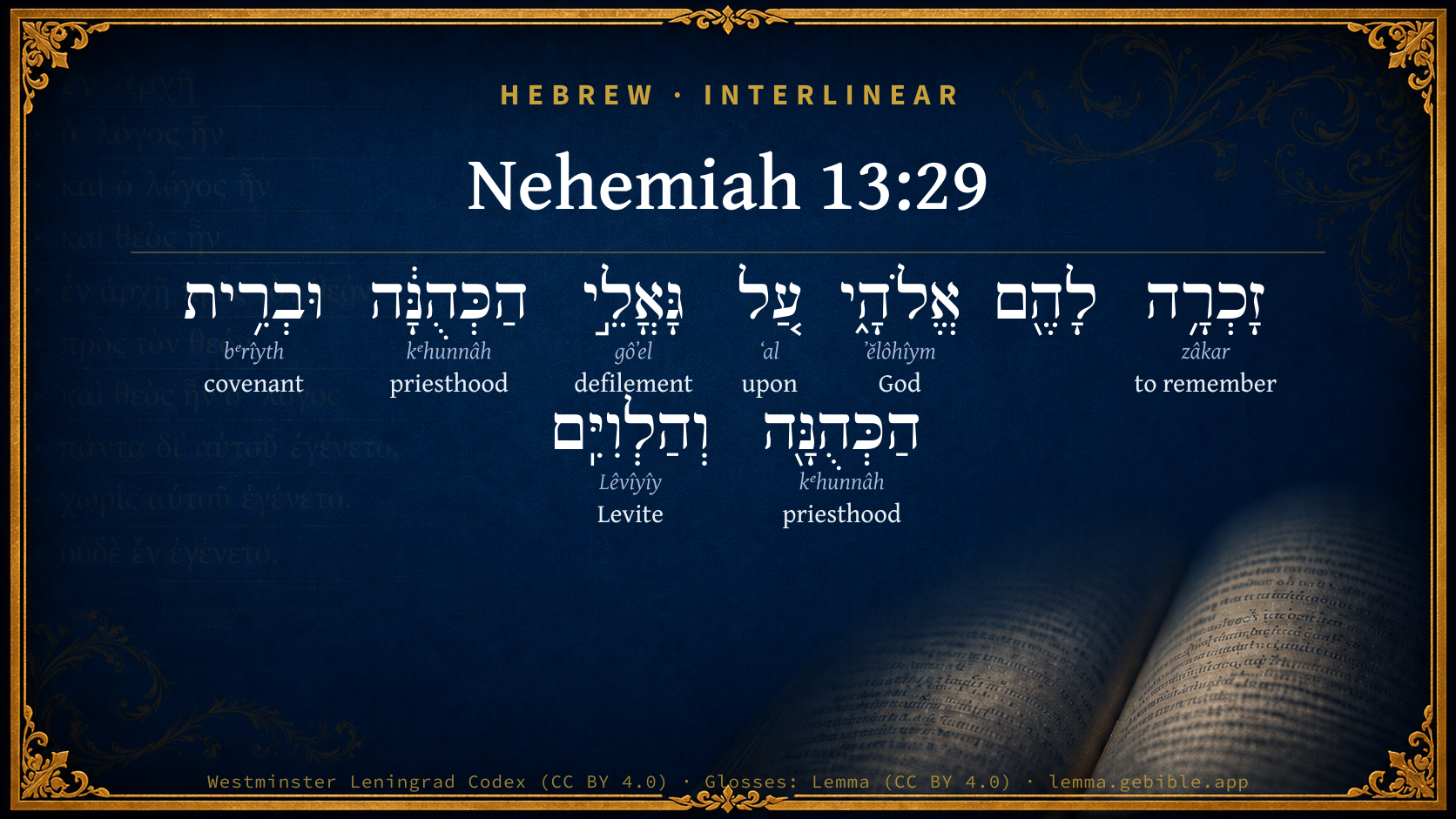
Hebrew (Westminster Leningrad Codex) Nehemiah 13:29 appears in the Hebrew Old Testament. The text above is from the Westminster Leningrad Codex. Each word links to its Strong’s number, a concise gloss, and parsing drawn from the Open Scriptures Hebrew Bible morphology. Click any word for its full Brown-Driver-Briggs (BDB) entry.
Download image
Cite this verse

Nehemiah 13:29 (World English Bible). Public Domain. Lemma interlinear Bible study tool, https://lemma.gebible.app/v/nehemiah/13/29.

Show BibTeX & RIS
BibTeX
RIS
English Translation
Remember them, my God, because they have defiled the priesthood, and the covenant of the priesthood, and of the Levites.
World English Bible · Public Domain
Highlights
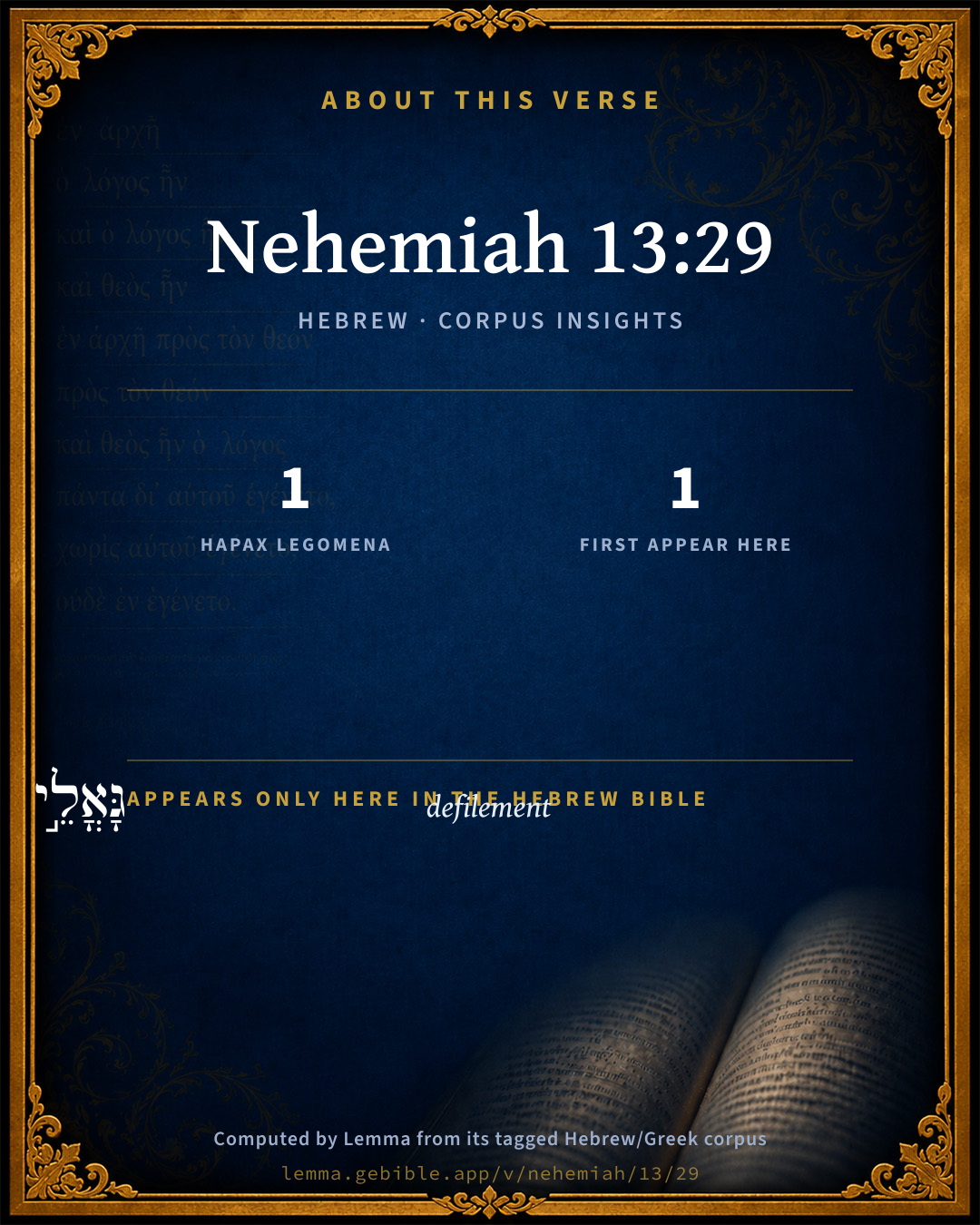
  • 1 hapax legomenon — only here in the Hebrew Bible
  • 1 first appearance in the Hebrew Bible
Full analysis ↓
Download a study sheet

One document with this verse’s original text, its word-by-word gloss line, the meaning frame, cross-references with their text, attributed commentary, and full source and license credits — printable, and it pastes into notes with its structure intact.

This verse Autodidact and up

Study sheet (.html) Plain text (.txt)

A passage Seminary Student

Up to 50 verses in one chapter. A passage sheet keeps up to 6 commentary sources and 12 cross-references per verse, in the order this page ranks them, and says so on the sheet whenever that leaves anything out. Ask for a single verse and you get the Autodidact verse sheet above.

Everything on this page stays free to read, with no account — the sheet is a download of what is already on screen, not access to it.

Want to remove ads? Support Godless Engineer
Compare translations 3

The same verse in 3 English versions, stacked beneath the original-language interlinear above. Click any original word for its lexicon entry.

Each is an independent rendering of the whole verse — the interlinear is not word-aligned to these translations.

Highlighted words mark where these versions differ — a whole-verse word diff, not a word-by-word alignment.

  • World English Bible Public Domain
    Remember them, my God, because they have defiled the priesthood, and the covenant of the priesthood, and of the Levites.
  • King James Version Public Domain
    Remember them, O my God, because they have defiled the priesthood, and the covenant of the priesthood, and of the Levites.
  • unfoldingWord Literal Text CC BY-SA 4.0
    Remember them, my God, on account of the defiling of the priesthood and the covenant of the priesthood and the Levites.

unfoldingWord Literal Text — © unfoldingWord, licensed CC BY-SA 4.0. Word-aligned USFM3 via Door43 (git.door43.org/unfoldingWord/en_ult).

Versions to compare (up to 4)

3 of 4 selected

Show all 18 translations

Every available English version of this verse, each an independent rendering of the whole verse.

  • World English Bible Public Domain
    Remember them, my God, because they have defiled the priesthood, and the covenant of the priesthood, and of the Levites.
  • Berean Standard Bible Public Domain
    Remember them, O my God, because they have defiled the priesthood and the covenant of the priesthood and of the Levites.
  • Majority Standard Bible Public Domain
    Remember them, O my God, because they have defiled the priesthood and the covenant of the priesthood and of the Levites.
  • King James Version Public Domain
    Remember them, O my God, because they have defiled the priesthood, and the covenant of the priesthood, and of the Levites.
  • American Standard Version (1901) Public Domain
    Remember them, O my God, because they have defiled the priesthood, and the covenant of the priesthood, and of the Levites.
  • Revised Version (1885) Public Domain
    Remember them, O my God, because they have defiled the priesthood, and the covenant of the priesthood, and of the Levites.
  • Geneva Bible (1599) Public Domain
    Remember them, O my God, that defile the Priesthoode, and the couenant of the Priesthoode, and of the Leuites.
  • Douay-Rheims (1899) Public Domain
    Remember them, O Lord my God, that defile the priesthood, and the law of priests and Levites.
  • Young's Literal Translation Public Domain
    Be mindful of them, O my God, for the redeemed of the priesthood, and the covenant of the priesthood, and of the Levites.
  • Literal Standard Version CC BY-SA 4.0
    Be mindful of them, O my God, for the redeemed of the priesthood, and the covenant of the priesthood, and of the Levites.
  • Unlocked Literal Bible CC BY-SA 4.0
    Call them to mind, my God, because they have defiled the priesthood, and the covenant of the priesthood and the Levites.
  • unfoldingWord Literal Text CC BY-SA 4.0
    Remember them, my God, on account of the defiling of the priesthood and the covenant of the priesthood and the Levites.
  • Darby Bible Public Domain
    Remember them, my God, for they are polluters of the priesthood, and of the covenant of the priesthood and of the Levites!
  • World Messianic Bible Public Domain
    Remember them, my God, because they have defiled the priesthood and the covenant of the priesthood and of the Levites.
  • Webster's Bible Public Domain
    Remember them, O my God, because they have defiled the priesthood, and the covenant of the priesthood and of the Levites.
  • Free Bible Version CC BY-SA 4.0
    My God, remember them and what they did, violating the priesthood and the solemn agreement of the priests and Levites.
  • Bible in Basic English Public Domain
    Keep them in mind, O my God, because they have put shame on the priests' name and on the agreement of the priests and the Levites.
  • JPS Tanakh (1917) Public Domain
    Remember them, O my God, because they have defiled the priesthood, and the covenant of the priesthood, and of the Levites.

Literal Standard Version (2020), Covenant Press — licensed CC BY-SA 4.0. Text via the HelloAO Bible API (eBible.org). Unlocked Literal Bible (unfoldingWord) — licensed CC BY-SA 4.0. Text via the HelloAO Bible API (eBible.org). unfoldingWord Literal Text — © unfoldingWord, licensed CC BY-SA 4.0. Word-aligned USFM3 via Door43 (git.door43.org/unfoldingWord/en_ult). Free Bible Version, Dr. Jonathan Gallagher — licensed CC BY-SA 4.0. Text via the HelloAO Bible API (eBible.org).

Word by word

More ways to search: Search by grammar → Find every occurrence → Compare this word →

Practice this passage: Drill this verse → Learn its vocabulary →

גָּאֳלֵ֣י
gôʼel
H1352
“defilements of”
Noun, Common, Masculine, Plural, Construct
Part of Speech
Noun
Type
Common
Gender
Masculine
Number
Plural
State
Construct
Full BDB Definition

Origin: from H1351

TWOT: 301a

defilement, defiling
  1. זָכְרָ֥ה zâkar H2142 “remember” Verb, Qal, Imperative, 2nd Person, Masculine, Singular + Suffix, h
  2. אֱלֹהָ֑י ʼĕlôhîym H430 “God(s) · my” Noun, Common, Masculine, Plural, Construct + Suffix, Personal, 1st Person, Common, Singular
  3. עַ֚ל ʻal H5921 “upon” Preposition
  4. הַכְּהֻנָּ֔ה kᵉhunnâh H3550 “the · priesthood” Particle, Definite Article + Noun, Common, Feminine, Singular, Absolute
  5. וּבְרִ֥ית bᵉrîyth H1285 “and · covenant of” Conjunction + Noun, Common, Feminine, Singular, Construct
  6. הַכְּהֻנָּ֖ה kᵉhunnâh H3550 “the · priesthood” Particle, Definite Article + Noun, Common, Feminine, Singular, Absolute
  7. וְהַלְוִיִּֽם Lêvîyîy H3881 “and · the · Levites” Conjunction + Particle, Definite Article + Noun, Gentilic, Masculine, Plural, Absolute

About this verse

These counts appear in no published source. They are computed here, from the morphology-tagged text and Lemma’s own curated glosses. What Lemma adds →

9
words
7
distinct lemmas
Historical
section

Notable vocabulary

1 hapax legomenon — a word that appears only here in the entire Hebrew Bible:

  • גָּאֳלֵ֣י defilement H1352

First appearance in Scripture

This word makes its first canonical appearance in the Hebrew Bible here:

  • גָּאֳלֵ֣י defilement H1352

Shared distinctive vocabulary

הַכְּהֻנָּ֔ה priesthood H3550 occurs in 12 verses of the Hebrew Bible. Also found in:

Grammatical profile

  • 1 verb
  • 6 nouns
  • 2 prepositions

Verb forms

  • זָכְרָ֥ה Qal · Imperative

Repetition

A word recurs within this verse — often emphatic in Hebrew:

  • הַכְּהֻנָּ֔ה priesthood H3550 ×2

Cross-references

9

Topical passages linked to Nehemiah 13:29 in the Treasury of Scripture Knowledge — connected by theme and wording, ordered by reader-vote popularity; previews shown in the World English Bible.

  • Nehemiah 6:14 Remember, my God, Tobiah and Sanballat according to these their works, and also the prophetess Noadiah, and the rest of the prophets, that would have put me in fear.
  • Leviticus 21:1–7 Yahweh said to Moses, "Speak to the priests, the sons of Aaron, and say to them, 'A priest shall not defile himself for the dead among his people;
  • Numbers 16:9–10 [seems it but] a small thing to you, that the God of Israel has separated you from the congregation of Israel, to bring you near to himself, to do the service of the tent of Yahweh, and to stand before the congregation to minister to them;
  • Numbers 25:12–13 Therefore say, Behold, I give to him my covenant of peace:
  • Malachi 2:4–8 You will know that I have sent this commandment to you, that my covenant may be with Levi," says Yahweh of Hosts.
  • 1 Samuel 2:30 Therefore Yahweh, the God of Israel, says, I said indeed that your house, and the house of your father, should walk before me forever: but now Yahweh says, Be it far from me; for those who honor me I will honor, and those who despise me shall be lightly esteemed.
  • Psalms 59:5–13 You, Yahweh God of hosts, the God of Israel, Rouse yourself to punish the nations. Show no mercy to the wicked traitors. Selah.
  • Malachi 2:10–12 Don't we all have one father? Hasn't one God created us? Why do we deal treacherously every man against his brother, profaning the covenant of our fathers?
  • 2 Timothy 4:14 Alexander, the coppersmith, did much evil to me. The Lord will repay him according to his works,

Cross-references courtesy of OpenBible.info (CC BY 4.0).

Hebrew and Greek witnesses Masoretic Hebrew ↔ Greek Septuagint

The same verse in the two great witnesses to the Old Testament, shown verse-for-verse.

These are two independent witnesses, not word-aligned to each other, and the Septuagint is shown in lemma (dictionary) form.

Hebrew Nehemiah 13:29 Masoretic · Westminster Leningrad Codex

זָכְרָ֥ה לָהֶ֖ם אֱלֹהָ֑י עַ֚ל גָּאֳלֵ֣י הַכְּהֻנָּ֔ה וּבְרִ֥ית הַכְּהֻנָּ֖ה וְהַלְוִיִּֽם

Remember them, my God, because they have defiled the priesthood, and the covenant of the priesthood, and of the Levites.

World English Bible · Public Domain

Greek LXX Structure differs

The Septuagint has no separate book of Nehemiah. Its Greek text is the second half of Esdras B (2 Esdras), chapters 11–23; Ezra is the first half (1–10).

A verse-for-verse comparison isn’t shown here because the chapters and verses don’t line up. Switch to the LXX edition with the MT / LXX toggle above to read the Greek directly.

On this verse, The Cambridge Bible for Schools and Colleges discusses the Septuagint’s reading. Read the note in Commentary ↓

Hebrew: Westminster Leningrad Codex (CC BY 4.0). Greek: Septuagint (public domain); English from a public-domain English Septuagint. How the Septuagint differs from the Hebrew →

Commentary

Notes on Nehemiah 13:29 from classic Christian and Jewish commentators (each source and its license shown beneath its notes). The classic Christian expositions comment on the surrounding passage and are grouped to its opening verse, so a note may address several verses; the Jewish commentaries on the Tanakh (Rashi and others) are per-verse, so they appear only where the commentator wrote on this verse.

Lemma curates 59 commentaries, every one of them public domain or Creative Commons licensed, each selected and text-cleaned for this edition rather than reprinted as found. About our sources →

Joseph Benson's Commentary

Neh 13:29. Remember them, O my God — Convince them of sin, and bring them to repentance; put them in mind of what they should be and do, that they may come to themselves. Or, remember them to reckon with them for it, and punish them according to their deserts. If we consider the words in this light, the prayer is a prediction that God would remember it against them. Because they have defiled the priesthood — God required greater purity in the priests than in other Israelites, and in the high-priest especially, who might marry none but a virgin of his own people, Lev 21:6-14; and the covenant of the priesthood, and of the Levites — There was a covenant with Phinehas (Numbers 25.) of an everlasting priesthood, which they had violated, because the covenant was mutual, binding them to observe the laws of the priesthood, as God engaged himself to preserve them in their office. What covenant was made with the Levites does not appear, but it is likely the meaning is, they dishonoured the whole tribe of Levi, who were set apart for divine ministries.

Joseph Benson's Commentary on the Old and New Testaments (1811–1818) — public domain. Text from a community e-Sword module.

Tyndale Open Study Notes

Tyndale Open Resources

13:29 Remember them, O my God: Many would probably resent Nehemiah’s aggressive attack on intermarriage in the family of the high priest. So he prayed for God’s judgment to fall on these spiritual leaders who defiled the priesthood.

Tyndale Open Study Notes — © Tyndale Open Resources, licensed CC BY-SA 4.0. Text via the HelloAO Bible API.

Geneva Bible (1599)

Geneva Bible translators

Punish them according to their fault and evil example, which they have given to the rest of thy people contrary to their vocation.

Geneva Bible (1599) marginal notes — public domain. Text via Bolls.life.

Adam Clarke's Commentary

Verse 29. Because they have defiled the priesthood] God, therefore, will remember their iniquities against them, and punish them for their transgressions. These words of Nehemiah are to be understood declaratively.

Adam Clarke's Commentary on the Bible (1810–1826) — public domain. Text from a community e-Sword/MySword module.

Ellicott's Commentary for English Readers

(29) Remember them.—This priestly violation of law is committed to God alone for punishment.

And of the Levites.—God chose the tribe of Levi for Himself, specially the house of Aaron, and every priest was to be “holy to the Lord” (Lev_21:6; Lev_21:8). This was “the covenant of the priesthood;” though there may be an undertone of reference to the great covenant in Nehemiah 10.

A Bible Commentary for English Readers, edited by Charles John Ellicott (1878–1897) — public domain. Text from a community e-Sword module.

The Cambridge Bible for Schools and Colleges

gen. ed. J. J. S. Perowne

29. Remember them] Here in a bad sense.

because they have defiled] R.V. marg. ‘Heb. for the defilings of’. The word so rendered occurs only here. It is from the same root as the word ‘Goel,’ which explains the confusion of the LXX. ἐπὶ ἀγχιστείᾳ τῆς ἱερατείας.

the priesthood … the covenant of the priesthood, and of the Levites] Joiada’s son, not being high-priest, did not himself fall under the marriage law of the high-priest, Lev_21:13-15. But as a possible successor to the office, his marriage with Sanballat’s daughter violated the spirit of the Law. ‘The covenant of the priesthood, and of the Levites’ seems to mean the peculiar relation of the priests and the Levites as holy, set apart for the special service of God, and as representatives of the whole people. It is possible that Nehemiah’s words relate not to the offence of an individual, but to the shame accruing to the whole priesthood in the fact that renegade priests had founded a rival Jehovah worship on Mt Gerizim, among the hated Samaritans. The expression is very similar to that in Mal_2:8, ‘But ye are turned aside out of the way; ye have caused many to stumble in the law; ye have corrupted the covenant of Levi, saith the Lord of hosts.’ For ‘the covenant of the priesthood,’ cf. Deu_33:8-11, Mal_2:1-8 will form an excellent commentary upon Nehemiah’s earnest denunciation.

The Cambridge Bible for Schools and Colleges (gen. ed. J. J. S. Perowne; Cambridge University Press, 1878–1918) — public domain. Text from a community e-Sword module.

Matthew Poole's English Annotations

That covenant made between me and his progenitors for themselves and their posterity, whereby I promised to give them an everlasting priesthood, Num 25:12,13, and they covenanted with me that they would faithfully and holily execute that sacred function according to the rules which I gave them, whereby, among other things, they were enjoined to keep themselves pure from all unlawful marriages, and from all other things which might pollute them or the priesthood.

Matthew Poole's English Annotations on the Holy Bible (1683–1685) — public domain. Text from a community e-Sword/MySword module.

Whedon's Commentary on the Bible

Daniel D. Whedon

29. Remember them — All who were involved in the sin of Joiada’s son.

They… defiled the priesthood — By being parties in the contraction of this marriage with a foreign woman. If it were sinful — a breach of the law — for any Israelite to marry a heathen wife, much more so for a son of the high priest to do it. The law expressly forbade a high priest to marry a widow, or a divorced woman, or profane, or harlot, or any but a virgin of his own nation. Lev_21:14. Hence this marriage of the high priest’s son was a breach of the covenant of the priesthood, and of the Levites. Compare Mal_2:1-8. For though this apostate son of Joiada were not himself high priest, his marriage with a foreign woman was a stigma on his father’s family.

Daniel D. Whedon (gen. ed.), Commentary on the Old and New Testaments (1874–1909) — public domain. Text from a community e-Sword module.

The Pulpit Commentary

They have defiled the priesthood, and the covenant of the priesthood, and of the Levites. We look in vain for any distinct "covenant" which the priestly order broke by allying itself with the heathen, or indeed for any special law forbidding the priests to take heathen wives, which was not equally binding upon laymen. But Nehemiah feels that every sin is worse in a priest than in one who is not a priest; that a priest who contracts a pollution "pollutes the priesthood;" and that there is a tacit covenant by which priests and Levites bind themselves to holiness of life more absolutely and definitely than others.

The Pulpit Commentary (1880–1919), ed. H.D.M. Spence-Jones & Joseph S. Exell — public domain. Text from a community e-Sword module.

Rashi

Rabbi Shlomo Yitzchaki (Rashi)

Remember them the good that they did.

Rashi on the Tanakh — English translations: “The Judaica Press complete Tanach with Rashi, translated by A. J. Rosenberg” (CC BY 4.0); “Pentateuch with Rashi's commentary by M. Rosenbaum and A.M. Silbermann, 1929-1934” (public domain); “The Metsudah Tanach series, Lakewood, N.J” (CC BY 4.0); and “The Book of Joshua, Metsudah Publications, 1997” (CC BY 4.0). Text via Sefaria.

Lesson kit

Teaching starters — assembled from the data on this page, not authored interpretation. Every prompt links to the verse data it draws on. Edit before teaching.

Nehemiah, in the Historical, opens this verse with 9 words (7 distinct Hebrew lemmas). Its most distinctive word is gôʼel (“defilement”). A historical commentator’s framing appears above. Read the whole chapter for the surrounding context.

Discussion questions

  1. What does “defilement” (gôʼel) contribute to the verse as a whole?
  2. This verse holds 1 word here found nowhere else in the Hebrew Bible. What might the rare word draw attention to?
  3. The word “defilement” first appears here in Scripture. What is being introduced at this debut?
  4. Exodus 29:9 shares the word «priesthood» with this verse. How do the two illuminate each other?
  5. “priesthood” occurs 2× in this one verse. What is the effect of the repetition?
  6. These translations render this verse differently; the difference is in the English rendering, not the original. What questions does that raise?
  7. The verb «זָכְרָ֥ה» is Qal Imperative. How does its form color the action?
  8. Reading how Joseph Benson's Commentary and Tyndale Open Study Notes read this verse, where do the two commentators agree and where do they part?

Things to notice

  • 1 word in this verse appears nowhere else in the Hebrew Bible.
  • 1 word makes its first canonical appearance in Scripture here.
  • These translations choose different wording for 6 words in this verse.
  • “priesthood” occurs 2× in this single verse.
  • 7 distinct Hebrew lemmas span 9 words in this verse.

Reading settings

Reading text

Shown beneath each verse's original-language words.

Old Testament
Old Testament edition

Read the OT as the Masoretic Hebrew (MT) or the Greek Septuagint (LXX).

English shown for the Greek Septuagint (in the Hebrew ↔ Greek comparison).

Comparing translations? Open the Compare panel on any verse page to stack up to four side by side.