
Jeremiah 22:2

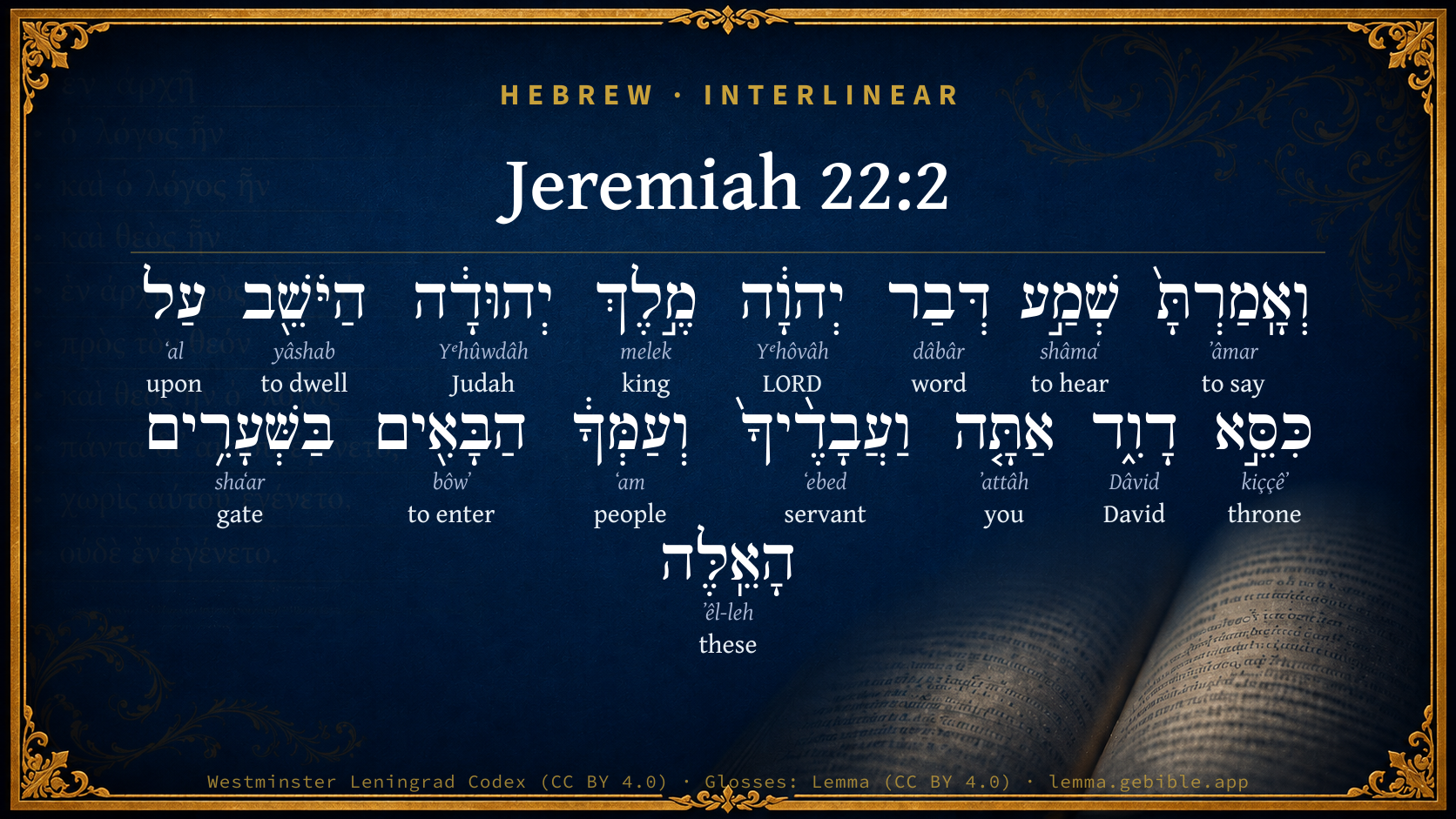
Hebrew (Westminster Leningrad Codex) Jeremiah 22:2 appears in the Hebrew Old Testament. The text above is from the Westminster Leningrad Codex. Each word links to its Strong’s number, a concise gloss, and parsing drawn from the Open Scriptures Hebrew Bible morphology. Click any word for its full Brown-Driver-Briggs (BDB) entry.
Download image
Cite this verse

Jeremiah 22:2 (World English Bible). Public Domain. Lemma interlinear Bible study tool, https://lemma.gebible.app/v/jeremiah/22/2.

Show BibTeX & RIS
BibTeX
RIS
English Translation
Say, Hear the word of Yahweh, king of Judah, who sits on the throne of David, you, and your servants, and your people who enter in by these gates.
World English Bible · Public Domain
Download a study sheet

One document with this verse’s original text, its word-by-word gloss line, the meaning frame, cross-references with their text, attributed commentary, and full source and license credits — printable, and it pastes into notes with its structure intact.

This verse Autodidact and up

Study sheet (.html) Plain text (.txt)

A passage Seminary Student

Up to 50 verses in one chapter. A passage sheet keeps up to 6 commentary sources and 12 cross-references per verse, in the order this page ranks them, and says so on the sheet whenever that leaves anything out. Ask for a single verse and you get the Autodidact verse sheet above.

Everything on this page stays free to read, with no account — the sheet is a download of what is already on screen, not access to it.

Want to remove ads? Support Godless Engineer
Compare translations 3

The same verse in 3 English versions, stacked beneath the original-language interlinear above. Click any original word for its lexicon entry.

Each is an independent rendering of the whole verse — the interlinear is not word-aligned to these translations.

Highlighted words mark where these versions differ — a whole-verse word diff, not a word-by-word alignment.

  • World English Bible Public Domain
    Say, Hear the word of Yahweh, king of Judah, who sits on the throne of David, you, and your servants, and your people who enter in by these gates.
  • King James Version Public Domain
    And say, Hear the word of the LORD, O king of Judah, that sittest upon the throne of David, thou, and thy servants, and thy people that enter in by these gates:
  • unfoldingWord Literal Text CC BY-SA 4.0
    And you shall say, ‘Hear the word of Yahweh, king of Judah, the one sitting on the throne of David, you and your servants and your people who are entering in these gates.

unfoldingWord Literal Text — © unfoldingWord, licensed CC BY-SA 4.0. Word-aligned USFM3 via Door43 (git.door43.org/unfoldingWord/en_ult).

Versions to compare (up to 4)

3 of 4 selected

Show all 18 translations

Every available English version of this verse, each an independent rendering of the whole verse.

  • World English Bible Public Domain
    Say, Hear the word of Yahweh, king of Judah, who sits on the throne of David, you, and your servants, and your people who enter in by these gates.
  • Berean Standard Bible Public Domain
    saying, ‘Hear the word of the LORD, O king of Judah, who sits on the throne of David—you and your officials and your people who enter these gates.
  • Majority Standard Bible Public Domain
    saying, ‘Hear the word of the LORD, O king of Judah, who sits on the throne of David—you and your officials and your people who enter these gates.
  • King James Version Public Domain
    And say, Hear the word of the LORD, O king of Judah, that sittest upon the throne of David, thou, and thy servants, and thy people that enter in by these gates:
  • American Standard Version (1901) Public Domain
    And say, Hear the word of Jehovah, O king of Judah, that sittest upon the throne of David, thou, and thy servants, and thy people that enter in by these gates.
  • Revised Version (1885) Public Domain
    And say, Hear the word of the LORD, O king of Judah, that sittest upon the throne of David, thou, and thy servants, and thy people that enter in by these gates.
  • Geneva Bible (1599) Public Domain
    And say, Heare the worde of the Lord, O King of Iudah, that sittest vpon the throne of Dauid, thou and thy seruants, and thy people that enter in by these gates.
  • Douay-Rheims (1899) Public Domain
    And thou shalt say: Hear the word of the Lord, O king of Juda, that sittest upon the throne of David: thou and thy servants, and thy people, who enter in by these gates.
  • Young's Literal Translation Public Domain
    Hear a word of Jehovah, O king of Judah, who art sitting on the throne of David, thou, and thy servants, and thy people, who are coming in at these gates,
  • Literal Standard Version CC BY-SA 4.0
    Hear a word of YHWH, O king of Judah, who are sitting on the throne of David, you, and your servants, and your people, who are coming in at these gates,”
  • Unlocked Literal Bible CC BY-SA 4.0
    Say, 'King of Judah, listen to the word of Yahweh—you who sit on David's throne—you, and your servants, and your people who come through these gates.
  • unfoldingWord Literal Text CC BY-SA 4.0
    And you shall say, ‘Hear the word of Yahweh, king of Judah, the one sitting on the throne of David, you and your servants and your people who are entering in these gates.
  • Darby Bible Public Domain
    and say, Hear the word of Jehovah, O king of Judah, that sittest upon the throne of David, thou, and thy servants, and thy people who enter in through these gates.
  • World Messianic Bible Public Domain
    ‘Hear the LORD’s word, king of Judah, who sits on David’s throne—you, your servants, and your people who enter in by these gates.
  • Webster's Bible Public Domain
    And say, Hear the word of the LORD, O king of Judah, that sittest upon the throne of David, thou, and thy servants, and thy people that enter by these gates:
  • Free Bible Version CC BY-SA 4.0
    Tell them: Listen to what the Lord has to say to you, king of Judah, sitting on the throne of David, you and your officials and the people here with you.
  • Bible in Basic English Public Domain
    And say, Give ear to the word of the Lord, O king of Judah, seated on the seat of David, you and your servants and your people who come in by these doors.
  • JPS Tanakh (1917) Public Domain
    and say: Hear the word of the LORD, O king of Judah, that sittest upon the throne of David, thou, and thy servants, and thy people that enter in by these gates.

Literal Standard Version (2020), Covenant Press — licensed CC BY-SA 4.0. Text via the HelloAO Bible API (eBible.org). Unlocked Literal Bible (unfoldingWord) — licensed CC BY-SA 4.0. Text via the HelloAO Bible API (eBible.org). unfoldingWord Literal Text — © unfoldingWord, licensed CC BY-SA 4.0. Word-aligned USFM3 via Door43 (git.door43.org/unfoldingWord/en_ult). Free Bible Version, Dr. Jonathan Gallagher — licensed CC BY-SA 4.0. Text via the HelloAO Bible API (eBible.org).

Word by word

More ways to search: Search by grammar → Find every occurrence → Compare this word →

Practice this passage: Drill this verse → Learn its vocabulary →

כִּסֵּ֣א
kiççêʼ
H3678
“throne of”
Noun, Common, Masculine, Singular, Construct
Part of Speech
Noun
Type
Common
Gender
Masculine
Number
Singular
State
Construct
Full BDB Definition

Origin: from H3680

TWOT: 1007

seat (of honour), throne, seat, stool - seat (of honour), throne - royal dignity, authority, power (figuratively)
  1. וְאָֽמַרְתָּ֙ ʼâmar H559 “and · to say” Conjunction + Verb, Qal, Sequential Perfect, 2nd Person, Masculine, Singular
  2. שְׁמַ֣ע shâmaʻ H8085 “hear” Verb, Qal, Imperative, 2nd Person, Masculine, Singular
  3. דְּבַר dâbâr H1697 “word of” Noun, Common, Masculine, Singular, Construct
  4. יְהוָ֔ה Yᵉhôvâh H3068 “LORD” Noun, Proper
  5. מֶ֣לֶךְ melek H4428 “king of” Noun, Common, Masculine, Singular, Construct
  6. יְהוּדָ֔ה Yᵉhûwdâh H3063 “Judah” Noun, Proper
  7. הַיֹּשֵׁ֖ב yâshab H3427 “the · dwelling” Particle, Definite Article + Verb, Qal, Participle Active, Masculine, Singular, Absolute
  8. עַל ʻal H5921 “upon” Preposition
  9. דָוִ֑ד Dâvid H1732 “David” Noun, Proper
  10. אַתָּ֤ה ʼattâh H859 “you” Pronoun, Personal, 2nd Person, Masculine, Singular
  11. וַעֲבָדֶ֨יךָ֙ ʻebed H5650 “and · servants · your” Conjunction + Noun, Common, Masculine, Plural, Construct + Suffix, Personal, 2nd Person, Masculine, Singular
  12. וְעַמְּךָ֔ ʻam H5971 “and · people · your” Conjunction + Noun, Common, Masculine, Singular, Construct + Suffix, Personal, 2nd Person, Masculine, Singular
  13. הַבָּאִ֖ים bôwʼ H935 “the · entering” Particle, Definite Article + Verb, Qal, Participle Active, Masculine, Plural, Absolute
  14. בַּשְּׁעָרִ֥ים shaʻar H8179 “in/at the · gates” Preposition, Determined + Noun, Common, Masculine, Plural, Absolute
  15. הָאֵֽלֶּה ʼêl-leh H428 “the · these” Particle, Definite Article + Pronoun, Demonstrative, Common, Plural

About this verse

These counts appear in no published source. They are computed here, from the morphology-tagged text and Lemma’s own curated glosses. What Lemma adds →

16
words
16
distinct lemmas
Prophets
section

Grammatical profile

  • 4 verbs
  • 9 nouns
  • 2 pronouns
  • 1 preposition

Verb forms

  • וְאָֽמַרְתָּ֙ Qal · Sequential Perfect
  • שְׁמַ֣ע Qal · Imperative
  • הַיֹּשֵׁ֖ב Qal · Participle Active
  • הַבָּאִ֖ים Qal · Participle Active

Hebrew & Septuagint length

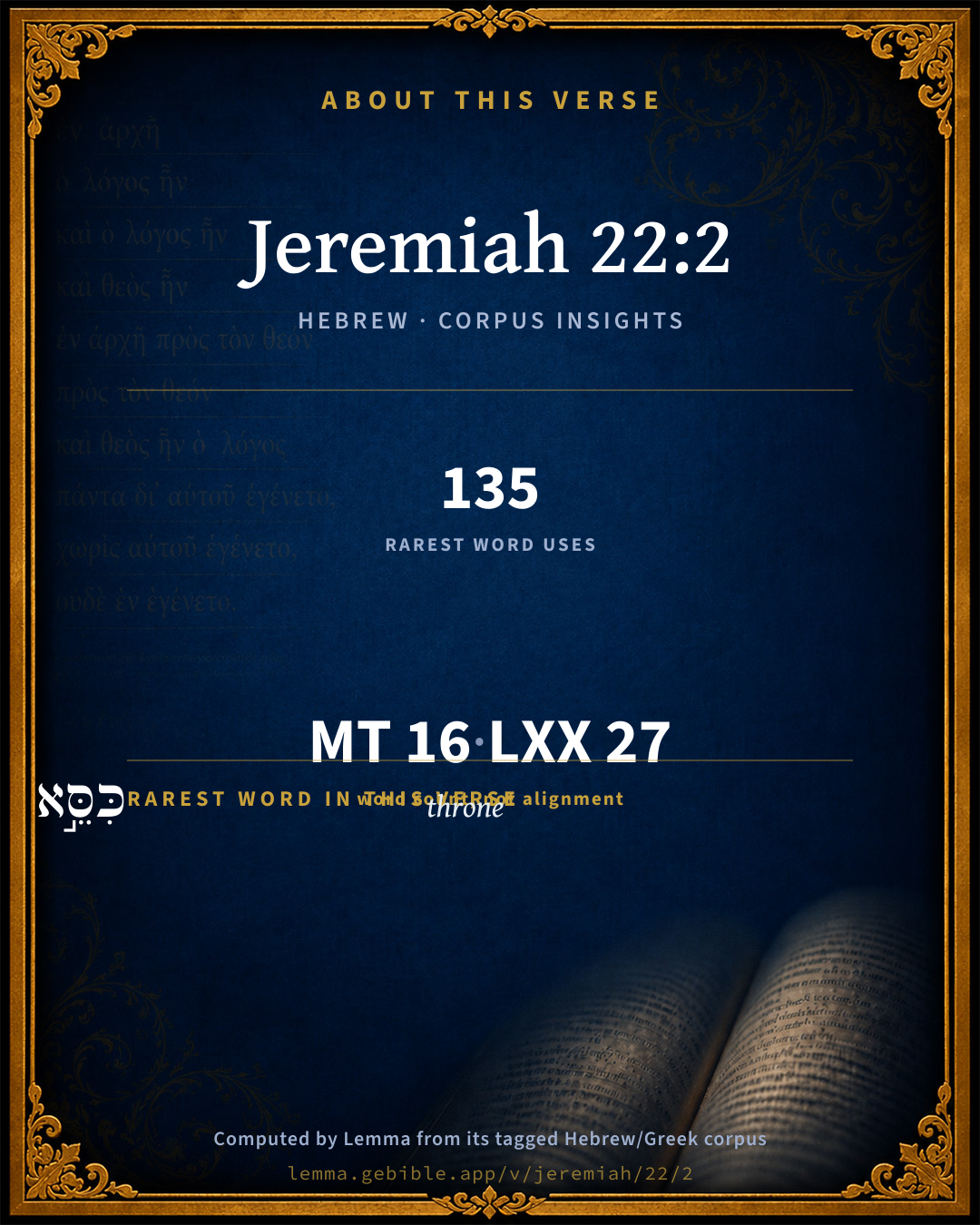
In the original languages it is 16 Hebrew tokens and 27 Greek tokens — but the two are counted differently (Hebrew bundles its prefixes and suffixes into one token; the Greek is in lemma form), so that isn’t a like-for-like length.

Cross-references

16

Topical passages linked to Jeremiah 22:2 in the Treasury of Scripture Knowledge — connected by theme and wording, ordered by reader-vote popularity; previews shown in the World English Bible.

  • Luke 1:32 He will be great, and will be called the Son of the Most High. The Lord God will give him the throne of his father, David,
  • Isaiah 1:10 Hear the word of Yahweh, you rulers of Sodom! Listen to the law of our God, you people of Gomorrah!
  • Isaiah 9:7 Of the increase of his government and of peace there shall be no end, on the throne of David, and on his kingdom, to establish it, and to uphold it with justice and with righteousness from henceforth even forever. The zeal of Yahweh of Hosts will perform this.
  • Jeremiah 22:4 For if you do this thing indeed, then shall there enter in by the gates of this house kings sitting on the throne of David, riding in chariots and on horses, he, and his servants, and his people.
  • 1 Kings 22:19 [Micaiah] said, Therefore hear you the word of Yahweh: I saw Yahweh sitting on his throne, and all the host of heaven standing by him on his right hand and on his left.
  • Isaiah 28:14 Why hear the word of Yahweh, you scoffers, that rule this people that is in Jerusalem:
  • Jeremiah 7:2 Stand in the gate of Yahweh's house, and proclaim there this word, and say, Hear the word of Yahweh, all you of Judah, who enter in at these gates to worship Yahweh.
  • Jeremiah 13:18 Say you to the king and to the queen-mother, Humble yourselves, sit down; for your headdresses are come down, even the crown of your glory.
  • Jeremiah 17:20–27 and tell them, Hear you the word of Yahweh, you kings of Judah, and all Judah, and all the inhabitants of Jerusalem, that enter in by these gates:
  • Jeremiah 19:3 and say, Hear you the word of Yahweh, kings of Judah, and inhabitants of Jerusalem: thus says Yahweh of Hosts, the God of Israel, Behold, I will bring evil on this place, which whoever hears, his ears shall tingle.
  • Jeremiah 22:29–30 O earth, earth, earth, hear the word of Yahweh.
  • Jeremiah 29:20 Hear you therefore the word of Yahweh, all you of the captivity, whom I have sent away from Jerusalem to Babylon.
  • Jeremiah 36:30 Therefore thus says Yahweh concerning Jehoiakim king of Judah: He shall have none to sit on the throne of David; and his dead body shall be cast out in the day to the heat, and in the night to the frost.
  • Ezekiel 34:7 Therefore, you shepherds, hear the word of Yahweh:
  • Amos 7:16 Now therefore listen to the word of Yahweh: 'You say, Don't prophesy against Israel, and don't preach against the house of Isaac.'
  • Jeremiah 29:16–17 thus says Yahweh concerning the king who sits on the throne of David, and concerning all the people who dwell in this city, your brothers who haven't gone forth with you into captivity;

Cross-references courtesy of OpenBible.info (CC BY 4.0).

Hebrew and Greek witnesses Masoretic Hebrew ↔ Greek Septuagint

The same verse in the two great witnesses to the Old Testament, shown verse-for-verse.

These are two independent witnesses, not word-aligned to each other, and the Septuagint is shown in lemma (dictionary) form.

Hebrew Jeremiah 22:2 Masoretic · Westminster Leningrad Codex

וְאָֽמַרְתָּ֙ שְׁמַ֣ע דְּבַר יְהוָ֔ה מֶ֣לֶךְ יְהוּדָ֔ה הַיֹּשֵׁ֖ב עַל כִּסֵּ֣א דָוִ֑ד אַתָּ֤ה וַעֲבָדֶ֨יךָ֙ וְעַמְּךָ֔ הַבָּאִ֖ים בַּשְּׁעָרִ֥ים הָאֵֽלֶּה

Say, Hear the word of Yahweh, king of Judah, who sits on the throne of David, you, and your servants, and your people who enter in by these gates.

World English Bible · Public Domain

Greek LXX Structure differs

In the Septuagint, Jeremiah is about an eighth shorter than the Hebrew and arranges its material differently — the Oracles Against the Nations (Hebrew chapters 46–51) appear in the middle of the Greek book, after 25:13. Because the chapter and verse boundaries do not line up, a verse-for-verse comparison with the Hebrew is not shown.

A verse-for-verse comparison isn’t shown here because the chapters and verses don’t line up. Switch to the LXX edition with the MT / LXX toggle above to read the Greek directly.

On this verse, The Pulpit Commentary discusses the Septuagint’s reading. Read the note in Commentary ↓

Hebrew: Westminster Leningrad Codex (CC BY 4.0). Greek: Septuagint (public domain); English from a public-domain English Septuagint. How the Septuagint differs from the Hebrew →

Targum (Aramaic paraphrase)

1

The Targum is the ancient Jewish Aramaic paraphrase of the Hebrew Scriptures — an interpretive translation, not the Hebrew text itself. Onkelos (literal) and Pseudo-Jonathan (expansive) render the Torah, and Jonathan the Prophets. Coverage is partial: where no permissively-licensed English translation exists for a verse, only the Aramaic is shown. This is verse-level text, not a word-by-word alignment to the Hebrew.

  1. Targum Jonathan Prophets (Joshua–Malachi)
    וְתֵימַר קַבֵּיל פִּתְגָמָא דַייָ מְלַךְ שִׁבְטָא דְבֵית יְהוּדָה דְיָתֵיב עַל כּוּרְסֵי דָוִד אַתְּ וְעַבְדָךְ וְעַמָךְ דְעָלִין בְּתַרְעַיָא הָאִלֵין:

    (no public-domain English translation for this verse)

    Targum Jonathan — Aramaic: “Mikraot Gedolot” (public domain). English: “Sefaria Community Translation” (CC0 1.0 (public-domain dedication)); “London "Chaldee Paraphrase," 1871” (public domain). Text via Sefaria.

Commentary

Notes on Jeremiah 22:2 from classic Christian and Jewish commentators (each source and its license shown beneath its notes). The classic Christian expositions comment on the surrounding passage and are grouped to its opening verse, so a note may address several verses; the Jewish commentaries on the Tanakh (Rashi and others) are per-verse, so they appear only where the commentator wrote on this verse.

Lemma curates 59 commentaries, every one of them public domain or Creative Commons licensed, each selected and text-cleaned for this edition rather than reprinted as found. About our sources →

Trapp's Complete Commentary

John Trapp

Jer 22:2 And say, Hear the word of the LORD, O king of Judah, that sittest upon the throne of David, thou, and thy servants, and thy people that enter in by these gates:

Ver. 2. Thou and thy servants.] Thine attendants and officers, who, too oft, are evil instruments. This made the primitive Christians pray for the emperor, that God would send him Senatum fidelem, faithful counsellors. {a}

{a} Tertul. Apol.

John Trapp, A Commentary or Exposition upon All the Books of the Old and New Testament (1647–1656) — public domain. Text from a community e-Sword module.

Jamieson, Fausset & Brown

Robert Jamieson, A. R. Fausset & David Brown

these gates--of the king's palace.

Jamieson, Fausset & Brown — Commentary Critical and Explanatory on the Whole Bible (1871) — public domain (CC PDM 1.0). Text via the HelloAO Bible API.

Adam Clarke's Commentary

Verse 2. O king of Judah - thou, and thy servants] His ministers are here addressed, as chiefly governing the nation; and who had counselled Zedekiah to rebel.

Adam Clarke's Commentary on the Bible (1810–1826) — public domain. Text from a community e-Sword/MySword module.

John Calvin's Commentaries

But he speaks of the king as sitting on the throne of David; but not, as I have already said, for the sake of honor, but for the purpose of enhancing his guilt; for he occupied a sacred throne, of which he was wholly unworthy. For though God is said to sit in the midst of the gods, because by him kings rule, we yet know that the throne of David was more eminent than any other; for it was a priestly kingdom and a type of that celestial kingdom which was afterwards fully revealed in Christ. As, then, the kings of Judah, the descendants of David, were types of Christ, less tolerable was their impiety, when, unmindful of their vocation, they had departed from the piety of their father David and became wholly degenerated. So the Prophet, by mentioning the house of Israel and the house of Jacob, no doubt condemned the Jews, because they had become unlike the holy patriarch. We now, then, understand the object of the Prophet when he says, “Hear the word of Jehovah, thou king of Judah, who sittest on the throne of David.”

But that his reproof might have its just weight, the Prophet carefully shews that he brought nothing but what had been committed to him from above; this is the reason why he repeats, thou shalt say, “Thus saith Jehovah, Go down, speak, and say.” From the king he comes to the courtiers, and from them to the whole people. Thou, he says, and thy servants; by the king’s servants the Scripture means, all those ministers who were his counsellors, who were appointed to administer justice and who exercised authority. But we must notice, that at last he addresses the whole people. We hence see that what he taught belonged in common to all, though he began with the king and his counsellors, that the common people might not think that they would be unpunished if they despised the doctrine to which even kings were to submit.

John Calvin's Commentaries (1540-1563) — public domain. Text from the Calvin Translation Society English edition (1840s-50s) via the Christian Classics Ethereal Library (ccel.org). Calvin's coverage is partial (roughly two-thirds of the Bible); uncommented books and verses are honest gaps, never fabricated. The 19th-century editor's footnotes and remarks are omitted so the notes are faithfully Calvin's own voice.

Ellicott's Commentary for English Readers

(2) That sittest upon the throne of David.—The words obviously imply that the message was delivered to the king as he sat in the gate in the presence of his people.

A Bible Commentary for English Readers, edited by Charles John Ellicott (1878–1897) — public domain. Text from a community e-Sword module.

The Cambridge Bible for Schools and Colleges

gen. ed. J. J. S. Perowne

2. Cp. Jer_17:20.

The Cambridge Bible for Schools and Colleges (gen. ed. J. J. S. Perowne; Cambridge University Press, 1878–1918) — public domain. Text from a community e-Sword module.

John Gill's Exposition

And say, hear the word of the Lord, O king of Judah,.... O Jehoiakim king of Judah, hear the word of the King of kings; listen to it, and obey it, as kings ought to do; and it is for their good, as well as it is their duty, so to do:

that sittest upon the throne of David; whom he mentions, to put him in mind of his illustrious ancestor, whose successor he was, that he might be prompted to follow his example:

thou, and thy servants, and that people that enter in by these gates; the king and his courtiers, his nobles and privy counsellors, that were continually waiting upon him, and were frequently passing and repassing the gates of the palace; for not the gates of the court in the temple are meant, as Kimchi suggests; and all other people, that either waited on or came to the king, upon business, with their suits, and to have their causes heard and tried.

John Gill's Exposition of the Whole Bible (1746–1763) — public domain (CC PDM 1.0). Text via the HelloAO Bible API.

Matthew Poole's English Annotations

None is so great but he is obliged to hear the word of the Lord. The prophet’s mentioning him under the notion of him that sat

upon the throne of David, both minds him of God’s faithfulness, who had promised that David should not want one to sit on his throne; and his duty, to walk in the steps of him upon whose throne he sat; and also of his errors, he not walking in David’s steps, though he sat upon his throne. The word of the Lord concerned not the king alone, but all his instruments in places of magistracy, and also all the people of Jerusalem and Judea.

Matthew Poole's English Annotations on the Holy Bible (1683–1685) — public domain. Text from a community e-Sword/MySword module.

Whedon's Commentary on the Bible

Daniel D. Whedon

2. Throne of David — The highest seat a man might occupy; but now this humble God-sent prophet is higher still.

Thou… servants… people — Showing that the word was of common interest. All are bound up together in the issues of this solemn crisis.

These gates — That is, the gates of the royal palace. Probably the people were wont to assemble there to wait upon the administration of the king.

Daniel D. Whedon (gen. ed.), Commentary on the Old and New Testaments (1874–1909) — public domain. Text from a community e-Sword module.

The Pulpit Commentary

And thy people. The Septuagint reads, "And thy house and thy people;" thus the passage will agree with Jer_21:11, Jer_21:12.

The Pulpit Commentary (1880–1919), ed. H.D.M. Spence-Jones & Joseph S. Exell — public domain. Text from a community e-Sword module.

Lesson kit

Teaching starters — assembled from the data on this page, not authored interpretation. Every prompt links to the verse data it draws on. Edit before teaching.

Jeremiah, in the Prophets, opens this verse with 16 words (16 distinct Hebrew lemmas). Its most distinctive word is kiççêʼ (“throne”). A historical commentator’s framing appears above. Read the whole chapter for the surrounding context.

Discussion questions

  1. The word kiççêʼ carries the sense “throne.” How does it shape the verse?
  2. How does Luke 1:32, which shares this passage’s theme, read alongside this verse?
  3. The translations on this page render this verse differently — a whole-verse word diff, not a word-by-word alignment. What might account for the different wordings?
  4. «וְאָֽמַרְתָּ֙» is a Qal Sequential Perfect verb. How does that grammatical form shape the action described?
  5. Compare how Trapp's Complete Commentary and Jamieson, Fausset & Brown read this verse. Where do they agree or differ?

Things to notice

Reading settings

Reading text

Shown beneath each verse's original-language words.

Old Testament
Old Testament edition

Read the OT as the Masoretic Hebrew (MT) or the Greek Septuagint (LXX).

English shown for the Greek Septuagint (in the Hebrew ↔ Greek comparison).

Comparing translations? Open the Compare panel on any verse page to stack up to four side by side.