Jeremiah 23:22

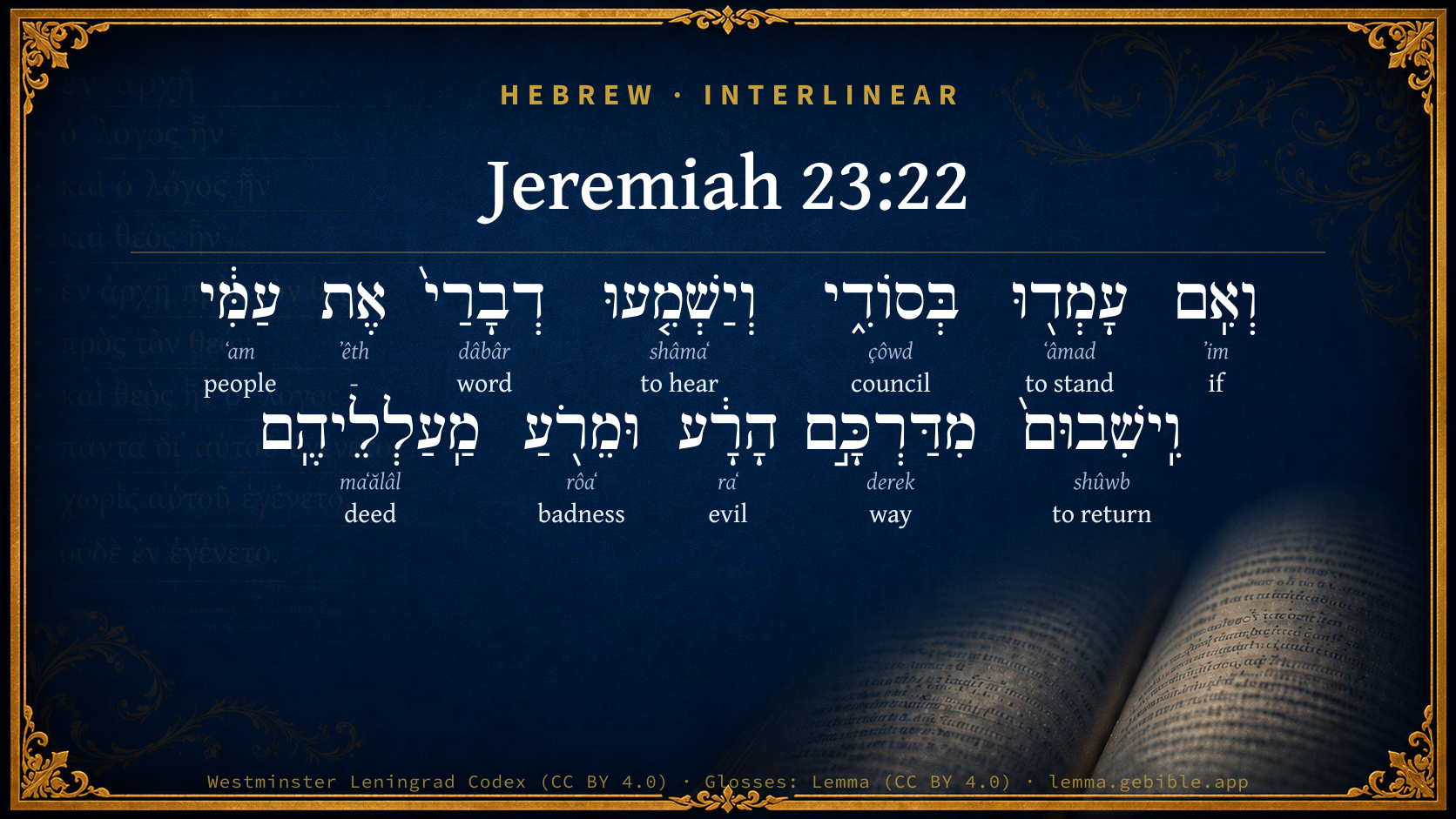
Hebrew (Westminster Leningrad Codex) Jeremiah 23:22 appears in the Hebrew Old Testament. The text above is from the Westminster Leningrad Codex. Each word links to its Strong’s number, a concise gloss, and parsing drawn from the Open Scriptures Hebrew Bible morphology. Click any word for its full Brown-Driver-Briggs (BDB) entry.
Download image
Cite this verse

Jeremiah 23:22 (World English Bible). Public Domain. Lemma interlinear Bible study tool, https://lemma.gebible.app/v/jeremiah/23/22.

Show BibTeX & RIS
BibTeX
RIS
English Translation
But if they had stood in my council, then had they caused my people to hear my words, and had turned them from their evil way, and from the evil of their doings.
World English Bible · Public Domain
Download a study sheet

One document with this verse’s original text, its word-by-word gloss line, the meaning frame, cross-references with their text, attributed commentary, and full source and license credits — printable, and it pastes into notes with its structure intact.

This verse Autodidact and up

Study sheet (.html) Plain text (.txt)

A passage Seminary Student

Up to 50 verses in one chapter. A passage sheet keeps up to 6 commentary sources and 12 cross-references per verse, in the order this page ranks them, and says so on the sheet whenever that leaves anything out. Ask for a single verse and you get the Autodidact verse sheet above.

Everything on this page stays free to read, with no account — the sheet is a download of what is already on screen, not access to it.

Want to remove ads? Support Godless Engineer
Compare translations 3

The same verse in 3 English versions, stacked beneath the original-language interlinear above. Click any original word for its lexicon entry.

Each is an independent rendering of the whole verse — the interlinear is not word-aligned to these translations.

Highlighted words mark where these versions differ — a whole-verse word diff, not a word-by-word alignment.

  • World English Bible Public Domain
    But if they had stood in my council, then had they caused my people to hear my words, and had turned them from their evil way, and from the evil of their doings.
  • King James Version Public Domain
    But if they had stood in my counsel, and had caused my people to hear my words, then they should have turned them from their evil way, and from the evil of their doings.
  • unfoldingWord Literal Text CC BY-SA 4.0
    But if they had stood in my counsel, then they would have caused my people to hear my words, and they would have turned them back from their evil way and from the evil of their deeds.” q1

unfoldingWord Literal Text — © unfoldingWord, licensed CC BY-SA 4.0. Word-aligned USFM3 via Door43 (git.door43.org/unfoldingWord/en_ult).

Versions to compare (up to 4)

3 of 4 selected

Show all 18 translations

Every available English version of this verse, each an independent rendering of the whole verse.

  • World English Bible Public Domain
    But if they had stood in my council, then had they caused my people to hear my words, and had turned them from their evil way, and from the evil of their doings.
  • Berean Standard Bible Public Domain
    But if they had stood in My council, they would have proclaimed My words to My people and turned them back from their evil ways and deeds.”
  • Majority Standard Bible Public Domain
    But if they had stood in My council, they would have proclaimed My words to My people and turned them back from their evil ways and deeds.”
  • King James Version Public Domain
    But if they had stood in my counsel, and had caused my people to hear my words, then they should have turned them from their evil way, and from the evil of their doings.
  • American Standard Version (1901) Public Domain
    But if they had stood in my council, then had they caused my people to hear my words, and had turned them from their evil way, and from the evil of their doings.
  • Revised Version (1885) Public Domain
    But if they had stood in my council, then had they caused my people to hear my words, and had turned them from their evil way, and from the evil of their doings.
  • Geneva Bible (1599) Public Domain
    But if they had stande in my counsell, and had declared my words to my people, then they should haue turned them from their euill way, and from the wickednesse of their inuentions.
  • Douay-Rheims (1899) Public Domain
    If they stood in my counsel, and had made my words known to my people, I should have turned them from their evil way and from their wicked doings.
  • Young's Literal Translation Public Domain
    But -- if they stood in My counsel, Then they cause My people to hear My words, And they turn them back from their evil way, And from the evil of their doings.
  • Literal Standard Version CC BY-SA 4.0
    But if they stood in My counsel, || Then they cause My people to hear My words, || And they turn them back from their evil way, || And from the evil of their doings.
  • Unlocked Literal Bible CC BY-SA 4.0
    For if they had stood in my council meeting, they would have caused my people to hear my word; they would have caused them to turn from their wicked words and corrupt practices.
  • unfoldingWord Literal Text CC BY-SA 4.0
    But if they had stood in my counsel, then they would have caused my people to hear my words, and they would have turned them back from their evil way and from the evil of their deeds.” q1
  • Darby Bible Public Domain
    But if they had stood in my council, and had caused my people to hear my words, then would they have turned them from their evil way and from the wickedness of their doings.
  • World Messianic Bible Public Domain
    But if they had stood in my council, then they would have caused my people to hear my words, and would have turned them from their evil way, and from the evil of their doings.
  • Webster's Bible Public Domain
    But if they had stood in my counsel, and had caused my people to hear my words, then they would have turned them from their evil way, and from the evil of their doings.
  • Free Bible Version CC BY-SA 4.0
    Now if they had attended my council, they would have delivered my instructions to my people and brought them back from their evil way of life, from their evil actions.
  • Bible in Basic English Public Domain
    But if they had been in my secret, then they would have made my people give ear to my words, turning them from their evil way, and from the evil of their doings.
  • JPS Tanakh (1917) Public Domain
    But if they have stood in My council, then let them cause My people to hear My words, and turn them from their evil way, and from the evil of their doings.

Literal Standard Version (2020), Covenant Press — licensed CC BY-SA 4.0. Text via the HelloAO Bible API (eBible.org). Unlocked Literal Bible (unfoldingWord) — licensed CC BY-SA 4.0. Text via the HelloAO Bible API (eBible.org). unfoldingWord Literal Text — © unfoldingWord, licensed CC BY-SA 4.0. Word-aligned USFM3 via Door43 (git.door43.org/unfoldingWord/en_ult). Free Bible Version, Dr. Jonathan Gallagher — licensed CC BY-SA 4.0. Text via the HelloAO Bible API (eBible.org).

Word by word

More ways to search: Search by grammar → Find every occurrence → Compare this word →

Practice this passage: Drill this verse → Learn its vocabulary →

וּמֵרֹ֖עַ
rôaʻ
H7455
“and · from · badness of”
Conjunction + Preposition + Noun, Common, Masculine, Singular, Construct
Part of Speech
Conjunction + Preposition + Noun
Type
Common
Gender
Masculine
Number
Singular
State
Construct
Full BDB Definition

Origin: from H7489

TWOT: 2191b

badness, evil - badness, bad quality - wilfulness - evil, badness (ethical) - sadness
  1. וְאִֽם ʼim H518 “and · if” Conjunction + Conjunction
  2. עָמְד֖וּ ʻâmad H5975 “to stand” Verb, Qal, Perfect, 3rd Person, Common, Plural
  3. בְּסוֹדִ֑י çôwd H5475 “in/at · council · my” Preposition + Noun, Common, Masculine, Singular, Construct + Suffix, Personal, 1st Person, Common, Singular
  4. וְיַשְׁמִ֤עוּ shâmaʻ H8085 “and · to hear” Conjunction + Verb, Hiphil, Imperfect, 3rd Person, Masculine, Plural
  5. דְבָרַי֙ dâbâr H1697 “words · my” Noun, Common, Masculine, Plural, Construct + Suffix, Personal, 1st Person, Common, Singular
  6. אֶת ʼêth H853 “-” Particle, Direct Object
  7. עַמִּ֔י ʻam H5971 “people · my” Noun, Common, Masculine, Singular, Construct + Suffix, Personal, 1st Person, Common, Singular
  8. וִֽישִׁבוּם֙ shûwb H7725 “and · to return · them” Conjunction + Verb, Hiphil, Imperfect, 3rd Person, Masculine, Plural + Suffix, Personal, 3rd Person, Masculine, Plural
  9. מִדַּרְכָּ֣ם derek H1870 “from · way · their” Preposition + Noun, Common, Both, Singular, Construct + Suffix, Personal, 3rd Person, Masculine, Plural
  10. הָרָ֔ע raʻ H7451 “the · evil” Particle, Definite Article + Adjective, Adjective, Masculine, Singular, Absolute
  11. מַֽעַלְלֵיהֶֽם maʻălâl H4611 “deeds · their” Noun, Common, Masculine, Plural, Construct + Suffix, Personal, 3rd Person, Masculine, Plural

About this verse

These counts appear in no published source. They are computed here, from the morphology-tagged text and Lemma’s own curated glosses. What Lemma adds →

12
words
12
distinct lemmas
Prophets
section

Notable vocabulary

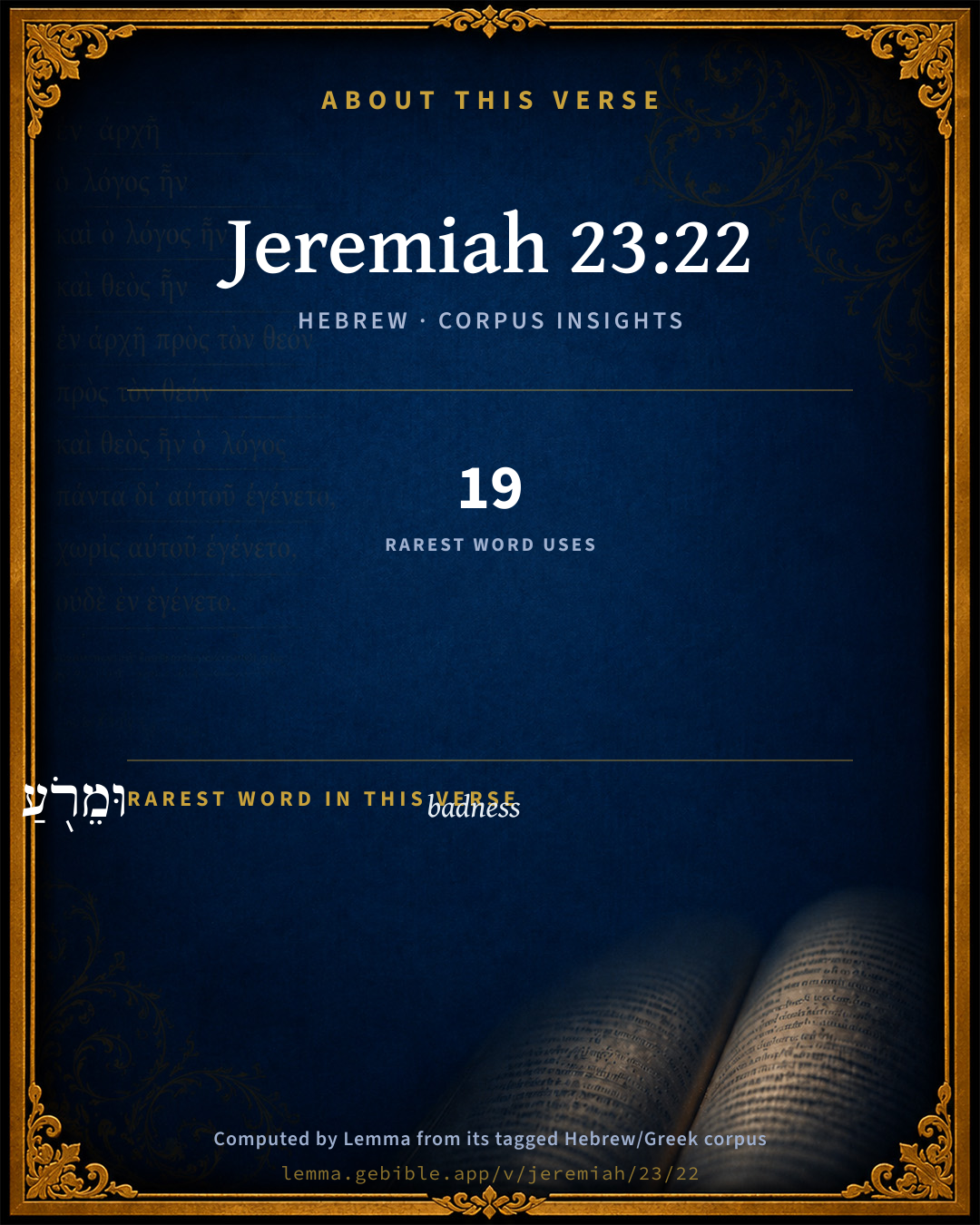
The rarest word here is וּמֵרֹ֖עַ badness H7455 — appearing just 19 times in the whole Hebrew Bible.

Shared distinctive vocabulary

וּמֵרֹ֖עַ badness H7455 occurs in 19 verses of the Hebrew Bible. Also found in:

Grammatical profile

  • 3 verbs
  • 6 nouns
  • 1 adjective
  • 1 conjunction
  • 1 particle

Verb forms

  • עָמְד֖וּ Qal · Perfect
  • וְיַשְׁמִ֤עוּ Hiphil · Imperfect
  • וִֽישִׁבוּם֙ Hiphil · Imperfect

Cross-references

13

Topical passages linked to Jeremiah 23:22 in the Treasury of Scripture Knowledge — connected by theme and wording, ordered by reader-vote popularity; previews shown in the World English Bible.

  • Jeremiah 23:18 For who has stood in the council of Yahweh, that he should perceive and hear his word? who has marked my word, and heard it?
  • Jeremiah 25:5 saying, Return you now everyone from his evil way, and from the evil of your doings, and dwell in the land that Yahweh has given to you and to your fathers, from of old and even forevermore;
  • Zechariah 1:4 Don't you be like your fathers, to whom the former prophets proclaimed, saying: Thus says Yahweh of hosts, 'Return now from your evil ways, and from your evil doings;' but they did not hear, nor listen to me, says Yahweh.
  • Jeremiah 35:15 I have sent also to you all my servants the prophets, rising up early and sending them, saying, Return you now every man from his evil way, and amend your doings, and don't go after other gods to serve them, and you shall dwell in the land which I have given to you and to your fathers: but you have not inclined your ear, nor listened to me.
  • Ezekiel 13:22 Because with lies you have grieved the heart of the righteous, whom I have not made sad; and strengthened the hands of the wicked, that he should not return from his wicked way, and be saved alive:
  • Acts 20:27 for I didn't shrink from declaring to you the whole counsel of God.
  • Ezekiel 2:7 You shall speak my words to them, whether they will hear, or whether they will forbear; for they are most rebellious.
  • Ezekiel 3:17 Son of man, I have made you a watchman to the house of Israel: therefore hear the word at my mouth, and give them warning from me.
  • Ezekiel 18:30 Therefore I will judge you, house of Israel, everyone according to his ways, says the Lord Yahweh. Return you, and turn yourselves from all your transgressions; so iniquity shall not be your ruin.
  • Acts 26:18–20 to open their eyes, that they may turn from darkness to light and from the power of Satan to God, that they may receive remission of sins and an inheritance among those who are sanctified by faith in me.'
  • 1 Thessalonians 5:6 so then let's not sleep, as the rest do, but let's watch and be sober.
  • Jeremiah 36:3 It may be that the house of Judah will hear all the evil which I purpose to do to them; that they may return every man from his evil way; that I may forgive their iniquity and their sin.
  • 1 Thessalonians 1:9–10 For they themselves report concerning us what kind of a reception we had from you; and how you turned to God from idols, to serve a living and true God,

Cross-references courtesy of OpenBible.info (CC BY 4.0).

Hebrew and Greek witnesses Masoretic Hebrew ↔ Greek Septuagint

The same verse in the two great witnesses to the Old Testament, shown verse-for-verse.

These are two independent witnesses, not word-aligned to each other, and the Septuagint is shown in lemma (dictionary) form.

Hebrew Jeremiah 23:22 Masoretic · Westminster Leningrad Codex

וְאִֽם עָמְד֖וּ בְּסוֹדִ֑י וְיַשְׁמִ֤עוּ דְבָרַי֙ אֶת עַמִּ֔י וִֽישִׁבוּם֙ מִדַּרְכָּ֣ם הָרָ֔ע וּמֵרֹ֖עַ מַֽעַלְלֵיהֶֽם

But if they had stood in my council, then had they caused my people to hear my words, and had turned them from their evil way, and from the evil of their doings.

World English Bible · Public Domain

Greek LXX Structure differs

In the Septuagint, Jeremiah is about an eighth shorter than the Hebrew and arranges its material differently — the Oracles Against the Nations (Hebrew chapters 46–51) appear in the middle of the Greek book, after 25:13. Because the chapter and verse boundaries do not line up, a verse-for-verse comparison with the Hebrew is not shown.

A verse-for-verse comparison isn’t shown here because the chapters and verses don’t line up. Switch to the LXX edition with the MT / LXX toggle above to read the Greek directly.

Hebrew: Westminster Leningrad Codex (CC BY 4.0). Greek: Septuagint (public domain); English from a public-domain English Septuagint. How the Septuagint differs from the Hebrew →

Targum (Aramaic paraphrase)

1

The Targum is the ancient Jewish Aramaic paraphrase of the Hebrew Scriptures — an interpretive translation, not the Hebrew text itself. Onkelos (literal) and Pseudo-Jonathan (expansive) render the Torah, and Jonathan the Prophets. Coverage is partial: where no permissively-licensed English translation exists for a verse, only the Aramaic is shown. This is verse-level text, not a word-by-word alignment to the Hebrew.

  1. Targum Jonathan Prophets (Joshua–Malachi)
    וְאִלוּ קָמוּ אִתְגְלֵי לְהוֹן רָז מִן קֳדָם יְיָ וְאַשְׁמָעִי פִּתְגָמֵי יַת עַמִי וַאֲתֵיבִינוּן מֵאוֹרְחַתְהוֹן בִּישְׁתָא וּמִבִּישׁוּת עוֹבָדֵיהוֹן:

    (no public-domain English translation for this verse)

    Targum Jonathan — Aramaic: “Mikraot Gedolot” (public domain). English: “Sefaria Community Translation” (CC0 1.0 (public-domain dedication)); “London "Chaldee Paraphrase," 1871” (public domain). Text via Sefaria.

Commentary

Notes on Jeremiah 23:22 from classic Christian and Jewish commentators (each source and its license shown beneath its notes). The classic Christian expositions comment on the surrounding passage and are grouped to its opening verse, so a note may address several verses; the Jewish commentaries on the Tanakh (Rashi and others) are per-verse, so they appear only where the commentator wrote on this verse.

Lemma curates 59 commentaries, every one of them public domain or Creative Commons licensed, each selected and text-cleaned for this edition rather than reprinted as found. About our sources →

Trapp's Complete Commentary

John Trapp

Jer 23:22 But if they had stood in my counsel, and had caused my people to hear my words, then they should have turned them from their evil way, and from the evil of their doings.

Ver. 22. But if they had stood in my counsel, &c.] As they vainly vaunt they do, {Jer 23:18} and that they know more of my mind than any others.

And had caused my people to hear my words.] And not their own fancies or cunningly devised fables. {2Pe 1:16}

Then they should have turned them from the evil of their way.] Not but that a goodly preacher may want success; {Isa 49:4} {See Trapp on "Isa 49:4"} And, on the contrary, a bad minister may be a means of good to others, as the dull whetstone edgeth iron, and the lifeless heaven enliveneth other creatures. The head of a toad may yield the precious stone bufonites, and wholesome sugar be found in a poisoned cane. Noah’s builders were a means to save him and his family, yet themselves were drowned; so was Palinurus, Aeneas’s pilot in the poet. {a} But God usually honoureth his faithful lahourers with some success; and they can say, as Chrysostom doth, Si decimus quisque, si unus persuasus fuerit, ad consolationem abunde sufficit. If but one in ten be converted by our ministry, yea, if but one in all, it is comfort enough. See Jas 5:20.

{a} Virgil, Aeneid, iii.

John Trapp, A Commentary or Exposition upon All the Books of the Old and New Testament (1647–1656) — public domain. Text from a community e-Sword module.

Tyndale Open Study Notes

Tyndale Open Resources

23:22 The messages of the false prophets would have been quite different if they had actually come from the Lord. God wanted the people to reject their evil ways (such as Baal worship) and turn to the one true God.

Tyndale Open Study Notes — © Tyndale Open Resources, licensed CC BY-SA 4.0. Text via the HelloAO Bible API.

Geneva Bible (1599)

Geneva Bible translators

He showeth the difference between the true Prophets and the false, between the hireling and the true minister.

Geneva Bible (1599) marginal notes — public domain. Text via Bolls.life.

Jamieson, Fausset & Brown

Robert Jamieson, A. R. Fausset & David Brown

stood in . . . counsel-- (Jer 23:18).

they should have turned them from their evil way--They would have given such counsels to the people as would have turned them from their sins (Jer 25:5; Isa 55:11), and so would have averted punishment. Their not teaching the law in which God's counsel is set forth proves they are not His prophets, though they boast of being so (Mat 7:15-20).

Jamieson, Fausset & Brown — Commentary Critical and Explanatory on the Whole Bible (1871) — public domain (CC PDM 1.0). Text via the HelloAO Bible API.

John Calvin's Commentaries

This verse is as it were an explanation of the former; for many might have been perplexed, if it had only been said to them, that there are none who are fit and legitimate teachers but those who had been sent and entrusted with what God had commanded. Hence the Prophet here calls our attention to the truth which is certain and manifest; for God had delivered the sum of all truth in his Law. As then the perfection of wisdom was found in the Law, from which the prophets drew whatever we read in their writings, no excuses, such as the following, could be admitted, — “How can we know that the prophets speak from God’s mouth, that they bring nothing devised by themselves, that they have the instructions which God approves?”

The Prophet then calls the attention of the Jews to the Law, as though He had said as Moses did,

“There is no need to ascend above the clouds, or to descend into the depths, or to run beyond the sea; for the Law and the word is nigh in thy mouth, that is, God has set before you whatever is necessary and useful to be known.” (Deuteronomy 30:12-14; Romans 10:6.)

This, then, is fully made known to you, nor will the knowledge of anything necessary be obscure, if ye attend to the Law. Hence the cause of error is not only your sloth, but also your perverseness; for ye wilfully neglect the Law, and remain doubtful and inquire, “Which is the way?”

“This is the way,” said Moses, “walk ye in it.” (Deuteronomy 5:33.)

We now then perceive what Jeremiah had in view: he had before said, that none were to be attended to, except they who were sent and spoke from the mouth of God; but he now explains what he meant, even that the Law contained the whole sum of wisdom. But as he had before introduced the false prophets, as boldly deriding the true and faithful servants of God, by objecting to them and saying, “Who had stood in the counsel of God? these imagine that they have fallen from the clouds, they terrify you with dreadful threatenings, as though they were angels from heaven,” — as then the false prophets were thus wont to speak disdainfully of God’s servants, and alleged that they did not stand in God’s counsel, Jeremiah now retorts upon them, and says, speaking in God’s name, If they had stood in my counsel, they would doubtless have spoken from my Law; as though he had said, “They believe not my servants, because they are men and not angels; they hence deny that they are of my counsel: thus they persuade the whole people to despise the doctrine of salvation. There are, however, some prophets whom I have sent: now, if they wish to be deemed sent, let them prove themselves to be so.” What is the true proof? If they had stood in my counsel, they would have doubtless made known my word to my people. What is that word? the definition follows, even the word of the Law, They would have turned the straying people from their evil way

The passage may seem obscure, but from the context itself we can gather that the real design of the Prophet was to convict the false teachers, that they might no longer boast of God’s name, and falsely pretend that they were endued with the prophetic office, and glory in that distinction. He says that it was an evident proof that they were not God’s prophets, because they did not faithfully teach what they ought to have derived from the Law.

It is indeed certain, that no one has been God’s counsellor, according to what Scripture says in many places, when the object is to check the arrogance of those who, in their curiosity, attempt to penetrate into the hidden judgments of God, (Isaiah 40:13;) and Paul, while speaking of God’s eternal election, it being incomprehensible, exclaims, Who has been his counsellor? (Romans 11: 34.) He uses a similar language in the First Epistle to the Corinthians, (1 Corinthians 2:16:) and why? that he might check the temerity of the human mind, which ventures farther than it is lawful. But afterwards Paul adds by way of correction, “But we have the mind of Christ:” how so? because he has made known his counsel to us. When, therefore, the false prophets denied that God’s servants were his counsellors, they might indeed have said so, viewing them only as mortal men; but their object was to discredit and to render void the word of God; so that they wished to put a restraint not only on men, but also on God himself. This was an intolerable insult to God.

Moreover the Prophet now turns as it were upon them, “There is then no Prophet of God in the world!” But fixed was that saying, that there would ever be some prophets; and none of the Jews could have dared to deny Moses to have been divinely inspired. This, then, being allowed, the Prophet now indirectly reproves them, “Where are the prophets of God?” and as they laid claim to this distinction, he says, “Doubtless ye stand not in God’s counsel. How so? because the counsel of God is included in his Law; and as ye have departed from the doctrine of true religion, as ye have no care to convey instruction, as your doctrine does not teach men the fear of God, nor leads to repentance, it follows that ye are not God’s counsellors nor his prophets.” But that this may appear more evident, we must bear in mind what Moses said, that God has his own secret things, but that whatever is taught in the Law belongs to us and to our children. (Deuteronomy 29:29.) There is then no reason why the inquiry should be difficult respecting the true prophets of God; for they, without controversy, deserve to be heard as the angels of God, who are faithful interpreters of his Law; but they who lead us away from the Law ought to be firmly and boldly rejected.

But we must also bear in mind the definition that is given when it is said, that they ought to have turned the people from their evil way, and from the wickedness of their doings We indeed know that the worst men insolently pretend to preach God’s word, as the Papists do at this day: though they have inebriated the whole world with their ungodly and delirious doctrines, they yet boast that they are the servants of God. Hence the Prophet, after having spoken generally of God’s word, adds a special distinction, — that the doctrine of God is that which edifies, which teaches and leads men to repentance and the fear of God, according to what Paul says, that the Scripture is useful for these purposes, (2 Timothy 3:16;) for by so saying, he intended to condemn all false interpreters of Scripture, as there were many then who boasted that they were the best teachers, while yet they only pleased itching ears. As then there were many who regarded display and not edification, Paul says, that the Scripture is useful; and therefore he rejected with contempt all expositions in which there was nothing useful. So also in this place the Prophet shews that the right and legitimate use of Scripture was when it was employed to restore men from their evil way.

There is, indeed, here an instance of a part being stated for the whole: for if we only exhort men to repent, there will be no great fruit; and our teaching would be defective, for the doctrine of repentance would be inefficient without faith and without calling on the name of God. But the Prophet did not intend here to mention every part of a sound and useful doctrine; he deemed it enough to confute the false teachers who wished to be alone in repute, while yet they had no care to edify the people; for they saw all things in disorder, they saw crimes prevailing everywhere, they saw a dreadful contempt of God, but to these things they were wholly blind. It might then have been hence easily inferred that they neither faithfully labored for God nor manifested any care for the safety of the Church; for they thus betrayed miserable souls, whose ruin they saw was near at hand.

We now then see the whole design of the Prophet. But there is no doubt but that to the evil way he added the wickedness of their doings, in order that he might more fully expose the insensibility of those who under such an urgency were silent and remained inactive. There is sometimes the need of a moderate reproof; but when people allow themselves an extreme license in wickedness, when impunity is everywhere permitted, and when such corruptions prevail in common, that nothing remains untainted, if then the tongue of the teacher is silent and as it were tied, is he not rightly called an idle and a dumb dog? And thus the Prophet enhances the insensibility, for which he condemns the false teachers; they were silent, as though things were in a good order, while they had to witness not only common crimes, but even a vast accumulation of all kinds of crimes; for the people gave themselves up not only to one kind of wickedness, but to all kinds, and wholly despised God and his Law. It afterwards follows, —

John Calvin's Commentaries (1540-1563) — public domain. Text from the Calvin Translation Society English edition (1840s-50s) via the Christian Classics Ethereal Library (ccel.org). Calvin's coverage is partial (roughly two-thirds of the Bible); uncommented books and verses are honest gaps, never fabricated. The 19th-century editor's footnotes and remarks are omitted so the notes are faithfully Calvin's own voice.

Ellicott's Commentary for English Readers

(22) If they had stood in my counsel.—Better, as before, council. The test of the true mission is seen in results. Are the people better or worse for the prophet’s work? What are the fruits of his teaching? (Comp. Mat_7:20.) The question meets us, Is this always a test? Was Jeremiah’s own work successful in this sense? Must not the true teacher speak “whether they [men] will hear, or whether they will forbear?” (Eze_2:5.) The answer is found (1) in the fact that true teaching seldom fails altogether of its work; (2) that where it seems to fail it satisfies the other test, and at least stirs and rouses men from lethargy, even if it stirs them to antagonism. It is never satisfied with speaking smooth things and acquiescing in the evil that surrounds it.

A Bible Commentary for English Readers, edited by Charles John Ellicott (1878–1897) — public domain. Text from a community e-Sword module.

The Cambridge Bible for Schools and Colleges

gen. ed. J. J. S. Perowne

22. my council] See Jer_23:18.

The Cambridge Bible for Schools and Colleges (gen. ed. J. J. S. Perowne; Cambridge University Press, 1878–1918) — public domain. Text from a community e-Sword module.

John Gill's Exposition

But if they had stood in my counsel,.... As they boasted they did; or, as they reproached the true prophets, and charged them with vanity and arrogance, in talking as if they had; had this been truly their case, as it was that of the prophets of the Lord:

and had caused my people to hear my words; or, "then they would have caused my people to hear my words"; had it been so, they would have heard first the words of the Lord themselves in secret and privately, and then they would have caused the people to have heard them; they would not have gone to them with their own lies; they would not have dared to have done that; they would have delivered nothing but what they had heard from the Lord:

then they should, or, "and they would",

have turned them from their evil way, and from the evil of their doings; and not have strengthened their hands, and hardened them in their wickedness, and so kept them from repentance and reformation, Jer 23:14. The Lord argues from the efficacy and success of the ministry of the word to the truth of it, and their miss:, on from him; for though a good ministry is not always successful, at least so successful as could be wished for, and as it might reasonably be expected it would; yet it is more or less so; and at least it has a tendency to bring men off from their evil practices; and it attempts to do it, though it may fail in the execution; whereas a wicked ministry, such as this of the false prophets, had no tendency hereunto; nor was it the design of it; nor did they attempt it; but, on the contrary, encouraged and hardened men in sin.

John Gill's Exposition of the Whole Bible (1746–1763) — public domain (CC PDM 1.0). Text via the HelloAO Bible API.

Albert Barnes' Notes on the Bible

They should have turned them ... - The work of the true prophet, which is to turn men from evil unto good.

Albert Barnes' Notes on the Bible (1834–1885) — public domain. Text from a community e-Sword/MySword module.

Haydock's Catholic Bible Commentary

I should. Some copies read avertissent, "they would have turned," conformably with the Hebrew, &c., and we should suspect that this was a mistake of the transcriber, if St. Jerome did not agree with the Vulgate in his commentary, (Calmet) though not in express terms: (Haydock) "I also should not have abandoned them to impurity....Let us behold how heretics, having once given way to despair,...seek the gratification of their sensual appetite." (St. Jerome)

George Leo Haydock (1774–1849), Haydock's Catholic Family Bible and Commentary, 1859 edition — public domain. Excludes Psalms (Douay-Rheims chapter numbering differs from Protestant) and Deuterocanonical books (Catholic canon only).

Matthew Poole's English Annotations

These false prophets did not prophesy without the approbation of the rulers of the ecclesiastical state amongst the Jews in their corrupt state, but so they might, and yet not be sent of God. The judgment of a Divine mission for the revelation of God’s mind unto people must not be merely from their external mission, (which yet they ought to have in a church that is in order,) but from the faithful discharge of their ministry. Those whom God sends, and who are truly acquainted with his counsels, will cause his people to hear, not their own conceits and inventions, but the word of the Lord. God sendeth none upon any other errand but to reveal his will and tell his mind unto people.

Then, saith the prophet,

they should have turned them from their evil way; that is, they would have made this their scope, business, and end, to turn sinners from their sinful ways; and though possibly their labours would not have had so good an effect upon all, yet they would have had an effect upon some to turn them from their evil doings.

Matthew Poole's English Annotations on the Holy Bible (1683–1685) — public domain. Text from a community e-Sword/MySword module.

Rashi

Rabbi Shlomo Yitzchaki (Rashi)

And if they stood in My council, they should have let My people hear My word, etc. They should have let My people hear My words and My Torah, rather than cause them to stray away from Me.

Rashi on the Tanakh — English translations: “The Judaica Press complete Tanach with Rashi, translated by A. J. Rosenberg” (CC BY 4.0); “Pentateuch with Rashi's commentary by M. Rosenbaum and A.M. Silbermann, 1929-1934” (public domain); “The Metsudah Tanach series, Lakewood, N.J” (CC BY 4.0); and “The Book of Joshua, Metsudah Publications, 1997” (CC BY 4.0). Text via Sefaria.

Lesson kit

Teaching starters — assembled from the data on this page, not authored interpretation. Every prompt links to the verse data it draws on. Edit before teaching.

Jeremiah, in the Prophets, opens this verse with 12 words (12 distinct Hebrew lemmas). Its most distinctive word is rôaʻ (“badness”). A historical commentator’s framing appears above. Read the whole chapter for the surrounding context.

Discussion questions

  1. The word rôaʻ carries the sense “badness.” How does it shape the verse?
  2. Genesis 41:19 shares the word «badness» with this verse. How do the two illuminate each other?
  3. These translations render this verse differently. What is at stake in choosing one wording over another?
  4. The verb «עָמְד֖וּ» is Qal Perfect. How does its form color the action?
  5. Reading how Trapp's Complete Commentary and Tyndale Open Study Notes read this verse, where do the two commentators agree and where do they part?

Things to notice

Reading settings

Reading text

Shown beneath each verse's original-language words.

Old Testament
Old Testament edition

Read the OT as the Masoretic Hebrew (MT) or the Greek Septuagint (LXX).

English shown for the Greek Septuagint (in the Hebrew ↔ Greek comparison).

Comparing translations? Open the Compare panel on any verse page to stack up to four side by side.