
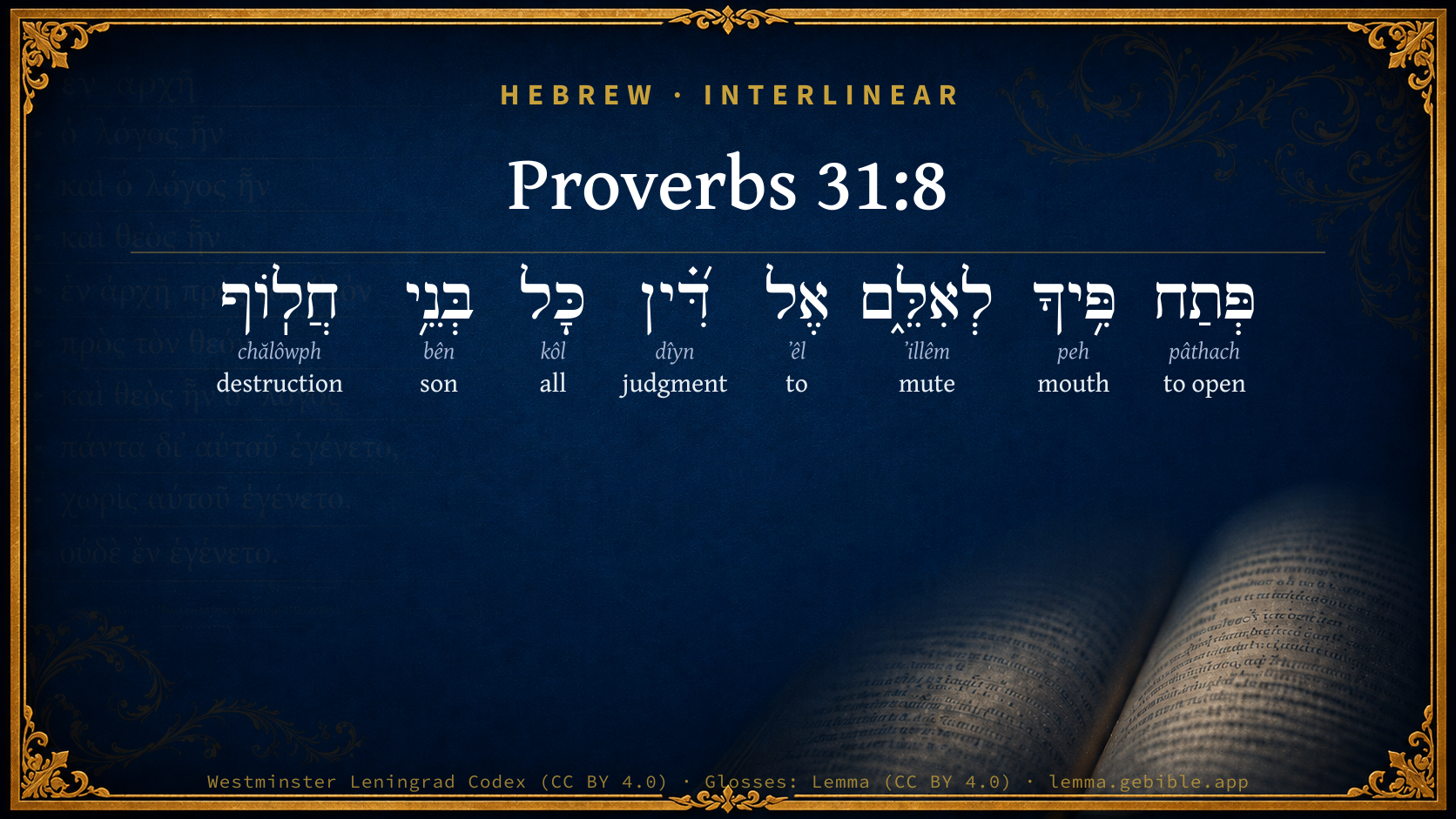
Proverbs 31:8

Hebrew (Westminster Leningrad Codex) Proverbs 31:8 appears in the Hebrew Old Testament. The text above is from the Westminster Leningrad Codex. Each word links to its Strong’s number, a concise gloss, and parsing drawn from the Open Scriptures Hebrew Bible morphology. Click any word for its full Brown-Driver-Briggs (BDB) entry.
Download image
Cite this verse

Proverbs 31:8 (World English Bible). Public Domain. Lemma interlinear Bible study tool, https://lemma.gebible.app/v/proverbs/31/8.

Show BibTeX & RIS
BibTeX
RIS
English Translation
Open your mouth for the mute, In the cause of all who are left desolate.
World English Bible · Public Domain
Highlights
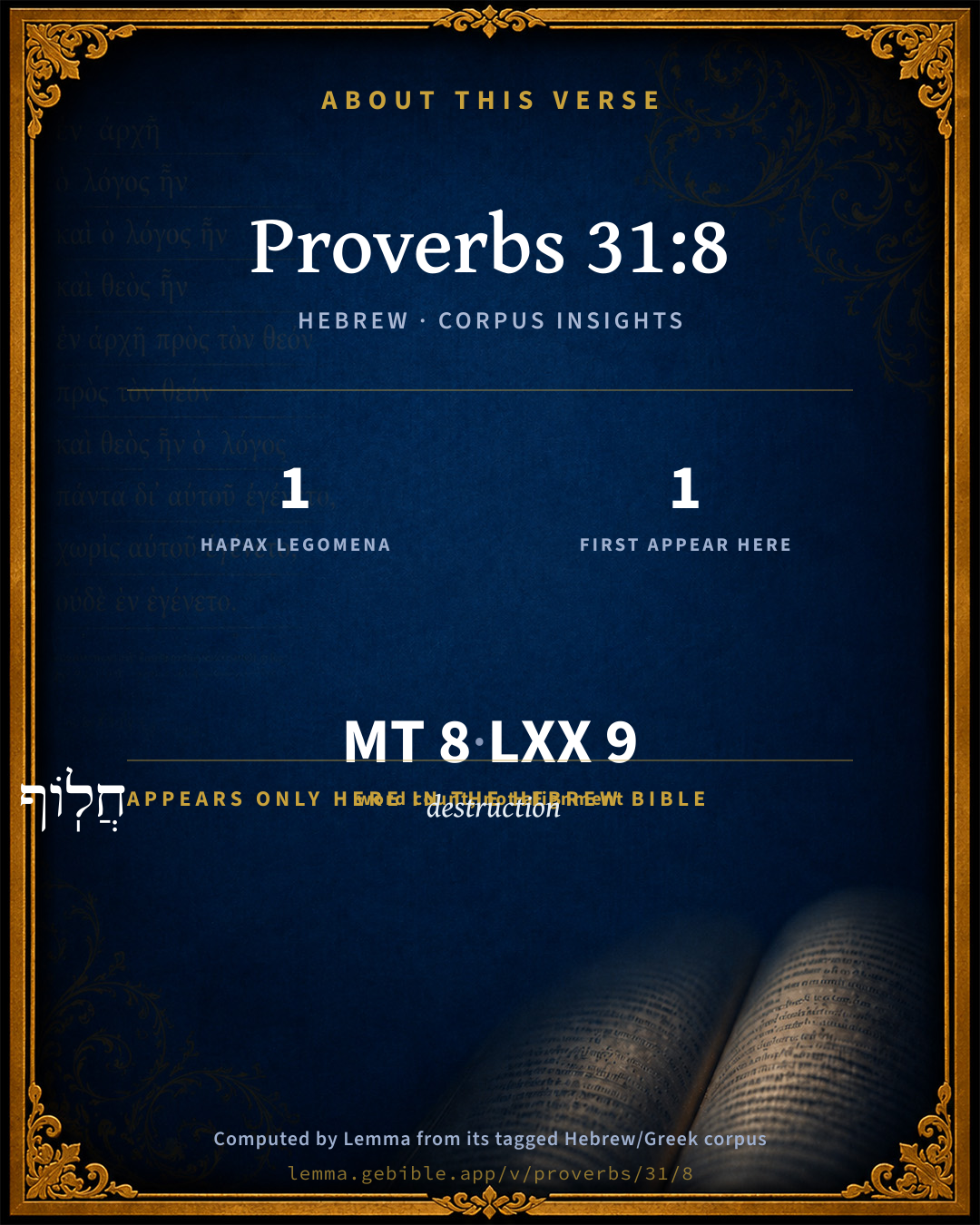
  • 1 hapax legomenon — only here in the Hebrew Bible
  • 1 first appearance in the Hebrew Bible
Full analysis ↓
Download a study sheet

One document with this verse’s original text, its word-by-word gloss line, the meaning frame, cross-references with their text, attributed commentary, and full source and license credits — printable, and it pastes into notes with its structure intact.

This verse Autodidact and up

Study sheet (.html) Plain text (.txt)

A passage Seminary Student

Up to 50 verses in one chapter. A passage sheet keeps up to 6 commentary sources and 12 cross-references per verse, in the order this page ranks them, and says so on the sheet whenever that leaves anything out. Ask for a single verse and you get the Autodidact verse sheet above.

Everything on this page stays free to read, with no account — the sheet is a download of what is already on screen, not access to it.

Want to remove ads? Support Godless Engineer
Compare translations 3

The same verse in 3 English versions, stacked beneath the original-language interlinear above. Click any original word for its lexicon entry.

Each is an independent rendering of the whole verse — the interlinear is not word-aligned to these translations.

Highlighted words mark where these versions differ — a whole-verse word diff, not a word-by-word alignment.

  • World English Bible Public Domain
    Open your mouth for the mute, In the cause of all who are left desolate.
  • King James Version Public Domain
    Open thy mouth for the dumb in the cause of all such as are appointed to destruction.
  • unfoldingWord Literal Text CC BY-SA 4.0
    Open your mouth for a mute one, for the legal claim of all the sons of the one passing away.

unfoldingWord Literal Text — © unfoldingWord, licensed CC BY-SA 4.0. Word-aligned USFM3 via Door43 (git.door43.org/unfoldingWord/en_ult).

Versions to compare (up to 4)

3 of 4 selected

Show all 18 translations

Every available English version of this verse, each an independent rendering of the whole verse.

  • World English Bible Public Domain
    Open your mouth for the mute, In the cause of all who are left desolate.
  • Berean Standard Bible Public Domain
    Open your mouth for those with no voice, for the cause of all the dispossessed.
  • Majority Standard Bible Public Domain
    Open your mouth for those with no voice, for the cause of all the dispossessed.
  • King James Version Public Domain
    Open thy mouth for the dumb in the cause of all such as are appointed to destruction.
  • American Standard Version (1901) Public Domain
    Open thy mouth for the dumb, In the cause of all such as are left desolate.
  • Revised Version (1885) Public Domain
    Open thy mouth for the dumb, in the cause of all such as are left desolate.
  • Geneva Bible (1599) Public Domain
    Open thy mouth for the domme in the cause of all the children of destruction.
  • Douay-Rheims (1899) Public Domain
    Open thy mouth for the dumb, and for the causes of all the children that pass.
  • Young's Literal Translation Public Domain
    Open thy mouth for the dumb, For the right of all sons of change.
  • Literal Standard Version CC BY-SA 4.0
    Open your mouth for the mute, || For the right of all sons of change.
  • Unlocked Literal Bible CC BY-SA 4.0
    Speak for those who cannot speak, for the causes of all who are perishing.
  • unfoldingWord Literal Text CC BY-SA 4.0
    Open your mouth for a mute one, for the legal claim of all the sons of the one passing away.
  • Darby Bible Public Domain
    Open thy mouth for the dumb, for the cause of all those that are left desolate.
  • World Messianic Bible Public Domain
    Open your mouth for the mute, in the cause of all who are left desolate.
  • Webster's Bible Public Domain
    Open thy mouth for the dumb in the cause of all such as are appointed to destruction.
  • Free Bible Version CC BY-SA 4.0
    Speak up for those who have no voice, for the rights of those marginalized by society.
  • Bible in Basic English Public Domain
    Let your mouth be open for those who have no voice, in the cause of those who are ready for death.
  • JPS Tanakh (1917) Public Domain
    Open thy mouth for the dumb, in the cause of all such as are appointed to destruction.

Literal Standard Version (2020), Covenant Press — licensed CC BY-SA 4.0. Text via the HelloAO Bible API (eBible.org). Unlocked Literal Bible (unfoldingWord) — licensed CC BY-SA 4.0. Text via the HelloAO Bible API (eBible.org). unfoldingWord Literal Text — © unfoldingWord, licensed CC BY-SA 4.0. Word-aligned USFM3 via Door43 (git.door43.org/unfoldingWord/en_ult). Free Bible Version, Dr. Jonathan Gallagher — licensed CC BY-SA 4.0. Text via the HelloAO Bible API (eBible.org).

Word by word

More ways to search: Search by grammar → Find every occurrence → Compare this word →

Practice this passage: Drill this verse → Learn its vocabulary →

About this verse

These counts appear in no published source. They are computed here, from the morphology-tagged text and Lemma’s own curated glosses. What Lemma adds →

8
words
8
distinct lemmas
Wisdom
section

Notable vocabulary

1 hapax legomenon — a word that appears only here in the entire Hebrew Bible:

  • חֲלֽוֹף destruction H2475

First appearance in Scripture

This word makes its first canonical appearance in the Hebrew Bible here:

  • חֲלֽוֹף destruction H2475

Shared distinctive vocabulary

לְאִלֵּ֑ם mute H483 occurs in 6 verses of the Hebrew Bible. Also found in:

Grammatical profile

  • 1 verb
  • 5 nouns
  • 1 adjective
  • 1 preposition

Verb forms

  • פְּתַח Qal · Imperative

Hebrew & Septuagint length

In English translation the verse runs 15 words from the Hebrew and 12 from the Septuagint (LXX English) — closely comparable.

A rough comparison of the two English renderings, which tokenize alike — not a word-level alignment.

Word counts can differ between the Hebrew and the Greek without any difference in meaning — e.g. the Hebrew direct-object marker אֵת has no separate Greek word, and Greek often adds the article ὁ.

In the original languages it is 8 Hebrew tokens and 9 Greek tokens — but the two are counted differently (Hebrew bundles its prefixes and suffixes into one token; the Greek is in lemma form), so that isn’t a like-for-like length.

Cross-references

13

Topical passages linked to Proverbs 31:8 in the Treasury of Scripture Knowledge — connected by theme and wording, ordered by reader-vote popularity; previews shown in the World English Bible.

  • Psalms 82:3–4 "Defend the weak, the poor, and the fatherless. Maintain the rights of the poor and oppressed.
  • Proverbs 24:11–12 Rescue those who are being led away to death! Indeed, hold back those who are staggering to the slaughter!
  • Esther 4:13–16 Then Mordecai bade them return answer to Esther, Don't think to yourself that you shall escape in the king's house, more than all the Jews.
  • Job 29:12–17 Because I delivered the poor who cried, And the fatherless also, who had none to help him.
  • Jeremiah 26:24 But the hand of Ahikam the son of Shaphan was with Jeremiah, that they should not give him into the hand of the people to put him to death.
  • Jeremiah 38:7–10 Now when Ebedmelech the Ethiopian, a eunuch, who was in the king's house, heard that they had put Jeremiah in the dungeon (the king then sitting in the gate of Benjamin),
  • Psalms 79:11 Let the sighing of the prisoner come before you. According to the greatness of your power, preserve those who are sentenced to death;
  • Jeremiah 26:16–19 Then said the princes and all the people to the priests and to the prophets: This man is not worthy of death; for he has spoken to us in the name of Yahweh our God.
  • John 7:51 "Does our law judge a man, unless it first hears from him personally and knows what he does?"
  • 1 Samuel 19:4–7 Jonathan spoke good of David to Saul his father, and said to him, Don't let the king sin against his servant, against David; because he has not sinned against you, and because his works have been very good toward you:
  • 1 Samuel 20:32 Jonathan answered Saul his father, and said to him, "Why should he be put to death? What has he done?"
  • 1 Samuel 22:14–15 Then Ahimelech answered the king, and said, Who among all your servants is so faithful as David, who is the king's son-in-law, and is taken into your council, and is honorable in your house?
  • Proverbs 24:7 Wisdom is too high for a fool: He doesn't open his mouth in the gate.

Cross-references courtesy of OpenBible.info (CC BY 4.0).

Hebrew and Greek witnesses Masoretic Hebrew ↔ Greek Septuagint

The same verse in the two great witnesses to the Old Testament, shown verse-for-verse.

These are two independent witnesses, not word-aligned to each other, and the Septuagint is shown in lemma (dictionary) form.

Hebrew Proverbs 31:8 Masoretic · Westminster Leningrad Codex

פְּתַח פִּ֥יךָ לְאִלֵּ֑ם אֶל דִּ֝֗ין כָּל בְּנֵ֥י חֲלֽוֹף

Open your mouth for the mute, In the cause of all who are left desolate.

World English Bible · Public Domain

Greek LXX Proverbs 31:8 Septuagint · lemma form

ἀναοἴγω σός στόμα λόγος θεός καί κρίνω πᾶς ὑγιῶς

Open your mouth with the word of God, and judge all fairly.

LXX2012 (modern English Septuagint) · Public Domain

On this verse, Haydock's Catholic Bible Commentary discusses the Septuagint’s reading. Read the note in Commentary ↓

Hebrew: Westminster Leningrad Codex (CC BY 4.0). Greek: Septuagint (public domain); English from LXX2012 (modern English Septuagint) (Public Domain). How the Septuagint differs from the Hebrew →

Commentary

Notes on Proverbs 31:8 from classic Christian and Jewish commentators (each source and its license shown beneath its notes). The classic Christian expositions comment on the surrounding passage and are grouped to its opening verse, so a note may address several verses; the Jewish commentaries on the Tanakh (Rashi and others) are per-verse, so they appear only where the commentator wrote on this verse.

Lemma curates 59 commentaries, every one of them public domain or Creative Commons licensed, each selected and text-cleaned for this edition rather than reprinted as found. About our sources →

Trapp's Complete Commentary

John Trapp

Pro 31:8 Open thy mouth for the dumb in the cause of all such as are appointed to destruction.

Ver. 8. Open thy mouth for the dumb,] i.e., Speak wisely and freely for those that either cannot or may not speak for themselves. Thus Nicodemus spoke for our Saviour; {Joh 7:21} Paphnutius in the council for the married clergy; Pliny to Trajan for the persecuted Christians; the Elector of Saxony for Luther, &c. Oecolampadius saith {a} that wise men only open their mouths, for a fool’s mouth is never but open. Hence, κεχηνοτες, gapers, are put for fools in Lucian and Aristophanes.

{a} Oecolamp. in Job xxxiii.

John Trapp, A Commentary or Exposition upon All the Books of the Old and New Testament (1647–1656) — public domain. Text from a community e-Sword module.

The Biblical Illustrator

Joseph S. Exell

Pro_31:8

Open thy mouth for the dumb in the cause of all such as are appointed to destruction.

The sin of cruelty to the brute creation

There is no necessary reference in this verse to the inferior animals. We use it merely for our accommodation. That there is such cruelty requires neither proof nor argument. What persuasions should urge to guard against this cruelty in every form?

1. The affecting consideration that the lower animals have not the power of expressing and complaining of their wrongs.

2. Their subserviency to the comfort and happiness of man.

3. They are the objects of Gods peculiar and providential care.

4. Cruelty to animals is utterly inconsistent with the spirit and law of Christianity. (David Runciman, M.A.)

Jobs example

Job was an excellent pattern to all princes. He was eyes to the blind, and feet to the lame, and a father to the poor, and no doubt he was a mouth also to the dumb. Such a prince the mother of Lemuel wishes her son to be. She exhorts him to do justice and judgment to all his people, but to regard with peculiar tenderness those unfortunate men that were in danger of losing their estates and lives by reason of accusations brought against them. If they were unable, through ignorance, or awkwardness, or fear, to plead their own cause, she would have him to be their advocate, and to plead everything that truth and equity would allow on their behalf. But charity to the poor, and clemency to the accused, must not interfere with the due administration of justice. It is the business of princes, in the administration of justice, to see that the poor do not suffer. (George Lawson, D.D.)

The Biblical Illustrator, edited by Joseph S. Exell (c. 1880s–1900s) — public domain. Text from a community e-Sword module.

Joseph Benson's Commentary

Pro 31:8. Open thy mouth — Speak freely and impartially, as becomes a king and a judge to do: for the dumb — For such as cannot speak in their own cause, either through ignorance, or because of the dread of their more potent adversaries. In the cause of all such as are appointed to destruction — Who, without such succour from the judges, are likely to be utterly ruined.

Joseph Benson's Commentary on the Old and New Testaments (1811–1818) — public domain. Text from a community e-Sword module.

Tyndale Open Study Notes

Tyndale Open Resources

31:8-9 Rather than opening his mouth to drink wine (31:4-7), the king should speak up on behalf of the defenseless.

Tyndale Open Study Notes — © Tyndale Open Resources, licensed CC BY-SA 4.0. Text via the HelloAO Bible API.

Geneva Bible (1599)

Geneva Bible translators

Defend their cause that are not able to help themselves.

Geneva Bible (1599) marginal notes — public domain. Text via Bolls.life.

Jamieson, Fausset & Brown

Robert Jamieson, A. R. Fausset & David Brown

Open . . . cause--Plead for those who cannot plead for themselves, as the orphan, stranger, &c. (compare Psa 72:12; Isa 1:17).

appointed to destruction--who are otherwise ruined by their oppressors (compare Pro 29:14, Pro 29:16).

Jamieson, Fausset & Brown — Commentary Critical and Explanatory on the Whole Bible (1871) — public domain (CC PDM 1.0). Text via the HelloAO Bible API.

Adam Clarke's Commentary

Verse 8. Open thy mouth for the dumb] For such accused persons as have no counsellors, and cannot plead for themselves.

Are appointed to destruction.] בני חלוף beney chaloph, variously translated, children of passage - indigent travellers; children of desolation - those who have no possessions, or orphans. I believe it either signifies those who are strangers, and are travelling from place to place, or those who are ready to perish in consequence of want or oppression.

Adam Clarke's Commentary on the Bible (1810–1826) — public domain. Text from a community e-Sword/MySword module.

Ellicott's Commentary for English Readers

(8) Open thy mouth for the dumb.—Who cannot from timidity or ignorance plead his own cause, and who would therefore be crushed by his antagonist.

Such as are appointed to destruction.—Certain to perish if left unaided. Comp. Job’s account of his exertions for victims of high-handed oppression, an ever recurring evil under weak despotic governments (Job_29:12, sqq.).

A Bible Commentary for English Readers, edited by Charles John Ellicott (1878–1897) — public domain. Text from a community e-Sword module.

The Cambridge Bible for Schools and Colleges

gen. ed. J. J. S. Perowne

8. for the dumb] for all who cannot plead their own cause.

such as are appointed to destruction] Lit. the sons of passing away. We may understand this either of those who are in danger of ruin by being condemned to loss of life or goods; or of those who are left desolate (R.V. text), and have no one to plead their cause. Comp. “the fatherless children and widows, and all that are desolate and oppressed.”

The Cambridge Bible for Schools and Colleges (gen. ed. J. J. S. Perowne; Cambridge University Press, 1878–1918) — public domain. Text from a community e-Sword module.

John Gill's Exposition

Open thy mouth for the dumb,.... Not who are naturally so, but who cannot speak in their own behalf, either through want of elocution, or knowledge of the laws; or who are bashful, timorous, and fearful, being overawed by the majesty of a court of judicature, or by their prosecutors; or who, as they have not a tongue, so not a purse, to speak for them, the fatherless and the widow; which latter has her name, in the Hebrew language, from dumbness. Here Lemuel's mother advises him to open his mouth freely, readily, boldly, and intrepidly, and plead for such persons. Even

in the cause of all such as are appointed to destruction; whose destruction is resolved on by their accusers and prosecutors; and who are in danger of it, being charged with capital crimes; unless some persons of wisdom, power, and authority, interpose on their behalf. It may be rendered, "in the cause of all the children of change", or "passing away" (s); the children of the world, which passeth away with all things in it, as Kimchi; or orphans, whose help passeth away, as Jarchi; or rather strangers, as others, who pass from place to place and whose state and condition is liable to many changes who may be ignorant of the laws of the country where they are, and may stand in need of persons to plead for them.

(s) "filiormn transitus", Montanus, Gejerus, Michaelis; "transeuntis, sub. seculi", Vatablus, so Ben Melech; "filiorum mutationis loci", Piscator; "filii mutationis, h. e. hujus mundi", Baynus.

John Gill's Exposition of the Whole Bible (1746–1763) — public domain (CC PDM 1.0). Text via the HelloAO Bible API.

Albert Barnes' Notes on the Bible

In contrast with the two besetting sins of Eastern monarchs stands their one great duty, to give help to those who had no other helper.

Such as are appointed to destruction - literally, “children of bereavement,” with the sense, either, as in the text, of those “destined to be bereaved of life or goods,” or of “bereaved or fatherless children.”

Albert Barnes' Notes on the Bible (1834–1885) — public domain. Text from a community e-Sword/MySword module.

Haydock's Catholic Bible Commentary

Pass through life, or the country. (Calmet) --- Septuagint, "Open thy mouth and judge righteously. Render justice to the poor and weak." (Haydock) --- Doctrine is best received by those who are more ready to hear than to speak. (Worthington)

George Leo Haydock (1774–1849), Haydock's Catholic Family Bible and Commentary, 1859 edition — public domain. Excludes Psalms (Douay-Rheims chapter numbering differs from Protestant) and Deuterocanonical books (Catholic canon only).

Matthew Poole's English Annotations

Open thy mouth, speak freely and impartially, as becomes a king and judge to do, for the dumb; for such as cannot speak in their own cause, either through ignorance and infirmity, or because of the dread of their more potent adversaries, or of the majesty of the king sitting in judgment.

Such as are appointed to destruction; who without such succour from the judge are like to be utterly ruined, whom therefore both justice and charity oblige thee to preserve.

Matthew Poole's English Annotations on the Holy Bible (1683–1685) — public domain. Text from a community e-Sword/MySword module.

Whedon's Commentary on the Bible

Daniel D. Whedon

8. For the dumb — Not merely those deprived of speech, but also those who are unable from any cause to plead their own cause; defend the defenceless.

Such as are appointed to destruction — Sons of those passed away; that is, for every orphan. Be the patron of all the bereaved and helpless. “Favour the cause or right of all orphan children.” — Zockler and Conant.

Daniel D. Whedon (gen. ed.), Commentary on the Old and New Testaments (1874–1909) — public domain. Text from a community e-Sword module.

The Pulpit Commentary

Vers. 8, 9. The third exhortation, admonishing the king to judge righteously.

Open thy mouth for the dumb. The "dumb" is any one who for any reason whatever is unable to plead his own cause; he may be of tender age, or of lowly station, or ignorant, timid, and boorish; and the prince is enjoined to plead for him and defend him. (comp. Job_29:15) In the cause of all such as are appointed to destruction; literally, the sons of passing away; (Isa_2:18) i.e. not orphans, children whose parents have vanished from the earth, nor strangers from a foreign country, nor, generally, mortals, subjects of frail human nature (all of which explanations have been given), but persons who are in imminent danger of perishing, certain, if left unaided, to come to ruin.Septuagint, (comp. Job_29:12) "Open thy mouth for the Word of God, and judge all men soundly (ugiwv ).

Vers. 8, 9. The function and the privilege of power.

God gives to some men place and power; they may inherit it, or they may win their way to it by the force of their talent or their merit. When they have reached it, what should be the use they make of it? We may look first at

I WHAT HAS BEEN ITS HABIT. Only too often the actual use that has been made of high station and of civil or military lower is that of

(1) indulgence; or

(2) appropriation; or

(3) oppression.

Men have used their elevation only to drink the sweet cup of pleasure; or to secure to themselves the spoils of high office, the treasures which law within their grasp; or to find a mean and despicable gratification in the enforcement of their own dignity and the humiliation of those beneath them. This is "human," if by human we understand that which is natural to man as sin has dwarfed and spoilt his nature, perverting his powers and degrading his delights. But of man as God meant him to be, and as a Divine Redeemer is renewing him, all this is utterly unworthy, let us see

II WHAT IS ITS TRUE FUNCTION. It is that of righteousness. A man is placed on high in order that he may "judge righteously." Whether he be the king, as in David"s and Solomon"s time; or whether he be the magistrate, as in our own time; or whether he be the teacher, or the manufacturer, or the farmer, or the master or father in the home; whatever be the kind or measure of authority enjoyed, the function of power is to judge righteously; it is to do justice; it is to see that innocency is acquitted and guilt condemned; it is to take pains and exercise patience in order that worth may be rewarded and that sin may be shamed; it is to be a tower of refuge to those who are conscious of rectitude, and to be a source of fear to those who know that they have been "doing evil;" it is to be a strength to the righteous and a terror to the guilty.

III WHAT IT SHOULD COUNT ITS PECULIAR PRIVILEGE; IT IS TO BEFRIEND THE FRIENDLESS. There are those who are too weak to be of much service to their neighbours; there are those who are too selfish to cherish the ambition; but the strong man who is the good man, the man in power who has in him the spirit of his Master, will rejoice in his power mainly because it enables him to help those who would otherwise go on and go down without a helper;

(1) those suffering from physical privation the blind, the deaf, the dumb;

(2) those lacking mental qualifications the weak minded, the timid, the reserved;

(3) those too poor to purchase the aid that is sometimes essential to justice and right;

(4) those over whom some great disaster, which is at the same time a cruel wrong, impends to destruction." To lift up those who have been wrongfully laid low, to befriend the unfortunate and the desolate, to stand by the side of those who cannot assert their own claims, to be eyes to the blind and a voice to the dumb, to "make the widow"s heart to sing for joy," to place the destitute in the path which leads up to competency and honor, to act in the spirit and to promote the cause of beneficence is the true privilege, as it is the brightest crown and the deepest joy, of power. C.

The Pulpit Commentary (1880–1919), ed. H.D.M. Spence-Jones & Joseph S. Exell — public domain. Text from a community e-Sword module.

John Wesley's Explanatory Notes

The dumb - For such as cannot speak in their own cause, either through ignorance, or because of the dread of their more potent adversaries. Destruction - Who, without such succor from the Judges, are like to be utterly ruined.

John Wesley, Explanatory Notes Upon the Whole Bible (1754–1765) — public domain. Text via the GEBible commentary corpus.

Keil & Delitzsch

C. F. Keil & F. Delitzsch

8 Open thy mouth for the dumb,

For the right of all the children of leaving;

9 Open thy mouth, judge righteously,

And do right to the poor and needy.

He is called dumb who suffers the infirmity of dumbness, as עוּר and פּסּח, Job 29:15, is he who suffers the infirmity of blindness or lameness, not here figuratively; at the same time, he who, on account of his youth, or on account of his ignorance, or from fear, cannot speak before the tribunal for himself (Fleischer). With ל the dat. commodi (lxx after Lagarde, μογιλάλῳ; Aquila, Symmachus, Theodotion, ἀλάλῳ; the Venet. after Gebhardt, βωβῷ) אל, of the object aimed at, interchanges, as e.g., Kg1 19:3; Kg2 7:7, אל־נפשׁם, for the preservation of their life, or for the sake of their life, for it is seldom that it introduces the object so purely as here. And that an infin. such as חלוף should stand as a subst. occurs proportionally seldomer in Heb. (Isa 4:4; Psa 22:7; cf. with ה of the artic., Num 4:12; Psa 66:9) than it does in Arab. בּני חלוף in the same way as בּני־עני, 5b, belongs to the Arab. complexion of this proverb, but without its being necessary to refer to the Arab. in order to fix the meaning of these two words. Hitzig explains after khalf, to come after, which further means "to have the disadvantage," in which Zckler follows him; but this verb in Arab. does not mean ὑστερεῖν (ὑστερεῖσθαι), we must explain "sons of him that remains behind," i.e., such as come not forward, but remain behind ('an) others. Mhlau goes further, and explains, with Schultens and Vaihinger: those destitute of defence, after (Arab.) khalafahu he is ranked next to him, and has become his representative - a use of the word foreign to the Heb. Still less is the rendering of Gesenius justified, "children of inheritance" = children left behind, after khallafa, to leave behind; and Luther, "for the cause of all who are left behind," by the phrase (Arab.) khallfany'an 'awnih, he has placed me behind his help, denied it to me, for the Kal of the verb cannot mean to abandon, to leave. And that בני חלוף means the opposers of the truth, or of the poor, or the litigious person, the quarrelsome, is perfectly inadmissible, since the Kal חלוף cannot be equivalent to (Arab.) khilaf, the inf. of the 3rd conj., and besides, the gen. after דּין always denotes those in whose favour, not those against whom it is passed; the latter is also valid against Ralbag's "sons of change," i.e., who say things different from what they think; and Ahron b. Josef's "sons of changing," viz., the truth into lies. We must abide by the meaning of the Heb. חלף, "to follow after, to change places, pass away." Accordingly, Fleischer understands by חלוף, the going away, the dying, viz., of parents, and translates: eorum qui parentibus orbati sunt. In another way Rashi reaches the same sense: orphans deprived of their helper. But the connection בני חלף requires that we make those who are intended themselves the subject of חלוף. Rightly Ewald, Bertheau, Kamphausen, compare Isa 2:18 (and Psa 90:5., this with questionable right), and understand by the sons of disappearance those whose inherited lot, whose proper fate, is to disappear, to die, to perish (Symmachus: πάντων υἱῶν ἀποιχομένων; Jerome: omnium filiorum qui pertranseunt). It is not men in general as children of frailty that are meant (Kimchi, Meri, Immanuel, Euchel, and others), after which the Venet. τῶν υἱῶν τοῦ μεταβάλλειν (i.e., those who must exchange this life for another), but such as are on the brink of the abyss. צדק in שׁפט־צדק is not equivalent to בּצדק, but is the accus. of the object, as at Zac 8:16, decide justice, i.e., so that justice is the result of thy judicial act; cf. Knobel on Deu 1:16. ודּין is imper., do right to the miserable and the poor; cf. Psa 54:3 with Jer 22:16; Jer 5:28. That is a king of a right sort, who directs his high function as a judge, so as to be an advocate [procurator] for the helpless of his people.

Keil & Delitzsch — Biblical Commentary on the Old Testament (1861–1891) — public domain (CC PDM 1.0). Text via the HelloAO Bible API. (Old Testament only.)

Bridges on Proverbs

Charles Bridges

Very soundly does the wise mother inculcate mercy upon her royal son. This is one of the pillars of the king’s throne. (Pro 20:28 .) He must be the Father of his people, employing all his authority to protect those, who cannot protect themselves. (Psa 72:12-14 .) No case of distress, when coming to his knowledge, should be below his attention. Thus our law makes the judge the counsel for the prisoner, who is unable to plead for himself — opening his mouth for the dumb. Thus should magistrates more carefully consider, that no one should lose his just right from want of ability to defend it.†1 Those who are, or appear to be, appointed to destruction, should have their fair and open course to plead, and save their lives.†2

This it was, that made the difference between the prosperity of godly Josiah and the ruin of his wicked son. (Jer 22:15-19 .) How repeatedly did Jonathan open his mouth for his friend appointed for destruction!†3 How effectively did Esther plead the cause of her helpless and devoted people! (Est 7:3-4 .) To descend into lower ranks (for why should we restrict these wise injunctions within the narrow limits of royalty?) what a complete pattern of this mercy does Job exhibit! "Eyes as he was to the blind, and feet to the lame," doubtless he perfected his character as "a father to the poor, by being a mouth to the dumb." (Job 29:15-16 .) How was Ebedmelech honoured for this merciful advocacy of the condemned!†4 How awful is the threatened vengeance for the neglect of this mercy!†5 Alas! Jesus, though he had found an advocate in earlier times, yet stood as a sheep before his shearers —- dumb, appointed for destruction. None was found to open his mouth for the divine afflicted victim.†6 And yet how does he reverse this picture of pitiless neglect, in his powerful effectual pleading in the cause of those, whom the voice of justice so loudly, so justly appoints for destruction! Let his representatives on earth study the character of their king in heaven, and be conformed more fully to his image of forgiveness and love.

Footnotes:

†1 Deu 16:18-20. Psa 82:3-4 .

†2 Contrast 1Ki 21:9-13, with Joh 7:51 .

†3 1Sa 19:4-7 ; 1Sa 20:32 ; 1Sa 22:14-15 .

†4 Jer 38:8-9; Jer 39:15-18 .

†5 Pro 24:11-12. Jer 5:28-29 .

†6 Isa 53:7. Mat 26:59, Mat 26:63 .

Charles Bridges, An Exposition of the Book of Proverbs (1846) — public domain. Text from a community e-Sword module.

unfoldingWord translationNotes

Door43 World Missions Community

Speak for those who cannot speak

Speaking is a metonym for using words to defend innocent people. AT: "Defend those who cannot defend themselves" (See: Idiom)

for the causes of all who are perishing

The cause represents the person whose cause it is. AT: "so that people will treat all who are perishing justly" (See: Metonymy)

for the causes

The ellipsis can be filled in. AT: "speak for the causes" or "speak out for" (See: Ellipsis)

poor and needy people

These two words have basically the same meaning and are used together for emphasis. AT: "people who are poor and cannot get the things that they need" (See: Doublet)

translationWords

perish

judge

plea

unfoldingWord translationNotes — © Distant Shores Media and the Door43 World Missions Community, licensed CC BY-SA 4.0. Source: git.door43.org/Door43/en_tn.

Rashi

Rabbi Shlomo Yitzchaki (Rashi)

all whose help has passed Heb. בני חלוף. These are the orphans, whose help has passed and gone away.

Rashi on the Tanakh — English translations: “The Judaica Press complete Tanach with Rashi, translated by A. J. Rosenberg” (CC BY 4.0); “Pentateuch with Rashi's commentary by M. Rosenbaum and A.M. Silbermann, 1929-1934” (public domain); “The Metsudah Tanach series, Lakewood, N.J” (CC BY 4.0); and “The Book of Joshua, Metsudah Publications, 1997” (CC BY 4.0). Text via Sefaria.

Lesson kit

Teaching starters — assembled from the data on this page, not authored interpretation. Every prompt links to the verse data it draws on. Edit before teaching.

Proverbs, in the Wisdom, opens this verse with 8 words (8 distinct Hebrew lemmas). Its most distinctive word is chălôwph (“destruction”). A historical commentator’s framing appears above. Read the whole chapter for the surrounding context.

Discussion questions

  1. How does “destruction” (chălôwph) shape what this verse is saying?
  2. 1 word here appears nowhere else in the Hebrew Bible. Why might the author reach for such rare wording?
  3. This is the first place “destruction” appears in Scripture (first appears here). What does its debut here establish?
  4. How does Exodus 4:11, which shares the word «mute», read alongside this verse?
  5. These translations render this verse differently. What is at stake in choosing one wording over another?
  6. «פְּתַח» is a Qal Imperative verb. How does that grammatical form shape the action described?
  7. Compare how Trapp's Complete Commentary and The Biblical Illustrator read this verse. Where do they agree or differ?

Things to notice

Reading settings

Reading text

Shown beneath each verse's original-language words.

Old Testament
Old Testament edition

Read the OT as the Masoretic Hebrew (MT) or the Greek Septuagint (LXX).

English shown for the Greek Septuagint (in the Hebrew ↔ Greek comparison).

Comparing translations? Open the Compare panel on any verse page to stack up to four side by side.