Jeremiah 23:19

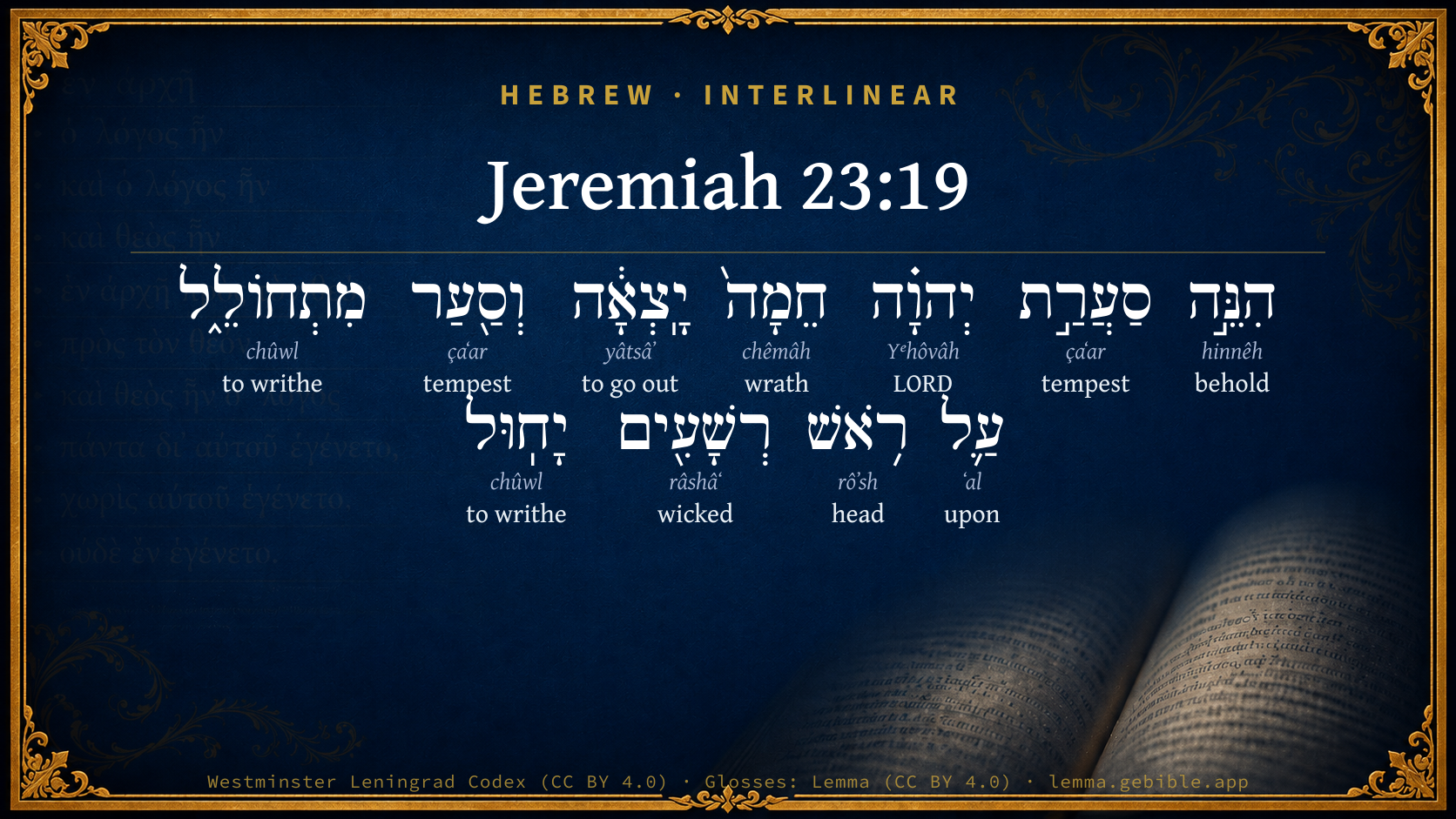
Hebrew (Westminster Leningrad Codex) Jeremiah 23:19 appears in the Hebrew Old Testament. The text above is from the Westminster Leningrad Codex. Each word links to its Strong’s number, a concise gloss, and parsing drawn from the Open Scriptures Hebrew Bible morphology. Click any word for its full Brown-Driver-Briggs (BDB) entry.
Download image
Cite this verse

Jeremiah 23:19 (World English Bible). Public Domain. Lemma interlinear Bible study tool, https://lemma.gebible.app/v/jeremiah/23/19.

Show BibTeX & RIS
BibTeX
RIS
English Translation
Behold, the tempest of Yahweh, [even his] wrath, is gone forth, yes, a whirling tempest: it shall burst on the head of the wicked.
World English Bible · Public Domain
Download a study sheet

One document with this verse’s original text, its word-by-word gloss line, the meaning frame, cross-references with their text, attributed commentary, and full source and license credits — printable, and it pastes into notes with its structure intact.

This verse Autodidact and up

Study sheet (.html) Plain text (.txt)

A passage Seminary Student

Up to 50 verses in one chapter. A passage sheet keeps up to 6 commentary sources and 12 cross-references per verse, in the order this page ranks them, and says so on the sheet whenever that leaves anything out. Ask for a single verse and you get the Autodidact verse sheet above.

Everything on this page stays free to read, with no account — the sheet is a download of what is already on screen, not access to it.

Want to remove ads? Support Godless Engineer
Compare translations 3

The same verse in 3 English versions, stacked beneath the original-language interlinear above. Click any original word for its lexicon entry.

Each is an independent rendering of the whole verse — the interlinear is not word-aligned to these translations.

Highlighted words mark where these versions differ — a whole-verse word diff, not a word-by-word alignment.

  • World English Bible Public Domain
    Behold, the tempest of Yahweh, [even his] wrath, is gone forth, yes, a whirling tempest: it shall burst on the head of the wicked.
  • King James Version Public Domain
    Behold, a whirlwind of the LORD is gone forth in fury, even a grievous whirlwind: it shall fall grievously upon the head of the wicked.
  • unfoldingWord Literal Text CC BY-SA 4.0
    Behold, a storm of Yahweh! Wrath has gone out, and a whirling tempest— upon the head of the wicked it will whirl.

unfoldingWord Literal Text — © unfoldingWord, licensed CC BY-SA 4.0. Word-aligned USFM3 via Door43 (git.door43.org/unfoldingWord/en_ult).

Versions to compare (up to 4)

3 of 4 selected

Show all 18 translations

Every available English version of this verse, each an independent rendering of the whole verse.

  • World English Bible Public Domain
    Behold, the tempest of Yahweh, [even his] wrath, is gone forth, yes, a whirling tempest: it shall burst on the head of the wicked.
  • Berean Standard Bible Public Domain
    Behold, the storm of the LORD has gone out with fury, a whirlwind swirling down upon the heads of the wicked.
  • Majority Standard Bible Public Domain
    Behold, the storm of the LORD has gone out with fury, a whirlwind swirling down upon the heads of the wicked.
  • King James Version Public Domain
    Behold, a whirlwind of the LORD is gone forth in fury, even a grievous whirlwind: it shall fall grievously upon the head of the wicked.
  • American Standard Version (1901) Public Domain
    Behold, the tempest of Jehovah, `even his' wrath, is gone forth, yea, a whirling tempest: it shall burst upon the head of the wicked.
  • Revised Version (1885) Public Domain
    Behold, the tempest of the LORD, even his fury, is gone forth, yea, a whirling tempest: it shall burst upon the head of the wicked.
  • Geneva Bible (1599) Public Domain
    Beholde, the tempest of the Lord goeth forth in his wrath, and a violent whirlewinde shall fall downe vpon the head of the wicked.
  • Douay-Rheims (1899) Public Domain
    Behold the whirlwind of the Lord's indignation shall come forth, and a tempest shall break out and come upon the head of the wicked.
  • Young's Literal Translation Public Domain
    Lo, a whirlwind of Jehovah -- Fury hath gone out, even a piercing whirlwind, On the head of the wicked it stayeth.
  • Literal Standard Version CC BY-SA 4.0
    Behold, a whirlwind of YHWH—Fury has gone out, even a piercing whirlwind, || It stays on the head of the wicked.
  • Unlocked Literal Bible CC BY-SA 4.0
    See, there is a storm coming from Yahweh! His fury is going out, and a tempest is whirling about. It is whirling around the heads of the wicked.
  • unfoldingWord Literal Text CC BY-SA 4.0
    Behold, a storm of Yahweh! Wrath has gone out, and a whirling tempest— upon the head of the wicked it will whirl.
  • Darby Bible Public Domain
    Behold, a tempest of Jehovah, fury is gone forth, yea, a whirling storm: it shall whirl down upon the head of the wicked.
  • World Messianic Bible Public Domain
    Behold, the LORD’s storm, his wrath, has gone out. Yes, a whirling storm! It will burst on the head of the wicked.
  • Webster's Bible Public Domain
    Behold, a whirlwind of the LORD is gone forth in fury, even a grievous whirlwind: it shall fall grievously upon the head of the wicked.
  • Free Bible Version CC BY-SA 4.0
    Watch out! The Lord has sent out a furious storm, a tornado swirling around the heads of the wicked.
  • Bible in Basic English Public Domain
    See, the storm-wind of the Lord, even the heat of his wrath, has gone out, a rolling storm, bursting on the heads of the evil-doers.
  • JPS Tanakh (1917) Public Domain
    Behold, a storm of the LORD is gone forth in fury, yea, a whirling storm; it shall whirl upon the head of the wicked.

Literal Standard Version (2020), Covenant Press — licensed CC BY-SA 4.0. Text via the HelloAO Bible API (eBible.org). Unlocked Literal Bible (unfoldingWord) — licensed CC BY-SA 4.0. Text via the HelloAO Bible API (eBible.org). unfoldingWord Literal Text — © unfoldingWord, licensed CC BY-SA 4.0. Word-aligned USFM3 via Door43 (git.door43.org/unfoldingWord/en_ult). Free Bible Version, Dr. Jonathan Gallagher — licensed CC BY-SA 4.0. Text via the HelloAO Bible API (eBible.org).

Word by word

More ways to search: Search by grammar → Find every occurrence → Compare this word →

Practice this passage: Drill this verse → Learn its vocabulary →

About this verse

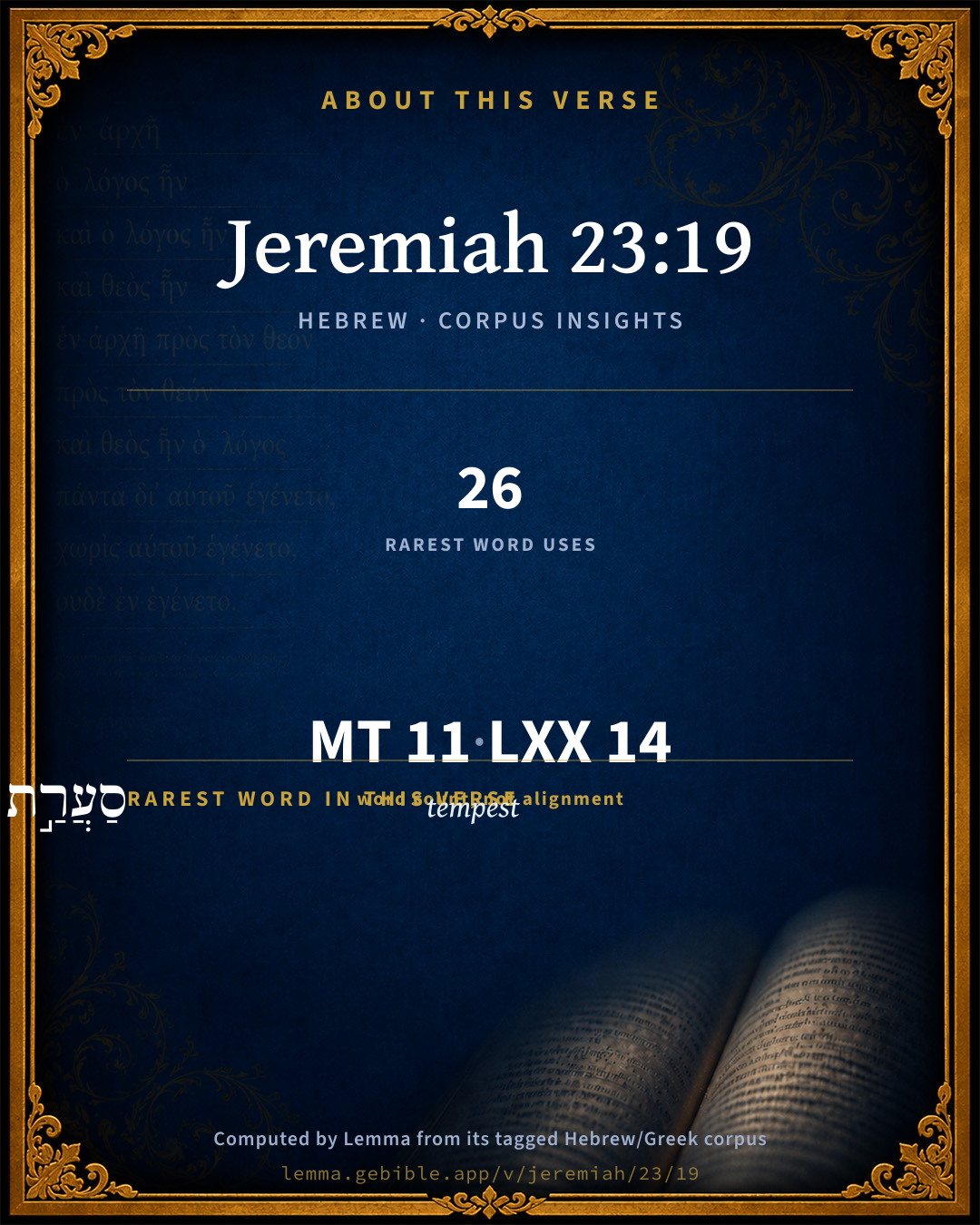
These counts appear in no published source. They are computed here, from the morphology-tagged text and Lemma’s own curated glosses. What Lemma adds →

11
words
9
distinct lemmas
Prophets
section

Shared distinctive vocabulary

סַעֲרַ֣ת tempest H5591 occurs in 22 verses of the Hebrew Bible. Also found in:

Grammatical profile

  • 3 verbs
  • 5 nouns
  • 1 adjective
  • 1 preposition
  • 1 particle

Verb forms

  • יָֽצְאָ֔ה Qal · Perfect
  • מִתְחוֹלֵ֑ל Hithpolel · Participle Active
  • יָחֽוּל Qal · Imperfect

Repetition

Words recur within this verse — often emphatic in Hebrew:

  • סַעֲרַ֣ת tempest H5591 ×2
  • מִתְחוֹלֵ֑ל to writhe H2342 ×2

Hebrew & Septuagint length

In the original languages it is 11 Hebrew tokens and 14 Greek tokens — but the two are counted differently (Hebrew bundles its prefixes and suffixes into one token; the Greek is in lemma form), so that isn’t a like-for-like length.

Cross-references

13

Topical passages linked to Jeremiah 23:19 in the Treasury of Scripture Knowledge — connected by theme and wording, ordered by reader-vote popularity; previews shown in the World English Bible.

  • Jeremiah 30:23 Behold, the tempest of Yahweh, [even his] wrath, is gone forth, a sweeping tempest: it shall burst on the head of the wicked.
  • Jeremiah 25:32 Thus says Yahweh of hosts, Behold, evil shall go forth from nation to nation, and a great tempest shall be raised up from the uttermost parts of the earth.
  • Amos 1:14 But I will kindle a fire in the wall of Rabbah, And it will devour its palaces, With shouting in the day of battle, With a tempest in the day of the whirlwind;
  • Proverbs 10:25 When the whirlwind passes, the wicked is no more; But the righteous stand firm forever.
  • Isaiah 21:1 The burden of the wilderness of the sea. As whirlwinds in the South sweep through, it comes from the wilderness, from an awesome land.
  • Nahum 1:3–6 Yahweh is slow to anger, and great in power, and will by no means leave the guilty unpunished. Yahweh has his way in the whirlwind and in the storm, and the clouds are the dust of his feet.
  • Psalms 58:9 Before your pots can feel the heat of the thorns, He will sweep away the green and the burning alike.
  • Proverbs 1:27 When calamity overtakes you like a storm, When your disaster comes on like a whirlwind; When distress and anguish come on you.
  • Isaiah 5:25–28 Therefore Yahweh's anger burns against his people, And he has stretched out his hand against them, and has struck them. The mountains tremble, And their dead bodies are as refuse in the midst of the streets. For all this, his anger is not turned away, But his hand is still stretched out.
  • Isaiah 40:24 Yes, they have not been planted; yes, they have not been sown; yes, their stock has not taken root in the earth: moreover he blows on them, and they wither, and the whirlwind takes them away as stubble.
  • Isaiah 66:15–16 For, behold, Yahweh will come with fire, and his chariots shall be like the whirlwind; to render his anger with fierceness, and his rebuke with flames of fire.
  • Jeremiah 4:11 At that time shall it be said to this people and to Jerusalem, A hot wind from the bare heights in the wilderness toward the daughter of my people, not to winnow, nor to cleanse;
  • Zechariah 9:14 Yahweh will be seen over them; And his arrow will go flash like lightning; And the Lord Yahweh will blow the trumpet, And will go with whirlwinds of the south.

Cross-references courtesy of OpenBible.info (CC BY 4.0).

Hebrew and Greek witnesses Masoretic Hebrew ↔ Greek Septuagint

The same verse in the two great witnesses to the Old Testament, shown verse-for-verse.

These are two independent witnesses, not word-aligned to each other, and the Septuagint is shown in lemma (dictionary) form.

Hebrew Jeremiah 23:19 Masoretic · Westminster Leningrad Codex

הִנֵּ֣ה סַעֲרַ֣ת יְהוָ֗ה חֵמָה֙ יָֽצְאָ֔ה וְסַ֖עַר מִתְחוֹלֵ֑ל עַ֛ל רֹ֥אשׁ רְשָׁעִ֖ים יָחֽוּל

Behold, the tempest of Yahweh, [even his] wrath, is gone forth, yes, a whirling tempest: it shall burst on the head of the wicked.

World English Bible · Public Domain

Greek LXX Structure differs

In the Septuagint, Jeremiah is about an eighth shorter than the Hebrew and arranges its material differently — the Oracles Against the Nations (Hebrew chapters 46–51) appear in the middle of the Greek book, after 25:13. Because the chapter and verse boundaries do not line up, a verse-for-verse comparison with the Hebrew is not shown.

A verse-for-verse comparison isn’t shown here because the chapters and verses don’t line up. Switch to the LXX edition with the MT / LXX toggle above to read the Greek directly.

Hebrew: Westminster Leningrad Codex (CC BY 4.0). Greek: Septuagint (public domain); English from a public-domain English Septuagint. How the Septuagint differs from the Hebrew →

Targum (Aramaic paraphrase)

1

The Targum is the ancient Jewish Aramaic paraphrase of the Hebrew Scriptures — an interpretive translation, not the Hebrew text itself. Onkelos (literal) and Pseudo-Jonathan (expansive) render the Torah, and Jonathan the Prophets. Coverage is partial: where no permissively-licensed English translation exists for a verse, only the Aramaic is shown. This is verse-level text, not a word-by-word alignment to the Hebrew.

  1. Targum Jonathan Prophets (Joshua–Malachi)
    הָא מְזוֹפִיתָא מִן קָדָם יְיָ בִּרְגַז נַפְקֵת וְעִלְעוּל מִשְׁתַּגֵשׁ עַל רֵישׁ רַשִׁיעִין יֵחוּל:

    (no public-domain English translation for this verse)

    Targum Jonathan — Aramaic: “Mikraot Gedolot” (public domain). English: “Sefaria Community Translation” (CC0 1.0 (public-domain dedication)); “London "Chaldee Paraphrase," 1871” (public domain). Text via Sefaria.

Commentary

Notes on Jeremiah 23:19 from classic Christian and Jewish commentators (each source and its license shown beneath its notes). The classic Christian expositions comment on the surrounding passage and are grouped to its opening verse, so a note may address several verses; the Jewish commentaries on the Tanakh (Rashi and others) are per-verse, so they appear only where the commentator wrote on this verse.

Lemma curates 59 commentaries, every one of them public domain or Creative Commons licensed, each selected and text-cleaned for this edition rather than reprinted as found. About our sources →

Trapp's Complete Commentary

John Trapp

Jer 23:19 Behold, a whirlwind of the LORD is gone forth in fury, even a grievous whirlwind: it shall fall grievously upon the head of the wicked.

Ver. 19. Behold, a whirlwind of the Lord,] q.d., Though these flatterers make all fair weather before you, yet assure yourselves the tempest of God’s wrath, such as shall never be blown over, is even breaking forth upon them and you together. Look to it, therefore.

John Trapp, A Commentary or Exposition upon All the Books of the Old and New Testament (1647–1656) — public domain. Text from a community e-Sword module.

Joseph Benson's Commentary

Jer 23:19-20. Behold, a whirlwind of the Lord is gone forth with fury — A severe judgment of God, that shall resemble a whirlwind for the sudden and utter destruction that it shall bring. The same word, סערה, is elsewhere translated a storm. It is called a whirlwind of the Lord, both to denote the greatness of it, and to signify that it should come forth from God, and be of his sending. It shall fall grievously upon the head of the wicked — Whatever these flattering teachers may assert to the contrary. Blaney translates the verse, Behold, the whirlwind of Jehovah! it goeth forth hot, even a settling whirlwind; (so he translates מתחולל, which we render, grievous,) upon the head of the wicked it shall settle. And he observes, “The hot, scorching wind, blowing from the south, (see note on Jer 4:11-12,) is evidently here alluded to, that blows, not with a transient blast, but exerts a continued force upon the head of the unfortunate traveller till it has effectually destroyed him:” an emblem this of the consuming and insupportable wrath of God. The anger of the Lord shall not return — The prophet speaks of the judgment as of a messenger, which should not return till it had done its errand, and executed what God had resolved it should effect. In the latter days ye shall consider, &c. — Though you will not now believe it, but flatter yourselves with vain hopes, yet hereafter, when it shall be too late, you shall consider it perfectly, that is, when this judgment hath over-taken you, you shall fully believe and understand that God did indeed bring it upon you, for the punishment of your sins.

Joseph Benson's Commentary on the Old and New Testaments (1811–1818) — public domain. Text from a community e-Sword module.

Tyndale Open Study Notes

Tyndale Open Resources

23:19-20 Contrary to the lies of the false prophets, the world was facing the storm of the Lord’s anger. The political situation was a whirlwind that would soon strike the wicked. The Lord had planned this punishment and would ensure that it took place. After the war, the survivors would look back and see that Jeremiah had prophesied correctly.

Tyndale Open Study Notes — © Tyndale Open Resources, licensed CC BY-SA 4.0. Text via the HelloAO Bible API.

Jamieson, Fausset & Brown

Robert Jamieson, A. R. Fausset & David Brown

So far from all prosperity awaiting the people as the false prophets say (Jer 23:17), wrath is in store for them.

grievous--literally, "eddying," whirling itself about, a tornado. In Jer 30:23, "continuing" is substituted for "grievous."

fall grievously--it shall be hurled on.

Jamieson, Fausset & Brown — Commentary Critical and Explanatory on the Whole Bible (1871) — public domain (CC PDM 1.0). Text via the HelloAO Bible API.

Adam Clarke's Commentary

Verse 19. Behold, a whirlwind] The simoom: the hot pestilential wind blowing from the south, frequently mentioned or referred to in the sacred writings; see Jer 23:10.

Adam Clarke's Commentary on the Bible (1810–1826) — public domain. Text from a community e-Sword/MySword module.

John Calvin's Commentaries

The verse which I read at the end of my last Lecture must be now repeated to you, Behold, the tempest (or whirlwind) of Jehovah! it shall go forth with fury; even the impending whirlwind! on the head of the ungodly shall it abide, or fall; for יחול, ichul, means both. The Prophet now assails with more vehemence the false teachers, for they were almost stupid. None, indeed, can betray so much audacity as to oppose God, except when wholly blinded by Satan. Hence our Prophet deals with the false teachers as with fanatics or those wholly stupified: he tells them that God would come like a whirlwind Whether we render it a whirlwind or a storm, there is not much difference. And he adds, that they could not escape, for the wrath of God was impending over them, and would at length remain on them.

Now, it is usual in Scripture to deal very sharply with hypocrites, and especially with false teachers, because Satan rules in them to an awful extent. And doubtless, as I have already said, except a person be fascinated with illusions, he could not dare to oppose God. There is, then, no wonder that the Prophet fulminates against these ungodly teachers; for it was nothing but play and sport to them to pretend God’s sacred name that they might deceive the people. He afterwards adds, —

John Calvin's Commentaries (1540-1563) — public domain. Text from the Calvin Translation Society English edition (1840s-50s) via the Christian Classics Ethereal Library (ccel.org). Calvin's coverage is partial (roughly two-thirds of the Bible); uncommented books and verses are honest gaps, never fabricated. The 19th-century editor's footnotes and remarks are omitted so the notes are faithfully Calvin's own voice.

Ellicott's Commentary for English Readers

(19) Behold, a whirlwind . . .—Better, Behold, the storm of Jehovah, wrath is gone forth, a whirling storm, upon the heads of the wicked shall it whirl down. The word translated “whirlwind” is properly more generic in its meaning (“tempest” in Isa_29:6). and gets its specific force here from the associated word rendered in the Authorised Version “grievous,” but rightly, as above, whirling.

A Bible Commentary for English Readers, edited by Charles John Ellicott (1878–1897) — public domain. Text from a community e-Sword module.

The Cambridge Bible for Schools and Colleges

gen. ed. J. J. S. Perowne

19, 20. See introd. summary to section. These vv. agree substantially with Jer_30:23 f., and are probably introduced here from that passage. They have no apparent connexion with the preceding or following vv., and may have been inserted here as a declaration of Jehovah’s real purpose as opposed to the predictions of the false prophets.

The Cambridge Bible for Schools and Colleges (gen. ed. J. J. S. Perowne; Cambridge University Press, 1878–1918) — public domain. Text from a community e-Sword module.

John Gill's Exposition

Behold, a whirlwind of the Lord is gone forth in fury,.... Or, "behold, a whirlwind of the Lord, of the fury is gone forth" (b); which latter clause explains the former; and, hews, that by "the whirlwind of the Lord" is meant his "fury" or "wrath"; which, like a whirlwind, would come suddenly, and at an unawares, and be very boisterous and powerful, and carry all before it; and which was gone forth from the Lord in the decree and commission; and would quickly break out and appear in the Chaldean army that would invade Judea and besiege Jerusalem, compared to a full and fanning wind, and its chariots to a whirlwind, Jer 4:11; from whence it would appear, that these men, the false prophets, were not in the counsel of God; had seen no vision from him, nor had marked his word: since they prophesied of peace and prosperity, when a blustering storm was coming:

even a grievous whirlwind: it shall fall grievously upon the head of the wicked; or "rest" (c) thereon; even on the head of the wicked prophets, and all such wicked persons as give heed unto them; on them it would fall with its full weight, and give excessive pain, and there continue to their utter ruin. Kimchi says this refers to the days of the Messiah, when all the wicked shall be consumed. It may refer to the destruction of Jerusalem by the Romans, at least include it; which was a grievous whirlwind indeed.

(b) "ecce turbo Domini exandescentia", Montanus, Junius & Tremellius; "en procella Jehovae! ira exivit", Schmidt. (c) "manebit", Montanus, Cocceius; "permanebit", Junius & Tremellius; "residebit", Targ. "requiescet", Syr.

John Gill's Exposition of the Whole Bible (1746–1763) — public domain (CC PDM 1.0). Text via the HelloAO Bible API.

Albert Barnes' Notes on the Bible

Rather, “Behold, the tempest of Yahweh, even hot anger hath gone forth and a whirlwind shall burst upon the head of the wicked.”

Albert Barnes' Notes on the Bible (1834–1885) — public domain. Text from a community e-Sword/MySword module.

Matthew Poole's English Annotations

A severe judgment of God, that should resemble a whirlwind, for the sudden and utter destruction that it shall bring. See Jer 30:23,24. The same word is elsewhere translated a storm, Psa 83:15; Amo 1:14; Jon 1:4. It is called a whirlwind of the Lord, either to denote the greatness of it, as Psa 36:6, or to let us know that the judgment came forth from God, and was of his sending. And whatever these flattering teachers said, it should fall upon wicked men, so as they should have no peace, but evil should most certainly come upon them.

Matthew Poole's English Annotations on the Holy Bible (1683–1685) — public domain. Text from a community e-Sword/MySword module.

Whedon's Commentary on the Bible

Daniel D. Whedon

19. A whirlwind — So far from this vision of peace and prosperity being true, the tempest of Jehovah — even fury — goeth forth, and a whirlwind shall hurl itself upon the head of the wicked.

Daniel D. Whedon (gen. ed.), Commentary on the Old and New Testaments (1874–1909) — public domain. Text from a community e-Sword module.

The Pulpit Commentary

Vers. 19, 20. These two verses seem to be connected with ver. 17. The false prophets say, "Ye shall have peace." How different the message of the true! (A duplicate of these verses occurs in Jer_30:23, Jer_30:24)

A whirlwind of the Lord, etc.; rather, A storm of the Lord, even fury, is gone forth, and a whirling storm upon the head of the wicked shall it whirl. The hurricane has already broken out; it will soon reach Jerusalem. This seems to be the force of Jeremiah"s expressive figure.

The Pulpit Commentary (1880–1919), ed. H.D.M. Spence-Jones & Joseph S. Exell — public domain. Text from a community e-Sword module.

unfoldingWord translationNotes

Door43 World Missions Community

Connecting Statement:

Jeremiah continues to deliver Yahweh's message about the false prophets and priests that he began in Jeremiah 23:9.

there is a storm coming from Yahweh ... His fury is going out ... a tempest is whirling about

These three phrases all refer to a great storm that is a metaphor for Yahweh's anger. This can be stated as a simile. AT: "Yahweh's anger is coming like a great storm, going out with fury and whirling like a tempest" (See: Metaphor and Simile)

a tempest

a violent windstorm

It is whirling around the heads of the wicked

Yahweh's anger is spoken of as if it were a windstorm whirling around the wicked. AT: "It is coming upon the wicked like a windstorm" (See: Metaphor and Simile)

Yahweh's wrath will not return until it

Yahweh's wrath is spoken of as if it were alive and could act on its own. AT: "Yahweh will not stop being angry until he" (See: Personification)

carried out and brought into being his heart's intentions

Here "heart's intentions" refers to the things that Yahweh wanted to happen. AT: "completed and accomplished all the punishment that he had planned" (See: Metonymy)

the final days

"the future"

translationWords

wrath

last day

unfoldingWord translationNotes — © Distant Shores Media and the Door43 World Missions Community, licensed CC BY-SA 4.0. Source: git.door43.org/Door43/en_tn.

Rashi

Rabbi Shlomo Yitzchaki (Rashi)

a whirling A resting storm, a storm which seeks to rest, and it shall rest on the heads of the wicked.

Rashi on the Tanakh — English translations: “The Judaica Press complete Tanach with Rashi, translated by A. J. Rosenberg” (CC BY 4.0); “Pentateuch with Rashi's commentary by M. Rosenbaum and A.M. Silbermann, 1929-1934” (public domain); “The Metsudah Tanach series, Lakewood, N.J” (CC BY 4.0); and “The Book of Joshua, Metsudah Publications, 1997” (CC BY 4.0). Text via Sefaria.

Lesson kit

Teaching starters — assembled from the data on this page, not authored interpretation. Every prompt links to the verse data it draws on. Edit before teaching.

Jeremiah, in the Prophets, opens this verse with 11 words (9 distinct Hebrew lemmas). Its most distinctive word is çaʻar (“tempest”). A historical commentator’s framing appears above. Read the whole chapter for the surrounding context.

Discussion questions

  1. What does “tempest” (çaʻar) contribute to the verse as a whole?
  2. 2 Kings 2:1 shares the word «tempest» with this verse. How do the two illuminate each other?
  3. “tempest” occurs 2× in this one verse. What is the effect of the repetition?
  4. These translations render this verse differently; the difference is in the English rendering, not the original. What questions does that raise?
  5. The verb «יָֽצְאָ֔ה» is Qal Perfect. How does its form color the action?
  6. Reading how Trapp's Complete Commentary and Joseph Benson's Commentary read this verse, where do the two commentators agree and where do they part?

Things to notice

Reading settings

Reading text

Shown beneath each verse's original-language words.

Old Testament
Old Testament edition

Read the OT as the Masoretic Hebrew (MT) or the Greek Septuagint (LXX).

English shown for the Greek Septuagint (in the Hebrew ↔ Greek comparison).

Comparing translations? Open the Compare panel on any verse page to stack up to four side by side.