

Jeremiah 24:2

Hebrew (Westminster Leningrad Codex) Jeremiah 24:2 appears in the Hebrew Old Testament. The text above is from the Westminster Leningrad Codex. Each word links to its Strong’s number, a concise gloss, and parsing drawn from the Open Scriptures Hebrew Bible morphology. Click any word for its full Brown-Driver-Briggs (BDB) entry.
Download image
Cite this verse

Jeremiah 24:2 (World English Bible). Public Domain. Lemma interlinear Bible study tool, https://lemma.gebible.app/v/jeremiah/24/2.

Show BibTeX & RIS
BibTeX
RIS
English Translation
One basket had very good figs, like the figs that are first-ripe; and the other basket had very bad figs, which could not be eaten, they were so bad.
World English Bible · Public Domain
Highlights
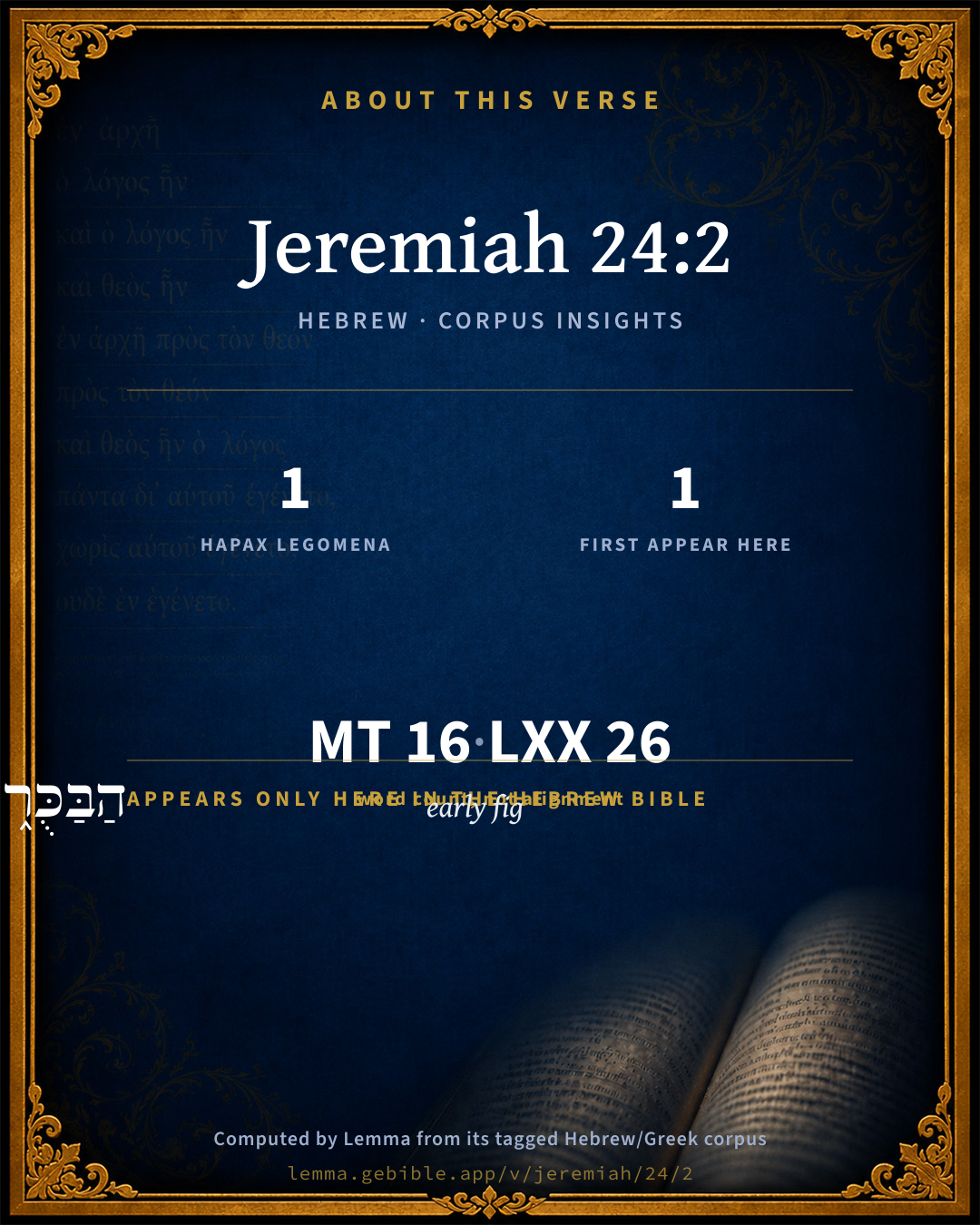
  • 1 hapax legomenon — only here in the Hebrew Bible
  • 1 first appearance in the Hebrew Bible
Full analysis ↓
Download a study sheet

One document with this verse’s original text, its word-by-word gloss line, the meaning frame, cross-references with their text, attributed commentary, and full source and license credits — printable, and it pastes into notes with its structure intact.

This verse Autodidact and up

Study sheet (.html) Plain text (.txt)

A passage Seminary Student

Up to 50 verses in one chapter. A passage sheet keeps up to 6 commentary sources and 12 cross-references per verse, in the order this page ranks them, and says so on the sheet whenever that leaves anything out. Ask for a single verse and you get the Autodidact verse sheet above.

Everything on this page stays free to read, with no account — the sheet is a download of what is already on screen, not access to it.

Want to remove ads? Support Godless Engineer
Compare translations 3

The same verse in 3 English versions, stacked beneath the original-language interlinear above. Click any original word for its lexicon entry.

Each is an independent rendering of the whole verse — the interlinear is not word-aligned to these translations.

Highlighted words mark where these versions differ — a whole-verse word diff, not a word-by-word alignment.

  • World English Bible Public Domain
    One basket had very good figs, like the figs that are first-ripe; and the other basket had very bad figs, which could not be eaten, they were so bad.
  • King James Version Public Domain
    One basket had very good figs, even like the figs that are first ripe: and the other basket had very naughty figs, which could not be eaten, they were so bad.
  • unfoldingWord Literal Text CC BY-SA 4.0
    One basket very good figs, like the first ripe figs, and one basket very bad figs that could not be eaten from badness.

unfoldingWord Literal Text — © unfoldingWord, licensed CC BY-SA 4.0. Word-aligned USFM3 via Door43 (git.door43.org/unfoldingWord/en_ult).

Versions to compare (up to 4)

3 of 4 selected

Show all 18 translations

Every available English version of this verse, each an independent rendering of the whole verse.

  • World English Bible Public Domain
    One basket had very good figs, like the figs that are first-ripe; and the other basket had very bad figs, which could not be eaten, they were so bad.
  • Berean Standard Bible Public Domain
    One basket had very good figs, like those that ripen early, but the other basket contained very poor figs, so bad they could not be eaten.
  • Majority Standard Bible Public Domain
    One basket had very good figs, like those that ripen early, but the other basket contained very poor figs, so bad they could not be eaten.
  • King James Version Public Domain
    One basket had very good figs, even like the figs that are first ripe: and the other basket had very naughty figs, which could not be eaten, they were so bad.
  • American Standard Version (1901) Public Domain
    One basket had very good figs, like the figs that are first-ripe; and the other basket had very bad figs, which could not be eaten, they were so bad.
  • Revised Version (1885) Public Domain
    One basket had very good figs, like the figs that are first ripe: and the other basket had very bad figs, which could not be eaten, they were so bad.
  • Geneva Bible (1599) Public Domain
    One basket had verie good figges, euen like the figges that are first ripe: and the other basket had verie naughtie figges, which could not be eaten, they were so euill.
  • Douay-Rheims (1899) Public Domain
    One basket had very good figs, like the figs of the first season: and the other basket had very bad figs, which could not be eaten, because they were bad.
  • Young's Literal Translation Public Domain
    In the one basket `are' figs very good, like the first-ripe figs, and in the other basket `are' figs very bad, that are not eaten for badness.
  • Literal Standard Version CC BY-SA 4.0
    In one basket [are] very good figs, like the first-ripe figs, and in the other basket [are] very bad figs that are not eaten because of badness.
  • Unlocked Literal Bible CC BY-SA 4.0
    One basket of figs was very good, like first ripe figs, but the other basket of figs was so very bad that they could not be eaten.
  • unfoldingWord Literal Text CC BY-SA 4.0
    One basket very good figs, like the first ripe figs, and one basket very bad figs that could not be eaten from badness.
  • Darby Bible Public Domain
    One basket had very good figs, like the figs first ripe; and the other basket had very bad figs, which could not be eaten for badness.
  • World Messianic Bible Public Domain
    One basket had very good figs, like the figs that are first-ripe; and the other basket had very bad figs, which could not be eaten, they were so bad.
  • Webster's Bible Public Domain
    One basket had very good figs, even like the figs that are first ripe: and the other basket had very poor figs, which could not be eaten, they were so bad.
  • Free Bible Version CC BY-SA 4.0
    One basket was full of very good figs, like those that ripen early, but the other basket only had very bad figs, so bad they couldn't be eaten.
  • Bible in Basic English Public Domain
    One basket had very good figs, like the figs which first come to growth: and the other basket had very bad figs, so bad that they were of no use for food.
  • JPS Tanakh (1917) Public Domain
    One basket had very good figs, like the figs that are first-ripe; and the other basket had very bad figs, which could not be eaten, they were so bad.

Literal Standard Version (2020), Covenant Press — licensed CC BY-SA 4.0. Text via the HelloAO Bible API (eBible.org). Unlocked Literal Bible (unfoldingWord) — licensed CC BY-SA 4.0. Text via the HelloAO Bible API (eBible.org). unfoldingWord Literal Text — © unfoldingWord, licensed CC BY-SA 4.0. Word-aligned USFM3 via Door43 (git.door43.org/unfoldingWord/en_ult). Free Bible Version, Dr. Jonathan Gallagher — licensed CC BY-SA 4.0. Text via the HelloAO Bible API (eBible.org).

Word by word

More ways to search: Search by grammar → Find every occurrence → Compare this word →

Practice this passage: Drill this verse → Learn its vocabulary →

הַבַּכֻּר֑וֹת
bakkurâh
H1073
“the · early figs”
Particle, Definite Article + Noun, Common, Feminine, Plural, Absolute
Part of Speech
Particle + Noun
Type
Common
Gender
Feminine
Number
Plural
State
Absolute
Full BDB Definition

Origin: by orthographical variation for H1063

TWOT: 244f

first ripe fig, early fig - (TWOT) firstfruits
  1. הַדּ֣וּד dûwd H1731 “the · pot” Particle, Definite Article + Noun, Common, Masculine, Singular, Absolute
  2. אֶחָ֗ד ʼechâd H259 “one” Adjective, Cardinal number, Masculine, Singular, Absolute
  3. תְּאֵנִים֙ tᵉʼên H8384 “figs” Noun, Common, Feminine, Plural, Absolute
  4. טֹב֣וֹת ṭôwb H2896 “good” Adjective, Adjective, Feminine, Plural, Absolute
  5. מְאֹ֔ד mᵉʼôd H3966 “exceedingly” Adverb
  6. כִּתְאֵנֵ֖י tᵉʼên H8384 “like/as · figs of” Preposition + Noun, Common, Feminine, Plural, Construct
  7. וְהַדּ֣וּד dûwd H1731 “and · the · pot” Conjunction + Particle, Definite Article + Noun, Common, Masculine, Singular, Absolute
  8. אֶחָ֗ד ʼechâd H259 “one” Adjective, Cardinal number, Masculine, Singular, Absolute
  9. תְּאֵנִים֙ tᵉʼên H8384 “figs” Noun, Common, Feminine, Plural, Absolute
  10. רָע֣וֹת raʻ H7451 “evil” Adjective, Adjective, Feminine, Plural, Absolute
  11. מְאֹ֔ד mᵉʼôd H3966 “exceedingly” Adverb
  12. אֲשֶׁ֥ר ʼăsher H834 “which” Particle, Relative
  13. לֹא lôʼ H3808 “not” Particle, Negative
  14. תֵֽאָכַ֖לְנָה ʼâkal H398 “to eat” Verb, Niphal, Imperfect, 3rd Person, Feminine, Plural
  15. מֵרֹֽעַ rôaʻ H7455 “from · badness” Preposition + Noun, Common, Masculine, Singular, Absolute

About this verse

These counts appear in no published source. They are computed here, from the morphology-tagged text and Lemma’s own curated glosses. What Lemma adds →

16
words
11
distinct lemmas
Prophets
section

Notable vocabulary

1 hapax legomenon — a word that appears only here in the entire Hebrew Bible:

  • הַבַּכֻּר֑וֹת early fig H1073

First appearance in Scripture

This word makes its first canonical appearance in the Hebrew Bible here:

  • הַבַּכֻּר֑וֹת early fig H1073

Shared distinctive vocabulary

הַדּ֣וּד pot H1731 occurs in 6 verses of the Hebrew Bible. Also found in:

Grammatical profile

  • 1 verb
  • 7 nouns
  • 4 adjectives
  • 2 adverbs
  • 2 particles

Verb forms

  • תֵֽאָכַ֖לְנָה Niphal · Imperfect

Repetition

Words recur within this verse — often emphatic in Hebrew:

  • תְּאֵנִים֙ fig H8384 ×3
  • הַדּ֣וּד pot H1731 ×2
  • אֶחָ֗ד one H259 ×2
  • מְאֹ֔ד exceedingly H3966 ×2

Hebrew & Septuagint length

In the original languages it is 16 Hebrew tokens and 26 Greek tokens — but the two are counted differently (Hebrew bundles its prefixes and suffixes into one token; the Greek is in lemma form), so that isn’t a like-for-like length.

Cross-references

9

Topical passages linked to Jeremiah 24:2 in the Treasury of Scripture Knowledge — connected by theme and wording, ordered by reader-vote popularity; previews shown in the World English Bible.

  • Isaiah 5:4 What could have been done more to my vineyard, that I have not done in it? Why, when I looked for it to yield grapes, did it yield wild grapes?
  • Isaiah 5:7 For the vineyard of Yahweh of Hosts is the house of Israel, And the men of Judah his pleasant plant: And he looked for justice, but, behold, oppression; For righteousness, but, behold, a cry of distress.
  • Micah 7:1 Misery is mine! Indeed, I am like one who gathers the summer fruits, as gleanings of the vinyard: There is no cluster of grapes to eat. My soul desires to eat the early fig.
  • Jeremiah 24:5–10 Thus says Yahweh, the God of Israel: Like these good figs, so will I regard the captives of Judah, whom I have sent out of this place into the land of the Chaldeans, for good.
  • Jeremiah 29:17 thus says Yahweh of Hosts; Behold, I will send on them the sword, the famine, and the pestilence, and will make them like vile figs, that can't be eaten, they are so bad.
  • Ezekiel 15:2–5 Son of man, what is the vine tree more than any tree, the vine-branch which is among the trees of the forest?
  • Hosea 9:10 I found Israel like grapes in the wilderness. I saw your fathers as the first ripe in the fig tree at its first season; But they came to Baal Peor, and consecrated themselves to the shameful thing, And became abominable like that which they loved.
  • Malachi 1:12–14 "But you profane it, in that you say, 'Yahweh's table is polluted, and its fruit, even its food, is contemptible.'
  • Matthew 5:13 "You are the salt of the earth, but if the salt has lost its flavor, with what will it be salted? It is then good for nothing, but to be cast out and trodden under the feet of men.

Cross-references courtesy of OpenBible.info (CC BY 4.0).

Hebrew and Greek witnesses Masoretic Hebrew ↔ Greek Septuagint

The same verse in the two great witnesses to the Old Testament, shown verse-for-verse.

These are two independent witnesses, not word-aligned to each other, and the Septuagint is shown in lemma (dictionary) form.

Hebrew Jeremiah 24:2 Masoretic · Westminster Leningrad Codex

הַדּ֣וּד אֶחָ֗ד תְּאֵנִים֙ טֹב֣וֹת מְאֹ֔ד כִּתְאֵנֵ֖י הַבַּכֻּר֑וֹת וְהַדּ֣וּד אֶחָ֗ד תְּאֵנִים֙ רָע֣וֹת מְאֹ֔ד אֲשֶׁ֥ר לֹא תֵֽאָכַ֖לְנָה מֵרֹֽעַ

One basket had very good figs, like the figs that are first-ripe; and the other basket had very bad figs, which could not be eaten, they were so bad.

World English Bible · Public Domain

Greek LXX Structure differs

In the Septuagint, Jeremiah is about an eighth shorter than the Hebrew and arranges its material differently — the Oracles Against the Nations (Hebrew chapters 46–51) appear in the middle of the Greek book, after 25:13. Because the chapter and verse boundaries do not line up, a verse-for-verse comparison with the Hebrew is not shown.

A verse-for-verse comparison isn’t shown here because the chapters and verses don’t line up. Switch to the LXX edition with the MT / LXX toggle above to read the Greek directly.

Hebrew: Westminster Leningrad Codex (CC BY 4.0). Greek: Septuagint (public domain); English from a public-domain English Septuagint. How the Septuagint differs from the Hebrew →

Targum (Aramaic paraphrase)

1

The Targum is the ancient Jewish Aramaic paraphrase of the Hebrew Scriptures — an interpretive translation, not the Hebrew text itself. Onkelos (literal) and Pseudo-Jonathan (expansive) render the Torah, and Jonathan the Prophets. Coverage is partial: where no permissively-licensed English translation exists for a verse, only the Aramaic is shown. This is verse-level text, not a word-by-word alignment to the Hebrew.

  1. Targum Jonathan Prophets (Joshua–Malachi)
    סִלָא הֲדָא תֵינִין טָבָא לַחֲדָא כְּתֵינִין בַּכִּירִין וְסַלָא חַד תֵּינִין בִּישִׁין לַחֲדָא (וּדְבִישִׁין בִּישִׁין לַחֲדָא) דְלָא מִתְאַכְלִין מִבִּישׁוּ:

    (no public-domain English translation for this verse)

    Targum Jonathan — Aramaic: “Mikraot Gedolot” (public domain). English: “Sefaria Community Translation” (CC0 1.0 (public-domain dedication)); “London "Chaldee Paraphrase," 1871” (public domain). Text via Sefaria.

Commentary

Notes on Jeremiah 24:2 from classic Christian and Jewish commentators (each source and its license shown beneath its notes). The classic Christian expositions comment on the surrounding passage and are grouped to its opening verse, so a note may address several verses; the Jewish commentaries on the Tanakh (Rashi and others) are per-verse, so they appear only where the commentator wrote on this verse.

Lemma curates 59 commentaries, every one of them public domain or Creative Commons licensed, each selected and text-cleaned for this edition rather than reprinted as found. About our sources →

Trapp's Complete Commentary

John Trapp

Jer 24:2 One basket [had] very good figs, [even] like the figs [that are] first ripe: and the other basket [had] very naughty figs, which could not be eaten, they were so bad.

Ver. 2. One basket had very good figs.] Maturas et praecoquas, ripe and ready early, bursas melle plenas, as one once called such good figs, purses full of honey.

“ Ficus habet lactis nivei, rutilique saporem

Mellis, et ambrosiae similes cum nectare succos. ”

- Passerat.

The other basket had very naughty figs.] Sour and ill-tasted, because blasted, haply, or worm eaten, &c. Of the Athenians Plutarch {a} saith, that they were all very good or stark naught; no middle men: like as that country also produceth both the most excellent honey and the most deadly poison. Sure it is that non sunt media coram Deo, neque placet tepiditas, before God every man is either a good tree yielding good fruit, or an evil tree bearing evil fruit. He that is not with Christ is against him. He acknowledgeth not a mediocrity, he detesteth an indifference in religion; hot or cold he wisheth men, and threateneth to "spue the lukewarm out of his mouth." {Rev 3:15-16} The best that can be said of such neuter passives is that which Tacitus saith of Galba, Magis extra vitia quam cum virtutibus, that they are rather not vicious than virtuous; their goodness is merely negative. The world crieth them up for right honest men, but God decrieth them for naught, stark naught; they may not be endured, they are so naught. See Luk 16:15.

{a} In Vit. Dion.

John Trapp, A Commentary or Exposition upon All the Books of the Old and New Testament (1647–1656) — public domain. Text from a community e-Sword module.

The Biblical Illustrator

Joseph S. Exell

Jer_24:2-3

One basket had very good figs.

Two baskets of figs

I. The same nation may contain two distinct characters, yet both may be equally involved in a national visitation. There are laws of retribution m operation in relation to nations which, so far as the outward condition is concerned-, are no respecters of persons.

II. Submission to Divine chastisement will lead, in time, to deliverance from it, while resistance will bring ruin. Two members of a family may be suffering from the same disease; the physician will insist upon submission to his treatment from both his patients. If one refuses, he must not complain of the physician, supposing he grows worse. God desired to heal the Jewish nation of its idolatrous tendencies; for this purpose He had decreed that it should go into captivity. Those who submitted willingly are hem promised that the discipline should be for their good, and that they should be brought again to their own land; while those who resisted, would be consumed from off the land that He gave unto them and their fathers.

III. Lessons,

1. In this life retribution to nations is more certain than to individuals. God can deal with individual characters in any world, therefore we sometimes find the greatest villains apparently unmarked by Him now.

2. Outward circumstance is no standard by which to judge Gods estimate of character. Jobs friends were not afflicted as he was, but God esteemed him far more highly than He did them.

3. Moral crime is commercial ruin to a nation. Israel lost God first, and then her national prosperity and greatness. A body soon decays when the life has departed, and a putrid carcase will soon be visited by the birds of prey. (A London Minister.)

What seest thou, Jeremiah?--

Reflections on some of the characteristics of the age we live in

It is not difficult to see the force and application of this homely but sententious little allegory. Jeremiah lived in those days of declension and disaster in which the invasion of Judea by the King of Babylon was not only threatened, but actually took place. He saw the departure of the King of Judah, and the princes of Judah, with the carpenters and smiths, from Jerusalem, and these were all carried away captive to Babylon. Nevertheless, many of every class were left behind, and these were placed under the government of that weak and wicked king, Zedekiah. Those who were carried away comprised the best of the population with regard to intelligence, religious feeling, and patriotism. Their sorrows and afflictions humbled them, so that they repented of their idolatries and obtained mercy of the Lord. In due time the way was prepared for the return of the exiles to their own land; and there, under the leadership of such men as Ezra, Nehemiah, and Zerubbabel, they founded afresh a pious commonwealth, in which the worship of the true God was ever afterwards main-rained down to the time of the coming of Christ. In them was fulfilled the promise contained in verses 4-7. On the other hand, the Jews who remained at home with Zedekiah and his princes revolted against God more and more. They abandoned themselves openly to licentiousness and idolatry. Their temper fiery and mutinous, their language blasphemous, their whole conduct infamous. (See verses 8-13.) These were the evil figs, so evil that they could not be eaten. The point suggested to us by Jeremiahs vision is, that there occur periods, or special circumstances, in the religious life of nations, which tend to develop and force the maturation of character with unusual energy and astonishing rapidity. In such times, you do not find people merely good or bad; but the good are very good, and the evil very evil. Now, it is evident that no parallel whatever can be drawn between our position and circumstances in England at the present time and those of Judea in the days of Jeremiah. We are not, as a nation, suffering either from internal anarchy or from external assault. But still it may be, that other influences and conditions of society are at work, producing an exactly analogous result to that at the time referred to in the text.

I. Certain peculiarities of our times and position my be noted.

1. This is an age of extraordinary intellectual and social activity. The most absolute liberty of speech exists, and men shrink from the utterance of no opinion, the broaching of no speculation. This unusual activity and daring of thought produces rapid and extraordinary changes in both political and ecclesiastical affairs. Amid the astonishment and whirl of such events, it requires a great effort to keep the mind calm, and hold fast in our judgments, utterances, and actions to the sober requirements of sound principle and acknowledged truth (Pro_17:27, margin).

2. The very full and clear religious light which we enjoy.

3. The corresponding increase of activity in the Church. All manner of special devices are being tried and carried out vigorously whereby to reach all classes, to instruct the most ignorant and reform the most vicious, whilst ancient and ordinary means of grace are sustained with unprecedented interest and efficiency.

II. What do all these things import? and what do they necessitate on our part individually? Truly we find here divers potent and stimulating agencies in operation, calculated to arouse us up to repentance and godly solicitude, and then to prompt us on to vigorous Christian life and action. If we yield to them, how fast and far may we soon be carried in the path of faith, in a career of usefulness! What bold, what firm, what fruitful Christians we must become if we enter fully into the spirit of the times, considered as engaged on the side of Christ and His Gospel! But if we refuse to do so, if we set ourselves to resist these powerful influences, how strenuous must that resistance be! how determined and how self-conscious that action of the will which still fights against God and clings to worldliness and sin! Facts are in harmony with these reasonings. Illustrations abound on every side. In this earnest age you find earnest men both for good and evil. Was ever war conducted on so fearful a scale as we have lately witnessed? In our day, we have also seen such specimens of commercial roguery and robbery, conceived on so magnificent a scale, and executed under so clever and admirable a cloak of hypocrisy, as no previous age has ever presented to the world. On the other hand, look at the men who stand foremost in the van of religion and philanthropy. These are Gods heroes; men are still living amongst us worthy of comparison with the spiritual heroes of ancient times, in regard to all that is noble in faith, self-denying in zeal, munificent in giving, or abundant in labours. These, indeed, are among the good figs, which by Gods grace are very good: and to the production of such instances of exalted and matured piety, the present times are not in the least unfavourable. One might speak of books, as well as men. And if, on the other hand, it be true that infidelity and immorality were never so speciously or so boldly advocated as now, in sensational novels, in shallow critiques, or in vulgar serials; so, again, we defy any age to show such noble and masterly treatises as are now written by men of sanctified learning and genius, either in exposition of the Scriptures, or in vindication of their contents. Then there are public institutions and societies to be looked at. If chapels are multiplied, so are theatres. Look at the state of our large towns and cities. Were ever such facilities for evil doing? such criminal attractions for the young? so many places where vice is seductive and sin made easy? The kingdom of Satan is as active and roused up to new exertions as is the kingdom of Christ. It is said that, in the early colonisation of Van Diemens Land, one man took a hive of bees, and soon the island was filled with swarms, and both the trees and rocks dropped with honey; another took a handful of thistle-down, and ere long the country was overrun with prickly and gigantic weeds. Like such actions, are the deeds of all men now. Shall we, then, multiply honey-hives, or scatter thistles in the earth? Let us seek to be good, and do good: and then, behold what glorious possibilities belong to us, of being pre-eminently holy, blest and useful! (T. G. Horon.)

Figs good and bad

Events are divided. What seest thou? I see two kinds of events, one good, and the other vile: and there they are in life. It is so in families: how do you account for it that one son prays, and the other never saw the need of prayer? The one is filial; the other has a heart of stone. Look at life broadly. What seest thou, O prophet, O man of the piercing eyes, what seest thou? Two events, or series of events, one excellent, the other vile; one leading upward, the other downward. What seest thou? Heaven---hell. The vision is still before us; we need to have our attention called to it. He who deals in singularities, in isolations, never enters into the philosophy of Providence, the method of the sublime organisation which is denominated the universe. (J. Parker, D. D.)

The Biblical Illustrator, edited by Joseph S. Exell (c. 1880s–1900s) — public domain. Text from a community e-Sword module.

Joseph Benson's Commentary

Jer 24:2. One basket had very good figs — Dr. Shaw speaks of three sorts of figs; the first of which he calls “boccore, (being those here spoken of,) which come to maturity toward the middle or latter end of June; the second, the kermez, or summer fig, which ripens seldom before August; and the third, the winter fig. This is usually of a much longer shape, and dark complexion than the kermez, hanging and ripening upon the tree even after the leaves are shed; and, provided the winter proves temperate, is gathered as a delicious morsel in the spring.” — Shaw’s Travels, p. 370, fol. The doctor thinks that the latter sort were those which our Saviour expected to find on the fig-tree at the time of the passover in March, Mat 21:19; Mar 11:13. See Blaney.

Joseph Benson's Commentary on the Old and New Testaments (1811–1818) — public domain. Text from a community e-Sword module.

The Expositor's Bible

CHAPTER XXVII

SOCIAL AND RELIGIOUS CORRUPTION

"Very bad figs too bad to be eaten."- Jer_24:2; Jer_24:8; Jer_29:17

PROPHETS and preachers have taken the Israelites for Gods helots, as if the Chosen People had been made drunk with the cup of the Lords indignation, in order that they might be held up as a warning to His more favoured children throughout after ages. They seemed depicted as "sinners above all men," that by this supreme warning the heirs of a better covenant may be kept in the path of righteousness. Their sin is no mere inference from the long tragedy of their national history, "because they have Suffered such things"; their own prophets and their own Messiah testify continually against them. Religious thought has always singled out Jeremiah as the most conspicuous and uncompromising witness to the sins of his people. One chief feature of his mission was to declare Gods condemnation of ancient Judah. Jeremiah watched and shared the prolonged agony and overwhelming catastrophes of the last days of the Jewish monarchy, and ever and anon raised his voice to declare that his fellow countrymen suffered, not as martyrs, but as criminals. He was like the herald who accompanies a condemned man on the way to execution, and proclaims his crime to the spectators.

What were these crimes? How was Jerusalem a sink of iniquity, an Augean stable, only to be cleansed by turning through it the floods of Divine chastisement? The annalists of Egypt and Chaldea show no interest in the morality of Judah; but there is no reason to believe that they regarded Jerusalem as more depraved than Tyre, or Babylon, or Memphis. If a citizen of one of these capitals of the East visited the city of David he might miss something of accustomed culture, and might have occasion to complain of the inferiority of local police arrangements, but he would be as little conscious of any extraordinary wickedness in the city as a Parisian would in London. Indeed, if an English Christian familiar with the East of the nineteenth century could be transported to Jerusalem under King Zedekiah, in all probability its moral condition would not affect him very differently from that of Cabul or Ispahan.

When we seek to learn from Jeremiah wherein the guilt of Judah lay, his answer is neither clear nor full: he does not gather up her sins into any complete and detailed indictment; we are obliged to avail ourselves of casual references scattered through his prophecies. For the most part Jeremiah speaks in general terms; a precise. and exhaustive catalogue of current vices would have seemed too familiar and commonplace for the written record.

The corruption of Judah is summed up by Jeremiah in the phrase "the evil of your doings," and her punishment is described in a corresponding phrase as "the fruit of your doings," or as coming upon her "because of the evil of your doings." The original of "doings" is a peculiar word occurring most frequently in Jeremiah, and the phrases are very common in Jeremiah, and hardly occur at all elsewhere. The constant reiteration of this melancholy refrain is an eloquent symbol of Jehovahs sweeping condemnation. In the total depravity of Judah, no special sin, no one group of sins, stood out from the rest. Their "doings" were evil altogether.

The picture suggested by the scattered hints as to the character of these evil doings is such as might be drawn of almost any Eastern state in its darker days. The arbitrary hand of the. government is illustrated by Jeremiahs own experience of the bastinado {Jer_20:2; Jer_37:15} and the dungeon, (chapters 37, 38) and by the execution of Uriah ben Shemaiah. {Jer_26:20-24} The rights of less important personages were not likely to be more scrupulously respected. The reproach of shedding innocent blood is more than once made against the people and their rulers; {Jer_2:34; Jer_19:4; Jer_22:17} and the more general charge of oppression occurs still more frequently. {Jer_5:25; Jer_6:6; Jer_7:5}

The motive for both these crimes was naturally covetousness; {Jer_6:13} as usual, they were specially directed against the helpless, "the poor," {Jer_2:34} "the stranger, the fatherless, and the widow"; and the machinery of oppression was ready to hand in venal judges and rulers. Upon occasion, however, recourse was had to open violence-men could "steal and murder," as well as "swear falsely"; {Jer_7:5-9} they lived in an atmosphere of falsehood, they "walked in a lie." {Jer_23:14} Indeed the word "lie" is one of the keynotes of these prophecies. The last days of the monarchy offered special temptations to such vices. Social wreckers reaped an unhallowed harvest in these stormy times. Revolutions were frequent, and each in its turn meant fresh plunder for unscrupulous partisans. Flattery and treachery could always find a market in the court of the suzerain or the camp of the invader. Naturally, amidst this general demoralization, the life of the family did not remain untouched: "the land was full of adulterers." {Jer_23:10; Jer_23:14} Zedekiah and Ahab, the false prophets at Babylon are accused of having committed adultery with their neighbours wives. {Jer_29:23} In these passages "adultery" can scarcely be a figure for idolatry; and even if it is, idolatry always involved immoral ritual.

In accordance with the general teaching of the Old Testament, Jeremiah traces the roots of the peoples depravity to a certain moral stupidity; they are "a foolish people, without understanding," who, like the idols in Psa_115:5-6, "have eyes and see not" and "have ears and hear not." In keeping with their stupidity was an unconsciousness of guilt which even rose into proud self-righteousness. They could still come with pious fervour to worship in the temple of Jehovah and to claim the protection of its inviolable sanctity. They could still assail Jeremiah with righteous indignation because he announced the coming destruction of the place where Jehovah had chosen to set His name. (chapters 7, 26) They said that they had no sin, and met the prophets rebukes with protests of conscious innocence: "Wherefore hath Jehovah pronounced all this great evil against us? or what is our iniquity? or what is our sin that we have committed against Jehovah our God?" {Jer_16:10}

When the public conscience condoned alike the abuse of the forms of law and its direct violation, actual legal rights would be strained to the utmost against debtors, hired labourers, and slaves. In their extremity, the princes and people of Judah sought to propitiate the anger of Jehovah by emancipating their Hebrew slaves; when the immediate danger had passed away for a time, they revoked the emancipation. (Chapter 34) The form of their submission to Jehovah reveals their consciousness that their deepest sin lay in their behaviour to their helpless dependents. This prompt repudiation of a most solemn covenant illustrated afresh their callous indifference to the well-being of their inferiors. The depravity of Judah was not only total, it was also universal. In the older histories we read how Achans single act of covetousness involved the whole people in misfortune, and how the treachery of the bloody house of Saul brought three years famine upon the land; but now the sins of individuals and classes were merged in the general corruption. Jeremiah dwells with characteristic reiteration of idea and phrase upon this melancholy truth. Again and again he enumerates the different classes of the community: "kings, princes, priests, prophets, men of Judah and inhabitants of Jerusalem." They had all done evil and provoked Jehovah to anger; they were all to share the same punishment. {Jer_32:26-35} cf. "Characteristic Expressions." (chapter 3) They were all arch rebels, given to slander; nothing but base metal; corrupters, every one of them. {Jer_6:28} "The universal extent of total depravity is most forcibly expressed when Zedekiah with his court and people are summarily described as a basket of "very bad figs, too bad to be eaten." The dark picture of Israels corruption is not yet complete-Israels corruption, for now the prophet is no longer exclusively concerned with Judah. The sin of these last days is no new thing; it is as old as the Israelite occupation of Jerusalem. "This city hath been to Me a provocation of My anger and of My fury from the day that they built it even unto this day"; from the earliest days of Israels national existence, from the time of Moses and the Exodus, the people have been given over to iniquity. "The children of Israel and the children of Judah have done nothing but evil before Me from their youth. {Jer_32:26-35} Thus we see at last that Jeremiahs teaching concerning the sin of Judah can be summed up in one brief and comprehensive proposition. Throughout their whole history all classes of the community have been wholly given over to every kind of wickedness.

This gloomy estimate of Gods Chosen People is substantially confirmed by the prophets of the later monarchy, from Amos and Hosea onwards. Hosea speaks of Israel in terms as sweeping as those of Jeremiah. "Hear the word of Jehovah, ye children of Israel; for Jehovah hath a controversy with the inhabitants of the land, because there is no truth, nor mercy, nor knowledge of God in the land. Swearing and lying and killing and stealing and committing adultery, they cast off all restraint, and blood toucheth blood." As a prophet of the Northern Kingdom, Hosea is mainly concerned with his own country, but his casual references to Judah include her in the same condemnation. Amos again condemns both Israel and Judah: Judah, "because they have despised the law of Jehovah, and have not kept His commandments, and their lies caused them to err, after the which their fathers walked"; Israel, "because they sold the righteous for silver and the poor for a pair of shoes, and pant after the dust of the earth on the head of the poor and turn aside the way of the meek." {Amo_2:4-8} The first chapter of Isaiah is in a similar strain: Israel is "a sinful nation, a people laden with iniquity, a seed of evil-doers"; "the whole head is sick, the whole heart faint. From the sole of the foot even unto the head there is no soundness in it, but wounds and bruises and putrefying sores." According to Micah, "Zion is built up with blood and Jerusalem with iniquity. The heads thereof judge for reward, and the priests thereof teach for hire, and the prophets thereof divine for money." {Mic_3:10-11}

Jeremiahs older and younger contemporaries, Zephaniah and Ezekiel, alike confirm his testimony. In the spirit and even the style afterwards used by Jeremiah, Zephaniah enumerates the sins of the nobles and teachers of Jerusalem. "Her princes within her are roaring lions; her judges are evening wolvesHer prophets are light and treacherous persons: her priests have polluted the sanctuary, they have done violence to the law." {Zep_3:3-4} Ezekiel 20 traces the defections of Israel from the sojourn in Egypt to the Captivity. Elsewhere Ezekiel says that "the land is full of bloody crimes, and the city is full of violence"; (Eze_7:23 :; Eze_7:9; Eze_22:1-12) Jer_22:23-31 he catalogues the sins of priests, princes, prophets, and people, and proclaims that Jehovah "sought for a man among them that should make up the hedge, and stand in the gap before Me for the land, that I should not destroy it: but I found none."

We have now fairly before us the teaching of Jeremiah and the other prophets as to the condition of Judah: the passages quoted or referred to represent its general tone and attitude; it remains to estimate its significance. We should naturally suppose that such sweeping statements as to the total depravity of the whole people throughout all their history were not intended to be interpreted as exact mathematical formulae. And the prophets themselves state or imply qualifications. Isaiah insists upon the existence of a righteous remnant. When Jeremiah speaks of Zedekiah and his subjects as a basket of very bad figs, he also speaks of the Jews who had already gone into captivity as a basket of very good figs. The mere fact of going into captivity can hardly have accomplished an immediate and wholesale conversion. The "good figs" among the captives were presumably good before they went into exile. Jeremiahs general statements that "they were all arch rebels" do not therefore preclude the existence of righteous men in the community, Similarly, when he tells us that the city and people have always been given over to iniquity, Jeremiah is not ignorant of Moses and Joshua, David and Solomon, and the kings "who did right in the eyes of Jehovah"; nor does he intend to contradict the familiar accounts of ancient history. On the other hand, the universality which the prophets ascribe to the corruption of their people is no mere figure of rhetoric, and yet it is by no means incompatible with the view that Jerusalem, in its worst days, was not more conspicuously wicked than Babylon or Tyre; or even, allowing for the altered circumstances of the times, than London or Paris. It would never have occurred to Jeremiah to apply the average morality of Gentile cities as a standard by which to judge Jerusalem; and Christian readers of the Old Testament have caught something of the old prophetic spirit. The very introduction into the present context of any comparison between Jerusalem and Babylon may seem to have a certain flavour of irreverence. We perceive with the prophets that the City of Jehovah and the cities of the Gentiles must be placed in different categories. The popular modern explanation is that heathenism was so utterly abominable that Jerusalem at its worst was still vastly superior to Nineveh or Tyre. However exaggerated such views may be, they still contain an element of truth; but Jeremiahs estimate of the moral condition of Judah was based on entirely different ideas. His standards were not relative, but absolute; not practical, but ideal. His principles were the very antithesis of the tacit ignoring of difficult and unusual duties, the convenient and somewhat shabby compromise represented by the modern word "respectable." Israel was to be judged by its relation to Jehovahs purpose for His people. Jehovah had called them out of Egypt, and delivered them from a thousand dangers. He had raised up for them judges and kings, Moses, David, and Isaiah. He had spoken to them by Torah and by prophecy. This peculiar munificence of Providence and Revelation was not meant to produce a people only better by some small percentage than their heathen neighbours.

The comparison between Israel and its neighbours would no doubt be much more favourable under David than under Zedekiah, but even then the outcome of Mosaic religion as practically embodied in the national life was utterly unworthy of the Divine ideal; to have described the Israel of David or the Judah of Hezekiah as Jehovahs specially cherished possession, a kingdom of priests and a holy nation, {Exo_19:6} would have seemed a ghastly irony even to the sons of Zeruiah, far more to Nathan, Gad, or Isaiah. Nor had any class, as a class, been wholly true to Jehovah at any period of the history. If for any considerable time the numerous order of professional prophets had had a single eye to the glory of Jehovah, the fortunes of Israel would have been altogether different, and where prophets failed, priests and princes and common people were not likely to succeed.

Hence, judged as citizens of Gods Kingdom on earth, the Israelites were corrupt in every faculty of their nature: as masters and servants, as rulers and subjects, as priests, prophets, and worshippers of Jehovah, they succumbed to selfishness and cowardice, and perpetrated the ordinary crimes and vices of ancient Eastern life.

The reader is perhaps tempted to ask: Is this all that is meant by the fierce and impassioned denunciations of Jeremiah? Not quite all. Jeremiah had had the mortification of seeing the great religious revival under Josiah spend itself, apparently in vain, against the ingrained corruption of the people. The reaction, as under Manasseh, had accentuated the worst features of the national life. At the same time the constant distress and dismay caused by disastrous invasionstended to general license and anarchy. A long period of decadence reached its nadir.

But these are mere matters of degree and detail; the main thing for Jeremiah was not that Judah had become worse, but that it had failed to become better. One great period of Israels probation was finally closed. The kingdom had served its purpose in the Divine Providence; but it was impossible to hope any longer that the Jewish monarchy was to prove the earthly embodiment of the Kingdom of God. There was no prospect of Judah attaining a social order appreciably better than that of the surrounding nations. Jehovah and His Revelation would be disgraced by any further association with the Jewish state.

Certain schools of socialists bring a similar charge against the modern social order; that it is not a Kingdom of God upon earth is sufficiently obvious; and they assert that our social system has become stereotyped on lines that exclude and resist progress towards any higher ideal. Now it is certainly true that every great civilisation hitherto has grown old and obsolete; if Christian society is to establish its right to abide permanently, it must show itself something more than an improved edition of the Athens of Pericles or the Empire of the Antonines.

All will agree that Christendom falls sadly short of its ideal, and therefore we may seek to gather instruction from Jeremiahs judgment on the shortcomings of Judah. Jeremiah specially emphasises the universality of corruption in individual character, in all classes of society and throughout the whole duration of history. Similarly we have to recognise that prevalent social and moral evils lower the general tone of individual character. Moral faculties are not set apart in watertight compartments. "Whosoever shall keep the whole law, and yet offend in one point, is guilty of all," is no mere forensic principle. The one offence impairs the earnestness and sincerity with which a man keeps the rest of the law, even though there may be no obvious lapse. There are moral surrenders made to the practical exigencies of commercial, social, political, and ecclesiastical life. Probably we should be startled and dismayed if we understood the consequent sacrifice of individual character.

We might also learn from the prophet that the responsibility for our social evils rests with all classes. Time was when the lower classes were plentifully lectured as the chief authors of public troubles; now it is the turn of the capitalist, the parson, and the landlord. The former policy had no very marked success, possibly the new method may not fare better.

Wealth and influence imply opportunity and responsibility which do not belong to the poor and feeble; but power is by no means confined to the privileged classes; and the energy, ability, and self-denial embodied in the great Trades Unions have sometimes shown themselves as cruel and selfish towards the weak and destitute as any association of capitalists. A necessary preliminary to social amendment is a General confession by each class of its own sins. Finally, the Divine Spirit had taught Jeremiah that Israel had always been sadly imperfect. He did not deny Divine Providence and human hope by teaching that the Golden Age lay in the past, that the Kingdom of God had been realised and allowed to perish. He was under no foolish delusion as to "the good old times"; in his most despondent moods he was not given over to wistful reminiscence. His example may help us not to become discouraged through exaggerated ideas about the attainments of past generations.

In considering modern life it may seem that we pass to an altogether different quality of evil to that denounced by Jeremiah, that we have lost sight of anything that could justify his fierce indignation, and thus that we fail in appreciating his character and message. Any such illusion may be corrected by a glance at the statistics of congested town districts, sweated industries, and prostitution. A social reformer, living in contact with these evils, may be apt to think Jeremiahs denunciations specially adapted to the society which tolerates them with almost unruffled complacency.

William Robertson Nicoll, ed., The Expositor's Bible (London: Hodder & Stoughton, 1887–1910) — public domain. 65 of 66 books (1 Corinthians is not separately keyed, as that volume carries no machine-parseable verse references); section-level commentary keyed to the opening verse. Introductory and overview sections not keyed to a specific passage are excluded.

Jamieson, Fausset & Brown

Robert Jamieson, A. R. Fausset & David Brown

figs . . . first ripe--the "boccora," or early fig (see on Isa 28:4). Baskets of figs used to be offered as first-fruits in the temple. The good figs represent Jeconiah and the exiles in Babylon; the bad, Zedekiah and the obstinate Jews in Judea. They are called good and bad respectively, not in an absolute, but a comparative sense, and in reference to the punishment of the latter. This prophecy was designed to encourage the despairing exiles, and to reprove the people at home, who prided themselves as superior to those in Babylon and abused the forbearance of God (compare Jer 52:31-34).

Jamieson, Fausset & Brown — Commentary Critical and Explanatory on the Whole Bible (1871) — public domain (CC PDM 1.0). Text via the HelloAO Bible API.

Adam Clarke's Commentary

Verse 2. Very good figs] Or, figs of the early sort. The fig-trees in Palestine, says Dr. Shaw, produce fruit thrice each year. The first sort, called boccore, those here mentioned, come to perfection about the middle or end of June. The second sort, called kermez, or summer fig, is seldom ripe before August. And the third, which is called the winter fig, which is larger, and of a darker complexion than the preceding, hangs all the winter on the tree, ripening even when the leaves are shed, and is fit for gathering in the beginning of spring.

Could not be eaten] The winter fig, - then in its crude or unripe state; the spring not being yet come.

Adam Clarke's Commentary on the Bible (1810–1826) — public domain. Text from a community e-Sword/MySword module.

John Calvin's Commentaries

He now adds, that one basket had very good figs, and that the other had very bad figs. If it be asked whether Jeconiah was in himself approved by God, the answer is easy, — that he was suffering punishment for his sins. Then the Prophet speaks here comparatively, when he calls some good and others bad. We must also notice, that he speaks not here of persons but of punishment; as though he had said, “ye feel a dread when those exiles are mentioned, who have been deprived of the inheritance promised them by God: this seems hard to you; but this is moderate when ye consider what end awaits you.” He then does not call Jeconiah and other captives good in themselves; but he calls them good figs, because God had chastened them more gently than he intended to chastise Zedekiah and the rest. Thus he calls the Jews who remained bad figs, not only for this reason, because they were more wicked, though this was in part the reason, but he had regard to the punishment that was nigh at hand; for the severity of God was to be greater towards those whom he had spared, and against whom he had not immediately executed his vengeance. We now perceive the meaning of the Prophet. The rest we shall defer to the next Lecture.

John Calvin's Commentaries (1540-1563) — public domain. Text from the Calvin Translation Society English edition (1840s-50s) via the Christian Classics Ethereal Library (ccel.org). Calvin's coverage is partial (roughly two-thirds of the Bible); uncommented books and verses are honest gaps, never fabricated. The 19th-century editor's footnotes and remarks are omitted so the notes are faithfully Calvin's own voice.

Ellicott's Commentary for English Readers

(2) Like the figs that are first ripe.—Figs were usually gathered in August. The “first ripe,” the “summer fruits” of Mic_7:1, the “hasty fruit before the summer” (Isa_28:4; Hos_9:10) were looked upon as a choice delicacy. The “naughty” (i.e., worthless) fruits were those that had been left behind on the tree, bruised and decayed. The word was not confined in the 16th century to the language of the nursery, and was applied freely to things as well as persons. So North’s translation of Plutarch speaks of men “fighting on naughty ground.”

“So shines a good deed in a naughty world.”

SHAKESPEARE, Merchant of Venice, v. 1.

A Bible Commentary for English Readers, edited by Charles John Ellicott (1878–1897) — public domain. Text from a community e-Sword module.

The Cambridge Bible for Schools and Colleges

gen. ed. J. J. S. Perowne

2. the figs that are first ripe] The proper time for gathering figs in Palestine is in August. Certain kinds of trees, however, bear twice in the year, in which case the first crop, ripening in June, are esteemed a special delicacy. See Isa_28:4; Hos_9:10; Mic_7:1; Nah_3:12.

“The bad figs may have been such either from having decayed and thus been reduced to a rotten condition, or as being the fruit of the sycamore, which contains a bitter juice.” Tristram, op. cit. p. 399.

The Cambridge Bible for Schools and Colleges (gen. ed. J. J. S. Perowne; Cambridge University Press, 1878–1918) — public domain. Text from a community e-Sword module.

John Gill's Exposition

One basket had very good figs, even like the figs that are first ripe,.... As there are some figs that are ripe sooner than others, and which are always the most desirable and acceptable; and such were they that were presented to the Lord, Mic 7:1; these signified those that were carried captive into Babylon with Jeconiah, among whom were some very good men, as Ezekiel, and others; and all might be said to be so, in comparison of those that were at Jerusalem, who were very wicked, and grew worse and worse:

and the other basket had very naughty figs, which could not be eaten, they were so bad; as nothing is more sweet and luscious, and agreeable to the taste than a sound ripe fig, and especially a first ripe one; so nothing is more nauseous than a naughty rotten one: these signified the wicked Jews at Jerusalem indulging themselves in all manner of sin; so those who seemed to be the worst, through their being carried captive, were the best; and those who, seemed to be the best, by their prosperity, were the worst. This is to be understood in a comparative sense, as Calvin observes; though this does not so much design the quality of persons, as the issue of things, with respect unto them. The captivity of the one would issue in their good, and so are compared to good figs; when the sins of the other would bring upon them utter ruin and destruction without recovery, and therefore compared to bad figs that cannot be eaten.

John Gill's Exposition of the Whole Bible (1746–1763) — public domain (CC PDM 1.0). Text via the HelloAO Bible API.

Albert Barnes' Notes on the Bible

Fig-trees bear three crops of figs, of which the first is regarded as a great delicacy.

Albert Barnes' Notes on the Bible (1834–1885) — public domain. Text from a community e-Sword/MySword module.

Haydock's Catholic Bible Commentary

Season. Appearing in autumn and ripe in spring, Micheas vii. 1. (Calmet)

George Leo Haydock (1774–1849), Haydock's Catholic Family Bible and Commentary, 1859 edition — public domain. Excludes Psalms (Douay-Rheims chapter numbering differs from Protestant) and Deuterocanonical books (Catholic canon only).

Matthew Poole's English Annotations

God afterwards explaineth to the prophet, and he to the king’s house, the significancy of this vision. The figs first ripe are usually best. By these

good figs, as will appear by the following verses, are intended Jeconiah or Jehoiachin, with the ten thousand mentioned 2Ki 24:14, and the seven thousand mentioned 2Ki 24:16, which went with him into captivity. By the other figs which were very bad, not to be eaten, are signified Zedekiah and the residue of the people carried with him into captivity. Some may object that Jeconiah and the people then carried away were wicked enough, why else were they carried away? and being so, how are they compared to good figs?

Answ. 1. Though they were bad, yet they might be comparatively good; this people, for the eleven years they continued in their own land, after that their brethren were carried away, not only continuing in their former courses, but still growing worse and worse.

2. They seem not to be called good or bad figs with respect to their manners or quality, but in respect to what God intended to do to them, viz. to use them as bad figs are used, not fit to: be eaten.

Matthew Poole's English Annotations on the Holy Bible (1683–1685) — public domain. Text from a community e-Sword/MySword module.

Whedon's Commentary on the Bible

Daniel D. Whedon

2. First ripe — The fig-tree bears three crops: the first, which ripened in June, being considered specially choice. (Compare Isa_28:4, and Hos_9:10.)

Naughty figs — Possibly because decayed, or, more suitably to the scope of the passage, fruit essentially poor, such, for instance, as the sycamore figs, which, unless they are punctured as they ripen, cannot be eaten.

Daniel D. Whedon (gen. ed.), Commentary on the Old and New Testaments (1874–1909) — public domain. Text from a community e-Sword module.

The Pulpit Commentary

Like the figs that are first ripe. The early spring fig was considered a special delicacy; (comp. Isa_27:4 Hos_9:10) "ficus praecox," Pliny calls it ("Hist. Nat.," 15:19, quoted by Trench). Tristram suggests that the "bad figs" were those of a sycamore tree.

The Pulpit Commentary (1880–1919), ed. H.D.M. Spence-Jones & Joseph S. Exell — public domain. Text from a community e-Sword module.

Keil & Delitzsch

C. F. Keil & F. Delitzsch

"The one basket very good figs" is short for: the basket was quite full of very good figs; cf. Friedr. W. M. Philippi, on the Nature and Origin of the Status constr. in Hebrew (1871), p. 93. The comparison to early figs serves simply to heighten the idea of very good; for the first figs, those ripened at the end of June, before the fruit season in August, were highly prized dainties. Cf. Isa 28:4; Hos 9:10.

Keil & Delitzsch — Biblical Commentary on the Old Testament (1861–1891) — public domain (CC PDM 1.0). Text via the HelloAO Bible API. (Old Testament only.)

Rashi

Rabbi Shlomo Yitzchaki (Rashi)

like the first ripe figs that have ripened completely in the beginning of the ripening of the figs which are dear to all those who find them in their beginning.

Rashi on the Tanakh — English translations: “The Judaica Press complete Tanach with Rashi, translated by A. J. Rosenberg” (CC BY 4.0); “Pentateuch with Rashi's commentary by M. Rosenbaum and A.M. Silbermann, 1929-1934” (public domain); “The Metsudah Tanach series, Lakewood, N.J” (CC BY 4.0); and “The Book of Joshua, Metsudah Publications, 1997” (CC BY 4.0). Text via Sefaria.

Lesson kit

Teaching starters — assembled from the data on this page, not authored interpretation. Every prompt links to the verse data it draws on. Edit before teaching.

Jeremiah, in the Prophets, opens this verse with 16 words (11 distinct Hebrew lemmas). Its most distinctive word is bakkurâh (“early fig”). A historical commentator’s framing appears above. Read the whole chapter for the surrounding context.

Discussion questions

  1. How does “early fig” (bakkurâh) shape what this verse is saying?
  2. 1 word here appears nowhere else in the Hebrew Bible. Why might the author reach for such rare wording?
  3. This is the first place “early fig” appears in Scripture (first appears here). What does its debut here establish?
  4. How does 1 Samuel 2:14, which shares the word «pot», read alongside this verse?
  5. What does the repetition of “fig” (3× in this one verse) do in this verse?
  6. The translations on this page render this verse differently — a whole-verse word diff, not a word-by-word alignment. What might account for the different wordings?
  7. «תֵֽאָכַ֖לְנָה» is a Niphal Imperfect verb. How does that grammatical form shape the action described?
  8. Compare how Trapp's Complete Commentary and The Biblical Illustrator read this verse. Where do they agree or differ?

Things to notice

  • 1 word in this verse appears nowhere else in the Hebrew Bible.
  • 1 word makes its first canonical appearance in Scripture here.
  • This verse counts 16 Hebrew ↔ 26 Greek words.
  • These translations choose different wording for 9 words in this verse.
  • “fig” occurs 3× in this single verse.

Reading settings

Reading text

Shown beneath each verse's original-language words.

Old Testament
Old Testament edition

Read the OT as the Masoretic Hebrew (MT) or the Greek Septuagint (LXX).

English shown for the Greek Septuagint (in the Hebrew ↔ Greek comparison).

Comparing translations? Open the Compare panel on any verse page to stack up to four side by side.