
Ezekiel 36:22

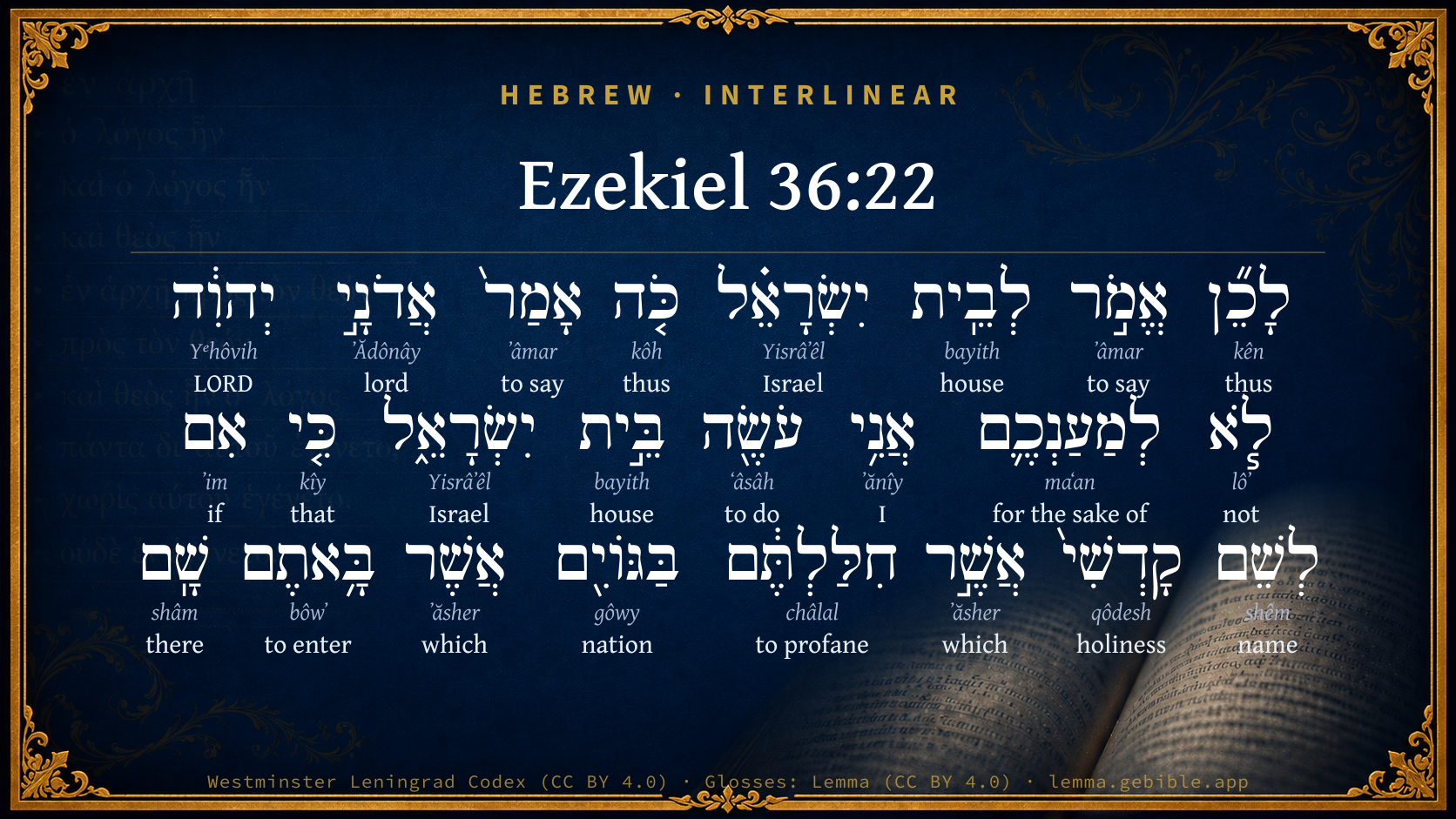
Hebrew (Westminster Leningrad Codex) Ezekiel 36:22 appears in the Hebrew Old Testament. The text above is from the Westminster Leningrad Codex. Each word links to its Strong’s number, a concise gloss, and parsing drawn from the Open Scriptures Hebrew Bible morphology. Click any word for its full Brown-Driver-Briggs (BDB) entry.
Download image
Cite this verse

Ezekiel 36:22 (World English Bible). Public Domain. Lemma interlinear Bible study tool, https://lemma.gebible.app/v/ezekiel/36/22.

Show BibTeX & RIS
BibTeX
RIS
English Translation
Therefore tell the house of Israel, Thus says the Lord Yahweh: I don't do [this] for your sake, house of Israel, but for my holy name, which you have profaned among the nations, where you went.
World English Bible · Public Domain
Download a study sheet

One document with this verse’s original text, its word-by-word gloss line, the meaning frame, cross-references with their text, attributed commentary, and full source and license credits — printable, and it pastes into notes with its structure intact.

This verse Autodidact and up

Study sheet (.html) Plain text (.txt)

A passage Seminary Student

Up to 50 verses in one chapter. A passage sheet keeps up to 6 commentary sources and 12 cross-references per verse, in the order this page ranks them, and says so on the sheet whenever that leaves anything out. Ask for a single verse and you get the Autodidact verse sheet above.

Everything on this page stays free to read, with no account — the sheet is a download of what is already on screen, not access to it.

Want to remove ads? Support Godless Engineer
Compare translations 3

The same verse in 3 English versions, stacked beneath the original-language interlinear above. Click any original word for its lexicon entry.

Each is an independent rendering of the whole verse — the interlinear is not word-aligned to these translations.

Highlighted words mark where these versions differ — a whole-verse word diff, not a word-by-word alignment.

  • World English Bible Public Domain
    Therefore tell the house of Israel, Thus says the Lord Yahweh: I don't do [this] for your sake, house of Israel, but for my holy name, which you have profaned among the nations, where you went.
  • King James Version Public Domain
    Therefore say unto the house of Israel, thus saith the Lord GOD; I do not this for your sakes, O house of Israel, but for mine holy name's sake, which ye have profaned among the heathen, whither ye went.
  • unfoldingWord Literal Text CC BY-SA 4.0
    Therefore say to the house of Israel, ‘The Lord Yahweh says this: I am not doing this for your sake, house of Israel, but for my holy name, which you have profaned among the nations everywhere you have gone.

unfoldingWord Literal Text — © unfoldingWord, licensed CC BY-SA 4.0. Word-aligned USFM3 via Door43 (git.door43.org/unfoldingWord/en_ult).

Versions to compare (up to 4)

3 of 4 selected

Show all 18 translations

Every available English version of this verse, each an independent rendering of the whole verse.

  • World English Bible Public Domain
    Therefore tell the house of Israel, Thus says the Lord Yahweh: I don't do [this] for your sake, house of Israel, but for my holy name, which you have profaned among the nations, where you went.
  • Berean Standard Bible Public Domain
    Therefore tell the house of Israel that this is what the Lord GOD says: It is not for your sake that I will act, O house of Israel, but for My holy name, which you profaned among the nations to which you went.
  • Majority Standard Bible Public Domain
    Therefore tell the house of Israel that this is what the Lord GOD says: It is not for your sake that I will act, O house of Israel, but for My holy name, which you profaned among the nations to which you went.
  • King James Version Public Domain
    Therefore say unto the house of Israel, thus saith the Lord GOD; I do not this for your sakes, O house of Israel, but for mine holy name's sake, which ye have profaned among the heathen, whither ye went.
  • American Standard Version (1901) Public Domain
    Therefore say unto the house of Israel, Thus saith the Lord Jehovah: I do not `this' for your sake, O house of Israel, but for my holy name, which ye have profaned among the nations, whither ye went.
  • Revised Version (1885) Public Domain
    Therefore say unto the house of Israel, Thus saith the Lord GOD: I do not this for your sake, O house of Israel, but for mine holy name, which ye have profaned among the nations, whither ye went.
  • Geneva Bible (1599) Public Domain
    Therfore say vnto the house of Israel, Thus saith ye Lord God, I doe not this for your sakes, O house of Israel, but for mine holy Names sake, which yee polluted among the heathen whither ye went.
  • Douay-Rheims (1899) Public Domain
    Therefore thou shalt say to the house of Israel: Thus saith the Lord God: It is not for your sake that I will do this, O house of Israel, but for my holy name's sake, which you have profaned among the nations whither you went.
  • Young's Literal Translation Public Domain
    Therefore, say to the house of Israel, Thus said the Lord Jehovah: Not for your sake am I working, O house of Israel, But -- for My holy name, That ye have polluted among nations whither ye have gone in.
  • Literal Standard Version CC BY-SA 4.0
    Therefore, say to the house of Israel, Thus said Lord YHWH: I am not working for your sake, || O house of Israel, but for My holy Name || That you have defiled || Among the nations to where you have gone in.
  • Unlocked Literal Bible CC BY-SA 4.0
    Therefore say to the house of Israel, 'The Lord Yahweh says this: I am not doing this for your sake, house of Israel, but for my holy name, which you have profaned among the nations everywhere you have gone.
  • unfoldingWord Literal Text CC BY-SA 4.0
    Therefore say to the house of Israel, ‘The Lord Yahweh says this: I am not doing this for your sake, house of Israel, but for my holy name, which you have profaned among the nations everywhere you have gone.
  • Darby Bible Public Domain
    Therefore say unto the house of Israel, Thus saith the Lord Jehovah: I do not this for your sakes, O house of Israel, but for my holy name, which ye have profaned among the nations whither ye went.
  • World Messianic Bible Public Domain
    “Therefore tell the house of Israel, ‘The Lord GOD says: “I don’t do this for your sake, house of Israel, but for my holy name, which you have profaned among the nations where you went.
  • Webster's Bible Public Domain
    Therefore say to the house of Israel, Thus saith the Lord GOD; I do not this for your sakes, O house of Israel, but for my holy name's sake, which ye have profaned among the heathen, whither ye went.
  • Free Bible Version CC BY-SA 4.0
    Tell the people of Israel that this is what the Lord God says: I'm not doing this for you, people of Israel, but for my reputation for holiness, which you ruined among the nations where you went.
  • Bible in Basic English Public Domain
    For this cause say to the children of Israel, This is what the Lord has said: I am doing this, not because of you, O children of Israel, but because of my holy name, which you have made unclean among the nations wherever you went.
  • JPS Tanakh (1917) Public Domain
    Therefore say unto the house of Israel: Thus saith the Lord GOD: I do not this for your sake, O house of Israel, but for My holy name, which ye have profaned among the nations, whither ye came.

Literal Standard Version (2020), Covenant Press — licensed CC BY-SA 4.0. Text via the HelloAO Bible API (eBible.org). Unlocked Literal Bible (unfoldingWord) — licensed CC BY-SA 4.0. Text via the HelloAO Bible API (eBible.org). unfoldingWord Literal Text — © unfoldingWord, licensed CC BY-SA 4.0. Word-aligned USFM3 via Door43 (git.door43.org/unfoldingWord/en_ult). Free Bible Version, Dr. Jonathan Gallagher — licensed CC BY-SA 4.0. Text via the HelloAO Bible API (eBible.org).

Word by word

More ways to search: Search by grammar → Find every occurrence → Compare this word →

Practice this passage: Drill this verse → Learn its vocabulary →

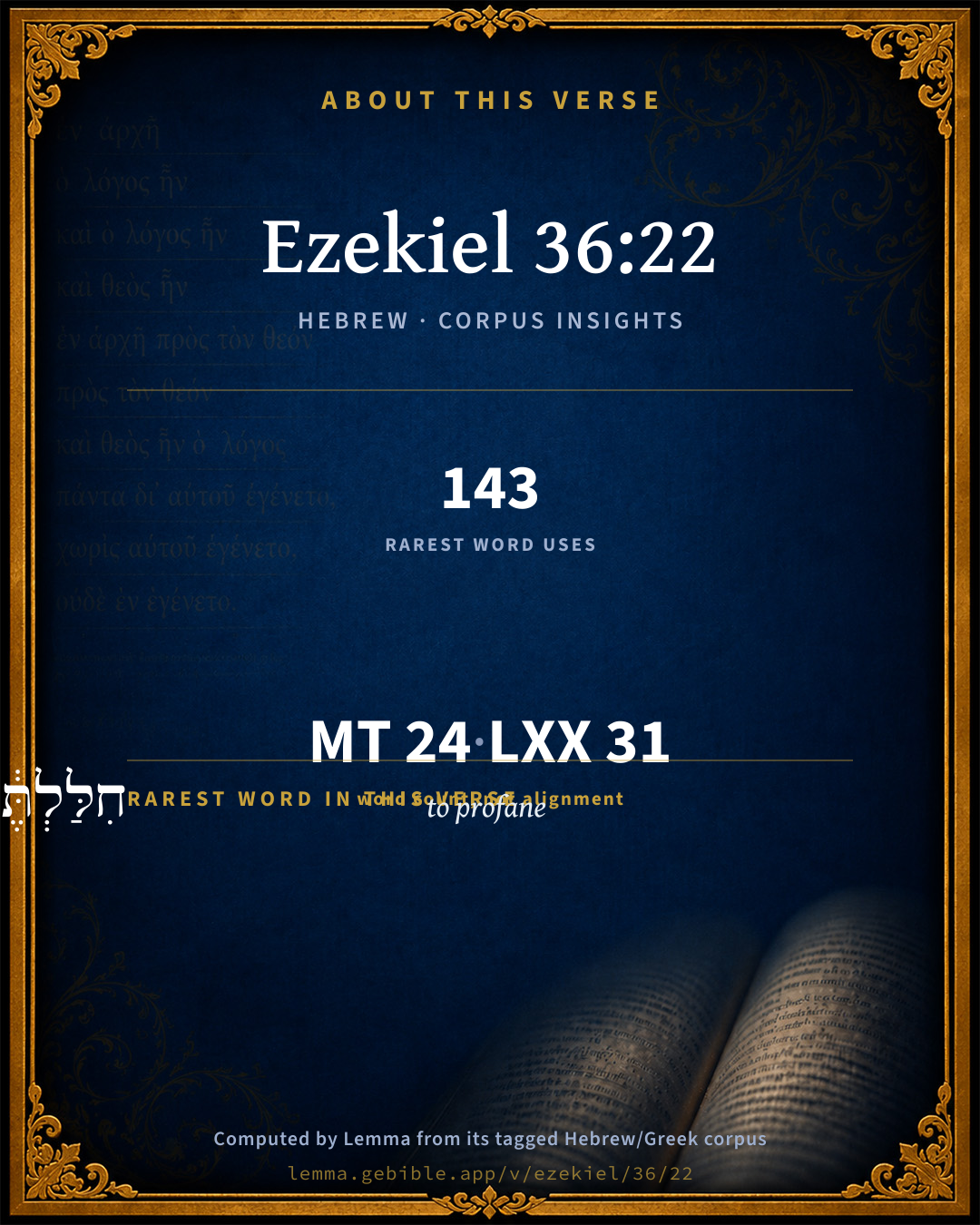
חִלַּלְתֶּ֔ם
châlal
H2490
“to profane”
Verb, Piel, Perfect, 2nd Person, Masculine, Plural
Part of Speech
Verb
Stem
Piel
Form
Perfect
Person
2nd Person
Gender
Masculine
Number
Plural
Full BDB Definition

Origin: a primitive root [compare H2470 ]

TWOT: 660 , 661

to profane, defile, pollute, desecrate, begin - (Niphal) - to profane oneself, defile oneself, pollute oneself - ritually - sexually - to be polluted, be defiled - (Piel) - to profane, make common, defile, pollute - to violate the honour of, dishonour - to violate (a covenant) - to treat as common - (Pual) to profane (name of God) - (Hiphil) - to let be profaned - to begin - (Hophal) to be begun - to wound (fatally), bore through, pierce, bore - (Qal) to pierce - (Pual) to be slain - (Poel) to wound, pierce - (Poal) to be wounded - (Piel) to play the flute or pipe
  1. לָכֵ֞ן kên H3651 “to/for · thus” Preposition + Adverb
  2. אֱמֹ֣ר ʼâmar H559 “say” Verb, Qal, Imperative, 2nd Person, Masculine, Singular
  3. לְבֵֽית bayith H1004 “to/for · house of” Preposition + Noun, Common, Masculine, Singular, Construct
  4. יִשְׂרָאֵ֗ל Yisrâʼêl H3478 “Israel” Noun, Proper
  5. כֹּ֤ה kôh H3541 “thus” Adverb
  6. אָמַר֙ ʼâmar H559 “to say” Verb, Qal, Perfect, 3rd Person, Masculine, Singular
  7. אֲדֹנָ֣י ʼĂdônây H136 “Lord · my” Noun, Common, Masculine, Plural, Construct + Suffix, Personal, 1st Person, Common, Singular
  8. יְהוִ֔ה Yᵉhôvih H3069 “LORD” Noun, Proper
  9. לֹ֧א lôʼ H3808 “not” Particle, Negative
  10. לְמַעַנְכֶ֛ם maʻan H4616 “for the sake of · you” Preposition + Suffix, Personal, 2nd Person, Masculine, Plural
  11. אֲנִ֥י ʼănîy H589 “I” Pronoun, Personal, 1st Person, Common, Singular
  12. עֹשֶׂ֖ה ʻâsâh H6213 “doing” Verb, Qal, Participle Active, Masculine, Singular, Absolute
  13. בֵּ֣ית bayith H1004 “house of” Noun, Common, Masculine, Singular, Construct
  14. יִשְׂרָאֵ֑ל Yisrâʼêl H3478 “Israel” Noun, Proper
  15. כִּ֤י kîy H3588 “that” Conjunction
  16. אִם ʼim H518 “if” Conjunction
  17. לְשֵׁם shêm H8034 “to/for · name of” Preposition + Noun, Common, Masculine, Singular, Construct
  18. קָדְשִׁי֙ qôdesh H6944 “holiness · my” Noun, Common, Masculine, Singular, Construct + Suffix, Personal, 1st Person, Common, Singular
  19. אֲשֶׁ֣ר ʼăsher H834 “which” Particle, Relative
  20. בַּגּוֹיִ֖ם gôwy H1471 “in/at the · nations” Preposition, Determined + Noun, Common, Masculine, Plural, Absolute
  21. אֲשֶׁר ʼăsher H834 “which” Particle, Relative
  22. בָּ֥אתֶם bôwʼ H935 “to enter” Verb, Qal, Perfect, 2nd Person, Masculine, Plural
  23. שָֽׁם shâm H8033 “there” Adverb

About this verse

These counts appear in no published source. They are computed here, from the morphology-tagged text and Lemma’s own curated glosses. What Lemma adds →

24
words
20
distinct lemmas
Prophets
section

Grammatical profile

  • 5 verbs
  • 9 nouns
  • 1 pronoun
  • 1 preposition
  • 2 conjunctions
  • 3 adverbs
  • 3 particles

Verb forms

  • אֱמֹ֣ר Qal · Imperative
  • אָמַר֙ Qal · Perfect
  • עֹשֶׂ֖ה Qal · Participle Active
  • חִלַּלְתֶּ֔ם Piel · Perfect
  • בָּ֥אתֶם Qal · Perfect

Repetition

Words recur within this verse — often emphatic in Hebrew:

  • אֱמֹ֣ר to say H559 ×2
  • לְבֵֽית house H1004 ×2
  • יִשְׂרָאֵ֗ל Israel H3478 ×2
  • אֲשֶׁ֣ר which H834 ×2

Hebrew & Septuagint length

In English translation the verse runs 36 words from the Hebrew and 39 from the Septuagint (LXX English) — closely comparable.

A rough comparison of the two English renderings, which tokenize alike — not a word-level alignment.

Word counts can differ between the Hebrew and the Greek without any difference in meaning — e.g. the Hebrew direct-object marker אֵת has no separate Greek word, and Greek often adds the article ὁ.

In the original languages it is 24 Hebrew tokens and 31 Greek tokens — but the two are counted differently (Hebrew bundles its prefixes and suffixes into one token; the Greek is in lemma form), so that isn’t a like-for-like length.

Cross-references

5

Topical passages linked to Ezekiel 36:22 in the Treasury of Scripture Knowledge — connected by theme and wording, ordered by reader-vote popularity; previews shown in the World English Bible.

  • Psalms 106:8 Nevertheless he saved them for his name's sake, That he might make his mighty power known.
  • Ezekiel 36:32 Nor for your sake do I [this], says the Lord Yahweh, be it known to you: be ashamed and confounded for your ways, house of Israel.
  • Psalms 115:1–2 Not to us, Yahweh, not to us, But to your name give glory, For your loving kindness, and for your truth's sake.
  • Deuteronomy 7:7–8 Yahweh didn't set his love on you, nor choose you, because you were more in number than any people; for you were the fewest of all peoples:
  • Deuteronomy 9:5–7 Not for your righteousness, or for the uprightness of your heart, do you go in to possess their land; but for the wickedness of these nations Yahweh your God does drive them out from before you, and that he may establish the word which Yahweh swore to your fathers, to Abraham, to Isaac, and to Jacob.

Cross-references courtesy of OpenBible.info (CC BY 4.0).

Hebrew and Greek witnesses Masoretic Hebrew ↔ Greek Septuagint

The same verse in the two great witnesses to the Old Testament, shown verse-for-verse.

These are two independent witnesses, not word-aligned to each other, and the Septuagint is shown in lemma (dictionary) form.

Hebrew Ezekiel 36:22 Masoretic · Westminster Leningrad Codex

לָכֵ֞ן אֱמֹ֣ר לְבֵֽית יִשְׂרָאֵ֗ל כֹּ֤ה אָמַר֙ אֲדֹנָ֣י יְהוִ֔ה לֹ֧א לְמַעַנְכֶ֛ם אֲנִ֥י עֹשֶׂ֖ה בֵּ֣ית יִשְׂרָאֵ֑ל כִּ֤י אִם לְשֵׁם קָדְשִׁי֙ אֲשֶׁ֣ר חִלַּלְתֶּ֔ם בַּגּוֹיִ֖ם אֲשֶׁר בָּ֥אתֶם שָֽׁם

Therefore tell the house of Israel, Thus says the Lord Yahweh: I don't do [this] for your sake, house of Israel, but for my holy name, which you have profaned among the nations, where you went.

World English Bible · Public Domain

Greek LXX Ezekiel 36:22 Septuagint · lemma form

διά οὗτος εἶπον ὁ οἶκος ἰσραήλ ὅδε λέγω κύριος οὐ σύ ἐγώ ποιέω οἶκος ἰσραήλ ἀλλά ἤ διά ὁ ὄνομα ἐγώ ὁ ἅγιος ὅς βεβηλόω ἐν ὁ ἔθνος ὅς εἰςἔρχομαι ἐκεῖ

Therefore say to the house of Israel, Thus says the Lord; I do not this, O house of Israel, for your sakes, but because of my holy name, which you⌃ have profaned among the nations, among whom you⌃ went.

LXX2012 (modern English Septuagint) · Public Domain

Hebrew: Westminster Leningrad Codex (CC BY 4.0). Greek: Septuagint (public domain); English from LXX2012 (modern English Septuagint) (Public Domain). How the Septuagint differs from the Hebrew →

Targum (Aramaic paraphrase)

1

The Targum is the ancient Jewish Aramaic paraphrase of the Hebrew Scriptures — an interpretive translation, not the Hebrew text itself. Onkelos (literal) and Pseudo-Jonathan (expansive) render the Torah, and Jonathan the Prophets. Coverage is partial: where no permissively-licensed English translation exists for a verse, only the Aramaic is shown. This is verse-level text, not a word-by-word alignment to the Hebrew.

  1. Targum Jonathan Prophets (Joshua–Malachi)
    בְּכֵן אֲמַר לְבֵית יִשְׂרָאֵל כִּדְנַן אֲמַר יְיָ אֱלֹהִים לָא בְּדִילְכוֹן אֲנָא עָבֵיד בֵּית יִשְׂרָאֵל אֱלָהֵין עַל שְׁמָא דְקוּדְשִׁי דְאָחֵילְתּוּן בֵּינֵי עַמְמַיָא דְאִתְגְלִיתוּן לְתַמָן:

    (no public-domain English translation for this verse)

    Targum Jonathan — Aramaic: “Mikraot Gedolot” (public domain). English: “Sefaria Community Translation” (CC0 1.0 (public-domain dedication)); “London "Chaldee Paraphrase," 1871” (public domain). Text via Sefaria.

Commentary

Notes on Ezekiel 36:22 from classic Christian and Jewish commentators (each source and its license shown beneath its notes). The classic Christian expositions comment on the surrounding passage and are grouped to its opening verse, so a note may address several verses; the Jewish commentaries on the Tanakh (Rashi and others) are per-verse, so they appear only where the commentator wrote on this verse.

Lemma curates 59 commentaries, every one of them public domain or Creative Commons licensed, each selected and text-cleaned for this edition rather than reprinted as found. About our sources →

Trapp's Complete Commentary

John Trapp

Eze 36:22 Therefore say unto the house of Israel, Thus saith the Lord GOD; I do not [this] for your sakes, O house of Israel, but for mine holy name’s sake, which ye have profaned among the heathen, whither ye went.

Ver. 22. I do not this for your sakes.] To do good without respect of desert is royal, yea, it is divine.

But for mine own holy name’s sake.] God maketh our utter unworthiness a foil to set forth the freeness of his love, in making us worthy whom he found not so.

John Trapp, A Commentary or Exposition upon All the Books of the Old and New Testament (1647–1656) — public domain. Text from a community e-Sword module.

Fairbairn on Ezekiel, Jonah & the Pastoral Epistles

Patrick Fairbairn

Eze 36:22. Therefore say to the house of Israel, Thus saith the Lord Jehovah, Not for your sakes do I it, house of Israel, but on account of my holy name, which ye have profaned among the heathen, whither ye have gone.

Eze 36:23. And I sanctify my name, the great, the profaned among the heathen, which ye have profaned in your midst; and the heathen know that I am Jehovah, saith the Lord Jehovah, when I sanctify myself in you before your eyes.

Eze 36:24. And I will take you from among the heathen, and gather you from all the countries, and bring you into your land. (It should be noted that this part of the promise very clearly implied the breaking of the yoke of Babylon, and the precipitation of that power in some way from its present ascendancy. No one could mistake this to- be implied in such predictions; but it is only by this sort of implication that the doom of Babylon is referred to in Ezekiel.)

Eze 36:25. And I will sprinkle upon you clean water, and ye shall be clean; from all your defilements and from all your idols will I cleanse you.

Eze 36:26. And I will give you a new heart, and a new spirit will I put within you; and I will take away the heart of stone out of your flesh, and give you a heart of flesh.

Eze 36:27. And my Spirit will I put within you, and cause that ye walk in my statutes; and my judgments ye shall keep and do them.

Eze 36:28. And ye shall dwell in the land which I gave to your fathers, and ye shall be to me a people, and I will be to you a God.

Eze 36:29. And I will deliver you from all your defilements, and will call to the corn and increase it, and will not send famine upon you.

Eze 36:30. And I will increase the fruit of the tree, and the produce of the field, that the reproach of hunger may no more light upon you among the heathen.

Eze 36:31. And ye shall remember your ways that are evil, and your doings that are not good, and abhor yourselves on account of your iniquities, and on account of your abominations.

Eze 36:32. Not for your sakes do I it, saith the Lord Jehovah, be it known to you: be ashamed and confounded because of your ways, O house of Israel.

In this rich and encouraging promise of good things to come there is, first, a very strong asseveration as to the ground on which God’s contemplated interference for Israel’s behoof was to proceed; negatively, not on their own account,—positively, on account of his own name, which they had profaned. Looking simply to their state and conduct, the Lord, it is declared, could find occasion only for continued severity of dealing, and they themselves for profound humiliation and silent shame. The axe was here, therefore, laid at the root of all self-righteous boasting and fleshly confidences. Just as at first, when Moses said to their fathers, “Not for thy righteousness or for the uprightness of thy heart dost thou go to possess this land, for thou art a stiff-necked people” (Deu 9:5-6); so here the prophet disclosed the utter absence of any personal claim on the Divine goodness, and showed that whatever might henceforth be experienced, it must proceed from the upper spring of God’s own grace and righteousness. In himself alone could the Lord find the motive of benevolent action. And while this laid all human merit in the dust, it furnished at the same time a rich ground of consolation and hope, such as could not be found in any inferior consideration or fleshly confidence. For it carried the humble heart of faith above the very sins and backslidings which had caused the judgments of Heaven to alight, and presented to it a source of life and blessing which even these could not stanch. And need we say, that as this was then the only hope of Israel, so now it is the one fountain-head of all the salvation that is experienced by the Christian? “Not by works of righteousness which we have done, but by his mercy, he saved us,” is the truth which is written on the threshold of faith, and which must pass into the experience of every sinner as he enters therein. No real life is attainable but such as carries in its bosom the death of all self-trust, and the renunciation of every personal claim on the goodness of God. And mortifying as this is to human pride, it yet provides the only solid and abiding peace for those who have come rightly to know the evil of sin; for it draws the soul up to God, and teaches it to form its expectations of good, not by any merit or demerit of its own, but by the large measures of God’s own free and spontaneous beneficence, and the eternal principles of his high administration. The creature thus exchanges the vanity of a human ground for the infinite sufficiency of a Divine one, and the feebleness of an arm of flesh for the all-prevailing might of omnipotence.

But in regard to the promise before us, it is to be considered not only that God finds the ground of action solely in himself, but in himself with respect to his own glory, or the vindication of his name before the world. By what has happened in Israel, and what is still proceeding among them, this name is blasphemed; for it seems as if Jehovah, the God of Israel, were unable to stand before the might of heathenism, and protect and bless his people. Such thoughts, however naturally arising in the circumstances, proceeded on a partial and mistaken view of the character of Jehovah, and especially from an ignorance of his essential righteousness. The heathen judged of Jehovah from their own idol-gods, and hence had no way of accounting for the desolations that had befallen the land and people of Canaan but the comparative impotence of Him in whom they trusted. Therefore, in wiping away this foul reproach, the Lord must act in such a manner as would serve to bring clearly out in the light of day the righteousness which forms the most distinguishing element of his character, and which required only to be understood, both to explain what had taken place of evil, and secure the introduction of the contrary good. But how could such a manifestation of the Divine righteousness be given? It must plainly begin where the evil had its rise—in the hearts of the people with whom God’s name was associated. The love of sin there was the polluted fountain-head from which the whole succession of troubles and disasters had sprung; and nothing could effectually reach the evil which did not provide for the re-establishment of holiness in their hearts. Therefore Israel must first of all be made a holy people,—their pollutions must be done away, their hearts subdued and wrought into a conformity to God’s holiness,—that they might be known to be his chosen ones from the bright reflection seen in them of his own pure and righteous character. Then, understanding from the regenerated state and exemplary lives of his people what sort of being Jehovah is, the heathen would find a ready explanation of all the tribulations that he had brought upon Israel in the past; they would perceive these to be only the necessary vindications of Jehovah’s righteousness on a people who refused to yield themselves to his authority and comply with his will. At the same time, also, the way would be opened for the introduction of a more blessed and glorious future; for the people now entering with their very hearts into the righteousness of God, became capable of the highest outward good from his hand; and all the peculiar blessings of the covenant in a land replenished with the bountifulness of heaven would once more become their portion. Thus God would vindicate the glory of his name by first forming his people to the possession of his own holiness and then by treating them, as thus renewed and sanctified, to the richest outward tokens of his favour and goodness. (Such appears to be the leading design and purport of this prophecy. Hengstenberg, in his Christology, on the passage, has viewed the matter as if it was God’s faithfulness to his covenant that was at stake, which required that a seed of blessing should still be found among the people of the covenant, notwithstanding all their sins and defections. That certainly is true, but, as Hävernick justly remarks, not the truth under consideration here. The heathen did not reproach God for want of fidelity to his own covenant; for in truth they did not know what that covenant really was or required. This was precisely the thing to be made plain; God must let them know that here holiness was everything, and that by the possession or the want of it all his outward dealings must be regulated.) Keeping in view the distinctive character of the prophecy as now explained, no difficulty can be found in regard to its particular expressions. Thus the expression in Eze 36:23, “I sanctify my name,” is at once seen to refer, not to what this name is in itself, but to the reflection given of it in his people. It had been profaned by their wickedness and misery, it must again be sanctified by their returning to holiness and blessing; for God is sanctified when what he is in himself becomes apparent in the world, especially in those who stand nearest to him. So also the expression at the close of the same verse, “when I sanctify myself in you before your eyes;” for which many critical authorities, both ancient and modern, would substitute, “before their eyes,” namely, those of the heathen. This expression creates no difficulty to a person who enters thoroughly into the import of the passage, for it points to the fact that Israel as well as the heathen needed the manifestation in question of Jehovah’s righteousness. It must be done first before the eyes of the people, who by their depravity had lost sight of God’s real character; and then what was seen by them experimentally would also be seen reflectively by the heathen who dwelt around. This twofold perception of God’s character is also brought out in other passages of our prophet; as in chap. Eze 20:41-42: “And I will be sanctified in you before the eyes of the heathen, and ye shall know that I am Jehovah.” Finally, the mention, in Eze 36:25, of clean water to be sprinkled on the people as the means of purification can only be understood symbolically; it does not refer to any mere external rite, or to any specific ordinance of the old covenant, such as the lustration ceremony with water and the ashes of the red heifer (Rosenmüller, Hengs.), or to the ablutions connected with the consecration of the Levites (Hävernick); it is rather to be viewed in reference to the purifications by water collectively, which were all, in one respect or another, symbolical of the removal of impurity, and the establishment of the worshipper in a sound and acceptable condition. This was no more of a merely formal and outward character in Old Testament times than it is now, as we may learn from the whole tenor of this prophecy. It was by their moral pollutions most of all that the people of Israel had profaned God’s name and drawn down his displeasure; and the purification, which was to undo the evil and again to sanctify the name of God, could be nothing short of a conformity to God’s own righteousness, which throughout all ages is the same. The whole of the water-lustrations of the Jews were symbolical of this purity of heart and conduct; and in referring to them here the prophet simply expresses in symbolical language a great spiritual promise—the Lord would make Israel in reality what under the law was outwardly denoted by a sprinkling with clean water. He gives himself, indeed, the interpretation in the verses that follow, where the change is described by the Lord’s imparting to them a new heart, and putting his own Spirit within them. In short, the peculiar blessing promised for the future was their being raised to the participation of God’s holiness, precisely as in the past the great evil was their having become morally so unlike him.

Patrick Fairbairn — An Exposition of Ezekiel (1851), Jonah (1849), and The Pastoral Epistles (1874) — public domain. Text from a community e-Sword module.

Geneva Bible (1599)

Geneva Bible translators

This excludeth from man all dignity, and means to deserve anything by, seeing that God referreth the whole to himself, and that only for the glory of his holy Name.

Geneva Bible (1599) marginal notes — public domain. Text via Bolls.life.

Jamieson, Fausset & Brown

Robert Jamieson, A. R. Fausset & David Brown

not . . . for your sakes--that is, not for any merit in you; for, on the contrary, on your part, there is everything to call down continued severity (compare Deu 9:5-6). The sole and sure ground of hope was God's regard to "His own name," as the God of covenant grace (Psa 106:45), which He must vindicate from the dishonor brought on it by the Jews, before the heathen.

Jamieson, Fausset & Brown — Commentary Critical and Explanatory on the Whole Bible (1871) — public domain (CC PDM 1.0). Text via the HelloAO Bible API.

Ellicott's Commentary for English Readers

(22) Not . . . for your sakes, . . . but for mine holy name’s sake.—Comp. Exod. xxxii; Numbers 14; Deuteronomy 9. This is the constant burden of God’s teaching to His people throughout their history. Hence it is an idle objection to the Scripture narrative that it represents Israel as the favourite of heaven, and is thus just like the human legends of every other ancient nation. In fact, this narrative is unlike any other. It speaks of God as having chosen one nation as the means of accomplishing His purpose for the salvation of the whole world, but continually chastising them for their sins, again and again setting aside the mass of them, and restoring and purifying and blessing a remnant, not for their own sake, but for the accomplishment of His own holy purpose and promise, thus sanctifying His name.

A Bible Commentary for English Readers, edited by Charles John Ellicott (1878–1897) — public domain. Text from a community e-Sword module.

The Cambridge Bible for Schools and Colleges

gen. ed. J. J. S. Perowne

22. do not this for your sakes] Not for what Israel has been or deserved. The ref. is to Israel’s past history; such a meaning as that it is not for any interest which he has in Israel or in order to benefit them that Jehovah delivers them, but only to magnify his own name is entirely extraneous to the passage and a distortion of its sense. Cf. Isa_43:22-28; Isa_48:9-15. “Name” is not equivalent to person, but is a reflection or expression of the person; hence all that is due to the person or can be said of it, is due to the name and can be employed of it.

The Cambridge Bible for Schools and Colleges (gen. ed. J. J. S. Perowne; Cambridge University Press, 1878–1918) — public domain. Text from a community e-Sword module.

John Gill's Exposition

Therefore say unto the house of Israel,.... This is an order to the prophet, the son of man, Eze 36:17,

thus saith the Lord God, I do not this for your sakes, O house of Israel; what he hereafter promises to do for them, both with respect to things temporal and spiritual; which he did, not on account of any deserts or worthiness in them; for they had none, having done nothing to merit his favour, but, on the contrary, everything to provoke the eyes of his glory:

but for my holy name's sake, which ye have profaned among the Heathen, whither ye went; for the honour of his holy name, for the glory of his holy word, holy worship, and holy religion; all which were traduced and reproached among the Heathen, by reason of the ungodly behaviour of the Jews.

John Gill's Exposition of the Whole Bible (1746–1763) — public domain (CC PDM 1.0). Text via the HelloAO Bible API.

Haydock's Catholic Bible Commentary

Holy, that my attributes of justice and mercy may be confessed, Isaias xlviii. 2., Daniel iii. 49., and Judith viii. 24.

George Leo Haydock (1774–1849), Haydock's Catholic Family Bible and Commentary, 1859 edition — public domain. Excludes Psalms (Douay-Rheims chapter numbering differs from Protestant) and Deuterocanonical books (Catholic canon only).

Matthew Poole's English Annotations

I do not this, which I have done, sparing you and preserving you, and giving you favour in the sight of the heathen; nor do I that I am about to do for you, returning you to Judea, planting you, increasing you, and establishing you, and making you a blessing; I do not this for your sake, you deserve no such kindness from me.

For mine holy name’s sake; my infinite mercy is the spring and fountain; the vindicating my name from all imputation of weakness or unfaithfulness, and the magnifying the glory of my goodness, wisdom, truth, and power, are the reasons on which I do what I do for Israel.

Which ye have profaned; brought under suspicion with the heathen, who think that the only and almighty God should do better for his own and only people!

Matthew Poole's English Annotations on the Holy Bible (1683–1685) — public domain. Text from a community e-Sword/MySword module.

The Pulpit Commentary

Not for your sakes but for mine holy Name"s sake. Thus Jehovah repudiates the claim of merit on Israel"s part (comp. ver. 32); and if Israel had no claim on Jehovah for deliverance from the Babylonish exile any more than she had at first to be put in possession of Canaan, (Deu_9:6) much less has fallen man a claim on God for salvation from the condemnation and dominion of sin. (Rom_11:6; Eph_2:8-10) As the essential holiness and righteousness of God were the real reason of Israel"s exile and dispersion among the nations, so were these qualities in God the ultimate grounds to which Israel"s recovery and restoration should be traced.

The Pulpit Commentary (1880–1919), ed. H.D.M. Spence-Jones & Joseph S. Exell — public domain. Text from a community e-Sword module.

unfoldingWord translationNotes

Door43 World Missions Community

General Information:

Yahweh continues speaking to Ezekiel, and he gives him a message to Israel.

the house of Israel

Here "house" represents people. AT: "the people of Israel" (See: Metonymy)

for your sake

"because of you" or "in order to help you"

but for my holy name, which you have profaned among the nations everywhere you have gone

Here "name" represents Yahweh and his reputation. AT: "but so that the people of the nations, who mock me because of you, will know that I am holy" (See: Metonymy)

you have profaned among the nations everywhere you have gone

"you have caused the people of the nations to mock everywhere you have gone"

translationWords

Lord Yahweh

profane

unfoldingWord translationNotes — © Distant Shores Media and the Door43 World Missions Community, licensed CC BY-SA 4.0. Source: git.door43.org/Door43/en_tn.

Rashi

Rabbi Shlomo Yitzchaki (Rashi)

Not for your sake, etc. is the salvation that I shall save you [by].

Rashi on the Tanakh — English translations: “The Judaica Press complete Tanach with Rashi, translated by A. J. Rosenberg” (CC BY 4.0); “Pentateuch with Rashi's commentary by M. Rosenbaum and A.M. Silbermann, 1929-1934” (public domain); “The Metsudah Tanach series, Lakewood, N.J” (CC BY 4.0); and “The Book of Joshua, Metsudah Publications, 1997” (CC BY 4.0). Text via Sefaria.

Lesson kit

Teaching starters — assembled from the data on this page, not authored interpretation. Every prompt links to the verse data it draws on. Edit before teaching.

Ezekiel, in the Prophets, opens this verse with 24 words (20 distinct Hebrew lemmas). Its most distinctive word is châlal (“to profane”). A historical commentator’s framing appears above. Read the whole chapter for the surrounding context.

Discussion questions

  1. How does “to profane” (châlal) shape what this verse is saying?
  2. Psalms 106:8 shares this passage’s theme. How do the two illuminate each other?
  3. “to say” occurs 2× in this one verse. What is the effect of the repetition?
  4. These translations render this verse differently. What is at stake in choosing one wording over another?
  5. The verb «אֱמֹ֣ר» is Qal Imperative. How does its form color the action?
  6. Reading how Trapp's Complete Commentary and Fairbairn on Ezekiel, Jonah & the Pastoral Epistles read this verse, where do the two commentators agree and where do they part?

Things to notice

Reading settings

Reading text

Shown beneath each verse's original-language words.

Old Testament
Old Testament edition

Read the OT as the Masoretic Hebrew (MT) or the Greek Septuagint (LXX).

English shown for the Greek Septuagint (in the Hebrew ↔ Greek comparison).

Comparing translations? Open the Compare panel on any verse page to stack up to four side by side.