
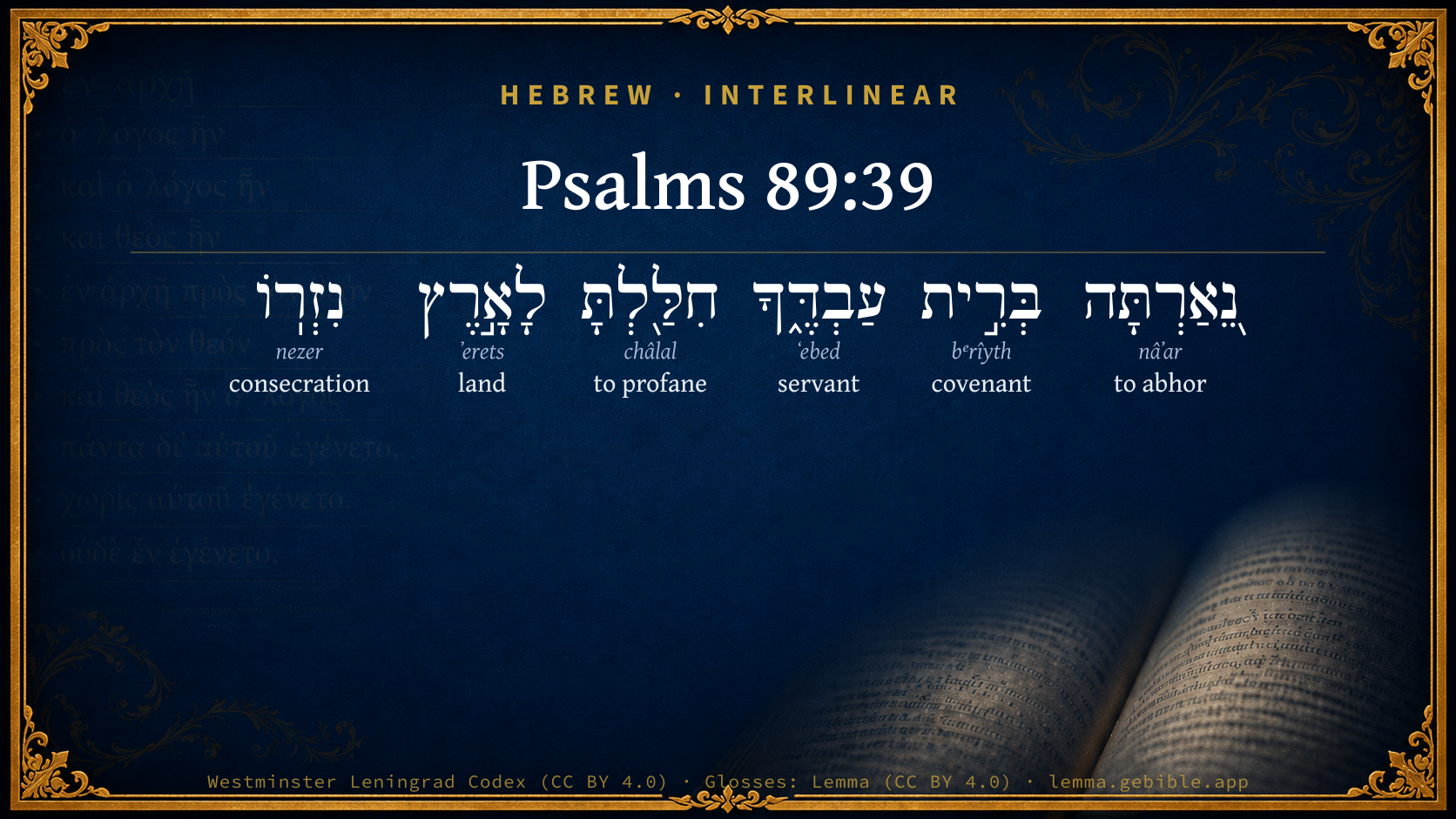
Psalms 89:39

Hebrew (Westminster Leningrad Codex) Psalms 89:39 appears in the Hebrew Old Testament. The text above is from the Westminster Leningrad Codex. Each word links to its Strong’s number, a concise gloss, and parsing drawn from the Open Scriptures Hebrew Bible morphology. Click any word for its full Brown-Driver-Briggs (BDB) entry.
Download image
Cite this verse

Psalms 89:39 (World English Bible). Public Domain. Lemma interlinear Bible study tool, https://lemma.gebible.app/v/psalms/89/39.

Show BibTeX & RIS
BibTeX
RIS
English Translation
You have renounced the covenant of your servant. You have defiled his crown in the dust.
World English Bible · Public Domain
Highlights
  • 1 first appearance in the Hebrew Bible
Full analysis ↓
Download a study sheet

One document with this verse’s original text, its word-by-word gloss line, the meaning frame, cross-references with their text, attributed commentary, and full source and license credits — printable, and it pastes into notes with its structure intact.

This verse Autodidact and up

Study sheet (.html) Plain text (.txt)

A passage Seminary Student

Up to 50 verses in one chapter. A passage sheet keeps up to 6 commentary sources and 12 cross-references per verse, in the order this page ranks them, and says so on the sheet whenever that leaves anything out. Ask for a single verse and you get the Autodidact verse sheet above.

Everything on this page stays free to read, with no account — the sheet is a download of what is already on screen, not access to it.

Want to remove ads? Support Godless Engineer
Compare translations 3

The same verse in 3 English versions, stacked beneath the original-language interlinear above. Click any original word for its lexicon entry.

Each is an independent rendering of the whole verse — the interlinear is not word-aligned to these translations.

Highlighted words mark where these versions differ — a whole-verse word diff, not a word-by-word alignment.

  • World English Bible Public Domain
    You have renounced the covenant of your servant. You have defiled his crown in the dust.
  • King James Version Public Domain
    Thou hast made void the covenant of thy servant: thou hast profaned his crown by casting it to the ground.
  • unfoldingWord Literal Text CC BY-SA 4.0
    You have voided the covenant of your servant; you have profaned his crown to the ground.

unfoldingWord Literal Text — © unfoldingWord, licensed CC BY-SA 4.0. Word-aligned USFM3 via Door43 (git.door43.org/unfoldingWord/en_ult).

Versions to compare (up to 4)

3 of 4 selected

Show all 18 translations

Every available English version of this verse, each an independent rendering of the whole verse.

  • World English Bible Public Domain
    You have renounced the covenant of your servant. You have defiled his crown in the dust.
  • Berean Standard Bible Public Domain
    You have renounced the covenant with Your servant and sullied his crown in the dust.
  • Majority Standard Bible Public Domain
    You have renounced the covenant with Your servant and sullied his crown in the dust.
  • King James Version Public Domain
    Thou hast made void the covenant of thy servant: thou hast profaned his crown by casting it to the ground.
  • American Standard Version (1901) Public Domain
    Thou hast abhorred the covenant of thy servant: Thou hast profaned his crown `by casting it' to the ground.
  • Revised Version (1885) Public Domain
    Thou hast abhorred the covenant of thy servant: thou hast profaned his crown even to the ground.
  • Geneva Bible (1599) Public Domain
    Thou hast broken the couenant of thy seruant, and profaned his crowne, casting it on the ground.
  • Douay-Rheims (1899) Public Domain
    But thou hast rejected and despised: thou hast been angry with thy anointed.
  • Young's Literal Translation Public Domain
    Hast rejected the covenant of Thy servant, Thou hast polluted to the earth his crown,
  • Literal Standard Version CC BY-SA 4.0
    Have rejected the covenant of Your servant, || You have defiled his crown to the earth,
  • Unlocked Literal Bible CC BY-SA 4.0
    You have renounced the covenant of your servant. You have desecrated his crown on the ground.
  • unfoldingWord Literal Text CC BY-SA 4.0
    You have voided the covenant of your servant; you have profaned his crown to the ground.
  • Darby Bible Public Domain
    Thou hast made void the covenant of thy servant; thou hast profaned his crown to the ground:
  • World Messianic Bible Public Domain
    You have renounced the covenant of your servant. You have defiled his crown in the dust.
  • Webster's Bible Public Domain
    \\89:38\\But thou hast cast off and abhorred, thou hast been wroth with thy anointed.
  • Free Bible Version CC BY-SA 4.0
    You have broken the agreement you had with him; you have thrown his crown to the ground!
  • Bible in Basic English Public Domain
    You have made your agreement with your servant of no effect: you have had no respect for his crown, it has come down even to the earth.
  • JPS Tanakh (1917) Public Domain
    (89-40) Thou hast abhorred the covenant of Thy servant; Thou hast profaned his crown even to the ground.

Literal Standard Version (2020), Covenant Press — licensed CC BY-SA 4.0. Text via the HelloAO Bible API (eBible.org). Unlocked Literal Bible (unfoldingWord) — licensed CC BY-SA 4.0. Text via the HelloAO Bible API (eBible.org). unfoldingWord Literal Text — © unfoldingWord, licensed CC BY-SA 4.0. Word-aligned USFM3 via Door43 (git.door43.org/unfoldingWord/en_ult). Free Bible Version, Dr. Jonathan Gallagher — licensed CC BY-SA 4.0. Text via the HelloAO Bible API (eBible.org).

Word by word

More ways to search: Search by grammar → Find every occurrence → Compare this word →

Practice this passage: Drill this verse → Learn its vocabulary →

About this verse

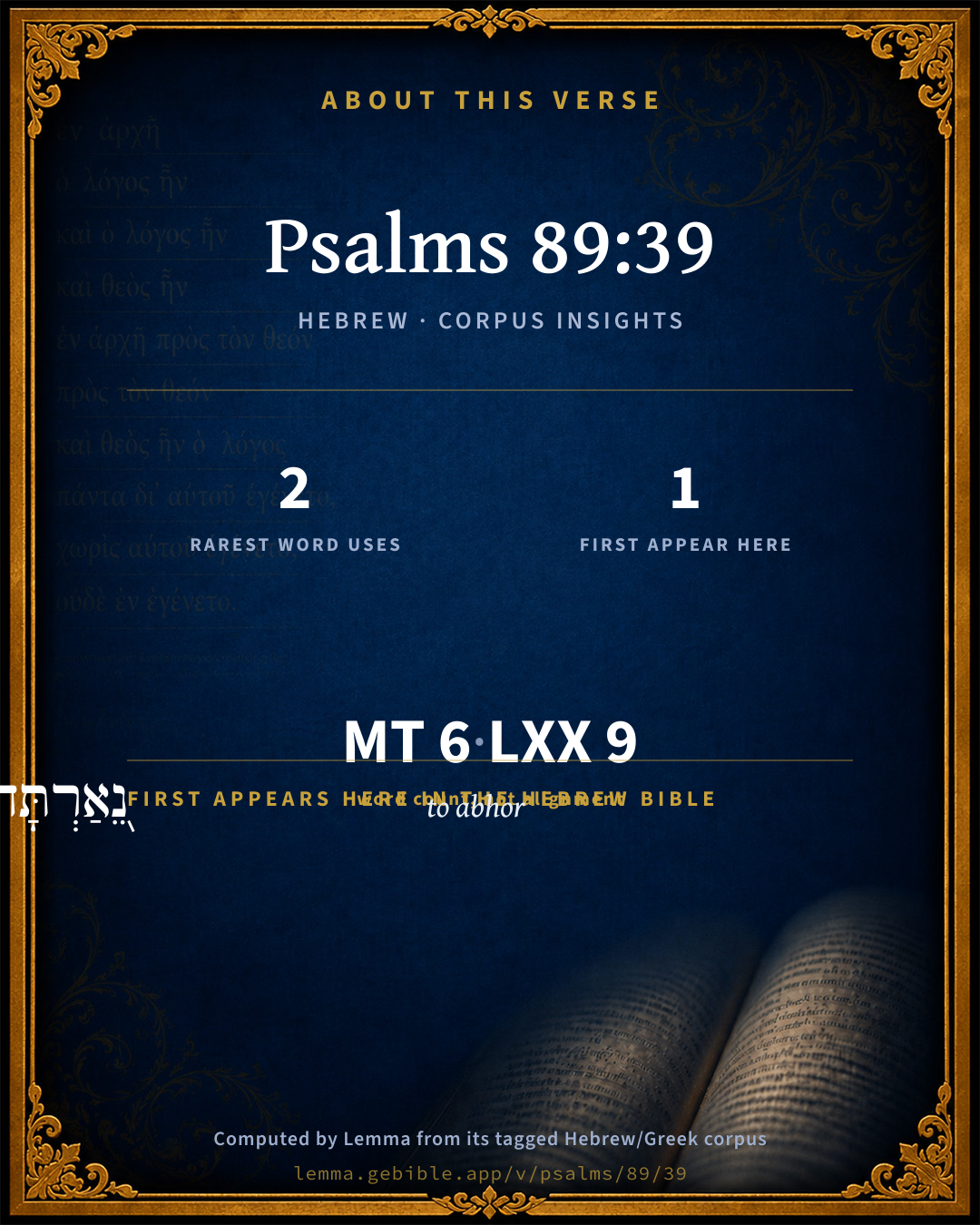
These counts appear in no published source. They are computed here, from the morphology-tagged text and Lemma’s own curated glosses. What Lemma adds →

6
words
6
distinct lemmas
Wisdom
section

Notable vocabulary

The rarest word here is נֵ֭אַרְתָּה to abhor H5010 — appearing just 2 times in the whole Hebrew Bible.

First appearance in Scripture

This word makes its first canonical appearance in the Hebrew Bible here:

  • נֵ֭אַרְתָּה to abhor H5010

Shared distinctive vocabulary

נֵ֭אַרְתָּה to abhor H5010 occurs in 2 verses of the Hebrew Bible. Also found in:

Grammatical profile

  • 2 verbs
  • 4 nouns

Verb forms

  • נֵ֭אַרְתָּה Piel · Perfect
  • חִלַּ֖לְתָּ Piel · Perfect

Hebrew & Septuagint length

In English translation the verse runs 16 words from the Hebrew and 18 from the Septuagint (LXX English) — closely comparable.

A rough comparison of the two English renderings, which tokenize alike — not a word-level alignment.

Word counts can differ between the Hebrew and the Greek without any difference in meaning — e.g. the Hebrew direct-object marker אֵת has no separate Greek word, and Greek often adds the article ὁ.

In the original languages it is 6 Hebrew tokens and 9 Greek tokens — but the two are counted differently (Hebrew bundles its prefixes and suffixes into one token; the Greek is in lemma form), so that isn’t a like-for-like length.

Cross-references

10

Topical passages linked to Psalms 89:39 in the Treasury of Scripture Knowledge — connected by theme and wording, ordered by reader-vote popularity; previews shown in the World English Bible.

  • Lamentations 5:16 The crown is fallen from our head: Woe to us! for we have sinned.
  • Psalms 74:7 They have burned your sanctuary to the ground. They have profaned the dwelling-place of your Name.
  • Psalms 89:34–36 I will not break my covenant, Nor alter what my lips have uttered.
  • Psalms 77:10 Then I thought, "I will appeal to this: The years of the right hand of the Most High."
  • Psalms 89:44 You have ended his splendor, And thrown his throne down to the ground.
  • Psalms 116:11 I said in my haste, "All men are liars."
  • Psalms 143:3 For the enemy pursues my soul. He has struck my life down to the ground. He has made me live in dark places, as those who have been long dead.
  • Isaiah 25:12 The high fortress of your walls has he brought down, laid low, and brought to the ground, even to the dust.
  • Isaiah 43:28 Therefore I will profane the princes of the sanctuary; and I will make Jacob a curse, and Israel a reviling.
  • John 13:7 Jesus answered him, "You don't know what I am doing now, but you will understand later."

Cross-references courtesy of OpenBible.info (CC BY 4.0).

Hebrew and Greek witnesses Masoretic Hebrew ↔ Greek Septuagint

The same verse in the two great witnesses to the Old Testament, shown verse-for-verse.

You’re reading Greek Psalm 88 (Hebrew Psalm 89). The Septuagint counts the superscription, so verse numbers can differ from the Hebrew — chapter-level alignment, not verse-by-verse. Numbering follows Rahlfs.

These are two independent witnesses, not word-aligned to each other, and the Septuagint is shown in lemma (dictionary) form.

Hebrew Psalms 89:39 Masoretic · Westminster Leningrad Codex

נֵ֭אַרְתָּה בְּרִ֣ית עַבְדֶּ֑ךָ חִלַּ֖לְתָּ לָאָ֣רֶץ נִזְרֽוֹ

You have renounced the covenant of your servant. You have defiled his crown in the dust.

World English Bible · Public Domain

Greek LXX Greek Psalm 88:39 Septuagint · lemma form

σύ δέ ἀποὠθέω καί ἐκοὐδενόω ἀναβάλλω ὁ χριστός σύ

You have overthrown the covenant of your servant; you have profaned his sanctuary, casting it to the ground.

LXX2012 (modern English Septuagint) · Public Domain

On this verse, Ellicott's Commentary for English Readers discusses the Septuagint’s reading. Read the note in Commentary ↓

Hebrew: Westminster Leningrad Codex (CC BY 4.0). Greek: Septuagint (public domain); English from LXX2012 (modern English Septuagint) (Public Domain). How the Septuagint differs from the Hebrew →

Commentary

Notes on Psalms 89:39 from classic Christian and Jewish commentators (each source and its license shown beneath its notes). The classic Christian expositions comment on the surrounding passage and are grouped to its opening verse, so a note may address several verses; the Jewish commentaries on the Tanakh (Rashi and others) are per-verse, so they appear only where the commentator wrote on this verse.

Lemma curates 59 commentaries, every one of them public domain or Creative Commons licensed, each selected and text-cleaned for this edition rather than reprinted as found. About our sources →

Trapp's Complete Commentary

John Trapp

Psa 89:39 Thou hast made void the covenant of thy servant: thou hast profaned his crown [by casting it] to the ground.

Ver. 39. Thou hast made void the covenant] This passage a certain Spanish Rabbi stumbled at (as hath been noted on the title of this psalm), but without cause; for all these things are spoken κατα δοξαν, and not κατ αληθειαν, according to opinion, and not according to the truth of things. And, therefore, Kimchi saith well here, Many wonder at this psalmist, and I do as much wonder at their wondering, &c.

Thou hast profaned his crown] By rendering his regal dignity contemptible. The Greek rendereth it, his sanctuary, αγιασμα αυτου..

John Trapp, A Commentary or Exposition upon All the Books of the Old and New Testament (1647–1656) — public domain. Text from a community e-Sword module.

J. A. Alexander on Psalms

Joseph Addison Alexander

40. (Psa 89:39) Thou hast broken the covenant of thy servant; thou hast profaned to the earth his crown. The first verb in Hebrew occurs only here and Lam 2:7. The usual explanation is conjectural, or founded on the ancient versions. A cognate verb in Arabic means to abhor, which would be appropriate in this place. The covenant of thy servant, i.e. thy covenant with thy servant. See above, on Psa 89:28; Psa 89:34. The pregnant construction, profaned to the ground, i.e. profaned by casting to the ground, occurs above, Psa 74:7. The theocratical crown was a sacred or religious dignity, any contempt of which might therefore well be called a pro-fanation. Compare what is said of the priestly diadem. Exo 28:36; Exo 29:6.

Joseph Addison Alexander, The Psalms Translated and Explained (1850) — public domain. Text from a community e-Sword module.

Geneva Bible (1599)

Geneva Bible translators

Because of the horrible confusion of things, the Prophet complaineth to God, as though he saw not the performance of his promise. And thus discharging his cares on God, he resisteth doubt and impatience.

By this he meaneth the horrible dissipation and renting of the kingdom, which was under Jeroboam: or else by the Spirit of prophecy Ethan speaketh of those great miseries, which came soon afterward to pass at the captivity of Babylon.

Geneva Bible (1599) marginal notes — public domain. Text via Bolls.life.

Ellicott's Commentary for English Readers

(39) Made void.—Better, cast off, as the word is rendered in Lam_2:7, the only other place where it occurs. There the LXX. have “shook off;” here, “turned upside down.”

Thou hast profaned.—Comp. Psa_74:7.

A Bible Commentary for English Readers, edited by Charles John Ellicott (1878–1897) — public domain. Text from a community e-Sword module.

The Cambridge Bible for Schools and Colleges

gen. ed. J. J. S. Perowne

39. Thou hast abhorred the covenant of thy servant:

Thou hast cast his desecrated crown to the ground.

Thine anointed, thy servant (cp. Psa_89:20) include both David and the successor who represents him. The titles plead the claim which the king had on God’s protection.

The word nçzer means (1) consecration, and (2) the crown or diadem of the high priest (Exo_29:6) or the king (2Sa_1:10), as the mark of consecration to their office. For the phrase profaned to the ground cp. Psa_74:7.

The Cambridge Bible for Schools and Colleges (gen. ed. J. J. S. Perowne; Cambridge University Press, 1878–1918) — public domain. Text from a community e-Sword module.

John Gill's Exposition

Thou hast broken down all his hedges,.... Round about his vine, the church; see Psa 80:12. A famous church was raised at Jerusalem, quickly after the death, resurrection, and ascension of Christ, which seemed to be well filled, fenced, and protected; but on a sudden a violent persecution arose, and the members of it were made havoc of, and the ministers of the word were scattered abroad, and which was the breaking down of the hedges; and what was done to the church was taken by Christ as done to himself, as it is here spoken of him; see Act 8:1, and this might seem contrary to the word and oath of God, that his seed should endure for ever, and his throne as the days of heaven, Psa 89:29, when the first Christian church was used in this manner; but that providence was overruled, for the spread of the Gospel, and the interest of Christ, in other parts; see Act 8:4, and so no objection to what is before said:

thou hast brought his strong holds to ruin; the same as before, the church of Christ, which seemed to be so well built and fortified; see Isa 26:1.

John Gill's Exposition of the Whole Bible (1746–1763) — public domain (CC PDM 1.0). Text via the HelloAO Bible API.

Albert Barnes' Notes on the Bible

Thou hast made void the covenant of thy servant - Thou hast dealt with him as if there were no such covenant; as if no such promise had been made to him. The word rendered “made void,” means to abhor, or reject.

Thou hast profaned his crown, by casting it to the ground - literally, “Thou hast profaned to the earth his crown;” that is, Thou hast treated it as a polluted thing; a thing to be rejected and abhorred; a thing which one casts indignantly upon the ground.

Albert Barnes' Notes on the Bible (1834–1885) — public domain. Text from a community e-Sword/MySword module.

Matthew Poole's English Annotations

Made void the covenant; which seems contrary to thy word given Psa 89:34.

Of thy servant, i.e. made with him.

Profained his crown, by exposing that sacred person, and family, and kingdom to contempt, and giving his sceptre and power into the hands of the uncircumcised.

Matthew Poole's English Annotations on the Holy Bible (1683–1685) — public domain. Text from a community e-Sword/MySword module.

The Treasury of David

Charles H. Spurgeon

Ver. 39. Thou hast made void the covenant of thy servant. The dispensations of providence looked as if there had been a disannulling of the sacred compact, though indeed it was not so.

Thou hast profaned his crown by casting it to the ground. The king had been subject to such sorrow and shame that his diadem had been as it were taken from his head, dashed on the earth, and rolled in the mire. He was a theocratic monarch, and the Lord, who gave him his crown, took it from him and treated it with contempt, at least so it seemed. In these sad days also we may utter the same complaint, for Jesus is not acknowledged in many of the churches, and usurpers have profaned his crown. When we hear of kings and queens set up as "heads of the church", and a priest styled "The Vicar of Christ", while parliaments and courts take upon themselves to legislate for the church of God, we may bitterly lament that things should come to so wretched a pass. Few are there who will acknowledge the crown rights of King Jesus, the very subject is considered to be out of date. O Lord how long!

Ver. 39. Thou hast profaned his crown, etc. The crown of a king, (like that of the high priest, on which was inscribed "holiness to the Lord") (Ex 28:36) was a sacred thing, and therefore to cast it in the dust was to profane it. A.R. Fausset.

Ver. 39.

1. Providence may often seem to be at variance with promises.

2. Promises are never at variance with providence. It is the covenant of thy servant and his crown still.

Ver. 39. How the throne of King Jesus may be profaned.

Psalms 89:40*

Charles H. Spurgeon's The Treasury of David (1869–1885) — public domain. Psalms only. Text from a community e-Sword/MySword module.

Whedon's Commentary on the Bible

Daniel D. Whedon

39. Made void the covenant—Wholly rejected the covenant; treated it as worthless. Contrast Psa_89:34-35.

Profaned his crown—By allowing it to be “cast to the ground”—despoiled. See Psa_89:19-20

Daniel D. Whedon (gen. ed.), Commentary on the Old and New Testaments (1874–1909) — public domain. Text from a community e-Sword module.

The Pulpit Commentary

Thou hast made void the covenant of thy servant; or, "abhorred" (Cheyne, Revised Version). The verb is a very unusual one, occurring only here and in Lam_2:7. Thou hast profaned his crown by casting it to the ground. (comp. Psa_74:7) The theocratic crown was so holy a thing, that any degradation of it might be regarded as a "profanation."

The Pulpit Commentary (1880–1919), ed. H.D.M. Spence-Jones & Joseph S. Exell — public domain. Text from a community e-Sword module.

Rashi

Rabbi Shlomo Yitzchaki (Rashi)

But You abandoned You dealt strictly with his children in counting their iniquity until You abandoned them and You rejected them in the days of Zedekiah.

Rashi on the Tanakh — English translations: “The Judaica Press complete Tanach with Rashi, translated by A. J. Rosenberg” (CC BY 4.0); “Pentateuch with Rashi's commentary by M. Rosenbaum and A.M. Silbermann, 1929-1934” (public domain); “The Metsudah Tanach series, Lakewood, N.J” (CC BY 4.0); and “The Book of Joshua, Metsudah Publications, 1997” (CC BY 4.0). Text via Sefaria.

Lesson kit

Teaching starters — assembled from the data on this page, not authored interpretation. Every prompt links to the verse data it draws on. Edit before teaching.

Psalms, in the Wisdom, opens this verse with 6 words (6 distinct Hebrew lemmas). Its most distinctive word is nâʼar (“to abhor”). A historical commentator’s framing appears above. Read the whole chapter for the surrounding context.

Discussion questions

  1. How does “to abhor” (nâʼar) shape what this verse is saying?
  2. This is the first place “to abhor” appears in Scripture (first appears here). What does its debut here establish?
  3. How does Lamentations 2:7, which shares the word «to abhor», read alongside this verse?
  4. These translations render this verse differently. What is at stake in choosing one wording over another?
  5. «נֵ֭אַרְתָּה» is a Piel Perfect verb. How does that grammatical form shape the action described?
  6. Compare how Trapp's Complete Commentary and J. A. Alexander on Psalms read this verse. Where do they agree or differ?

Things to notice

Reading settings

Reading text

Shown beneath each verse's original-language words.

Old Testament
Old Testament edition

Read the OT as the Masoretic Hebrew (MT) or the Greek Septuagint (LXX).

English shown for the Greek Septuagint (in the Hebrew ↔ Greek comparison).

Comparing translations? Open the Compare panel on any verse page to stack up to four side by side.