

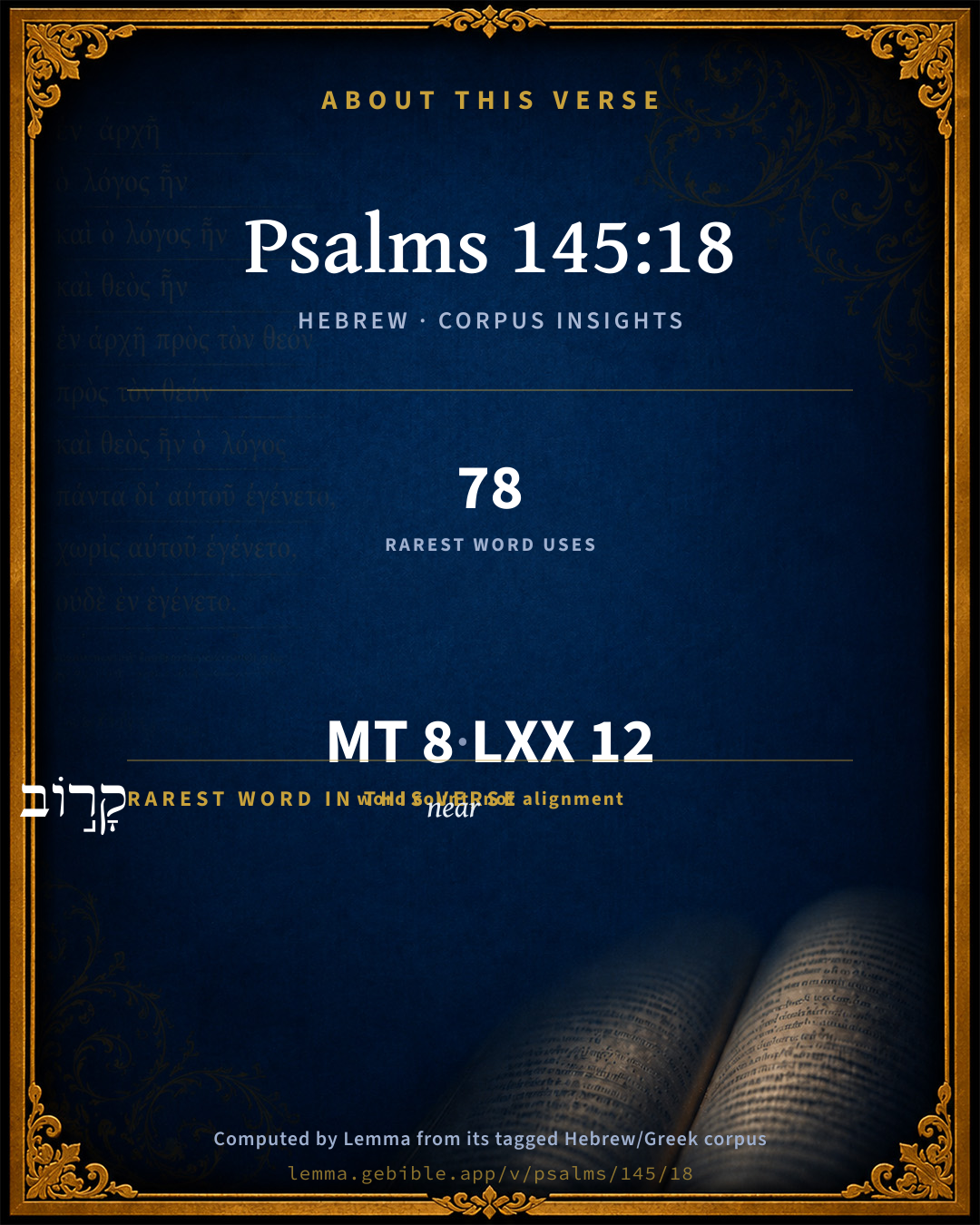
Psalms 145:18

Hebrew (Westminster Leningrad Codex) Psalms 145:18 appears in the Hebrew Old Testament. The text above is from the Westminster Leningrad Codex. Each word links to its Strong’s number, a concise gloss, and parsing drawn from the Open Scriptures Hebrew Bible morphology. Click any word for its full Brown-Driver-Briggs (BDB) entry.
Download image
Cite this verse

Psalms 145:18 (World English Bible). Public Domain. Lemma interlinear Bible study tool, https://lemma.gebible.app/v/psalms/145/18.

Show BibTeX & RIS
BibTeX
RIS
English Translation
Yahweh is near to all those who call on him, To all who call on him in truth.
World English Bible · Public Domain
Download a study sheet

One document with this verse’s original text, its word-by-word gloss line, the meaning frame, cross-references with their text, attributed commentary, and full source and license credits — printable, and it pastes into notes with its structure intact.

This verse Autodidact and up

Study sheet (.html) Plain text (.txt)

A passage Seminary Student

Up to 50 verses in one chapter. A passage sheet keeps up to 6 commentary sources and 12 cross-references per verse, in the order this page ranks them, and says so on the sheet whenever that leaves anything out. Ask for a single verse and you get the Autodidact verse sheet above.

Everything on this page stays free to read, with no account — the sheet is a download of what is already on screen, not access to it.

Want to remove ads? Support Godless Engineer
Compare translations 3

The same verse in 3 English versions, stacked beneath the original-language interlinear above. Click any original word for its lexicon entry.

Each is an independent rendering of the whole verse — the interlinear is not word-aligned to these translations.

Highlighted words mark where these versions differ — a whole-verse word diff, not a word-by-word alignment.

  • World English Bible Public Domain
    Yahweh is near to all those who call on him, To all who call on him in truth.
  • King James Version Public Domain
    The LORD is nigh unto all them that call upon him, to all that call upon him in truth.
  • unfoldingWord Literal Text CC BY-SA 4.0
    Yahweh near to all of the ones calling on him, to all who call on him in truth.

unfoldingWord Literal Text — © unfoldingWord, licensed CC BY-SA 4.0. Word-aligned USFM3 via Door43 (git.door43.org/unfoldingWord/en_ult).

Versions to compare (up to 4)

3 of 4 selected

Show all 17 translations

Every available English version of this verse, each an independent rendering of the whole verse.

  • World English Bible Public Domain
    Yahweh is near to all those who call on him, To all who call on him in truth.
  • Berean Standard Bible Public Domain
    The LORD is near to all who call on Him, to all who call out to Him in truth.
  • Majority Standard Bible Public Domain
    The LORD is near to all who call on Him, to all who call out to Him in truth.
  • King James Version Public Domain
    The LORD is nigh unto all them that call upon him, to all that call upon him in truth.
  • American Standard Version (1901) Public Domain
    Jehovah is nigh unto all them that call upon him, To all that call upon him in truth.
  • Revised Version (1885) Public Domain
    The LORD is nigh unto all them that call upon him, to all that call upon him in truth.
  • Geneva Bible (1599) Public Domain
    The Lord is neere vnto all that call vpon him: yea, to all that call vpon him in trueth.
  • Young's Literal Translation Public Domain
    Near `is' Jehovah to all those calling Him, To all who call Him in truth.
  • Literal Standard Version CC BY-SA 4.0
    YHWH [is] near to all those calling Him, || To all who call Him in truth.
  • Unlocked Literal Bible CC BY-SA 4.0
    Yahweh is near to all those who call to him, to all who call to him in trustworthiness.
  • unfoldingWord Literal Text CC BY-SA 4.0
    Yahweh near to all of the ones calling on him, to all who call on him in truth.
  • Darby Bible Public Domain
    Jehovah is nigh unto all that call upon him, unto all that call upon him in truth.
  • World Messianic Bible Public Domain
    The LORD is near to all those who call on him, to all who call on him in truth.
  • Webster's Bible Public Domain
    The LORD is nigh to all them that call upon him, to all that call upon him in truth.
  • Free Bible Version CC BY-SA 4.0
    The Lord is close to all who ask for his help, to all who ask in sincerity.
  • Bible in Basic English Public Domain
    The Lord is near all those who give honour to his name; even to all who give honour to him with true hearts.
  • JPS Tanakh (1917) Public Domain
    The LORD is nigh unto all them that call upon Him, to all that call upon Him in truth.

Literal Standard Version (2020), Covenant Press — licensed CC BY-SA 4.0. Text via the HelloAO Bible API (eBible.org). Unlocked Literal Bible (unfoldingWord) — licensed CC BY-SA 4.0. Text via the HelloAO Bible API (eBible.org). unfoldingWord Literal Text — © unfoldingWord, licensed CC BY-SA 4.0. Word-aligned USFM3 via Door43 (git.door43.org/unfoldingWord/en_ult). Free Bible Version, Dr. Jonathan Gallagher — licensed CC BY-SA 4.0. Text via the HelloAO Bible API (eBible.org).

Word by word

More ways to search: Search by grammar → Find every occurrence → Compare this word →

Practice this passage: Drill this verse → Learn its vocabulary →

About this verse

These counts appear in no published source. They are computed here, from the morphology-tagged text and Lemma’s own curated glosses. What Lemma adds →

8
words
6
distinct lemmas
Wisdom
section

Grammatical profile

  • 2 verbs
  • 4 nouns
  • 1 adjective
  • 1 particle

Verb forms

  • קֹרְאָ֑יו Qal · Participle Active
  • יִקְרָאֻ֣הוּ Qal · Imperfect

Repetition

Words recur within this verse — often emphatic in Hebrew:

  • לְכָל all H3605 ×2
  • קֹרְאָ֑יו to call H7121 ×2

Hebrew & Septuagint length

In English translation the verse runs 18 words from the Hebrew and 18 from the Septuagint (LXX English) — the same length.

A rough comparison of the two English renderings, which tokenize alike — not a word-level alignment.

Word counts can differ between the Hebrew and the Greek without any difference in meaning — e.g. the Hebrew direct-object marker אֵת has no separate Greek word, and Greek often adds the article ὁ.

In the original languages it is 8 Hebrew tokens and 12 Greek tokens — but the two are counted differently (Hebrew bundles its prefixes and suffixes into one token; the Greek is in lemma form), so that isn’t a like-for-like length.

Cross-references

19

Topical passages linked to Psalms 145:18 in the Treasury of Scripture Knowledge — connected by theme and wording, ordered by reader-vote popularity; previews shown in the World English Bible.

  • Jeremiah 29:12–13 You shall call on me, and you shall go and pray to me, and I will listen to you.
  • Psalms 34:18 Yahweh is near to those who have a broken heart, And saves those who have a crushed spirit.
  • Deuteronomy 4:7 For what great nation is there, that has a god so near to them, as Yahweh our God is whenever we call on him?
  • John 4:24 God is spirit, and those who worship him must worship in spirit and truth."
  • Isaiah 58:9 Then shall you call, and Yahweh will answer; you shall cry, and he will say, Here I am. If you take away from the midst of you the yoke, the putting forth of the finger, and speaking wickedly;
  • John 14:23 Jesus answered him, "If a man loves me, he will keep my word. My Father will love him, and we will come to him, and make our home with him.
  • James 4:8 Draw near to God, and he will draw near to you. Cleanse your hands, you sinners; and purify your hearts, you double-minded.
  • 1 John 3:20–22 because if our heart condemns us, God is greater than our heart, and knows all things.
  • Psalms 46:5 God is in her midst. She shall not be moved. God will help her at dawn.
  • Psalms 46:1 God is our refuge and strength, A very present help in trouble.
  • Matthew 6:5–8 "When you pray, you shall not be as the hypocrites, for they love to stand and pray in the synagogues and in the corners of the streets, that they may be seen by men. Most assuredly, I tell you, they have received their reward.
  • Psalms 119:2 Blessed are those who keep his statutes, Who seek him with their whole heart.
  • Psalms 17:1 Hear, Yahweh, my righteous plea; Give ear to my prayer, that doesn't go out of deceitful lips.
  • Hosea 7:14 They haven't cried to me with their heart, But they howl on their beds. They assemble themselves for grain and new wine. They turn away from me.
  • Psalms 119:151 You are near, Yahweh. All your commandments are truth.
  • Proverbs 15:8 The sacrifice made by the wicked is an abomination to Yahweh, But the prayer of the upright is his delight.
  • 1 Kings 18:27–28 It happened at noon, that Elijah mocked them, and said, Cry aloud; for he is a god: either he is musing, or he is gone aside, or he is on a journey, or peradventure he sleeps and must be awakened.
  • Isaiah 1:15–16 When you spread forth your hands, I will hide my eyes from you; Yes, when you make many prayers, I will not hear. Your hands are full of blood.
  • Matthew 23:13 "Woe to you, scribes and Pharisees, hypocrites! For you devour widows' houses, and as a pretense you make long prayers. Therefore you will receive greater condemnation.

Cross-references courtesy of OpenBible.info (CC BY 4.0).

Hebrew and Greek witnesses Masoretic Hebrew ↔ Greek Septuagint

The same verse in the two great witnesses to the Old Testament, shown verse-for-verse.

You’re reading Greek Psalm 144 (Hebrew Psalm 145). The Septuagint counts the superscription, so verse numbers can differ from the Hebrew — chapter-level alignment, not verse-by-verse. Numbering follows Rahlfs.

These are two independent witnesses, not word-aligned to each other, and the Septuagint is shown in lemma (dictionary) form.

Hebrew Psalms 145:18 Masoretic · Westminster Leningrad Codex

קָר֣וֹב יְ֭הוָה לְכָל קֹרְאָ֑יו לְכֹ֤ל אֲשֶׁ֖ר יִקְרָאֻ֣הוּ בֶאֱמֶֽת

Yahweh is near to all those who call on him, To all who call on him in truth.

World English Bible · Public Domain

Greek LXX Greek Psalm 144:18 Septuagint · lemma form

ἐγγύς κύριος πᾶς ὁ ἐπικαλέω αὐτός πᾶς ὁ ἐπικαλέω αὐτός ἐν ἀλήθεια

The Lord is near to all that call upon him, to all that call upon him in truth.

LXX2012 (modern English Septuagint) · Public Domain

Hebrew: Westminster Leningrad Codex (CC BY 4.0). Greek: Septuagint (public domain); English from LXX2012 (modern English Septuagint) (Public Domain). How the Septuagint differs from the Hebrew →

Commentary

Notes on Psalms 145:18 from classic Christian and Jewish commentators (each source and its license shown beneath its notes). The classic Christian expositions comment on the surrounding passage and are grouped to its opening verse, so a note may address several verses; the Jewish commentaries on the Tanakh (Rashi and others) are per-verse, so they appear only where the commentator wrote on this verse.

Lemma curates 59 commentaries, every one of them public domain or Creative Commons licensed, each selected and text-cleaned for this edition rather than reprinted as found. About our sources →

Trapp's Complete Commentary

John Trapp

Psa 145:18 The LORD [is] nigh unto all them that call upon him, to all that call upon him in truth.

Ver. 18. The Lord is nigh unto all those, &c.] He is ever at hand, to hear and help his faithful suitors and suppliants; these have the royalty of his ear, free access, sure success.

To all that call upon him in truth] That draw near with a true heart, in full assurance of faith, having their hearts sprinkled from an evil conscience, and their bodies washed with pure water, Heb 10:22.

John Trapp, A Commentary or Exposition upon All the Books of the Old and New Testament (1647–1656) — public domain. Text from a community e-Sword module.

The Biblical Illustrator

Joseph S. Exell

Psa_145:18-21

The Lord is nigh unto all them that call upon Him.

God and His people

I. The persons who are favoured with the Divine presence.

1. They call upon God.

2. They call upon Him in truth.

3. They desire Him.

4. They fear Him.

5. They cry unto Him.

6. They love Him.

7. They praise Him.

II. The favours which the Lord manifests to His people.

1. He is near them.

2. He will grant their desires.

3. He will save them.

4. He will preserve them.

5. They shall be with Him for ever.

III. The destruction of the wicked. He will destroy--

1. Their expectation (Pro_10:28-29).

2. Their souls and bodies in hell (Mat_10:28).

IV. Improvement.

1. See what great encouragement there is for prayer.

2. What incitements to filial confidence in God.

3. What reasons for gratitude and praise.

4. And what terror to the unbelieving. (T. B. Baker.)

The Biblical Illustrator, edited by Joseph S. Exell (c. 1880s–1900s) — public domain. Text from a community e-Sword module.

Joseph Benson's Commentary

Psa 145:18-19. The Lord is nigh unto all that call upon him — To answer their prayers, supposing they call upon him; in truth — Or, with an upright heart, asking those things only which are according to his will, sincerely desiring what they ask, trusting in him that he will give it, and waiting upon him in the way he hath appointed for that purpose. Observe, reader, our King “is not like earthly princes, difficult of access, but one of whom the meanest subject may at any time obtain an audience, and be certain of having his request granted, if it be made in truth, without wavering and without hypocrisy, with humble confidence and unwearied constancy,” he being found walking in the way of duty and obedience. He will fulfil the desire of them that fear him — So far as their desire is agreeable to his will, and it would be for their good to have it fulfilled.

Joseph Benson's Commentary on the Old and New Testaments (1811–1818) — public domain. Text from a community e-Sword module.

J. A. Alexander on Psalms

Joseph Addison Alexander

18. (Psa 145:18) Near (is) Jehovah to all calling upon him, to all calling upon him in truth, i.e. sincerely, with importunate desire and strong confidence. With this verse compare Psa 34:7; Psa 34:19.

Joseph Addison Alexander, The Psalms Translated and Explained (1850) — public domain. Text from a community e-Sword module.

Geneva Bible (1599)

Geneva Bible translators

Which only appertaineth to the faithful: and this virtue is contrary to infidelity, doubting, impatience and murmuring.

Geneva Bible (1599) marginal notes — public domain. Text via Bolls.life.

Jamieson, Fausset & Brown

Robert Jamieson, A. R. Fausset & David Brown

(Compare Psa 34:7, Psa 34:10).

Jamieson, Fausset & Brown — Commentary Critical and Explanatory on the Whole Bible (1871) — public domain (CC PDM 1.0). Text via the HelloAO Bible API.

Adam Clarke's Commentary

Verse 18. The Lord is nigh] Whoever calls upon God in truth, with a sincere and upright heart, one that truly desires his salvation, to that person God is nigh. The following verse shows he is not only near to praying people, but

1. He will hear their cry.

2. Fulfil their desires.

3. Save them.

Reader, lift up thy soul in prayer to this merciful God.

Adam Clarke's Commentary on the Bible (1810–1826) — public domain. Text from a community e-Sword/MySword module.

John Calvin's Commentaries

18. Jehovah is near to all that call upon him. This truth is principally applicable to believers, whom God in the way of singular privilege invites to draw near him, promising that he will be favorable to their prayers. Faith, there is no doubt, lies idle and even dead without prayer, in which the spirit of adoption shows and exercises itself, and by which we evidence that all his promises are considered by us as stable and sure. The inestimable grace of God, in short, towards believers, appears in this, that he exhibits himself to them as a Father. As many doubts steal upon us when we pray to God, and we either approach him with trembling, or fail by becoming discouraged and lifeless, David declares it to be true without exception, that God hears all who call upon him. At the same time, as most men pervert and profane the method of calling upon God through inventions of their own, the right manner of praying is laid down in the next part of the verse, which is, that we should pray in truth. Although men resort to God in a cold manner, or even in their prayers expostulate with him, while their hearts are swelling with pride or with anger, they yet complain that they are not heard; just as if there were no difference between praying and quarreling, or the exercise of faith and hypocrisy. The greater part of men, involved in infidelity, scarcely believe that there is a God in heaven at all; others would banish him from it if they could; others would tie him down to their views and, wishes, while some seek slight and insufficient ways of reconciling him, so that the common way of praying is but an idle and empty ceremony. “Les autres voudroyent qu’il fust sujet a eux: les autres comme par maniere d’acquit cerchent cluelque moyen de l’appaiser,” etc. — Fr.

John Calvin's Commentaries (1540-1563) — public domain. Text from the Calvin Translation Society English edition (1840s-50s) via the Christian Classics Ethereal Library (ccel.org). Calvin's coverage is partial (roughly two-thirds of the Bible); uncommented books and verses are honest gaps, never fabricated. The 19th-century editor's footnotes and remarks are omitted so the notes are faithfully Calvin's own voice.

Ellicott's Commentary for English Readers

(18) The Lord is nigh . . .

Closer is He than breathing, and nearer than hands and feet.”

TENNYSON: Higher Pantheism.

A Bible Commentary for English Readers, edited by Charles John Ellicott (1878–1897) — public domain. Text from a community e-Sword module.

The Cambridge Bible for Schools and Colleges

gen. ed. J. J. S. Perowne

18. nigh unto all them that call upon him] To answer and help. Cp. Deu_4:7; Psa_34:18; Psa_119:151.

in truth] The hypocrite finds no favour with Him. Cp. Isa_10:20; Joh_4:23-24.

The Cambridge Bible for Schools and Colleges (gen. ed. J. J. S. Perowne; Cambridge University Press, 1878–1918) — public domain. Text from a community e-Sword module.

John Gill's Exposition

The Lord is nigh unto all them that call upon him,.... He is not only nigh unto them in relation, being their near kinsman, brother, father, husband, and head, but with respect to place and presence; not in a general way, as he is the omnipresent God, and so nigh to all, and from whose presence there is no fleeing; but in a special way, he is so nigh to them as he is not unto others, Deu 4:7. He is in their hearts, and dwells there by faith, and they dwell in him; his blood is sprinkled in their consciences, and his righteousness is unto them and upon them; his salvation is brought near to them, to their very hearts, and they are nearer that than when they first believed; he is nigh to them that call upon him, for Christ is equally called upon as the Father; see Co1 1:2; so as to give them what they ask of him, and to help them in all their times of need;

to all that call upon him in truth; in faith and with fervency, constantly and importunely, and in the sincerity and uprightness of their hearts; with true hearts, cordially and affectionately; their hearts and mouths agreeing together, as Kimchi observes.

John Gill's Exposition of the Whole Bible (1746–1763) — public domain (CC PDM 1.0). Text via the HelloAO Bible API.

Albert Barnes' Notes on the Bible

The Lord is nigh unto all them that call upon him - There is a sense in which he is “nigh” to all, for he is everywhere present; but there is a special sense in which he seems to be near to us; in which he manifests himself to us; in which he gives us evidence of his presence. It is in prayer, in praise, in his ordinances - in his gracious interpositions in our behalf - in the peace and joy which we have in communion with him. Compare the notes at Psa 34:18 : “The Lord is nigh unto them that are of a broken heart.”

To all that call upon him in truth - In sincerity; not hypocritically; worshipping him as the true God, and with a sincere desire to obtain his favor. Compare the notes at Joh 4:24. We can have no hope that God will hear us unless we are sincere in our worship. He sees the heart, and he will act toward us as we are, and not as we profess to be.

Albert Barnes' Notes on the Bible (1834–1885) — public domain. Text from a community e-Sword/MySword module.

Matthew Poole's English Annotations

Is nigh unto all them, to answer their prayers for relief,

that call upon him in truth; sincerely, or with an upright heart, trusting to him, and waiting upon him in his way.

Matthew Poole's English Annotations on the Holy Bible (1683–1685) — public domain. Text from a community e-Sword/MySword module.

The Treasury of David

Charles H. Spurgeon

Ver. 18. The LORD is nigh unto all them that call upon him. Not only near by his omnipresence, but to sympathize and favour. He does not leave praying men, and men who confess his name, to battle with the world alone, but he is ever at their side. This favour is not for a few of those who invoke him; but for each one of the pious company. "All" who place themselves beneath the shield of his glorious name by calling themselves by it, and by calling upon it in supplication, shall find him to be a very present help in trouble. "To all that call upon him in truth": for there are many whose formal prayers and false professions will never bring them into communion with the Lord. To pray in truth, we must have a true heart, and the truth in our heart; and then we must be humble, for pride is a falsehood; and be earnest, or else prayer is a lie. A God of truth cannot be nigh to the spirit of hypocrisy; this he knows and hates; neither can he be far removed from a sincere spirit, since it is his work, and he forsakes not the work of his own hands.

Ver. 18. The Lord is nigh. The nearness or remoteness of a friend is very material and considerable in our troubles, distresses, wants, dangers etc. I have such a friend and he would help me, but he lives so far off; and I have another friend that has a great love for me, that is able to counsel me, and to speak a word in season to me, and that in my distress would stand close to me, but he is so remote. I have a special friend, that did he know how things stand with me would make my burdens his, and my wants his, and my sorrows his; but he is in a far country, he is at the Indies, and I may be undone before I can hear from him. But it is not thus with you, O Christians! who have a God so nigh unto you, who have the signal presence of God in the midst of you, yea, who have a God always standing by you, "The Lord stood by me", etc. 2Ti 4:17. Thomas Brooks.

Ver. 18. Them that call upon him. To call upon the name of the Lord implies right faith, to call upon him as he is; right trust in him, leaning upon him, right devotion, calling upon him as he has appointed; right life, ourselves who call upon him being, or becoming by his grace, what he wills. They "call" not "upon the Lord", but upon some idol of their own imagining, who call upon him as other than he has revealed himself, or remaining themselves other than those whom he has declared that he will hear. For such deny the very primary attribute of God, his truth. Their God is not a God of truth. Edward Bouverie Pusey, 1800-1882.

Ver. 18. To all that call upon him in truth. Because there is a counterfeit and false sort of worshipping, and calling upon God, which is debarred from the benefit of this promise, to wit, when the party suppliant is not reconciled, nor seeking reconciliation through Christ the Mediator, or is seeking something not promised, or something for a carnal end, that he may bestow it on his lusts; therefore he who hath right unto this promise must be a worshipper of God in faith, and sincere intention; and to such the Lord will show himself "nigh". David Dickson.

Ver. 18. To call upon God in truth is, first, to repose an implicit confidence in the faithfulness of his promise, and to look for unlimited answers to prayer from the riches of his grace in Christ Jesus. But it is also, in the next place, to feel our own urgent need of the things for which we supplicate, and to realize an earnest and unfeigned concern to obtain them. "What things ye desire when ye pray", said the Lord, "believe that ye receive them, and ye shall have them"; and hence we gather, that the hearty desire, arising out of the consciousness of need, is an integral and inseparable part of genuine and effectual prayer. Thomas Dale, 1853.

Ver. 18-19. God's people are a praying people, a generation of seekers, and such commonly are speeders. God never said to the seed of Jacob, Seek ye my face in vain. They seek his face, righteousness and strength, and he is found of them...The saints alone betake themselves to God and his help, run to him as their sanctuary; others fly from God's presence, run to the rocks, and the tops of the ragged rocks, call to the hills and the mountains; but a child of God goes only and tells his Father, and before him lays open his cause; as good Hezekiah did, when Rabshakeh came out against him; "O Lord, I am oppressed, undertake for me"; or the Church (Isa 33:2), "Be thou our arm every morning, and our salvation in time of trouble." They only sensibly need, and so alone crave and implore divine succour; and God will not suffer his people to lose the precious treasure of their prayers. "The Lord is nigh unto all them that call upon him; he will fulfil their desire, he will hear their cry", etc. That God who prepares his people's heart to pray, prepares also his own ear to hear; and he that promises to hear before we call, will never deny to hearken when we cry unto him. As Calvin saith: "Oppressions and afflictions make man cry, and cries and supplications make God hear." F. E., in "The Saint's Ebenezer", 1667.

Ver. 18-20. Gather from these verses the character of God's people.

1. They call upon God.

2. They fear God.

3. They have desires towards God.

4. They have answers from God.

5. They love God.

Ver. 18. (last clause.) True prayer, in what it differs essentially from mere formalism.

Ver. 18. At the palace gates.

1. Directions to callers.

a) "Call upon him"; let the repetition suggest pertinacity.

b) Call "in truth"; sincerely, with promises, in appointed way.

2. Encouragement for callers. Jehovah is nigh, with his ready ear, sympathizing heart, and helpful hand. W. B. H.

Ver. 18-19. The blessedness of prayer.

1. Definition of prayer: "calling upon God."

2. Variety in prayer: "call, desire, cry."

3. Essential characteristic of prayer: "truth."

4. God's nearness in prayer.

5. Assured success of prayer. "He will fulfil, hear, save." C. A. D.

Psalms 145:19*

Charles H. Spurgeon's The Treasury of David (1869–1885) — public domain. Psalms only. Text from a community e-Sword/MySword module.

Whedon's Commentary on the Bible

Daniel D. Whedon

18. The Lord is nigh—It is here shown that while God sends his rain and sunshine and harvest upon all his creatures, he gives special hearing and special mercy to the true hearted, to them that fear him.

Daniel D. Whedon (gen. ed.), Commentary on the Old and New Testaments (1874–1909) — public domain. Text from a community e-Sword module.

The Pulpit Commentary

The Lord is nigh unto all them that call upon him. (comp. Deu_4:7 Psa_34:18 Psa_46:1 Psa_119:151, etc.) God draws near to those who draw near to him; i.e. he makes his presence (which is always everywhere) felt by them. To all that call upon him in truth. A limiting clause. Mere formal prayer is useless, does not lessen the distance between God and man, rather augments it. If we really desire to enjoy the consciousness of his presence, we must call upon him "in truth," i.e. sincerely, with earnest desire and strong confidence.

The Pulpit Commentary (1880–1919), ed. H.D.M. Spence-Jones & Joseph S. Exell — public domain. Text from a community e-Sword module.

John Wesley's Explanatory Notes

Nigh - To answer their prayers. In truth - With an upright heart.

John Wesley, Explanatory Notes Upon the Whole Bible (1754–1765) — public domain. Text via the GEBible commentary corpus.

Lesson kit

Teaching starters — assembled from the data on this page, not authored interpretation. Every prompt links to the verse data it draws on. Edit before teaching.

Psalms, in the Wisdom, opens this verse with 8 words (6 distinct Hebrew lemmas). Its most distinctive word is qârôwb (“near”). A historical commentator’s framing appears above. Read the whole chapter for the surrounding context.

Discussion questions

  1. How does “near” (qârôwb) shape what this verse is saying?
  2. How does Jeremiah 29:12–13, which shares this passage’s theme, read alongside this verse?
  3. What does the repetition of “all” (2× in this one verse) do in this verse?
  4. These translations render this verse differently. What is at stake in choosing one wording over another?
  5. «קֹרְאָ֑יו» is a Qal Participle Active verb. How does that grammatical form shape the action described?
  6. Compare how Trapp's Complete Commentary and The Biblical Illustrator read this verse. Where do they agree or differ?

Things to notice

Reading settings

Reading text

Shown beneath each verse's original-language words.

Old Testament
Old Testament edition

Read the OT as the Masoretic Hebrew (MT) or the Greek Septuagint (LXX).

English shown for the Greek Septuagint (in the Hebrew ↔ Greek comparison).

Comparing translations? Open the Compare panel on any verse page to stack up to four side by side.