
Isaiah 43:14

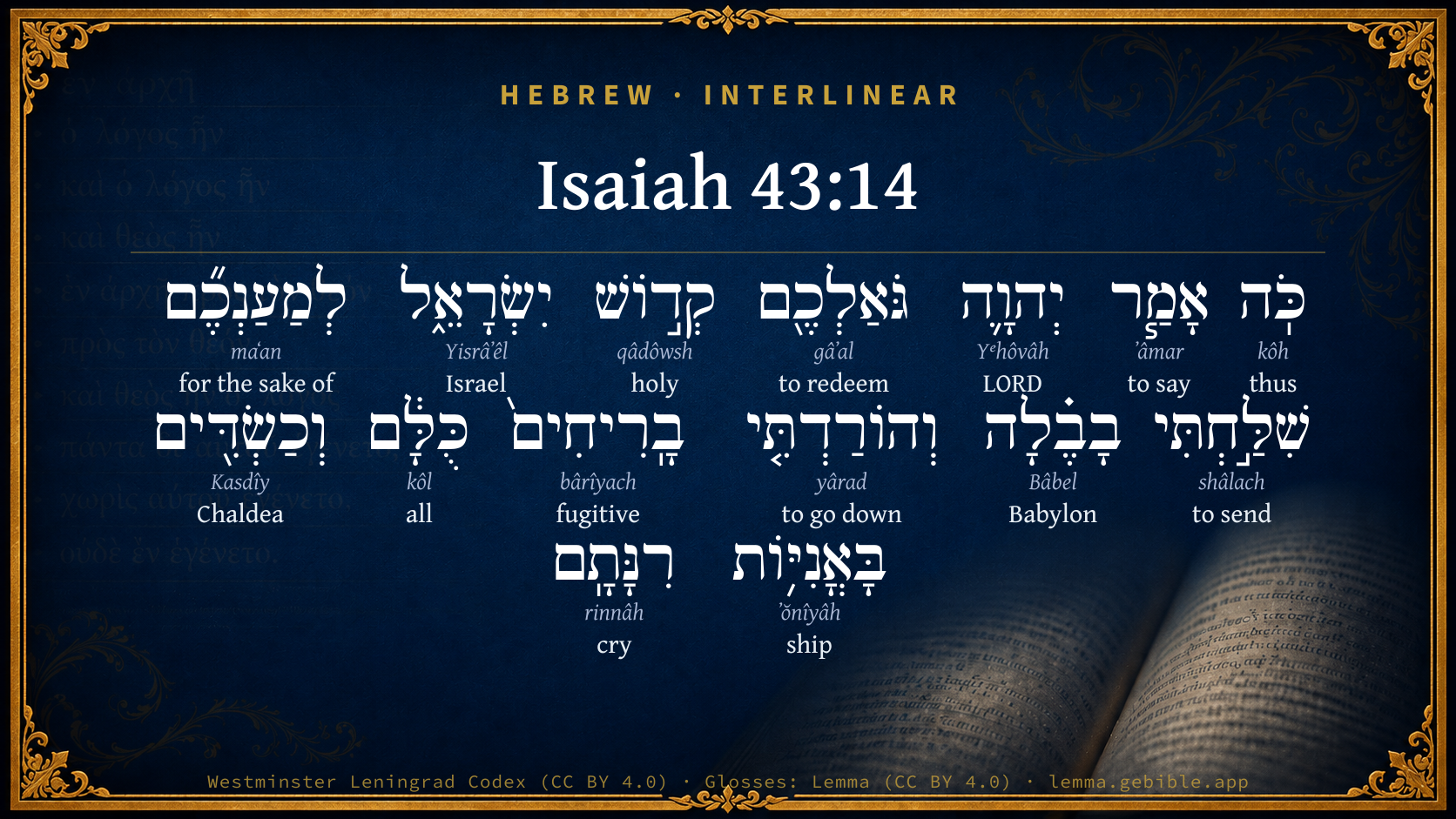
Hebrew (Westminster Leningrad Codex) Isaiah 43:14 appears in the Hebrew Old Testament. The text above is from the Westminster Leningrad Codex. Each word links to its Strong’s number, a concise gloss, and parsing drawn from the Open Scriptures Hebrew Bible morphology. Click any word for its full Brown-Driver-Briggs (BDB) entry.
Download image
Cite this verse

Isaiah 43:14 (World English Bible). Public Domain. Lemma interlinear Bible study tool, https://lemma.gebible.app/v/isaiah/43/14.

Show BibTeX & RIS
BibTeX
RIS
English Translation
Thus says Yahweh, your Redeemer, the Holy One of Israel: For your sake I have sent to Babylon, and I will bring down all of them as fugitives, even the Chaldeans, in the ships of their rejoicing.
World English Bible · Public Domain
Download a study sheet

One document with this verse’s original text, its word-by-word gloss line, the meaning frame, cross-references with their text, attributed commentary, and full source and license credits — printable, and it pastes into notes with its structure intact.

This verse Autodidact and up

Study sheet (.html) Plain text (.txt)

A passage Seminary Student

Up to 50 verses in one chapter. A passage sheet keeps up to 6 commentary sources and 12 cross-references per verse, in the order this page ranks them, and says so on the sheet whenever that leaves anything out. Ask for a single verse and you get the Autodidact verse sheet above.

Everything on this page stays free to read, with no account — the sheet is a download of what is already on screen, not access to it.

Want to remove ads? Support Godless Engineer
Compare translations 3

The same verse in 3 English versions, stacked beneath the original-language interlinear above. Click any original word for its lexicon entry.

Each is an independent rendering of the whole verse — the interlinear is not word-aligned to these translations.

Highlighted words mark where these versions differ — a whole-verse word diff, not a word-by-word alignment.

  • World English Bible Public Domain
    Thus says Yahweh, your Redeemer, the Holy One of Israel: For your sake I have sent to Babylon, and I will bring down all of them as fugitives, even the Chaldeans, in the ships of their rejoicing.
  • King James Version Public Domain
    Thus saith the LORD, your redeemer, the Holy One of Israel; For your sake I have sent to Babylon, and have brought down all their nobles, and the Chaldeans, whose cry is in the ships.
  • unfoldingWord Literal Text CC BY-SA 4.0
    Thus says Yahweh, your Redeemer, the Holy of Israel: “For your sake I will send to Babylon, and I will bring all of them down fugitives, and the Chaldeans, in the ships of their rejoicing.

unfoldingWord Literal Text — © unfoldingWord, licensed CC BY-SA 4.0. Word-aligned USFM3 via Door43 (git.door43.org/unfoldingWord/en_ult).

Versions to compare (up to 4)

3 of 4 selected

Show all 18 translations

Every available English version of this verse, each an independent rendering of the whole verse.

  • World English Bible Public Domain
    Thus says Yahweh, your Redeemer, the Holy One of Israel: For your sake I have sent to Babylon, and I will bring down all of them as fugitives, even the Chaldeans, in the ships of their rejoicing.
  • Berean Standard Bible Public Domain
    Thus says the LORD your Redeemer, the Holy One of Israel: “For your sake, I will send to Babylon and bring them all as fugitives, even the Chaldeans, in the ships in which they rejoice.
  • Majority Standard Bible Public Domain
    Thus says the LORD your Redeemer, the Holy One of Israel: “For your sake, I will send to Babylon and bring them all as fugitives, even the Chaldeans, in the ships in which they rejoice.
  • King James Version Public Domain
    Thus saith the LORD, your redeemer, the Holy One of Israel; For your sake I have sent to Babylon, and have brought down all their nobles, and the Chaldeans, whose cry is in the ships.
  • American Standard Version (1901) Public Domain
    Thus saith Jehovah, your Redeemer, the Holy One of Israel: For your sake I have sent to Babylon, and I will bring down all of them as fugitives, even the Chaldeans, in the ships of their rejoicing.
  • Revised Version (1885) Public Domain
    Thus saith the LORD, your redeemer, the Holy One of Israel: For your sake I have sent to Babylon, and I will bring down all of them as fugitives, even the Chaldeans, in the ships of their rejoicing.
  • Geneva Bible (1599) Public Domain
    Thus sayeth the Lord your redeemer, the holy one of Israel, For your sake I haue sent to Babel, and brought it downe: they are all fugitiues, and the Chaldeans crie in the shippes.
  • Douay-Rheims (1899) Public Domain
    Thus saith the Lord your redeemer, the Holy One of Israel: For your sake I sent to Babylon, and have brought down all their bars, and the Chaldeans glorying in their ships.
  • Young's Literal Translation Public Domain
    Thus said Jehovah, your Redeemer, The Holy One of Israel: `For your sake I have sent to Babylon, And caused bars to descend -- all of them, And the Chaldeans, whose song `is' in the ships.
  • Literal Standard Version CC BY-SA 4.0
    Thus said YHWH, your Redeemer, || The Holy One of Israel: “I have sent to Babylon for your sake, || And caused bars to descend—all of them, || And the Chaldeans, whose song [is] in the ships.
  • Unlocked Literal Bible CC BY-SA 4.0
    This is what Yahweh says, your Redeemer, the Holy One of Israel: “For your sake I send to Babylon and lead them all down as fugitives, turning the Babylonians' expressions of joy into songs of lamentation.
  • unfoldingWord Literal Text CC BY-SA 4.0
    Thus says Yahweh, your Redeemer, the Holy of Israel: “For your sake I will send to Babylon, and I will bring all of them down fugitives, and the Chaldeans, in the ships of their rejoicing.
  • Darby Bible Public Domain
    Thus saith Jehovah, your Redeemer, the Holy One of Israel: For your sake I have sent to Babylon, and have brought all of them down as fugitives, even the Chaldeans, whose cry is in the ships.
  • World Messianic Bible Public Domain
    The LORD, your Redeemer, the Holy One of Israel says: “For your sake, I have sent to Babylon, and I will bring all of them down as fugitives, even the Kasdim, in the ships of their rejoicing.
  • Webster's Bible Public Domain
    Thus saith the LORD, your Redeemer, the Holy One of Israel; For your sake I have sent to Babylon, and have brought down all their nobles, and the Chaldeans, whose cry is in the ships.
  • Free Bible Version CC BY-SA 4.0
    This is what the Lord, your Redeemer, the Holy One of Israel, says: For your sake I will send attackers against Babylon and bring them down. All the Babylonians will be like fugitives, escaping in the ships they're so proud of.
  • Bible in Basic English Public Domain
    The Lord, who has taken up your cause, the Holy One of Israel, says, Because of you I have sent to Babylon, and made all their seers come south, and the Chaldaeans whose cry is in the ships.
  • JPS Tanakh (1917) Public Domain
    Thus saith the LORD, your Redeemer, The Holy One of Israel: For your sake I have sent to Babylon, and I will bring down all of them as fugitives, even the Chaldeans, in the ships of their shouting.

Literal Standard Version (2020), Covenant Press — licensed CC BY-SA 4.0. Text via the HelloAO Bible API (eBible.org). Unlocked Literal Bible (unfoldingWord) — licensed CC BY-SA 4.0. Text via the HelloAO Bible API (eBible.org). unfoldingWord Literal Text — © unfoldingWord, licensed CC BY-SA 4.0. Word-aligned USFM3 via Door43 (git.door43.org/unfoldingWord/en_ult). Free Bible Version, Dr. Jonathan Gallagher — licensed CC BY-SA 4.0. Text via the HelloAO Bible API (eBible.org).

Word by word

More ways to search: Search by grammar → Find every occurrence → Compare this word →

Practice this passage: Drill this verse → Learn its vocabulary →

בָֽרִיחִים֙
bârîyach
H1281
“in/at the · fugitives”
Preposition, Determined + Noun, Common, Masculine, Plural, Absolute
Part of Speech
Preposition + Noun
Type
Common
Gender
Masculine
Number
Plural
State
Absolute
Full BDB Definition

Origin: from H1272

TWOT: 284a

fleeing (adjective) - fugitive (substantive)
  1. כֹּֽה kôh H3541 “thus” Adverb
  2. אָמַ֧ר ʼâmar H559 “to say” Verb, Qal, Perfect, 3rd Person, Masculine, Singular
  3. יְהוָ֛ה Yᵉhôvâh H3068 “LORD” Noun, Proper
  4. גֹּאַלְכֶ֖ם gâʼal H1350 “redeeming · you” Verb, Qal, Participle Active, Masculine, Singular, Construct + Suffix, Personal, 2nd Person, Masculine, Plural
  5. קְד֣וֹשׁ qâdôwsh H6918 “holy of” Adjective, Adjective, Masculine, Singular, Construct
  6. יִשְׂרָאֵ֑ל Yisrâʼêl H3478 “Israel” Noun, Proper
  7. לְמַעַנְכֶ֞ם maʻan H4616 “for the sake of · you” Preposition + Suffix, Personal, 2nd Person, Masculine, Plural
  8. שִׁלַּ֣חְתִּי shâlach H7971 “to send” Verb, Piel, Perfect, 1st Person, Common, Singular
  9. בָבֶ֗לָה Bâbel H894 “Babylon · toward” Noun, Proper + Suffix, Demonstrative
  10. וְהוֹרַדְתִּ֤י yârad H3381 “and · to go down” Conjunction + Verb, Hiphil, Sequential Perfect, 1st Person, Common, Singular
  11. כֻּלָּ֔ם kôl H3605 “all · their” Noun, Common, Masculine, Singular, Construct + Suffix, Personal, 3rd Person, Masculine, Plural
  12. וְכַשְׂדִּ֖ים Kasdîy H3778 “and · Chaldea” Conjunction + Noun, Proper
  13. בָּאֳנִיּ֥וֹת ʼŏnîyâh H591 “in/at · ships of” Preposition + Noun, Common, Feminine, Plural, Construct
  14. רִנָּתָֽם rinnâh H7440 “cry · their” Noun, Common, Feminine, Singular, Construct + Suffix, Personal, 3rd Person, Masculine, Plural

About this verse

These counts appear in no published source. They are computed here, from the morphology-tagged text and Lemma’s own curated glosses. What Lemma adds →

15
words
15
distinct lemmas
Prophets
section

Notable vocabulary

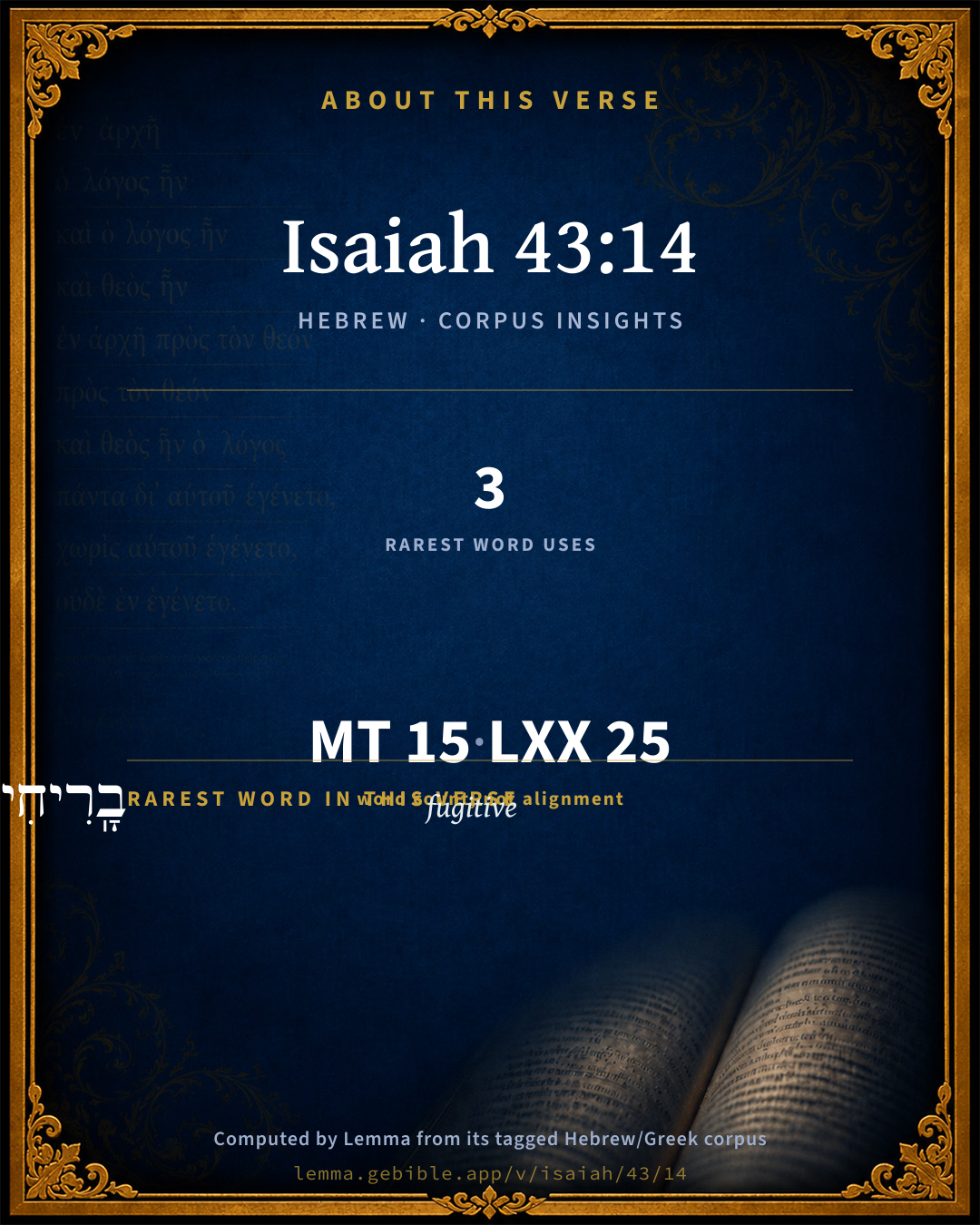
The rarest word here is בָֽרִיחִים֙ fugitive H1281 — appearing just 3 times in the whole Hebrew Bible.

Shared distinctive vocabulary

בָֽרִיחִים֙ fugitive H1281 occurs in 3 verses of the Hebrew Bible. Also found in:

Grammatical profile

  • 4 verbs
  • 8 nouns
  • 1 adjective
  • 1 preposition
  • 1 adverb

Verb forms

  • אָמַ֧ר Qal · Perfect
  • גֹּאַלְכֶ֖ם Qal · Participle Active
  • שִׁלַּ֣חְתִּי Piel · Perfect
  • וְהוֹרַדְתִּ֤י Hiphil · Sequential Perfect

Hebrew & Septuagint length

In English translation the verse runs 37 words from the Hebrew and 37 from the Septuagint (LXX English) — the same length.

A rough comparison of the two English renderings, which tokenize alike — not a word-level alignment.

Word counts can differ between the Hebrew and the Greek without any difference in meaning — e.g. the Hebrew direct-object marker אֵת has no separate Greek word, and Greek often adds the article ὁ.

In the original languages it is 15 Hebrew tokens and 25 Greek tokens — but the two are counted differently (Hebrew bundles its prefixes and suffixes into one token; the Greek is in lemma form), so that isn’t a like-for-like length.

Cross-references

16

Topical passages linked to Isaiah 43:14 in the Treasury of Scripture Knowledge — connected by theme and wording, ordered by reader-vote popularity; previews shown in the World English Bible.

  • Isaiah 23:13 Behold, the land of the Chaldeans: this people was not; the Assyrian founded it for those who dwell in the wilderness; they set up their towers; they overthrew the palaces of it; they made it a ruin.
  • Isaiah 44:6 Thus says Yahweh, the King of Israel, and his Redeemer, Yahweh of Hosts: I am the first, and I am the last; and besides me there is no God.
  • Jeremiah 51:24 I will render to Babylon and to all the inhabitants of Chaldea all their evil that they have done in Zion in your sight, says Yahweh.
  • Isaiah 44:24–45:5 Thus says Yahweh, your Redeemer, and he who formed you from the womb: I am Yahweh, who makes all things; who stretches forth the heavens alone; who spreads abroad the earth (who is with me?);
  • Psalms 19:14 Let the words of my mouth and the meditation of my heart Be acceptable in your sight, Yahweh, my rock, and my redeemer.
  • Isaiah 43:1 But now thus says Yahweh who created you, Jacob, and he who formed you, Israel: Don't be afraid, for I have redeemed you; I have called you by your name, you are mine.
  • Isaiah 43:3–4 For I am Yahweh your God, the Holy One of Israel, your Savior; I have given Egypt as your ransom, Ethiopia and Seba in your place.
  • Isaiah 54:5–8 For your Maker is your husband; Yahweh of Hosts is his name: and the Holy One of Israel is your Redeemer; the God of the whole earth shall he be called.
  • Jeremiah 50:2–11 Declare you among the nations and publish, and set up a standard; publish, and don't conceal: say, Babylon is taken, Bel is disappointed, Merodach is dismayed; her images are disappointed, her idols are dismayed.
  • Jeremiah 50:17–18 Israel is a hunted sheep; the lions have driven him away: first, the king of Assyria devoured him; and now at last Nebuchadrezzar king of Babylon has broken his bones.
  • Jeremiah 50:27–34 Kill all her bulls; let them go down to the slaughter: woe to them! for their day is come, the time of their visitation.
  • Jeremiah 51:1–11 Thus says Yahweh: Behold, I will raise up against Babylon, and against those who dwell in Lebkamai, a destroying wind.
  • Jeremiah 51:34–37 Nebuchadrezzar the king of Babylon has devoured me, he has crushed me, he has made me an empty vessel, he has, like a monster, swallowed me up, he has filled his maw with my delicacies; he has cast me out.
  • Ezekiel 27:29–36 All who handled the oar, the mariners, [and] all the pilots of the sea, shall come down from their ships; they shall stand on the land,
  • Revelation 5:9 They sang a new song, saying, "You are worthy to take the book, And to open its seals: For you were killed, And bought us for God with your blood, Out of every tribe, language, people, and nation,
  • Revelation 18:11–21 The merchants of the earth weep and mourn over her, for no one buys their merchandise any more;

Cross-references courtesy of OpenBible.info (CC BY 4.0).

Hebrew and Greek witnesses Masoretic Hebrew ↔ Greek Septuagint

The same verse in the two great witnesses to the Old Testament, shown verse-for-verse.

These are two independent witnesses, not word-aligned to each other, and the Septuagint is shown in lemma (dictionary) form.

Hebrew Isaiah 43:14 Masoretic · Westminster Leningrad Codex

כֹּֽה אָמַ֧ר יְהוָ֛ה גֹּאַלְכֶ֖ם קְד֣וֹשׁ יִשְׂרָאֵ֑ל לְמַעַנְכֶ֞ם שִׁלַּ֣חְתִּי בָבֶ֗לָה וְהוֹרַדְתִּ֤י בָֽרִיחִים֙ כֻּלָּ֔ם וְכַשְׂדִּ֖ים בָּאֳנִיּ֥וֹת רִנָּתָֽם

Thus says Yahweh, your Redeemer, the Holy One of Israel: For your sake I have sent to Babylon, and I will bring down all of them as fugitives, even the Chaldeans, in the ships of their rejoicing.

World English Bible · Public Domain

Greek LXX Isaiah 43:14 Septuagint · lemma form

οὕτως λέγω κύριος ὁ θεός ὁ λυτρόω σύ ὁ ἅγιος ἰσραήλ ἕνεκεν σύ ἀποστέλλω εἰς βαβυλών καί ἐπιἐγείρω πᾶς φεύγω καί χαλδαῖος ἐν πλοῖον δέω

Thus says the Lord God that redeems you, the Holy One of Israel; for your sakes I will send to Babylon, and I will stir up all that flee, and the Chaldeans shall be bound in ships.

LXX2012 (modern English Septuagint) · Public Domain

On this verse, Keil & Delitzsch discusses the Septuagint’s reading. Read the note in Commentary ↓

Hebrew: Westminster Leningrad Codex (CC BY 4.0). Greek: Septuagint (public domain); English from LXX2012 (modern English Septuagint) (Public Domain). How the Septuagint differs from the Hebrew →

Targum (Aramaic paraphrase)

1

The Targum is the ancient Jewish Aramaic paraphrase of the Hebrew Scriptures — an interpretive translation, not the Hebrew text itself. Onkelos (literal) and Pseudo-Jonathan (expansive) render the Torah, and Jonathan the Prophets. Coverage is partial: where no permissively-licensed English translation exists for a verse, only the Aramaic is shown. This is verse-level text, not a word-by-word alignment to the Hebrew.

  1. Targum Jonathan Prophets (Joshua–Malachi)
    כִּדְנַן אֲמַר יְיָ פָרִיקְכוֹן קַדִישָׁא דְיִשְׂרָאֵל בְּדִיל חוֹבֵיכוֹן אַגְלֵיתִי יַתְכוֹן לְבָבֶל וְאַחֲתֵית בִּמְשׁוֹטִין כּוּלְהוֹן וְכַסְדָאֵי בִּסְפִינַי תּוּשְׁבַּחְתְּהוֹן:

    Thus saith the Lord, your Redeemer, the Holy One of Israel, Because of your sins I led you captive to Babylon; but I will prostrate all of them with their oars, yea, the Chaldeans in the ships of which they boast.

    Targum Jonathan — Aramaic: “Mikraot Gedolot” (public domain). English: “Sefaria Community Translation” (CC0 1.0 (public-domain dedication)); “London "Chaldee Paraphrase," 1871” (public domain). Text via Sefaria.

Commentary

Notes on Isaiah 43:14 from classic Christian and Jewish commentators (each source and its license shown beneath its notes). The classic Christian expositions comment on the surrounding passage and are grouped to its opening verse, so a note may address several verses; the Jewish commentaries on the Tanakh (Rashi and others) are per-verse, so they appear only where the commentator wrote on this verse.

Lemma curates 59 commentaries, every one of them public domain or Creative Commons licensed, each selected and text-cleaned for this edition rather than reprinted as found. About our sources →

Matthew Henry's Commentary

To so low an ebb were the faith and hope of God's people in Babylon brought that there needed line upon line to assure them that they should be released out of their captivity; and therefore, that they might have strong consolation, the assurances of it are often repeated, and here very expressly and encouragingly.

I. God here takes to himself such titles of his honour as were very encouraging to them. He is the Lord their Redeemer, not only he will redeem them, but will take it upon him as his office and make it his business to do so. If he be their God, he will be all that to them which they need, and therefore, when they are in bondage, he will be their Redeemer. He is the Holy One of Israel (Isa 43:14), and again (Isa 43:15), their Holy One, and therefore will make good every word he has spoken to them. He is the Creator of Israel, that made them a people out of nothing (for that is creation), nay, worse than nothing; and he is their King, that owns them as his people and presides among them.

II. He assures them he will find out a way to break the power of their oppressors that held them captives and filled up the measure of their own iniquity by their resolution never to let them go, Isa 14:17. God will take care to send a victorious prince and army to Babylon, that shall bring down all their nobles, and lay their honour in the dust, and all their people too, even the Chaldeans, whose cry is in the ships (for seamen are apt to be noisy), or whose cry is to the ships, as their refuge when the city is taken, that they may escape by the benefit of their great river. Note, The destruction of Babylon must make way for the enlargement of God's people. And in the prediction of the fall of the New Testament Babylon we meet with the cries and lamentations of the sailors, Rev 18:17, Rev 18:18. And observe, It is for Israel's sake that Babylon is ruined, to make way for their deliverance.

III. He reminds them of the great things he did for their fathers when he brought them out of the land of Egypt; for so it may be read (Isa 43:16, Isa 43:17): "Thus saith the Lord, who did make a way in the sea, the Red Sea, and did bring forth Pharaoh's chariot and horse, that they might lie down together in the bottom of the sea, and never rise, but be extinct. He that did this can, if he please, make a way for you in the sea when you return out of Babylon, and will do so rather than leave you there." Note, For the encouragement of our faith and hope, it is good for us often to remember what God has done formerly for his people against his and their enemies. Think particularly what he did at the Red Sea, how he made it, 1. A road to his people, a straight way, a near way, nay, a refuge to them, into which they fled and were safe the waters being a wall unto them. 2. A grave to his enemies. The chariot and horse were drawn out by him who is Lord of all hosts, on purpose that they might fall together; howbeit, they meant not so, Mic 4:11, Mic 4:12.

IV. He promises to do yet greater things for them than he had done in the days of old; so that they should not have reason to ask, in a way of complaint, as Gideon did, Where are all the wonders that our fathers told us of? for they should see them repeated, nay, they should see them outdone (Isa 43:18): "Remember not the former things, from them to take occasion, as some do, to undervalue the present things, as if the former days were better than these; no, you may, if you will, comparatively forget them, and yet know enough by the events of your own day to convince you that the Lord is God alone; for, behold, the Lord will do a new thing, no way inferior, both for the wonder and the worth of the mercy, to the things of old." The best exposition of this is, Jer 16:14, Jer 16:15; Jer 23:7, Jer 23:8. It shall no more be said, The Lord liveth that brought up the children of Israel out of the land of Egypt; that is an old thing, the remembrance of which will be in a manner lost in the new thing, in the new proof that the Lord liveth, for he brought up the children of Israel out of the land of the north. Though former mercies must not be forgotten, fresh mercies must in a special manner be improved. Now it springs forth, as it were a surprise upon you; you are like those that dream. Shall you now know it? And will you not own God's hand in it?

V. He promises not only to deliver them out of Babylon, but to conduct them safely and comfortably to their own land (Isa 43:19, Isa 43:20): I will make a way in the wilderness and rivers in the desert; for, it seems, the way from Babylon to Canaan, as well as from Egypt, lay through a desert land, which, while the returning captives passed through, God would provide for them, that their camp should be both well victualled and under a good conduct. The same power that made a way in the sea (Isa 43:16) can make a way in the wilderness, and will force its passage through the greatest difficulties. And he that made dry land in the waters can produce waters in the dryest land, in such abundance as not only to give drink to his people, his chosen, but to the beasts of the field, also the dragons and the ostriches, who are therefore said to honour God for it; it is such a sensible refreshment, and yields them so much satisfaction, that, if they were capable of doing it, they would praise God for it, and shame man, who is made capable of praising his benefactor and does not. Now, 1. This looks back to what God did for Israel when he led them through the wilderness from Egypt to Canaan, and fetched water out of a rock to follow them; what God did for them formerly he would do again, for he is still the same. And, though we do not find that the miracle was repeated in their return out of Babylon, yet the mercy was, in the common course of Providence, for which it became them to be no less thankful to God. 2. It looks forward, not only to all the instances of God's care of the Jewish church in the latter ages of it, between their return from Babylon and the coming of Christ, but to the grace of the gospel, especially as it is manifested to the Gentile world, by which a way is opened in the wilderness and rivers in the desert; the world, which lay like a desert, in ignorance and unfruitfulness, was blessed with divine direction and divine comforts, and, in order to both, with a plentiful effusion of the Spirit. The sinners of the Gentiles, who had been as the beasts of the field, running wild, fierce as the dragons, stupid as the owls or ostriches, shall be brought to honour God for the extent of his grace to his chosen among them.

VI. He traces up all these promised blessings to their great original, the purposes and designs of his own glory (Isa 43:21): This people have I formed for myself, and therefore I do all this for them, that they may show forth my praise. Note, 1. The church is of God's forming, and so are all the living members of it. The new heaven, the new earth, the new man, are the work of God's hand, and are no more, no better, than he makes them; they are fashioned according to his will. 2. He forms it for himself. He that is the first cause is the highest end both of the first and of the new creation. The Lord has made all things for himself, his Israel especially, to be to him for a people, and for a name, and for a praise; and no otherwise can they be for him, or serviceable to him, than as his grace is glorified in them, Jer 13:11; Eph 1:6, Eph 1:12, Eph 1:14. 3. It is therefore our duty to show forth his praise, not only with our lips, but in our lives, by giving up ourselves to his service. As he formed us, so he feeds us, and keeps us, and leads us, and all for himself; for every instance therefore of his goodness we must praise him, else we answer not the end of the beings and blessings we have.

Matthew Henry's Commentary on the Whole Bible (1708–1710) — public domain (CC PDM 1.0). Text via the HelloAO Bible API.

Trapp's Complete Commentary

John Trapp

Isa 43:14 Thus saith the LORD, your redeemer, the Holy One of Israel; For your sake I have sent to Babylon, and have brought down all their nobles, and the Chaldeans, whose cry [is] in the ships.

Ver. 14. Thus saith the Lord, your Redeemer.] For their greater comfort and confirmation, the prophet purposely premiseth to the promise of deliverance from Babylon these sweet attributes of God, each of them dropping myrrh and mercy.

For your sakes I have sent to Babylon, and have brought down.] Or, I will send, and I will bring down.

All their nobles.] Heb., Bars. {Psa 147:13} Bars noblemen should be, to keep out evils, and to secure saints; but these were crossbars, &c.

Whose cry is in the ships.] Or, Whose outcry is to the ships, whereby they thought to save themselves, but could not, because Cyrus had drained and dried up their river Euphrates. Tremellius rendereth it, The Chaldees with their most famous ships.

John Trapp, A Commentary or Exposition upon All the Books of the Old and New Testament (1647–1656) — public domain. Text from a community e-Sword module.

Joseph Benson's Commentary

Isa 43:14. For your sake I have sent to Babylon — I have sent Cyrus, and the Medes and Persians with him, to war against Babylon, to this very end, that he might deliver you out of captivity, and restore you to your land, according to my promise. I have brought down — From that height of power and glory to which they were advanced; all their nobles — Their princes and great commanders. Bishop Lowth prefers the reading of the margin, (the word בריחיםproperly signifying bars,) and renders the next clauses, I will bring down all her strong bars, and the Chaldeans exulting in their ships. On which he observes, “Babylon was very advantageously situated, both in respect to commerce, and as a naval power. It was open to the Persian gulf by the Euphrates, which was navigable by large vessels; and, being joined to the Tigris above Babylon, by the canal called Naharmalca, or the royal river, supplied the city with the produce of the whole country to the north of it, as far as the Euxine and Caspian seas. — Herod, 1., 194. We are not to wonder that in later times we hear little of the commerce and naval power of Babylon: for, after the taking of the city by Cyrus, the Euphrates was not only rendered less fit for navigation by being, on that occasion, diverted from its course, and left to spread over the country; but the Persian monarchs, residing in their own country, to prevent any invasion by sea on that part of their empire, purposely obstructed the navigation of both rivers, by making cataracts in them, that is, by raising dams across the channel, and making artificial falls in them; that no vessel, of any size or force, could possibly come up. — Strabo, lib. 16. Alexander began to restore the navigation of the river by demolishing the cataracts upon the Tigris, as far up as Seleucia; but he did not live to finish his great designs: those upon the Euphrates still continued.”

Joseph Benson's Commentary on the Old and New Testaments (1811–1818) — public domain. Text from a community e-Sword module.

Keil & Delitzsch

C. F. Keil & F. Delitzsch

In close connection with the foregoing prophecy, the present one commences with the dissolution of the Chaldean empire. "Thus saith Jehovah, your Redeemer, the Holy One of Israel, For your sake I have sent to Babel, and will hurl them all down as fugitives, and the Chaldeans into the ships of their rejoicing. I, Jehovah, am your Holy One; (I) Israel's Creator, your King." Hitzig reads באניות, and adopts the rendering, "and drowned the shouting of the Chaldeans in groaning." Ewald also corrects Isa 43:14 thus: "And plunge their guitars into groanings, and the rejoicing of the Chaldeans into sighs." We cannot see any good taste in this un-Hebraic bombast. Nor is there any more reason for altering ברייחם (lxx φεύγοντας) into ברייחם (Jerome, vectes), as Umbreit proposes: "and make all their bolts

(Note: This would require כּל־בּריחיה.)

fall down, and the Chaldeans, who rejoice in ships" (bāŏniyōth). None of these alterations effect any improvement. For your sakes, says Jehovah, i.e., for the purpose of releasing you, I have sent to Babylon (sc., the agents of my judgments, Isa 13:3), and will throw them all down (viz., the πάμιμκτος ὄχλος of this market of the world; see Isa 13:14; Isa 47:15) as fugitives (bârı̄chı̄m with a fixed kametz, equivalent to barrı̄chı̄m), i.e., into a hurried flight; and the Chaldeans, who have been settled there from a hoary antiquity, even they shall be driven into the ships of their rejoicing (bŏŏniyōth, as in Pro 31:14), i.e., the ships which were previously the object of their jubilant pride and their jubilant rejoicing. והורדתּי stands in the perf. consec., as indicating the object of all the means already set in motion. The ships of pleasure are not air-balloons, as Hitzig affirms. Herodotus (i. 194) describes the freight ships discharging in Babylon; and we know from other sources that the Chaldeans not only navigated the Euphrates, but the Persian Gulf as well, and employed vessels built by Phoenicians for warlike purposes also.

(Note: See G. Rawlinson, Monarchies, i. 128, ii. 448.)

הוריד itself might indeed signify "to hurl to the ground" (Psa 56:8; Psa 59:12); but the allusion to ships shows that בּ הוריד are to be connected (cf., Isa 63:14), and that a general driving down both by land and water to the southern coast is intended. By thus sweeping away both foreigners and natives out of Babylon into the sea, Jehovah proves what He is in Himself, according to Isa 43:15, and also in His relation to Israel; we must supply a repetition of אני here (Isa 43:15), as in Isa 43:3. The congregation which addresses Him as the Holy One, the people who suffer Him to reign over them as their King, cannot remain permanently despised and enslaved.

Keil & Delitzsch — Biblical Commentary on the Old Testament (1861–1891) — public domain (CC PDM 1.0). Text via the HelloAO Bible API. (Old Testament only.)

Tyndale Open Study Notes

Tyndale Open Resources

43:14-21 The Lord assured Israel of its coming redemption from Babylon; the redemption would be modeled on Israel’s past redemption from Egypt and would be greater in some ways (43:18).

Tyndale Open Study Notes — © Tyndale Open Resources, licensed CC BY-SA 4.0. Text via the HelloAO Bible API.

Geneva Bible (1599)

Geneva Bible translators

They shall cry when they would escape by my water, seeing that the course of Euphrates is turned another way by the enemy.

By Darius and Cyrus.

Geneva Bible (1599) marginal notes — public domain. Text via Bolls.life.

Jamieson, Fausset & Brown

Robert Jamieson, A. R. Fausset & David Brown

sent--namely, the Medes and Persians (Isa 10:5-6; Isa 13:3).

brought down--"made to go down" to the sea (Isa 42:10), in order to escape the impending destruction of Babylon.

nobles--rather, "fugitives," namely, the foreigners who sojourned in populous Babylon (Isa 13:14), distinct from the Chaldeans [MAURER].

whose cry is in the ships--exulting in their ships with the joyous sailors--cry, boastingly; their joy heretofore in their ships contrasts sadly with their present panic in fleeing to them (Isa 22:2; Zep 2:15). Babylon was on the Euphrates, which was joined to the Tigris by a canal, and flowed into the Persian Gulf. Thus it was famed for ships and commerce until the Persian monarchs, to prevent revolt or invasion, obstructed navigation by dams across the Tigris and Euphrates.

Jamieson, Fausset & Brown — Commentary Critical and Explanatory on the Whole Bible (1871) — public domain (CC PDM 1.0). Text via the HelloAO Bible API.

Adam Clarke's Commentary

Verse 14. The Chaldeans, whose cry is in the ships - "The Chaldeans exulting in their ships."] Babylon was very advantageously situated both in respect to commerce, and as a naval power. It was open to the Persian Gulf by the Euphrates, which was navigable by large vessels; and being joined to the Tigris above Babylon by the canal called Naharmalca or the Royal River, supplied the city with the produce of the whole country to the north of it, as far as the Euxine and Caspian seas, Herod. i. 194. Semiramis was the foundress of this part also of the Babylonian greatness. She improved the navigation of the Euphrates, Herod. i. 184; Strabo, lib. xvi.; and is said to have had a fleet of three thousand galleys, Huet, Hist. du Commerce, chap. xi. We are not to wonder that in later times we hear little of the commerce and naval power of Babylon; for, after the taking of the city by Cyrus, the Euphrates was not only rendered less fit for navigation by being on that occasion diverted from its course and left to spread over the whole country; but the Persian monarchs, residing in their own country, to prevent any invasion by sea on that part of their empire, purposely obstructed the navigation of both the rivers by making cataracts in them, Strabo, ib., that is, by raising dams across the channel, and making artificial falls in them, that no vessel of any size or force could possibly come up. Alexander began to restore the navigation of the rivers by demolishing the cataracts upon the Tigris as far up as Seleucia, Arrian, lib. vii., but he did not live to finish his great designs; those upon the Euphrates still continued. Ammianus, xxiv. 1, mentions them as subsisting in his time.

The prophet therefore might very justly speak of the Chaldeans as glorying in their naval power in his time; though afterwards they had no foundation for making any such boast.

Adam Clarke's Commentary on the Bible (1810–1826) — public domain. Text from a community e-Sword/MySword module.

Ellicott's Commentary for English Readers

(14) I have sent to Babylon.—For the first time in 2 Isaiah, the place of exile is named. For “have brought down all their nobles” read, I will bring them all down as fugitives. The marginal “bars” represents a various reading, defences, in the sense of defenders.

The Chaldeans, whose cry is in the ships.—Better, into the ships of their shouting—i.e., the ships which used to echo with the exulting joy of sailors. The word for “shouting” is purposely chosen to suggest the thought that there will be a shout of another kind, even the wailing cry of despair. The commerce of Babylon, and its position on the Euphrates, made it, as it were, the Venice of the earlier East (Herod., 1:194). The prophet sees the inhabitants of Babylon fleeing in their ships from the presence of their conqueror.

A Bible Commentary for English Readers, edited by Charles John Ellicott (1878–1897) — public domain. Text from a community e-Sword module.

The Cambridge Bible for Schools and Colleges

gen. ed. J. J. S. Perowne

14, 15. A new section (14–21) commences here with a brief but explicit announcement of the fall of Babylon.

the Lord, your redeemer] see on ch. Isa_41:14.

I have sent (or perhaps, I will send) to Babylon] As object of the verb we must supply, the Persian army, the “consecrated ones” of ch. Isa_13:3.

and have brought … ships] This sentence is somewhat peculiar in its structure and phraseology, and many emendations have been proposed. Accepting the text as it stands, the best translation is no doubt that of R.V. and I will bring down all of them as fugitives, even the Chaldeans in the ships of their rejoicing. Since the verb “bring down” cannot be understood in two different senses in the two members, the idea must be that they shall all be sent down the Euphrates as fugitives in ships, which was precisely the manner in which Merodach-baladan made his escape from Sennacherib (see Schrader, Cuneiform Inscriptions, E. T. vol. II. p. 36). A description of the ships on the Euphrates is to be found in Herod. I. 194; they are here called “ships of rejoicing” as having formerly been used for pleasure. The rendering, however, is not altogether convincing. The “and” before “Chaldæans” seems to make a distinction between them and the fugitives, which is hardly to be explained by supposing that the latter are the foreign merchants referred to in ch. Isa_13:14. The probability is that the difficulties are due to somewhat extensive omissions in the text. The word for “fugitives” might (with the change of one vowel) be read as “bolts,” and this is taken by A.V., though without any justification, as a metaphor for “nobles.” It might, however, be a metaphor for the defences of Babylon, or a symbol of Israel’s captivity; “I will bring down the bolts” gives a good enough sense so far as it goes. Another slight emendation which naturally suggests itself is to change “ships” into “lamentations”: “and the shouting of the Chaldæans into lamentations.”

The Cambridge Bible for Schools and Colleges (gen. ed. J. J. S. Perowne; Cambridge University Press, 1878–1918) — public domain. Text from a community e-Sword module.

John Gill's Exposition

I am the Lord, your Holy One,.... And therefore need not doubt of the performance of those promises:

the Creator of Israel, your King; and therefore both able and willing to protect them.

John Gill's Exposition of the Whole Bible (1746–1763) — public domain (CC PDM 1.0). Text via the HelloAO Bible API.

Albert Barnes' Notes on the Bible

Thus saith the Lord your Redeemer - This verse commences another argument for the safety of his people. It is the assurance to the Jews in Babylon that he had sent to them a deliverer, and would bring down the pride of the Chaldeans, and demolish their city.

Your Redeemer - (See the note at Isa 43:1).

I have sent to Babylon - That is, the Persians and Medes, under the command of Cyrus (compare the note at Isa 13:3). This implies that God had command over all their armies and had the power of sending them where he pleased (compare the notes at Isa 10:5-6). This is to be understood as seen by the prophet in vision. He sees the armies of Cyrus encompass Babylon and the haughty city fall, and then says that God had sent or directed them there.

And have brought down all their nobles - Margin, ‘Bars.’ But the word in this place probably means neither, but rather fugitives (compare the notes at Isa 27:1). The word used (בריח bârı̂yach), means sometimes bar, cross-bar, that which passed from one side of the tabernacle to the other through rings, in order to carry it; thou a harbor bolt of any kind Jdg 16:3; Neh 3:3. But the word may also denote one who flies; a fugitive; and is properly used in that sense here. The verb ברח bârach, from which the word is derived, means often to break away, to flee Gen 16:8; Gen 35:1, Gen 35:7; 1Sa 19:12; Job 27:22; Jon 1:3. Here it means those who endeavored to escape from the impending calamity and destruction; or it may refer to those who had taken refuge in Babylon from other lands, as Babylon was doubtless composed in part of those who had sought a refuge there from other nations - a conflux of strangers. But the former is the more probable interpretation; and the idea seems to be, that Yahweh had brought them down to their ships, or had led them to take refuge in their ships from the impending judgments. Jerome, however, understands it of removing the strong bars with which the prisoners of the exile Jews were protected, so that they would be permitted to go forth in peace and safety. Lowth renders it, ‘I will bring down all her strong bars.’ The Septuagint renders it, φεύγοντες πάντας pheugontes pantas - ‘All that fly.’ So the Syriac.

And the Chaldeans - The inhabitants of Babylon.

Whose cry is in the ships - Lowth renders this, ‘Exulting in their ships.’ Noyes, ‘Ships of their delight.’ The Vulgate, ‘Glorying in their ships.’ The Septuagint, ‘The Chaldeans shall be bound (δεθήσονται dethēsontai) in ships.’ The Syriac, ‘Who glory in their ships.’ The sense is, probably, that the Chaldeans, when their city was taken, would seek to take refuge in their ships in which they would raise a shout (Rosenmuller). Or it may be, as Lowth supposes, that it was one of the characteristics of the Chaldeans, that they boasted of their ships, and of their commerce. Babylon was, as he remarks, favorably situated to be a commercial and naval power. It was on the large river Euphrates, and hence, had access to the Persian Gulf and the ocean; and there can be no doubt that it was engaged, in the height of its power, in commercial enterprises. On the north of the city, the Euphrates was united to the Tigris by the canal called Nahar Malca or the Royal River, and thus a large part of the produce of the northern countries, as far as the Euxine and Caspian seas, naturally descended to Babylon (Herod. i. 194).

Semiramis, the founder of Babylon, is said to have had a fleet of three thousand galleys. After the taking of the city by Cyrus, we hear indeed little of the commerce of Babylon. The Euphrates was diverted from its course, and spread over the adjacent country; and the Persian monarchs, in order to prevent the danger of invasion from that quarter, purposely obstructed the navigation, by making dams across both the Tigris and the Euphrates (Strabo xvi.) It is not to be deemed remarkable, therefore, that, in the times of its prosperity, the city of Babylon should be noted for its commerce; or as a city exulting in its shipping, or raising the sailor’s cry - a cry such as is heard in any port now where shipping abounds. The word rendered ‘cry’ (רנה rinnâh) denotes properly a shout of rejoicing or joy 1Ki 22:36; Psa 31:6; Psa 42:5; and then also a mournful cry, an outcry, wailing Psa 17:1; Psa 61:2. Here it may mean the joyful cry of commerce; the shout of the mariner as he leaves the port, or as he returns to his home - the shout, the clamor, which is heard at the wharfs of a commercial city. Such a cry is alluded to by Virgil in the naval games which AEneas celebrated:

- ferit athera clamor

Nauticus.

AEneid, v. 140, 1.

The sense here is, that God had sent to bring down that exulting city, and to destroy all the indications of its commercial importance and prosperity.

Albert Barnes' Notes on the Bible (1834–1885) — public domain. Text from a community e-Sword/MySword module.

Haydock's Catholic Bible Commentary

Bars. Septuagint, "fugitives." Theodotion, "strong ones." --- Glorying. Septuagint, "shall be bound in ships," to be sent beyond the Caspian Sea. (Calmet) --- Cyrus was victorious for the sake of God’s people; for he will not neglect his Church. (Worthington)

George Leo Haydock (1774–1849), Haydock's Catholic Family Bible and Commentary, 1859 edition — public domain. Excludes Psalms (Douay-Rheims chapter numbering differs from Protestant) and Deuterocanonical books (Catholic canon only).

Matthew Poole's English Annotations

I have sent to Babylon; I have sent Cyrus, and the Medes and Persians with him, to war against Babylon, to this very end and purpose, that he might deliver you out of captivity, and restore you to your land according to promise.

Have brought down from that height of power and glory to which they were advanced.

All their nobles; their princes and great commanders, who as they are called shields, Psa 47:9, so here they are called bars, for the same reason, because of that strength and defence which they give to their people.

The Chaldeans; the common people of Chaldea, together with their great men who had palaces in Babylon.

Whose cry is in the ships; who make fearful outcries, as they flee away from the Persians in ships; which they had opportunity to do, because of their two great and famous rivers Euphrates and Tigris, and the several branches of them.

Matthew Poole's English Annotations on the Holy Bible (1683–1685) — public domain. Text from a community e-Sword/MySword module.

Whedon's Commentary on the Bible

Daniel D. Whedon

14, 15. For your sake — Many a time the Jews had possessed signal proofs of divine interference in their behalf. In this Babylonian deliverance, Jehovah’s character occurs to their minds as more than deliverer from earthly enemies. He is the Holy One who spiritually redeems and saves.

I have sent — Cyrus and the Medes are instruments sent of God to Babylon; so obviously sent in their behalf that it amounts to a sure token of God’s spiritual — not national — purpose in the case.

Brought down all their nobles — Both verbs, here, are prophetic preterits, implying “nobles” in the sense of foreign merchants living in Babylon for a time — the crowd that naturally gathers at a great emporium. These, with the Chaldeans, become fugitives from the city on the invasion of an enemy. See Isa_13:14.

Whose cry is in the ships — The rivers and canals at Babylon seem to have made the dwellers a maritime people. The cry of sailors conveying away the fleeing people seems referred to.

Daniel D. Whedon (gen. ed.), Commentary on the Old and New Testaments (1874–1909) — public domain. Text from a community e-Sword module.

The Pulpit Commentary

Vers. 14-21. A DECLARATION AGAINST BABYLON, AND A PROMISE OF ISRAEL"S RESTORATION. Having wound up the preceding "controversy" with a reference to his own power to work great results (ver. 13), Jehovah now brings forward two examples the discomfiture of Babylon (vers. 14, 15), and the recovery and restoration of Israel (vers. 16-21), both of which he is about to accomplish.

For your sake I have sent to Babylon. For Israel"s sake God has already, in his counsels, sent to Babylon the instruments of his vengeance Cyrus and his soldiers and by their instrumentality has brought down all their nobles; or rather, has brought them all down to be fugitives; (comp. Isa_15:5) and the Chaldeans; or, even the Chaldeans. The Chaldeans are not in Isaiah, as in Daniel, (Dan_2:2 Dan_4:7 Dan_5:7) a special class of Babylonians, but, as elsewhere commonly in Scripture, the Babylonians generally. (see Isa_47:1) In the native inscriptions the term is especially applied to the inhabitants of the tract upon the sea-coast. Whose cry is in the ships; rather, into their ships of wailing. The Chaldeans, flying from the Persian attack, betake themselves to their ships with cries of grief, the ships thereby becoming "ships of wailing." The nautical character of the Babylonians is strongly marked in the inscriptions, where "the ships of Ur are celebrated at a very remote period, and the native kings, when hard pressed by the Assyrians, are constantly represented as going on ship-board, and crossing the Persian Gulf to Susiana, or to some of the islands (see "Records of the Past," vol. 1. pp. 40, 43, 73; vol. 7. p. 63; vol. 9. p. 60). The abundant traffic and the numerous merchants of Babylon are mentioned by Ezekiel. (Eze_17:4) Aesehylus, moreover, notes that the Babylonians of his day were "navigators of ships" ("Persae," 11. 52-55).

God the Redeemer.

Proof of the existence of God is not the proper subject of a revelation made to man in a book. The being of God is assumed by making a revelation in a book. The proper subject of a book-revelation is not God creating. That we might learn from the things created. Not God providing. That we could sufficiently understand by due observation of life. Not God ruling. That would be impressed upon us with ever-increasing force by the history of the ages as they accumulated. The great subject of a book revelation must be God redeeming. That we could not learn from the perfect order of creation. That we could not reach by the keenest observations of his providence. That is not traced upon human history save as the deeper, hidden lines which we need some key to decipher. With that our Scriptures are full. That must be told in human language, and shown in human signs. No researches of science will declare it; no natural relations of men involve it; no creature is commissioned to show it forth. No inquiry of the human mind can reach it. God the Redeemer. This is the unknown mystery unknown till God himself declares it. Too glorious to be received by men until it is seen proved over and over again, and at last gets its most melting display in that cross whereon God"s beloved Son dies in agony, for the glorifying for ever of the redeeming love of God. The Scriptures may have side information on matters of creation, providence, science, government, and duty; but these are not its great message. Creation is God"s first work; redemption is his second and greater, called for by the world"s confusion and man"s moral ruin. That second thought God could tell to man in no other way than by words; only words could reveal the deep fact of the pitying love of God, which the heart, not the head, of man alone can grasp. The heart wants to be spoken to with human words.

I REDEMPTION IS GOD"S CONSTANT WORK. Our Bible is full of it. It is the prominent thing on every page. Clouds of curse and woe hang heavy over the very first page of human history. The darkness of Divine indignations drops down on man and woman and tempting serpent. But right across the great thunder-clouds God threw a brilliant rainbow of promise. In symbol it said, Redemption is coming." In words it read thus: The seed of the woman shall bruise the serpent"s head." Abraham stands forth the head of a new race. Behold a man redeemed from Chaldean idolatries, redeemed unto God. A mystery hangs round the second patriarch, Isaac. Behold a sacrifice redeemed by God, through the substitution of the ram caught in the thicket! Jacob reads his life, and sees everywhere the angel who redeemed him from all evil." The national life of the Jewish people started in a glorious redemption, which was to be remembered for ever as giving the first and foundation-truth concerning God. A mighty host fled hurriedly forth from Egypt, and found themselves hemmed in by lofty hill-ranges, a flowing sea, and foes pressing hard upon their rear. But there is a pathway through the mighty waters, and the delivered sing of God their Salvation. Redemption is a constant theme in the Mosaic system. The story of the wanderings is a series of illustrations of redeeming grace. God was ever delivering in the time of the Judges. David was redeemed from Saul, Asa from the Ethiopians, Hezekiah from the Assyrians, The saints from all the ages unite to say, "I know that my Redeemer liveth.

II ALL GOD"S REDEMPTIONS DISPLAY HIS POWER, HIS HOLINESS, AND HIS LOVE. If they did not, they could be no redemption for us. If there is not Divine power in them, then he cannot reach our case. If but one of those redemptions start a question of the Divine righteousness, then we can have no confidence in the worthiness of his scheme to rescue us in Christ. We cannot be satisfied with Christ"s salvation unless it is perfectly plain that in his work "justice and mercy have met together, righteousness and peace have kissed each other." And if the redemption do not take such a shape as shall display a "love Divine, all love excelling," then our hard cold hearts will never be melted and won. But all these are fully seen in that great redemption wrought by Christ. His is a mighty salvation. The perfect obedience unto death of the beloved Son seals for ever the righteous Father"s claims. And as to love, what shall we say about love in sacrifice? "Greater love hath no man than this, that a man lay down his life for his friends;" but "God commendeth his love toward us in that, while we were yet sinners, Christ died for us." Love! It drops from the overcharged heart in the agony of the garden. It drops from the thorn-crowned brow in the mock judgment-hall. It drops from nail-pierced hands on the cruel cross. It drops from the wounded side of him who "bore our sins in his own body on the tree." O melting drops! Let them fall afresh on your heart and mine, and melt us into penitence and responsive love! R.T.

The Pulpit Commentary (1880–1919), ed. H.D.M. Spence-Jones & Joseph S. Exell — public domain. Text from a community e-Sword module.

John Wesley's Explanatory Notes

Sent - I have sent Cyrus against Babylon, to this very end, that he might deliver you out of captivity. Chaldeans - The common people of Chaldea, who make fearful outcries, as they flee away from the Persians in ships.

John Wesley, Explanatory Notes Upon the Whole Bible (1754–1765) — public domain. Text via the GEBible commentary corpus.

J. A. Alexander on Isaiah

Joseph Addison Alexander

“Thus saith Jehovah, your Redeemer, the Holy One of Israel: For your sake I have sent to Babylon, and have brought down (or made to descend) fugitives all of them; and the Chaldeans, in the ships their shout (or song).” This is a particular instance of the general protection vouchsafed by Jehovah to His people, and more especially of that providential substitution or redemption, of which we read above in vs. 3, 4. The inference before drawn from the general terms of v. 4, that the nations mentioned in v. 3 are only representatives or samples, is confirmed by this explicit mention of the fall of Babylon as an example of the same great truth. The titles added to Jehovah’s name are not mere expletives or words of course, but intimate that He would bring this great event to pass in His distinctive character as the Redeemer and the Holy One of Israel. The event, although still future to the writer, is described as past, in reference not only to the purposes of God, but also to the perceptions of the Prophet. As presented to his view by the prophetic inspiration, the destruction of Babylon was just as truly a historical event as that of Pharaoh and his host.

Joseph Addison Alexander, The Prophecies of Isaiah (1846–1847; New York: Scribner, 1870–1878) — public domain. Text from a community e-Sword module.

Kretzmann's Popular Commentary

Paul E. Kretzmann

Proof That Jehovah Is The Holy One

v. 14. Thus saith the Lord, your Redeemer, their Vindicator and Deliverer, the Holy One of Israel, whose outstanding attribute in dealing with His people is holiness: For your sake I have sent to Babylon and have brought down all their nobles, causing the Babylonians to be driven away as fugitives, and the Chaldeans, the original inhabitants of Babylonia, whose cry is in the ships, literally, "together with the Chaldeans on the ships of their exulting," over which they rejoiced with loud cries as the witnesses of their wealth and the bulwarks of their power.

v. 15. I am the Lord, your Holy One, the Creator of Israel, who chose and established Israel as His people, your King, their Ruler, Provider, and Protector.

v. 16. Thus saith the Lord, which maketh a way in the sea, as when He led Israel through the Red Sea, and a path in the mighty waters, whose almighty power is unchanged through the ages,

v. 17. which bringeth forth the chariot and horse, the cavalry being considered the most powerful part of an army in those days, the army and the power, the might of the enemies’ host; they shall lie down together, they shall not rise, being overcome completely; they are extinct, they are quenched as tow, as Pharaoh’s army was buried in a watery grave.

v. 18. Remember ye not the former things, when the Lord, in the past, performed such great things, neither consider the things of old, for what the Lord intended to do for His people in the future made all that which lay in the past seem insignificant by comparison.

v. 19. Behold, I will do a new thing, unusual, remarkable in its wonderful character; now it shall spring forth; shall ye not know it? The challenge intends to call their attention to his action, of which He now speaks. I will even make a way in the wilderness and rivers in the desert, thereby performing a miracle which was unheard of among men.

v. 20. The beast of the field, all the wild animals of the desert, shall honor Me, the dragons, or jackals, and the owls, the ostriches, the reference being to the Gentiles who are still in the wilderness of their sinfulness, because I give waters in the wilderness and rivers in the desert to give drink to My people, My chosen, the believers having the refreshing waters of the Word of mercy to sustain them on their way through the desert of this world.

v. 21. This people, the spiritual Israel, have I formed for Myself, made them His own by His creative and educative activity in their behalf; they shall show forth My praise. That is the end and object of the Christians’ life, to glorify the heavenly Father for the deeds of His mercy, as they have been enabled to do by His strength granted them through His call.

Paul E. Kretzmann, Popular Commentary of the Bible (1921–1924) — public domain. Text from a community e-Sword module.

unfoldingWord translationNotes

Door43 World Missions Community

General Information:

Yahweh continues speaking to the people of Israel.

Holy One of Israel

See how you translated this phrase in Isaiah 1:4.

I send to Babylon and lead them all down

The object of the verb "send" may be supplied in translation. AT: "I send an army to Babylon" (See: Assumed Knowledge and Implicit Information)

lead them all down as fugitives

"lead all of the Babylonians down as fugitives"

fugitives

A fugitive is a person who runs away so that his enemy will not capture him.

translationWords

Yahweh

redeem

Holy One

Israel

Babylon

joy

lament

create

king

unfoldingWord translationNotes — © Distant Shores Media and the Door43 World Missions Community, licensed CC BY-SA 4.0. Source: git.door43.org/Door43/en_tn.

Rashi

Rabbi Shlomo Yitzchaki (Rashi)

Because of you, I sent [you] to Babylon Jonathan paraphrases: Because of your sins I exiled you to Babylon.

and I lowered them all with oars Heb. וְהוֹרַדְתִּי בָרִיחִים. Jonathan renders: And I lowered with oars (בִּמְשׁוֹטִין), all of them. מְשׁוֹטִין denotes the wood that guides the ship and straightens it out.

and Chaldees led you in the ships of their rejoicing. This may also be explained as regards the news of the redemption, as follows: Because of you, I sent I will send the kings of Media to Babylon, and I will lower the Chaldees in ships and oars into exile to the land of Media. And the Chaldees I will lower in ships which their rejoicing was [i.e., the Chaldees would be taken into captivity with the very boats in which they had previously rejoiced].

Rashi on the Tanakh — English translations: “The Judaica Press complete Tanach with Rashi, translated by A. J. Rosenberg” (CC BY 4.0); “Pentateuch with Rashi's commentary by M. Rosenbaum and A.M. Silbermann, 1929-1934” (public domain); “The Metsudah Tanach series, Lakewood, N.J” (CC BY 4.0); and “The Book of Joshua, Metsudah Publications, 1997” (CC BY 4.0). Text via Sefaria.

Ibn Ezra

Rabbi Abraham ibn Ezra

שלחתי I was sent. Some think that the first person I refers to the prophet; but I am of opinion that God is speaking, because this verse begins, Thus saith the Lord, and the next verse, I am the Lord, The meaning of the phrase is: I have come so hastily, as if I were sent. A very learned man in Spain conjectures, that the Divine Glory, the same heavenly prince of Israel that has been sent to Babylon to redeem Israel, is speaking to the prophet.

והורדתי בריחים And have brought down the bars of Babylon, that is, I caused Babylon to be conquered; comp. He hath destroyed and broken her bars (Lam, 2:9). The bars of the gates of the place are meant.

וכשדים באניות רנתם And I shall bring down the Chaldæans from their ships of joy, in which they are.

Ibn Ezra on the Tanakh — English translations: “Sefaria Community Translation” (CC0 1.0 (public-domain dedication)); “Yalkut, Sifsei Chachomim Chumash, Metsudah Publications, 2009” (CC BY 4.0); and “Commentary of Ibn Ezra on Isaiah - trans. by M. Friedlander, 1873” (public domain). Text via Sefaria.

Lesson kit

Teaching starters — assembled from the data on this page, not authored interpretation. Every prompt links to the verse data it draws on. Edit before teaching.

Isaiah, in the Prophets, opens this verse with 15 words (15 distinct Hebrew lemmas). Its most distinctive word is bârîyach (“fugitive”). A historical commentator’s framing appears above. Read the whole chapter for the surrounding context.

Discussion questions

  1. What does “fugitive” (bârîyach) contribute to the verse as a whole?
  2. How does Job 26:13, which shares the word «fugitive», read alongside this verse?
  3. These translations render this verse differently; the difference is in the English rendering, not the original. What questions does that raise?
  4. «אָמַ֧ר» is a Qal Perfect verb. How does that grammatical form shape the action described?
  5. Compare how Matthew Henry's Commentary and Trapp's Complete Commentary read this verse. Where do they agree or differ?

Things to notice

Reading settings

Reading text

Shown beneath each verse's original-language words.

Old Testament
Old Testament edition

Read the OT as the Masoretic Hebrew (MT) or the Greek Septuagint (LXX).

English shown for the Greek Septuagint (in the Hebrew ↔ Greek comparison).

Comparing translations? Open the Compare panel on any verse page to stack up to four side by side.