Isaiah 54:5

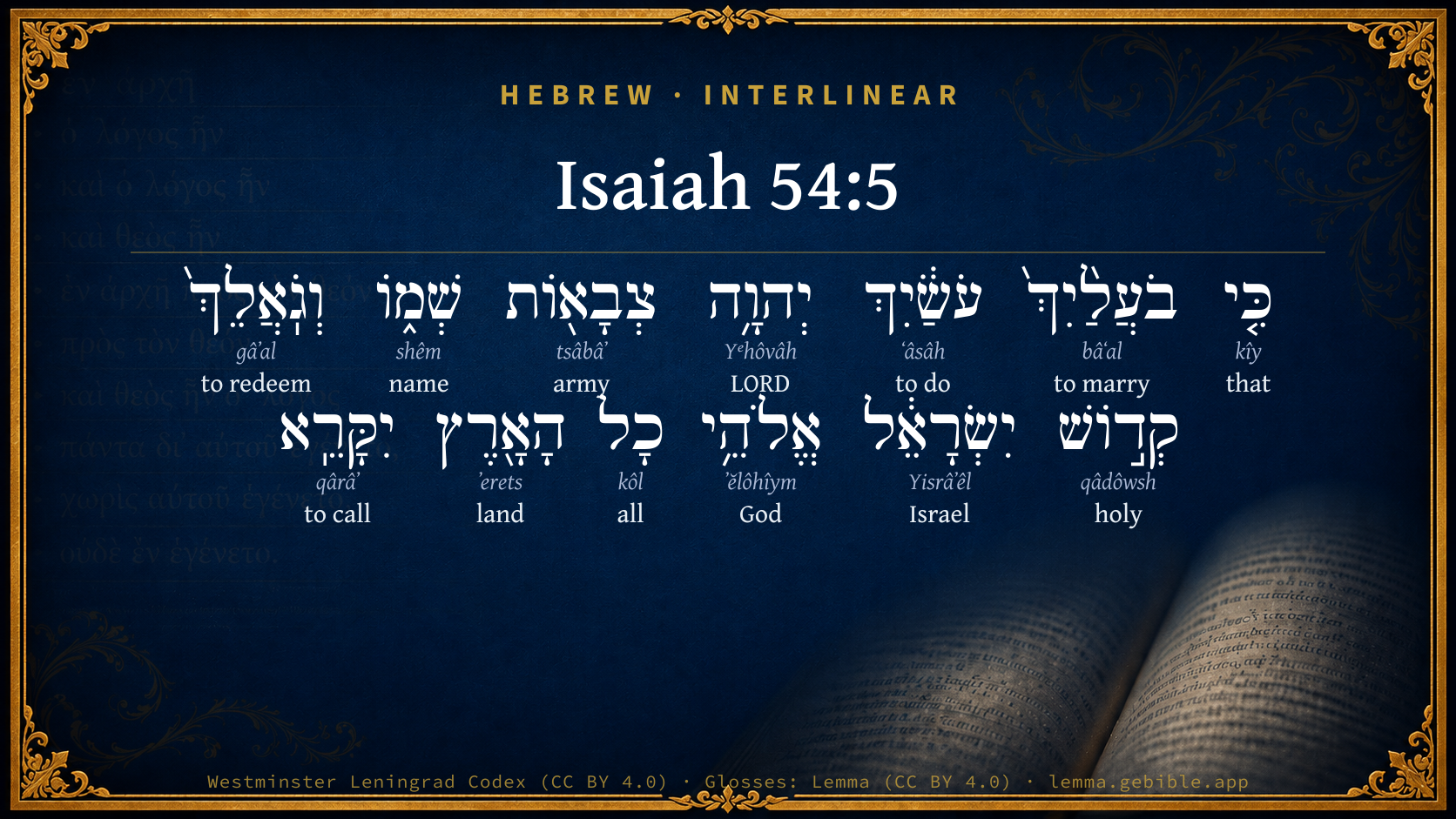
Hebrew (Westminster Leningrad Codex) Isaiah 54:5 appears in the Hebrew Old Testament. The text above is from the Westminster Leningrad Codex. Each word links to its Strong’s number, a concise gloss, and parsing drawn from the Open Scriptures Hebrew Bible morphology. Click any word for its full Brown-Driver-Briggs (BDB) entry.
Download image
Cite this verse

Isaiah 54:5 (World English Bible). Public Domain. Lemma interlinear Bible study tool, https://lemma.gebible.app/v/isaiah/54/5.

Show BibTeX & RIS
BibTeX
RIS
English Translation
For your Maker is your husband; Yahweh of Hosts is his name: and the Holy One of Israel is your Redeemer; the God of the whole earth shall he be called.
World English Bible · Public Domain
Download a study sheet

One document with this verse’s original text, its word-by-word gloss line, the meaning frame, cross-references with their text, attributed commentary, and full source and license credits — printable, and it pastes into notes with its structure intact.

This verse Autodidact and up

Study sheet (.html) Plain text (.txt)

A passage Seminary Student

Up to 50 verses in one chapter. A passage sheet keeps up to 6 commentary sources and 12 cross-references per verse, in the order this page ranks them, and says so on the sheet whenever that leaves anything out. Ask for a single verse and you get the Autodidact verse sheet above.

Everything on this page stays free to read, with no account — the sheet is a download of what is already on screen, not access to it.

Want to remove ads? Support Godless Engineer
Compare translations 3

The same verse in 3 English versions, stacked beneath the original-language interlinear above. Click any original word for its lexicon entry.

Each is an independent rendering of the whole verse — the interlinear is not word-aligned to these translations.

Highlighted words mark where these versions differ — a whole-verse word diff, not a word-by-word alignment.

  • World English Bible Public Domain
    For your Maker is your husband; Yahweh of Hosts is his name: and the Holy One of Israel is your Redeemer; the God of the whole earth shall he be called.
  • King James Version Public Domain
    For thy Maker is thine husband; the LORD of hosts is his name; and thy Redeemer the Holy One of Israel; The God of the whole earth shall he be called.
  • unfoldingWord Literal Text CC BY-SA 4.0
    For your husband your Maker; Yahweh of Armies his name. And your Redeemer the Holy One of Israel; he is called the God of all of the earth.

unfoldingWord Literal Text — © unfoldingWord, licensed CC BY-SA 4.0. Word-aligned USFM3 via Door43 (git.door43.org/unfoldingWord/en_ult).

Versions to compare (up to 4)

3 of 4 selected

Show all 18 translations

Every available English version of this verse, each an independent rendering of the whole verse.

  • World English Bible Public Domain
    For your Maker is your husband; Yahweh of Hosts is his name: and the Holy One of Israel is your Redeemer; the God of the whole earth shall he be called.
  • Berean Standard Bible Public Domain
    For your husband is your Maker—the LORD of Hosts is His name—the Holy One of Israel is your Redeemer; He is called the God of all the earth.
  • Majority Standard Bible Public Domain
    For your husband is your Maker—the LORD of Hosts is His name—the Holy One of Israel is your Redeemer; He is called the God of all the earth.
  • King James Version Public Domain
    For thy Maker is thine husband; the LORD of hosts is his name; and thy Redeemer the Holy One of Israel; The God of the whole earth shall he be called.
  • American Standard Version (1901) Public Domain
    For thy Maker is thy husband; Jehovah of hosts is his name: and the Holy One of Israel is thy Redeemer; the God of the whole earth shall he be called.
  • Revised Version (1885) Public Domain
    For thy Maker is thine husband; the LORD of hosts is his name: and the Holy One of Israel is thy redeemer; the God of the whole earth shall he be called.
  • Geneva Bible (1599) Public Domain
    For hee that made thee, is thine husband (whose Name is the Lord of hostes) and thy redeemer the Holy one of Israel, shall be called the God of the whole world.
  • Douay-Rheims (1899) Public Domain
    For he that made thee shall rule over thee, the Lord of hosts is his name: and thy Redeemer, the Holy One of Israel, shall be called the God of all the earth.
  • Young's Literal Translation Public Domain
    For thy Maker `is' thy husband, Jehovah of Hosts `is' His name, And thy Redeemer `is' the Holy One of Israel, `God of all the earth,' He is called.
  • Literal Standard Version CC BY-SA 4.0
    For your Maker [is] your husband, || YHWH of Hosts [is] His Name, || And your Redeemer [is] the Holy One of Israel, || He is called God of all the earth.
  • Unlocked Literal Bible CC BY-SA 4.0
    For your Maker is your husband; Yahweh of hosts is his name. The Holy One of Israel is your Redeemer; he is called the God of the whole earth.
  • unfoldingWord Literal Text CC BY-SA 4.0
    For your husband your Maker; Yahweh of Armies his name. And your Redeemer the Holy One of Israel; he is called the God of all of the earth.
  • Darby Bible Public Domain
    For thy Maker is thy husband: Jehovah of hosts is his name, and thy Redeemer, the Holy One of Israel: the God of the whole earth shall he be called.
  • World Messianic Bible Public Domain
    For your Maker is your husband; the LORD of Hosts is his name. The Holy One of Israel is your Redeemer. He will be called the God of the whole earth.
  • Webster's Bible Public Domain
    For thy maker is thy husband; the LORD of hosts is his name; and thy Redeemer the Holy One of Israel; The God of the whole earth shall he be called.
  • Free Bible Version CC BY-SA 4.0
    For your Maker is your husband, the Lord Almighty is his name. The Holy One of Israel is your Redeemer, he is called the God of the whole earth.
  • Bible in Basic English Public Domain
    For your Maker is your husband; the Lord of armies is his name: and the Holy One of Israel is he who takes up your cause; he will be named the God of all the earth.
  • JPS Tanakh (1917) Public Domain
    For thy Maker is thy husband, the LORD of hosts is His name; and the Holy One of Israel is thy Redeemer, the God of the whole earth shall He be called.

Literal Standard Version (2020), Covenant Press — licensed CC BY-SA 4.0. Text via the HelloAO Bible API (eBible.org). Unlocked Literal Bible (unfoldingWord) — licensed CC BY-SA 4.0. Text via the HelloAO Bible API (eBible.org). unfoldingWord Literal Text — © unfoldingWord, licensed CC BY-SA 4.0. Word-aligned USFM3 via Door43 (git.door43.org/unfoldingWord/en_ult). Free Bible Version, Dr. Jonathan Gallagher — licensed CC BY-SA 4.0. Text via the HelloAO Bible API (eBible.org).

Word by word

More ways to search: Search by grammar → Find every occurrence → Compare this word →

Practice this passage: Drill this verse → Learn its vocabulary →

בֹעֲלַ֨יִךְ֙
bâʻal
H1166
“marrying · you”
Verb, Qal, Participle Active, Masculine, Plural, Construct + Suffix, Personal, 2nd Person, Feminine, Singular
Part of Speech
Verb
Stem
Qal
Form
Participle Active
Gender
Masculine
Number
Plural
State
Construct
Full BDB Definition

Origin: a primitive root

TWOT: 262

to marry, rule over, possess, own - (Qal) - to marry, be lord (husband) over - to rule over - (Niphal) to be married
  1. כִּ֤י kîy H3588 “that” Conjunction
  2. עֹשַׂ֔יִךְ ʻâsâh H6213 “doing · you” Verb, Qal, Participle Active, Masculine, Plural, Construct + Suffix, Personal, 2nd Person, Feminine, Singular
  3. יְהוָ֥ה Yᵉhôvâh H3068 “LORD” Noun, Proper
  4. צְבָא֖וֹת tsâbâʼ H6635 “armies” Noun, Common, Both, Plural, Absolute
  5. שְׁמ֑וֹ shêm H8034 “name · his” Noun, Common, Masculine, Singular, Construct + Suffix, Personal, 3rd Person, Masculine, Singular
  6. וְגֹֽאֲלֵךְ֙ gâʼal H1350 “and · redeeming · you” Conjunction + Verb, Qal, Participle Active, Masculine, Singular, Construct + Suffix, Personal, 2nd Person, Feminine, Singular
  7. קְד֣וֹשׁ qâdôwsh H6918 “holy of” Adjective, Adjective, Masculine, Singular, Construct
  8. יִשְׂרָאֵ֔ל Yisrâʼêl H3478 “Israel” Noun, Proper
  9. אֱלֹהֵ֥י ʼĕlôhîym H430 “God(s) of” Noun, Common, Masculine, Plural, Construct
  10. כָל kôl H3605 “all of” Noun, Common, Masculine, Singular, Construct
  11. הָאָ֖רֶץ ʼerets H776 “the · land” Particle, Definite Article + Noun, Common, Both, Singular, Absolute
  12. יִקָּרֵֽא qârâʼ H7121 “to call” Verb, Niphal, Imperfect, 3rd Person, Masculine, Singular

About this verse

These counts appear in no published source. They are computed here, from the morphology-tagged text and Lemma’s own curated glosses. What Lemma adds →

13
words
13
distinct lemmas
Prophets
section

Notable vocabulary

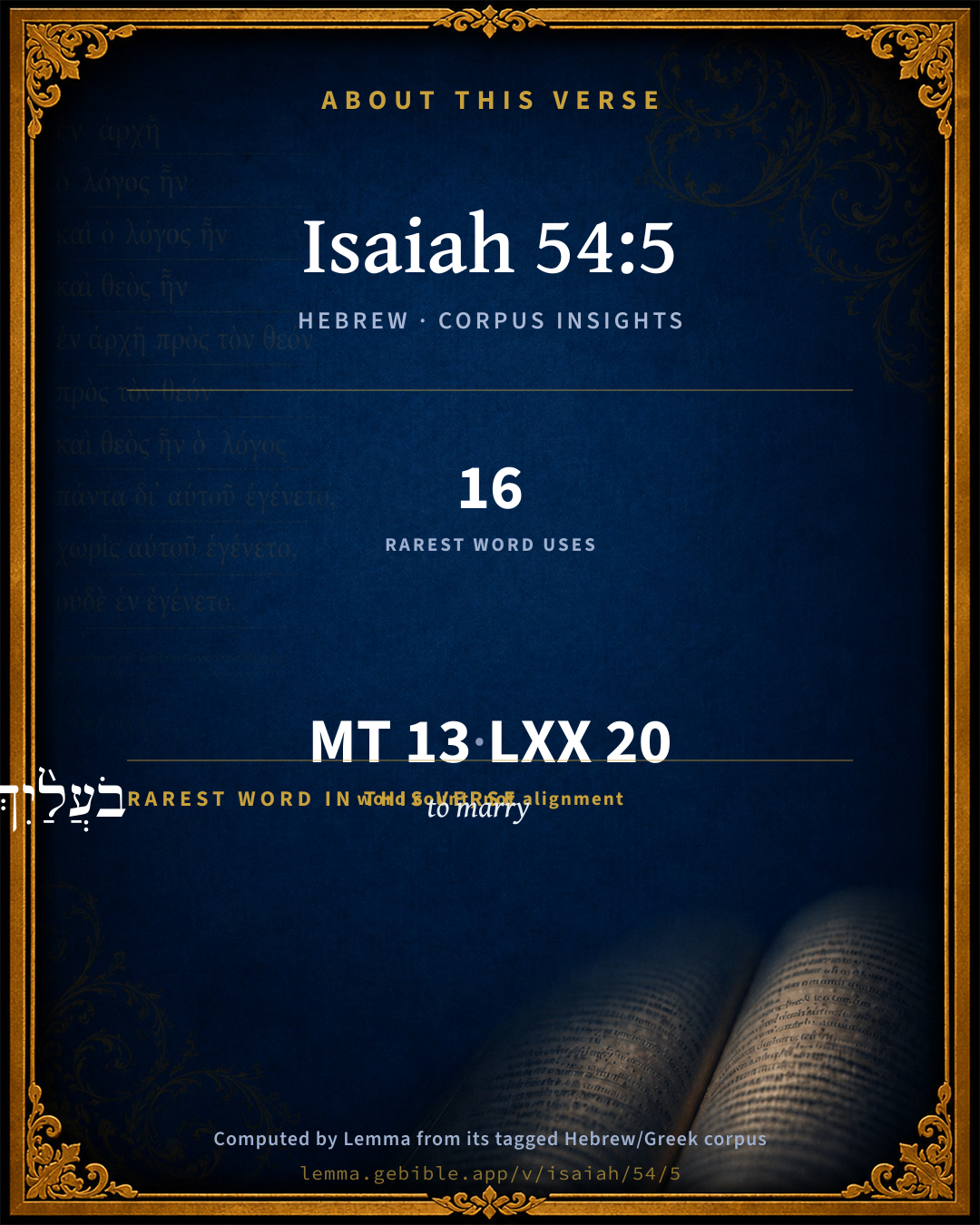
The rarest word here is בֹעֲלַ֨יִךְ֙ to marry H1166 — appearing just 16 times in the whole Hebrew Bible.

Shared distinctive vocabulary

בֹעֲלַ֨יִךְ֙ to marry H1166 occurs in 14 verses of the Hebrew Bible. Also found in:

Grammatical profile

  • 4 verbs
  • 7 nouns
  • 1 adjective
  • 1 conjunction

Verb forms

  • בֹעֲלַ֨יִךְ֙ Qal · Participle Active
  • עֹשַׂ֔יִךְ Qal · Participle Active
  • וְגֹֽאֲלֵךְ֙ Qal · Participle Active
  • יִקָּרֵֽא Niphal · Imperfect

Hebrew & Septuagint length

In English translation the verse runs 31 words from the Hebrew and 35 from the Septuagint (LXX English) — closely comparable.

A rough comparison of the two English renderings, which tokenize alike — not a word-level alignment.

Word counts can differ between the Hebrew and the Greek without any difference in meaning — e.g. the Hebrew direct-object marker אֵת has no separate Greek word, and Greek often adds the article ὁ.

In the original languages it is 13 Hebrew tokens and 20 Greek tokens — but the two are counted differently (Hebrew bundles its prefixes and suffixes into one token; the Greek is in lemma form), so that isn’t a like-for-like length.

Cross-references

17

Topical passages linked to Isaiah 54:5 in the Treasury of Scripture Knowledge — connected by theme and wording, ordered by reader-vote popularity; previews shown in the World English Bible.

  • Hosea 2:19–20 I will betroth you to me forever. Yes, I will betroth you to me in righteousness, in justice, in loving kindness, and in compassion.
  • Ephesians 5:25–27 Husbands, love your wives, even as Christ also loved the assembly, and gave himself up for it;
  • 2 Corinthians 11:2–3 For I am jealous over you with a godly jealousy. For I married you to one husband, that I might present you as a pure virgin to Christ.
  • Isaiah 48:17 Thus says Yahweh, your Redeemer, the Holy One of Israel: I am Yahweh your God, who teaches you to profit, who leads you by the way that you should go.
  • Ezekiel 16:8 Now when I passed by you, and looked at you, behold, your time was the time of love; and I spread my skirt over you, and covered your nakedness: yes, I swore to you, and entered into a covenant with you, says the Lord Yahweh, and you became mine.
  • Romans 3:29–30 Or is God the God of Jews only? Isn't he the God of Gentiles also? Yes, of Gentiles also,
  • John 3:29 He who has the bride is the bridegroom; but the friend of the bridegroom, who stands and hears him, rejoices greatly because of the bridegroom's voice. This, my joy, therefore is made full.
  • Psalms 45:10–17 Listen, daughter, consider, and turn your ear. Forget your own people, and also your father's house.
  • Zechariah 14:9 Yahweh will be King over all the earth. In that day Yahweh will be one, and his name one.
  • Ephesians 5:32 This mystery is great, but I speak concerning Christ and of the assembly.
  • Isaiah 6:3 One called to another, and said, "Holy, holy, holy, is Yahweh of Hosts! The whole earth is full of his glory!"
  • Jeremiah 3:14 Return, backsliding children, says Yahweh; for I am a husband to you: and I will take you one of a city, and two of a family, and I will bring you to Zion:
  • Jeremiah 51:19 The portion of Jacob is not like these; for he is the former of all things; and [Israel] is the tribe of his inheritance: Yahweh of Hosts is his name.
  • Luke 1:32 He will be great, and will be called the Son of the Most High. The Lord God will give him the throne of his father, David,
  • Isaiah 43:14 Thus says Yahweh, your Redeemer, the Holy One of Israel: For your sake I have sent to Babylon, and I will bring down all of them as fugitives, even the Chaldeans, in the ships of their rejoicing.
  • Jeremiah 10:16 The portion of Jacob is not like these; for he is the former of all things; and Israel is the tribe of his inheritance: Yahweh of Hosts is his name.
  • Revelation 11:15 The seventh angel sounded, and great voices in heaven followed, saying, "The kingdom of the world has become the Kingdom of our Lord, and of his Christ. He will reign forever and ever!"

Cross-references courtesy of OpenBible.info (CC BY 4.0).

Hebrew and Greek witnesses Masoretic Hebrew ↔ Greek Septuagint

The same verse in the two great witnesses to the Old Testament, shown verse-for-verse.

These are two independent witnesses, not word-aligned to each other, and the Septuagint is shown in lemma (dictionary) form.

Hebrew Isaiah 54:5 Masoretic · Westminster Leningrad Codex

כִּ֤י בֹעֲלַ֨יִךְ֙ עֹשַׂ֔יִךְ יְהוָ֥ה צְבָא֖וֹת שְׁמ֑וֹ וְגֹֽאֲלֵךְ֙ קְד֣וֹשׁ יִשְׂרָאֵ֔ל אֱלֹהֵ֥י כָל הָאָ֖רֶץ יִקָּרֵֽא

For your Maker is your husband; Yahweh of Hosts is his name: and the Holy One of Israel is your Redeemer; the God of the whole earth shall he be called.

World English Bible · Public Domain

Greek LXX Isaiah 54:5 Septuagint · lemma form

ὅτι κύριος ὁ ποιέω σύ κύριος σαβαωθ ὄνομα αὐτός καί ὁ ῥύομαι σύ αὐτός θεός ἰσραήλ πᾶς ὁ γῆ καλέω

For it is the Lord that made you; the Lord of hosts is his name: and he that delivered you, he is the God of Israel, and shall be called so by the whole earth.

LXX2012 (modern English Septuagint) · Public Domain

On this verse, Albert Barnes' Notes on the Bible discusses the Septuagint’s reading. Read the note in Commentary ↓

Hebrew: Westminster Leningrad Codex (CC BY 4.0). Greek: Septuagint (public domain); English from LXX2012 (modern English Septuagint) (Public Domain). How the Septuagint differs from the Hebrew →

Targum (Aramaic paraphrase)

1

The Targum is the ancient Jewish Aramaic paraphrase of the Hebrew Scriptures — an interpretive translation, not the Hebrew text itself. Onkelos (literal) and Pseudo-Jonathan (expansive) render the Torah, and Jonathan the Prophets. Coverage is partial: where no permissively-licensed English translation exists for a verse, only the Aramaic is shown. This is verse-level text, not a word-by-word alignment to the Hebrew.

  1. Targum Jonathan Prophets (Joshua–Malachi)
    אֲרֵי מָרִיךְ דְעַבְדִיךְ יְיָ צְבָאוֹת שְׁמֵהּ וּפָרְקִיךְ קַדִישָׁא דְיִשְׂרָאֵל אֱלָהּ כָּל אַרְעָא יִתְקְרֵי:

    For thy husband, who is thy Maker, the Lord of hosts is His name, and thy Redeemer is the Holy One of Israel; the God of the whole earth shall He be called.

    Targum Jonathan — Aramaic: “Mikraot Gedolot” (public domain). English: “Sefaria Community Translation” (CC0 1.0 (public-domain dedication)); “London "Chaldee Paraphrase," 1871” (public domain). Text via Sefaria.

Commentary

Notes on Isaiah 54:5 from classic Christian and Jewish commentators (each source and its license shown beneath its notes). The classic Christian expositions comment on the surrounding passage and are grouped to its opening verse, so a note may address several verses; the Jewish commentaries on the Tanakh (Rashi and others) are per-verse, so they appear only where the commentator wrote on this verse.

Lemma curates 59 commentaries, every one of them public domain or Creative Commons licensed, each selected and text-cleaned for this edition rather than reprinted as found. About our sources →

Trapp's Complete Commentary

John Trapp

Isa 54:5 For thy Maker [is] thine husband; the LORD of hosts [is] his name; and thy Redeemer the Holy One of Israel; The God of the whole earth shall he be called.

Ver. 5. For thy Maker is thine husband.] {a} Heb., Thy Makers. {Job 35:10} {See Trapp on "Job 35:10"} De sancta Trinitate dictum, saith Junius. Isaac hath the name of the most loving husband we read of in holy writ; but his love to Rebecca was not comparable to this of Christ to his Church, {Eph 5:25-26} where I doubt not but the apostle Paul had respect to this passage in Isaiah.

The Lord of hosts is his name.] Therefore thou, his wife, art sure of protection and provision, of all things necessary "to life and godliness"; for he "hateth putting away," {Mal 2:16} and will bear with more than any husband else would. {Jer 3:1; Joh 13:1} Surely "as the heaven is high above the earth, so great is his mercy toward them that fear him" {Psa 103:11}

The God of the whole earth.] Of the Church universal.

{a} Mariti tui factores tui.

John Trapp, A Commentary or Exposition upon All the Books of the Old and New Testament (1647–1656) — public domain. Text from a community e-Sword module.

The Biblical Illustrator

Joseph S. Exell

Isa_54:5

For thy Maker is thine Husband

The Lord peoples husband

I.

CONSIDER SOME THINGS WHICH ARE IMPLIED IN THIS RELATION WHEREIN CHRIST STANDS TO HIS PEOPLE, THAT NATURALLY TEND TO ENCOURAGE THEIR FAITH AND JOY IN HIM.

1. This relation intimates that nearness and union which there is between Christ and His Church. Among men the marriage union is the nearest and most strict of any that can possibly be. And because there is no higher allusion whereby to express the union of believers to Christ, the Holy Ghost useth this to give us the more lively apprehension of this admirable privilege (Eph_5:30); 1Co_6:17).

2. In this relation is implied the greatest love and tenderest affection.

3. The utmost care of and concern for those who are espoused.

4. The utmost pity and sympathy.

5. The having all convenient supplies which are in the power of a tender husband to give.

6. The relation of a husband gives his spouse a right to have with him everything that is properly his.

II. SHOW THE GROUND OR REASON WHICH HIS PEOPLE HAVE TO DEPEND UPON HIS ANSWERING TO THEM ALL THAT IS THUS INCLUDED UNDER THIS RELATION OF A HUSBAND.

III. MAKE PROPER IMPROVEMENT OF THE WHOLE.

1. This affords us an admirable instance of the riches of Divine grace, and the wonderful condescension of the Son of God, that He should demean Himself in such a manner as not to be ashamed of being styled a husband to such sinful worms as the best of His people are.

2. If it be the happiness of all Gods people that their Maker is their Husband; how much does it stand us in stead to examine whether we are of this number?

3. Does Christ stand in this relation to His people? This may administer matter of great comfort and joy to them at all times, and under all circumstances.

4. If believers are Christs spouse, how heinous and aggravated must their wilful trangressions be?

5. From the relation believers stand in to Christ we learn that the most ardent affection is due to Him from all His chosen.

6. This also teaches us how highly it concerns every Christian to pay a just regard to all the ordinances of our glorious Redeemer, and to take great satisfaction in yielding obedience to Him therein. How pleasant is it to a loving and an affectionate wife to wait in those paths in which her kind and absent spouse had appointed to meet her.

7. This relation Christ stands in to His people calls for their cheerful dependence upon Him. (E. Walker.)

The Divine Husband

I. THE DOCTRINE THESE WORDS CONTAIN.

1. Husband means house-band--the head and band of the family. Hence the word denotes unison, community of interests, and special affection.

2. We learn that the Maker of all things, who fainteth not, condescends to bear to His creatures the closest and most sacred relationship. In Hos_2:19-20, He says--I will betroth thee unto Me for ever. And the Christian in reply says, My Beloved is mine and I am His. The parallel is carried on in the New Testament (Mat_9:14-15). St. Paul refers to it-Husbands, love your wives, as Christ loved the Church.

3. Observe that in the original the word is in the plural--Thy Makers are thy Husband, evidently alluding to the Trinity. We learn, then, that the love of the Father, the atonement of the Son, and the comfort of the Holy Ghost, all pertain to saving, blessing, and comforting those who love God.

II. THE APPLICATION OF THE TRUTHS TO OURSELVES.

1. The wonderful sympathy of our God. He feels for our woes. We see a picture of widowhood, orphanage, a woman bereaved, forsaken in spirit. What volumes of suffering are depicted in the words mourning, solitude, and woe! So with orphanage, want of protection, and love. To them our Redeemer speaks, and Christ repeats the promises, for He says to His disciples, I will not leave you orphans. The Divine Being cannot see His children suffer. He will be their Husband, Friend, and Protector.

2. The wonderful efficacy of our Gods assistance. He will be the Husband of His people. This indicates nearness of relationship. It also indicates His right to help. The husband is the natural protector, stay, and support of his wife. It is he who makes all things conduce to the safety and happiness of his household.

3. The wonderful efficiency of our Gods protection. Thy Maker is Thy Husband. It is as if He said, He who is able to create thee is also able to preserve. And, oh, what is implied in that word Maker! What power, what skill, what marvellous foresight! And all is concentrated also in human preservation. Here is a word to the bereaved, the sorrowing, the tried, the longing. Here is a fulness for him that craves for sympathy and yearns for love. Here is blessedness for him that desires peace and protection. (Homilist.)

Christ the Husband of His Church

I. THE DIGNIFIED CHARACTER OF THE BRIDEGROOM.

1. His creating power. Thy Maker.

2. His glorious sway. The Lord of hosts is His name.

3. His redeeming love. Thy Redeemer.

4. His spotless holiness. The Holy One of Israel.

5. His universal dominion. The God of the whole earth.

II. THE INTERESTING NATURE OF THE UNION.

1. Its qualities.

(1) It is gracious in its origin.

(2) Powerful in its accomplishment.

(3) Spiritual in its nature.

(4) Permanent in its duration.

2. Its privileges.

(1) Communion.

(2) Riches.

(3) Protection.

3. Its terms.

(1) Undivided affection.

(2) Mutual consent.

Conclusion:

1. I hail those who are married to the Lord.

2. I would address such as are wedded to sin. What profit? etc. (E. Temple.)

God as Husband

If I marry the Merchant, the old Puritans said in their quaint and homely fashion, all His wares shall be mine.

The God of the whole earth

The mission of the Jewish nation

A candle does not belong to the candlestick that holds it, but to every one in the room where it shines; and the knowledge of God, the preciousness of the Divine revelation, does not belong to the nation in which it is first and most clearly disclosed. They hold it as a torch; but it is that all may have the benefit of its shining. (H. W.Beecher.)

The God of the whole earth

If God is the God of the whole earth, He must be the God of the whole earth just as it is; and I remark that while believers in the true God were tribal and national, the natural mistake which was made, and which should put us on our guard lest we fall into it again in substance, was that of supposing that God was in a special manner the God of a particular class. So let us not forget that if He is the God of the whole earth He is the God of all those physical conditions under which men are born. He is the God of those laws of descent which make the character of the parent go down to the children through many generations. He is the God of those decrees by which the drunkards children inherit the drunkards proclivities; by which deceit propagates deceit; by which honour breeds honour; by which motives brought to bear upon parents have an effect on the welfare of their children reaching down to the depths of futurity. He is the God of the climate in which every person lives--of that climate which drives the Esquimaux under ground during most of the months of the year, and that climate which brings the swarthy African all the year into the open air, without clothes and without a swelling. If He is the God of all the earth, then He is the God that establishes those laws which determine the occupations of men, and their characters, in a large degree. He is the God of the physical globe, in this sense: that whatever affects men by its nature, by its unconscious and continuous influence upon them, is of His ordination. Being the God of the whole earth, He is the God of the mountains and of the valleys; of the winter and of the summer; of industry and of commerce; of all the arrangements of life by which men are influenced. Mens places of abode, and their nature, are largely determined by their circumstances; and these circumstances are Gods decrees. (H. W.Beecher.)

An unchristian patriotism

God is the God of all nations. The Bible says that He is the God of all the earth, and I suppose there are people enough in other nations besides our own to occupy a considerable part of His sympathy and heart and attention. Well, patriotism is a good thing, but when patriotism is the influence that separates us from the other nations of the earth, it is a very narrow, mean thing, it is only another name for selfishness. (H. W. Beecher.)

All nations and all classes belong to God

All nations and all classes belong to God, the superior and the inferior; the men of knowledge belong to Gods sympathy and care, the men of virtue, the men of great acquisitions, the men of great capacity to acquire, the active, the popular, the administrative, the successful men; they are all the Lords because they are men. And the poor, and the lower classes, the lowest, the very slaves are all Gods. I have sometimes, thought that He reveals, more of Himself to them than He does to their superiors. In other words, their utter helplessness, the necessity of leaning upon something to support them in their weakness, has brought them into such moods of mind, that God has shown some elements and attributes of His character to them, to true Christian slave mothers and fathers, that other men have not had. There are things that happen among them that look as much like miracles as those in the Gospels. There are things that happen among them that look almost as if God had opened the heavens and had personally spoken to them. It agrees with the exhibition of the sympathy of God, to give ourselves to the lower rather than to the higher, because they need it most. (H. W. Beecher.)

Gods four-fold relationship

There are four great names by which Almighty God is most commonly called in Christendom--Creator, King, Judge, Father. The first and last, Creator and Father, are probably absolute and literal descriptions of Him; there is no other Creator but He, and all parentage but shadows the great fact of His Fatherhood. The other two names, King and Judge, are figurative and illustrative only. But all four are revealed names; authorized names; names given by God Himself to the yearning, importunate inquiries of men who, like wrestling Jacob, cry to Him, Tell me I pray Thee, Thy name. We must know God by more than His names if we are in any true sense to know Him; we must realize His presence; be quickened by His life; the presence everywhere revealed; the life everywhere felt. Yet on a consideration of each of His names we may find some interpretation of what is meant by the declaration that He is the God of the whole earth.

I. He is the God as being the Creator of the whole earth. The earth would not have come into existence, and would not be to-day, but for the will, the power, the goodness of God. In the architecture of the whole earth there is Gods design; in the structure there is Gods might; in both there is Gods love.

II. He is the God as being the King of the whole earth. Kingship is often a very conventional conception; royalty often a very conventional idea. Back of it all, in essential reality, is intended, not pomp and splendour, not rank and arbitrary authority, but genuine supremacy, the supremacy that must govern, that ought to control, and the glory that is inherent in such supremacy. We do not find much help to understanding the government of God in the kings and queens whose empire is but as an inch, whose reign n hour. Christs kingship, and not Caesars, nor Alexanders, nor Solomons, nor Pharaohs, is the true specimen of monarchy, of Divine sovereignty. He is Lord of a moral dominion, King of a spiritual empire, and yet, when He willed it, His sceptre controlled material nature, multiplying the handful of loaves and fishes into a sudden harvest by a touch, and calming the tempestuous winds and waves by a word.

III. He is the God as being the JUDGE of the whole earth. A world in which there is iniquity demands a Judge. Nay, the necessities of Gods own righteous nature compel Him to be a Judge. The whole earths God must be a universal Judge; between nations like France and Madagascar, between man and man, and between man and law, the God of all must be the supreme Judge. Unerring in His all-pervading knowledge, righteous in His infinite inspiration, infallible in His verdicts, shall not the Judge of all the earth do right?

IV. He is the God as being the FATHER of the whole earth. The heart of humanity cries, Show us the Father and it sufficeth us, and Jesus, by the words of His lips and by the works of His hands--yet more exceedingly by His Cross, by His character, and by His Spirit is ever revealing the Father. (U. R. Thomas, B. A.)

The Biblical Illustrator, edited by Joseph S. Exell (c. 1880s–1900s) — public domain. Text from a community e-Sword module.

The Preacher's Complete Homiletical Commentary

Joseph S. Exell (gen. ed.)

GODS DESIGNATION OF HIMSELF

Isa_54:5. The Holy One of Israel thy Redeemer (R. V.).

This subject requires to be approached with the utmost reverence, and with a deep consciousness of the imperfection of our powers.

I. THE HOLINESS OF GOD. The Bible is full of declarations of His holiness.

1. The nature of Divine holiness.

(1.) It is underived.

(2.) It is absolutely perfect. He is incapable of impurity (Hab_1:13). If we could conceive of God in any other character than this, we should revolt at the very idea of His existence and character, and our minds would be in perpetual anxiety and apprehension respecting His dealings toward us. But He always does right, and is always opposed to wrong. He is perfectly just and true—these are the two great branches of this attribute (Deu_32:4).

(3.) It is the glory of His nature (Exo_15:11; 2Ch_20:21; 2Ki_19:22; Isa_4:4; Eph_4:18). He represents Himself more frequently in this character than in any other.

(4.) It is the basis of His blessedness.

2. The demonstration of the Divine holiness. It appears—

(1.) In creating man holy (Ecc_7:29; Col_3:10).

(2.) In the law by which He governs humanity (Rom_7:12).

(3.) In the infliction of punishment upon man when he sinned.

(4.) In the restoration of man (2Co_3:18; Heb_7:26). The economy of grace is devised that polluted man may be restored to holiness. The cross of Christ is the highest possible expression of God’s love of holiness. Our justification is not by the imperfect works of creatures, but by an exact and infinite righteousness (Rom_3:25-26). See p. 295.

What a foundation for the trust and confidence of His people! How great is the sin of unbelief and pride. How earnestly we should long to be ever growing in likeness to Him, for His holiness is the reason and the standard of ours (1Pe_1:16). How terrible is God’s infinite holiness to the ungodly!” “Who can stand before this Holy Lord God?”

II. THE UNITY OF GOD. Contrary to the many gods of the heathen. Polytheism has been far more common than Atheism. How deplorable is the blindness of the heathen, who, instead of the one true God, worship innumerable deities. Some of the heathens had better notions—Epictetus, Plato, &c.

1. The nature of the Divine unity.

(1.) It is simple or uncompounded. He has no parts—His perfect nature admits of no composition.

(2.) It is singular and unshared unity. He is not one of a genus or kind. He admits of no rival—no partner of His peculiar nature: it is an absolutely exclusive unity.

2. The scriptural proof of the Divine unity.

3. The corroborative evidence of the Divine unity.

(1.) The self-existence of God. Two prime and original causes of all things are unimaginable. “If there is not one only God, there is no God.”

(2.) The infinite perfections of God. An absolutely perfect being must be one, &c.

(3.) The supreme dominion of God: there can only be one supreme governor of the world.

(4.) The analogy of nature. Everywhere signs of a monarchy. The unity of design observable in all the works of God.

The practical application of this subject is found in Deu_6:5, compared with Mar_12:29-30.

III. THE GRACIOUS RELATION WHICH THIS GLORIOUS BEING SUSTAINS TOWARD HIS PEOPLE. “Thy redeemer”—vindicator or deliverer.

1. The need of redemption. The Babylonians had taken Israel into captivity, and oppressed them, &c. Man is enslaved by sin, led captive by the devil; his spiritual enemies are numerous, and subtle, and powerful; and he is unable to overcome them, &c. He needs an emancipator—a redeemer.

2. The nature of redemption. May be considered both negatively and positively—what we are redeemed from, and what we are redeemed to. The spiritual Israel are redeemed, from the love and practice of sin, to the love and practice of holiness; from death to life; from the service of Satan to the service of God; from misery to bliss; from hell to heaven, &c.

3. The author of redemption. The doctrine of redemption is often underestimated and undervalued, from an inadequate conception of the majesty of its author. In the heart of God our redemption took its rise. Effected by the sacrifice of THE SON OF GOD (see p. 438). Redemption was made possible for all Israel, but it was open to any to reject the privileges it involved. So Christ has died for all, yet the benefits of His death will be secured only to those who believe.

No other way of deliverance from the deadly evils in which sin has involved you (H. E. I. 443).—A. Tucker.

The Preacher's Complete Homiletical Commentary (gen. ed. Joseph S. Exell; Funk & Wagnalls, c. 1892) — public domain (pre-1929). A full-Bible homiletical/sermon-outline anthology covering 65 of 66 books (2 John is absent from the source module). Text from a community e-Sword module.

Scofield Reference Notes

C. I. Scofield

husband

Wife (of Jehovah). Jer 31:32; Isa 54:5; Hos 2:1-23

The Scofield Reference Bible (1917 edition), notes by C. I. Scofield — public domain. Text from a community e-Sword module.

Tyndale Open Study Notes

Tyndale Open Resources

54:5 Creator . . . husband: The Lord committed himself to the abandoned woman (his people in exile) as her maker (44:24) and husband (see also 62:4-5; Hos 2:19-20). • The Redeemer transforms misery into freedom and fulfillment (see also Isa 41:14).

Tyndale Open Study Notes — © Tyndale Open Resources, licensed CC BY-SA 4.0. Text via the HelloAO Bible API.

Geneva Bible (1599)

Geneva Bible translators

His glory shall shine through the whole World, which seemed before to be shut up in Judea.

That did regenerate thee by his holy Spirit.

Geneva Bible (1599) marginal notes — public domain. Text via Bolls.life.

Jamieson, Fausset & Brown

Robert Jamieson, A. R. Fausset & David Brown

(Isa 62:5; Jer 3:14). That God was Israel's "Maker," both as individuals and as the theocratic kingdom, is the pledge of assurance that He will be her Redeemer (Isa 43:1-3). Hebrew, "makers . . . husbands"; plural for singular, to denote excellency.

of Israel . . . whole earth--Not until He manifests Himself as God of Israel shall He appear as God of the whole earth (Psa 102:13, Psa 102:15-16; Zac 14:5, Zac 14:9).

Jamieson, Fausset & Brown — Commentary Critical and Explanatory on the Whole Bible (1871) — public domain (CC PDM 1.0). Text via the HelloAO Bible API.

Ellicott's Commentary for English Readers

(5) The Lord of Hosts . . . the Holy One of Israel.—We note the combination of the two names so prominent in 1 Isaiah. The “Redeemer” in this context suggests the idea of the next of kin (such, e.g., as Boaz was to Ruth), taking on himself the kinsman’s duty of protection (Rth_4:4-6).

A Bible Commentary for English Readers, edited by Charles John Ellicott (1878–1897) — public domain. Text from a community e-Sword module.

The Cambridge Bible for Schools and Colleges

gen. ed. J. J. S. Perowne

5. thy Maker is thine husband] Rather, thy husband is thy Maker: He who has entered into this closest and tenderest of relations is none other than He who made thee. “Husband” in the original is a partic.; lit. “he who marries thee”; and both nouns are in the plural after the analogy of words like ǎdônîm (= lord, the so-called plural of majesty).

thy redeemer] See on Isa_41:14.

shall he be called] Perhaps, is he called, parallel to “is his name.” The ground of comfort lies in the thought that He who acknowledges Zion as His wife is the God of the whole earth, the ruler of all the forces of the universe.

The Cambridge Bible for Schools and Colleges (gen. ed. J. J. S. Perowne; Cambridge University Press, 1878–1918) — public domain. Text from a community e-Sword module.

John Gill's Exposition

For thy Maker is thine Husband,.... That is, Christ, the Husband of the church, and of every true believer; who secretly betrothed them to himself in eternity, having asked him of his father; and, being given to him, openly espouses them in conversion, one by one, as a chaste virgin; which he will do more publicly in a body at the last day, when the marriage of the Lamb will be come, when he will appear as the bridegroom of his people; and to which character he acts up, by loving them with a love of complacency and delight, most affectionately and constantly; by sympathizing with them in all their troubles; by nourishing and cherishing them as his own flesh, and interesting them in all he is and has. It is, in the Hebrew text (k) "thy Makers, thy Husbands", Father, Son, and Spirit; though the relation of a husband is more peculiar to Christ; and the words are a reason of the church's fruitfulness, and why she need not fear the performance of what was promised her; and which is wonderful and amazing; he who stands in such a near and endearing relation to his church and people, is the "Maker" of all things, yea, their Maker, both as creatures, and as new creatures:

the Lord of hosts is his name; of armies above and below, in heaven, and in earth; how great therefore must this their Husband be! to what honour and dignity are they advanced! how safe must they be under his protection! nor need they fear any enemy:

thy Redeemer, the Holy One of Israel; he who is the church's Husband is her Redeemer; and who so fit as he to redeem her from sin, Satan, and the law, and every enemy; who is of the same nature with her, so dearly loves her, and so able to save her? for which he is also abundantly qualified, being holy in both his natures, in his person and offices, in his birth, life, and death; for this seems greatly to respect him as man, as he was a descendant of the Israelitish nation, and of the seed of Abraham:

the God of the whole earth shall he be called: not of Israel only, but of all the nations of the world, of the Gentiles as well as of the Jews; the earth was made by him; the world and all that are in it are his: he is the Governor among the nations; and in the latter day will appear to be the King over all the earth, and will be owned as such; so great and illustrious a Person is the church's Husband. These words are applied by the Jews to the times of the Messiah (l).

(k) Heb. "mariti tui, factores tui", Piscator; "qui crearunt te, habent te in matrimonio", Cocceius. (l) Shemot Rabba, sect. 15. fol. 102. 4.

John Gill's Exposition of the Whole Bible (1746–1763) — public domain (CC PDM 1.0). Text via the HelloAO Bible API.

Albert Barnes' Notes on the Bible

For thy Maker is thine husband - Both these words, ‘maker’ and ‘husband,’ in the Hebrew are in the plural number. But the form is evidently the pluralis excellentiae - a form denoting majesty and honor (see 1Sa 19:13, 1Sa 19:16; Psa 149:2; Pro 9:10; Pro 30:3; Ecc 12:1; Hos 12:1). Here it refers to ‘Yahweh of hosts,’ necessarily in the singular, as Yahweh is one Deu 6:4. No argument can be drawn from this phrase to prove that there is a distinction of persons in the Godhead, as the form is so often used evidently with a singular signification. That the words here properly have a singular signification was the evident understanding of the ancient interpreters. Thus Jerome Quia dominabitur tui qui fecit te - ‘Because he shall rule ever thee who made thee’ So the Septuagint, Ὅτι κύριος ὁ ποιῶν σε, κ.τ.λ. Hoti kurios ho poiōn se, etc. ‘For the Lord who made thee, the Lord of Sabaoth,’ etc. So the Chaldee and the Syriac. Lowth renders it, ‘For thy husband is thy Maker.’ The word rendered ‘husband,’ from בעל ba‛al, denotes properly the lord, maker, or ruler of anyone; or the owner of anything. It often, however, means, to be a husband Deu 21:13; Deu 24:1; Isa 62:5; Mal 2:11, and is evidently used in that sense here. The idea is, that Yahweh would sustain to his people the relation of a husband; that he who had made them, who had originated all their laws and institutions, and moulded them as a people (see the note at Isa 43:1), would now take his church under his protection and care (see the notes at Isa 62:5).

And thy Redeemer - (See Notes on Isa 43:1-3.)

The God of the whole earth - He shall no more be regarded as uniquely the God of the Jewish people, but shall be acknowledged as the only true God, the God that rules over all the world. This refers undoubtedly to the times of the gospel, when he should be acknowledged as the God of the Gentiles as well as the Jews (see Rom 3:29).

Albert Barnes' Notes on the Bible (1834–1885) — public domain. Text from a community e-Sword/MySword module.

Haydock's Catholic Bible Commentary

Thee. Hebrew, "Bohalaic (Haydock) shall be your Baalim," or husband, who was styled Lord, 1 Peter iii. 6. Perhaps he may allude to the two wives, the synagogues and the Church, or to the idols, which should be adored no more.

George Leo Haydock (1774–1849), Haydock's Catholic Family Bible and Commentary, 1859 edition — public domain. Excludes Psalms (Douay-Rheims chapter numbering differs from Protestant) and Deuterocanonical books (Catholic canon only).

Matthew Poole's English Annotations

Thy Maker; he who made thee out of nothing, and therefore can easily fulfil all these promises, how unlikely soever they seem to be; and he who made thee a people, and, which is far more and better, his people, and therefore will not easily nor utterly forsake thee.

Is thine husband; he will own thee for his spouse, and will do the part of a husband to thee.

The Lord of hosts; who hath the sovereign command of all men and creatures, and therefore can subdue the Gentiles to thee, and can make thee to increase and multiply in so prodigious a measure, even in thine old age, notwithstanding thy barrenness in the days of thy youth, of which he speaketh in the foregoing verse.

The God of the whole earth; the God and Father of all nations; whereas formerly he was called only

the God of Israel, and the Gentiles had no special relation to him, nor interest in his covenant and favour, as was observed, Psa 147:19,20, and elsewhere.

Matthew Poole's English Annotations on the Holy Bible (1683–1685) — public domain. Text from a community e-Sword/MySword module.

Whedon's Commentary on the Bible

Daniel D. Whedon

5. The Lord of hosts is his name — Jehovah is thy husband as well as thy Maker, thy Redeemer, and the Sovereign of the earth. Barrenness and widowhood — which mean dishonour for a languishing cause — are no more to be feared. Protection such as a husband with these august names shall give, saves utterly from all occasions of fear.

Daniel D. Whedon (gen. ed.), Commentary on the Old and New Testaments (1874–1909) — public domain. Text from a community e-Sword module.

The Pulpit Commentary

For thy Maker is thine Husband; rather, for thy Husband is thy Maker. The verse is exegetical of the terms, "married with" in ver. 1, and "widowhood" in ver. 4. "I," says the prophet, "have called thee married and widowed, thereby yoking thee to a husband, for thou hast a Husband, namely, thy Maker." (The Hebrew has both words in the plural, to accord with the following Elohim.) This relationship of God to his Church is often asserted by the prophets, (Jer_3:14 Jer_31:32 Hos_2:19 Son_1:4, etc.) and lies at the root of the oft-recurring metaphor by which idolatry is called "lewdness," "adultery," or "playing the whore." Thy Redeemer the Holy One; rather, thy Redeemer is the Holy One. (On the title itself, see the comment on Isa_1:4) The God of the whole earth. (comp. Psa_24:1 Psa_47:2, 7 Ps 133, etc.) Materially, he was always this. Now, from this time, he will be "God of the whole earth" morally; not God of the Jews only, but also of the Gentiles. (see Rom_3:29)

The husband-figure for God.

"For thy Maker is thine Husband". (comp. Hos_2:16 "And it shall come to pass at that day, saith the Lord, that thou shalt call me, Ishi my Husband, and shalt call me no more, Baali my Lord The figure Isaiah uses is that of the Goel, or next of kin, and this very suggestive and beautiful illustration may be taken from the story of Ruth and Boaz. Boaz was a "next of kin," and on him rested the formal duty of recovering Ruth"s property, if the nearest kinsman failed to do his duty. But all formal relations were swallowed up in the tender love that knit Boaz and Ruth together as husband and wife.

I THE CLAIMS OF GOD EXPRESSED IN THIS HUSBAND-FIGURE. The points to illustrate and enforce are two.

1. Claims come out of the love which brings us into such a relationship. Love-claims are altogether the most searching and the most sacred. The wife is bound with cords of love. In view of this relation we lose all sternness from the commands and requirements of God; love glorifies them.

2. Claims come out of the honour which such a relationship brings us. Wemust "walk worthy of the vocation wherewith we are called.

II THE PROVIDINGS OF GOD ASSURED BY THE HUSBANDFIGURE. The wife is in the care of her husband, and because of his care she is free from care. He provides for the supply of all need. Apply the figure to the anxieties of the Church in exile, when required to set out on the long journey to Palestine, and enter upon unknown scenes, that would surely be full of toil and worry and danger. Infinite comfort came from the assurance that they were not as lone and friendless women, in view of the perplexities and anxieties of life. They had one who would shield them and keep them. "Their Maker was their Husband." The two figures for God, Father and Husband, still are for us full of gracious assurances. Helpless children have a Father; lonely women have a Husband Lord of hosts is his Name.

III THE PERSUADINGS OF GOD MADE THROUGH THE HUSBAND-FIGURE. The relation is a constant impulse to active duty. In the text it is a persuasion to energy in undertaking the journey, and impulse to the work of rebuilding the ruined city. It was persuasion to a bright and joyous acceptance of the Divine will, and a full belief in the largeness of the Divine restorations. Eastern sentiments concerning the protection and honour of having a husband put a keenness and fulness into this figure which we can hardly reach. What is evident to us is that God will put himself into any relation which may call out from us perfect trust in him. R.T.

God-worshippers outside Judaism.

"The God of the whole earth shall he be called." To our fathers the world seemed but small; to us it is great, and its bounds are ever enlarging. In olden times the few travellers came back with marvellous stories of griffins and dragons and mermaids, at which ignorant crowds gaped, but at which we can afford to smile. Now almost every part of the earth is searched again and again, and distant lands have become almost as familiar to us as our own. Men still chafe, indeed, because the vast northern seas will not yield the last mysteries which they conceal, though even the secret of the North Pole seems to be almost reached. How greatly our thoughts about God"s world differ from the thoughts of our fathers! How greatly the thoughts of our own manhood and age differ from the thoughts of our youth! We find it difficult to realize to ourselves some of the opinions of our forefathers, and to fit them into the Word of God, as we read it. This especially refers to their opinions about humanity as a whole, and about the destiny of the race. England, "encompassed by the inviolate sea," is in danger of being as exclusive as was Palestine, hemmed in by the mountains, the desert, and the sea; and unless we watch ourselves, and resist the evil tendency, there may grow up in us a pride as unlovely as that which marked the privileged Jew, and made him brand all other nations as heathen, who were wholly excluded from Jehovah"s love and care. The later Jewish prophets plead earnestly against that proud exclusiveness that led the people to think themselves the favoured of the Lord, and so to despise others. Prophets taught the people to look abroad, and see that God is working, both by his mercies and by his judgments, in all those nations around them which they called "heathen." The prophets, in effect, speak thus: It is quite true that you are set in the midst of the world to be a witness and a blessing to surrounding nations; but it is equally true that those nations are set about you to be example and impulse and warning to you. God is dealing with them for their sakes and for yours, just as truly as he is dealing with you for your sake and for theirs." That there might be no ground whatever for the exclusive appropriation of God by the Jews, God says, "Blessed be Egypt my people, and Assyria the work of my hands, and Israel mine inheritance" The nature of God"s relation to the entire race is the foundation of religious truth. All our religious ideas are toned by the view we take of this relation. Men but feebly grasp the notion of one only God, supreme in and over all things. They can much more readily grasp the conception of many gods, each one supreme in his own limited department. When God gives a particular revelation to one nation, that nation is tempted to say, "God is specially our God. He belongs to us, and to nobody else." So St. Paul"s appeal needs to be heard again and again, "Is he the God of the Jews only? Is he not also of the Gentiles?" No doubt we shall all agree that there is but one Creator, and that he who made all provides for all. tie is interested in all humanity; "his tender mercies are over all his works." But what a singular distinction has grown up in our minds! We have come to think that this one God is interested in the physical well-being of the million heathen, graciously watching over life, and health, and food, and pleasures, and relationships, but not really concerned for their moral and spiritual well-being. We do not find ourselves unutterably distressed, as we should be, with the thought, which is in many of our minds, that the million heathen brothers are outside the pale of God"s revelation, and eternally lost. But surely, if God made men moral beings; if there is, in the wildest savage, the sense of right and wrong; then God bears saving relations to the moral life of man everywhere. He must see and reward the man everywhere who offers him worship, as he apprehends him who struggles for the good as he knows it. He must see and punish the man everywhere who yields to the evil which he knows to be evil. So St. Paul thought, breaking free from the exclusive bondages of his Judaism. And so St. Paul teaches us to think. We must not venture to sweep all the vast mass of humanity, outside Christianity, into some terrible under-world of woe. There is but one God for them and for us. Everywhere he is Light, and he is Love Light and Love in his response to every poor heathen soul as truly as to us Christians. No matter what may be the name by which the heathen seeker may call the great Spirit be it Tangaroa, or Morimo, or Tsikuap, or Varuna, or Brahma he seeks the One, the Living, the Source of all. And he may gain the answering smile of the one God"s acceptance. St. Paul is very plain and very firm in his statement: "When the Gentiles, which have not the Law, do by nature the things contained in the Law, these, having not the Law, are a law unto themselves: which show the work of the Law written in their hearts, their conscience also bearing witness, and. their thoughts the mean while accusing or else excusing one another." We may wisely try to break clown this tendency to limit the operations of God"s grace just to ourselves. Mission work is breaking it down, by wakening our sympathy with seeking souls. The study of comparative religions is breaking it down, by showing us, hidden deep in heathen religions, penitence, confession, humility, love, faith, consecration, prayer, hope, virtue, and submission. Everywhere we find yearning hearts, the sense of sin, the prayer for pardon, the dependence of faith, the cry after God, who is "God of the whole earth. R.T.

The Pulpit Commentary (1880–1919), ed. H.D.M. Spence-Jones & Joseph S. Exell — public domain. Text from a community e-Sword module.

John Wesley's Explanatory Notes

Thy maker - Will own thee for his spouse. The Lord - Who hath the sovereign command of all men and creatures, and therefore can subdue the Gentiles to thee, and can make thee to increase and multiply in so prodigious a measure, even in thine old age, notwithstanding thy barrenness in the days of thy youth, of which he speaks in the foregoing verse. The God - The God and father of all nations, whereas formerly he was called only the God of Israel.

John Wesley, Explanatory Notes Upon the Whole Bible (1754–1765) — public domain. Text via the GEBible commentary corpus.

Keil & Delitzsch

C. F. Keil & F. Delitzsch

It was no real widowhood, however, but only an apparent one (Jer 51:5), for the husband of Jerusalem was living still, "For thy husband is thy Creator; Jehovah of hosts is His name; and thy Redeemer the Holy One of Israel; God of the whole earth is He called." The plurals בעליך and עשׂיך (see at Isa 22:11) are to be explained from the plural 'Elōhı̄m, which is connected with plural attributes in Jos 24:19; Sa1 17:26, Ps. 58:12 (compare מרימיו in Isa 10:15), and with plural predicates in Gen 20:13; Gen 35:7, and Sa2 7:23. By such expressions as these, which represent all the plurality of the divine nature as inherent in the One, the religion of revelation, both Israelitish and Christian, exhibits itself as embodying all that is true in polytheism. He who has entered into the relation of husband to Jerusalem (בעליך, not בעליך, Isa 1:3) is the very same through whom she first came into existence, the God whose bidding the heavenly hosts obey; and the Redeemer of Jerusalem, the Holy One of Israel, is called the God of the whole earth, and therefore has both the power and the means to help her, as prompted by the relation of love which exists between them.

Keil & Delitzsch — Biblical Commentary on the Old Testament (1861–1891) — public domain (CC PDM 1.0). Text via the HelloAO Bible API. (Old Testament only.)

J. A. Alexander on Isaiah

Joseph Addison Alexander

“For thy husband (is) thy Maker, Jehovah of Hosts (is) His name; and thy Redeemer (is) the Holy One of Israel, the God of all the earth shall He be called.” This verse is marked by a peculiar regularity of structure, the two members of the first clause corresponding exactly to the similar members of the other. In each clause the first member points out the relation of Jehovah to His people, while the second proclaims one of His descriptive names. He is related to the church as her Husband and Redeemer; He is known or shall be known to all mankind as the Lord of Hosts and as the God of the whole earth, which are not to be regarded as equivalent expressions. As the Goel of the Jewish institutions, the redeemer of a forfeited inheritance, was necessarily the next of kin, it is appropriately placed in opposition to the endearing name of husband; and as the title Lord of Hosts imports a universal sovereignty, it is no less exactly matched with the God of the whole earth. But this last phrase expresses the idea of universal recognition. Shall He be called, (i.e., He shall be recognized hereafter in the character which even now belongs to Him).

Joseph Addison Alexander, The Prophecies of Isaiah (1846–1847; New York: Scribner, 1870–1878) — public domain. Text from a community e-Sword module.

unfoldingWord translationNotes

Door43 World Missions Community

General Information:

Yahweh continues speaking to the people of Jerusalem.

For your Maker is your husband

Yahweh loving and taking care of his people is spoken of as if he were their husband. (See: Metaphor)

Maker

See how you translated this in Isaiah 17:7.

Yahweh of hosts

See how you translated this in Isaiah 1:24.

The Holy One of Israel

See how you translated this in Isaiah 5:16.

Redeemer

See how you translated this in Isaiah 41:14.

he is called the God of the whole earth

This can be stated in active form. AT: "he is the God of the whole earth" (See: Active or Passive)

Yahweh has called you back as a wife ... like a woman married young and rejected

Yahweh sending his people away into exile then bringing them back is spoken of as if Yahweh were a husband who had rejected his wife but now accepts her. (See: Metaphor and Simile)

grieved in spirit

Here "spirit" represents a person's inner being. AT: "grieved" or "made sad" (See: Metonymy)

translationWords

Maker

Yahweh of hosts

name

Holy One

Israel

redeem

God

earth

call

Yahweh

spirit

reject

unfoldingWord translationNotes — © Distant Shores Media and the Door43 World Missions Community, licensed CC BY-SA 4.0. Source: git.door43.org/Door43/en_tn.

Ibn Ezra

Rabbi Abraham ibn Ezra

בּוֹעֲלַיִךְ,עשַׁׂיִךְ Thine husband, thy Maker. As to the use of the plural, comp. בְּעשׇׁיו in Him that made him (Ps. 149:2); אלהים God; אדונים Lord; I have explained this in my commentary on Genesis (1:1). בועליך Thine husband is here used for מלכך thy King. and עשיך thy Maker for אלהיך thy God.

The God of the whole earth shall He be called. All nations will accept the divine Law. Comp. For then will I turn to the people a pure language that they may all call upon the name of the Lord, etc., (Zeph. 3:9)

Ibn Ezra on the Tanakh — English translations: “Sefaria Community Translation” (CC0 1.0 (public-domain dedication)); “Yalkut, Sifsei Chachomim Chumash, Metsudah Publications, 2009” (CC BY 4.0); and “Commentary of Ibn Ezra on Isaiah - trans. by M. Friedlander, 1873” (public domain). Text via Sefaria.

Lesson kit

Teaching starters — assembled from the data on this page, not authored interpretation. Every prompt links to the verse data it draws on. Edit before teaching.

Isaiah, in the Prophets, opens this verse with 13 words (13 distinct Hebrew lemmas). Its most distinctive word is bâʻal (“to marry”). A historical commentator’s framing appears above. Read the whole chapter for the surrounding context.

Discussion questions

  1. How does “to marry” (bâʻal) shape what this verse is saying?
  2. How does Genesis 20:3, which shares the word «to marry», read alongside this verse?
  3. The translations on this page render this verse differently — a whole-verse word diff, not a word-by-word alignment. What might account for the different wordings?
  4. «בֹעֲלַ֨יִךְ֙» is a Qal Participle Active verb. How does that grammatical form shape the action described?
  5. Compare how Trapp's Complete Commentary and The Biblical Illustrator read this verse. Where do they agree or differ?

Things to notice

Reading settings

Reading text

Shown beneath each verse's original-language words.

Old Testament
Old Testament edition

Read the OT as the Masoretic Hebrew (MT) or the Greek Septuagint (LXX).

English shown for the Greek Septuagint (in the Hebrew ↔ Greek comparison).

Comparing translations? Open the Compare panel on any verse page to stack up to four side by side.