
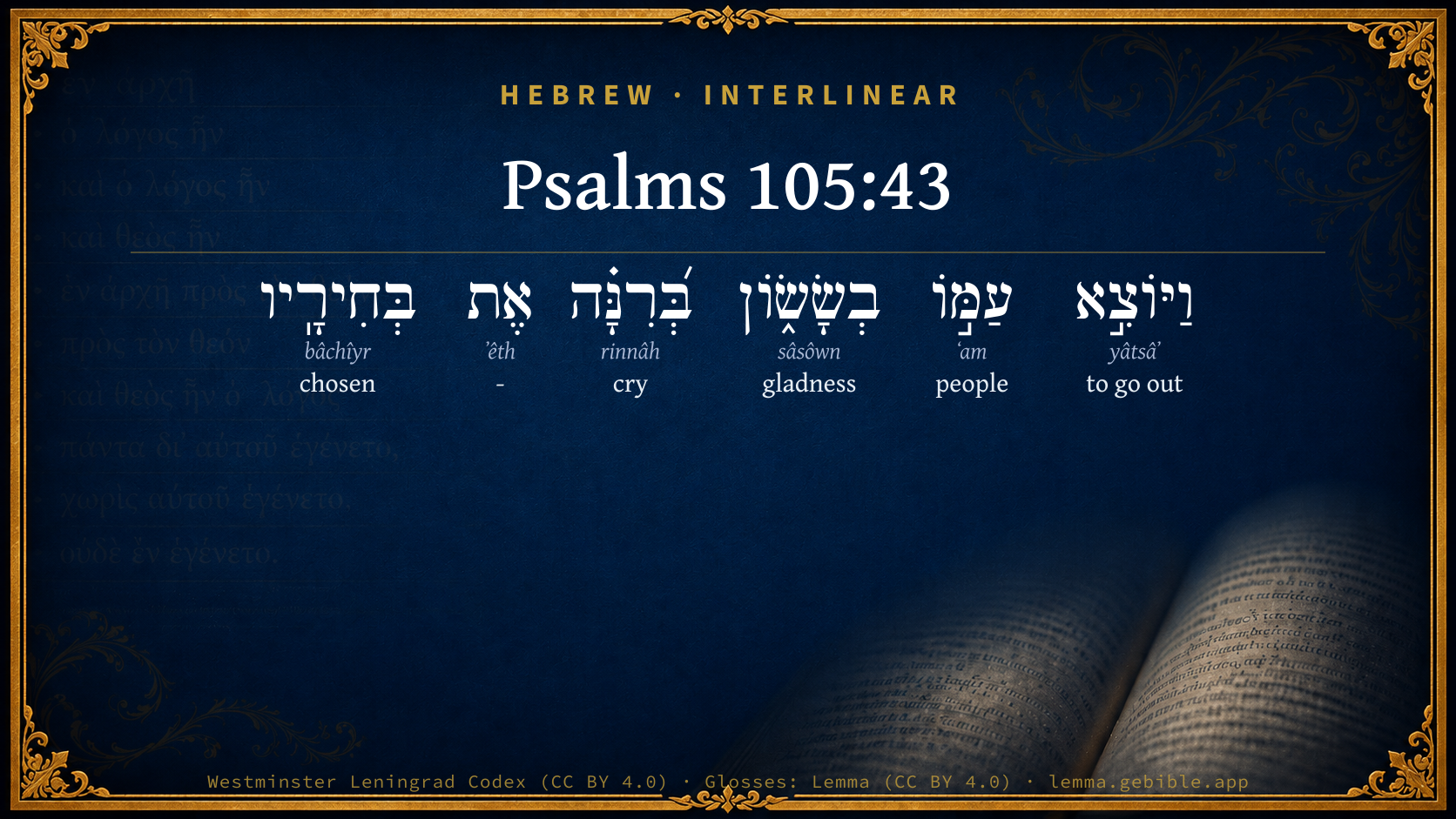
Psalms 105:43

Hebrew (Westminster Leningrad Codex) Psalms 105:43 appears in the Hebrew Old Testament. The text above is from the Westminster Leningrad Codex. Each word links to its Strong’s number, a concise gloss, and parsing drawn from the Open Scriptures Hebrew Bible morphology. Click any word for its full Brown-Driver-Briggs (BDB) entry.
Download image
Cite this verse

Psalms 105:43 (World English Bible). Public Domain. Lemma interlinear Bible study tool, https://lemma.gebible.app/v/psalms/105/43.

Show BibTeX & RIS
BibTeX
RIS
English Translation
He brought forth his people with joy, His chosen with singing.
World English Bible · Public Domain
Download a study sheet

One document with this verse’s original text, its word-by-word gloss line, the meaning frame, cross-references with their text, attributed commentary, and full source and license credits — printable, and it pastes into notes with its structure intact.

This verse Autodidact and up

Study sheet (.html) Plain text (.txt)

A passage Seminary Student

Up to 50 verses in one chapter. A passage sheet keeps up to 6 commentary sources and 12 cross-references per verse, in the order this page ranks them, and says so on the sheet whenever that leaves anything out. Ask for a single verse and you get the Autodidact verse sheet above.

Everything on this page stays free to read, with no account — the sheet is a download of what is already on screen, not access to it.

Want to remove ads? Support Godless Engineer
Compare translations 3

The same verse in 3 English versions, stacked beneath the original-language interlinear above. Click any original word for its lexicon entry.

Each is an independent rendering of the whole verse — the interlinear is not word-aligned to these translations.

Highlighted words mark where these versions differ — a whole-verse word diff, not a word-by-word alignment.

  • World English Bible Public Domain
    He brought forth his people with joy, His chosen with singing.
  • King James Version Public Domain
    And he brought forth his people with joy, and his chosen with gladness:
  • unfoldingWord Literal Text CC BY-SA 4.0
    He led his people out with joy, his chosen with shouts of triumph.

unfoldingWord Literal Text — © unfoldingWord, licensed CC BY-SA 4.0. Word-aligned USFM3 via Door43 (git.door43.org/unfoldingWord/en_ult).

Versions to compare (up to 4)

3 of 4 selected

Show all 18 translations

Every available English version of this verse, each an independent rendering of the whole verse.

  • World English Bible Public Domain
    He brought forth his people with joy, His chosen with singing.
  • Berean Standard Bible Public Domain
    He brought forth His people with rejoicing, His chosen with shouts of joy.
  • Majority Standard Bible Public Domain
    He brought forth His people with rejoicing, His chosen with shouts of joy.
  • King James Version Public Domain
    And he brought forth his people with joy, and his chosen with gladness:
  • American Standard Version (1901) Public Domain
    And he brought forth his people with joy, `And' his chosen with singing.
  • Revised Version (1885) Public Domain
    And he brought forth his people with joy, and his chosen with singing.
  • Geneva Bible (1599) Public Domain
    And he brought forth his people with ioy, and his chosen with gladnesse,
  • Douay-Rheims (1899) Public Domain
    And he brought forth his people with joy, and his chosen with gladness.
  • Young's Literal Translation Public Domain
    And He bringeth forth His people with joy, With singing His chosen ones.
  • Literal Standard Version CC BY-SA 4.0
    And He brings forth His people with joy, || His chosen ones with singing.
  • Unlocked Literal Bible CC BY-SA 4.0
    He led his people out with joy, his chosen with shouts of triumph.
  • unfoldingWord Literal Text CC BY-SA 4.0
    He led his people out with joy, his chosen with shouts of triumph.
  • Darby Bible Public Domain
    And he brought forth his people with gladness, his chosen with rejoicing;
  • World Messianic Bible Public Domain
    He brought his people out with joy, his chosen with singing.
  • Webster's Bible Public Domain
    And he brought forth his people with joy, and his chosen with gladness:
  • Free Bible Version CC BY-SA 4.0
    So he led his people out, his chosen ones, as they sang for joy.
  • Bible in Basic English Public Domain
    And he took his people out with joy, the men of his selection with glad cries:
  • JPS Tanakh (1917) Public Domain
    And He brought forth His people with joy, His chosen ones with singing.

Literal Standard Version (2020), Covenant Press — licensed CC BY-SA 4.0. Text via the HelloAO Bible API (eBible.org). Unlocked Literal Bible (unfoldingWord) — licensed CC BY-SA 4.0. Text via the HelloAO Bible API (eBible.org). unfoldingWord Literal Text — © unfoldingWord, licensed CC BY-SA 4.0. Word-aligned USFM3 via Door43 (git.door43.org/unfoldingWord/en_ult). Free Bible Version, Dr. Jonathan Gallagher — licensed CC BY-SA 4.0. Text via the HelloAO Bible API (eBible.org).

Word by word

More ways to search: Search by grammar → Find every occurrence → Compare this word →

Practice this passage: Drill this verse → Learn its vocabulary →

About this verse

These counts appear in no published source. They are computed here, from the morphology-tagged text and Lemma’s own curated glosses. What Lemma adds →

6
words
6
distinct lemmas
Wisdom
section

Notable vocabulary

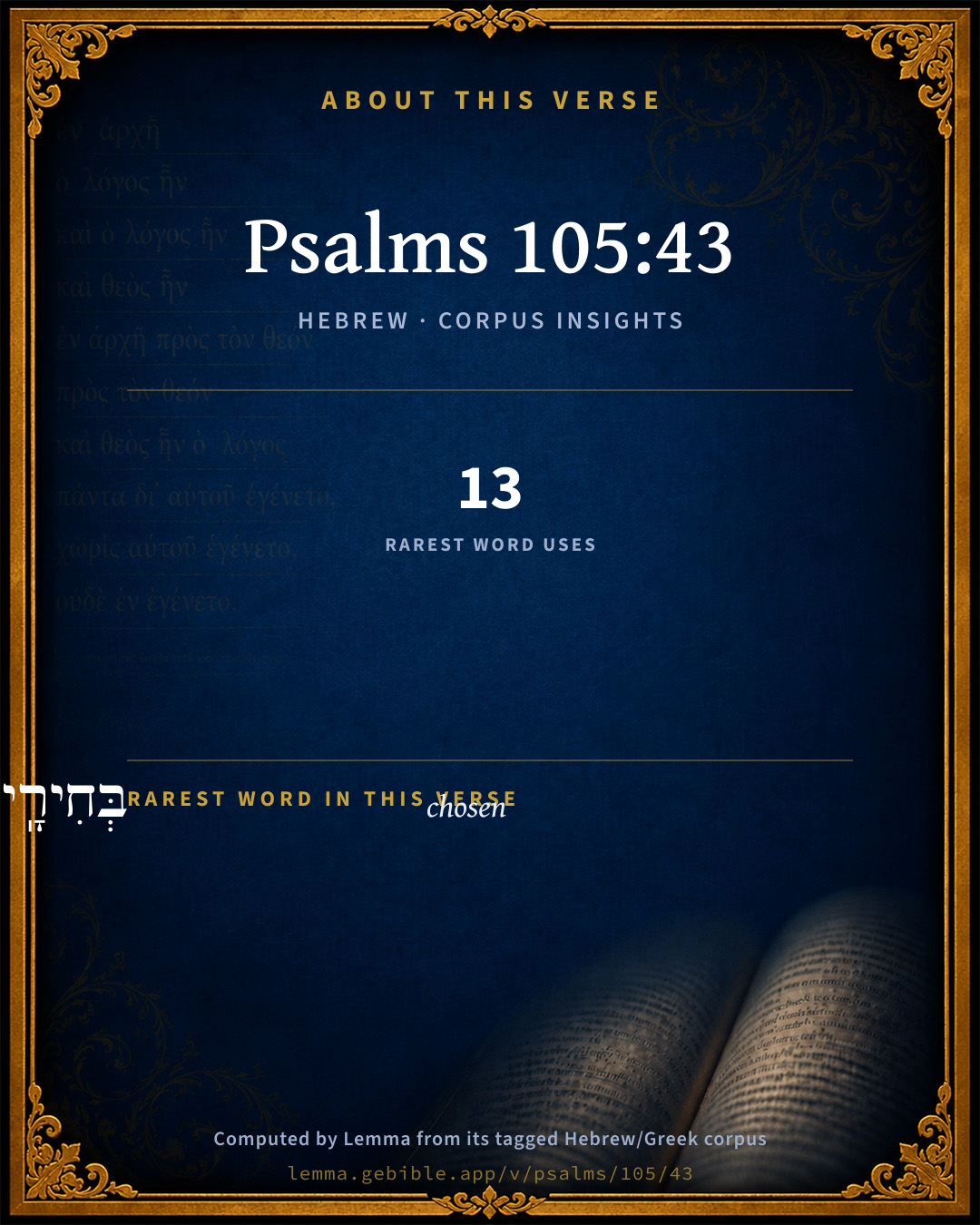
The rarest word here is בְּחִירָֽיו chosen H972 — appearing just 13 times in the whole Hebrew Bible.

Shared distinctive vocabulary

בְּחִירָֽיו chosen H972 occurs in 13 verses of the Hebrew Bible. Also found in:

Grammatical profile

  • 1 verb
  • 3 nouns
  • 1 adjective
  • 1 particle

Verb forms

  • וַיּוֹצִ֣א Hiphil · Sequential Imperfect

Hebrew & Septuagint length

In English translation the verse runs 11 words from the Hebrew and 13 from the Septuagint (LXX English) — closely comparable.

A rough comparison of the two English renderings, which tokenize alike — not a word-level alignment.

Word counts can differ between the Hebrew and the Greek without any difference in meaning — e.g. the Hebrew direct-object marker אֵת has no separate Greek word, and Greek often adds the article ὁ.

Cross-references

11

Topical passages linked to Psalms 105:43 in the Treasury of Scripture Knowledge — connected by theme and wording, ordered by reader-vote popularity; previews shown in the World English Bible.

  • Isaiah 35:10 and the ransomed of Yahweh shall return, and come with singing to Zion; and everlasting joy shall be on their heads: they shall obtain gladness and joy, and sorrow and sighing shall flee away.
  • Acts 13:17 The God of this people chose our fathers, and exalted the people when they stayed as aliens in the land of Egypt, and with an uplifted arm, he led them out of it.
  • Isaiah 55:12 For you shall go out with joy, and be led forth with peace: the mountains and the hills shall break forth before you into singing; and all the trees of the fields shall clap their hands.
  • Jeremiah 31:11–12 For Yahweh has ransomed Jacob, and redeemed him from the hand of him who was stronger than he.
  • Acts 7:36 This man led them out, having worked wonders and signs in Egypt, in the Red Sea, and in the wilderness for forty years.
  • Exodus 15:1–21 Then Moses and the children of Israel sang this song to Yahweh, and said, "I will sing to Yahweh, for he has triumphed gloriously: The horse and his rider he has thrown into the sea.
  • Deuteronomy 4:37–38 Because he loved your fathers, therefore he chose their seed after them, and brought you out with his presence, with his great power, out of Egypt;
  • Psalms 106:8–12 Nevertheless he saved them for his name's sake, That he might make his mighty power known.
  • Isaiah 51:10–11 Isn't it you who dried up the sea, the waters of the great deep; who made the depths of the sea a way for the redeemed to pass over?
  • Isaiah 63:11–14 Then he remembered the days of old, Moses [and] his people, [saying], Where is he who brought them up out of the sea with the shepherds of his flock? where is he who put his holy Spirit in the midst of them?
  • Psalms 78:52–53 But he led forth his own people like sheep, And guided them in the wilderness like a flock.

Cross-references courtesy of OpenBible.info (CC BY 4.0).

Hebrew and Greek witnesses Masoretic Hebrew ↔ Greek Septuagint

The same verse in the two great witnesses to the Old Testament, shown verse-for-verse.

You’re reading Greek Psalm 104 (Hebrew Psalm 105). The Septuagint counts the superscription, so verse numbers can differ from the Hebrew — chapter-level alignment, not verse-by-verse. Numbering follows Rahlfs.

These are two independent witnesses, not word-aligned to each other, and the Septuagint is shown in lemma (dictionary) form.

Hebrew Psalms 105:43 Masoretic · Westminster Leningrad Codex

וַיּוֹצִ֣א עַמּ֣וֹ בְשָׂשׂ֑וֹן בְּ֝רִנָּ֗ה אֶת בְּחִירָֽיו

He brought forth his people with joy, His chosen with singing.

World English Bible · Public Domain

Greek LXX Greek Psalm 104:43 Septuagint · lemma form

καί ἐκἄγω ὁ λαός αὐτός ἐν ἀγαλλίασις καί ὁ ἐκλεκτός αὐτός ἐν εὐφροσύνη

And he brought out his people with exultation, and his chosen with joy;

LXX2012 (modern English Septuagint) · Public Domain

Hebrew: Westminster Leningrad Codex (CC BY 4.0). Greek: Septuagint (public domain); English from LXX2012 (modern English Septuagint) (Public Domain). How the Septuagint differs from the Hebrew →

Commentary

Notes on Psalms 105:43 from classic Christian and Jewish commentators (each source and its license shown beneath its notes). The classic Christian expositions comment on the surrounding passage and are grouped to its opening verse, so a note may address several verses; the Jewish commentaries on the Tanakh (Rashi and others) are per-verse, so they appear only where the commentator wrote on this verse.

Lemma curates 59 commentaries, every one of them public domain or Creative Commons licensed, each selected and text-cleaned for this edition rather than reprinted as found. About our sources →

Trapp's Complete Commentary

John Trapp

Psa 105:43 And he brought forth his people with joy, [and] his chosen with gladness:

Ver. 43. And he brought forth his people with joy] According to his promise made to Abraham; and according to the time they were afflicted, so were they comforted, Psa 90:15.

John Trapp, A Commentary or Exposition upon All the Books of the Old and New Testament (1647–1656) — public domain. Text from a community e-Sword module.

J. A. Alexander on Psalms

Joseph Addison Alexander

43. (Psa 105:43) And brought out his people in, joy, in triumph his chosen (ones). He remembered his promise, and in execution of it brought out his people, etc. The parallelism of people and chosen throws light upon the latter term, as used in ver. 6 (Psa 105:6).

Joseph Addison Alexander, The Psalms Translated and Explained (1850) — public domain. Text from a community e-Sword module.

Geneva Bible (1599)

Geneva Bible translators

When the Egyptians lamented and were destroyed.

Geneva Bible (1599) marginal notes — public domain. Text via Bolls.life.

John Calvin's Commentaries

43. And he brought forth his people with joy The prophet makes mention of joy and gladness, the more highly to magnify the greatness of God’s grace. It was no small matter, that at the very time when the Egyptians were afflicted by a severe and dreadful plague, — when the whole kingdom was full of weeping and howling, — and when in almost every house there was a dead body, — the people who a little before were groaning in great distress, or rather lay almost dead, went forth with joyful hearts. By the appellation the chosen of God, they are reminded, that his favor was not thus exercised towards them on account of their own merits, or on account of the worth of their race, but because he had adopted them, that men having nothing left them in which to vaunt themselves might learn to glory in God alone.

John Calvin's Commentaries (1540-1563) — public domain. Text from the Calvin Translation Society English edition (1840s-50s) via the Christian Classics Ethereal Library (ccel.org). Calvin's coverage is partial (roughly two-thirds of the Bible); uncommented books and verses are honest gaps, never fabricated. The 19th-century editor's footnotes and remarks are omitted so the notes are faithfully Calvin's own voice.

Ellicott's Commentary for English Readers

(43) Gladness.—Better, singing. Alluding, possibly, to Miriam’s song on the shore of the Red Sea.

A Bible Commentary for English Readers, edited by Charles John Ellicott (1878–1897) — public domain. Text from a community e-Sword module.

The Cambridge Bible for Schools and Colleges

gen. ed. J. J. S. Perowne

43. with gladness] With jubilant singing, the rejoicing on the shores of the Red Sea, Exodus 15. But the language is a reminiscence of the prophecies of the Exodus from Babylon, Isa_35:10; Isa_51:11; Isa_55:12.

The Cambridge Bible for Schools and Colleges (gen. ed. J. J. S. Perowne; Cambridge University Press, 1878–1918) — public domain. Text from a community e-Sword module.

John Gill's Exposition

And gave them the lands of the Heathen,.... The countries of the seven nations that dwelt in Canaan; the Lord did it, who had a right to do it, being the possessor of heaven and earth; and who was provoked unto it by the sins of these Heathens, as well as promised it to his people the Israelites.

And they inherited the labour of the people; dwelled in the houses they had built, which they found full of all good things; enjoyed the vineyards and olive trees they had planted, and possessed the wells which they had dug, Deu 6:10. In like manner the heavenly Canaan is enjoyed by the saints without any labour of theirs; this inheritance is not of the law, nor of the works of it, it is the gift of God, Rom 4:14.

John Gill's Exposition of the Whole Bible (1746–1763) — public domain (CC PDM 1.0). Text via the HelloAO Bible API.

Albert Barnes' Notes on the Bible

And he brought forth his people with joy - With joy at their deliverance from bondage, and for his merciful interposition.

And his chosen with gladness - Margin, as in Hebrew, “singing.” See Exo. 15.

Albert Barnes' Notes on the Bible (1834–1885) — public domain. Text from a community e-Sword/MySword module.

The Treasury of David

Charles H. Spurgeon

Ver. 43. And he brought forth his people with joy, and his chosen with gladness. Up from the wilderness he led them, rejoicing over them himself and making them rejoice too. They were his people, his chosen, and hence in them he rejoiced, and upon them he showered his favours, that they might rejoice in him as their God, and their portion.

Psalms 105:44*

Charles H. Spurgeon's The Treasury of David (1869–1885) — public domain. Psalms only. Text from a community e-Sword/MySword module.

Whedon's Commentary on the Bible

Daniel D. Whedon

43. Brought forth his people with joy—A fitting type of the deliverances and triumphant joy of the spiritual Church. See Isa_35:10. And this joy should have remained with them through all their desert life. A joyful deliverance from sin, followed by rebellious, unbelief, murmurings, and discontent, can never recommend the religion of God and of Christ to a wicked world.

Daniel D. Whedon (gen. ed.), Commentary on the Old and New Testaments (1874–1909) — public domain. Text from a community e-Sword module.

The Pulpit Commentary

And brought forth his people with joy, and his chosen with gladness. The "bringing forth" intended is that of the Israelites from the wilderness into Canaan. It was naturally attended with much "joy" and "gladness."

The Pulpit Commentary (1880–1919), ed. H.D.M. Spence-Jones & Joseph S. Exell — public domain. Text from a community e-Sword module.

unfoldingWord translationNotes

Door43 World Missions Community

He led his people out ... his chosen with shouts of triumph

These two phrases have basically the same meaning and are used together to emphasize that God's people were joyful when he led them out of Egypt. The people were shouting joyfully. AT: "He led his chosen people out with shouts of joy and triumph" (See: Parallelism)

his chosen

Here "chosen" refers to Yahweh's chosen people. AT: "his chosen people" (See: Nominal Adjectives)

shouts of triumph

the sound that people make when they are shouting with joy because they have defeated their enemies

keep his statutes and obey his laws

These two phrases have basically the same meaning and are used together for emphasis. "To keep" his statutes means to obey them. AT: "obey his laws and statutes" (See: Parallelism)

translationWords

people of God

joy

chosen one

nation

possess

people group

statute

obey

law

praise

Yahweh

unfoldingWord translationNotes — © Distant Shores Media and the Door43 World Missions Community, licensed CC BY-SA 4.0. Source: git.door43.org/Door43/en_tn.

Lesson kit

Teaching starters — assembled from the data on this page, not authored interpretation. Every prompt links to the verse data it draws on. Edit before teaching.

Psalms, in the Wisdom, opens this verse with 6 words (6 distinct Hebrew lemmas). Its most distinctive word is bâchîyr (“chosen”). A historical commentator’s framing appears above. Read the whole chapter for the surrounding context.

Discussion questions

  1. How does “chosen” (bâchîyr) shape what this verse is saying?
  2. How does 2 Samuel 21:6, which shares the word «chosen», read alongside this verse?
  3. These translations render this verse differently; the difference is in the English rendering, not the original. What questions does that raise?
  4. «וַיּוֹצִ֣א» is a Hiphil Sequential Imperfect verb. How does that grammatical form shape the action described?
  5. Compare how Trapp's Complete Commentary and J. A. Alexander on Psalms read this verse. Where do they agree or differ?

Things to notice

Reading settings

Reading text

Shown beneath each verse's original-language words.

Old Testament
Old Testament edition

Read the OT as the Masoretic Hebrew (MT) or the Greek Septuagint (LXX).

English shown for the Greek Septuagint (in the Hebrew ↔ Greek comparison).

Comparing translations? Open the Compare panel on any verse page to stack up to four side by side.