
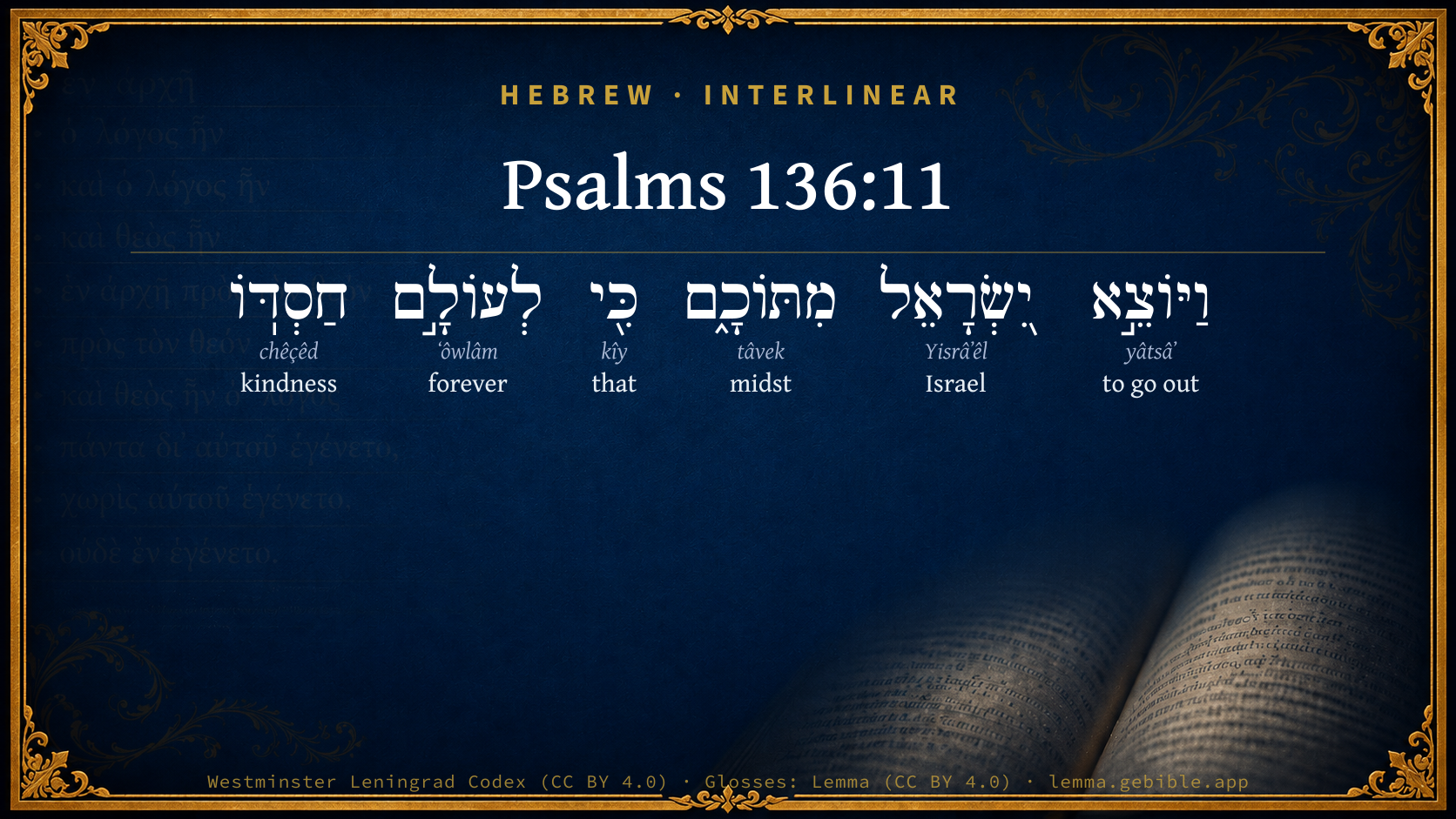
Psalms 136:11

Hebrew (Westminster Leningrad Codex) Psalms 136:11 appears in the Hebrew Old Testament. The text above is from the Westminster Leningrad Codex. Each word links to its Strong’s number, a concise gloss, and parsing drawn from the Open Scriptures Hebrew Bible morphology. Click any word for its full Brown-Driver-Briggs (BDB) entry.
Download image
Cite this verse

Psalms 136:11 (World English Bible). Public Domain. Lemma interlinear Bible study tool, https://lemma.gebible.app/v/psalms/136/11.

Show BibTeX & RIS
BibTeX
RIS
English Translation
And brought out Israel from among them; For his loving kindness endures forever;
World English Bible · Public Domain
Download a study sheet

One document with this verse’s original text, its word-by-word gloss line, the meaning frame, cross-references with their text, attributed commentary, and full source and license credits — printable, and it pastes into notes with its structure intact.

This verse Autodidact and up

Study sheet (.html) Plain text (.txt)

A passage Seminary Student

Up to 50 verses in one chapter. A passage sheet keeps up to 6 commentary sources and 12 cross-references per verse, in the order this page ranks them, and says so on the sheet whenever that leaves anything out. Ask for a single verse and you get the Autodidact verse sheet above.

Everything on this page stays free to read, with no account — the sheet is a download of what is already on screen, not access to it.

Want to remove ads? Support Godless Engineer
Compare translations 3

The same verse in 3 English versions, stacked beneath the original-language interlinear above. Click any original word for its lexicon entry.

Each is an independent rendering of the whole verse — the interlinear is not word-aligned to these translations.

Highlighted words mark where these versions differ — a whole-verse word diff, not a word-by-word alignment.

  • World English Bible Public Domain
    And brought out Israel from among them; For his loving kindness endures forever;
  • King James Version Public Domain
    And brought out Israel from among them: for his mercy endureth for ever:
  • unfoldingWord Literal Text CC BY-SA 4.0
    And he brought out Israel from their midst, for his covenant faithfulness to forever.

unfoldingWord Literal Text — © unfoldingWord, licensed CC BY-SA 4.0. Word-aligned USFM3 via Door43 (git.door43.org/unfoldingWord/en_ult).

Versions to compare (up to 4)

3 of 4 selected

Show all 18 translations

Every available English version of this verse, each an independent rendering of the whole verse.

  • World English Bible Public Domain
    And brought out Israel from among them; For his loving kindness endures forever;
  • Berean Standard Bible Public Domain
    and brought Israel out from among them His loving devotion endures forever.
  • Majority Standard Bible Public Domain
    and brought Israel out from among them His loving devotion endures forever.
  • King James Version Public Domain
    And brought out Israel from among them: for his mercy endureth for ever:
  • American Standard Version (1901) Public Domain
    And brought out Israel from among them; For his lovingkindness `endureth' for ever;
  • Revised Version (1885) Public Domain
    And brought out Israel from among them: for his mercy endureth for ever:
  • Geneva Bible (1599) Public Domain
    And brought out Israel from among them (for his mercie endureth for euer)
  • Douay-Rheims (1899) Public Domain
    Sehon king of the Amorrhites, and Og king of Basan, and all the kingdoms of Chanaan.
  • Young's Literal Translation Public Domain
    And bringing forth Israel from their midst, For to the age `is' His kindness.
  • Literal Standard Version CC BY-SA 4.0
    And bringing forth Israel from their midst, || For His kindness [is] for all time.
  • Unlocked Literal Bible CC BY-SA 4.0
    and brought out Israel from among them, for his covenant faithfulness endures forever—
  • unfoldingWord Literal Text CC BY-SA 4.0
    And he brought out Israel from their midst, for his covenant faithfulness to forever.
  • Darby Bible Public Domain
    And brought out Israel from among them, for his loving-kindness [endureth] for ever,
  • World Messianic Bible Public Domain
    and brought out Israel from among them, for his loving kindness endures forever;
  • Webster's Bible Public Domain
    And brought out Israel from among them: for his mercy endureth for ever:
  • Free Bible Version CC BY-SA 4.0
    He led his people out of Egypt. For his trustworthy love lasts forever.
  • Bible in Basic English Public Domain
    And took out Israel from among them: for his mercy is unchanging for ever:
  • JPS Tanakh (1917) Public Domain
    And brought out Israel from among them, for His mercy endureth for ever;

Literal Standard Version (2020), Covenant Press — licensed CC BY-SA 4.0. Text via the HelloAO Bible API (eBible.org). Unlocked Literal Bible (unfoldingWord) — licensed CC BY-SA 4.0. Text via the HelloAO Bible API (eBible.org). unfoldingWord Literal Text — © unfoldingWord, licensed CC BY-SA 4.0. Word-aligned USFM3 via Door43 (git.door43.org/unfoldingWord/en_ult). Free Bible Version, Dr. Jonathan Gallagher — licensed CC BY-SA 4.0. Text via the HelloAO Bible API (eBible.org).

Word by word

More ways to search: Search by grammar → Find every occurrence → Compare this word →

Practice this passage: Drill this verse → Learn its vocabulary →

About this verse

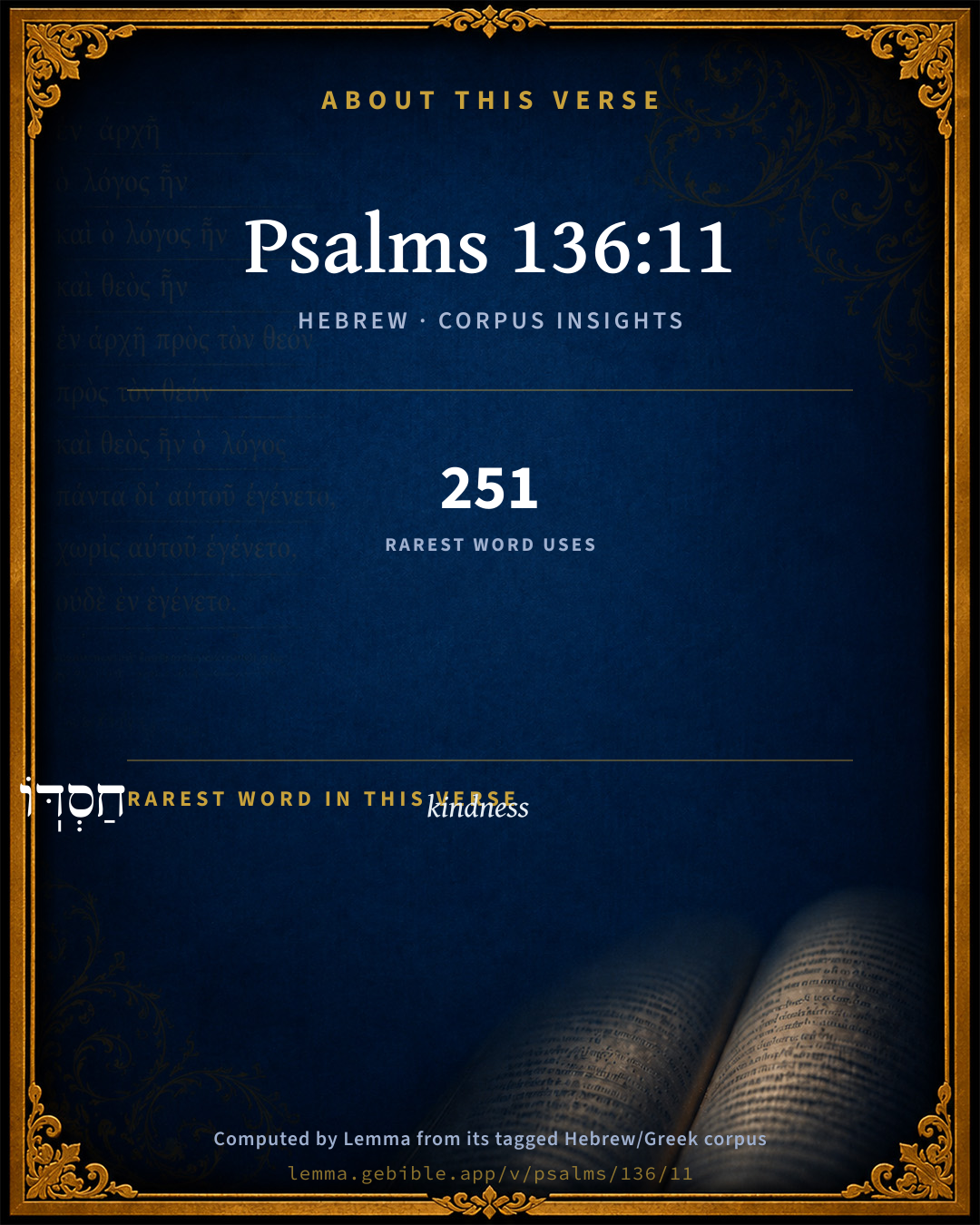
These counts appear in no published source. They are computed here, from the morphology-tagged text and Lemma’s own curated glosses. What Lemma adds →

6
words
6
distinct lemmas
Wisdom
section

Grammatical profile

  • 1 verb
  • 4 nouns
  • 1 conjunction

Verb forms

  • וַיּוֹצֵ֣א Hiphil · Sequential Imperfect

Hebrew & Septuagint length

In English translation the verse runs 13 words from the Hebrew and 15 from the Septuagint (LXX English) — closely comparable.

A rough comparison of the two English renderings, which tokenize alike — not a word-level alignment.

Word counts can differ between the Hebrew and the Greek without any difference in meaning — e.g. the Hebrew direct-object marker אֵת has no separate Greek word, and Greek often adds the article ὁ.

Cross-references

6

Topical passages linked to Psalms 136:11 in the Treasury of Scripture Knowledge — connected by theme and wording, ordered by reader-vote popularity; previews shown in the World English Bible.

  • Exodus 12:51 It happened the same day, that Yahweh brought the children of Israel out of the land of Egypt by their hosts.
  • Exodus 13:3 Moses said to the people, "Remember this day, in which you came out from Egypt, out of the house of bondage; for by strength of hand Yahweh brought you out from this place. No leavened bread shall be eaten.
  • Exodus 13:17 It happened, when Pharaoh had let the people go, that God didn't lead them by the way of the land of the Philistines, although that was near; for God said, "Lest perhaps the people change their minds when they see war, and they return to Egypt;"
  • 1 Samuel 12:6–8 Samuel said to the people, It is Yahweh who appointed Moses and Aaron, and that brought your fathers up out of the land of Egypt.
  • Psalms 78:52 But he led forth his own people like sheep, And guided them in the wilderness like a flock.
  • Psalms 105:37 He brought them forth with silver and gold. There was not one feeble person among his tribes.

Cross-references courtesy of OpenBible.info (CC BY 4.0).

Hebrew and Greek witnesses Masoretic Hebrew ↔ Greek Septuagint

The same verse in the two great witnesses to the Old Testament, shown verse-for-verse.

You’re reading Greek Psalm 135 (Hebrew Psalm 136). The Septuagint counts the superscription, so verse numbers can differ from the Hebrew — chapter-level alignment, not verse-by-verse. Numbering follows Rahlfs.

These are two independent witnesses, not word-aligned to each other, and the Septuagint is shown in lemma (dictionary) form.

Hebrew Psalms 136:11 Masoretic · Westminster Leningrad Codex

וַיּוֹצֵ֣א יִ֭שְׂרָאֵל מִתּוֹכָ֑ם כִּ֖י לְעוֹלָ֣ם חַסְדּֽוֹ

And brought out Israel from among them; For his loving kindness endures forever;

World English Bible · Public Domain

Greek LXX Greek Psalm 135:11 Septuagint · lemma form

καί ἐκἄγω ὁ ἰσραήλ ἐκ μέσος αὐτός ὅτι εἰς ὁ αἰών ὁ ἔλεος αὐτός

And brought Israel out of the midst of them; for his mercy endures for ever:

LXX2012 (modern English Septuagint) · Public Domain

Hebrew: Westminster Leningrad Codex (CC BY 4.0). Greek: Septuagint (public domain); English from LXX2012 (modern English Septuagint) (Public Domain). How the Septuagint differs from the Hebrew →

Commentary

Notes on Psalms 136:11 from classic Christian and Jewish commentators (each source and its license shown beneath its notes). The classic Christian expositions comment on the surrounding passage and are grouped to its opening verse, so a note may address several verses; the Jewish commentaries on the Tanakh (Rashi and others) are per-verse, so they appear only where the commentator wrote on this verse.

Lemma curates 59 commentaries, every one of them public domain or Creative Commons licensed, each selected and text-cleaned for this edition rather than reprinted as found. About our sources →

Trapp's Complete Commentary

John Trapp

Psa 136:11 And brought out Israel from among them: for his mercy [endureth] for ever:

Ver. 11. And brought out Israel] viz. By that last plague; for the former would not do. God will have the better of his enemies, for the good of his people; for it is not fit that he should lay down the bucklers first.

John Trapp, A Commentary or Exposition upon All the Books of the Old and New Testament (1647–1656) — public domain. Text from a community e-Sword module.

J. A. Alexander on Psalms

Joseph Addison Alexander

11. (Psa 136:11) And brought out Israel from the midst of them--for unto eternity (is) his mercy. Here for the first time we have a finite tense (the future conversive), interrupting the long series of participles, all agreeing with Jehovah understood.

Joseph Addison Alexander, The Psalms Translated and Explained (1850) — public domain. Text from a community e-Sword module.

Geneva Bible (1599)

Geneva Bible translators

God’s merciful providence toward man appeareth in all his creatures, but chiefly in that that he delivered his Church from the thraldom of their enemies.

Geneva Bible (1599) marginal notes — public domain. Text via Bolls.life.

The Cambridge Bible for Schools and Colleges

gen. ed. J. J. S. Perowne

11. O give thanks unto the Rock of Isaac, for &c.

The Cambridge Bible for Schools and Colleges (gen. ed. J. J. S. Perowne; Cambridge University Press, 1878–1918) — public domain. Text from a community e-Sword module.

John Gill's Exposition

And brought out Israel from among them,.... A wicked and idolatrous people, among whom they suffered great hardships; and this was done by means of God's judgments on them, and especially that before related; and was an instance of the mercy of God, as follows, for which thanks should be given;

for his mercy endureth for ever; and this is a proof of it, bringing the children of Israel out of Egypt, the house of bondage; when they cried unto him by reason of it, and he sent them a Saviour to deliver them out of their distress, Exo 2:23; an emblem of the grace and mercy of God, in delivering his people from a worse than Egyptian bondage; from the bondage of sin, Satan, the law, and through fear of death, into the glorious liberty of the children of God.

John Gill's Exposition of the Whole Bible (1746–1763) — public domain (CC PDM 1.0). Text via the HelloAO Bible API.

Albert Barnes' Notes on the Bible

And brought Israel out from among them - From the land of Egypt. By all the wonders manifested in their deliverance, and in conducting them out of the land so that they should escape from their pursuers.

For his mercy ... - His mercy in this respect was to be measured by all that there was of power in conducting them forth in safety, and by the results of it.

Albert Barnes' Notes on the Bible (1834–1885) — public domain. Text from a community e-Sword/MySword module.

The Treasury of David

Charles H. Spurgeon

Ver. 11. And brought out Israel from among them. Scattered as the tribes were up and down the country, and apparently held in a grasp which would never be relaxed, the Lord wrought their deliverance, and severed them from their idolatrous task masters. None of them remained in bondage. The Lord brought them out; brought them all out; brought them out at the very hour when his promise was due; brought them out despite their being mingled among the Egyptians; brought them out never to return. Unto his name let us give thanks for this further proof of his favour to the chosen ones,

For his mercy endureth for ever. Once the Israelites did not care to go out, but preferred to bear the ills they had rather than risk they knew not what; but the Lord's mercy endured that test also, and ceased not to stir up the nest till the birds were glad to take to their wings. He turned the land of plenty into a house of bondage, and the persecuted nation was glad to escape from slavery. The unfailing mercy of the Lord is gloriously seen in his separating his elect from the world. He brings out his redeemed and they are henceforth a people who show forth his praise.

"For God doth prove

Our constant friend;

His boundless love

Shall never end."

Ver. 11. And brought out Israel from among them. Such an emigration as this the world never saw. On the lowest computation, the entire multitude must have been above two millions, and in all probability the number exceeded three millions. Is the magnitude of this movement usually apprehended? Do we think of the emigration of the Israelites from Egypt as of the emigration of a number of families twice as numerous as the population of the principality of Wales, or considerably more than the whole population of the British Metropolis (in 1841), with all their goods, property, and cattle? The collecting together of so immense a multitudethe arranging the order of their marchthe provision of the requisite food even for a few days, must, under the circumstances, have been utterly impossible, unless a very special and overruling Providence had graciously interfered to obviate the difficulties of the case. To the most superficial observer it must be evident, that no man, or number of men, having nothing but human resources, could have ventured to undertake this journey. Scarcely any wonder, wrought by Divine power in Egypt, appears greater than this emigration of a nation, when fairly and fully considered. George Smith, in "Sacred Annals", 1850.

Ver. 11. The bringing out of God's people from their natural state, from their misery, and from association with the ungodly, a great marvel of everlasting mercy.

Ver. 11. Effectual calling; the intervention at the determined moment of the mercy of infinite ages. W.B.H.

Psalms 136:12*

Charles H. Spurgeon's The Treasury of David (1869–1885) — public domain. Psalms only. Text from a community e-Sword/MySword module.

The Pulpit Commentary

And brought out Israel from among them. (see Exo_12:51 Exo_14:19-31) For his mercy, etc.

The Pulpit Commentary (1880–1919), ed. H.D.M. Spence-Jones & Joseph S. Exell — public domain. Text from a community e-Sword module.

Lesson kit

Teaching starters — assembled from the data on this page, not authored interpretation. Every prompt links to the verse data it draws on. Edit before teaching.

Psalms, in the Wisdom, opens this verse with 6 words (6 distinct Hebrew lemmas). Its most distinctive word is chêçêd (“kindness”). A historical commentator’s framing appears above. Read the whole chapter for the surrounding context.

Discussion questions

  1. How does “kindness” (chêçêd) shape what this verse is saying?
  2. Exodus 12:51 shares this passage’s theme. How do the two illuminate each other?
  3. The translations on this page render this verse differently — a whole-verse word diff, not a word-by-word alignment. What might account for the different wordings?
  4. The verb «וַיּוֹצֵ֣א» is Hiphil Sequential Imperfect. How does its form color the action?
  5. Reading how Trapp's Complete Commentary and J. A. Alexander on Psalms read this verse, where do the two commentators agree and where do they part?

Things to notice

Reading settings

Reading text

Shown beneath each verse's original-language words.

Old Testament
Old Testament edition

Read the OT as the Masoretic Hebrew (MT) or the Greek Septuagint (LXX).

English shown for the Greek Septuagint (in the Hebrew ↔ Greek comparison).

Comparing translations? Open the Compare panel on any verse page to stack up to four side by side.