
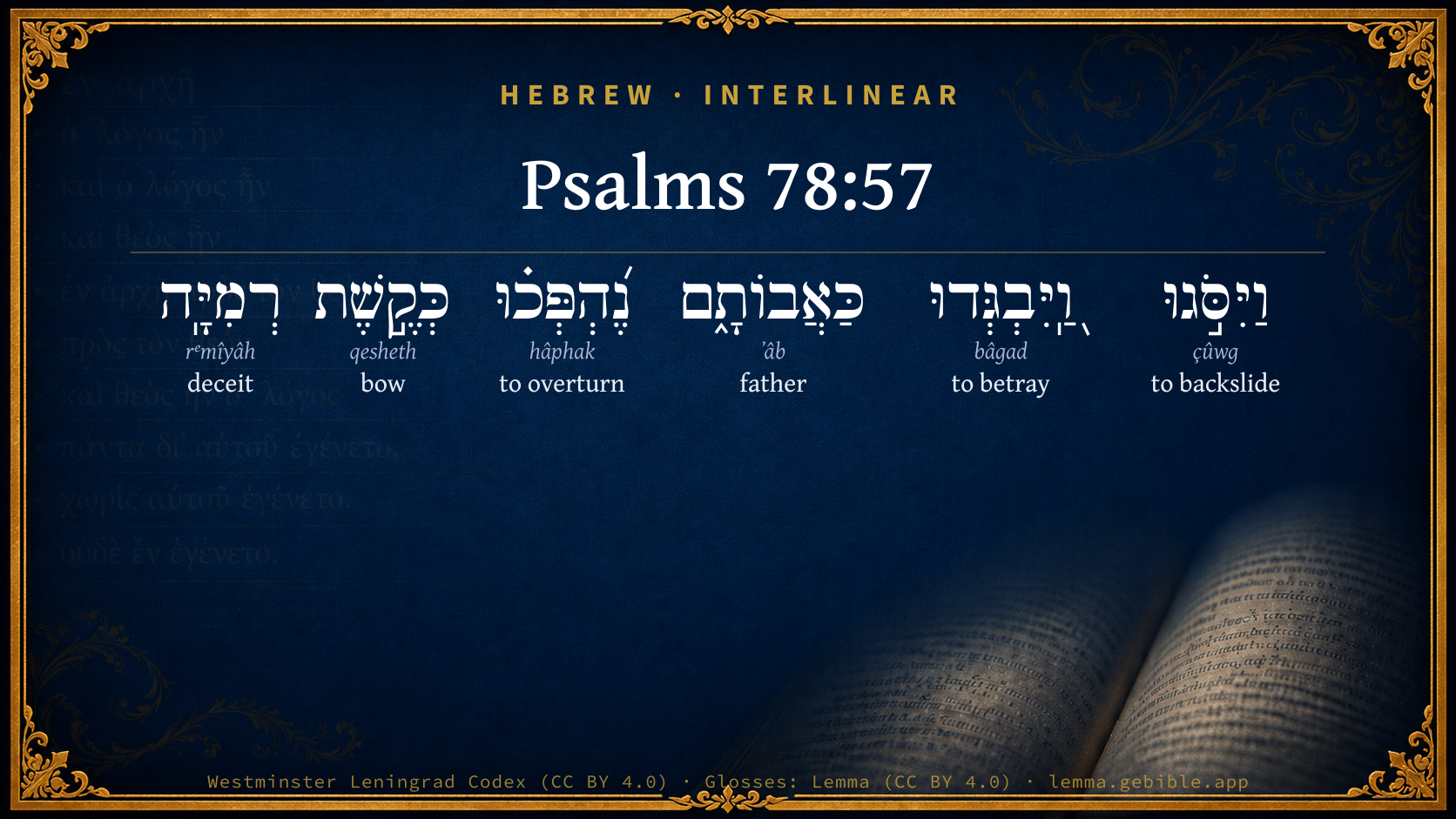
Psalms 78:57

Hebrew (Westminster Leningrad Codex) Psalms 78:57 appears in the Hebrew Old Testament. The text above is from the Westminster Leningrad Codex. Each word links to its Strong’s number, a concise gloss, and parsing drawn from the Open Scriptures Hebrew Bible morphology. Click any word for its full Brown-Driver-Briggs (BDB) entry.
Download image
Cite this verse

Psalms 78:57 (World English Bible). Public Domain. Lemma interlinear Bible study tool, https://lemma.gebible.app/v/psalms/78/57.

Show BibTeX & RIS
BibTeX
RIS
English Translation
But turned back, and dealt treacherously like their fathers. They were turned aside like a deceitful bow.
World English Bible · Public Domain
Download a study sheet

One document with this verse’s original text, its word-by-word gloss line, the meaning frame, cross-references with their text, attributed commentary, and full source and license credits — printable, and it pastes into notes with its structure intact.

This verse Autodidact and up

Study sheet (.html) Plain text (.txt)

A passage Seminary Student

Up to 50 verses in one chapter. A passage sheet keeps up to 6 commentary sources and 12 cross-references per verse, in the order this page ranks them, and says so on the sheet whenever that leaves anything out. Ask for a single verse and you get the Autodidact verse sheet above.

Everything on this page stays free to read, with no account — the sheet is a download of what is already on screen, not access to it.

Want to remove ads? Support Godless Engineer
Compare translations 3

The same verse in 3 English versions, stacked beneath the original-language interlinear above. Click any original word for its lexicon entry.

Each is an independent rendering of the whole verse — the interlinear is not word-aligned to these translations.

Highlighted words mark where these versions differ — a whole-verse word diff, not a word-by-word alignment.

  • World English Bible Public Domain
    But turned back, and dealt treacherously like their fathers. They were turned aside like a deceitful bow.
  • King James Version Public Domain
    But turned back, and dealt unfaithfully like their fathers: they were turned aside like a deceitful bow.
  • unfoldingWord Literal Text CC BY-SA 4.0
    And they turned back and acted treacherously like their fathers; they turned themselves like a bow of deceit.

unfoldingWord Literal Text — © unfoldingWord, licensed CC BY-SA 4.0. Word-aligned USFM3 via Door43 (git.door43.org/unfoldingWord/en_ult).

Versions to compare (up to 4)

3 of 4 selected

Show all 18 translations

Every available English version of this verse, each an independent rendering of the whole verse.

  • World English Bible Public Domain
    But turned back, and dealt treacherously like their fathers. They were turned aside like a deceitful bow.
  • Berean Standard Bible Public Domain
    They turned back and were faithless like their fathers, twisted like a faulty bow.
  • Majority Standard Bible Public Domain
    They turned back and were faithless like their fathers, twisted like a faulty bow.
  • King James Version Public Domain
    But turned back, and dealt unfaithfully like their fathers: they were turned aside like a deceitful bow.
  • American Standard Version (1901) Public Domain
    But turned back, and dealt treacherously like their fathers: They were turned aside like a deceitful bow.
  • Revised Version (1885) Public Domain
    But turned back, and dealt treacherously like their fathers: they were turned aside like a deceitful bow.
  • Geneva Bible (1599) Public Domain
    But turned backe and delt falsely like their fathers: they turned like a deceitfull bowe.
  • Douay-Rheims (1899) Public Domain
    And they turned away, and kept not the covenant: even like their fathers they were turned aside as a crooked bow.
  • Young's Literal Translation Public Domain
    And they turn back, And deal treacherously like their fathers, They have been turned like a deceitful bow,
  • Literal Standard Version CC BY-SA 4.0
    And they turn back, || And deal treacherously like their fathers, || They have been turned like a deceitful bow,
  • Unlocked Literal Bible CC BY-SA 4.0
    They were unfaithful and acted treacherously like their fathers; they were as undependable as a faulty bow.
  • unfoldingWord Literal Text CC BY-SA 4.0
    And they turned back and acted treacherously like their fathers; they turned themselves like a bow of deceit.
  • Darby Bible Public Domain
    And they drew back and dealt treacherously like their fathers: they turned like a deceitful bow.
  • World Messianic Bible Public Domain
    but turned back, and dealt treacherously like their fathers. They were twisted like a deceitful bow.
  • Webster's Bible Public Domain
    But turned back, and dealt unfaithfully like their fathers: they were turned aside like a deceitful bow.
  • Free Bible Version CC BY-SA 4.0
    Just like their forefathers they turned away from God and were unfaithful to him, as twisted as a defective bow.
  • Bible in Basic English Public Domain
    Their hearts were turned back and untrue like their fathers; they were turned to one side like a twisted bow.
  • JPS Tanakh (1917) Public Domain
    But turned back, and dealt treacherously like their fathers; they were turned aside like a deceitful bow.

Literal Standard Version (2020), Covenant Press — licensed CC BY-SA 4.0. Text via the HelloAO Bible API (eBible.org). Unlocked Literal Bible (unfoldingWord) — licensed CC BY-SA 4.0. Text via the HelloAO Bible API (eBible.org). unfoldingWord Literal Text — © unfoldingWord, licensed CC BY-SA 4.0. Word-aligned USFM3 via Door43 (git.door43.org/unfoldingWord/en_ult). Free Bible Version, Dr. Jonathan Gallagher — licensed CC BY-SA 4.0. Text via the HelloAO Bible API (eBible.org).

Word by word

More ways to search: Search by grammar → Find every occurrence → Compare this word →

Practice this passage: Drill this verse → Learn its vocabulary →

וַיִּסֹּ֣גוּ
çûwg
H5472
“and · to backslide”
Conjunction + Verb, Niphal, Sequential Imperfect, 3rd Person, Masculine, Plural
Part of Speech
Conjunction + Verb
Stem
Niphal
Form
Sequential Imperfect
Person
3rd Person
Gender
Masculine
Number
Plural
Full BDB Definition

Origin: a primitive root

TWOT: 1469

to move, go, turn back, move away, backslide - (Qal) to backslide, prove recreant to - (Niphal) - to turn oneself away, turn back - to be turned or driven back, be repulsed
  1. וַֽ֭יִּבְגְּדוּ bâgad H898 “and · to betray” Conjunction + Verb, Qal, Sequential Imperfect, 3rd Person, Masculine, Plural
  2. כַּאֲבוֹתָ֑ם ʼâb H1 “like/as · fathers · their” Preposition + Noun, Common, Masculine, Plural, Construct + Suffix, Personal, 3rd Person, Masculine, Plural
  3. נֶ֝הְפְּכ֗וּ hâphak H2015 “to overturn” Verb, Niphal, Perfect, 3rd Person, Common, Plural
  4. כְּקֶ֣שֶׁת qesheth H7198 “like/as · bow of” Preposition + Noun, Common, Feminine, Singular, Construct
  5. רְמִיָּֽה rᵉmîyâh H7423 “deceit” Noun, Common, Feminine, Singular, Absolute

About this verse

These counts appear in no published source. They are computed here, from the morphology-tagged text and Lemma’s own curated glosses. What Lemma adds →

6
words
6
distinct lemmas
Wisdom
section

Notable vocabulary

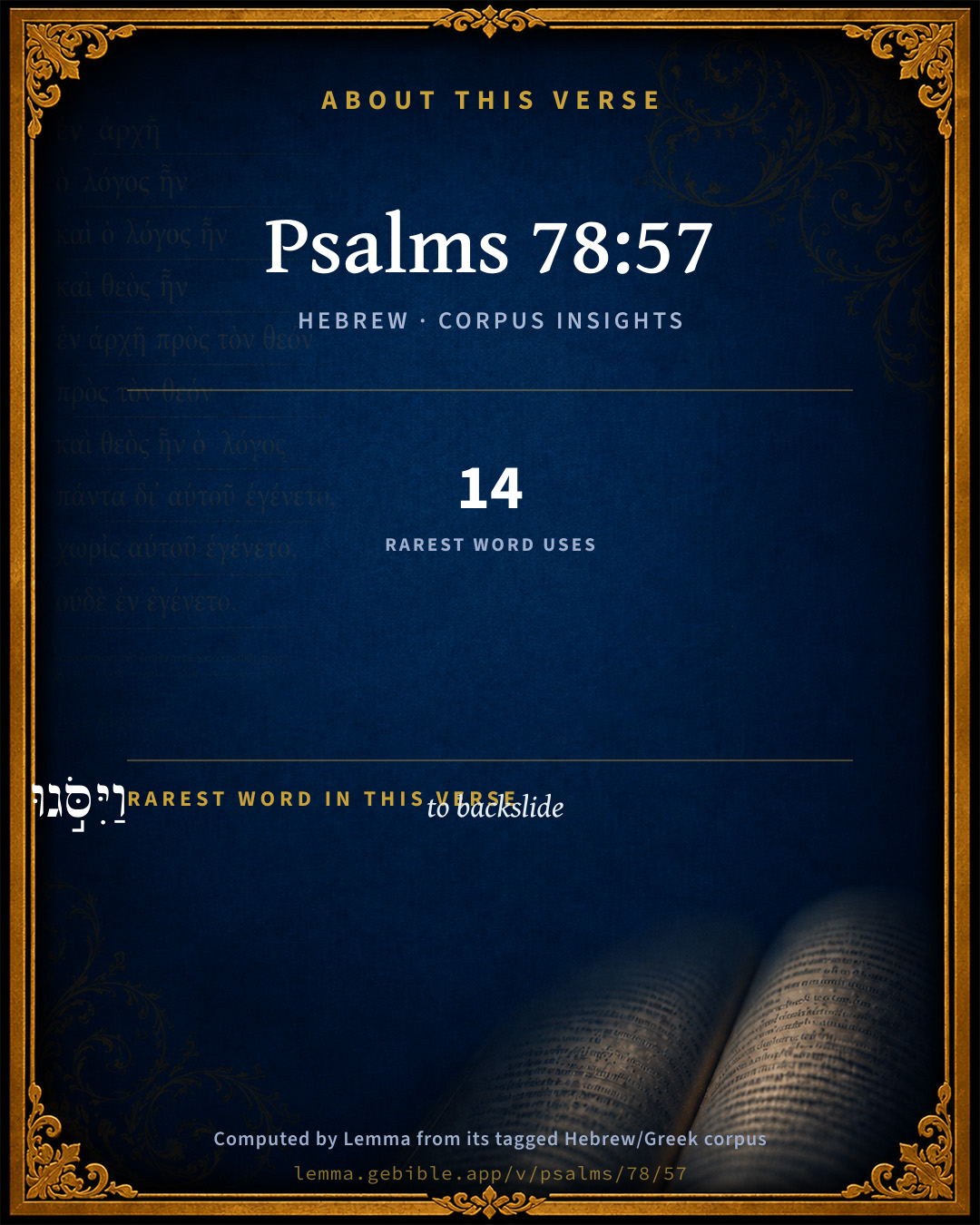
The rarest word here is וַיִּסֹּ֣גוּ to backslide H5472 — appearing just 14 times in the whole Hebrew Bible.

Shared distinctive vocabulary

וַיִּסֹּ֣גוּ to backslide H5472 occurs in 14 verses of the Hebrew Bible. Also found in:

Grammatical profile

  • 3 verbs
  • 3 nouns

Verb forms

  • וַיִּסֹּ֣גוּ Niphal · Sequential Imperfect
  • וַֽ֭יִּבְגְּדוּ Qal · Sequential Imperfect
  • נֶ֝הְפְּכ֗וּ Niphal · Perfect

Hebrew & Septuagint length

In English translation the verse runs 17 words from the Hebrew and 18 from the Septuagint (LXX English) — closely comparable.

A rough comparison of the two English renderings, which tokenize alike — not a word-level alignment.

Word counts can differ between the Hebrew and the Greek without any difference in meaning — e.g. the Hebrew direct-object marker אֵת has no separate Greek word, and Greek often adds the article ὁ.

Cross-references

7

Topical passages linked to Psalms 78:57 in the Treasury of Scripture Knowledge — connected by theme and wording, ordered by reader-vote popularity; previews shown in the World English Bible.

  • Hosea 7:16 They return, but not to the Most High. They are like a faulty bow. Their princes will fall by the sword for the rage of their tongue. This will be their derision in the land of Egypt.
  • Ezekiel 20:27–28 Therefore, son of man, speak to the house of Israel, and tell them, Thus says the Lord Yahweh: In this moreover have your fathers blasphemed me, in that they have committed a trespass against me.
  • Psalms 78:8 And might not be as their fathers, A stubborn and rebellious generation, A generation that didn't make their hearts loyal, Whose spirit was not steadfast with God.
  • Judges 3:5–7 The children of Israel lived among the Canaanites, the Hittites, and the Amorites, and the Perizzites, and the Hivites, and the Jebusites:
  • Judges 3:12 The children of Israel again did that which was evil in the sight of Yahweh: and Yahweh strengthened Eglon the king of Moab against Israel, because they had done that which was evil in the sight of Yahweh.
  • Psalms 78:10–37 They didn't keep God's covenant, And refused to walk in his law.
  • Psalms 78:41 They turned again and tempted God, And provoked the Holy One of Israel.

Cross-references courtesy of OpenBible.info (CC BY 4.0).

Hebrew and Greek witnesses Masoretic Hebrew ↔ Greek Septuagint

The same verse in the two great witnesses to the Old Testament, shown verse-for-verse.

You’re reading Greek Psalm 77 (Hebrew Psalm 78). The Septuagint counts the superscription, so verse numbers can differ from the Hebrew — chapter-level alignment, not verse-by-verse. Numbering follows Rahlfs.

These are two independent witnesses, not word-aligned to each other, and the Septuagint is shown in lemma (dictionary) form.

Hebrew Psalms 78:57 Masoretic · Westminster Leningrad Codex

וַיִּסֹּ֣גוּ וַֽ֭יִּבְגְּדוּ כַּאֲבוֹתָ֑ם נֶ֝הְפְּכ֗וּ כְּקֶ֣שֶׁת רְמִיָּֽה

But turned back, and dealt treacherously like their fathers. They were turned aside like a deceitful bow.

World English Bible · Public Domain

Greek LXX Greek Psalm 77:57 Septuagint · lemma form

καί ἀποστρέφω καί ἀσυνθετέω καθώς καί ὁ πατήρ αὐτός καί μεταστρέφω εἰς τόξον στρεβλός

And they turned back, and broke covenant, even as also their fathers: they became like a crooked bow.

LXX2012 (modern English Septuagint) · Public Domain

Hebrew: Westminster Leningrad Codex (CC BY 4.0). Greek: Septuagint (public domain); English from LXX2012 (modern English Septuagint) (Public Domain). How the Septuagint differs from the Hebrew →

Commentary

Notes on Psalms 78:57 from classic Christian and Jewish commentators (each source and its license shown beneath its notes). The classic Christian expositions comment on the surrounding passage and are grouped to its opening verse, so a note may address several verses; the Jewish commentaries on the Tanakh (Rashi and others) are per-verse, so they appear only where the commentator wrote on this verse.

Lemma curates 59 commentaries, every one of them public domain or Creative Commons licensed, each selected and text-cleaned for this edition rather than reprinted as found. About our sources →

Trapp's Complete Commentary

John Trapp

Psa 78:57 But turned back, and dealt unfaithfully like their fathers: they were turned aside like a deceitful bow.

Ver. 57. But turned back, &c.] They had a kind of willingness and velleity, a kind of wambling, as one speaketh, but it boiled not up to the full height of resolution for God.

They were turned aside like a deceitful bow] Non semper feriet quodcunque minabitur arcus; but a deceitful bow, that turneth back into belly, as we say, will be sure to deceive the archer, though he level his eye and his arrow never so directly to the mark, and think with himself to hit it. Lo, such a false rotten bow is man’s deceitful heart; and hence the arrows of his purposes and promises vanish oft in the air, as smoke.

John Trapp, A Commentary or Exposition upon All the Books of the Old and New Testament (1647–1656) — public domain. Text from a community e-Sword module.

The Treasury of David

Charles H. Spurgeon

Ver. 57. But turned back. Turned over the old leaf, repeated the same offences, started aside like an ill made bow, were false and faithless to their best promises.

And dealt unfaithfully like their fathers, proving themselves legitimate by manifesting the treachery of their sires. They were a new generation, but not a new nationanother race yet not another. Evil propensities are transmitted; the birth follows the progenitor; the wild ass breeds wild asses; the children of the raven fly to the carrion. Human nature does not improve, the new editions contain all the errata of the first, and sometimes fresh errors are imported.

They were turned aside like a deceitful bow, which not only fails to send the arrow towards the mark in a direct line, but springs back to the archer's hurt, and perhaps sends the shaft among his friends to their serious jeopardy. Israel boasted of the bow as the national weapon, they sang the song of the bow, and hence a deceitful bow is made to be the type and symbol of their own unsteadfastness; God can make men's glory the very ensign of their shame, he draws a bar sinister across the escutcheon of traitors.

Ver. 57. They were turned aside like a deceitful bow. The eastern bow, which when at rest is in the form of a (1), must be recurved, or turned the contrary way, in order to be what is called bent and strung. If a person who is unskilful or weak attempt to recurve and string one of these bows, if he take not great heed it will spring back and regain its quiescent position, and perhaps break his arm. And sometimes I have known it, when bent, to start aside, and regain its quiescent position, to my no small danger, and in one or two cases to my injury. This image is frequently used in the sacred writings; but no person has understood it, not being acquainted with the eastern bow, which must be recurved or bent the contrary way (1), in order to be proper for use. If not well made, they will fly back in discharging the arrow. It is said of the bow of Jonathan, "it turned not back, "2Sa 1:22, (rwxa gwsn al), lo nasog achor, "did not twist itself backward." It was a good bow, one on which he could depend. Hosea, Ho 7:16, compares the unfaithful Israelites to a deceitful bow; in that, when bent, would suddenly start aside and recover its former position. We may find the same passage in Jer 9:3. And this is precisely the kind of bow mentioned by Homer, Odyss. 21, which none of Penelope's suitors could bend, called toxon palinonon, the crooked bow, in the state of rest; but toxon palintonon, the recurved bow when prepared for use. And of his trial of strength and skill in the bending of the bow of Ulysses, none of the critics and commentators have been able to make anything, because they knew not the instrument in question. On the toxon yhsiv of Homer I have written a dissertation elsewhere. The image is very correct; these Israelites, when brought out of their natural bent, soon recoiled, and relapsed into their former state. Adam Clarke.

Ver. 57. Starting aside like a broken bow (English Prayer Book): but if a bow breaks, it will not start aside, for the elasticity which should make it start aside would be destroyed. Stephen Street.

Ver. 57. They were turned aside like a deceitful bow. When the bow is unbent the rift it hath may be undiscerned, but go to use it by drawing the arrow to the head, and it flies in pieces; thus doth a false heart when put to the trial. As the ape in the fable, dressed like a man, when nuts are thrown before her, cannot then dissemble her nature any longer, but shows herself as ape indeed; a false heart betrays itself before it is aware, when a fair occasion is presented for its lust; whereas sincerity keeps the soul pure in the face of temptation. William Gurnall.

Ver. 57. The fourth thing is the deceitful bow, (hymr tvq), a slack or warping bow arcus doli vel dolosus seu fallax (Hebrew) will be sure to deceive the archer that shoots in it; it will turn back into belly, as the archer's phrase is; and though he level both his eye and his arrow never so directly to the mark and think confidently with himself to hit it; yet, in the event, the arrow, through the warping of the bow, flies a quite contrary way, yea, and sometimes reflects upon the archer himself. Non semper feriet, quodcunque minabitur arcus, the bow smites not all it threatens, and the ill fashioned or casting bow will turn in the shooter's hand, and send the arrow sometimes one way and sometimes another way; yea, and sometimes it rebounds into his own sides; or if it be a rotten bow (though otherwise fair to look upon), when an arrow is drawn to the head it breaks in the hand, and deceives the archer. The same thing happeneth when the string of the bow is naughty, and breaks when the arrow is drawn. This is no less than a divine Scripture allegory. Behold, such a fallacious, warping, and rotten bow is man's deceitful heart; his purposes and promises are the arrows that he puts upon the string, the mark he aims at is repentance, to the which (in affliction especially) he looketh with an accurate and intent eye, as though he would repent indeed; but, alas! his heart deceives him, as being unsound in God's statutes, Ps 119:80; and hence it is that his promises and pretences do fall at his foot, or vanish in the air as smoke. Thus a deceiving, as well as a deceived, heart, turns him aside, Isa 64:20, as it did those false Israelites: oh, then, look to the secret warping of your own heart, and seeing you are God's bow, you must be bent by him, and stand bent for him, Zec 9:13; thereby you shall be like Jonathan's bow that "never returned empty, "2Sa 1:22. Christopher Ness, in "A Crystal Mirror." 1679.

Ver. 57-59. Not to be settled in the faith, is provoking to God. To espouse the truth, and then to fall away, brings an ill report upon the gospel, which will not go unpunished. They turned back, and dealt unfaithfully. When God heard this, he was wroth, and greatly abhorred Israel. The apostate drops as a windfall into the devil's mouth. Thomas Watson.

Ver. 57-59. See Psalms on "Ps 78:57" for further information.

Ver. 57-59. See Psalms on "Ps 78:57" for further information.

Ver. 57-59. See Psalms on "Ps 78:59" for further information.

Charles H. Spurgeon's The Treasury of David (1869–1885) — public domain. Psalms only. Text from a community e-Sword/MySword module.

Joseph Benson's Commentary

Psa 78:57-59. And dealt unfaithfully like their fathers — They imitated their forefathers, both in their frequent apostacies from God, and in their falseness to their promises, when they pretended to repent of them. They were turned aside like a deceitful bow — Which seems likely to send the arrow to the mark, but, when it is drawn, breaks, and drops the arrow at the archer’s foot, or shoots awry, and thereby frustrates his design and expectation: so their depraved hearts made them turn aside into crooked paths, which were not directed according to the will of God. For, when they pretended, and both God and men expected obedience and gratitude to their great benefactor, they behaved themselves undutifully and unfaithfully toward him. When God heard this — That is, perceived and understood it, speaking after the manner of men, or heard the cry of their iniquity which came before him; he was wroth — He took it very heinously, as well he might, and he greatly abhorred Israel, whom he had greatly loved and delighted in. They who had been the people of his choice, became the generation of his wrath. Presumptuous sins, idolatries especially, render even Israelites odious to God’s holiness, and obnoxious to his justice.

Joseph Benson's Commentary on the Old and New Testaments (1811–1818) — public domain. Text from a community e-Sword module.

J. A. Alexander on Psalms

Joseph Addison Alexander

57. (Psa 78:57) And revolted and dealt falsely like their fathers; they were turned like a deceitful bow. He here resumes the thread dropped at Psa 78:8, for the purpose of relating what their fathers did and were, i.e. the older generation who came out of Egypt. Having shewn this at great length, he now reiterates the charge that their descendants, after the days of Joshua, wereno better, and proceeds to prove it. The first clause describes them both as rebels and traitors. They were turned, i.e. as some suppose, turned aside, swerved or twisted in the archer's hand, so as to give a wrong direction to the arrow. Others understand it to mean, they were converted (or became) like a deceitful bow, i.e. one which deceives the expectation, and fails to accomplish the design for which it is employed. By a similar trope, falsehood or lying is ascribed to waters which are not perennial, but fail precisely when most needed. See Isa 58:11, Job 6:15. The figure of a deceitful bow is borrowed from this passage by Hosea (Hos 7:16).

Joseph Addison Alexander, The Psalms Translated and Explained (1850) — public domain. Text from a community e-Sword module.

Geneva Bible (1599)

Geneva Bible translators

Nothing more displeaseth God in the children, than when they continue in that wickedness, which their fathers had begun.

Geneva Bible (1599) marginal notes — public domain. Text via Bolls.life.

Adam Clarke's Commentary

Verse 57. They were turned aside like a deceitful bow.] The eastern bow, which when at rest is in the form of a [curved figure 'C'], must be recurved, or turned the contrary way, in order to be what is called bent and strung. If a person who is unskilful or weak attempt to recurve and string one of these bows, if he take not great heed it will spring back and regain its quiescent position, and perhaps break his arm. And sometimes I have known it, when bent, to start aside, and regain its quiescent position, to no small danger, and in one or two cases to my injury. This image is frequently used in the sacred writings; but no person has understood it, not being acquainted with the eastern bow [curved figure 'C'], which must be recurved, or bent the contrary way, [figure ''] in order to be proper for use. If not well made, they will fly back in discharging the arrow. It is said of the bow of Jonathan, it turned not back, 2Sa 1:22, לא נשוג אחור lo nasog achor, "did not twist itself backward." It was a good bow, one on which he could depend. Hosea, Ho 7:16, compares the unfaithful Israelites to a deceitful bow; one that, when bent, would suddenly start aside and recover its former position. We may find the same passage in Jer 9:3. And this is precisely the kind of bow mentioned by Homer, Odyss. xxi., which none of Penelope's suitors could bend, called καμπυλα τοξα and αγκυλα τοξα, the crooked bow in the state of rest; but τοξον παλιντονον, the recurred bow when prepared for use. And of this trial of strength and skill in the bending of the bow of Ulysses, none of the critics and commentators have been able to make any thing, because they knew not the instrument in question. On the τοξου θησις of Homer, I have written a dissertation elsewhere. The image is very correct; these Israelites, when brought out of their natural bent, soon recoiled, and relapsed into their former state.

Adam Clarke's Commentary on the Bible (1810–1826) — public domain. Text from a community e-Sword/MySword module.

Ellicott's Commentary for English Readers

(57) Turned aside . . .—Better, turned like a relaxed bow. (See Note to Psa_78:9.) The bows of the Hebrews, like those of other ancient nations, were probably, when unstrung, bent the reverse way to that assumed when strung, which makes the figure more expressive of the disposition which cannot be relied upon in the moment of need.

A Bible Commentary for English Readers, edited by Charles John Ellicott (1878–1897) — public domain. Text from a community e-Sword module.

The Cambridge Bible for Schools and Colleges

gen. ed. J. J. S. Perowne

57. unfaithfully] Or, as R.V., treacherously. Cp. Hos_5:7; Hos_6:7. like a deceitful bow] Which misses the mark and disappoints its owner. Cp. Hos_7:16.

The Cambridge Bible for Schools and Colleges (gen. ed. J. J. S. Perowne; Cambridge University Press, 1878–1918) — public domain. Text from a community e-Sword module.

John Gill's Exposition

For they provoked him to anger with their high places,.... Which they built to Baal, and other Heathen dieties:

and moved him to jealousy with their graven images; which they worshipped, see Jdg 10:6, which idolatry was spiritual adultery, and so made the Lord jealous of them, who stood in the relation of a husband to them, as a man becomes jealous by the unchaste and lascivious conduct of his wife; and such a course of life the Israelites lived, throughout the reigns of the judges, at certain seasons, until the times of Eli and Samuel, when the ark was carried captive, of which mention is made in the following verses.

John Gill's Exposition of the Whole Bible (1746–1763) — public domain (CC PDM 1.0). Text via the HelloAO Bible API.

Albert Barnes' Notes on the Bible

But turned back ... - See the notes at Psa 78:41.

They were turned aside like a deceitful bow - literally, a bow of deceit. That is, a bow that could not be depended on; a bow, one of whose arms was longer or more elastic than the other, so that the arrow would turn aside from the mark. The marksman would attempt to hit an object, and would fail. So it was with the people of Israel. They could not be depended on. No reliance could be put on their promises, their covenant-engagements, their attachment, their fidelity, for in these things they failed, as the arrow from a deceitful bow would fail to strike the mark. Their whole history shows how just was this charge; alas! the history of many of the professed people of God has shown how applicable the description has been to them also.

Albert Barnes' Notes on the Bible (1834–1885) — public domain. Text from a community e-Sword/MySword module.

Matthew Poole's English Annotations

Which either breaketh when it is drawn, or shooteth awry, and frustrateth the archer’s design and expectation So when they pretended, and both God and men expected, obedience and gratitude to their great Benefactor, they behaved themselves undutifully and unfaithfully towards him.

Matthew Poole's English Annotations on the Holy Bible (1683–1685) — public domain. Text from a community e-Sword/MySword module.

Whedon's Commentary on the Bible

Daniel D. Whedon

57. Turned aside like a deceitful bow—Hebrew, a bow of guile, not sending the arrow direct to the mark, owing to the unequal strength and elasticity of its parts. Hos_7:16. Or, if we put the bow by metonomy for the archer, as in Isa_21:17 and elsewhere, it is one who purposely turns the arrow aside from the mark—unreliable, treacherous. The most common words for sin, both in the Old and New Testaments, (חשׂא, αμαρτια,) are derived from verbs which literally signify to miss, to miss the mark. Faithlessness and deceit supply the fundamental idea.

Irregularities in worship, immoralities in life, the adoption of idolatry and heathenish customs, deface the history of the Israelites through the period of the Judges, to which Psa_78:56-58 exclusively refer.

Daniel D. Whedon (gen. ed.), Commentary on the Old and New Testaments (1874–1909) — public domain. Text from a community e-Sword module.

The Pulpit Commentary

But turned back, and dealt unfaithfully like their fathers (comp. ver. 8, end the comment ad loc.). They were turned aside like a deceitful bow. (comp. Hos_7:16) A "deceitful bow" is one that fails in the hour of need, either breaking, or losing its strength, or sending its arrows wide of the mark.

"A deceitful bow.

Note

I WHAT GOD REQUIRES IN HIS SERVANTS.

1. That they should be as a bow. That is a weapon, and for him. Christians are to be aggressive, a power in the hands of God against the world, the flesh, and the devil.

2. That they should be powerful. In the case of the bow, that depended on the elasticity of the wood, or the temper of the steel, of which the bow was made, also on the skill shown in its construction. Fault in either so much lessened the value of the bow. And God would have us a power in his hands; he can use weak things, but he would have us strong for himself.

3. True. The bow made of the right material and in right manner would send the arrow straight to the mark and up to the mark, so that it would not fall short or swerve aside. But how many of us, in serving God, are guilty of this! We fall short, are not thorough, or are by one cause or another turned aside.

4. And that their strength should abide. It was said of Joseph, "His bow abode in strength." As a good bow would retain its tenacity and elasticity, so that it could be permanently relied upon. Here is the real test of our fidelity; it is not so much our having strength at the beginning we all have this more or less but it is the keeping it, the standing the year-in-and-year-out strain. This is what God desires in us.

II WHAT BY HIS GRACE THEY VERY OFTEN ARE.

1. The bow was a very effective weapon. Hence no army was sent forth without a large body of trained archers. Its silent, swift, distant, deadly effect made it a weapon not only very valued, but indispensible. And God has such servants. Was not Peter one such, and Paul, and many other of less distinguished name men who so wrought for God as to render service of most effectual kind? And there are such still, men and women too, so endued with power by God that their presence and ministry are the signal at once for great victories to be won for God.

2. And it was therefore reckoned as very formidable, a force not to be trifled with by any foe. And because faithful ministers of God are such weapons for God, therefore it is that Satan strives with all his power to disarm them or to render their ministry of none effect. He knew full well what destruction the Lord Jesus would bring upon his dominion, and therefore, immediately after his baptism, he wrought during those dread forty days, by repeated and terrible temptation, to make his mission ineffectual and to baffle its design. But our Lord, as we all know, gained signal victory, as we also through him may gala like victory.

III HOW, THEREFORE, GOD REGARDS THEM.

1. The bow was a trusted weapon. "I will not trust in my bow," said the psalmist, (Psa_44:6) implying how usual was the trust men had in it. The sword and the bow are constantly coupled together in Scripture as the two chief weapons of the soldier on which he was to rely. And so God trusts his servants, commits the treasures of his grace to them, entrusts them to guard and keep the souls Christ died to redeem.

2. And hence a favourite weapon. David commanded that the children of Judah should be taught the use of the bow, because it was his beloved Jonathan"s favourite weapon. And it is not too much to say that the chosen means whereby God accomplishes his victories in his spiritual kingdom is through his faithful servants. Not to angels, not to the might, learning, or wisdom of this world, has God given this great charge. But to those who may be, and often are, weak and despised in the eyes of the world, but God makes them mighty.

IV BUT, NEVERTHELESS, THERE ARE THOSE WHO ARE DECEITFUL. In the bow itself, it is owing to fault in material or structure. In those whom the bow represents, it is because they are spiritually weak and untrue. The Prophet Hosea (Hos 8) uses this same figure, and shows how applicable it was to the people of his day. And there are such now.

V THE RESULTS OF SUCH DECEIT ARE ALL SAD. God is dishonoured; the faithful Church is reviled; the enemy triumphs; the bow itself is cast away.

VI HOW THIS MAY BE PREVENTED. By abiding in Christ, who is our Life, our Strength, our All. S.C.

The Pulpit Commentary (1880–1919), ed. H.D.M. Spence-Jones & Joseph S. Exell — public domain. Text from a community e-Sword module.

John Wesley's Explanatory Notes

Deceitful bow - Which either breaks when it is drawn, or shoots awry, and frustrates the archer's expectation.

John Wesley, Explanatory Notes Upon the Whole Bible (1754–1765) — public domain. Text via the GEBible commentary corpus.

Rashi

Rabbi Shlomo Yitzchaki (Rashi)

like a deceitful bow which does not shoot the arrow to the place the archer wishes.

Rashi on the Tanakh — English translations: “The Judaica Press complete Tanach with Rashi, translated by A. J. Rosenberg” (CC BY 4.0); “Pentateuch with Rashi's commentary by M. Rosenbaum and A.M. Silbermann, 1929-1934” (public domain); “The Metsudah Tanach series, Lakewood, N.J” (CC BY 4.0); and “The Book of Joshua, Metsudah Publications, 1997” (CC BY 4.0). Text via Sefaria.

Lesson kit

Teaching starters — assembled from the data on this page, not authored interpretation. Every prompt links to the verse data it draws on. Edit before teaching.

Psalms, in the Wisdom, opens this verse with 6 words (6 distinct Hebrew lemmas). Its most distinctive word is çûwg (“to backslide”). A historical commentator’s framing appears above. Read the whole chapter for the surrounding context.

Discussion questions

  1. What does “to backslide” (çûwg) contribute to the verse as a whole?
  2. How does Psalms 35:4, which shares the word «to backslide», read alongside this verse?
  3. The translations on this page render this verse differently — a whole-verse word diff, not a word-by-word alignment. What might account for the different wordings?
  4. «וַיִּסֹּ֣גוּ» is a Niphal Sequential Imperfect verb. How does that grammatical form shape the action described?
  5. Compare how Trapp's Complete Commentary and The Treasury of David read this verse. Where do they agree or differ?

Things to notice

Reading settings

Reading text

Shown beneath each verse's original-language words.

Old Testament
Old Testament edition

Read the OT as the Masoretic Hebrew (MT) or the Greek Septuagint (LXX).

English shown for the Greek Septuagint (in the Hebrew ↔ Greek comparison).

Comparing translations? Open the Compare panel on any verse page to stack up to four side by side.