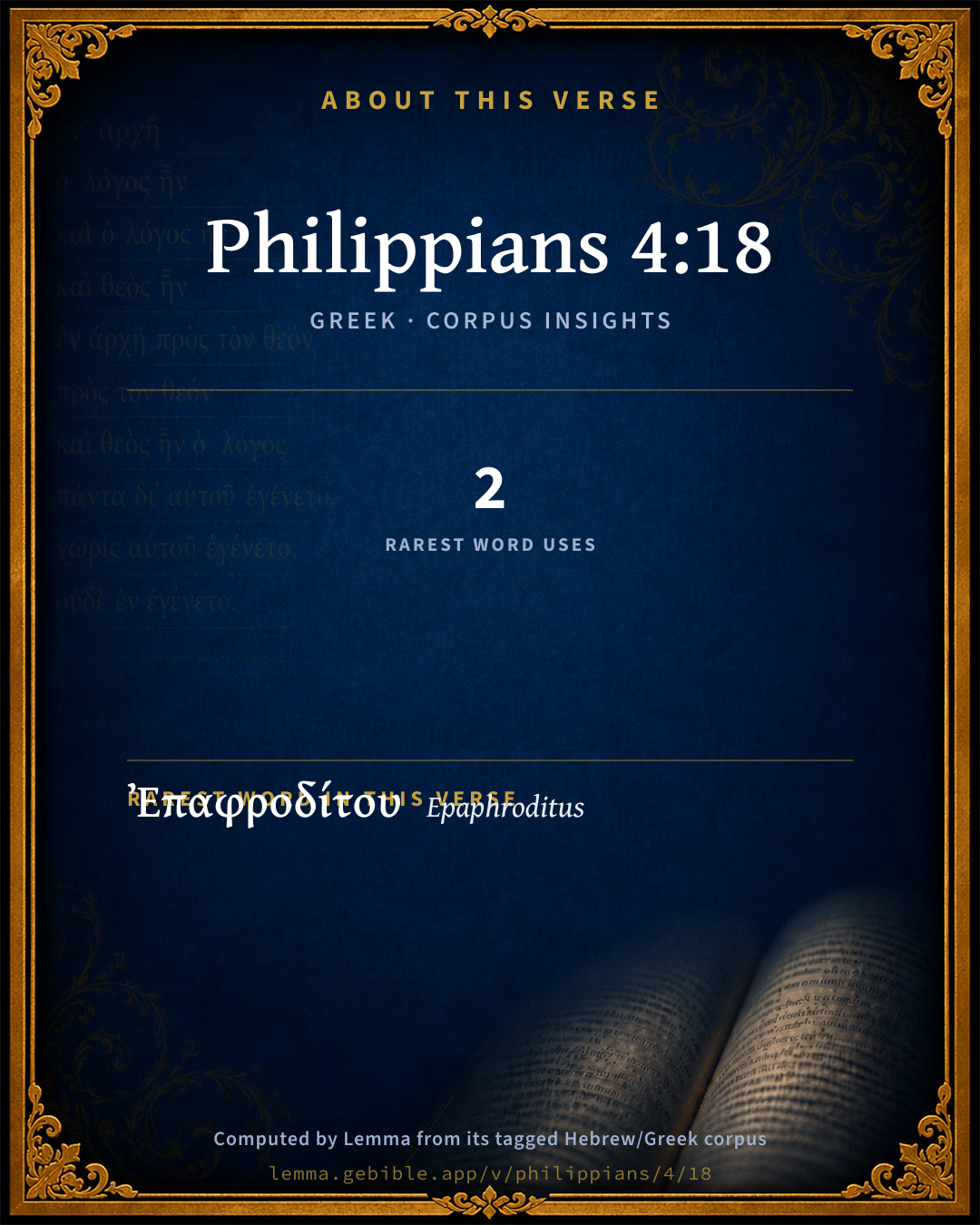
Philippians 4:18

Greek (Tischendorf 8th ed.) Philippians 4:18 appears in the Greek New Testament. The text above is from the Tischendorf 8th edition. Each word links to its Strong’s number and a concise gloss. Click any word for its full Thayer’s Greek Lexicon entry.
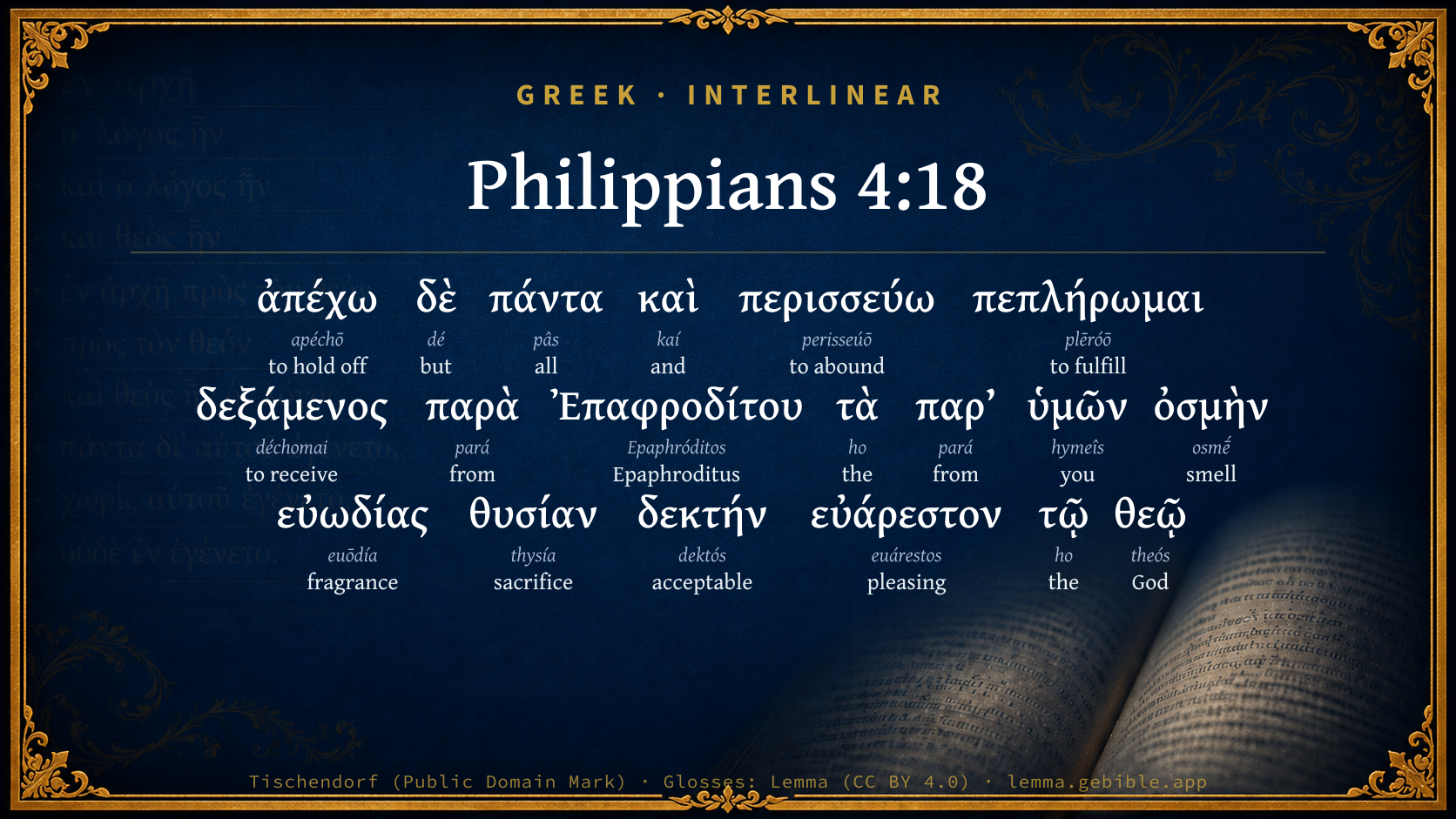
Download image
Cite this verse

Philippians 4:18 (World English Bible). Public Domain. Lemma interlinear Bible study tool, https://lemma.gebible.app/v/philippians/4/18.

Show BibTeX & RIS
BibTeX
RIS
English Translation
But I have all things, and abound. I am filled, having received from Epaphroditus the things that came from you, a sweet-smelling fragrance, an acceptable and well-pleasing sacrifice to God.
World English Bible · Public Domain
Download a study sheet

One document with this verse’s original text, its word-by-word gloss line, the meaning frame, cross-references with their text, attributed commentary, and full source and license credits — printable, and it pastes into notes with its structure intact.

This verse Autodidact and up

Study sheet (.html) Plain text (.txt)

A passage Seminary Student

Up to 50 verses in one chapter. A passage sheet keeps up to 6 commentary sources and 12 cross-references per verse, in the order this page ranks them, and says so on the sheet whenever that leaves anything out. Ask for a single verse and you get the Autodidact verse sheet above.

Everything on this page stays free to read, with no account — the sheet is a download of what is already on screen, not access to it.

Want to remove ads? Support Godless Engineer
Compare translations 3

The same verse in 3 English versions, stacked beneath the original-language interlinear above. Click any original word for its lexicon entry.

Each is an independent rendering of the whole verse — the interlinear is not word-aligned to these translations.

Highlighted words mark where these versions differ — a whole-verse word diff, not a word-by-word alignment.

  • World English Bible Public Domain
    But I have all things, and abound. I am filled, having received from Epaphroditus the things that came from you, a sweet-smelling fragrance, an acceptable and well-pleasing sacrifice to God.
  • King James Version Public Domain
    But I have all, and abound: I am full, having received of Epaphroditus the things which were sent from you, an odour of a sweet smell, a sacrifice acceptable, wellpleasing to God.
  • unfoldingWord Literal Text CC BY-SA 4.0
    Now I have all things in full, and I abound. I have been filled, having received from Epaphroditus the things from you, an aroma, a sweet smell, an acceptable, pleasing sacrifice to God.

unfoldingWord Literal Text — © unfoldingWord, licensed CC BY-SA 4.0. Word-aligned USFM3 via Door43 (git.door43.org/unfoldingWord/en_ult).

Versions to compare (up to 4)

3 of 4 selected

Show all 19 translations

Every available English version of this verse, each an independent rendering of the whole verse.

  • World English Bible Public Domain
    But I have all things, and abound. I am filled, having received from Epaphroditus the things that came from you, a sweet-smelling fragrance, an acceptable and well-pleasing sacrifice to God.
  • Berean Standard Bible Public Domain
    I have all I need and more, now that I have received your gifts from Epaphroditus. They are a fragrant offering, an acceptable sacrifice, well-pleasing to God.
  • Majority Standard Bible Public Domain
    I have all I need and more, now that I have received your gifts from Epaphroditus. They are a fragrant offering, an acceptable sacrifice, well-pleasing to God.
  • King James Version Public Domain
    But I have all, and abound: I am full, having received of Epaphroditus the things which were sent from you, an odour of a sweet smell, a sacrifice acceptable, wellpleasing to God.
  • American Standard Version (1901) Public Domain
    But I have all things, and abound: I am filled, having received from Epaphroditus the things `that came' from you, and odor of a sweet smell, a sacrifice acceptable, well-pleasing to God.
  • Revised Version (1885) Public Domain
    But I have all things, and abound: I am filled, having received from Epaphroditus the things that came from you, an odour of a sweet smell, a sacrifice acceptable, well-pleasing to God.
  • Geneva Bible (1599) Public Domain
    Now I haue receiued all, and haue plentie: I was euen filled, after that I had receiued of Epaphroditus that which came from you, an odour that smellleth sweete, a sacrifice acceptable and pleasant to God.
  • Douay-Rheims (1899) Public Domain
    But I have all, and abound: I am filled, having received from Epaphroditus the things you sent, an odour of sweetness, an acceptable sacrifice, pleasing to God.
  • Young's Literal Translation Public Domain
    and I have all things, and abound; I am filled, having received from Epaphroditus the things from you -- an odour of a sweet smell -- a sacrifice acceptable, well-pleasing to God:
  • Literal Standard Version CC BY-SA 4.0
    and I have all things, and abound; I am filled, having received from Epaphroditus the things from you—an odor of a refreshing fragrance—a sacrifice acceptable, well-pleasing to God:
  • Unlocked Literal Bible CC BY-SA 4.0
    I have received everything in full, and even more. I have been well-supplied now that I have received from Epaphroditus the things you sent. They are a sweet-smelling aroma, a sacrifice acceptable and pleasing to God.
  • unfoldingWord Literal Text CC BY-SA 4.0
    Now I have all things in full, and I abound. I have been filled, having received from Epaphroditus the things from you, an aroma, a sweet smell, an acceptable, pleasing sacrifice to God.
  • Darby Bible Public Domain
    But I have all things in full supply and abound; I am full, having received of Epaphroditus the things [sent] from you, an odour of sweet savour, an acceptable sacrifice, agreeable to God.
  • World Messianic Bible Public Domain
    But I have all things and abound. I am filled, having received from Epaphroditus the things that came from you, a sweet-smelling fragrance, an acceptable and well-pleasing sacrifice to God.
  • Webster's Bible Public Domain
    But I have all, and abound: I am full, having received from Epaphroditus the things which were sent from you, an odor of a sweet smell, a sacrifice acceptable, well-pleasing to God.
  • Free Bible Version CC BY-SA 4.0
    For I have everything, more than I need! I'm thankful to receive from Epaphroditus the things you sent. They're like a sweet-smelling sacrifice that pleases God and that he approves of.
  • Bible in Basic English Public Domain
    I have all things and more than enough: I am made full, having had from Epaphroditus the things which came from you, a perfume of a sweet smell, an offering well pleasing to God.
  • Text-Critical English NT CC BY 4.0
    I have received everything in full and have an abundance. I am amply supplied, now that I have received from Epaphroditus the gifts you sent. They are an aroma of a sweet fragrance, an acceptable sacrifice, pleasing to God.
  • Tyndale New Testament (1534) Public Domain
    I receaved all and have plentie. I was even filled after that I had receaved of Epaphroditus that which came from you an odour that smelleth swete a sacrifice accepted and plesaunt to God.

Literal Standard Version (2020), Covenant Press — licensed CC BY-SA 4.0. Text via the HelloAO Bible API (eBible.org). Unlocked Literal Bible (unfoldingWord) — licensed CC BY-SA 4.0. Text via the HelloAO Bible API (eBible.org). unfoldingWord Literal Text — © unfoldingWord, licensed CC BY-SA 4.0. Word-aligned USFM3 via Door43 (git.door43.org/unfoldingWord/en_ult). Free Bible Version, Dr. Jonathan Gallagher — licensed CC BY-SA 4.0. Text via the HelloAO Bible API (eBible.org).

Word by word

More ways to search: Search by grammar → Find every occurrence → Compare this word →

Practice this passage: Drill this verse → Learn its vocabulary →

Ἐπαφροδίτου
Epaphróditos
G1891
“Epaphroditus”
Noun, Genitive, Singular, Masculine
Part of Speech
Noun
Case
Genitive
Number
Singular
Gender
Masculine
Full Thayer's Definition

Origin: from G1909 (in the sense of devoted to) and Aphrodite (Venus)

TDNT: None

Epaphroditus = "lovely" 1. an associate with Paul in the ministry
  1. ἀπέχω apéchō G568 “to hold off” Verb, Present, Active, Indicative, 1st person, Singular
  2. δὲ dé G1161 “but” Conjunction
  3. πάντα pâs G3956 “all” Adjective, Accusative, Plural, Neuter
  4. καὶ kaí G2532 “and” Conjunction
  5. περισσεύω perisseúō G4052 “to abound” Verb, Present, Active, Indicative, 1st person, Singular
  6. πεπλήρωμαι plēróō G4137 “to fulfill” Verb, Perfect, Passive, Indicative, 1st person, Singular
  7. δεξάμενος déchomai G1209 “to receive” Verb, Aorist, Middle deponent, Participle, Nominative, Singular, Masculine
  8. παρὰ pará G3844 “from” Preposition
  9. τὰ ho G3588 “the” Article, Accusative, Plural, Neuter
  10. παρ’ pará G3844 “from” Preposition
  11. ὑμῶν hymeîs G5210 “you” Personal pronoun, 2nd person, Genitive, Plural
  12. ὀσμὴν osmḗ G3744 “smell” Noun, Accusative, Singular, Feminine
  13. εὐωδίας euōdía G2175 “fragrance” Noun, Genitive, Singular, Feminine
  14. θυσίαν thysía G2378 “sacrifice” Noun, Accusative, Singular, Feminine
  15. δεκτήν dektós G1184 “acceptable” Adjective, Accusative, Singular, Feminine
  16. εὐάρεστον euárestos G2101 “pleasing” Adjective, Accusative, Singular, Feminine
  17. τῷ ho G3588 “the” Article, Dative, Singular, Masculine
  18. θεῷ theós G2316 “God” Noun, Dative, Singular, Masculine

About this verse

These counts appear in no published source. They are computed here, from the morphology-tagged text and Lemma’s own curated glosses. What Lemma adds →

19
words
17
distinct lemmas
Pauline Epistles
section

Notable vocabulary

The rarest word here is Ἐπαφροδίτου Epaphroditus G1891 — appearing just 2 times in the whole Greek New Testament.

Shared distinctive vocabulary

Ἐπαφροδίτου Epaphroditus G1891 occurs in 2 verses of the Greek New Testament. Also found in:

Repetition

Words recur within this verse:

Cross-references

10

Topical passages linked to Philippians 4:18 in the Treasury of Scripture Knowledge — connected by theme and wording, ordered by reader-vote popularity; previews shown in the World English Bible.

  • Hebrews 13:16 But don't forget to be doing good and sharing, for with such sacrifices God is well pleased.
  • 2 Corinthians 9:12 For this service of giving that you perform not only makes up for lack among the saints, but abounds also through many givings of thanks to God;
  • Philippians 4:12 I know how to be humbled, and I know also how to abound. In everything and in all things I have learned the secret both to be filled and to be hungry, both to abound and to be in need.
  • Ephesians 5:2 Walk in love, even as Christ also loved you, and gave himself up for us, an offering and a sacrifice to God for a sweet-smelling fragrance.
  • Philippians 2:25–26 But I counted it necessary to send to you Epaphroditus, my brother, fellow worker, fellow soldier, and your apostle and minister to my need;
  • Romans 12:1 Therefore I urge you, brothers, by the mercies of God, to present your bodies a living sacrifice, holy, acceptable to God, which is your spiritual service.
  • 2 Corinthians 2:14–16 Now thanks be to God, who always leads us in triumph in Christ, and reveals through us the sweet aroma of his knowledge in every place.
  • 2 Thessalonians 1:3 We are bound to always give thanks to God for you, brothers, even as it is appropriate, because your faith grows exceedingly, and the love of each and every one of you towards one another abounds;
  • 1 Peter 2:5 You also, as living stones, are built up as a spiritual house, to be a holy priesthood, to offer up spiritual sacrifices, acceptable to God through Jesus Christ.
  • John 12:3–8 Mary, therefore, took a pound of ointment of pure nard, very precious, and anointed the feet of Jesus, and wiped his feet with her hair. The house was filled with the fragrance of the ointment.

Cross-references courtesy of OpenBible.info (CC BY 4.0).

Commentary

Notes on Philippians 4:18 from classic Christian and Jewish commentators (each source and its license shown beneath its notes). The classic Christian expositions comment on the surrounding passage and are grouped to its opening verse, so a note may address several verses; the Jewish commentaries on the Tanakh (Rashi and others) are per-verse, so they appear only where the commentator wrote on this verse.

Lemma curates 59 commentaries, every one of them public domain or Creative Commons licensed, each selected and text-cleaned for this edition rather than reprinted as found. About our sources →

The Cambridge Bible for Schools and Colleges

gen. ed. J. J. S. Perowne

18. But] He carries on the correction, begun in Php_4:17, of a possible misunderstanding of his warm words. He must not be thought to “spell” for future gifts, least of all now, so amply supplied as he is.

I have all] The Greek verb is one used in connexions of payment, to express a full receipt. We might almost paraphrase, “you have paid me in full in all respects.”

and abound] It is enough, and more than enough; I “run over” with your bounty. See Php_4:12, above.

Epaphroditus] See on Php_2:25; Php_2:30. We learn definitely here that he was the bringer of the collection.

the things] He seems to avoid the word “money.” It was more than money; the coin was the symbol of priceless love.

an odour of a sweet smell] See Eph_5:2, for the same Greek phrase. It is common in LXX. as the translation of the Heb. rêach níchóach, a savour of rest; the fume of the altar, smelt by the Deity, (in the picture language of typical sacrifices), and recognized as a token of welcome allegiance or propitiation. See note in this Series on Eph_5:2.—Here the fragrance is that of either the “burnt-offering” of self-dedication (see Lev_1:9), or the “meal offering,” or “peace offering,” of thanksgiving (see Lev_2:2; Lev_3:5), or of both combined, as they are combined in our Liturgy of the Holy Communion.

a sacrifice acceptable &c.] Cp. last note, and Heb_13:16. See also Eph_6:8, and note in this Series.

I. PHILIPPI AND THE EPISTLE. (Ch. Php_4:18)

From an essay by Prof. J. Agar Beet, in The Expositor (January, 1889), I extract the closing sentences:—

“With this reply [the Epistle], a gift infinitely more precious than that he brought from Philippi, Epaphroditus starts on his homeward journey. The joy caused by his return, and the effect of this wonderful letter when first read in the Church at Philippi, are hidden from us. And we may almost say that with this letter the Church itself passes from our view. To-day, in silent meadows quiet cattle browse among the ruins which mark the site of what was once the flourishing Roman colony of Philippi, the home of the most attractive Church of the apostolic age. But the name and fame and spiritual influence of that Church will never pass. To myriads of men and women in every age and nation, the letter written in a dungeon at Rome and carried along the Egnatian Way by an obscure Christian messenger, has been a light Divine, and a cheerful guide along the most rugged paths in life. As I watch, and myself rejoice in, the brightness of that far-shining light, and glance at those silent ruins, I see fulfilled an ancient prophecy: The grass withereth, the flower fadeth: but the word of our God shall stand for ever.”

The Cambridge Bible for Schools and Colleges (gen. ed. J. J. S. Perowne; Cambridge University Press, 1878–1918) — public domain. Text from a community e-Sword module.

The Biblical Illustrator

Joseph S. Exell

Php_4:18

I have all and abound

Ministry to the saints an acceptable sacrifice

I.

The individual receiving the benefit.

1. A Christian. The first duty of Christians is towards each other. Charity does not stay at home, but it begins there. The largest hearted charity towards the ends of the earth will not excuse parsimoniousness towards our fellow believers close at hand.

2. An aged Christian. Paul has borne the burden and heat of the day. Every Christian has a claim upon his brother Christian, but those who have the greatest claim are those who are worn out in the service of their Master.

3. A poor Christian. Although an apostle and richly endowed, Paul never employed his endowments on his own behalf. After having surrendered the brightest prospects he was now dependent on the charities of Gods people. Blessed is the man who considereth the poor.

4. A Christian minister, who having expended his spiritual gifts on his people, had a right to their temporal support.

II. The benefit bestowed. A sacrifice.

1. In the truest sense there is now no real sacrifice. By one offering Christ hath perfected forever them who are sanctified.

2. But in an inferior sense sacrifices are still offered. There is the sacrifice of praise and the sacrifice of charity. To do good and to communicate forget not, for with such sacrifices God is well pleased.

3. The essence of sacrifice is self-denial. It is that which costs the offerer something.

III. The value of the benefit.

1. In relation to God. It is acceptable and well-pleasing to Him--

(1) From the motive from which it springs.

(2) From the good it does.

2. In relation to the object of the benefit.

(1) It produces satisfaction and gratitude.

(2) It becomes a means of usefulness. Fruit to your account. (J. H. Evans, M. A.)

Present blessings

Such is Pauls confession concerning his temporal condition even in the midst of trials. He did not look on this life with bitterness, or refuse to enjoy it. He was not soured by his trials, but felt that if he had troubles he had blessings also. Gloom is no Christian temper. We must live in sunshine, even when we sorrow. We ought to bless God that we have--

I. The gift of life.

1. And not merely that we live, but for those blessings which are included in the notion of our living. God has made life to imply the existence of certain things which are in themselves a happiness. We cannot live without the means of life, and the means of life are means of pleasure. It might have been ordered that life should be sustained by means neither pleasurable nor painful, or even by means that were painful, and that what are the extraordinary means of preserving life should be the ordinary. Suppose, then, that food were medicine, and that wounds and bruises imparted health and strength! On the contrary, life is sustained by blessings.

2. The gospel guarantees these things. God has not promised what the world understands by good things; things whose good is only in the imagination, large estates, sumptuous furniture, carnal, sensual enjoyments, etc. But He has promised that life shall not be a burden but a blessing.

3. And giving us as much as this He bids us be satisfied with it, to confess that we have all when we have so much; that we abound when we have enough. He promises food, raiment, lodging, and He bids us, having that, to be content.

II. The gift of sleep. God does not suffer us to be miserable for a long time together, even when He afflicts us, but He breaks our trials into portions; takes us out of this world ever and anon, and gives us holiday time, like children at school. Sleep is equally the comfort and recruiting of rich and poor. We sleep whether we are in sorrow or in joy, in anxiety or hope.

III. The blessings of the Christian brotherhood. As food, raiment, sleep, are necessary conditions of life, so is society. When God removes us from the world He puts us into the Church; and distance, as proved in the case of St. Paul, does not break the communion of saints.

IV. The blessings of present peace in the Church, freedom from persecution.

V. The privileges of free speech and action.

VI. The privileges of daily worship and weekly communion. Let us then enjoy our present blessings and bless the Giver. (Cardinal Newman.)

Gratitude

I. Is associated with contentment--it has enough--desires no more.

II. Acknowledges its obligation--fully--thankfully.

III. Appreciates the spirit of the gift--love--sacrifice--well-pleasing to God. (J. Lyth, D. D.)

Acceptable giving

It is related of Andrew Fuller that, on a begging tour for the cause of missions, he called on a certain wealthy nobleman to whom he was unknown, but who had heard much of Fullers talents and piety. After he had stated to him the object of his visit, his lordship observed that he thought he should make him no donation. Dr. Fuller was preparing to return, when the nobleman remarked that there was one man to whom, if he could see him, he thought he would give something for the mission, and that man was Andrew Fuller. Mr. Fuller immediately replied, My name, sir, is Andrew Fuller. On this the nobleman, with some hesitation, gave him a guinea. Observing the indifference of the donor, Mr. Fuller looked him in the face with much gravity, and said, Does this donation, sir, come from your heart? If it does not, I wish not to receive it. The nobleman was melted and overcome with this honest frankness, and taking from his purse ten guineas more, said, There, sir, these come from my heart. Men should give to the cause of missions cheerfully. They should do good with a good motive. The Lord loveth a cheerful giver. (J. Whitecross.)

The Biblical Illustrator, edited by Joseph S. Exell (c. 1880s–1900s) — public domain. Text from a community e-Sword module.

Tyndale Open Study Notes

Tyndale Open Resources

4:18 Epaphroditus (see also 2:25-30) had carried the gifts from Philippi. • Their gifts were a sweet-smelling sacrifice: In the Old Testament, acceptable offerings were a pleasant fragrance to God (see Lev 1:9, 13, 17; 2:2, 9; 3:5, 16; cp. Rom 12:1; Eph 5:2).

Tyndale Open Study Notes — © Tyndale Open Resources, licensed CC BY-SA 4.0. Text via the HelloAO Bible API.

Bengel's Gnomon

Johann Albrecht Bengel

Php 4:18. Ἀπέχω) The apostle’s receipt.[58]—περισσεύω, I abound) Behold the contented and grateful mind!—τὰ παρʼ ὑμῶν, the things (which came) from you) They had sent money or clothes and what might be serviceable.—ὀσμὴν εὐωδίας, the odour of a sweet smell) He describes their conduct by a beautiful figure.—θυσίαν, a sacrifice) Heb 13:16.

[58] ‘Apocha’ may either be his acknowledgment of having received in full the debt of kindness due to him from them, or else Beng. uses ἀποχὴ as Epictetus for forbearance, moderation in desires. In the ‘apocha’ there is a direct allusion to the ἀπέχω of the text.—ED.

Bengel's Gnomon of the New Testament — English translation (T&T Clark, Edinburgh, 1860) — public domain. Text from a community e-Sword module.

Meyer's Critical & Exegetical Commentary

Heinrich August Wilhelm Meyer

Php_4:18. Δέ] The train of thought is: not the gift do I seek, but the fruit (Php_4:17); and as regards what has been received from you in the present instance, I have everything already, and need nothing further. That this refers to the desire of the church to know what he possibly still needed (Hofmann), is a very unnecessary assumption.

ἀπέχω δὲ πάντα] not: habeo autem omnia (Vulgate); not a mere acknowledgment of receipt (Erasmus, Beza, Grotius, Cornelius a Lapide, Heinrichs, and others); nor yet equivalent to περισσεύω (Rheinwald); but, in keeping with the sense of the compound: I have everything away, so that I have nothing left to desire at your hands. Comp. Phm_1:15; Mat_6:2; Mat_6:5; Mat_6:16; Luk_6:24; Callim. ep. 22; Arrian. Epict. iii. 2. 13, iii. 24. 17; Jacobs, ad Anthol. VII. pp. 276, 298. Πάντα, therefore, according to the context (ἐπιζητῶ τ. δόμα, Php_4:17), is: everything which I could desire, although there is no necessity for introducing specially, with Chrysostom and Oecumenius, τὰ ἐλλειφθέντα ἐν τῷ παρελθόντι χρόνῳ. The emphasis, moreover, is laid, not on πάντα, but on ἀπέχω, in contrast to ἐπιζητεῖν.

καὶ περισσεύω] and my wants are thus so fully satisfied, that I have over.

πεπλήρωμαι] forms a climax to περισσ.: I am full, I have abundance. The gift must have been ample; but gratitude sets this forth in all the stronger a light. To πεπλήρ. is attached δεξάμενος κ.τ.λ.

ὀσμὴν εὐωδίας κ.τ.λ.] This apposition to τὰ παρʼ ὑμῶν, expressing a judgment as to the latter (see on Rom_12:1), sets forth, to the honour of the givers, the relation in which the gifts received stand towards God, by whom they are esteemed as a sacrifice well-pleasing to Him. As to ὀσμὴ εὐωδίας, smell of a sweet savour, רֵיחַ נְיח̇חַ (genitive of quality), which is used of free-will offerings, see on Eph_5:2. It describes the thing according to its effect on God, namely, that it is acceptable to Him; θυσίαν κ.τ.λ., however, describes it according to what it is.

δεκτὴν, εὐάρεστ.] acceptable, well-pleasing, a vividly asyndetic climax (on the former, comp. Sir_32:7); τῷ Θεῷ, however, applies to the whole apposition ὀσμὴν … εὐαρ. The asyndetic juxtaposition of several epithets is frequent also in classical authors, from Homer onward (Ameis z. Od. iv., Anh.). As to the view, originating in the O. T., which regards works well-pleasing to God as ethical sacrifices, see the expositors on Rom_12:1; 1Pe_2:5; Heb_13:16. Comp. Philo, de vit. Mos. II. p. 151: ἡ γὰρ ἀληθὴς ἱερουργία τίς ἂν εἴη πλὴν ψυχῆς θεοφιλοῦς εὐσέβεια; passages from the Rabbins in Schoettg. Hor. p. 1006.

Meyer — Critical and Exegetical Commentary on the New Testament — English translation by Peter Christie, edited by Frederick Crombie (T&T Clark, 1880) — public domain. Text from a community e-Sword module.

Expositor's Greek Testament

ed. W. Robertson Nicoll

Phi 4:18 . ἀπέχω . The use of this word adds much force to the thought, when we bear in mind that it was the regular expression in the Papyri to denote the receipt of what was due, e.g. , Faijûm Pap., Sept. 6, A.D. 57: ἀπέχω παρʼ ὑμῶν τὸν φόρον τοῦ ἐλα [ ι ] ουργίου ὧν ἔχετε [ μο ] υ ἐν μισθώσει . (Dsm [66] . , NBS [67] . , p. 56.) Chr [68] . evidently knew this sense, for he says, “ ἔδειξεν ὅτι ὀφειλή ἐστιν τὸ πρᾶγμα · τοῦτο γάρ ἐστιν , ἀπέχω ”. Thus the prevailing tone of the whole context is maintained. The word is almost = “I give you a receipt for what you owed me”. The genial strain of humour is in no discord with his more serious thoughts. περισσεύω . Cf. Sayings of Jew. Fathers , p. 64: “Who is rich? He that is contented with his lot.” πεπλήρ . Classical Greek would hardly use the word in this personal sense. The closing words of the verse have underlying them the idea of sacrifice. A gift to an Apostle or spiritual teacher seems to have been regarded in the Early Church, like the gifts brought in the Eucharist, as an offering to God. The recipient is looked upon as the representative of God (see Sohm, Kirchenrecht , pp. 74 ff., 81 n. ). ὀσμ . εὐωδ . “A scent of sweet savour.” θυσίαν δεκτ . “A technical term according to Sir 32:9 ” (Hpt [69] . ). εὐάρεστον . Cf. Rom 12:1 ff., which bears closely upon the whole passage.

[66] Deissmann ( BS. = Bibelstudien, NBS. = Neue Bibelstudien ).

[67] Neue Bibelstudien

[68] Chrysostom.

[69] Haupt.

The Expositor's Greek Testament, edited by W. Robertson Nicoll (1897–1910) — public domain. Text from a community e-Sword module.

Geneva Bible (1599)

Geneva Bible translators

He alludeth to the sweet smelling savors that were offered in the old Law.

Geneva Bible (1599) marginal notes — public domain. Text via Bolls.life.

Jamieson, Fausset & Brown

Robert Jamieson, A. R. Fausset & David Brown

But--Though "the gift" is not what I chiefly "seek after" (Phi 4:17), yet I am grateful for the gift, and hereby acknowledge it as ample for all my needs. Translate, "I have all" that I want, "and more than enough." Literally, as English Version, "I abound" over and above my needs.

I am full--Greek, "I am filled full."

the odour of a sweet smell--(See on Eph 5:2). The figure is drawn from the sweet-smelling incense which was burnt along with the sacrifices; their gift being in faith was not so much to Paul, as to God (Mat 25:40), before whom it "came up for a memorial" (Act 10:4), sweet-smelling in God's presence (Gen 8:21; Rev 8:3-4).

sacrifice acceptable-- (Heb 13:16).

Jamieson, Fausset & Brown — Commentary Critical and Explanatory on the Whole Bible (1871) — public domain (CC PDM 1.0). Text via the HelloAO Bible API.

Adam Clarke's Commentary

Verse 18. I have all] Ye have now sent me so much by Epaphroditus, that I abound in all the necessaries of life.

Having received - the things] Probably a supply of clothes and such like necessaries, as well as of money.

An odour of a sweet smell] Alluding to the sacrifices offered up under the law. With what ye have done to me, his servant, God is well pleased. See Eph 5:2, and the note there.

Adam Clarke's Commentary on the Bible (1810–1826) — public domain. Text from a community e-Sword/MySword module.

John Calvin's Commentaries

18 I have received all things, and abound He declares in more explicit terms, that he has what is sufficient, and honors their liberality with a remarkable testimony, by saying, that he has been filled. It was undoubtedly a moderate sum that they had sent, but he says, that by means of that moderate sum he is filled to satiety. It is, however, a more distinguished commendation that he bestows upon the gift in what follows, when he calls it a sacrifice acceptable, and presented as the odour of a good fragrance For what better thing can be desired than that our acts of kindness should be sacred offerings, which God receives from our hands, and takes pleasure in their sweet odour? For the same reason Christ says, Whatsoever ye shall have done unto one of the least of these, ye have done it unto me.

The similitude of sacrifices, however, adds much emphasis, by which we are taught, that the exercise of love which God enjoins upon us, is not merely a benefit conferred upon man, but is also a spiritual and sacred service which is performed to God, as we read in the Epistle to the Hebrews, that he is well pleased with such sacrifices. (Hebrews 13:16.) Alas for our indolence! — which appears in this, that while God invites us with so much kindness to the honor of priesthood, and even puts sacrifices in our hands, we nevertheless do not sacrifice to him, and those things which were set apart for sacred oblations we not only lay out for profane uses, but squander them wickedly upon the most polluted contaminations. For the altars, on which sacrifices from our resources ought to be presented, are the poor, and the servants of Christ. To the neglect of these some squander their resources on every kind of luxury, others upon the palate, others upon immodest attire, others upon magnificent dwellings.

John Calvin's Commentaries (1540-1563) — public domain. Text from the Calvin Translation Society English edition (1840s-50s) via the Christian Classics Ethereal Library (ccel.org). Calvin's coverage is partial (roughly two-thirds of the Bible); uncommented books and verses are honest gaps, never fabricated. The 19th-century editor's footnotes and remarks are omitted so the notes are faithfully Calvin's own voice.

Ellicott's Commentary for English Readers

(18) I have all, and abound.—The original is stronger, I have all to the full (as in Mat_6:2; Mat_6:5; Mat_6:16), and more than to the full. “I have all, and more than all, I need.” Yet not content with this, he adds, “I am full,” thoroughly complete in all things. The exuberance of courtesy and gratitude is strongly marked.

An odour of a sweet smell.—See Eph_5:2, and Note there. Here St. Paul adds at once an explanation of the meaning of this metaphorical phrase, in the words, “a sacrifice acceptable, well-pleasing to God.” Comp. Rom_12:2, “a sacrifice holy, acceptable to God.” The word “sacrifice” used in both cases is the one which properly signifies a “bloody sacrifice,” and in relation to such sacrifices the idea of propitiation naturally occurs to our minds; since we know that “without shedding of blood is no remission.” But it is clear that here it belongs to the class of Eucharistic or free-will offerings; for it is simply an offering made freely, in grateful love to God and man; and exactly in this sense we find, in Heb_13:16 (in close connection with “we have an altar”), “To do good, and to communicate forget not; for with such sacrifices God is well pleased.” In the Epistle to the Romans it is, on the other hand, used for that which the burnt offering typified—the absolute self-dedication of the sacrificer, body and soul, to God. (See Note on Rom_12:2.) To 1Pe_2:5, where all Christians are called “a holy priesthood to offer up spiritual sacrifices acceptable to God in Jesus Christ,” both senses may be fairly applied. It may be noted that most superstitions in the Church as to the spiritual value of either of these forms of sacrifice, have come from confusion between them and the true or propitiatory sacrifice.

A Bible Commentary for English Readers, edited by Charles John Ellicott (1878–1897) — public domain. Text from a community e-Sword module.

John Gill's Exposition

But I have all things, and abound,.... Or "I have received all things", as the Syriac version renders it; all that they had sent by Epaphroditus; and for which he now gives a receipt; and by virtue of which he now abounded; and which abundance of his was not so much owing to the largeness of their presents, as to the peace of his mind; looking upon this gift of theirs, though it might be but small in itself, a fulness to him; for he adds,

I am full; as much as he desired, he wanted no more, he had enough:

having received of Epaphroditus the things which were sent from you: and which he acknowledged, that the character of this good man might stand clear, who had been intrusted with this affair:

an odour of a sweet smell, a sacrifice acceptable, well pleasing to God, this is said in allusion to the sacrifices under the former dispensation, in which God smelled a sweet savour, Gen 8:21, in reference to which, as the sacrifice of Christ is said to be of a sweet smelling savour, Eph 5:2, and as the spiritual sacrifices of the saints, as praises and prayers, are called odours, Rev 5:8, and are said to be acceptable unto God, Pe1 2:5; so acts of beneficence are called sacrifices, with which he is well pleased, Heb 13:16.

John Gill's Exposition of the Whole Bible (1746–1763) — public domain (CC PDM 1.0). Text via the HelloAO Bible API.

Trapp's Complete Commentary

John Trapp

18 But I have all, and abound: I am full, having received of Epaphroditus the things which were sent from you, an odour of a sweet smell, a sacrifice acceptable, wellpleasing to God.

Ver. 18. I have all] viz. That you sent, and I give you an acquittance, which the Greeks, from the word απεχω here used, call Αποχη. Compare Pro 3:27.

I abound, I am full] As a bird with a little eye, and the advantage of a wing to soar with, may see far wider than an ox with a greater; so the righteous with a little estate, joined with faith and devotion, may feel more comfort and see more of God’s bounty than one of vast possessions, whose heart cannot lift itself above the earth. They say, it is not the great cage that maketh the bird sing. Sure we are, it is not the great estate that brings always the inward joy, the cordial contentment. A staff may help a traveller, but a bundle of staves may be a burden to him. The greatest thing in the least compass, saith one, is a contented mind in a man’s body; which if a man have, deliciosius vivit etiam is qui teruntium non habet, quam si in unum hominem confles sexcentos Sardanapalos, he hath all things, though he want everything.

John Trapp, A Commentary or Exposition upon All the Books of the Old and New Testament (1647–1656) — public domain. Text from a community e-Sword module.

Albert Barnes' Notes on the Bible

But I have all - Margin, “or, have received.” The phrase here is equivalent to, “I have received everything. I have all I want, and desire no more.” He was entirely satisfied. What they had sent to him is, of course, now unknown. It is sufficient to know, that it was of such a nature as to make his situation comfortable.

I am full - I have enough, This is a strong expression, denoting that nothing was lacking.

Having received of Epaphroditus - see the notes at Phi 2:25.

An odour of a sweet smell - This does not mean that it was such an odor to Paul, but to God. He regarded it as an offering which they had made to God himself; and he was persuaded that he would regard it as acceptable to him. They had doubtless made the offering, not merely from personal friendship for Paul, but because he was a minister of Christ, and from love for his cause; and Paul felt assured that this offering would be acceptable to him; compare Mat 10:41-42. The word “odor” refers properly to the pleasant fragrance produced in the temple by the burning of incense; notes on Luk 1:9. On the meaning of the word rendered “a sweet smell,” - εὐωδία euōdia - see the notes at 2Co 2:15. The whole language here is taken from an act of worship; and the apostle regarded what he had received from the Philippians as in fact a thank-offering to God, and a presented with the spirit of true devotion to him. It was not, indeed, a formal act of worship; but it was acceptable to God as an expression of their regard for his cause.

A sacrifice acceptable - Acceptable to God; compare Heb 13:16; notes, Rom 12:1.

Well-pleasing to God - Because it evinced a regard for true religion. Hence, learn:

(1) That kindness done to the ministers of the gospel is regarded as an acceptable offering to God.

(2) That kindness to the servants of God in distress and want, is as well-pleasing to God as direct acts of worship.

(3) That such acts of benevolence are evidences of attachment to the cause of religion, and are proofs of genuine piety; notes, Mat 10:42.

Albert Barnes' Notes on the Bible (1834–1885) — public domain. Text from a community e-Sword/MySword module.

Matthew Poole's English Annotations

He further testifies his thankfulness from the effect their gratuity had upon him, by three words here which declare the same thing, viz. that he was abundantly satisfied, having all that he could wish, even enough and more; so that he did not expect any thing more than what he had already received by their faithful messenger Epaphroditus; which he further commends from its great acceptableness to God, in allusion to the sweet odours in the sacrifices that God himself took pleasure in, Lev 2:1,2; 3:16; Heb 13:16; so that that present God himself would accept through Christ, as if it had been offered to himself, 1Pe 2:5. It is true, the Socinians, to lessen the meritoriousness of Christ’s sacrifice of himself, which the apostle mentions, Eph 5:2, with respect to Gen 8:21, would by this text corrupt that: but the truth is, it hath nothing like with that, for the benevolence and gratuity of the Philippians is said by Paul to be an odour of a sweet smell, a sacrifice acceptable, & c.; but it is not said that the Philippians themselves did give themselves and dour of a sweet smell, as it is said Christ gave himself for us an offering and a sacrifice to God for a sweet-smelling savour; which being once offered for all, was sufficient to take away sin, Heb 10:10,12. And therefore their reasoning is fallacious from that parity they suggest. It is true, believers and their good works are as sweet odours, Rom 12:1, acceptable, but in Christ, 1Pe 2:5, because they please God only for him, for his sake and merit. But Christ, because he doth appease God himself, who smells a savour of rest in his sacrifice, which all others under the law did but shadow, receiving their efficacy from his: Christ did it by himself, believers and their services are only acceptable in him.

Matthew Poole's English Annotations on the Holy Bible (1683–1685) — public domain. Text from a community e-Sword/MySword module.

Whedon's Commentary on the Bible

Daniel D. Whedon

18. A sacrifice—A loftier view of the subject is now taken. Gladly received by himself, and inuring to his abundance, it was, in its higher aspect, an offering to God, freely brought to the altar, with which he was well pleased.

Daniel D. Whedon (gen. ed.), Commentary on the Old and New Testaments (1874–1909) — public domain. Text from a community e-Sword module.

The Pulpit Commentary

But I have all, and abound: am full. I have to the full all that I need, and more. (For the word apecw , comp. Mat_6:2, Mat_6:5, Mat_6:16,lu Mat_6:24) Having received of Epaphroditus the things which were sent from you, an odour of a sweet smell, a sacrifice acceptable, well-pleasing to God. He uses another metaphor: in ver. 17 the gift was fruit, now it is a sacrifice: given to the servant of God, it is in truth offered to God himself. "How high does he lift their gift!" says Chrysostom; "it is not I, he says, who have received it, but God through me." The words, osmh euwdiav an odour of sweet smell, occur often in the Old Testament in connection with sacrifice (see Gen_8:21 Exo_29:18; also for the metaphor, Eph_5:2) in Heb_13:16 almsgiving is also described as a sacrifice with which God is well pleased. The first and chiefest offering we can make is ourselves: We offer and present unto thee, O Lord, ourselves, our souls and bodies"; (comp. Rom_12:1) in that chief offering is involved the lesser gift of alms.

The Pulpit Commentary (1880–1919), ed. H.D.M. Spence-Jones & Joseph S. Exell — public domain. Text from a community e-Sword module.

John Wesley's Explanatory Notes

An odour of a sweet smell - More pleasing to God than the sweetest perfumes to men.

John Wesley, Explanatory Notes Upon the Whole Bible (1754–1765) — public domain. Text via the GEBible commentary corpus.

The People's New Testament

B. W. Johnson

18. An odor of a sweet smell. The incense offered in the temple worship was very fragrant. Their offerings were like incense, like a sacrifice with which God was well pleased.

B. W. Johnson's The People's New Testament with Notes (1889–1891) — public domain. Electronic text from the Christian Classics Ethereal Library (CCEL) ThML edition.

unfoldingWord translationNotes

Door43 World Missions Community

Connecting Statement:

Paul finishes thanking the Philippians for their gift (see Philippians 3:11) and assures them that God will take care of them.

I have received everything in full

Possible meanings are 1) Paul has received everything that the Philippians sent or 2) Paul is using humor to continue the business metaphor from Philippians 3:8 and saying that this part of the letter is a receipt for commercial goods that Epaphroditus delivered.

even more

Paul means plenty of the things that he needs for himself. (See: Assumed Knowledge and Implicit Information)

They are a sweet-smelling aroma, a sacrifice acceptable and pleasing to God

Paul speaks of the gift from the Philippian church as if it were a sacrifice offered to God on an altar. Paul implies that the church's gift is very pleasing to God, like the sacrifices that the priests burned, which had a smell that pleased God. AT: "I assure you these gifts are very pleasing to God, like an acceptable sacrifice" (See: Metaphor)

will meet all your needs

This is the same word translated "have been well-supplied" in verse 18. It is an idiom meaning "will provide everything you need" (See: Idiom)

according to his riches in glory in Christ Jesus

"from his glorious riches that he gives through Christ Jesus"

Now to our God

The word "Now" marks the closing prayer and the end of this section of the letter.

translationWords

sacrifice

glory

Jesus

God the Father

eternity

amen

unfoldingWord translationNotes — © Distant Shores Media and the Door43 World Missions Community, licensed CC BY-SA 4.0. Source: git.door43.org/Door43/en_tn.

Cambridge Greek Testament for Schools and Colleges

18. ἀπέχω δὲ. The δὲ carries on the correction, begun in Php 4:17, of any possible mistake of his warm words. He is well supplied; he must not be suspected of suggesting more gifts in the future.

ἀπέχω. “I have received in full.” Cp. Mat 6:2; Mat 6:5; Mat 6:16, ἀπέχονσι τὸν μισθὸν αὐτῶν: Luk 6:24, ἀπέχετε τὴν παράκλησιν ὑμῶν: Phm 1:15, ἵνα αἰώνιον αὐτὸν ἀπέχῃς. So in classical Greek, Callim., Epigr. 57, τὸ χρέος ὡς ἀπέχεις, Ἀσκληπιέ, κτλ. If the Philippians did owe him anything, they have amply paid!

παρὰ Ἐπαφροδίτου. See on Php 2:25-30. Here we learn explicitly what is implied there (Php 2:25; Php 2:30), that he was the bringer of the collection to St Paul.

τὰ παρʼ ὑμῶν. He will not say τὰ παρʼ ἱ. χρήματα: it was more than money; the money was but the symbol of their hearts.

ὀσμὴν εὐωδίας. “Odour of fragrancy” (εὖ, ὄζω). So Eph 5:2, of the Saviour’s atoning Sacrifice. The phrase is common in LXX. for the Hebrew רֵיחַ הַנִּיחֹחַ, “savour of rest” (e.g. Gen 8:21); the fume of the altar, recognized by the Deity as a token of allegiance or propitiation. Here the ὀσμὴ εὐωδίας is either that of the “burnt-offering” of self-dedication, embodied in self-denying giving, or that of the “peace-offering” of thanksgiving, similarly embodied (cp. Lev 1:9; Lev 3:5), or that of both, as both are combined in our Liturgy of the Holy Communion.

θυσίαν δεκτὴν εὐάρεστον. Cp. Heb 13:16, τῆς εὐποιΐας καὶ κοινωνίας μὴ ἐπιλανθάνεσθε, τοιαύταις γὰρ θυσίαις εὐαρεστεῖται ὁ θεός.

Cambridge Greek Testament for Schools and Colleges (Cambridge University Press, 1896; 21 vols, various authors incl. Carr, Maclear, Plummer, Farrar, Lumby, Moule, M. R. James, Simcox) — public domain. Text from a community e-Sword module.

Alford’s Greek Testament

Henry Alford

18.] But (notwithstanding that the gift is not that which I desire, I have received it, and been sufficiently supplied by it) I have (emphatic, and exactly as in ἀπέχειν τὸν μισθόν—‘I have no more to ask from you, but have enough:’—not as Erasm., Beza, Grot., &c. ‘I have duly received all you sent’) all (I want), and abound (over and above): I am filled (repetition and intensification of περισσεύω), having received at the hands of Epaphroditus the remittance from you, a savour of fragrance (a clause in apposition, expressing a judgment,—so frequently in poetry, especially in tragedians,—Il. ω. 735, ἤ τις Ἀχαιῶν ῥίψει, χειρὸς ἑλών, ἀπὸ πύργου, λυγρὸν ὄλεθρον: Eur. Orest. 950, τιθεῖσα λευκὸν ὄνυχα διὰ παρηΐδων, αἱματηρὸν ἄταν. See Kühner, ii. 146. On ὀσμὴ εὐωδίας see Eph 5:2, note), a sacrifice acceptable, well pleasing to God (see Heb 13:16; 1Pe 2:5).

Henry Alford, The Greek Testament (1849–1861) — public domain. Text from a community e-Sword module.

International Critical Commentary

18. ἀπέχω δὲ πάντα: ‘and I have all things.’ Δὲ is not adversative, but connective, introducing an additional reason for οὐχ ἐπιζητῶ τὸ δόμα, ‘I do not seek the gift but the fruit; and as to my need, I have all that I could need.’

Otherwise Ellic., De W., Ead., Weiss, Alf., Vulg., who take δὲ as adversative. So Alf. “But, notwithstanding that the gift is not that which I desire, I have received it, and am sufficiently supplied by it.” This seems feeble and superfluous after the strong adversative ἀλλὰ.

ἀπέχω: ‘I have to the full.’ Nothing remains for me to desire. Ἀπὸ marks correspondence; i.e. “of the contents to the capacity; of the possession to the desire” (Lightf.). (See Win. xl. 46.) So Mat 6:2. “They have their reward in full.” There is nothing more for them to receive. (Comp. Luk 6:24.) Not a formal acknowledgment of the gift, omitted in vs. 17 (Chr., Œc., Theoph.).

καὶ περισσεύω: ‘and abound.’ Not only is my need met, but I have more than I could desire. On περισσεύειν see Lightf. on 1Th 3:12.

πεπλήρωμαι: ‘I am filled.’ Hardly the completion of a climax (Ellic.), since fulness is not an advance on περισς. It rather introduces the following clause, which is an explanatory comment upon what precedes.

δεξάμενος: Explanatory of πεπλ. ‘I am filled, now that I have received.’

παρὰ Ἐπαφροδίτου: See on 2:25.

τὰ παρʼ ὑμῶν: ‘the things sent from you’ (through him). Παρὰ emphasises the idea of transmission, and marks the connection between the giver and the receiver, more than ἀπὸ, which merely points to the source. (See Win. xlvii.; Lightf. on Gal 1:12; Schmidt, Synon. 107, 18.)

ὀσμὴν εὐωδίας: ‘an odor of a sweet smell.’ Their offering of love is described as a sweet-smelling sacrifice. The expression is common in O.T. to describe a sacrifice acceptable to God. (See Gen 8:21; Lev 1:9, Lev 1:13, Lev 1:17. Comp. 2Co 2:15, 2Co 2:16; Eph 5:2.) Ὀσμὴν is in apposition with τὰ παρʼ ὑμῶν; εὐωδίας is genit. of quality. Ὀσμὴ is more general than εὐωδία, denoting an odor of any kind, pleasing or otherwise.

θυσίαν: ‘a sacrifice.’ Not the act of sacrifice, but the thing sacrificed. (See on 2:17.) Here in the same sense as Rom 12:1.

δεκτήν: ‘acceptable.’ Rare in N.T., and only here by Paul, 2Co 6:2 being a quotation. (See LXX; Lev 1:3, Lev 1:4, 19:5, 22:19.)

εὐάρεστον: ‘well-pleasing,’ as Rom 12:1. In N.T. only in Paul and Heb. (See Rom 14:18; 2Co 5:9; Eph 5:10; Heb 13:21; LXX; Sap. 4:10, 9:10.)

τῷ θεῷ: Connect with both ὀσμ. εὐωδ. and θυς.

International Critical Commentary — older volumes (1896–1929), various authors — public domain. Text from a community e-Sword module.

Vincent's Word Studies in the New Testament

Marvin R. Vincent

I have [απεχω] . I have received in full. See on Mt 6:2; Luk 6:24.

Odor of a sweet smell. See on 2Co 2:15, 16. Frequent in Septuagint, of the odor of sacrifices.

Marvin R. Vincent, Word Studies in the New Testament (1887–1900) — public domain. Text from a community e-Sword/MySword module.

Lesson kit

Teaching starters — assembled from the data on this page, not authored interpretation. Every prompt links to the verse data it draws on. Edit before teaching.

Philippians, in the Pauline Epistles, opens this verse with 19 words (17 distinct Greek lemmas). Its most distinctive word is Epaphróditos (“Epaphroditus”). A historical commentator’s framing appears above. Read the whole chapter for the surrounding context.

Discussion questions

  1. The word Epaphróditos carries the sense “Epaphroditus.” How does it shape the verse?
  2. Philippians 2:25 shares the word «Epaphroditus» with this verse. How do the two illuminate each other?
  3. “from” occurs 2× in this one verse. What is the effect of the repetition?
  4. The translations on this page render this verse differently — a whole-verse word diff, not a word-by-word alignment. What might account for the different wordings?
  5. Reading how The Cambridge Bible for Schools and Colleges and The Biblical Illustrator read this verse, where do the two commentators agree and where do they part?

Things to notice

Reading settings

Reading text

Shown beneath each verse's original-language words.

Old Testament
Old Testament edition

Read the OT as the Masoretic Hebrew (MT) or the Greek Septuagint (LXX).

English shown for the Greek Septuagint (in the Hebrew ↔ Greek comparison).

Comparing translations? Open the Compare panel on any verse page to stack up to four side by side.