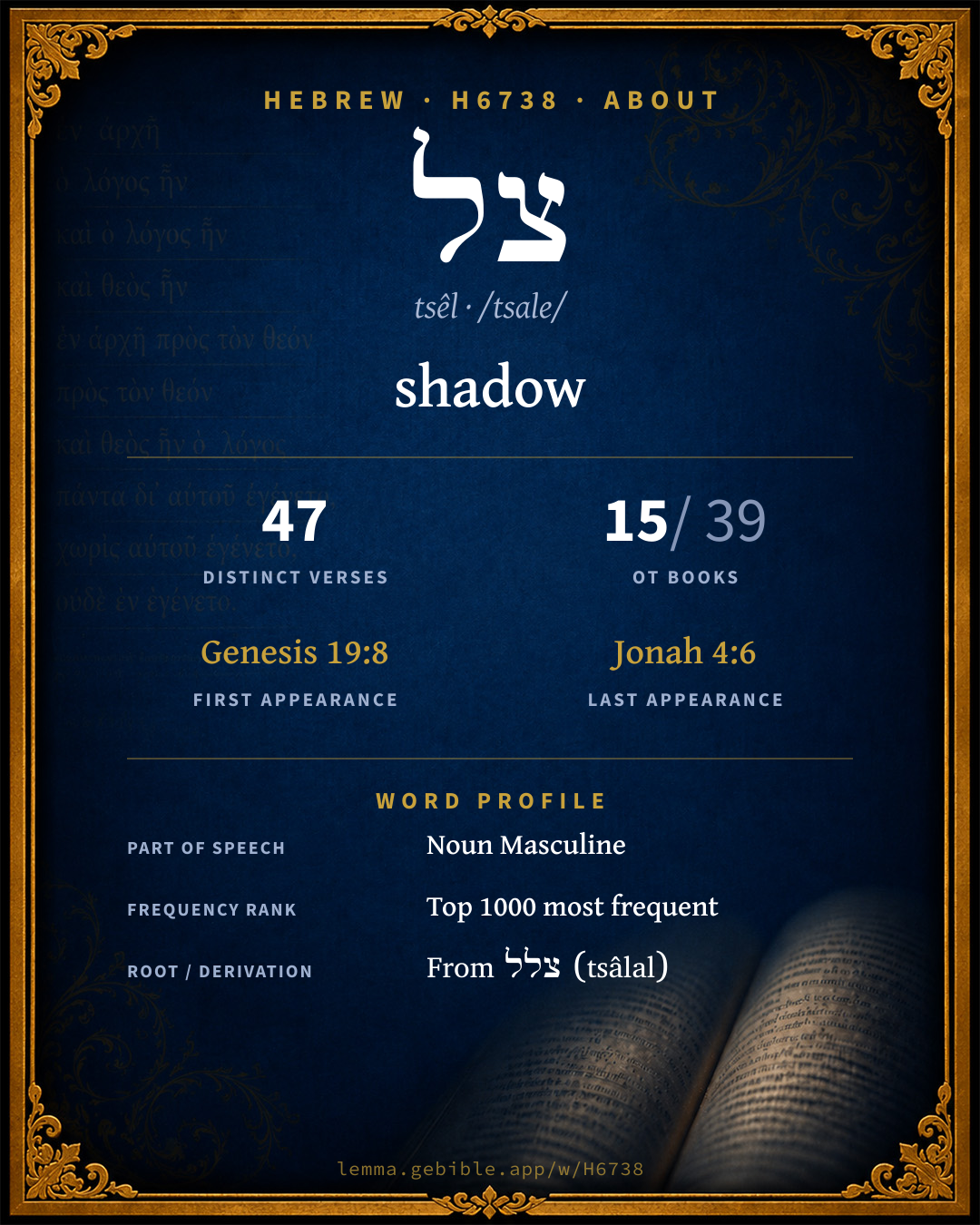
צֵל
shadow
‘shadow’ is one of 4 main senses fuller range ↓
Full lexicon entry — Brown-Driver-Briggs (BDB)
From Brown-Driver-Briggs (BDB)
Where this word appears
See every Construct-state word in the Hebrew Bible →
Grammar key — what these labels mean
Part of speech
- Noun
- A naming word — a person, place, thing, or idea.
Noun type
- Common
- A common noun — a general class of person, place, or thing (“king,” “city,” “water”), not a specific name.
State
- Construct
- A noun bound to a following noun in a possessive / “of” relationship (the construct chain).
- Absolute
- The independent form of a noun, not bound to a following word.
Gender
- Masculine
- Grammatically masculine.
Number
- Singular
- One.
Grammatical forms
- Noun, Common, Masculine, Singular, Construct 29 times (59%)
- Noun, Common, Masculine, Singular, Absolute 20 times (41%)
Parsed forms decoded from the imported morphology (morphhb / Westminster Leningrad Codex — WLC text public domain, morphhb tagging CC BY 4.0), counted across 49 parsed occurrences — not distinct verses.
Every verse where H6738 appears — 47 distinct verses across 15 books. Click any verse to open its interlinear word-by-word view. Verse text shown in the World English Bible for context — . Each verse’s Hebrew form is shown with its reference; the English is not keyword-highlighted, since the data carries no word-level English alignment. Use “Compare translations” on any verse to read it across multiple English versions. This concordance covers the Hebrew Bible; Septuagint (Greek Old Testament) occurrences are not indexed here.
Genesis 1 verse
Numbers 1 verse
Judges 2 verses
- Judges 9:15 בְ/צִלִּ֑/י prep + n c ms cs + sfx pers 1cs The bramble said to the trees, If in truth you anoint me king over you, then come and take refuge in my shade; and if not, let fire come out of the bramble, and devour the cedars of Lebanon.
- Judges 9:36 צֵ֧ל n c ms cs When Gaal saw the people, he said to Zebul, Behold, there come people down from the tops of the mountains. Zebul said to him, You see the shadow of the mountains as if they were men.
2 Kings 3 verses
- 2 Kings 20:9 הַ/צֵּל֙ ptcl def.art + n c ms Isaiah said, This shall be the sign to you from Yahweh, that Yahweh will do the thing that he has spoken: shall the shadow go forward ten steps, or go back ten steps?
- 2 Kings 20:10 לַ/צֵּ֔ל הַ/צֵּ֛ל prep det + n c ms ptcl def.art + n c ms Hezekiah answered, It is a light thing for the shadow to decline ten steps: nay, but let the shadow return backward ten steps.
- 2 Kings 20:11 הַ/צֵּ֗ל ptcl def.art + n c ms Isaiah the prophet cried to Yahweh; and he brought the shadow ten steps backward, by which it had gone down on the dial of Ahaz.
1 Chronicles 1 verse
Job 4 verses
- Job 7:2 צֵ֑ל n c ms As a servant who earnestly desires the shadow, As a hireling who looks for his wages,
- Job 8:9 צֵ֖ל n c ms (For we are but of yesterday, and know nothing, Because our days on earth are a shadow.)
- Job 14:2 כַּ֝/צֵּ֗ל prep det + n c ms He comes forth like a flower, and is cut down. He also flees like a shadow, and doesn't continue.
- Job 17:7 כַּ/צֵּ֣ל prep det + n c ms My eye also is dim by reason of sorrow. All my members are as a shadow.
Psalms 10 verses
- Psalms 17:8 בְּ/צֵ֥ל prep + n c ms cs Keep me as the apple of your eye; Hide me under the shadow of your wings,
- Psalms 36:7 בְּ/צֵ֥ל prep + n c ms cs How precious is your loving kindness, God! The children of men take refuge under the shadow of your wings.
- Psalms 57:1 וּ/בְ/צֵֽל conj + prep + n c ms cs Be merciful to me, God, be merciful to me, For my soul takes refuge in you. Yes, in the shadow of your wings, I will take refuge, Until disaster has passed.
- Psalms 63:7 וּ/בְ/צֵ֖ל conj + prep + n c ms cs For you have been my help. I will rejoice in the shadow of your wings.
- Psalms 80:10 צִלָּ֑/הּ n c ms cs + sfx pers 3fs The mountains were covered with its shadow. Its boughs were like God's cedars.
- Psalms 91:1 בְּ/צֵ֥ל prep + n c ms cs He who dwells in the secret place of the Most High Will rest in the shadow of the Almighty.
- Psalms 102:11 כְּ/צֵ֣ל prep + n c ms My days are like a long shadow. I have withered like grass.
- Psalms 109:23 כְּ/צֵל prep + n c ms I fade away like an evening shadow. I am shaken off like a locust.
- Psalms 121:5 צִ֝לְּ/ךָ֗ n c ms cs + sfx pers 2ms Yahweh is your keeper. Yahweh is your shade on your right hand.
- Psalms 144:4 כְּ/צֵ֣ל prep + n c ms Man is like a breath. His days are like a shadow that passes away.
Ecclesiastes 3 verses
- Ecclesiastes 6:12 כַּ/צֵּ֑ל prep det + n c ms For who knows what is good for man in life, all the days of his vain life which he spends like a shadow? For who can tell a man what will be after him under the sun?
- Ecclesiastes 7:12 בְּ/צֵ֥ל בְּ/צֵ֣ל prep + n c ms prep + n c ms For wisdom is a defense, even as money is a defense; but the excellency of knowledge is that wisdom preserves the life of him who has it.
- Ecclesiastes 8:13 כַּ/צֵּ֑ל prep det + n c ms But it shall not be well with the wicked, neither shall he lengthen days like a shadow; because he doesn't fear God.
Song of Solomon 1 verse
Isaiah 11 verses
- Isaiah 4:6 לְ/צֵל prep + n c ms There will be a pavilion for a shade in the daytime from the heat, and for a refuge and for a shelter from storm and from rain.
- Isaiah 16:3 צִלֵּ֖/ךְ n c ms cs + sfx pers 2fs Give counsel, execute justice; make your shade as the night in the midst of the noonday; hide the outcasts; don't betray the fugitive.
- Isaiah 25:4 צֵ֣ל n c ms For you have been a stronghold to the poor, a stronghold to the needy in his distress, a refuge from the storm, a shade from the heat, when the blast of the awesome ones is as a storm against the wall.
- Isaiah 25:5 בְּ/צֵ֣ל prep + n c ms cs As the heat in a dry place will you bring down the noise of strangers; as the heat by the shade of a cloud, the song of the awesome ones shall be brought low.
- Isaiah 30:2 בְּ/צֵ֥ל prep + n c ms cs that set out to go down into Egypt, and have not asked at my mouth; to strengthen themselves in the strength of Pharaoh, and to take refuge in the shadow of Egypt!
- Isaiah 30:3 בְּ/צֵל prep + n c ms cs Therefore shall the strength of Pharaoh be your shame, and the refuge in the shadow of Egypt your confusion.
- Isaiah 32:2 כְּ/צֵ֥ל prep + n c ms cs A man shall be as a hiding-place from the wind, and a covert from the tempest, as streams of water in a dry place, as the shade of a great rock in a weary land.
- Isaiah 34:15 בְ/צִלָּ֑/הּ prep + n c ms cs + sfx pers 3fs There shall the dart-snake make her nest, and lay, and hatch, and gather under her shade; yes, there shall the kites be gathered, everyone with her mate.
- Isaiah 38:8 צֵ֣ל n c ms cs behold, I will cause the shadow on the steps, which is gone down on the dial of Ahaz with the sun, to return backward ten steps. So the sun returned ten steps on the dial whereon it was gone down.
- Isaiah 49:2 בְּ/צֵ֥ל prep + n c ms cs and he has made my mouth like a sharp sword; in the shadow of his hand has he hid me: and he has made me a polished shaft; in his quiver has he kept me close:
- Isaiah 51:16 וּ/בְ/צֵ֥ל conj + prep + n c ms cs I have put my words in your mouth, and have covered you in the shadow of my hand, that I may plant the heavens, and lay the foundations of the earth, and tell Zion, You are my people.
Jeremiah 1 verse
Lamentations 1 verse
Ezekiel 4 verses
- Ezekiel 17:23 בְּ/צֵ֥ל prep + n c ms cs in the mountain of the height of Israel will I plant it; and it shall bring forth boughs, and bear fruit, and be a goodly cedar: and under it shall dwell all birds of every wing; in the shade of the branches of it shall they dwell.
- Ezekiel 31:6 וּ/בְ/צִלּ/וֹ֙ conj + prep + n c ms cs + sfx pers 3ms All the birds of the sky made their nests in its boughs; and under its branches did all the animals of the field bring forth their young; and under its shadow lived all great nations.
- Ezekiel 31:12 מִ/צִּלּ֛/וֹ prep + n c ms cs + sfx pers 3ms Strangers, the terrible of the nations, have cut him off, and have left him: on the mountains and in all the valleys his branches are fallen, and his boughs are broken by all the watercourses of the land; and all the peoples of the earth are gone down from his shadow, and have left him.
- Ezekiel 31:17 בְ/צִלּ֖/וֹ prep + n c ms cs + sfx pers 3ms They also went down into Sheol with him to those who are slain by the sword; yes, those who were his arm, [that] lived under his shadow in the midst of the nations.
Hosea 2 verses
- Hosea 4:13 צִלָּ֑/הּ n c ms cs + sfx pers 3fs They sacrifice on the tops of the mountains, And burn incense on the hills, under oaks and poplars and terebinths, Because its shade is good. Therefore your daughters play the prostitute, And your brides commit adultery.
- Hosea 14:7 בְ/צִלּ֔/וֹ prep + n c ms cs + sfx pers 3ms Men will dwell in his shade. They will revive like the grain, And blossom like the vine. Their fragrance will be like the wine of Lebanon.
Jonah 2 verses
- Jonah 4:5 בַּ/צֵּ֔ל prep det + n c ms Then Jonah went out of the city, and sat on the east side of the city, and there made himself a booth, and sat under it in the shade, until he might see what would become of the city.
- Jonah 4:6 צֵל֙ n c ms Yahweh God prepared a vine, and made it to come up over Jonah, that it might be a shade over his head, to deliver him from his discomfort. So Jonah was exceedingly glad because of the vine.
About this entry
At a glance — auto-summarized from this page’s data, not written by a person. Every figure links to its source below. This summary describes the numbers; it doesn’t interpret them.
“shadow” is the headline sense of the Hebrew noun צל (tsêl). Older and newer Bibles part ways — “shadow” in the King James Version, “shade” (Berean Standard Bible) in modern versions. See the renderings breakdown. It appears 47 verses across 15 books of the Hebrew Bible, among its moderately common vocabulary. Scripture first uses it in Genesis 19:8. Carrying more than one sense, it rewards its full sense range. The sections below give every sense, occurrence, and version rendering.
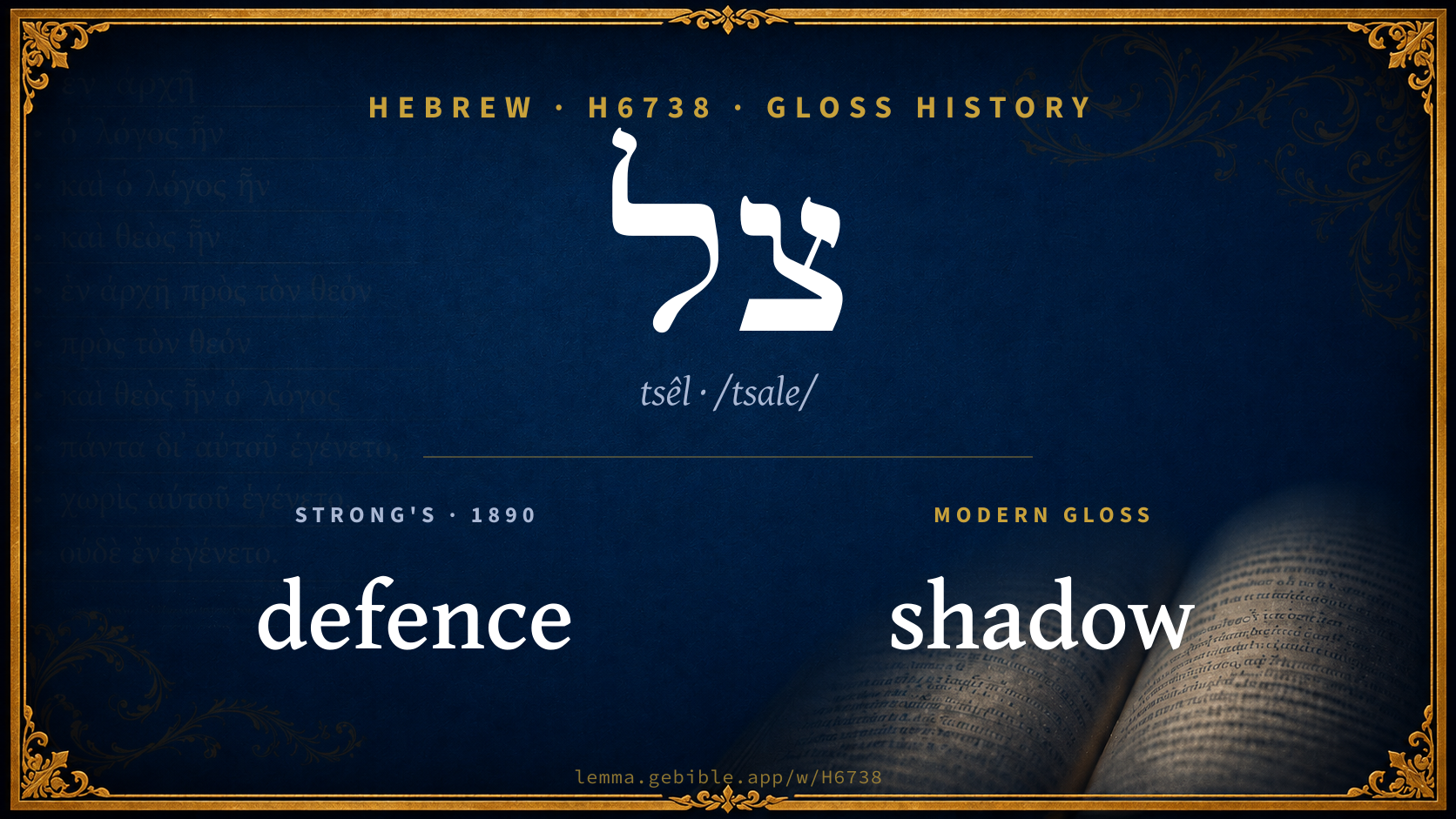
Gloss history
Strong's 1890 vs modern scholarship
About this word
Strong's H6738 catalogs a Hebrew word from the Hebrew Old Testament.
These counts are not copied from any lexicon or concordance. They are computed here, from the morphology-tagged Hebrew Old Testament. What Lemma adds →
- 47
- distinct verses
- The word appears in 47 distinct verses.
- 15 / 39
- OT books
- The word appears in 15 of 39 Old Testament books.
- #752
- by frequency
- Top 1000 most frequent Hebrew words (rank 752 of 8,640 Hebrew words by occurrence).
View all 47 occurrences in the concordance →
By section of the Old Testament
By traditional corpus
Conventional, traditional groupings — biblical authorship is debated, so this is a traditional corpus grouping, not an authorship claim. Each share is this word’s portion of its verses in that division of the Hebrew canon. Each figure is a share of the word’s 47 distinct verses.
- Prophets (Nevi'im) 25 verses · 53%
- Writings (Ketuvim) 20 verses · 43%
- Torah (Pentateuch) 2 verses · 4%
How translations render this word
Counts come from each version’s own published word-to-Strong’s tagging or interlinear alignment — an approximate guide to how each version renders this word, not a word-level alignment the data otherwise carries. Because each total is that version’s own tagged count, the per-version totals vary from one another and need not match the appearance or distinct-verse counts above. These counts may also differ from a printed concordance because Lemma counts each distinctly tagged rendering and does not collapse phrase taggings into a single head-word total. This is a fixed set of word-tagged versions (KJV, ASV, BSB, ULT) and does not change with the reading translation you choose elsewhere. Each version’s license is shown beside its name below (and on Sources).
BDB lists this Strong’s number as 2 distinct words (homographs). Each count above pools all of them and is not split by sense — see the Senses section below. A low-frequency rendering may belong to a different one of those words, not the primary meaning.
- King James Version†: Shadow 20×, Are as a shadow 4×, Under his shadow 4×
- American Standard Version†: Shadow 12×, Shade 7×, Under the shadow 5×
- Berean Standard Bible†: Shade 19×, Shadow 14×, Like a shadow 2×
- unfoldingWord Literal Text†: Shadow 13×, Shadow of 12×, Shade 10×
King James Version Public Domain
Renders H6738 across 49† tagged occurrences — most commonly:
Plus 15 renderings that appear only once — usually multi-word phrases or single function words the recovered tagging swept in, not distinct renderings.
American Standard Version Public Domain
Renders H6738 across 49† tagged occurrences — most commonly:
Plus 16 renderings that appear only once — usually multi-word phrases or single function words the recovered tagging swept in, not distinct renderings.
Berean Standard Bible Public Domain
Renders H6738 across 48† tagged occurrences — most commonly:
Plus 11 renderings that appear only once — usually multi-word phrases or single function words the recovered tagging swept in, not distinct renderings. Not rendered by a distinct English word in 1 further occurrence.
unfoldingWord Literal Text CC BY-SA 4.0
Renders H6738 across 52† tagged occurrences — most commonly:
Plus 11 renderings that appear only once — usually multi-word phrases or single function words the recovered tagging swept in, not distinct renderings.
Senses in the full BDB
What do BDB’s symbols mean?
BDB uses these scholarly abbreviations:
| Symbol | Meaning |
|---|---|
| 𝔊 | the Septuagint (the ancient Greek translation, LXX) |
| 𝔙 | the Vulgate (the Latin translation) |
| 𝔖 | the Syriac version (the Peshitta) |
| 𝔗 | the Targum (the Aramaic translation) |
| ψ | the Psalms |
| √ | root (the underlying root or stem) |
| ‖ | parallel passage (a synonymous or contrasted parallel) |
| † | the dagger: every passage where the word occurs is cited |
The 3 senses and sub-senses the full Brown-Driver-Briggs lexicon distinguishes for this word, in lexicon order (not ranked by frequency), with BDB’s own verbatim wording and sub-sense lettering. Shown in Hebrew script with BDB’s own scholarly abbreviations. The condensed entry is in the Lexicon Entry tab. See also the Forms in the corpus table below.
- 1. shadow on dial 2 K 20:9, 10(×2), 11 ‖ Is 38:8; צִלְלֵי־עָ֑רֶב Je 6:4, cf. Ct 2:17; 4:6; of mt. Ju 9:36. e.g. 2 Kings 20:9
- 2. shadow, shade, as protection (from sun): of branches, Ju 9:15 (in allegory), Ho 4:13; Jb 40:22; Jon 4:5, 6 and (in fig.) Ho 14:8; Ez 17:23; 31:6, 12, 17 ψ 80:11 Ct 2:3 (of refreshment, delight); of rock Is 32:2 (sim.); צ׳ קֹרָתִי Gn 19:8 shadow of my roof; of cloud Is 25:4 and (fig. of י׳’s protection 4:6; 25:4, so prob. 16:3; צ׳ כְּנָפֶיךָ shadow of thy wings, fig. of י׳’s protection ψ 17:8; 36:8; 57:2; 63:8; shade, in gen., Jb 7:2, fig. of י׳ ψ 121:5; hence = protection, defence, of city (wall) Je 48:45; of י׳ Nu 14:9 (JE), ψ 91:1 (v. also n.pr. בְּצַלְאֵל), cf. צֵל יָדוֹ Is 49:2 (covering prophet, under fig. of sword), 51:16 (covering people); of human ally Is 30:2, 3, of king La 4:20; also of wisdom Ec 7:12, money v 12.—בְּצִלָּהּ Is 34:15 appar. ref. to קִפּוֹז, but improb.; read perhaps בֵּצֶיהָ her eggs Du CheHpt. (CheHeb. Hpt. transp. וּבָֽקְעָה וְדָֽגְרָה). e.g. Judges 9:15
- 3. shadow as symb. of transitoriness of life Jb 8:9; 14:2 ψ 144:4 (כְּצֵל עוֹבֵר), Ec 6:12; 8:13; כְּצֵל נָטוּי of an individ. life near its end ψ 102:12, so כְּצֵל כִּנְטוֹתוֹ 109:23; in sim. of emaciated members, וִיצֻרַי כַּצֵּל Jb 17:7. e.g. Job 8:9
Senses from the full Brown-Driver-Briggs lexicon (Brown, Driver, Briggs; Oxford 1906 — public domain), digitized via Sefaria, supplemented by the OpenScriptures HebrewLexicon (CC BY 4.0). Full attribution on Sources.
Word origin
n.m. ψ 144:4 shadow;—צ׳ abs. 2 K 20:9 +, cstr. Gn 19:8 +; sf. צִלְּךָ ψ 121:5, צִלּוֹ Ez 31:6 +, also צִלְלוֹ Jb 40:22, etc.; pl. צְלָלִים Ct 2:17; 4:6; cstr. צִלְלֵי Je 6:4;—
— Brown-Driver-Briggs (Oxford 1906, public domain), digitized via Sefaria, supplemented by the OpenScriptures HebrewLexicon (CC BY 4.0). See Sources.
Derived from צלל (tsâlal) (H6751) — to be dark.
Jastrow Dictionary
A second Hebrew/Aramaic lexicon for comparison, covering Aramaic and post-biblical (Talmudic, Targumic, Midrashic) usage that the biblical-Hebrew BDB does not. Matched by lemma rather than by Strong’s number, so a lemma may carry more than one Jastrow headword (shown separately below), and the entries cover usage well beyond the Bible.
צַל
- , v. צְלַל
צֵל
- , v. טְלָלָא) shade, shadow; protection. Succ. 2ᵃ עד … אדם יושב בצל סוכה up to a height (of the walls) of twenty cubits one sits in the shade of the ceiling of the booth; למעלה … בצל רפנות above twenty cubits, one sits no longer shaded by the ceiling, but shaded by the walls. Ib.ᵇ כיון דרויחא איכא צל סוכה when the Succah is very large, there is the shade of the ceiling (even when the walls are higher than twenty cubits). Koh. R. to I, 2 (ref. to ib. VI, 12) כאיזה צל אם כצִלּוֹ של כותל וכ׳ like what shadow? if like the shadow of a wall, there is some reality in it; ib. כצִלָּן של דבורים וכ׳ like the shadow cast by flying bees &c.; Gen. R. s. 96 כצִילּוֹ וכ׳. Pes. 114ᵃ אכול בָּצֵל ושב בַּצֵּל וכ׳ eat onions and sit in the shade (of thy house in contentment) rather than &c. Y. Ab. Zar. III, 43ᵇ bot. צִיּלָּהּ אסור צל צילה מותר the shade of a worshipped tree is forbidden (to be enjoyed), the shade of the shade is permitted; כל שאילן … זהו צילה וכ׳ as far as the tree would reach if felled, so far is its shadow; what is beyond, is the shadow of the shadow; Bab. Ab. Zar. 48ᵇ צל קומתה the extent of the shadow corresponding to the height of the tree. Midr. Sam. ch. XIV; Yalk. Sam. 109, v. צַח. Ex. R. s. 34 (ref. to Ps. XCI, 1) בצל שעשה בצלאל in the shade which Bezalel has made (the Tabernacle). Ber. 55ᵃ (play on בצלאל) שמא בצל אל היית וכ׳ hast thou been in the shade of God that thou knowest it?; a. v. fr. e.g. Psalms 91:1
A Dictionary of the Targumim, the Talmud Babli and Yerushalmi, and the Midrashic Literature (Marcus Jastrow; London, Luzac, 1903) — Public Domain. Digitized via Sefaria. Digitized via Sefaria. Full attribution on Sources.
Forms in the corpus
The 36 distinct written forms H6738 takes in the Hebrew Bible, most frequent first — each parse links to that state’s occurrences in the concordance. Hebrew forms include their vowel points and cantillation, so a single lemma takes many written forms.
Same root — word family
Other BDB entries built from the same root as H6738, grouped by Strong’s listed origin. These share a root / origin per the lexicon — not necessarily a shared meaning. Each links to that word’s own entry.
Derives from
Shares the same root
Derived from this word
Proper names from this root
People and places named from this root — a name, not an additional meaning of the word.
- בצלאל Bᵉtsalʼêl H1212 Bezaleel
- צלה Tsillâh H6741 Zillah
- צלמנע Tsalmunnâʻ H6759 Zalmunna
- צלצח Tseltsach H6766 Zelzah
- צלתי Tsillᵉthay H6769 Zilthai
Compare all same-root words → Showing 4 of 10 — not the complete family. 5 of the same-root words are proper names (people or places). They share a root, not necessarily a meaning.
Septuagint verse parallels
This word appears in 45 verses that also exist in the Greek Old Testament (Septuagint), out of the 47 Hebrew verses it occurs in. You can read those verses in Greek by switching the Old Testament edition to the Septuagint.
Read these verses in the Septuagint
- Genesis 19:8
- Numbers 14:9
- Judges 9:15
- 2 Kings 20:9
- 1 Chronicles 29:15
- Job 7:2
- Psalms 17:8
- Ecclesiastes 6:12
- Song of Solomon 2:3
- Isaiah 4:6
- Lamentations 4:20
- Ezekiel 17:23
This is a verse-level parallel only — the same verses exist in both the Hebrew and Greek Old Testaments. No word-level Hebrew↔Greek correspondence is claimed: the data carries no such alignment, so no Greek word is shown as this Hebrew word’s translation. Coverage is not total — the Septuagint omits the deuterocanon and renumbers the Psalms, so some Hebrew verses have no direct Greek parallel.