
Job 17:7

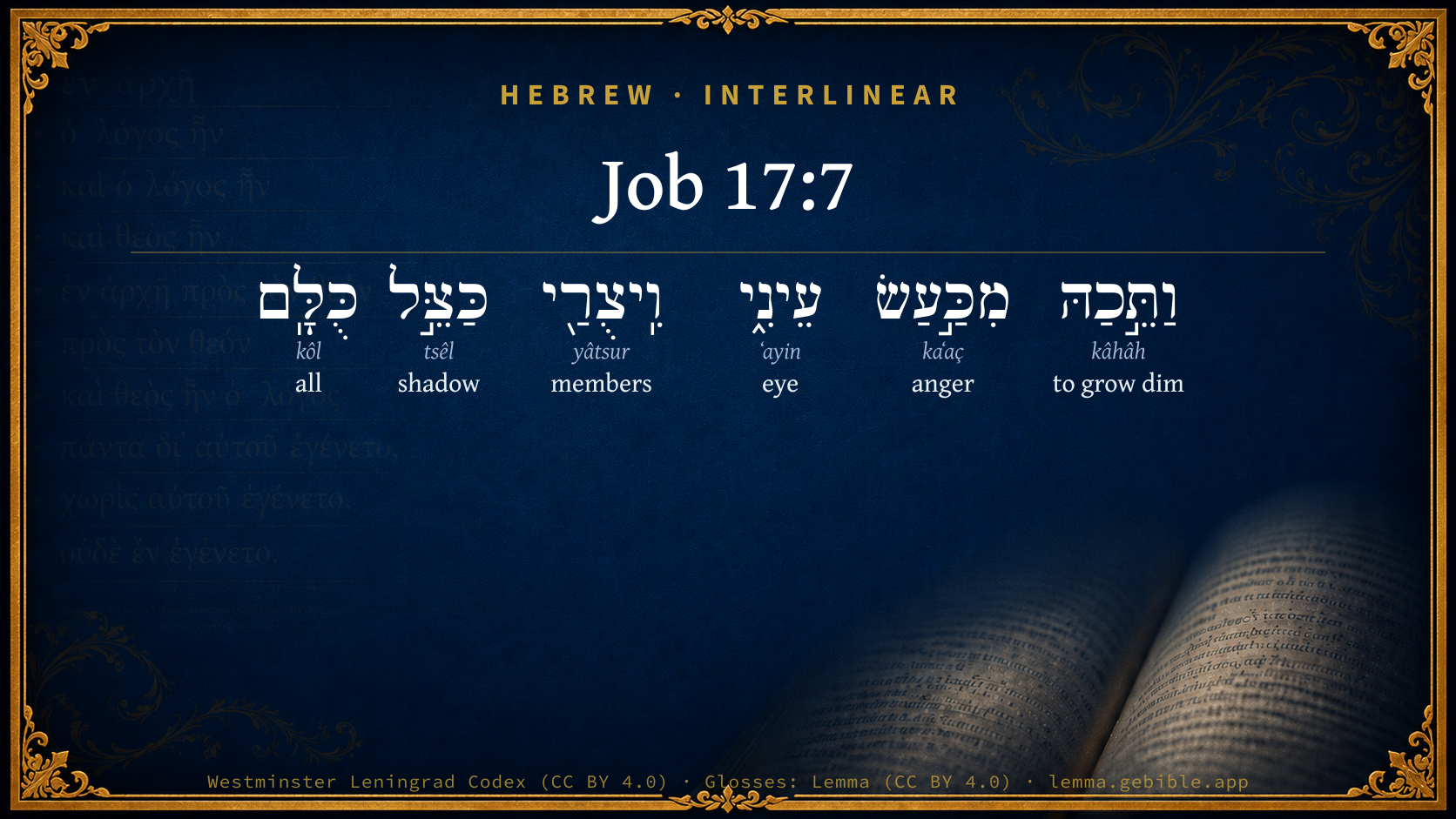
Hebrew (Westminster Leningrad Codex) Job 17:7 appears in the Hebrew Old Testament. The text above is from the Westminster Leningrad Codex. Each word links to its Strong’s number, a concise gloss, and parsing drawn from the Open Scriptures Hebrew Bible morphology. Click any word for its full Brown-Driver-Briggs (BDB) entry.
Download image
Cite this verse

Job 17:7 (World English Bible). Public Domain. Lemma interlinear Bible study tool, https://lemma.gebible.app/v/job/17/7.

Show BibTeX & RIS
BibTeX
RIS
English Translation
My eye also is dim by reason of sorrow. All my members are as a shadow.
World English Bible · Public Domain
Highlights
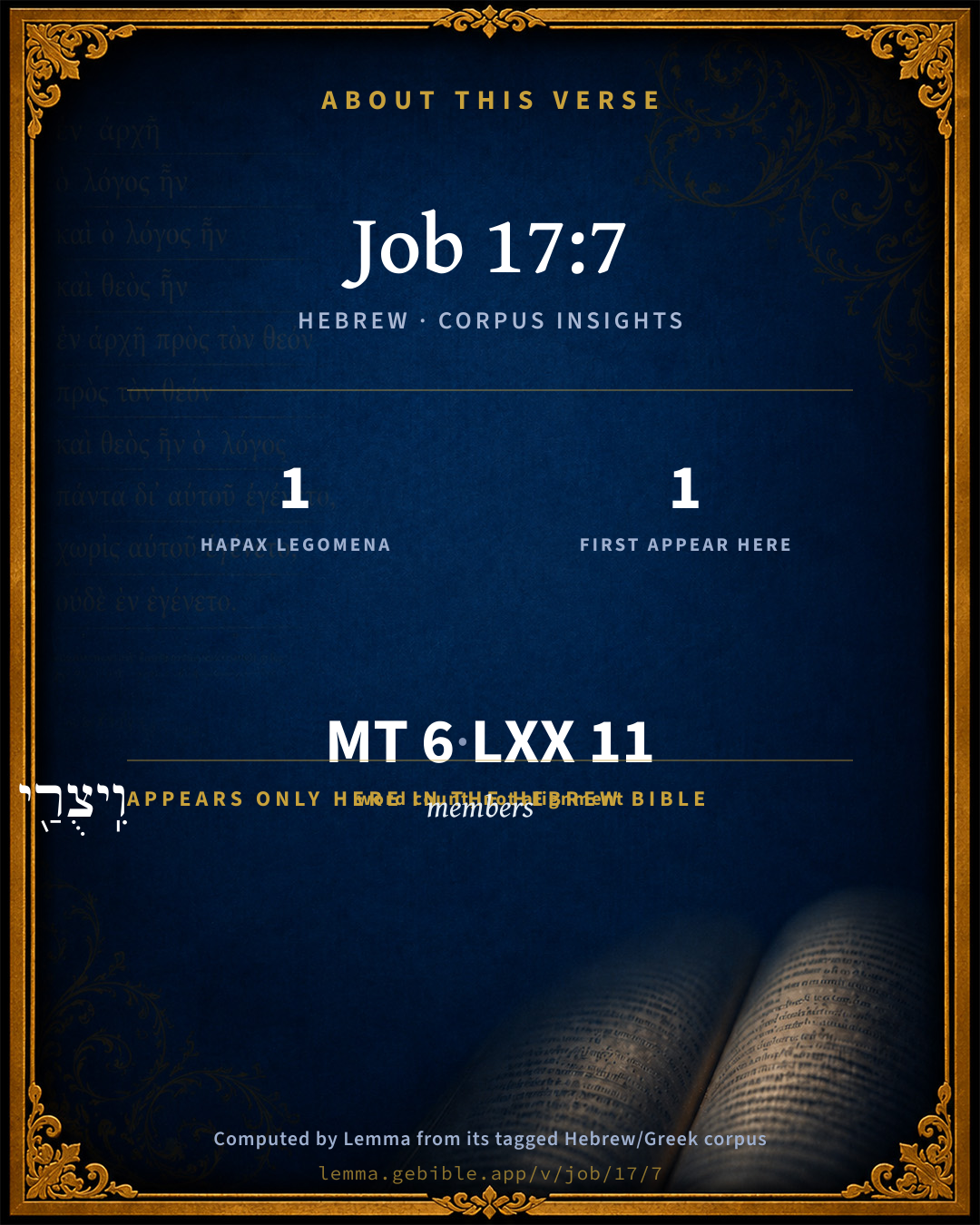
  • 1 hapax legomenon — only here in the Hebrew Bible
  • 1 first appearance in the Hebrew Bible
Full analysis ↓
Download a study sheet

One document with this verse’s original text, its word-by-word gloss line, the meaning frame, cross-references with their text, attributed commentary, and full source and license credits — printable, and it pastes into notes with its structure intact.

This verse Autodidact and up

Study sheet (.html) Plain text (.txt)

A passage Seminary Student

Up to 50 verses in one chapter. A passage sheet keeps up to 6 commentary sources and 12 cross-references per verse, in the order this page ranks them, and says so on the sheet whenever that leaves anything out. Ask for a single verse and you get the Autodidact verse sheet above.

Everything on this page stays free to read, with no account — the sheet is a download of what is already on screen, not access to it.

Want to remove ads? Support Godless Engineer
Compare translations 3

The same verse in 3 English versions, stacked beneath the original-language interlinear above. Click any original word for its lexicon entry.

Each is an independent rendering of the whole verse — the interlinear is not word-aligned to these translations.

Highlighted words mark where these versions differ — a whole-verse word diff, not a word-by-word alignment.

  • World English Bible Public Domain
    My eye also is dim by reason of sorrow. All my members are as a shadow.
  • King James Version Public Domain
    Mine eye also is dim by reason of sorrow, and all my members are as a shadow.
  • unfoldingWord Literal Text CC BY-SA 4.0
    and my eye is dim from sorrow, and my members like a shadow, all of them.

unfoldingWord Literal Text — © unfoldingWord, licensed CC BY-SA 4.0. Word-aligned USFM3 via Door43 (git.door43.org/unfoldingWord/en_ult).

Versions to compare (up to 4)

3 of 4 selected

Show all 18 translations

Every available English version of this verse, each an independent rendering of the whole verse.

  • World English Bible Public Domain
    My eye also is dim by reason of sorrow. All my members are as a shadow.
  • Berean Standard Bible Public Domain
    My eyes have grown dim with grief, and my whole body is but a shadow.
  • Majority Standard Bible Public Domain
    My eyes have grown dim with grief, and my whole body is but a shadow.
  • King James Version Public Domain
    Mine eye also is dim by reason of sorrow, and all my members are as a shadow.
  • American Standard Version (1901) Public Domain
    Mine eye also is dim by reason of sorrow, And all my members are as a shadow.
  • Revised Version (1885) Public Domain
    Mine eye also is dim by reason of sorrow, and all my members are as a shadow.
  • Geneva Bible (1599) Public Domain
    Mine eye therefore is dimme for griefe, and all my strength is like a shadowe.
  • Douay-Rheims (1899) Public Domain
    My eye is dim through indignation, and my limbs are brought as it were to nothing.
  • Young's Literal Translation Public Domain
    And dim from sorrow is mine eye, And my members as a shadow all of them.
  • Literal Standard Version CC BY-SA 4.0
    And my eye is dim from sorrow, || And my members—all of them—as a shadow.
  • Unlocked Literal Bible CC BY-SA 4.0
    My eye is also dim because of sorrow; all my body parts are as thin as shadows.
  • unfoldingWord Literal Text CC BY-SA 4.0
    and my eye is dim from sorrow, and my members like a shadow, all of them.
  • Darby Bible Public Domain
    And mine eye is dim by reason of grief, and all my members are as a shadow.
  • World Messianic Bible Public Domain
    My eye also is dim by reason of sorrow. All my members are as a shadow.
  • Webster's Bible Public Domain
    My eye also is dim by reason of sorrow, and all my members are as a shade.
  • Free Bible Version CC BY-SA 4.0
    My eyes are worn out from crying and my body is a shadow of its former self.
  • Bible in Basic English Public Domain
    My eyes have become dark because of my pain, and all my body is wasted to a shade.
  • JPS Tanakh (1917) Public Domain
    Mine eye also is dimmed by reason of vexation, and all my members are as a shadow.

Literal Standard Version (2020), Covenant Press — licensed CC BY-SA 4.0. Text via the HelloAO Bible API (eBible.org). Unlocked Literal Bible (unfoldingWord) — licensed CC BY-SA 4.0. Text via the HelloAO Bible API (eBible.org). unfoldingWord Literal Text — © unfoldingWord, licensed CC BY-SA 4.0. Word-aligned USFM3 via Door43 (git.door43.org/unfoldingWord/en_ult). Free Bible Version, Dr. Jonathan Gallagher — licensed CC BY-SA 4.0. Text via the HelloAO Bible API (eBible.org).

Word by word

More ways to search: Search by grammar → Find every occurrence → Compare this word →

Practice this passage: Drill this verse → Learn its vocabulary →

About this verse

These counts appear in no published source. They are computed here, from the morphology-tagged text and Lemma’s own curated glosses. What Lemma adds →

6
words
6
distinct lemmas
Wisdom
section

Notable vocabulary

1 hapax legomenon — a word that appears only here in the entire Hebrew Bible:

  • וִֽיצֻרַ֖י members H3338

First appearance in Scripture

This word makes its first canonical appearance in the Hebrew Bible here:

  • וִֽיצֻרַ֖י members H3338

Shared distinctive vocabulary

וַתֵּ֣כַהּ to grow dim H3543 occurs in 7 verses of the Hebrew Bible. Also found in:

Grammatical profile

  • 1 verb
  • 5 nouns

Verb forms

  • וַתֵּ֣כַהּ Qal · Sequential Imperfect

Hebrew & Septuagint length

In English translation the verse runs 16 words from the Hebrew and 14 from the Septuagint (LXX English) — closely comparable.

A rough comparison of the two English renderings, which tokenize alike — not a word-level alignment.

Word counts can differ between the Hebrew and the Greek without any difference in meaning — e.g. the Hebrew direct-object marker אֵת has no separate Greek word, and Greek often adds the article ὁ.

In the original languages it is 6 Hebrew tokens and 11 Greek tokens — but the two are counted differently (Hebrew bundles its prefixes and suffixes into one token; the Greek is in lemma form), so that isn’t a like-for-like length.

Cross-references

7

Topical passages linked to Job 17:7 in the Treasury of Scripture Knowledge — connected by theme and wording, ordered by reader-vote popularity; previews shown in the World English Bible.

  • Job 16:16 My face is red with weeping. Deep darkness is on my eyelids.
  • Psalms 6:7 My eye wastes away because of grief; It grows old because of all my adversaries.
  • Psalms 31:9–10 Have mercy on me, Yahweh, for I am in distress. My eye, my soul, and my body waste away with grief.
  • Job 16:8 You have shriveled me up. This is a witness against me. My leanness rises up against me, It testifies to my face.
  • Psalms 109:23 I fade away like an evening shadow. I am shaken off like a locust.
  • Ecclesiastes 6:12 For who knows what is good for man in life, all the days of his vain life which he spends like a shadow? For who can tell a man what will be after him under the sun?
  • Lamentations 5:17 For this our heart is faint; For these things our eyes are dim;

Cross-references courtesy of OpenBible.info (CC BY 4.0).

Hebrew and Greek witnesses Masoretic Hebrew ↔ Greek Septuagint

The same verse in the two great witnesses to the Old Testament, shown verse-for-verse.

These are two independent witnesses, not word-aligned to each other, and the Septuagint is shown in lemma (dictionary) form.

Hebrew Job 17:7 Masoretic · Westminster Leningrad Codex

וַתֵּ֣כַהּ מִכַּ֣עַשׂ עֵינִ֑י וִֽיצֻרַ֖י כַּצֵּ֣ל כֻּלָּֽם

My eye also is dim by reason of sorrow. All my members are as a shadow.

World English Bible · Public Domain

Greek LXX Job 17:7 Septuagint · lemma form

πωρόω γάρ ἀπό ὀργή ὁ ὀφθαλμός ἐγώ πολιορκέω μεγάλως ὑπό πᾶς

For my eyes are dimmed through pain; I have been grievously beset by all.

LXX2012 (modern English Septuagint) · Public Domain

Hebrew: Westminster Leningrad Codex (CC BY 4.0). Greek: Septuagint (public domain); English from LXX2012 (modern English Septuagint) (Public Domain). How the Septuagint differs from the Hebrew →

Commentary

Notes on Job 17:7 from classic Christian and Jewish commentators (each source and its license shown beneath its notes). The classic Christian expositions comment on the surrounding passage and are grouped to its opening verse, so a note may address several verses; the Jewish commentaries on the Tanakh (Rashi and others) are per-verse, so they appear only where the commentator wrote on this verse.

Lemma curates 59 commentaries, every one of them public domain or Creative Commons licensed, each selected and text-cleaned for this edition rather than reprinted as found. About our sources →

Trapp's Complete Commentary

John Trapp

Job 17:7 Mine eye also is dim by reason of sorrow, and all my members [are] as a shadow.

Ver. 7. Mine eye also is dim by reason of sorrow] Not only is my good name blasted, but my body also is wasted; the nerves of mine eyes are contracted, the visual faculty decayed, Psa 6:7. "Mine eye is consumed because of grief; yea, my soul and my belly," Psa 31:9. Not the visual only, but the vital powers are wasted; {see Job 16:16} yea, the intellectual part as well as the sensitive, understood by the formations in the next clause, that is, the cogitations, say they, according to Gen 6:5. But I rather take it according to our translation, for the members of the body.

And all my members are as a shadow] My membra members are but umbra, shadows, they look more like a skeleton, an anatomy, an apparition, than a true body, nothing being left but skin and bone, so much meagred are all my members. This is hyperbolica malorum suorum amplificatio, saith Merlin.

John Trapp, A Commentary or Exposition upon All the Books of the Old and New Testament (1647–1656) — public domain. Text from a community e-Sword module.

Joseph Benson's Commentary

Job 17:7. Mine eye also is dim by reason of sorrow — Through excessive weeping and decay of spirits, which cause a dimness of the sight. And all my members are as a shadow — My body is so reduced, and I am grown so poor and thin, and my colour so wan and ghastly, that I look more like a ghost or a shadow than a man.

Joseph Benson's Commentary on the Old and New Testaments (1811–1818) — public domain. Text from a community e-Sword module.

Jamieson, Fausset & Brown

Robert Jamieson, A. R. Fausset & David Brown

(Psa 6:7; Psa 31:9; Deu 34:7).

members--literally, "figures"; all the individual members being peculiar forms of the body; opposed to "shadow," which looks like a figure without solidity.

Jamieson, Fausset & Brown — Commentary Critical and Explanatory on the Whole Bible (1871) — public domain (CC PDM 1.0). Text via the HelloAO Bible API.

Adam Clarke's Commentary

Verse 7. Mine eye also is dim] Continual weeping impairs the sight; and indeed any affliction that debilitates the frame generally weakens the sight in the same proportion.

All my members are as a shadow.] Nothing is left but skin and bone. I am but the shadow of my former self.

Adam Clarke's Commentary on the Bible (1810–1826) — public domain. Text from a community e-Sword/MySword module.

The Cambridge Bible for Schools and Colleges

gen. ed. J. J. S. Perowne

7. The sorrowful condition to which Job was reduced by his afflictions.

The Cambridge Bible for Schools and Colleges (gen. ed. J. J. S. Perowne; Cambridge University Press, 1878–1918) — public domain. Text from a community e-Sword module.

John Gill's Exposition

Mine eye also is dim by reason of sorrow,.... Through excessive weeping, and the abundance of tears he shed, so that he had almost lost his eyesight, or however it was greatly weakened and impaired by that means, which is often the case, see Psa 6:7;

and all my members are as a shadow; his flesh was consumed off his bones, there were nothing left scarcely but skin and bone; he was a mere anatomy, and as thin as a lath, as we commonly say of a man that is quite worn away, as it were; is a walking shadow, has scarce any substance in him, but is the mere shadow of a man; the Targum interprets it of his form, splendour, and countenance, which were like a shadow; some interpret it "my thoughts" (t), and understand it of the formations of his mind, and not of his body, which were shadows, empty, fleeting, and having no consistence in them through that sorrow that possessed him.

(t) "cogitationes meae", Pagninus, Bolducius, Codurcus, so Ben Gersom.

John Gill's Exposition of the Whole Bible (1746–1763) — public domain (CC PDM 1.0). Text via the HelloAO Bible API.

Albert Barnes' Notes on the Bible

Mine eye is dim by reason of sorrow - Schultens supposes that this refers to his external appearance in general, as being worn down, exhausted, “defaced” by his many troubles; but it seems rather to mean that his eyes failed on account of weeping.

And all my members are as a shadow - “I am a mere skeleton, I am exhausted and emaciated by my sufferings.” It is common to speak of persons who are emaciated by sickness or famine as mere shadows. Thus, Livy (L. 21:40) says, Effigies, imo, “umbrce hominum;” fame, frigore, illuvie, squalore enecti, contusi, debilitati inter saxa rupesque. So Aeschylus calls Oedipus - Οἰδίπου σκιαν Oidipou skian - the shadow of Oedipus.

Albert Barnes' Notes on the Bible (1834–1885) — public domain. Text from a community e-Sword/MySword module.

Haydock's Catholic Bible Commentary

Indignation of God, or of myself. (Menochius) --- Nothing. Hebrew, "as a shadow." (Calmet)

George Leo Haydock (1774–1849), Haydock's Catholic Family Bible and Commentary, 1859 edition — public domain. Excludes Psalms (Douay-Rheims chapter numbering differs from Protestant) and Deuterocanonical books (Catholic canon only).

Matthew Poole's English Annotations

By reason of sorrow; through excessive weeping and decay of spirits, which cause a dimness in the sight.

All my members are as a shadow; my body is so consumed, and my colour so wan and ghastly, that I look more like a ghost, or a shadow, than like a man.

Matthew Poole's English Annotations on the Holy Bible (1683–1685) — public domain. Text from a community e-Sword/MySword module.

Whedon's Commentary on the Bible

Daniel D. Whedon

7. Eye also is dim — Dimness of the eye is a figure frequently employed in Scripture to indicate the effects of grief, or of advanced age. As a shadow. See note Job_8:9.

Daniel D. Whedon (gen. ed.), Commentary on the Old and New Testaments (1874–1909) — public domain. Text from a community e-Sword module.

The Pulpit Commentary

Mine eye also is dim by reason of sorrow. (comp. Psa_6:7 Psa_31:9) Excessive weeping, such as stains the cheeks, (Job_16:16) will also in most cases dim and dull the eyesight. And all my members are as a shadow. Weak, that is, worn out, unstable, fleeting, ready to pass away.

The eye that is made dim by sorrow.

Job has just been saying that God bad hidden the heart of his tormentors from understanding (ver. 4). Now he sadly observes that sorrow has dimmed his own eye. It is not easy to see clearly through a veil of tears. Excessive weeping induces blindness. The sad soul sits in darkness.

I SORROW PREVENTS US FROM SEEING ALL THE TRUTH. It limits the range of vision even when it does not drive us down to the darkness of despair.

1. It is an emotion"and as such it absorbs our consciousness with internal feeling, and therefore does not permit it to look out in external observation. All subjectivity is unobservant.

2. It is a depressing influence. It tends to lower our vitality. It will scarcely let us lift up our eyes to see even when we have the power of vision. Poor Hagar was too broken-hearted to notice the well which was to restore life to her child. Thus in great grief the soul cannot see the Divine purpose, nor the love that is above all. Black clouds hide the heavens. A rain of tears blots out the earthly landscape. To the sorrowful eye there are no flowers in spring.

II SORROW SHOULD LEAD US TO EXERCISE FAITH. What if the eye be dim? We are not dependent on sight. Our part is to walk by faith. Too clear a landscape excludes the sense of mystery, and absorbs our attention in connection with things earthly and visible. It is well to feel our littleness, our darkness, our limitation. Then our sorrow really enlarges our lives, by leading us to look at the things which are not seen, but which are eternal. (2Co_4:18)

III SORROW MAY OPEN OUR EYES TO NEW TRUTHS. The tears which blind us may also purge our vision. Shutting out the familiar sight of common scenes, they may open to us a new sight of heavenly truths. There have been revelations in sorrow. Jacob saw heaven opened when he was a fugitive for his life; Joseph interpreted dreams in prison, and Daniel in exile; Moses saw the burning bush in the wilderness; John beheld his great apocalypse when he was banished to Parinos. Poets learn in sorrow what they teach in song.

IV IT IS CRUEL TO BE HARSH WITH THOSE WHOSE BLINDNESS COMES FROM SORROW. We must learn to distinguish this blindness from the lack of understanding which springs from a perverse heart, like that of the three friends (ver. 4). Sinful and reckless scepticism deserves a severe rebuke. But this is very different from the doubt which is born of sorrow. In the hour of deepest grief it may be that all the heavens seem blurred and confused. The old landmarks are washed away in the deluge. We cannot see God, and his love is lost sight of. Even Christ in his bitter agony exclaimed, "My God, my God, why hast thou forsaken me?

V ULTIMATELY GOD WILL GIVE CLEAR VISION TO THE SORROW-BLINDED EYE. When he wipes away the tears he will restore the sight. The burden of the mystery will not be borne for ever. We have only to walk for a season in the darkness. "Weeping may endure for a night, but joy cometh in the morning". (Psa_30:5) Then the very background of old troubles will throw up the new joys with the more intense splendour, and the previous blindness will make the new vision the more vivid and gladsome. W.F.A.

The Pulpit Commentary (1880–1919), ed. H.D.M. Spence-Jones & Joseph S. Exell — public domain. Text from a community e-Sword module.

John Wesley's Explanatory Notes

As a shadow - I am grown so poor and thin, that I am not to be called a man, but the shadow of a man.

John Wesley, Explanatory Notes Upon the Whole Bible (1754–1765) — public domain. Text via the GEBible commentary corpus.

Rashi

Rabbi Shlomo Yitzchaki (Rashi)

and my limbs namely, the limbs with which I was formed.

Rashi on the Tanakh — English translations: “The Judaica Press complete Tanach with Rashi, translated by A. J. Rosenberg” (CC BY 4.0); “Pentateuch with Rashi's commentary by M. Rosenbaum and A.M. Silbermann, 1929-1934” (public domain); “The Metsudah Tanach series, Lakewood, N.J” (CC BY 4.0); and “The Book of Joshua, Metsudah Publications, 1997” (CC BY 4.0). Text via Sefaria.

Lesson kit

Teaching starters — assembled from the data on this page, not authored interpretation. Every prompt links to the verse data it draws on. Edit before teaching.

Job, in the Wisdom, opens this verse with 6 words (6 distinct Hebrew lemmas). Its most distinctive word is yâtsur (“members”). A historical commentator’s framing appears above. Read the whole chapter for the surrounding context.

Discussion questions

  1. What does “members” (yâtsur) contribute to the verse as a whole?
  2. This verse holds 1 word here found nowhere else in the Hebrew Bible. What might the rare word draw attention to?
  3. The word “members” first appears here in Scripture. What is being introduced at this debut?
  4. Genesis 27:1 shares the word «to grow dim» with this verse. How do the two illuminate each other?
  5. These translations render this verse differently; the difference is in the English rendering, not the original. What questions does that raise?
  6. The verb «וַתֵּ֣כַהּ» is Qal Sequential Imperfect. How does its form color the action?
  7. Reading how Trapp's Complete Commentary and Joseph Benson's Commentary read this verse, where do the two commentators agree and where do they part?

Things to notice

Reading settings

Reading text

Shown beneath each verse's original-language words.

Old Testament
Old Testament edition

Read the OT as the Masoretic Hebrew (MT) or the Greek Septuagint (LXX).

English shown for the Greek Septuagint (in the Hebrew ↔ Greek comparison).

Comparing translations? Open the Compare panel on any verse page to stack up to four side by side.