Isaiah 4:6

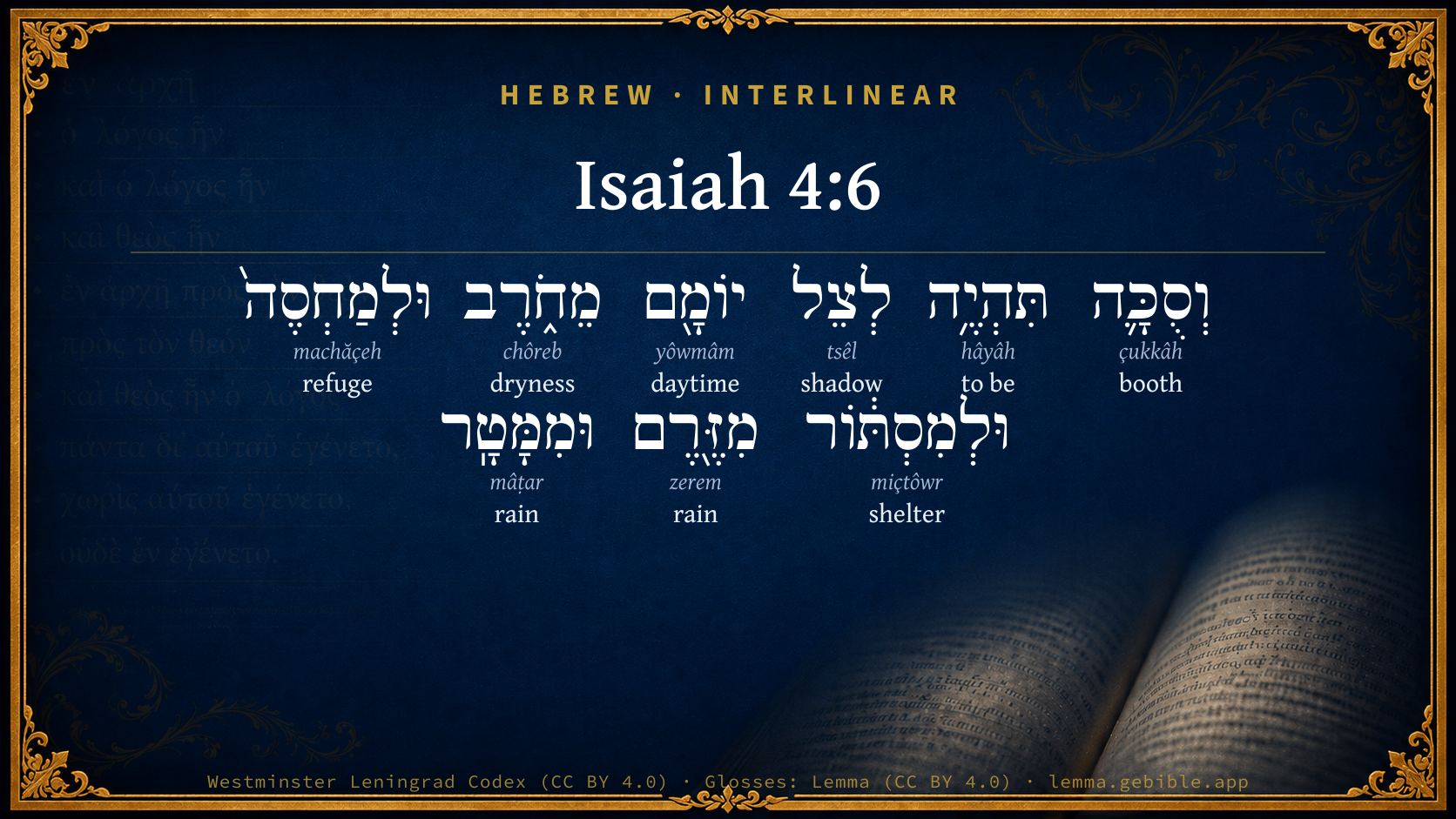
Hebrew (Westminster Leningrad Codex) Isaiah 4:6 appears in the Hebrew Old Testament. The text above is from the Westminster Leningrad Codex. Each word links to its Strong’s number, a concise gloss, and parsing drawn from the Open Scriptures Hebrew Bible morphology. Click any word for its full Brown-Driver-Briggs (BDB) entry.
Download image
Cite this verse

Isaiah 4:6 (World English Bible). Public Domain. Lemma interlinear Bible study tool, https://lemma.gebible.app/v/isaiah/4/6.

Show BibTeX & RIS
BibTeX
RIS
English Translation
There will be a pavilion for a shade in the daytime from the heat, and for a refuge and for a shelter from storm and from rain.
World English Bible · Public Domain
Highlights
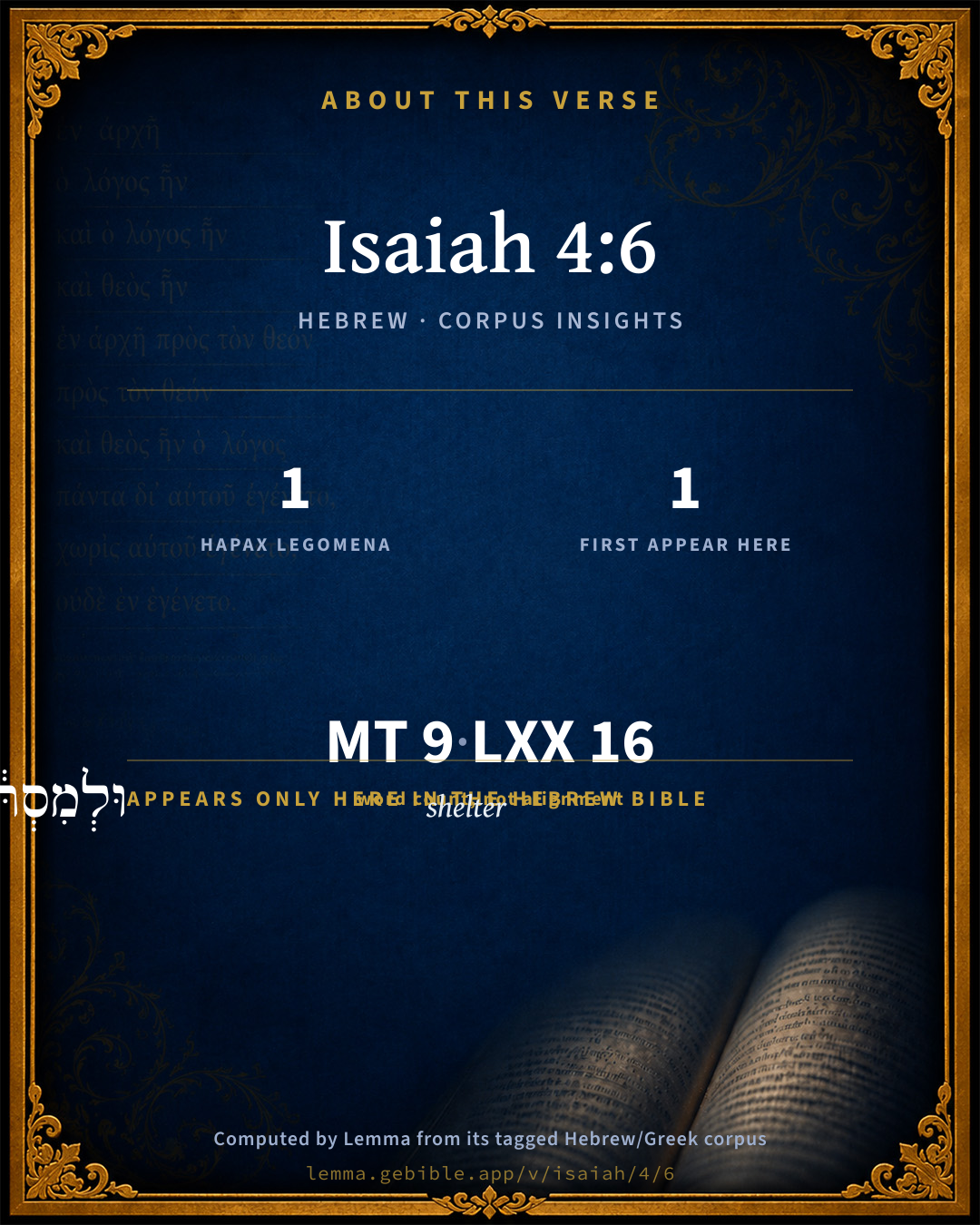
  • 1 hapax legomenon — only here in the Hebrew Bible
  • 1 first appearance in the Hebrew Bible
Full analysis ↓
Download a study sheet

One document with this verse’s original text, its word-by-word gloss line, the meaning frame, cross-references with their text, attributed commentary, and full source and license credits — printable, and it pastes into notes with its structure intact.

This verse Autodidact and up

Study sheet (.html) Plain text (.txt)

A passage Seminary Student

Up to 50 verses in one chapter. A passage sheet keeps up to 6 commentary sources and 12 cross-references per verse, in the order this page ranks them, and says so on the sheet whenever that leaves anything out. Ask for a single verse and you get the Autodidact verse sheet above.

Everything on this page stays free to read, with no account — the sheet is a download of what is already on screen, not access to it.

Want to remove ads? Support Godless Engineer
Compare translations 3

The same verse in 3 English versions, stacked beneath the original-language interlinear above. Click any original word for its lexicon entry.

Each is an independent rendering of the whole verse — the interlinear is not word-aligned to these translations.

Highlighted words mark where these versions differ — a whole-verse word diff, not a word-by-word alignment.

  • World English Bible Public Domain
    There will be a pavilion for a shade in the daytime from the heat, and for a refuge and for a shelter from storm and from rain.
  • King James Version Public Domain
    And there shall be a tabernacle for a shadow in the day time from the heat, and for a place of refuge, and for a covert from storm and from rain.
  • unfoldingWord Literal Text CC BY-SA 4.0
    And a booth will be for shade by day from the heat and for a refuge and for a shelter from the storm and from the rain.

unfoldingWord Literal Text — © unfoldingWord, licensed CC BY-SA 4.0. Word-aligned USFM3 via Door43 (git.door43.org/unfoldingWord/en_ult).

Versions to compare (up to 4)

3 of 4 selected

Show all 18 translations

Every available English version of this verse, each an independent rendering of the whole verse.

  • World English Bible Public Domain
    There will be a pavilion for a shade in the daytime from the heat, and for a refuge and for a shelter from storm and from rain.
  • Berean Standard Bible Public Domain
    a shelter to give shade from the heat by day, and a refuge and hiding place from the storm and the rain.
  • Majority Standard Bible Public Domain
    a shelter to give shade from the heat by day, and a refuge and hiding place from the storm and the rain.
  • King James Version Public Domain
    And there shall be a tabernacle for a shadow in the day time from the heat, and for a place of refuge, and for a covert from storm and from rain.
  • American Standard Version (1901) Public Domain
    And there shall be a pavilion for a shade in the day-time from the heat, and for a refuge and for a covert from storm and from rain.
  • Revised Version (1885) Public Domain
    And there shall be a pavilion for a shadow in the day-time from the heat, and for a refuge and for a covert from storm and from rain.
  • Geneva Bible (1599) Public Domain
    And a couering shalbe for a shadow in the day for the heate, and a place of refuge and a couert for the storme and for the raine.
  • Douay-Rheims (1899) Public Domain
    And there shall be a tabernacle for a shade in the daytime from the heat, and for a security and covert from the whirlwind, and from rain.
  • Young's Literal Translation Public Domain
    And a covering may be, For a shadow by day from drought, And for a refuge, and for a hiding place, From inundation and from rain!
  • Literal Standard Version CC BY-SA 4.0
    And a covering may be, || For a shadow from drought by day, || And for a refuge, and for a hiding place, || From inundation and from rain!
  • Unlocked Literal Bible CC BY-SA 4.0
    It will be a shelter for shade in the daytime from the heat, and a refuge and a cover from the storm and rain.
  • unfoldingWord Literal Text CC BY-SA 4.0
    And a booth will be for shade by day from the heat and for a refuge and for a shelter from the storm and from the rain.
  • Darby Bible Public Domain
    And there shall be a tabernacle for shade by day from the heat, and for a shelter and for a covert from storm and from rain.
  • World Messianic Bible Public Domain
    There will be a pavilion for a shade in the daytime from the heat, and for a refuge and for a shelter from storm and from rain.
  • Webster's Bible Public Domain
    And there shall be a tabernacle for a shade in the day time from the heat, and for a place of refuge, and for a covert from storm and from rain.
  • Free Bible Version CC BY-SA 4.0
    It will provide a place to stay in the shade of the daytime heat, and a shelter to hide from storm and rain.
  • Bible in Basic English Public Domain
    And a shade in the daytime from the heat, and a safe cover from storm and from rain.
  • JPS Tanakh (1917) Public Domain
    And there shall be a pavilion for a shadow in the day-time from the heat, and for a refuge and for a covert from storm and from rain.

Literal Standard Version (2020), Covenant Press — licensed CC BY-SA 4.0. Text via the HelloAO Bible API (eBible.org). Unlocked Literal Bible (unfoldingWord) — licensed CC BY-SA 4.0. Text via the HelloAO Bible API (eBible.org). unfoldingWord Literal Text — © unfoldingWord, licensed CC BY-SA 4.0. Word-aligned USFM3 via Door43 (git.door43.org/unfoldingWord/en_ult). Free Bible Version, Dr. Jonathan Gallagher — licensed CC BY-SA 4.0. Text via the HelloAO Bible API (eBible.org).

Word by word

More ways to search: Search by grammar → Find every occurrence → Compare this word →

Practice this passage: Drill this verse → Learn its vocabulary →

וּלְמִסְתּ֔וֹר
miçtôwr
H4563
“and · to/for · shelter”
Conjunction + Preposition + Noun, Common, Masculine, Singular, Absolute
Part of Speech
Conjunction + Preposition + Noun
Type
Common
Gender
Masculine
Number
Singular
State
Absolute
Full BDB Definition

Origin: from H5641

TWOT: 1551c

place of shelter
  1. וְסֻכָּ֛ה çukkâh H5521 “and · booth” Conjunction + Noun, Common, Feminine, Singular, Absolute
  2. תִּהְיֶ֥ה hâyâh H1961 “to be” Verb, Qal, Imperfect, 3rd Person, Feminine, Singular
  3. לְצֵל tsêl H6738 “to/for · shadow” Preposition + Noun, Common, Masculine, Singular, Absolute
  4. יוֹמָ֖ם yôwmâm H3119 “daytime” Adverb
  5. מֵחֹ֑רֶב chôreb H2721 “from · dryness” Preposition + Noun, Common, Masculine, Singular, Absolute
  6. וּלְמַחְסֶה֙ machăçeh H4268 “and · to/for · refuge” Conjunction + Preposition + Noun, Common, Masculine, Singular, Absolute
  7. מִזֶּ֖רֶם zerem H2230 “from · rain” Preposition + Noun, Common, Masculine, Singular, Absolute
  8. וּמִמָּטָֽר mâṭar H4306 “and · from · rain” Conjunction + Preposition + Noun, Common, Masculine, Singular, Absolute

About this verse

These counts appear in no published source. They are computed here, from the morphology-tagged text and Lemma’s own curated glosses. What Lemma adds →

9
words
9
distinct lemmas
Prophets
section

Notable vocabulary

1 hapax legomenon — a word that appears only here in the entire Hebrew Bible:

  • וּלְמִסְתּ֔וֹר shelter H4563

First appearance in Scripture

This word makes its first canonical appearance in the Hebrew Bible here:

  • וּלְמִסְתּ֔וֹר shelter H4563

Shared distinctive vocabulary

מִזֶּ֖רֶם rain H2230 occurs in 7 verses of the Hebrew Bible. Also found in:

Grammatical profile

  • 1 verb
  • 7 nouns
  • 1 adverb

Verb forms

  • תִּהְיֶ֥ה Qal · Imperfect

Hebrew & Septuagint length

In English translation the verse runs 27 words from the Hebrew and 25 from the Septuagint (LXX English) — closely comparable.

A rough comparison of the two English renderings, which tokenize alike — not a word-level alignment.

Word counts can differ between the Hebrew and the Greek without any difference in meaning — e.g. the Hebrew direct-object marker אֵת has no separate Greek word, and Greek often adds the article ὁ.

In the original languages it is 9 Hebrew tokens and 16 Greek tokens — but the two are counted differently (Hebrew bundles its prefixes and suffixes into one token; the Greek is in lemma form), so that isn’t a like-for-like length.

Cross-references

13

Topical passages linked to Isaiah 4:6 in the Treasury of Scripture Knowledge — connected by theme and wording, ordered by reader-vote popularity; previews shown in the World English Bible.

  • Isaiah 25:4 For you have been a stronghold to the poor, a stronghold to the needy in his distress, a refuge from the storm, a shade from the heat, when the blast of the awesome ones is as a storm against the wall.
  • Psalms 27:5 For in the day of trouble he will keep me secretly in his pavilion. In the covert of his tent he will hide me. He will lift me up on a rock.
  • Isaiah 32:2 A man shall be as a hiding-place from the wind, and a covert from the tempest, as streams of water in a dry place, as the shade of a great rock in a weary land.
  • Proverbs 18:10 The name of Yahweh is a strong tower: The righteous run to him, and are safe.
  • Isaiah 8:14 He shall be for a sanctuary; but for a stone of stumbling and for a rock of offense to both the houses of Israel, for a gin and for a snare to the inhabitants of Jerusalem.
  • Psalms 91:1 He who dwells in the secret place of the Most High Will rest in the shadow of the Almighty.
  • Psalms 121:5–6 Yahweh is your keeper. Yahweh is your shade on your right hand.
  • Isaiah 32:18–19 My people shall abide in a peaceable habitation, and in safe dwellings, and in quiet resting-places.
  • Hebrews 6:18 that by two immutable things, in which it is impossible for God to lie, we may have a strong encouragement, who have fled for refuge to take hold of the hope set before us.
  • Hebrews 11:7 By faith, Noah, being warned about things not yet seen, moved with godly fear, prepared an ark for the saving of his house, through which he condemned the world, and became heir of the righteousness which is according to faith.
  • Revelation 7:16 They will never be hungry, neither thirsty any more; neither will the sun beat on them, nor any heat;
  • Ezekiel 11:16 Therefore say, Thus says the Lord Yahweh: Whereas I have removed them far off among the nations, and whereas I have scattered them among the countries, yet will I be to them a sanctuary for a little while in the countries where they are come.
  • Matthew 7:24–27 "Everyone therefore who hears these words of mine, and does them, I will liken him to a wise man, who built his house on a rock.

Cross-references courtesy of OpenBible.info (CC BY 4.0).

Hebrew and Greek witnesses Masoretic Hebrew ↔ Greek Septuagint

The same verse in the two great witnesses to the Old Testament, shown verse-for-verse.

These are two independent witnesses, not word-aligned to each other, and the Septuagint is shown in lemma (dictionary) form.

Hebrew Isaiah 4:6 Masoretic · Westminster Leningrad Codex

וְסֻכָּ֛ה תִּהְיֶ֥ה לְצֵל יוֹמָ֖ם מֵחֹ֑רֶב וּלְמַחְסֶה֙ וּלְמִסְתּ֔וֹר מִזֶּ֖רֶם וּמִמָּטָֽר

There will be a pavilion for a shade in the daytime from the heat, and for a refuge and for a shelter from storm and from rain.

World English Bible · Public Domain

Greek LXX Isaiah 4:6 Septuagint · lemma form

καί εἰμί εἰς σκιά ἀπό καῦμα καί ἐν σκέπης καί ἐν ἀπόκρυφος ἀπό σκληρότης καί ὑετός

And it shall be for a shadow from the heat, and as a shelter and a hiding place from inclemency of weather and from rain.

LXX2012 (modern English Septuagint) · Public Domain

On this verse, The Cambridge Bible for Schools and Colleges discusses the Septuagint’s reading. Read the note in Commentary ↓

Hebrew: Westminster Leningrad Codex (CC BY 4.0). Greek: Septuagint (public domain); English from LXX2012 (modern English Septuagint) (Public Domain). How the Septuagint differs from the Hebrew →

Targum (Aramaic paraphrase)

1

The Targum is the ancient Jewish Aramaic paraphrase of the Hebrew Scriptures — an interpretive translation, not the Hebrew text itself. Onkelos (literal) and Pseudo-Jonathan (expansive) render the Torah, and Jonathan the Prophets. Coverage is partial: where no permissively-licensed English translation exists for a verse, only the Aramaic is shown. This is verse-level text, not a word-by-word alignment to the Hebrew.

  1. Targum Jonathan Prophets (Joshua–Malachi)
    וְעַל יְרוּשָׁלֵם תְּהֵי מַטְלַת עֲנָנֵי לְאַטְלָלָה עֲלָהּ בִימָם מִשְׁרָב וּלְבֵית סֵתֶר וּלְאַגָנָא מִזַרְמִית וּמִמִטְרָא:

    And over Jerusalem shall be a tabernacle of clouds, to overshadow it by day from the scorching heat, and for a place of refuge from storm and from rain.

    Targum Jonathan — Aramaic: “Mikraot Gedolot” (public domain). English: “Sefaria Community Translation” (CC0 1.0 (public-domain dedication)); “London "Chaldee Paraphrase," 1871” (public domain). Text via Sefaria.

Commentary

Notes on Isaiah 4:6 from classic Christian and Jewish commentators (each source and its license shown beneath its notes). The classic Christian expositions comment on the surrounding passage and are grouped to its opening verse, so a note may address several verses; the Jewish commentaries on the Tanakh (Rashi and others) are per-verse, so they appear only where the commentator wrote on this verse.

Lemma curates 59 commentaries, every one of them public domain or Creative Commons licensed, each selected and text-cleaned for this edition rather than reprinted as found. About our sources →

Trapp's Complete Commentary

John Trapp

Isa 4:6 And there shall be a tabernacle for a shadow in the daytime from the heat, and for a place of refuge, and for a covert from storm and from rain.

Ver. 6. And there shall be a tabernacle for a shadow.] Or, He shall be. Christ is a shelter and a shadow to his, whenas all worldly comforts are but as so many burning glasses, to scorch the soul more.

John Trapp, A Commentary or Exposition upon All the Books of the Old and New Testament (1647–1656) — public domain. Text from a community e-Sword module.

The Biblical Illustrator

Joseph S. Exell

Isa_4:6

And there shall be a tabernacle for a shadow

A substantial shadow amid the insubstantials

The tabernacles of the Old Testament typify the abiding glory of that true tabernacle which the Lord pitched and not marl They were taken down.

This abideth evermore. The dissolving process of death only developed the capacity of the Divine Redeemer to become a universal tabernacle. Isaiah saw the Divine King in all His beauty and in all His adaptedness for the worlds deep needs when he declared, And there shall be a tabernacle for a shadow in the day time from the heat. The word shadow is not always attractively employed. Job, in mournful imagery, describes the traveller going to the land of darkness, and the shadow of death. And cheering ideas are not always suggested by the proverb which affirms that coming events cast their shadows before them. But the sublime tabernacle spoken of by Isaiah is a shadow that always attracts. It never hides any sunlight which may be needful for the ripening of celestial fruits.

I. This tabernacle is a COOLING SHADOW. The heats of this world will not be so oppressive to him who dwells in this tabernacle. For the soul finds adequate provisions for the wants and aspirations of its largo capacities in this substantial shadow.

II. This tabernacle is a LIFE GIVING AND PRESERVING SHADOW. The summer heat of Judaea is intense. Some of the rivers are dried up, and become lanes of burning sand. Near Mount Tabor many of the soldiers of Baldwin IV died through the oppressive heat; and at this very place of Shunem, the son of the Shunamite was struck in the head by the suns rays as he went up to his father to the reapers, and he died. A shadow to impart and preserve life as well as to give a cooling place of resort. The spirit of man dies in consequence of unforgiven transgression, but life is found in the true tabernacle.

III. This tabernacle is a DELIGHTFUL SHADOW. Delightful, not only in protecting from evils, but in the direct impartation of pleasure. If there is any delightful state in this world, it is where and when the soul sits down under the shadows of the Beloved and holds sublime communion with the Infinite.

IV. This shadow is an ABIDING SHADOW. Unlike that afforded by Jonahs gourd. God blasts our cherished gourds in order to lead us out of all narrow and selfish policies. Earths protecting shadows flee away to teach us to abide more constantly and believingly beneath the one perfect and ever-abiding shadow. (W. Burrows, B. A.)

.

The Biblical Illustrator, edited by Joseph S. Exell (c. 1880s–1900s) — public domain. Text from a community e-Sword module.

Joseph Benson's Commentary

Isa 4:6. And there shall be, &c. — Or, He, that is, the Lord, shall be, a tabernacle, or a tent, for a shadow from the heat, &c. — He alludes to the circumstance of tents being necessary, in those eastern countries, to defend people from the intolerable heat of the sun, and the violent tempests which frequently happen; in consequence of which a portable tent becomes an important part of a traveller’s baggage, for defence and shelter. Thus, he signifies, the Christian Church, in its early ages, exposed as it was to the heat and violent storms of repeated persecutions, stood in peculiar need of the divine protection, and was favoured therewith, and that frequently, in a very extraordinary and even miraculous way.

Joseph Benson's Commentary on the Old and New Testaments (1811–1818) — public domain. Text from a community e-Sword module.

Tyndale Open Study Notes

Tyndale Open Resources

4:6 shelter (literally shadow; see 32:2): See 32:2; God’s protection would keep the remnant safe from enemies and from the destruction he would bring on the wicked (33:14-16).

Tyndale Open Study Notes — © Tyndale Open Resources, licensed CC BY-SA 4.0. Text via the HelloAO Bible API.

Geneva Bible (1599)

Geneva Bible translators

God promiseth to be the defense of his Church against all troubles and dangers.

Geneva Bible (1599) marginal notes — public domain. Text via Bolls.life.

Adam Clarke's Commentary

Verse 6. A tabernacle] In countries subject to violent tempests, as well as to intolerable heat, a portable tent is a necessary part of a traveller's baggage, for defence and shelter. And to such tents the words of the text make evident allusion. They are to be met with in every part of Arabia and Egypt, and in various other places in the East.

Adam Clarke's Commentary on the Bible (1810–1826) — public domain. Text from a community e-Sword/MySword module.

Ellicott's Commentary for English Readers

(6) And there shall be a tabernacle.—Perhaps It shall be . . . The thought is that of Psa_27:5; Psa_31:20. In the manifested glory of Jehovah men would find, as the traveller finds in his tent, a protection against all forms of danger, against the scorching heat of noon, and against the pelting storm.

A Bible Commentary for English Readers, edited by Charles John Ellicott (1878–1897) — public domain. Text from a community e-Sword module.

The Cambridge Bible for Schools and Colleges

gen. ed. J. J. S. Perowne

6. a tabernacle] a pavilion as in Psa_18:11.

in the daytime] is omitted by the LXX.

for a place of refuge … rain] for a refuge and shelter from storm and from rain. The mention of these “lesser inconveniences” reads like an anticlimax. It is certainly difficult to think that Isaiah would have written so weak a conclusion to an important oracle. The passage may be fragmentary.

The Cambridge Bible for Schools and Colleges (gen. ed. J. J. S. Perowne; Cambridge University Press, 1878–1918) — public domain. Text from a community e-Sword module.

John Gill's Exposition

And there shall be a tabernacle,.... Christ, who tabernacled in our nature, and is the minister of the true tabernacle, which God pitched, and not man; who will be spiritually present in the word and ordinances, where the shepherds pitch their tents; and who will be that to his people as shepherds' tents are to them, to which the allusion is:

for a shadow in the day time from the heat: from the heat of a fiery law, which works wrath; from the flaming sword of justice, which calls for vengeance; from the wrath of God, which is poured forth like fire; from Satan's temptations, compared to fiery darts; and from the violence of persecution; for there will be no more after the last struggle of the beast, and the slaying of the witnesses:

and for a place of refuge; until the indignation be over and past: as Christ is a refuge for sensible sinners to flee unto for safety, from avenging justice, and the wrath of God; so he is a place of security, and has his chambers of safety for saints, from all dangers, and from every enemy, Isa 26:20,

and for a covert from storm and from rain; from the blast of the terrible ones, the antichristian powers, which will be as a storm against a wall, Isa 25:4 this will be the hour of temptation, which will come upon and try them that dwell upon the earth, from which Christ will preserve his faithful ones, Rev 3:10.

Next: Isaiah Chapter 5

John Gill's Exposition of the Whole Bible (1746–1763) — public domain (CC PDM 1.0). Text via the HelloAO Bible API.

Albert Barnes' Notes on the Bible

And there shall be a tabernacle - The reference here is to the “tabernacle,” or sacred “tent” that God directed Moses to make in the wilderness. The image of the cloudy pillar mentioned in the previous verses, seems to have suggested to the mind of the prophet the idea of the tabernacle over which that pillar rested. The principal idea here is, however, not a tabernacle as a symbol of the divine protection, or of divine worship, but of a place of refuge from a tempest; that is, that they should be “safe” under his protection. In Eastern countries they dwelt chiefly in tents. The idea is, therefore, that God would furnish them a place of shelter, a hiding-place from the storm.

In the daytime from the heat - The heat in those regions was often very intense, particularly in the vast plains of sand. The “idea” here is, therefore, one that is very striking. It means, that God would furnish to them a refuge that would be like the comfort derived from a tent in a burning desert.

For a place of refuge - A place to which to flee in the midst of a storm, as a tent would be.

A covert - A place of retreat, a safe place to retire to. The figure used here is not unfrequently employed in the prophets; Isa 25:4; Isa 32:2. In eastern countries this idea would be very striking. While traversing the burning sands of a desert, exposed to the rays of a tropical sun, nothing could be more grateful than the cool shadow of a rock. Such figures are, therefore, common in oriental writings, to denote protection and agreeable shelter from calamities; see the note at Isa 32:2. The idea in these verses is:

(1) That God will be a defender of his people.

(2) That he will protect their families, and that his blessing will be upon their dwelling-places; compare the note at Isa 59:21.

(3) They may expect his blessing on their religious assemblies.

(4) God, through the promised Messiah, would be a refuge and defense.

The sinner is exposed to the burning wrath of God, and to the storms of divine vengeance that shall beat forever on the naked soul in hell. From all this burning wrath, and from this raging tempest, the Messiah is the only refuge. Through him God forgives sin; and united to him by faith, the soul is safe. There are few images more beautiful than this. Soon the storms of divine vengeance will beat on the sinner. God will summon him to judgment. But then, he who has fled to the Messiah - the Lord Jesus - as the refuge of his soul, shall be safe. He shall have nothing to fear, and in his arms shall find defense and salvation.

Albert Barnes' Notes on the Bible (1834–1885) — public domain. Text from a community e-Sword/MySword module.

Matthew Poole's English Annotations

There shall be a tabernacle; or, he, i.e. the Lord, shall be a tabernacle, or a tent, to defend them from the violent heat of the sun, and other injuries of the weather, which was the use and benefit of tents.

Matthew Poole's English Annotations on the Holy Bible (1683–1685) — public domain. Text from a community e-Sword/MySword module.

Whedon's Commentary on the Bible

Daniel D. Whedon

6. Tabernacle — That of Moses in the wilderness prefigures God’s pavilion, which, by Messiah, he spreads everywhere over his people. As its bridegroom, Messiah overshadows his Church. He is its canopy (an idea of which the canopy at the oriental wedding is the symbol) to shield from fierce heats and violent rains; in other words, he secures perfect protection from all moral disasters. This security the renewed Jerusalem, or Zion, shall enjoy for ever — not merely in the best days of the Church on earth, but in the eternally better days of the New Jerusalem above. Revelation 21.

The prophecy begun at chapter ii closes here. Its leading thought is the overthrow of the false glory of Israel, and the perfect establishment of its true glory by means of judgment and of severe discipline. Doubtless the prophecy covers the whole area of history to Judah as a nation, and an indefinite outlook thence onward into Messianic times. The themes touched upon here are often a burden with this prophet in other modes of warning, illustration, or enforcement, nearly all of which have more or less the same hopeful closing.

Daniel D. Whedon (gen. ed.), Commentary on the Old and New Testaments (1874–1909) — public domain. Text from a community e-Sword module.

The Pulpit Commentary

And there shall be, etc.; rather, and it (i.e. "the canopy") shall be a tabernacle, or bower, a shelter from the sun"s heat by day, and from storm and rain both by day and night. The metaphors need no explanation.

The Pulpit Commentary (1880–1919), ed. H.D.M. Spence-Jones & Joseph S. Exell — public domain. Text from a community e-Sword module.

John Wesley's Explanatory Notes

And there - Or, he, the Lord, shall be a tabernacle, to defend them from the heat of the sun, and other injuries of the weather.

John Wesley, Explanatory Notes Upon the Whole Bible (1754–1765) — public domain. Text via the GEBible commentary corpus.

Keil & Delitzsch

C. F. Keil & F. Delitzsch

Thus would Zion be a secure retreat from all adversities and disasters."And it will be a booth for shade by day from the heat of the sun, and for a refuge and covert from storm and from rain." The subject to "will be" is not the miraculous roofing; for ânân (cloud) is masculine, and the verb feminine, and there would be no sense in saying that a Chuppâh or canopy would be a succâh or booth. Either, therefore, the verb contains the subject in itself, and the meaning is, "There will be a booth" (the verb hâyâh being used in a pregnant sense, as in Isa 15:6; Isa 23:13); or else Zion (Isa 4:5) is the subject. We prefer the latter. Zion or Jerusalem would be a booth, that is to say, as the parallel clause affirms, a place of security and concealment (mistor, which only occurs here, is used on account of the alliteration with machseh in the place of sether, which the prophet more usually employs, viz., in Isa 28:17; Isa 32:2). "By day" (yōmâm, which is construed with לצל in the construct state, cf., Eze 30:16) is left intentionally without any "by night" to answer to it in the parallel clause, because reference is made to a place of safety and concealment for all times, whether by day or night. Heat, storm, and rain are mentioned as examples to denote the most manifold dangers; but it is a singular fact that rain, which is a blessing so earnestly desired in the time of Chōreb, i.e., of drought and burning heat, should also be included. At the present day, when rain falls in Jerusalem, the whole city dances with delight. Nevertheless rain, i.e., the rain which falls from the clouds, is not paradisaical; and its effects are by no means unfrequently destructive. According to the archives of Genesis, rain from the clouds took the place of dew for the first time at the flood, when it fell in a continuous and destructive form. The Jerusalem of the last time will be paradise restored; and there men will be no longer exposed to destructive changes of weather. In this prediction the close of the prophetic discourse is linked on to the commencement. This mountain of Zion, roofed over with a cloud of smoke by day and the shining of a flaming fire by night, is no other than the mountain of the house of Jehovah, which was to be exalted above all the mountains, and to which the nations would make their pilgrimage; and this Jerusalem, so holy within, and all glorious without, is no other than the place from which the word of Jehovah was one day to go forth into all the world. But what Jerusalem is this? Is it the Jerusalem of the time of final glory awaiting the people of God in this life, as described in Rev 11 (for, notwithstanding all that a spiritualistic and rationalistic anti-chiliasm may say, the prophetic words of both Old and New Testament warrant us in expecting such a time of glory in this life); or is it the Jerusalem of the new heaven and new earth described in Rev 20:1-15 :21? The true answer is, "Both in one." The prophet's real intention was to depict the holy city in its final and imperishable state after the last judgment. But to his view, the state beyond and the closing state here were blended together, so that the glorified Jerusalem of earth and the glorified Jerusalem of heaven appeared as if fused into one. It was a distinguishing characteristic of the Old Testament, to represent the closing scene on this side the grave, and the eternal state beyond, as a continuous line, having its commencement here. The New Testament first drew the cross line which divides time from eternity. It is true, indeed, as the closing chapters of the Apocalypse show, that even the New Testament prophecies continue to some extent to depict the state beyond in figures drawn from the present world; with this difference, however, that when the line had once been drawn, the demand was made, of which there was no consciousness in the Old Testament, that the figures taken from this life should be understood as relating to the life beyond, and that eternal realities should be separated from their temporal forms.

Keil & Delitzsch — Biblical Commentary on the Old Testament (1861–1891) — public domain (CC PDM 1.0). Text via the HelloAO Bible API. (Old Testament only.)

Rashi

Rabbi Shlomo Yitzchaki (Rashi)

And a tabernacle shall be for shade...from heat to protect from the burning of the future sun, as it is said in regard to the wicked (Malachi 3:19): “And the coming sun shall set them ablaze,” for the Holy One, blessed be He, will take the sun out of its case, and cause it to burn them.

and for a shelter Heb. וּלְמַחְסֶה. [This is] an expression of covering.

and for a covert in which to hide.

from stream of fire gushing forth from the river of fire on the wicked in Gehinnom, as it is said (Jeremiah 23:19): “On the heads of the wicked it shall rest.” [This is found] in Tractate Chagigah 13b.

and from rain the rain that falls on the wicked, as in the manner stated in Psalms 11:6: “He rains on the wicked burning coals.”

Rashi on the Tanakh — English translations: “The Judaica Press complete Tanach with Rashi, translated by A. J. Rosenberg” (CC BY 4.0); “Pentateuch with Rashi's commentary by M. Rosenbaum and A.M. Silbermann, 1929-1934” (public domain); “The Metsudah Tanach series, Lakewood, N.J” (CC BY 4.0); and “The Book of Joshua, Metsudah Publications, 1997” (CC BY 4.0). Text via Sefaria.

Lesson kit

Teaching starters — assembled from the data on this page, not authored interpretation. Every prompt links to the verse data it draws on. Edit before teaching.

Isaiah, in the Prophets, opens this verse with 9 words (9 distinct Hebrew lemmas). Its most distinctive word is miçtôwr (“shelter”). A historical commentator’s framing appears above. Read the whole chapter for the surrounding context.

Discussion questions

  1. What does “shelter” (miçtôwr) contribute to the verse as a whole?
  2. 1 word here appears nowhere else in the Hebrew Bible. Why might the author reach for such rare wording?
  3. This is the first place “shelter” appears in Scripture (first appears here). What does its debut here establish?
  4. How does Job 24:8, which shares the word «rain», read alongside this verse?
  5. These translations render this verse differently; the difference is in the English rendering, not the original. What questions does that raise?
  6. «תִּהְיֶ֥ה» is a Qal Imperfect verb. How does that grammatical form shape the action described?
  7. Compare how Trapp's Complete Commentary and The Biblical Illustrator read this verse. Where do they agree or differ?

Things to notice

Reading settings

Reading text

Shown beneath each verse's original-language words.

Old Testament
Old Testament edition

Read the OT as the Masoretic Hebrew (MT) or the Greek Septuagint (LXX).

English shown for the Greek Septuagint (in the Hebrew ↔ Greek comparison).

Comparing translations? Open the Compare panel on any verse page to stack up to four side by side.