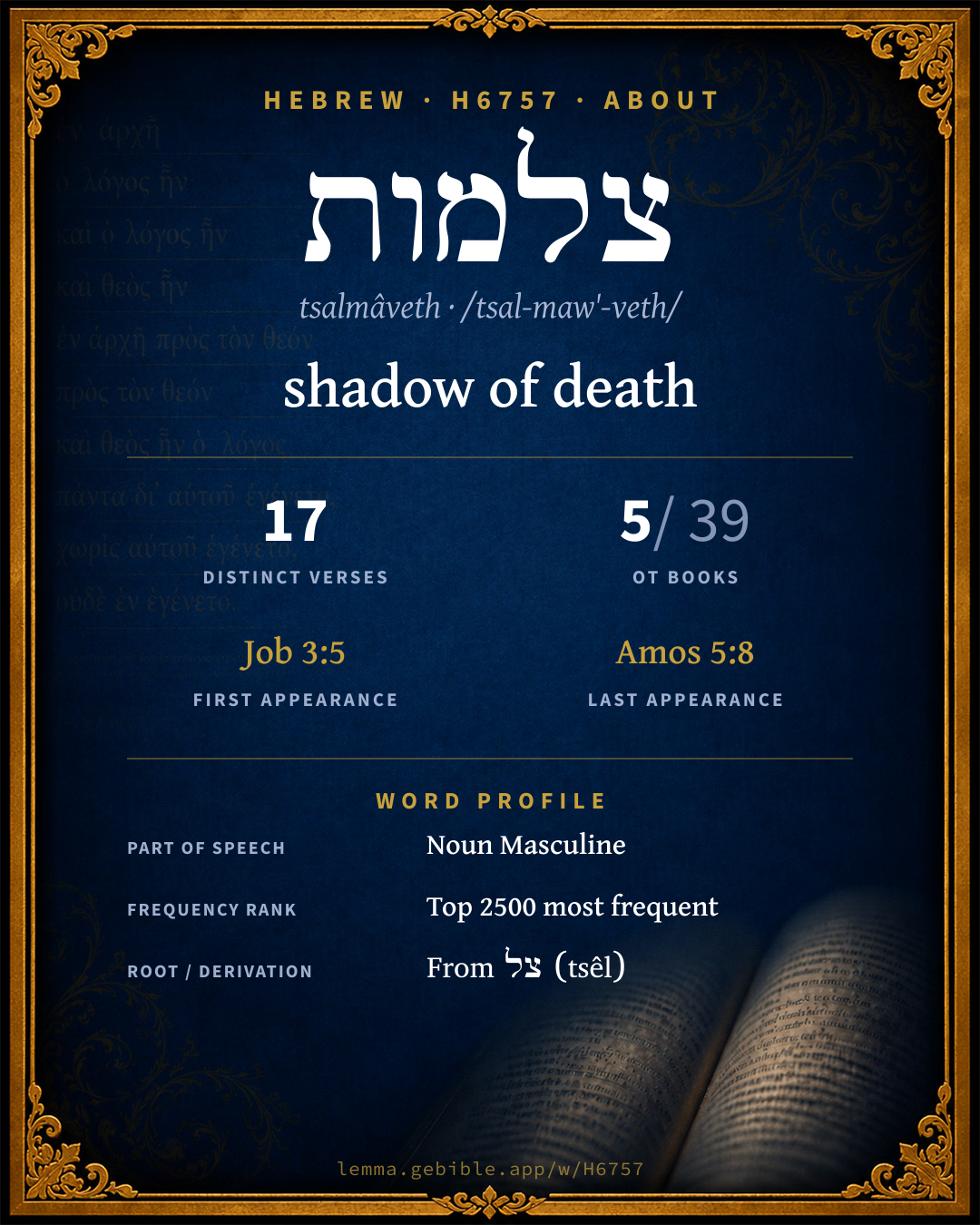
צַלְמָ֫וֶת
shadow of death
also: death-shadow, deep shadow, deep darkness fuller range ↓
Full lexicon entry — Brown-Driver-Briggs (BDB)
From Brown-Driver-Briggs (BDB)
Where this word appears
Grammar key — what these labels mean
Part of speech
- Noun
- A naming word — a person, place, thing, or idea.
Noun type
- Common
- A common noun — a general class of person, place, or thing (“king,” “city,” “water”), not a specific name.
State
- Absolute
- The independent form of a noun, not bound to a following word.
Gender
- Masculine
- Grammatically masculine.
Number
- Singular
- One.
Every verse where H6757 appears — 17 distinct verses across 5 books. Click any verse to open its interlinear word-by-word view. Verse text shown in the World English Bible for context — . Each verse’s Hebrew form is shown with its reference; the English is not keyword-highlighted, since the data carries no word-level English alignment. Use “Compare translations” on any verse to read it across multiple English versions. This concordance covers the Hebrew Bible; Septuagint (Greek Old Testament) occurrences are not indexed here.
Job 9 verses
- Job 3:5 וְ֭/צַלְמָוֶת conj + n c ms Let darkness and the shadow of death claim it for their own. Let a cloud dwell on it. Let all that makes black the day terrify it.
- Job 10:21 וְ/צַלְמָֽוֶת conj + n c ms Before I go where I shall not return from, To the land of darkness and of the shadow of death;
- Job 10:22 צַ֭לְמָוֶת n c ms The land dark as midnight, Of the shadow of death, without any order, Where the light is as midnight.'"
- Job 12:22 צַלְמָֽוֶת n c ms He uncovers deep things out of darkness, And brings out to light the shadow of death.
- Job 16:16 צַלְמָֽוֶת n c ms My face is red with weeping. Deep darkness is on my eyelids.
- Job 24:17 צַלְמָ֑וֶת צַלְמָֽוֶת n c ms n c ms For the morning is to all of them like thick darkness, For they know the terrors of the thick darkness.
- Job 28:3 וְ/צַלְמָֽוֶת conj + n c ms Man sets an end to darkness, And searches out, to the furthest bound, The stones of obscurity and of thick darkness.
- Job 34:22 צַלְמָ֑וֶת n c ms There is no darkness, nor thick gloom, Where the workers of iniquity may hide themselves.
- Job 38:17 צַלְמָ֣וֶת n c ms Have the gates of death been revealed to you? Or have you seen the gates of the shadow of death?
Psalms 4 verses
- Psalms 23:4 צַלְמָ֡וֶת n c ms Even though I walk through the valley of the shadow of death, I will fear no evil, for you are with me. Your rod and your staff, they comfort me.
- Psalms 44:19 בְ/צַלְמָֽוֶת prep + n c ms Though you have crushed us in the haunt of jackals, And covered us with the shadow of death.
- Psalms 107:10 וְ/צַלְמָ֑וֶת conj + n c ms Some sat in darkness and in the shadow of death, Being bound in affliction and iron,
- Psalms 107:14 וְ/צַלְמָ֑וֶת conj + n c ms He brought them out of darkness and the shadow of death, And broke their bonds in sunder.
Isaiah 1 verse
Jeremiah 2 verses
- Jeremiah 2:6 וְ/צַלְמָ֔וֶת conj + n c ms Neither said they, Where is Yahweh who brought us up out of the land of Egypt, who led us through the wilderness, through a land of deserts and of pits, through a land of drought and of the shadow of death, through a land that none passed through, and where no man lived?
- Jeremiah 13:16 לְ/צַלְמָ֔וֶת prep + n c ms Give glory to Yahweh your God, before he cause darkness, and before your feet stumble on the dark mountains, and, while you look for light, he turn it into the shadow of death, and make it gross darkness.
Amos 1 verse
About this entry
At a glance — auto-summarized from this page’s data, not written by a person. Every figure links to its source below. This summary describes the numbers; it doesn’t interpret them.
צלמות — transliterated tsalmâveth — is a Hebrew noun carrying the sense “shadow of death.” Its uses cluster heavily in Job (53% of all occurrences). With 17 verses in 5 books, it is an uncommon word in the Hebrew Bible. It also covers “death-shadow”, “deep shadow”, and “deep darkness”, alongside “shadow of death” — see its full sense range. Translators differ — “shadow of death” in the King James Version, then “deep darkness” (unfoldingWord Literal Text), as the renderings breakdown shows. See the sense tree, 17-verse concordance, and the renderings breakdown below.
Gloss history
Strong's 1890 vs modern scholarship
About this word
Strong's H6757 catalogs a Hebrew word from the Hebrew Old Testament.
These counts are not copied from any lexicon or concordance. They are computed here, from the morphology-tagged Hebrew Old Testament. What Lemma adds →
- 17
- distinct verses
- The word appears in 17 distinct verses.
- 5 / 39
- OT books
- The word appears in 5 of 39 Old Testament books.
- #1,612
- by frequency
- Top 2500 most frequent Hebrew words (rank 1,612 of 8,640 Hebrew words by occurrence).
View all 17 occurrences in the concordance →
By section of the Old Testament
By traditional corpus
Conventional, traditional groupings — biblical authorship is debated, so this is a traditional corpus grouping, not an authorship claim. Each share is this word’s portion of its verses in that division of the Hebrew canon. Each figure is a share of the word’s 17 distinct verses.
- Writings (Ketuvim) 13 verses · 76%
- Prophets (Nevi'im) 4 verses · 24%
How translations render this word
Counts come from each version’s own published word-to-Strong’s tagging or interlinear alignment — an approximate guide to how each version renders this word, not a word-level alignment the data otherwise carries. Because each total is that version’s own tagged count, the per-version totals vary from one another and need not match the appearance or distinct-verse counts above. These counts may also differ from a printed concordance because Lemma counts each distinctly tagged rendering and does not collapse phrase taggings into a single head-word total. This is a fixed set of word-tagged versions (KJV, ASV, BSB, ULT) and does not change with the reading translation you choose elsewhere. Each version’s license is shown beside its name below (and on Sources).
BDB lists this Strong’s number as 2 distinct words (homographs). Each count above pools all of them and is not split by sense — see the Senses section below. A low-frequency rendering may belong to a different one of those words, not the primary meaning.
- King James Version†: Shadow of death 16×
- American Standard Version†: Shadow of death 12×, Thick darkness 3×
- Berean Standard Bible†: Shadow of death 5×, Darkness 3×, Deep shadow 2×
- unfoldingWord Literal Text†: Deep darkness 7×, Dark shadow 4×, Gloom 2×
King James Version Public Domain
Renders H6757 across 18† tagged occurrences — most commonly:
Plus 2 renderings that appear only once — usually multi-word phrases or single function words the recovered tagging swept in, not distinct renderings.
American Standard Version Public Domain
Renders H6757 across 18† tagged occurrences — most commonly:
Plus 3 renderings that appear only once — usually multi-word phrases or single function words the recovered tagging swept in, not distinct renderings.
Berean Standard Bible Public Domain
Renders H6757 across 17† tagged occurrences — most commonly:
Plus 3 renderings that appear only once — usually multi-word phrases or single function words the recovered tagging swept in, not distinct renderings. Not rendered by a distinct English word in 1 further occurrence.
unfoldingWord Literal Text CC BY-SA 4.0
Renders H6757 across 20† tagged occurrences — most commonly:
Plus 3 renderings that appear only once — usually multi-word phrases or single function words the recovered tagging swept in, not distinct renderings.
Senses in the full BDB
What do BDB’s symbols mean?
BDB uses these scholarly abbreviations:
| Symbol | Meaning |
|---|---|
| 𝔊 | the Septuagint (the ancient Greek translation, LXX) |
| 𝔙 | the Vulgate (the Latin translation) |
| 𝔖 | the Syriac version (the Peshitta) |
| 𝔗 | the Targum (the Aramaic translation) |
| ψ | the Psalms |
| √ | root (the underlying root or stem) |
| ‖ | parallel passage (a synonymous or contrasted parallel) |
| † | the dagger: every passage where the word occurs is cited |
The 5 senses and sub-senses the full Brown-Driver-Briggs lexicon distinguishes for this word, in lexicon order (not ranked by frequency), with BDB’s own verbatim wording and sub-sense lettering. Shown in Hebrew script with BDB’s own scholarly abbreviations. The condensed entry is in the Lexicon Entry tab. See also the Forms in the corpus table below.
- 1. = deep shadow, darkness (cf. הַרְרֵי אֵל, אַרְזֵי אֵל): Am 5:8; Jb 3:5; 12:22; 24:17a; 28:3; 34:22; of eyes heavy with weeping 16:16; בַּלְהוֹת צ׳ 24:17b terrors of the darkness. e.g. Amos 5:8
- 2. fig.
- a. of distress Je 13:16 ψ 107:10, 14; אֶרֶץ צ׳ Is 9:1. e.g. Jeremiah 13:16
- b. of extreme danger Je 2:6 ψ 23:4; 44:20. e.g. Jeremiah 2:6
- 3. characterizing world of the dead, אֶרֶץ חֹשֶׁךְ וצ׳ Jb 10:21, כְּמוֹ אֹפֶל צ׳ v 22 (text dub., v. Bu Du); וְשַׁעֲרֵי צ׳ 38:17 (𝔊 πυλωροὶ δὲ ᾅδου; ‖ שַׁעֲרֵי־מָ֑וֶת). e.g. Job 10:21
Senses from the full Brown-Driver-Briggs lexicon (Brown, Driver, Briggs; Oxford 1906 — public domain), digitized via Sefaria, supplemented by the OpenScriptures HebrewLexicon (CC BY 4.0). Full attribution on Sources.
Word origin
n.[m.] death-shadow, deep shadow, poet. (prob. = צֵל + מָוֶת, 𝔊 (usually) σκιὰ θανάτου, cf. 𝔖 𝔙, so Thes SchwallyLeben n. d. Tode, 194, v. especially NöZAW xvii (1897), 183 ff.; Ew Br and most mod. (after older comm.) read צַלְמוּת darkness, deep darkness, cp. Arabic ظَلَمَ iv, Assyrian [ṣalâmu], Ethiopic ጸልመ be black, dark);—death-shadow, cf. ظُلْمَةٌ 6, often ‖ חֹשֶׁךְ, לַיְלָה, etc., and opp. בֹּקֶר, אוֹר.
— Brown-Driver-Briggs (Oxford 1906, public domain), digitized via Sefaria, supplemented by the OpenScriptures HebrewLexicon (CC BY 4.0). See Sources.
Derived from צל (tsêl) (H6738) — shadow.
Jastrow Dictionary
A second Hebrew/Aramaic lexicon for comparison, covering Aramaic and post-biblical (Talmudic, Targumic, Midrashic) usage that the biblical-Hebrew BDB does not. Matched by lemma rather than by Strong’s number, so a lemma may carry more than one Jastrow headword (shown separately below), and the entries cover usage well beyond the Bible.
צַלְמָוֶת
- (b. h.) = צַלְמוּת, darkness; (homilet. = צֵל מָוֶת) shadow of death, Gehenna. Mekh. B’shall., Vayassʿa, s. 1 (ref. to Jer. II, 6) צֵל ועמו מָוֶת shadow and with it death (v. עֶכֶס); Tanḥ. ib. 18; Yalk. Jer. 266. Pesik. R. s. 23; Yalk. Job 906 (ref. to Job X, 22) מהו צ׳ צא למות וכ׳ what is tsalmaveth? (The angel Dumah says, when the Sabbath ends, to those relieved from Gehenna during the Sabbath,) Go out unto death, for the Sabbath exercises (v. סֵדֶר) are over. Ber. 15ᵇ (ref. to Ps. LXVIII, 15) א"ת בצלמון אלא בצ׳ read not b’tsalmon, but b’tsalmaveth (in Gehenna). Tanḥ. R’eh 13 (ref. to Ps. l. c.) הוא צ׳ שלהן the snow is their hell; (Tanḥ. ed. Bub. ib. 10 צַלְמוֹנָא; Pesik. ‘Asser, p. 97ᵇ צַלְמוֹנָה; Midr. Prov. to ch. XXXI, 21 צלמונה; Yalk. Deut. 892 צלמונ׳). Midr. Till. to Ps. XCII זימן … אחת של אופל ואחת של צ׳ the Lord prepared for Adam two stones, one from Ofel (darkness) and one from Tsalmaveth (ref. to Job XXVIII, 3); a. e. e.g. Jeremiah 2:6
A Dictionary of the Targumim, the Talmud Babli and Yerushalmi, and the Midrashic Literature (Marcus Jastrow; London, Luzac, 1903) — Public Domain. Digitized via Sefaria. Digitized via Sefaria. Full attribution on Sources.
Forms in the corpus
The 12 distinct written forms H6757 takes in the Hebrew Bible, most frequent first — each parse links to that state’s occurrences in the concordance. Hebrew forms include their vowel points and cantillation, so a single lemma takes many written forms.
| Form | Parsing | Example | Uses |
|---|---|---|---|
| צַלְמָֽוֶת | Noun, Common, Masculine, Singular, Absolute | Job 12:22 | 3 |
| וְ/צַלְמָ֑וֶת | Noun, Common, Masculine, Singular, Absolute | Psalms 107:10 | 2 |
| וְ/צַלְמָֽוֶת | Noun, Common, Masculine, Singular, Absolute | Job 10:21 | 2 |
| צַלְמָ֑וֶת | Noun, Common, Masculine, Singular, Absolute | Job 24:17 | 2 |
| צַלְמָ֔וֶת | Noun, Common, Masculine, Singular, Absolute | Amos 5:8 | 2 |
| בְ/צַלְמָֽוֶת | Noun, Common, Masculine, Singular, Absolute | Psalms 44:19 | 1 |
| וְ/צַלְמָ֔וֶת | Noun, Common, Masculine, Singular, Absolute | Jeremiah 2:6 | 1 |
| וְ֭/צַלְמָוֶת | Noun, Common, Masculine, Singular, Absolute | Job 3:5 | 1 |
| לְ/צַלְמָ֔וֶת | Noun, Common, Masculine, Singular, Absolute | Jeremiah 13:16 | 1 |
| צַ֭לְמָוֶת | Noun, Common, Masculine, Singular, Absolute | Job 10:22 | 1 |
| צַלְמָ֡וֶת | Noun, Common, Masculine, Singular, Absolute | Psalms 23:4 | 1 |
| צַלְמָ֣וֶת | Noun, Common, Masculine, Singular, Absolute | Job 38:17 | 1 |
Same root — word family
Other BDB entries built from the same root as H6757, grouped by Strong’s listed origin. These share a root / origin per the lexicon — not necessarily a shared meaning. Each links to that word’s own entry.
Derives from
Proper names from this root
People and places named from this root — a name, not an additional meaning of the word.
- בצלאל Bᵉtsalʼêl H1212 Bezaleel
- צלה Tsillâh H6741 Zillah
- צלמנע Tsalmunnâʻ H6759 Zalmunna
- צלצח Tseltsach H6766 Zelzah
- צלתי Tsillᵉthay H6769 Zilthai
- צלמנה Tsalmônâh H6758 Zalmonah
Compare all same-root words → Showing 4 of 8 — not the complete family. 6 of the same-root words are proper names (people or places). They share a root, not necessarily a meaning.
Septuagint verse parallels
This word appears in 16 verses that also exist in the Greek Old Testament (Septuagint), out of the 17 Hebrew verses it occurs in. You can read those verses in Greek by switching the Old Testament edition to the Septuagint.
Read these verses in the Septuagint
This is a verse-level parallel only — the same verses exist in both the Hebrew and Greek Old Testaments. No word-level Hebrew↔Greek correspondence is claimed: the data carries no such alignment, so no Greek word is shown as this Hebrew word’s translation. Coverage is not total — the Septuagint omits the deuterocanon and renumbers the Psalms, so some Hebrew verses have no direct Greek parallel.