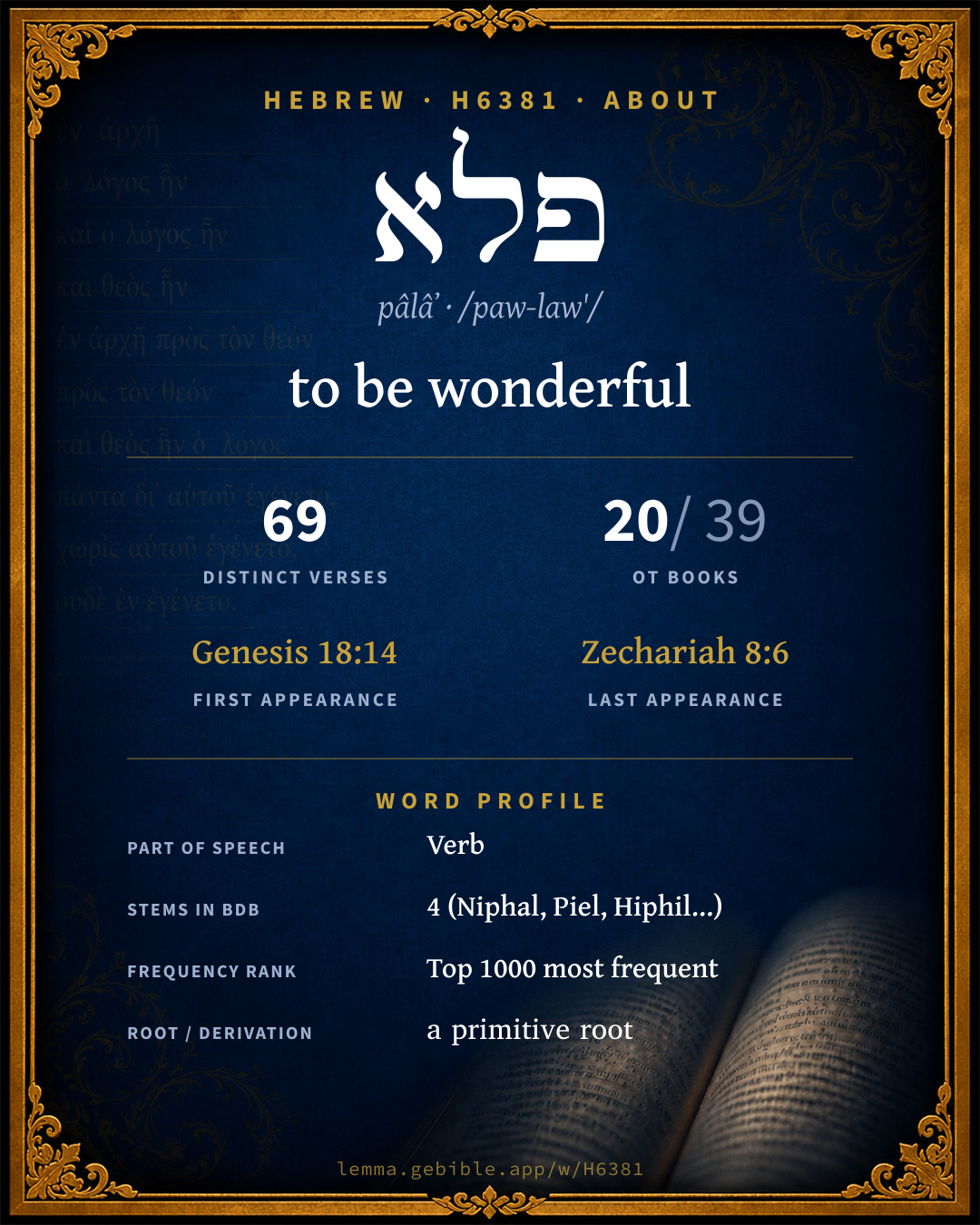
פָּלָא
to be wonderful
‘to be wonderful’ is one of 3 main senses fuller range ↓
Full lexicon entry — Brown-Driver-Briggs (BDB)
From Brown-Driver-Briggs (BDB)
Where this word appears
Grammar key — what these labels mean
Part of speech
- Verb
- An action or state-of-being word.
Stem
- Niphal
- Usually the simple passive or reflexive of the Qal (“he was written”). Here: ‘be beyond one's power’
- Piel
- An intensive or resultative active stem.
- Hiphil
- The causative active stem (“he caused / brought about”). Here: ‘do a hard or difficult thing’
- Hithpael
- The reflexive or reciprocal stem (the subject acts on itself).
Form
- Participle Active
- A verbal adjective expressing ongoing or characteristic action (“writing / one who writes”).
- Imperfect
- An incomplete, ongoing, or future action (“he will / would write”).
- Infinitive Construct
- A bound verbal noun, frequently with prepositions (“to write / in writing”).
- Perfect
- A completed action or state — Hebrew marks aspect (completeness) more than strict tense (“he wrote”).
- Sequential Imperfect
- An imperfect with prefixed waw — the standard past-narrative form (waw-consecutive imperfect).
- Infinitive Absolute
- An unbound verbal noun, often intensifying or standing in for a finite verb.
- Sequential Perfect
- A perfect with prefixed waw continuing a preceding imperfect or command (waw-consecutive perfect).
State
- Absolute
- The independent form of a noun, not bound to a following word.
- Construct
- A noun bound to a following noun in a possessive / “of” relationship (the construct chain).
Person
- 3rd Person
- The one spoken about (“he / she / it / they”).
- 2nd Person
- The one addressed (“you”).
Gender
- Feminine
- Grammatically feminine.
- Masculine
- Grammatically masculine.
- Common
- Either gender — not distinguished for this form.
Number
- Plural
- More than one (in Hebrew, generally three or more).
- Singular
- One.
Every verse where H6381 appears in the Book of Exodus — 2 distinct verses. Click any verse to open its interlinear word-by-word view. Verse text shown in the World English Bible for context — . Each verse’s Hebrew form is shown with its reference; the English is not keyword-highlighted, since the data carries no word-level English alignment. Use “Compare translations” on any verse to read it across multiple English versions. This concordance covers the Hebrew Bible; Septuagint (Greek Old Testament) occurrences are not indexed here.
Exodus
- Exodus 3:20 נִפְלְאֹתַ֔/י Niphal ptcp.act fp cs + sfx pers 1cs I will put forth my hand and strike Egypt with all my wonders which I will do in the midst of it, and after that he will let you go.
- Exodus 34:10 נִפְלָאֹ֔ת Niphal ptcp.act fp He said, "Behold, I make a covenant: before all your people I will do marvels, such as have not been worked in all the earth, nor in any nation; and all the people among which you are shall see the work of Yahweh; for it is an awesome thing that I do with you.
About this entry
At a glance — auto-summarized from this page’s data, not written by a person. Every figure links to its source below. This summary describes the numbers; it doesn’t interpret them.
“to be wonderful” is the headline sense of the Hebrew verb פלא (pâlâʼ). Different stems carry different senses — BDB groups them under 4 stems, among them Niphal and Piel. It appears 69 verses across 20 books of the Hebrew Bible, among its moderately common vocabulary. More than a third of its appearances fall in Psalms. First canonically at Genesis 18:14, it enters the text early. See the sense tree, 69-verse concordance, and the renderings breakdown below.
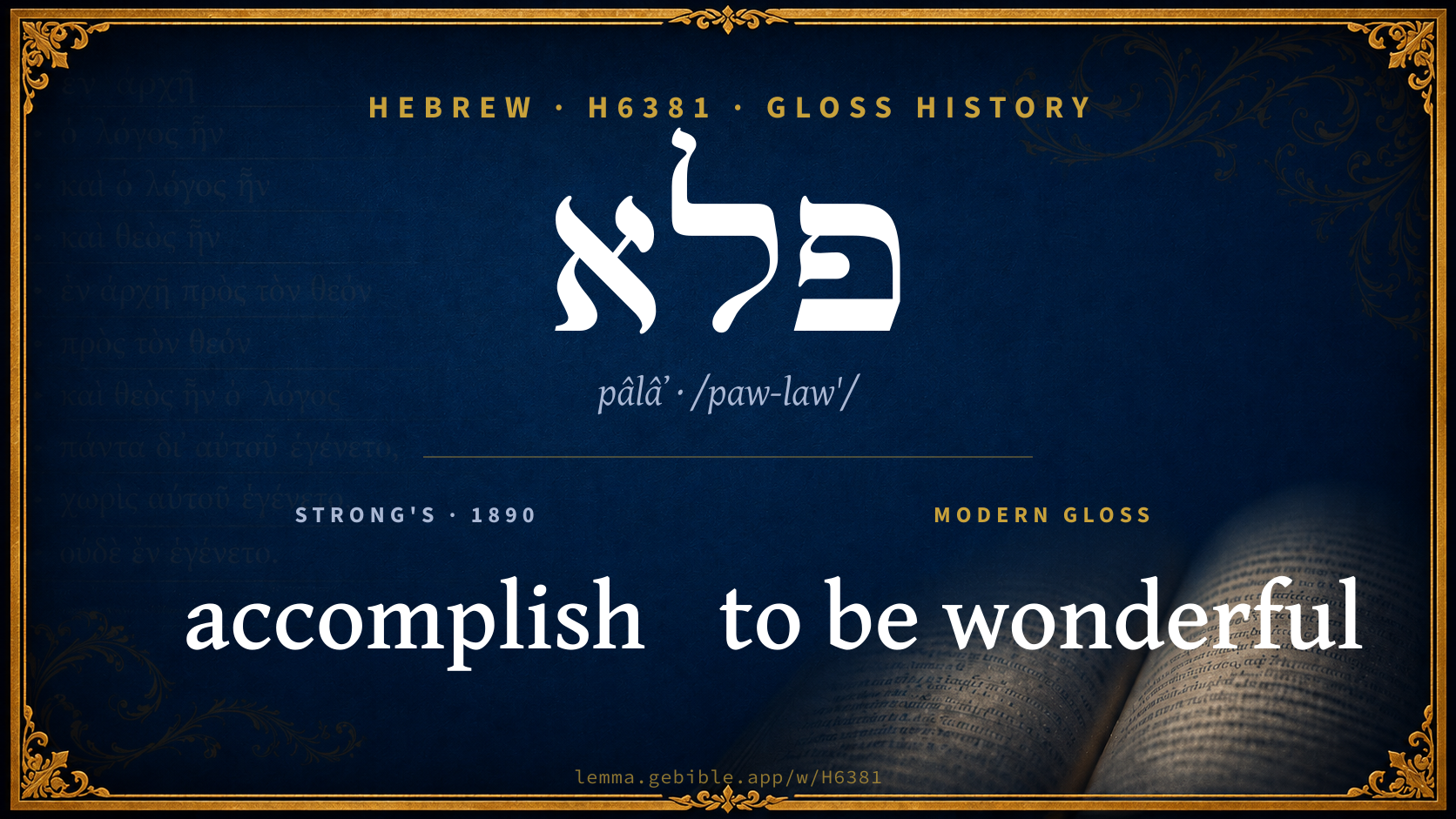
Gloss history
Strong's 1890 vs modern scholarship
About this word
Strong's H6381 catalogs a Hebrew word from the Hebrew Old Testament.
These counts are not copied from any lexicon or concordance. They are computed here, from the morphology-tagged Hebrew Old Testament. What Lemma adds →
- 69
- distinct verses
- The word appears in 69 distinct verses.
- 20 / 39
- OT books
- The word appears in 20 of 39 Old Testament books.
- #558
- by frequency
- Top 1000 most frequent Hebrew words (rank 558 of 8,640 Hebrew words by occurrence).
View all 69 occurrences in the concordance →
By section of the Old Testament
By traditional corpus
Conventional, traditional groupings — biblical authorship is debated, so this is a traditional corpus grouping, not an authorship claim. Each share is this word’s portion of its verses in that division of the Hebrew canon. Each figure is a share of the word’s 69 distinct verses.
- Writings (Ketuvim) 45 verses · 65%
- Prophets (Nevi'im) 13 verses · 19%
- Torah (Pentateuch) 11 verses · 16%
How translations render this word
Counts come from each version’s own published word-to-Strong’s tagging or interlinear alignment — an approximate guide to how each version renders this word, not a word-level alignment the data otherwise carries. Because each total is that version’s own tagged count, the per-version totals vary from one another and need not match the appearance or distinct-verse counts above. These counts may also differ from a printed concordance because Lemma counts each distinctly tagged rendering and does not collapse phrase taggings into a single head-word total. This is a fixed set of word-tagged versions (KJV, ASV, BSB, ULT) and does not change with the reading translation you choose elsewhere. Each version’s license is shown beside its name below (and on Sources).
- King James Version: Wonders 7×, Wonderful works 6×, Wondrous works 5×
- American Standard Version: Wonderful works 5×, Wonders 5×, Wondrous works 5×
- Berean Standard Bible: Wonders 30×, Too difficult 3×, Fulfill 2×
- unfoldingWord Literal Text: Wonders 16×, Amazing deeds 4×, Marvelous 4×
King James Version Public Domain
Renders H6381 across 73 tagged occurrences — most commonly:
Plus 34 renderings that appear only once — usually multi-word phrases or single function words the recovered tagging swept in, not distinct renderings.
American Standard Version Public Domain
Renders H6381 across 71 tagged occurrences — most commonly:
Plus 33 renderings that appear only once — usually multi-word phrases or single function words the recovered tagging swept in, not distinct renderings.
Berean Standard Bible Public Domain
Renders H6381 across 70 tagged occurrences — most commonly:
Plus 23 renderings that appear only once — usually multi-word phrases or single function words the recovered tagging swept in, not distinct renderings. Not rendered by a distinct English word in 1 further occurrence.
unfoldingWord Literal Text CC BY-SA 4.0
Renders H6381 across 76 tagged occurrences — most commonly:
Plus 30 renderings that appear only once — usually multi-word phrases or single function words the recovered tagging swept in, not distinct renderings.
10 senses and sub-senses in the full BDB
Hebrew verbs can shift meaning by stem (binyan): Qal is the basic action, Niphal is often passive or reflexive, Piel often intensifies or makes it factitive, and Hiphil is typically causative. The senses below are grouped under the stem BDB assigns to each. This entry also uses Hithpael (reflexive or reciprocal).
What do BDB’s symbols mean?
BDB uses these scholarly abbreviations:
| Symbol | Meaning |
|---|---|
| 𝔊 | the Septuagint (the ancient Greek translation, LXX) |
| 𝔙 | the Vulgate (the Latin translation) |
| 𝔖 | the Syriac version (the Peshitta) |
| 𝔗 | the Targum (the Aramaic translation) |
| ψ | the Psalms |
| √ | root (the underlying root or stem) |
| ‖ | parallel passage (a synonymous or contrasted parallel) |
| † | the dagger: every passage where the word occurs is cited |
The 10 senses and sub-senses the full Brown-Driver-Briggs lexicon distinguishes for this word, in lexicon order (not ranked by frequency), with BDB’s own verbatim wording and sub-sense lettering. Shown in Hebrew script with BDB’s own scholarly abbreviations. The condensed entry is in the Lexicon Entry tab. See also the Forms in the corpus table below.
Niphal
- 1. be beyond one's power, difficult to do
- 2. be difficult to understand
- 3.
- a. be extraordinary, wonderful
- b. as subst., marvellous things
- 4. = wonderful acts of י׳ in judgement and redemption
Piel
- . make a special votive offering
Hiphil
- 1. do a hard or difficult thing
- 2. make wonderful, do wondrously
- 3. of God working wonders in doing
Hithpael
- . thou dost shew thyself marvellous (act inexplicably) against me
Senses from the full Brown-Driver-Briggs lexicon (Brown, Driver, Briggs; Oxford 1906 — public domain), digitized via Sefaria, supplemented by the OpenScriptures HebrewLexicon (CC BY 4.0). Full attribution on Sources.
Word origin
[ פָּלָא ] 71 vb. denom. Niph. etc., be surpassing, extraordinary
— Brown-Driver-Briggs (Oxford 1906, public domain), digitized via Sefaria, supplemented by the OpenScriptures HebrewLexicon (CC BY 4.0). See Sources.
Origin: a primitive root
Jastrow Dictionary
A second Hebrew/Aramaic lexicon for comparison, covering Aramaic and post-biblical (Talmudic, Targumic, Midrashic) usage that the biblical-Hebrew BDB does not. Matched by lemma rather than by Strong’s number, so a lemma may carry more than one Jastrow headword (shown separately below), and the entries cover usage well beyond the Bible.
פָּלָא
- , v. פלי
פֶּלֶא
- preced.) strange thing, wonder, miracle. Mekh. B’shall., Shir., s. 8 (ref. to Ex. XV, 11) עשה עמנו פ׳ וכ׳ he has done wonders for us, and he will do &c.; a. e.—Pl. פְּלָאִים, פְּלָאִין, פְּלָאוֹת. Midr. Till. to Ps. CVI, beg. (ref. to Ps. CXXXVI, 4; 13; 25) מה הפרנסה … בלא ניסין ובלא פ׳ as the world cannot exist without sustenance (which the Lord provides), so it cannot exist without (daily) signs and wonders. Ib. ואינו יודע כמה פ׳ עשה וכ׳ ed. Bub. (ed. מה פלאי, corr. acc.) and man knows not how many miraculous salvations the Lord works for him. Gen. R. s. 20 (ref. to Ps. CXXXVI, 24 sq.) מה גאולה פ׳ אף פרנסה פ׳ as the redemption was miraculous, so man’s sustenance is miraculous. Ex. R. s. 12, end (expl. אפילת, Ex. IX, 32) פ׳ עשה הק"בה בהם the Lord showed wonders by them. Snh. 109ᵇ (play on פלת, Num. XVI, 1) שנעשו לו פ׳ wonderful things (delivery from destruction with Korah) happened to him (On); Num. R. s. 18; (Tanḥ. Kor. 10 נפלאות). Midr. Till. To Ps. CXIX, 18 פ׳ היא התורה the Law is full of strange (obscure) things. Ib. 129; a. fr.—[Yalk. Gen. 47 ומקרע בפלאות, read: בכִילָאוֹת, v. כִּילָה.] e.g. Exodus 15:11
פֶּלֶא ²
- —Pl. פִּלְאִין, פְּלָאִין. Targ. Y. Ex. VIII, 18. Targ. Y. II ib. XV, 18.
פלי
- (b. h.) to split, separate; to remove; to search; v. פֶּלֶא, פְּלִיאָה.
- to be remote, hidden, obscure. Midr. Till. to Ps. CXIX, 18 א־נה נִפְלֵאת וכ׳ it (the Law) is not hidden, as it is said (Deut. XXX, 11) &c.; לא נִפְלֵאת אלא ממך וכ׳ it is hidden from thee only (through thy own fault), who didst not take pains to study it. V. נִפְלָא III e.g. Deuteronomy 30:11
- (cmp. פרֹש)
- 1. to distinguish, speak distinctly, clearly; esp. (sub. נֶדֶר) to utter a distinct vow (with ref. to Num. VI, 2). Naz. 62ᵃ; Num. R. s. 10 יודע להַפְלוֹת, לַפְלוֹת (from פָּלָה) who knows how to express a vow (is conscious of its bearings); Sifré Num. 22. e.g. Numbers 6:2
- 2. (denom. of פֶּלֶא) to do strange, wonderful things. Ber. 60ᵇ מַפְלִיא לעשות who does wonderful things.—[Tosef. Ab. Zar. III (IV), 19 מפליא ויצא ed. Zuck., missing in ed., a corrupt gloss for מפליא ליצנותא, v. לֵיצָנוּתָא.]
- 3. to search, question. Midr. Till. to Ps. III ואין מי שיַפְלִיא אחריהן and none questions the correctness of their decision; Yalk. Sam. 151.
- 4. to be too difficult to decide. Num. R. s. 21 וה׳ ממנו and he (Moses) could not decide it. Ib. שה׳ מן משה שיש צדיקים וכ׳ Moses was unable to decide, because many a righteous man prides himself …, and the Lord weakens his power (as a punishment).—Part. pass. מוּפְלָא q. v.
- to search, v. next w.
פְּלֵי
- (v. preced. wds.) to split, cut open. B. Bath. 160ᵇ; 164ᵇ פּלְיֵיה וחזייה he ripped open the tied-up document and saw it (that the signature was in the folds). Ḥull. 11ᵃ דילמא דפ׳ ליה וכ׳ may it not be that he (the priest) opened the skull and examined it? Yoma 87ᵃ הוה יתיב וקא פָלֵי רישא was sitting and chopping (an animal’s) head. Snh. 108ᵇ קא פָאלֵי וכ׳ was opening pomegranates; a. e.
- 1. to search (garments). Y. M. Kat. III, 82ᵃ top מְפַלֵּא מאנוי searching his garments.
- 2. to search after, glean; to remove. Targ. O. Deut. XXIV, 20 (h. text תפאר). Ib. XXVI, 13 (h. text בערתי). Targ. I Kings XVI, 3. Targ. Zeph. III, 15 (h. text פנה); a. fr.—[Targ. I Sam. II, 25, v. infra.]
- 1. to do strange, wonderful things; to go to the extreme of. Targ. Is. IX, 5 מַפְלֵי ed. Lag. (ed. Wil. מַפְלְיָא; oth. ed. מַפְלִיא Hebraism).—Ab. Zar. 44ᵃ מַפְלְיָא, v. לֵיצָנוּתָא.
- 2. to decide, arbitrate. Targ. I Sam. II, 25 (Bxt. וִיפַלֵּי, Pa.; h. text פלל).
- 3. (with ב; cmp. Is. XXIX, 14) to mystify, perplex, outwit, fool. Lam. R. to I, 1 רבתי (חד מאת׳ 8) חד … והוה מַפְלֵי … סגי an Athenian used to come to Jerusalem and outwit the Jerusalemites frequently. Ib. מכאן ולהבא לא תַפְלֵי וכ׳ henceforth thou shalt not again attempt to outwit &c. Gen. R. s. 42, v. מְרֵי. Gen. R. s. 91 למה אַפְלְיַית בי why didst thou mystify (deceive) me?; לא אַפְלְיִית בך I did not deceive thee; Koh. R. to VII, 11 אַפְלְיַת, אַפְלִית; Y. Naz. V, end, 54ᵇ אַפְלֵיתָה, אַפְלֵיתִי; Y. Ber. VII, 11ᵇ bot.; Yalk. Gen. 148. Ib. 62 מה את מַפְלֵי בי (Gen. R. s. 38 מה את מַפְלֶה בי) why wilt thou fool me? Y. Shebi. IX, 38ᵈ, v. לֵי; a. e. e.g. Isaiah 29:14
A Dictionary of the Targumim, the Talmud Babli and Yerushalmi, and the Midrashic Literature (Marcus Jastrow; London, Luzac, 1903) — Public Domain. Digitized via Sefaria. Digitized via Sefaria. Full attribution on Sources.
Forms in the corpus
The 52 distinct written forms H6381 takes in the Hebrew Bible, most frequent first — each parse links to that stem’s occurrences in the concordance. Hebrew forms include their vowel points and cantillation, so a single lemma takes many written forms.
Same root — word family
Other BDB entries built from the same root as H6381, grouped by Strong’s listed origin. These share a root / origin per the lexicon — not necessarily a shared meaning. Each links to that word’s own entry.
Derived from this word
Proper names from this root
People and places named from this root — a name, not an additional meaning of the word.
Compare all same-root words → Showing 4 of 5 — not the complete family. 1 of the same-root words is a proper name (a person or place). They share a root, not necessarily a meaning.
Septuagint verse parallels
This word appears in 57 verses that also exist in the Greek Old Testament (Septuagint), out of the 69 Hebrew verses it occurs in. You can read those verses in Greek by switching the Old Testament edition to the Septuagint.
Read these verses in the Septuagint
- Genesis 18:14
- Exodus 3:20
- Leviticus 22:21
- Numbers 6:2
- Deuteronomy 17:8
- Joshua 3:5
- Judges 6:13
- 2 Samuel 1:26
- 1 Chronicles 16:9
- 2 Chronicles 2:9
- Job 5:9
- Psalms 9:1
This is a verse-level parallel only — the same verses exist in both the Hebrew and Greek Old Testaments. No word-level Hebrew↔Greek correspondence is claimed: the data carries no such alignment, so no Greek word is shown as this Hebrew word’s translation. Coverage is not total — the Septuagint omits the deuterocanon and renumbers the Psalms, so some Hebrew verses have no direct Greek parallel.