
Psalms 105:5

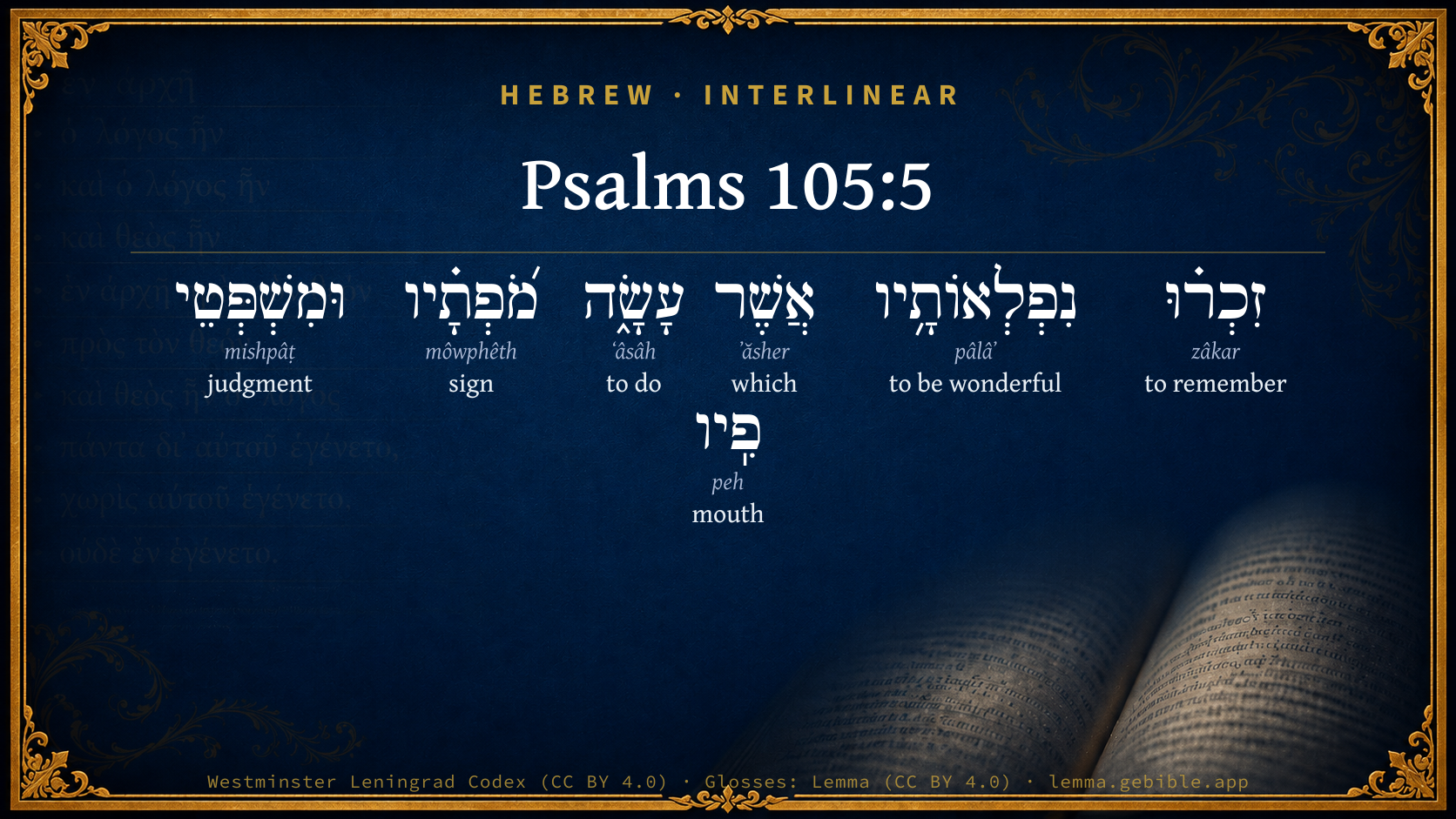
Hebrew (Westminster Leningrad Codex) Psalms 105:5 appears in the Hebrew Old Testament. The text above is from the Westminster Leningrad Codex. Each word links to its Strong’s number, a concise gloss, and parsing drawn from the Open Scriptures Hebrew Bible morphology. Click any word for its full Brown-Driver-Briggs (BDB) entry.
Download image
Cite this verse

Psalms 105:5 (World English Bible). Public Domain. Lemma interlinear Bible study tool, https://lemma.gebible.app/v/psalms/105/5.

Show BibTeX & RIS
BibTeX
RIS
English Translation
Remember his marvelous works that he has done; His wonders, and the judgments of his mouth,
World English Bible · Public Domain
Download a study sheet

One document with this verse’s original text, its word-by-word gloss line, the meaning frame, cross-references with their text, attributed commentary, and full source and license credits — printable, and it pastes into notes with its structure intact.

This verse Autodidact and up

Study sheet (.html) Plain text (.txt)

A passage Seminary Student

Up to 50 verses in one chapter. A passage sheet keeps up to 6 commentary sources and 12 cross-references per verse, in the order this page ranks them, and says so on the sheet whenever that leaves anything out. Ask for a single verse and you get the Autodidact verse sheet above.

Everything on this page stays free to read, with no account — the sheet is a download of what is already on screen, not access to it.

Want to remove ads? Support Godless Engineer
Compare translations 3

The same verse in 3 English versions, stacked beneath the original-language interlinear above. Click any original word for its lexicon entry.

Each is an independent rendering of the whole verse — the interlinear is not word-aligned to these translations.

Highlighted words mark where these versions differ — a whole-verse word diff, not a word-by-word alignment.

  • World English Bible Public Domain
    Remember his marvelous works that he has done; His wonders, and the judgments of his mouth,
  • King James Version Public Domain
    Remember his marvellous works that he hath done; his wonders, and the judgments of his mouth;
  • unfoldingWord Literal Text CC BY-SA 4.0
    Recall the marvelous things that he has done, his miracles and the decrees from his mouth,

unfoldingWord Literal Text — © unfoldingWord, licensed CC BY-SA 4.0. Word-aligned USFM3 via Door43 (git.door43.org/unfoldingWord/en_ult).

Versions to compare (up to 4)

3 of 4 selected

Show all 18 translations

Every available English version of this verse, each an independent rendering of the whole verse.

  • World English Bible Public Domain
    Remember his marvelous works that he has done; His wonders, and the judgments of his mouth,
  • Berean Standard Bible Public Domain
    Remember the wonders He has done, His marvels, and the judgments He has pronounced,
  • Majority Standard Bible Public Domain
    Remember the wonders He has done, His marvels, and the judgments He has pronounced,
  • King James Version Public Domain
    Remember his marvellous works that he hath done; his wonders, and the judgments of his mouth;
  • American Standard Version (1901) Public Domain
    Remember his marvellous works that he hath done, His wonders, and the judgments of his mouth,
  • Revised Version (1885) Public Domain
    Remember his marvelous works that he hath done; his wonders, and the judgments of his mouth;
  • Geneva Bible (1599) Public Domain
    Remember his marueilous woorkes, that he hath done, his wonders and the iudgements of his mouth,
  • Douay-Rheims (1899) Public Domain
    Remember his marvellous works which he hath done; his wonders, and the judgments of his mouth.
  • Young's Literal Translation Public Domain
    Remember His wonders that He did, His signs and the judgments of His mouth.
  • Literal Standard Version CC BY-SA 4.0
    Remember His wonders that He did, || His signs and the judgments of His mouth.
  • Unlocked Literal Bible CC BY-SA 4.0
    Recall the marvelous things he has done, his miracles and the decrees from his mouth,
  • unfoldingWord Literal Text CC BY-SA 4.0
    Recall the marvelous things that he has done, his miracles and the decrees from his mouth,
  • Darby Bible Public Domain
    Remember his wondrous works which he hath done, his miracles and the judgments of his mouth:
  • World Messianic Bible Public Domain
    Remember his marvelous works that he has done: his wonders, and the judgments of his mouth,
  • Webster's Bible Public Domain
    Remember his wonderful works that he hath done; his wonders, and the judgments of his mouth;
  • Free Bible Version CC BY-SA 4.0
    Remember all the wonderful things he's done, the miracles he's performed, and the judgments he's carried out,
  • Bible in Basic English Public Domain
    Keep in mind the great works which he has done; his wonders, and the decisions of his mouth;
  • JPS Tanakh (1917) Public Domain
    Remember His marvellous works that He hath done, His wonders, and the judgments of His mouth;

Literal Standard Version (2020), Covenant Press — licensed CC BY-SA 4.0. Text via the HelloAO Bible API (eBible.org). Unlocked Literal Bible (unfoldingWord) — licensed CC BY-SA 4.0. Text via the HelloAO Bible API (eBible.org). unfoldingWord Literal Text — © unfoldingWord, licensed CC BY-SA 4.0. Word-aligned USFM3 via Door43 (git.door43.org/unfoldingWord/en_ult). Free Bible Version, Dr. Jonathan Gallagher — licensed CC BY-SA 4.0. Text via the HelloAO Bible API (eBible.org).

Word by word

More ways to search: Search by grammar → Find every occurrence → Compare this word →

Practice this passage: Drill this verse → Learn its vocabulary →

About this verse

These counts appear in no published source. They are computed here, from the morphology-tagged text and Lemma’s own curated glosses. What Lemma adds →

7
words
7
distinct lemmas
Wisdom
section

Shared distinctive vocabulary

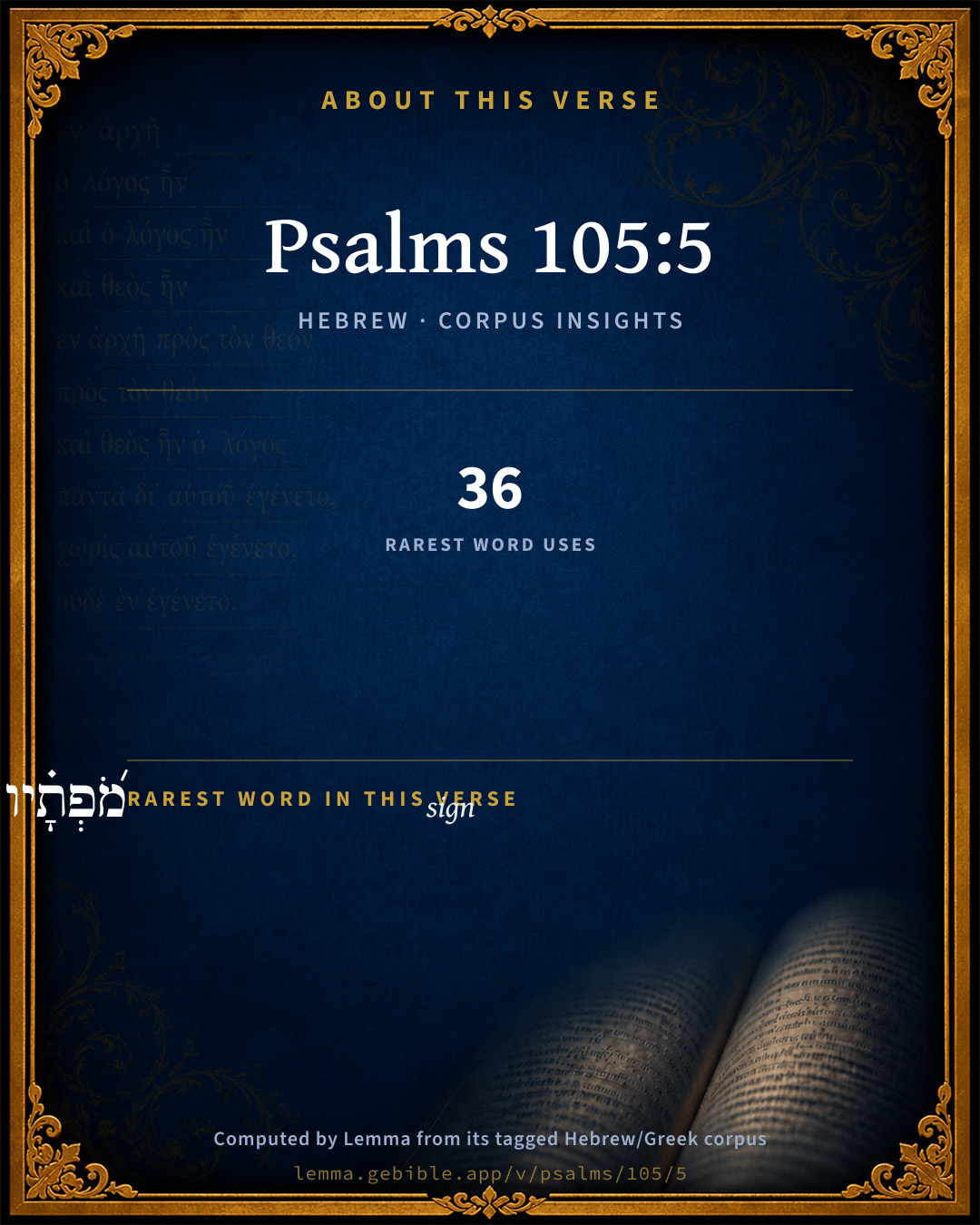
מֹ֝פְתָ֗יו sign H4159 occurs in 35 verses of the Hebrew Bible. Also found in:

Grammatical profile

  • 3 verbs
  • 3 nouns
  • 1 particle

Verb forms

  • זִכְר֗וּ Qal · Imperative
  • נִפְלְאוֹתָ֥יו Niphal · Participle Active
  • עָשָׂ֑ה Qal · Perfect

Hebrew & Septuagint length

In English translation the verse runs 16 words from the Hebrew and 16 from the Septuagint (LXX English) — the same length.

A rough comparison of the two English renderings, which tokenize alike — not a word-level alignment.

Word counts can differ between the Hebrew and the Greek without any difference in meaning — e.g. the Hebrew direct-object marker אֵת has no separate Greek word, and Greek often adds the article ὁ.

Cross-references

12

Topical passages linked to Psalms 105:5 in the Treasury of Scripture Knowledge — connected by theme and wording, ordered by reader-vote popularity; previews shown in the World English Bible.

  • Psalms 77:11 I will remember Yah's deeds; For I will remember your wonders of old.
  • Psalms 119:13 With my lips, I have declared all the ordinances of your mouth.
  • Isaiah 43:18–19 Don't remember the former things, neither consider the things of old.
  • Luke 22:19 He took bread, and when he had given thanks, he broke it, and gave to them, saying, "This is my body which is given for you. Do this in memory of me."
  • Deuteronomy 32:7 Remember the days of old, Consider the years of many generations: Ask your father, and he will show you; Your elders, and they will tell you.
  • Revelation 16:7 I heard the altar saying, "Yes, Lord God, the Almighty, true and righteous are your judgments."
  • Deuteronomy 7:18–19 you shall not be afraid of them: you shall well remember what Yahweh your God did to Pharaoh, and to all Egypt;
  • Deuteronomy 8:2 You shall remember all the way which Yahweh your God has led you these forty years in the wilderness, that he might humble you, to prove you, to know what was in your heart, whether you would keep his commandments, or not.
  • Psalms 40:5 Many, Yahweh, my God, are the wonderful works which you have done, And your thoughts which are toward us. They can't be set in order to you; If I would declare and speak of them, they are more than can be numbered.
  • Psalms 103:2 Praise Yahweh, my soul, And don't forget all his benefits;
  • 1 Corinthians 11:24–26 When he had given thanks, he broke it, and said, "Take, eat. This is my body, which is broken for you. Do this in memory of me."
  • Revelation 19:2 for true and righteous are his judgments. For he has judged the great prostitute, who corrupted the earth with her sexual immorality, and he has avenged the blood of his servants at her hand."

Cross-references courtesy of OpenBible.info (CC BY 4.0).

Hebrew and Greek witnesses Masoretic Hebrew ↔ Greek Septuagint

The same verse in the two great witnesses to the Old Testament, shown verse-for-verse.

You’re reading Greek Psalm 104 (Hebrew Psalm 105). The Septuagint counts the superscription, so verse numbers can differ from the Hebrew — chapter-level alignment, not verse-by-verse. Numbering follows Rahlfs.

These are two independent witnesses, not word-aligned to each other, and the Septuagint is shown in lemma (dictionary) form.

Hebrew Psalms 105:5 Masoretic · Westminster Leningrad Codex

זִכְר֗וּ נִפְלְאוֹתָ֥יו אֲשֶׁר עָשָׂ֑ה מֹ֝פְתָ֗יו וּמִשְׁפְּטֵי פִֽיו

Remember his marvelous works that he has done; His wonders, and the judgments of his mouth,

World English Bible · Public Domain

Greek LXX Greek Psalm 104:5 Septuagint · lemma form

μιμνήσκω ὁ θαυμάσιος αὐτός ὅς ποιέω ὁ τέρας αὐτός καί ὁ κρίμα ὁ στόμα αὐτός

Remember his wonderful works that he has done; his wonders, and the judgments of his mouth;

LXX2012 (modern English Septuagint) · Public Domain

On this verse, The Pulpit Commentary discusses the Septuagint’s reading. Read the note in Commentary ↓

Hebrew: Westminster Leningrad Codex (CC BY 4.0). Greek: Septuagint (public domain); English from LXX2012 (modern English Septuagint) (Public Domain). How the Septuagint differs from the Hebrew →

Commentary

Notes on Psalms 105:5 from classic Christian and Jewish commentators (each source and its license shown beneath its notes). The classic Christian expositions comment on the surrounding passage and are grouped to its opening verse, so a note may address several verses; the Jewish commentaries on the Tanakh (Rashi and others) are per-verse, so they appear only where the commentator wrote on this verse.

Lemma curates 59 commentaries, every one of them public domain or Creative Commons licensed, each selected and text-cleaned for this edition rather than reprinted as found. About our sources →

Trapp's Complete Commentary

John Trapp

Psa 105:5 Remember his marvellous works that he hath done; his wonders, and the judgments of his mouth;

Ver. 5. Remember his marvellous works, &c.] Deeply and diligently ponder both the works and words of God, comparing the one with the other, that ye may the better conceive of both.

John Trapp, A Commentary or Exposition upon All the Books of the Old and New Testament (1647–1656) — public domain. Text from a community e-Sword module.

Joseph Benson's Commentary

Psa 105:5-7. Remember the judgments of his mouth — Either, 1st, The laws delivered from his mouth: Or rather, 2d, The plagues, or punishments, which he brought upon Egypt by his mere word or command. O ye seed of Abraham his servant — Born in his house, his church, and being thereby entitled to the privileges of his servants, you are also bound to do the duty of servants, to consult your master’s honour, obey his commands, and do all that is in your power to advance his interest. Ye children of Jacob his chosen — To whom he restrains the former more general expression, because the posterity of Jacob were the only branch of Abraham’s seed included in the covenant, and entitled to the blessings here mentioned. He is the Lord — Hebrew, Jehovah, our God — A Being self-existent and self- sufficient, having an incontestable sovereignty over us, and unquestionable power to protect and save us. We depend upon him; our expectation is from him; and we ought to be devoted to his service. His judgments are in all the earth — Either, 1st, The fame of his judgments upon the Egyptians is spread over the face of the whole earth: Or, 2d, He executes his judgments upon all nations and people.

Joseph Benson's Commentary on the Old and New Testaments (1811–1818) — public domain. Text from a community e-Sword module.

J. A. Alexander on Psalms

Joseph Addison Alexander

5. (Psa 105:5) Remember his wondrous deeds which he did, his miracles and the judgments of his mouth. They are exhorted not to forget them, as Israel is charged with doing, Psa 78:11. Miracles, prodigies or wonders, proofs of divine power. There is no need of identifying these with the judgmentsof his mouth, which include his laws and the sentences pronounced upon his enemies. The latter is probably the prominent idea, as best suited to this context.

Joseph Addison Alexander, The Psalms Translated and Explained (1850) — public domain. Text from a community e-Sword module.

Geneva Bible (1599)

Geneva Bible translators

Because his power was thereby as lively declared, as if he should have declared it by mouth.

Which he hath wrought in the deliverance of his people.

Geneva Bible (1599) marginal notes — public domain. Text via Bolls.life.

Adam Clarke's Commentary

Verse 5. Remember his marvellous works] Keep up communion with thy Maker, that thou mayest neither forget him nor his works.

The judgments of his mouth] Whatsoever he has spoken concerning good or evil. His commands, promises, threatenings; and particularly what he has foretold, and what he has done.

Adam Clarke's Commentary on the Bible (1810–1826) — public domain. Text from a community e-Sword/MySword module.

The Cambridge Bible for Schools and Colleges

gen. ed. J. J. S. Perowne

5. Remember] Compare the frequent injunctions in Deuteronomy (Deu_7:18; Deu_8:2; &c.). But Israel’s history had been one long record of forgetfulness (Psa_78:11).

his wonders] A word often coupled with ‘signs’ (Psa_105:27; Deu_4:34; &c.) to denote the miracles of the Exodus.

the judgments of his mouth] Not the precepts of the law, but the sentence pronounced and executed upon Pharaoh and the Egyptians (Exo_6:6; Exo_7:4; Exo_12:12).

The Cambridge Bible for Schools and Colleges (gen. ed. J. J. S. Perowne; Cambridge University Press, 1878–1918) — public domain. Text from a community e-Sword module.

John Gill's Exposition

Remember his marvellous works which he hath done,.... Which Aben Ezra interprets of the works of creation; rather they seem to design the works of Providence in favour of the children of Israel: best of all, works of grace done for his saints, none of which are to be forgotten; especially the great work of redemption and salvation, for the remembrance of which, under the New Testament, an ordinance is particularly appointed.

His wonders, and the judgments of his mouth: the above Jewish writer, by "wonders", understands the miracles in Egypt, the plagues inflicted on the Egyptians;

and by the judgments of his mouth, the laws and statutes given at Sinai: each of which were indeed to be remembered: but "his wonders" may take in all the wonderful things done in Egypt and in the wilderness, and in settling the Israelites in the land of Canaan; and "his judgments" may also intend the judgments which he threatened to bring upon the enemies of Israel, and which he did bring upon them as he said. The wonders of his grace, of his law and Gospel, his judgments and his testimonies, are not to be forgotten.

John Gill's Exposition of the Whole Bible (1746–1763) — public domain (CC PDM 1.0). Text via the HelloAO Bible API.

Albert Barnes' Notes on the Bible

Remember his marvelous works ... - The works suited to excite wonder. Call them to remembrance in your psalm; seek the aid of music and song to impress the memory of them deeply on your hearts.

His wonders - His miracles. See Psa 78:43, note; Isa 8:18, note.

And the judgments of his mouth - That is, properly, the judgments which he pronounced on his enemies, and which were followed by their overthrow. The word does not refer here, as it often does, to his statutes or commands.

Albert Barnes' Notes on the Bible (1834–1885) — public domain. Text from a community e-Sword/MySword module.

Matthew Poole's English Annotations

Either,

1. The laws delivered from his mouth. Or rather,

2. The plagues or punishments (as this same word is used here, Psa 105:7, and every where) which he brought upon Egypt by his mere word or command, as is oft noted in the history of them in Exodus.

Matthew Poole's English Annotations on the Holy Bible (1683–1685) — public domain. Text from a community e-Sword/MySword module.

The Treasury of David

Charles H. Spurgeon

Ver. 5. Remember his marvellous works that he hath done. Memory is never better employed than upon such topics. Alas, we are far more ready to recollect foolish and evil things than to retain in our minds the glorious deeds of Jehovah. If we would keep these in remembrance our faith would be stronger, our gratitude warmer, our devotion more fervent, and our love more intense. Shame upon us that we should let slip what it would seem impossible to forget. We ought to need no exhortation to remember such wonders, especially as he has wrought them all on the behalf of his people.

His wonders, and the judgments of his mouth these also should be had in memory. The judgments of his mouth are as memorable as the marvels of his band. God had but to speak and the enemies of his people were sorely afflicted; his threats were not mere words, but smote his adversaries terribly. As the Word of God is the salvation of his saints, so is it the destruction of the ungodly: out of his mouth goeth a two edged sword with which he will slay the wicked.

Ver. 5. Remember. How others may be affected I do not ask. For myself, I confess, that there is no care or sorrow, by which I am so severely harassed, as when I feel myself guilty of ingratitude to my most kind Lord. It not seldom appears to be a fault so inexplicable, that I am alarmed when I read these words, inasmuch as I consider them addressed to myself, and others like me. Remember, O ye forgetful, thoughtless, and ungrateful, the works of God, which he hath done to us, with so many signs and proofs of his goodness. What more could he have done, which he hath not done? Folengius.

Ver. 5. Themes for memory.

1. What God has done.

2. What he has said.

Ver. 5 Our memory and God's memory. "Remember." "He hath remembered."

Psalms 105:6*

Charles H. Spurgeon's The Treasury of David (1869–1885) — public domain. Psalms only. Text from a community e-Sword/MySword module.

Whedon's Commentary on the Bible

Daniel D. Whedon

5. Marvellous works… wonders—The words are nearly equal, with perhaps a rising in the sense, as if he would say, “his wonders,” his miraculous tokens. The allusion is to the miracles of Egypt, the desert, and the settlement in Canaan. Psa_78:4; Psa_78:12.

Judgments—His judicial sentences, as in Psa_105:7. God’s words are all of the nature of law, and his providential ‘“works” are illustrative applications of law.

Daniel D. Whedon (gen. ed.), Commentary on the Old and New Testaments (1874–1909) — public domain. Text from a community e-Sword module.

The Pulpit Commentary

Remember his marvellous works that he hath done (see ver. 2). These "wondrous works" are apter than anything else to stir up the heart to gratitude and thankfulness to God; and therefore they naturally lead on to the utterance of praise and thanksgiving. His wonders; or, "miracles ta terata autou , LXX such as those touched on in vers. 27-36 and 39-41. And the judgments of his mouth. His sentences upon sinners, as upon the Egyptians (vers. 28, et seqq. ) and upon the Canaanites (vers. 11, 44).

The Pulpit Commentary (1880–1919), ed. H.D.M. Spence-Jones & Joseph S. Exell — public domain. Text from a community e-Sword module.

John Wesley's Explanatory Notes

Judgments - The punishments which he brought upon Egypt by his mere word.

John Wesley, Explanatory Notes Upon the Whole Bible (1754–1765) — public domain. Text via the GEBible commentary corpus.

Lesson kit

Teaching starters — assembled from the data on this page, not authored interpretation. Every prompt links to the verse data it draws on. Edit before teaching.

Psalms, in the Wisdom, opens this verse with 7 words (7 distinct Hebrew lemmas). Its most distinctive word is môwphêth (“sign”). A historical commentator’s framing appears above. Read the whole chapter for the surrounding context.

Discussion questions

  1. What does “sign” (môwphêth) contribute to the verse as a whole?
  2. How does Exodus 4:21, which shares the word «sign», read alongside this verse?
  3. These translations render this verse differently. What is at stake in choosing one wording over another?
  4. «זִכְר֗וּ» is a Qal Imperative verb. How does that grammatical form shape the action described?
  5. Compare how Trapp's Complete Commentary and Joseph Benson's Commentary read this verse. Where do they agree or differ?

Things to notice

Reading settings

Reading text

Shown beneath each verse's original-language words.

Old Testament
Old Testament edition

Read the OT as the Masoretic Hebrew (MT) or the Greek Septuagint (LXX).

English shown for the Greek Septuagint (in the Hebrew ↔ Greek comparison).

Comparing translations? Open the Compare panel on any verse page to stack up to four side by side.