
Job 10:16

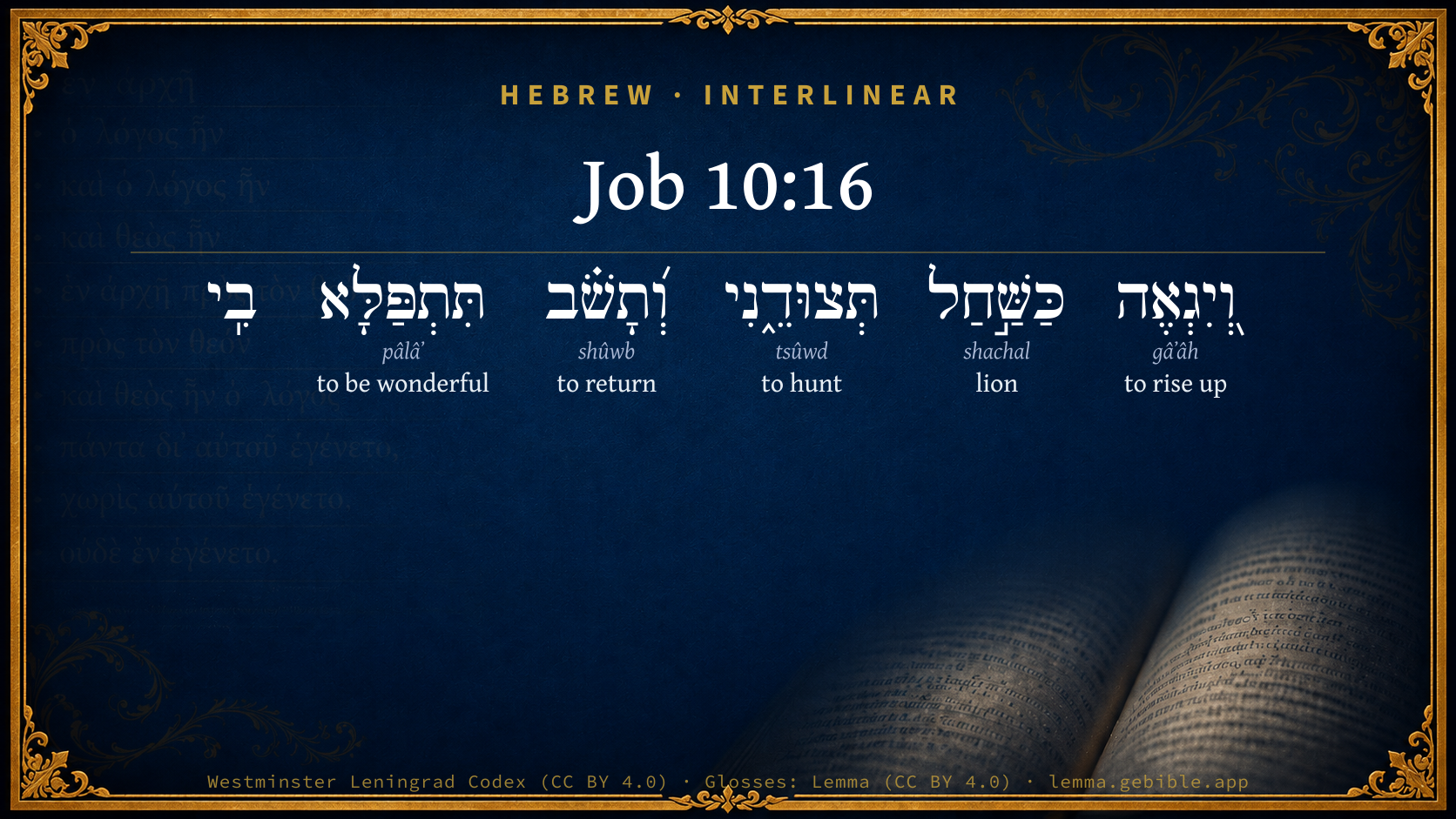
Hebrew (Westminster Leningrad Codex) Job 10:16 appears in the Hebrew Old Testament. The text above is from the Westminster Leningrad Codex. Each word links to its Strong’s number, a concise gloss, and parsing drawn from the Open Scriptures Hebrew Bible morphology. Click any word for its full Brown-Driver-Briggs (BDB) entry.
Download image
Cite this verse

Job 10:16 (World English Bible). Public Domain. Lemma interlinear Bible study tool, https://lemma.gebible.app/v/job/10/16.

Show BibTeX & RIS
BibTeX
RIS
English Translation
If my head is held high, you hunt me like a lion. Again you show yourself powerful to me.
World English Bible · Public Domain
Download a study sheet

One document with this verse’s original text, its word-by-word gloss line, the meaning frame, cross-references with their text, attributed commentary, and full source and license credits — printable, and it pastes into notes with its structure intact.

This verse Autodidact and up

Study sheet (.html) Plain text (.txt)

A passage Seminary Student

Up to 50 verses in one chapter. A passage sheet keeps up to 6 commentary sources and 12 cross-references per verse, in the order this page ranks them, and says so on the sheet whenever that leaves anything out. Ask for a single verse and you get the Autodidact verse sheet above.

Everything on this page stays free to read, with no account — the sheet is a download of what is already on screen, not access to it.

Want to remove ads? Support Godless Engineer
Compare translations 3

The same verse in 3 English versions, stacked beneath the original-language interlinear above. Click any original word for its lexicon entry.

Each is an independent rendering of the whole verse — the interlinear is not word-aligned to these translations.

Highlighted words mark where these versions differ — a whole-verse word diff, not a word-by-word alignment.

  • World English Bible Public Domain
    If my head is held high, you hunt me like a lion. Again you show yourself powerful to me.
  • King James Version Public Domain
    For it increaseth. Thou huntest me as a fierce lion: and again thou shewest thyself marvellous upon me.
  • unfoldingWord Literal Text CC BY-SA 4.0
    And should it arise, you would stalk me like a lion, and you would return, you would distinguish yourself against me.

unfoldingWord Literal Text — © unfoldingWord, licensed CC BY-SA 4.0. Word-aligned USFM3 via Door43 (git.door43.org/unfoldingWord/en_ult).

Versions to compare (up to 4)

3 of 4 selected

Show all 18 translations

Every available English version of this verse, each an independent rendering of the whole verse.

  • World English Bible Public Domain
    If my head is held high, you hunt me like a lion. Again you show yourself powerful to me.
  • Berean Standard Bible Public Domain
    Should I hold my head high, You would hunt me like a lion, and again display Your power against me.
  • Majority Standard Bible Public Domain
    Should I hold my head high, You would hunt me like a lion, and again display Your power against me.
  • King James Version Public Domain
    For it increaseth. Thou huntest me as a fierce lion: and again thou shewest thyself marvellous upon me.
  • American Standard Version (1901) Public Domain
    And if `my head' exalt itself, thou huntest me as a lion; And again thou showest thyself marvellous upon me.
  • Revised Version (1885) Public Domain
    And if my head exalt itself, thou huntest me as a lion: and again thou shewest thyself marvelous upon me.
  • Geneva Bible (1599) Public Domain
    But let it increase: hunt thou me as a lyon: returne and shew thy selfe marueilous vpon me.
  • Douay-Rheims (1899) Public Domain
    And for pride thou wilt take me as a lioness, and returning thou tormentest me wonderfully.
  • Young's Literal Translation Public Domain
    And it riseth -- as a lion Thou huntest me. And Thou turnest back -- Thou shewest Thyself wonderful in me.
  • Literal Standard Version CC BY-SA 4.0
    And it rises—as a lion You hunt me. And You turn back—You show Yourself wonderful in me.
  • Unlocked Literal Bible CC BY-SA 4.0
    If my head were lifted up, you would stalk me like a lion; and again you would show yourself with marvellous acts of power against me.
  • unfoldingWord Literal Text CC BY-SA 4.0
    And should it arise, you would stalk me like a lion, and you would return, you would distinguish yourself against me.
  • Darby Bible Public Domain
    And it increaseth: thou huntest me as a fierce lion; and ever again thou shewest thy marvellous power upon me.
  • World Messianic Bible Public Domain
    If my head is held high, you hunt me like a lion. Again you show yourself powerful to me.
  • Webster's Bible Public Domain
    For it increaseth. Thou huntest me as a fierce lion: and again thou showest thyself wonderful upon me.
  • Free Bible Version CC BY-SA 4.0
    If I do hold my head high you hunt me down like a lion, showing how powerful you are in hurting me.
  • Bible in Basic English Public Domain
    And that if there was cause for pride, you would go after me like a lion; and again put out your wonders against me:
  • JPS Tanakh (1917) Public Domain
    And if it exalt itself, Thou huntest me as a lion; and again Thou showest Thyself marvellous upon me.

Literal Standard Version (2020), Covenant Press — licensed CC BY-SA 4.0. Text via the HelloAO Bible API (eBible.org). Unlocked Literal Bible (unfoldingWord) — licensed CC BY-SA 4.0. Text via the HelloAO Bible API (eBible.org). unfoldingWord Literal Text — © unfoldingWord, licensed CC BY-SA 4.0. Word-aligned USFM3 via Door43 (git.door43.org/unfoldingWord/en_ult). Free Bible Version, Dr. Jonathan Gallagher — licensed CC BY-SA 4.0. Text via the HelloAO Bible API (eBible.org).

Word by word

More ways to search: Search by grammar → Find every occurrence → Compare this word →

Practice this passage: Drill this verse → Learn its vocabulary →

About this verse

These counts appear in no published source. They are computed here, from the morphology-tagged text and Lemma’s own curated glosses. What Lemma adds →

6
words
5
distinct lemmas
Wisdom
section

Notable vocabulary

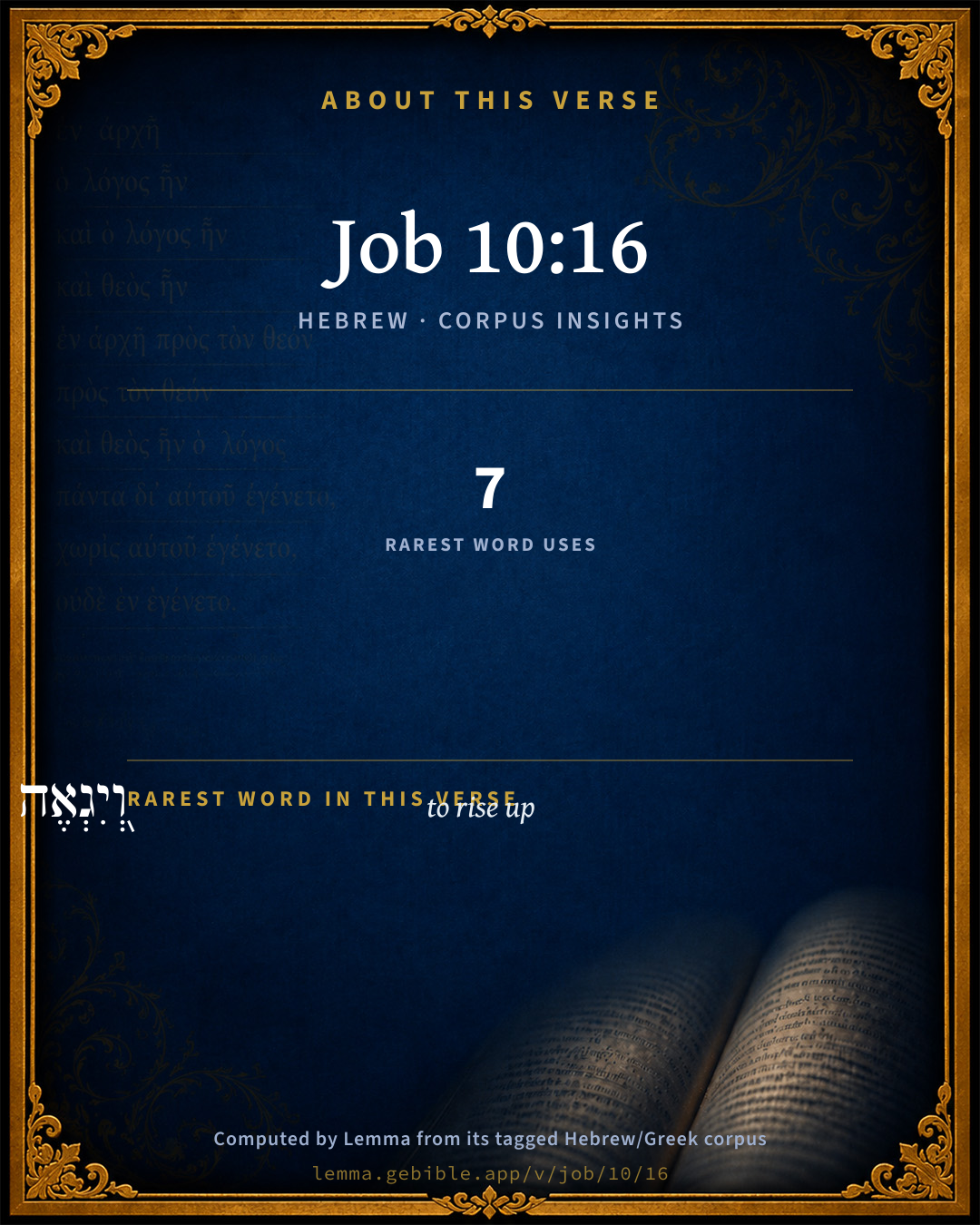
The rarest word here is וְ֭יִגְאֶה to rise up H1342 — appearing just 7 times in the whole Hebrew Bible.

Shared distinctive vocabulary

וְ֭יִגְאֶה to rise up H1342 occurs in 5 verses of the Hebrew Bible. Also found in:

Grammatical profile

  • 4 verbs
  • 1 noun
  • 1 preposition

Verb forms

  • וְ֭יִגְאֶה Qal · Imperfect
  • תְּצוּדֵ֑נִי Qal · Imperfect
  • וְ֝תָשֹׁ֗ב Qal · Imperfect
  • תִּתְפַּלָּא Hithpael · Imperfect

Hebrew & Septuagint length

In English translation the verse runs 19 words from the Hebrew and 19 from the Septuagint (LXX English) — the same length.

A rough comparison of the two English renderings, which tokenize alike — not a word-level alignment.

Word counts can differ between the Hebrew and the Greek without any difference in meaning — e.g. the Hebrew direct-object marker אֵת has no separate Greek word, and Greek often adds the article ὁ.

Cross-references

7

Topical passages linked to Job 10:16 in the Treasury of Scripture Knowledge — connected by theme and wording, ordered by reader-vote popularity; previews shown in the World English Bible.

  • Isaiah 38:13 I quieted [myself] until morning; as a lion, so he breaks all my bones: From day even to night will you make an end of me.
  • Lamentations 3:10 He is to me as a bear lying in wait, as a lion in secret places.
  • Job 5:9 Who does great things that can't be fathomed, Marvelous things without number;
  • Numbers 16:29–30 If these men die the common death of all men, or if they be visited after the visitation of all men; then Yahweh hasn't sent me.
  • Deuteronomy 28:59 then Yahweh will make your plagues wonderful, and the plagues of your seed, even great plagues, and of long continuance, and sore sicknesses, and of long continuance.
  • Hosea 13:7–8 Therefore am I to them like a lion; Like a leopard I will lurk by the path.
  • Amos 3:8 The lion has roared. Who will not fear? The Lord Yahweh has spoken. Who can but prophesy?

Cross-references courtesy of OpenBible.info (CC BY 4.0).

Hebrew and Greek witnesses Masoretic Hebrew ↔ Greek Septuagint

The same verse in the two great witnesses to the Old Testament, shown verse-for-verse.

These are two independent witnesses, not word-aligned to each other, and the Septuagint is shown in lemma (dictionary) form.

Hebrew Job 10:16 Masoretic · Westminster Leningrad Codex

וְ֭יִגְאֶה כַּשַּׁ֣חַל תְּצוּדֵ֑נִי וְ֝תָשֹׁ֗ב תִּתְפַּלָּא בִֽי

If my head is held high, you hunt me like a lion. Again you show yourself powerful to me.

World English Bible · Public Domain

Greek LXX Job 10:16 Septuagint · lemma form

ἀγρεύω γάρ ὥσπερ λέων εἰς σφαγή πάλιν δέ μεταβάλλω δεινῶς ἐγώ ὀλέκω

For I am hunted like a lion for slaughter; for again you have changed and are terribly destroying me;

LXX2012 (modern English Septuagint) · Public Domain

On this verse, Trapp's Complete Commentary discusses the Septuagint’s reading. Read the note in Commentary ↓

Hebrew: Westminster Leningrad Codex (CC BY 4.0). Greek: Septuagint (public domain); English from LXX2012 (modern English Septuagint) (Public Domain). How the Septuagint differs from the Hebrew →

Commentary

Notes on Job 10:16 from classic Christian and Jewish commentators (each source and its license shown beneath its notes). The classic Christian expositions comment on the surrounding passage and are grouped to its opening verse, so a note may address several verses; the Jewish commentaries on the Tanakh (Rashi and others) are per-verse, so they appear only where the commentator wrote on this verse.

Lemma curates 59 commentaries, every one of them public domain or Creative Commons licensed, each selected and text-cleaned for this edition rather than reprinted as found. About our sources →

Trapp's Complete Commentary

John Trapp

Job 10:16 For it increaseth. Thou huntest me as a fierce lion: and again thou shewest thyself marvellous upon me.

Ver. 16. For it increaseth] Heb. For it lifteth up itself; it even boileth up to the height, or it waxeth proud, as the proud surges of the sea. Broughton rendered it, Oh how it fleeth up! Why how? Surely, as a fierce lion, so it hunteth me; it riseth upon me, as a lion rampant doth upon his prey, or as a lion, when he is pursued, gives not place, hides not his head, but comes into the open fields as holding it a disgrace to withdraw; so some sense it: or,

Thou huntest me as a fierce lion] Tanquam leo. God, when he afflicteth men, is oft compared to a lion, Isa 38:13 Hos 5:14; Hos 13:7. Or, tanquam leonem, as if I were a ravening lion; so thou huntest me, setting thy nets and toils, making thy snares and pits ut capiar ad occisionem (so the Septuagint), that I may be taken and destroyed, as 2Pe 2:12.

And again thou showest thyself marvellous upon me] Heb. And thou returnest. Here Job showeth, saith an interpreter, what a confidence he had, that God, returning to him in mercy, would do wonderfully for him in the end; the word turning here, and the turning his captivity, Job 42:10, so aptly answering the one to the other to approve this exposition. But others understand it to be the continued or repeated acts of Job’s affliction, una vice post aliam; as if he should say, thou clappest one affliction upon another; my pains know not only no period, but no pause; thou layest upon me extraordinary sorrows, as if thou wouldest declare in me alone, quam mirus sis artifex, what an excellent artisan thou art when thou pleasest, and what thou canst do against a poor creature; surely thou hast made my plagues wonderful, Deu 28:59. So the apostles were made a gazing stock, a theatre, a spectacle of human misery, 1Co 4:9.

John Trapp, A Commentary or Exposition upon All the Books of the Old and New Testament (1647–1656) — public domain. Text from a community e-Sword module.

Joseph Benson's Commentary

Job 10:16. Thou huntest me as a fierce lion — Which hunteth after his prey with eagerness, and, when he overtakes it, falls upon it with great fury. Again thou showest — Hebrews ותשׁב תתפלא בי, vetashob tithpalla bi, Thou turnest again: Thou art marvellous, or, thou showest thyself marvellous upon, in, or against me. The lion tears its prey speedily, and so ends its torments; but thou renewest my calamities again and again, and makest my plagues wonderful, both for kind, and extremity, and continuance.

Joseph Benson's Commentary on the Old and New Testaments (1811–1818) — public domain. Text from a community e-Sword module.

Geneva Bible (1599)

Geneva Bible translators

Job being sore assaulted in this battle between the flesh and the spirit, bursteth out into these affections, wishing rather short days than long pain.

Geneva Bible (1599) marginal notes — public domain. Text via Bolls.life.

Jamieson, Fausset & Brown

Robert Jamieson, A. R. Fausset & David Brown

increaseth--rather, "(if) I lift up (my head) Thou wouldest hunt me," &c. [UMBREIT].

and again--as if a lion should not kill his prey at once, but come back and torture it again.

Jamieson, Fausset & Brown — Commentary Critical and Explanatory on the Whole Bible (1871) — public domain (CC PDM 1.0). Text via the HelloAO Bible API.

Adam Clarke's Commentary

Verse 16. For it increaseth.] Probably this refers to the affliction mentioned above, which is increased in proportion to its duration. Every day made his escape from such a load of evils less and less probable.

Thou huntest me as a fierce lion] As the hunters attack the king of beasts in the forest, so my friends attack me. They assail me on every side.

Thou showest thyself marvellous] Thy designs, thy ways, thy works, are all incomprehensible to me; thou dost both confound and overpower me. Mr. Good translates thus: -

"For uprousing as a ravenous lion dost thou spring upon me.

And again thou showest over me thy vast power."

Adam Clarke's Commentary on the Bible (1810–1826) — public domain. Text from a community e-Sword/MySword module.

Ellicott's Commentary for English Readers

(16) For it increaseth.—This verse is very obscure. Some understand it thus: “But is it so glorious a thing that Thou shouldst hunt me like a fierce lion, and then again show Thyself mysterious and wonderful towards me? hunting me like a lion, and yet hiding alike Thy person and Thy motive from me?” Or the subject is the head of the former verse, “And if it exalt itself, Thou huntest me,” &c. Or again, as in the Authorised Version, the subject is the affliction, “For it increaseth: Thou huntest me,” &c.

A Bible Commentary for English Readers, edited by Charles John Ellicott (1878–1897) — public domain. Text from a community e-Sword module.

The Cambridge Bible for Schools and Colleges

gen. ed. J. J. S. Perowne

16. This verse reads, and if it (i. e. my head) should lift itself up, thou wouldst hunt me as a fierce lion, and again shew &c. Cf. the figure of a wild beast again, ch. Job_16:9. There is a touch of sarcasm in the words “shew thyself marvellous upon me,”—marvellous in the variety and nature of His plagues, and in plaguing such an object.

The Cambridge Bible for Schools and Colleges (gen. ed. J. J. S. Perowne; Cambridge University Press, 1878–1918) — public domain. Text from a community e-Sword module.

John Gill's Exposition

Thou renewest thy witnesses against me,.... Not the devils, as some, nor Job's friends, as others; but rather afflictions, which were daily renewed, and frequently repeated, new troubles coming continually one upon another; which were brought as fresh witnesses against him, which made the suit tiresome to him, the trial to last the longer, which he wished was at end, that the decisive sentence might be pronounced and executed, and he be dispatched at once; but instead of that the affair was protracted by bringing in one witness after another, or one affliction upon the back of another, which were brought as witnesses "before him" (a), as some render it; either to accuse him, and convince of sin, or as proofs of God's indignation against him, as in the next clause; or they were witnesses against him with the profane world, and even with his friends, who from hence concluded he must have been, and was, a wicked man, that had so many and such great afflictions laid upon him, and these continued and repeated; of which they judged these were full and sufficient proofs and testimonies. Schultens renders it, "thy incursions", and interprets it of instruments of hunting, as nets and the like, to which afflictions may be compared:

and increasest thine indignation upon me; the tokens of it, by increasing afflictions, and the sense of it in his mind; for from his afflictions, and the increase of them, he judged of the indignation of God upon him, or "against him" (b), and the increase of it; as these were daily renewed, and were greater and greater, so was the sense he had of the wrath and displeasure of God against him; see Job 6:4,

changes and war are against me; or "with me", or "upon me" (c); by changes are meant the various afflictive providences which attended him, which were repeated, or succeeded one another in their turns; great changes he had undergone in his estate and substance, from the greatest man in the east now become the poorest; in his family, his servants and children being destroyed; in his body, being covered with boils; and in his mind, being filled with a sense of God's displeasure, and under the hidings of his face: and "war" was against him on every side, not only the law in his members was warring against the law of his mind, his corruptions working powerfully under his afflictions; and he was conflicting with Satan, and his principalities and powers; but even his friends were at war with him, yea, God himself, in his opinion, counted and treated him as an enemy. Job was in a warfare state, and his afflictions came upon him like troops, and charged him one after another; or his afflictions were like an "army" (d) as the word may be rendered, many and numerous; and these were either repeated, or new ones succeeded others; different afflictions in their turns came upon him, and particularly an army of worms were continually running to and fro upon him; see Job 7:5; the word is rendered an "appointed time", Job 7:1; and so some take it here, and may signify that all the changes and vicissitudes in life he passed through, the various afflictions that came upon him, were at the set and appointed time, as well as there was an appointed time for him on earth, until his last change came.

(a) "coram me", Pagninus, Montanus, Beza, Mercerus, Schmidt, Schultens. (b) "adversus me", Junius & Tremellius, Piscator, Schultens; so Vatablus. (c) "mecum", Pagninus, Montanus, Bolducius, Morcerus, Schmidt; "apud me", Beza, Piscator, Cocceius. (d) "militia", Montanus, Bolducius; "exercitus", Beza, Junius & Tremellius, Piscator, Mercerus, Schmidt, Schultens.

John Gill's Exposition of the Whole Bible (1746–1763) — public domain (CC PDM 1.0). Text via the HelloAO Bible API.

Albert Barnes' Notes on the Bible

For it increaseth - Our translators understand this as meaning that the calamities of Job, so far from becoming less, were constantly increasing, and thus augmenting his perplexity and embarrassment. But a somewhat different explanation is given to it by many interpreters. The word rendered “increaseth” (גאה gâ'âh) means properly, to lift up, to lift up oneself, to rise; and Gesenius supposes that it refers here to “the head,” and that the meaning is, “if it lift up itself (sc. my head), thou huntest me as a lion.” It cannot be denied that the notion of pride, elation, haughtiness, is usually connected with the use of the word, but it is not necessary here to depart from the common interpretation, meaning that the increase of his affliction greatly augmented his perplexity. Jerome, however, readers it, “and on account of pride, thou dost seize me as a lioness.” The idea is, “my affliction, as it were, exalts itself, or, becomes more and more prominent.” This is a better interpretation than to refer it to the raising up of his head.

Thou huntest me as a fierce lion - On the meaning of the word here rendered “fierce lion” שׁחל shachal, see the notes at Job 4:10. The sense here is, that God hunted or followed him as a fierce lion pursued his prey.

And again thou showest thyself marvelous - Or rather, “thou turnest, and art wonderful toward me.” The meaning is, that he did not at once spring upon his prey and then leave it, but he came back as if it had not been put to death when first seized, as if a lion should come back and torture his victim again. The meaning of the phrase “shewest thyself marvelous” is, that the dealings of God toward him were wonderful. They were wholly incomprehensible. He had no means of finding out the reasons of his doings. On the word used here, compare the notes at Isa 9:6.

Albert Barnes' Notes on the Bible (1834–1885) — public domain. Text from a community e-Sword/MySword module.

Haydock's Catholic Bible Commentary

Pride. If I give way to pride, thou wilt pull me down, though I were as fierce and strong as a lioness. Hebrew, "for it (affliction) increaseth. Thou huntest me." (Protestants) --- Returning. Hebrew and Septuagint, "again." (Haydock)

George Leo Haydock (1774–1849), Haydock's Catholic Family Bible and Commentary, 1859 edition — public domain. Excludes Psalms (Douay-Rheims chapter numbering differs from Protestant) and Deuterocanonical books (Catholic canon only).

Matthew Poole's English Annotations

As a fierce lion; which hunteth after his prey with great eagerness, and when he overtakes it, falls upon it with great fury.

And again thou showest thyself marvellous upon me, Heb.

and thou returnest and showest thyself marvellous upon, or in, or against me. The lion tears its prey speedily, and so ends its torments; but thou renewest my calamities again and again, and makest my plagues wonderful, both for kind, and extremity, and continuance.

Matthew Poole's English Annotations on the Holy Bible (1683–1685) — public domain. Text from a community e-Sword/MySword module.

Whedon's Commentary on the Bible

Daniel D. Whedon

16. For it increaseth, etc. — And (if) it (the head) lift itself up, thou huntest me like the lion, (shahhal,) see note, Job_4:10. This image is of frequent occurrence. (Isa_31:4; Isa_38:13; Hos_5:14; Hos_13:7.) “Good and Boothroyd seem rightly to consider that the fine passage in this and the following verse refers to the sport which lions, and, indeed, all the feline tribe, exercise over their prey before they finally devour it.” — DR. KITTO, Pict. Bible. This painful feature of instinct is relieved by the consideration that the senses of the victim are probably to a good extent paralyzed. Such was the experience of Dr. Livingstone when once in the jaws of a lion. (Travels in South Africa, p. 12.) The figure is one of unspeakable terror, but not necessitated by the text, though the Speaker’s Commentary seems to adopt it.

Marvellous upon me — “Mighty against me.” (Furst.) The crude form of the verb is the same as Isa_9:6, translated wonderful. God adapts his afflictions to the heart. He shows as marvellous wisdom in the various visitations he makes to the souls of men as he does in the works of creation.

Daniel D. Whedon (gen. ed.), Commentary on the Old and New Testaments (1874–1909) — public domain. Text from a community e-Sword module.

The Pulpit Commentary

For it increaseth. Thou huntest me. This passage is very obscure, and has been taken in several quite different senses. On the whole, it is not clear that any better meaning can be assigned to it than that of the Authorized Version, "For my affliction increaseth," or "is ever increasing. Thou huntest me;" i.e. thou art continually pursuing me with thy plagues, thy "arrows", (Job_6:4) thy" wounds", (Job_9:17) thy poisonedshafts. (Job_6:4) Thou givest me no rest, therefore I am ever conscious of my afflictions. As a fierce lion. Schultens regards Job as the lion, and so Jarchi and others. But most commentators take the view that the lion is God. (comp. Isa_31:4 Isa_38:13 Jer_25:38 Hos_5:14 Hos_13:7, Hos_13:8) And again thou showest thyself marvellous upon me; or, thou dealest marvellously with me; i.e. "in-flictest on me strange anti marvellous sufferings."

The Pulpit Commentary (1880–1919), ed. H.D.M. Spence-Jones & Joseph S. Exell — public domain. Text from a community e-Sword module.

John Wesley's Explanatory Notes

Lion - Which hunteth after his prey with great eagerness, and when he overtakes it, falls upon it with great fury. Returnest - The lion tears its prey speedily, and so ends its torments; but thou renewest my calamities again and again, and makest my plagues wonderful both for kind and extremity, and continuance.

John Wesley, Explanatory Notes Upon the Whole Bible (1754–1765) — public domain. Text via the GEBible commentary corpus.

Rashi

Rabbi Shlomo Yitzchaki (Rashi)

And it is so great that You hunt me like a lion And it is so great in Your eyes to be to You as a burden and a disappointment, that You hunt me like a lion; You spread out a net for me as though I was as mighty as a lion.

and You repeatedly from day to day.

pronounce a verdict upon me Heb. תתפלא, to exact and to pronounce judgment, an expression of (Num. 6:2). “shall pronounce (יפלא).”

Rashi on the Tanakh — English translations: “The Judaica Press complete Tanach with Rashi, translated by A. J. Rosenberg” (CC BY 4.0); “Pentateuch with Rashi's commentary by M. Rosenbaum and A.M. Silbermann, 1929-1934” (public domain); “The Metsudah Tanach series, Lakewood, N.J” (CC BY 4.0); and “The Book of Joshua, Metsudah Publications, 1997” (CC BY 4.0). Text via Sefaria.

Lesson kit

Teaching starters — assembled from the data on this page, not authored interpretation. Every prompt links to the verse data it draws on. Edit before teaching.

Job, in the Wisdom, opens this verse with 6 words (5 distinct Hebrew lemmas). Its most distinctive word is gâʼâh (“to rise up”). A historical commentator’s framing appears above. Read the whole chapter for the surrounding context.

Discussion questions

  1. The word gâʼâh carries the sense “to rise up.” How does it shape the verse?
  2. How does Exodus 15:1, which shares the word «to rise up», read alongside this verse?
  3. These translations render this verse differently; the difference is in the English rendering, not the original. What questions does that raise?
  4. «וְ֭יִגְאֶה» is a Qal Imperfect verb. How does that grammatical form shape the action described?
  5. Compare how Trapp's Complete Commentary and Joseph Benson's Commentary read this verse. Where do they agree or differ?

Things to notice

Reading settings

Reading text

Shown beneath each verse's original-language words.

Old Testament
Old Testament edition

Read the OT as the Masoretic Hebrew (MT) or the Greek Septuagint (LXX).

English shown for the Greek Septuagint (in the Hebrew ↔ Greek comparison).

Comparing translations? Open the Compare panel on any verse page to stack up to four side by side.