
Job 9:10

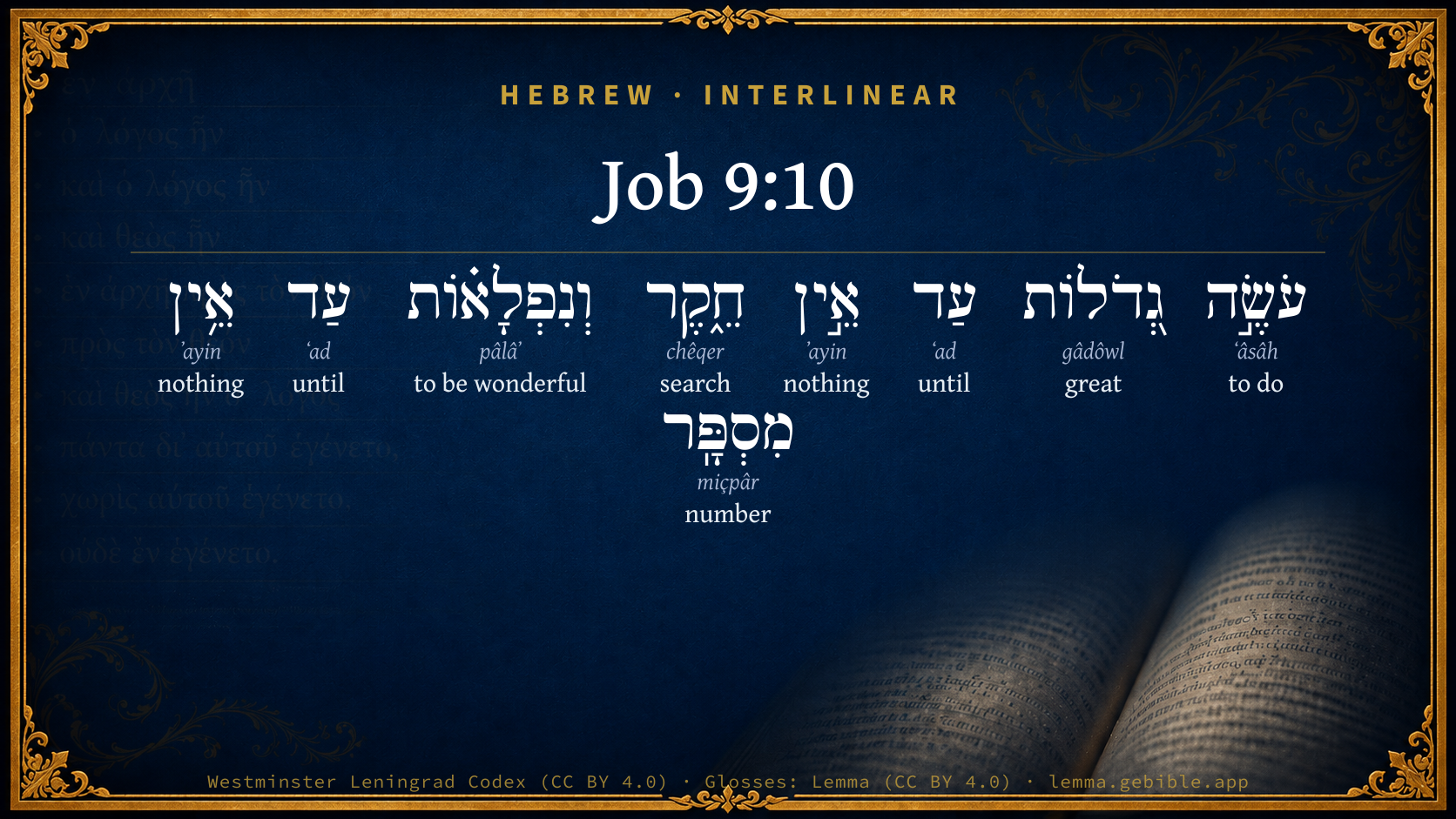
Hebrew (Westminster Leningrad Codex) Job 9:10 appears in the Hebrew Old Testament. The text above is from the Westminster Leningrad Codex. Each word links to its Strong’s number, a concise gloss, and parsing drawn from the Open Scriptures Hebrew Bible morphology. Click any word for its full Brown-Driver-Briggs (BDB) entry.
Download image
Cite this verse

Job 9:10 (World English Bible). Public Domain. Lemma interlinear Bible study tool, https://lemma.gebible.app/v/job/9/10.

Show BibTeX & RIS
BibTeX
RIS
English Translation
Who does great things past finding out, Yes, marvelous things without number.
World English Bible · Public Domain
Download a study sheet

One document with this verse’s original text, its word-by-word gloss line, the meaning frame, cross-references with their text, attributed commentary, and full source and license credits — printable, and it pastes into notes with its structure intact.

This verse Autodidact and up

Study sheet (.html) Plain text (.txt)

A passage Seminary Student

Up to 50 verses in one chapter. A passage sheet keeps up to 6 commentary sources and 12 cross-references per verse, in the order this page ranks them, and says so on the sheet whenever that leaves anything out. Ask for a single verse and you get the Autodidact verse sheet above.

Everything on this page stays free to read, with no account — the sheet is a download of what is already on screen, not access to it.

Want to remove ads? Support Godless Engineer
Compare translations 3

The same verse in 3 English versions, stacked beneath the original-language interlinear above. Click any original word for its lexicon entry.

Each is an independent rendering of the whole verse — the interlinear is not word-aligned to these translations.

Highlighted words mark where these versions differ — a whole-verse word diff, not a word-by-word alignment.

  • World English Bible Public Domain
    Who does great things past finding out, Yes, marvelous things without number.
  • King James Version Public Domain
    Which doeth great things past finding out; yea, and wonders without number.
  • unfoldingWord Literal Text CC BY-SA 4.0
    doing great until there is no searching and distinguished until there is no number.

unfoldingWord Literal Text — © unfoldingWord, licensed CC BY-SA 4.0. Word-aligned USFM3 via Door43 (git.door43.org/unfoldingWord/en_ult).

Versions to compare (up to 4)

3 of 4 selected

Show all 18 translations

Every available English version of this verse, each an independent rendering of the whole verse.

  • World English Bible Public Domain
    Who does great things past finding out, Yes, marvelous things without number.
  • Berean Standard Bible Public Domain
    He does great things beyond searching out, and wonders without number.
  • Majority Standard Bible Public Domain
    He does great things beyond searching out, and wonders without number.
  • King James Version Public Domain
    Which doeth great things past finding out; yea, and wonders without number.
  • American Standard Version (1901) Public Domain
    That doeth great things past finding out, Yea, marvellous things without number.
  • Revised Version (1885) Public Domain
    Which doeth great things past finding out; yea, marvelous things without number.
  • Geneva Bible (1599) Public Domain
    He doeth great things, and vnsearcheable: yea, marueilous things without nomber.
  • Douay-Rheims (1899) Public Domain
    Who doth things great and incomprehensible, and wonderful, of which there is no number.
  • Young's Literal Translation Public Domain
    Doing great things till there is no searching, And wonderful, till there is no numbering.
  • Literal Standard Version CC BY-SA 4.0
    Doing great things until there is no searching, || And wonderful, until there is no numbering.
  • Unlocked Literal Bible CC BY-SA 4.0
    He does great and unsearchable things, and wonderful things that cannot be counted.
  • unfoldingWord Literal Text CC BY-SA 4.0
    doing great until there is no searching and distinguished until there is no number.
  • Darby Bible Public Domain
    Who doeth great things past finding out, and wonders without number.
  • World Messianic Bible Public Domain
    He does great things past finding out; yes, marvelous things without number.
  • Webster's Bible Public Domain
    Who doeth great things past finding out; yes, and wonders without number.
  • Free Bible Version CC BY-SA 4.0
    He is the one who does incredible things that are beyond our understanding, marvelous things that are uncountable.
  • Bible in Basic English Public Domain
    Who does great things not to be searched out; yes, wonders without number.
  • JPS Tanakh (1917) Public Domain
    Who doeth great things past finding out; yea, marvellous things without number.

Literal Standard Version (2020), Covenant Press — licensed CC BY-SA 4.0. Text via the HelloAO Bible API (eBible.org). Unlocked Literal Bible (unfoldingWord) — licensed CC BY-SA 4.0. Text via the HelloAO Bible API (eBible.org). unfoldingWord Literal Text — © unfoldingWord, licensed CC BY-SA 4.0. Word-aligned USFM3 via Door43 (git.door43.org/unfoldingWord/en_ult). Free Bible Version, Dr. Jonathan Gallagher — licensed CC BY-SA 4.0. Text via the HelloAO Bible API (eBible.org).

Word by word

More ways to search: Search by grammar → Find every occurrence → Compare this word →

Practice this passage: Drill this verse → Learn its vocabulary →

About this verse

These counts appear in no published source. They are computed here, from the morphology-tagged text and Lemma’s own curated glosses. What Lemma adds →

9
words
7
distinct lemmas
Wisdom
section

Notable vocabulary

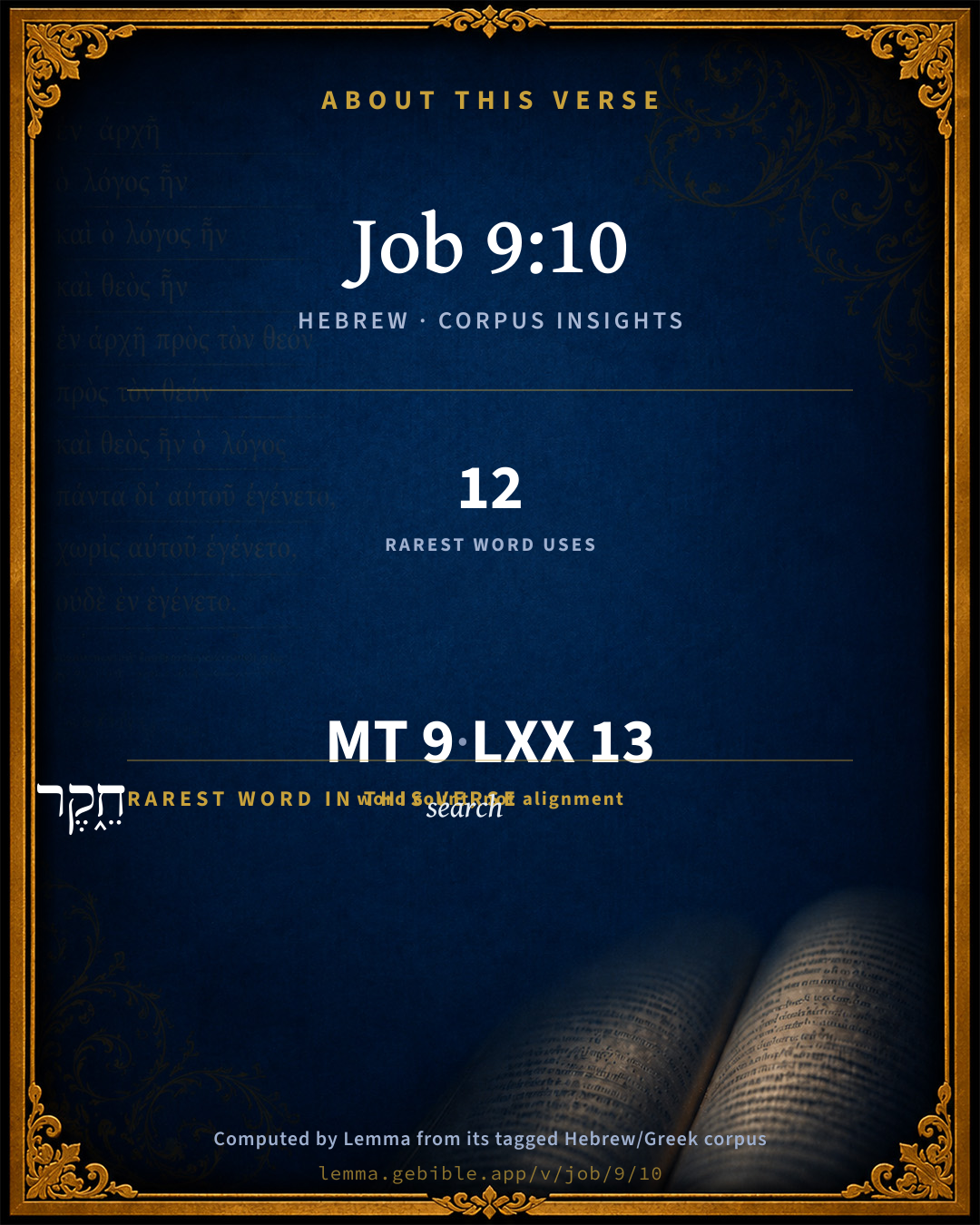
The rarest word here is חֵ֑קֶר search H2714 — appearing just 12 times in the whole Hebrew Bible.

Shared distinctive vocabulary

חֵ֑קֶר search H2714 occurs in 12 verses of the Hebrew Bible. Also found in:

Grammatical profile

  • 2 verbs
  • 2 nouns
  • 1 adjective
  • 2 prepositions
  • 2 particles

Verb forms

  • עֹשֶׂ֣ה Qal · Participle Active
  • וְנִפְלָא֗וֹת Niphal · Participle Active

Repetition

Words recur within this verse — often emphatic in Hebrew:

  • עַד until H5704 ×2
  • אֵ֣ין nothing H369 ×2

Hebrew & Septuagint length

In English translation the verse runs 12 words from the Hebrew and 12 from the Septuagint (LXX English) — the same length.

A rough comparison of the two English renderings, which tokenize alike — not a word-level alignment.

Word counts can differ between the Hebrew and the Greek without any difference in meaning — e.g. the Hebrew direct-object marker אֵת has no separate Greek word, and Greek often adds the article ὁ.

In the original languages it is 9 Hebrew tokens and 13 Greek tokens — but the two are counted differently (Hebrew bundles its prefixes and suffixes into one token; the Greek is in lemma form), so that isn’t a like-for-like length.

Cross-references

12

Topical passages linked to Job 9:10 in the Treasury of Scripture Knowledge — connected by theme and wording, ordered by reader-vote popularity; previews shown in the World English Bible.

  • Job 5:9 Who does great things that can't be fathomed, Marvelous things without number;
  • Psalms 72:18 Praise be to Yahweh God, the God of Israel, Who alone does marvelous deeds.
  • Romans 11:33 Oh the depth of the riches both of the wisdom and the knowledge of God! How unsearchable are his judgments, and his ways past tracing out!
  • Ephesians 3:20 Now to him who is able to do exceedingly abundantly above all that we ask or think, according to the power that works in us,
  • Psalms 136:4 To him who alone does great wonders; For his loving kindness endures forever:
  • Daniel 4:2–3 It has seemed good to me to show the signs and wonders that the Most High God has worked toward me.
  • Ecclesiastes 3:11 He has made everything beautiful in its time. He has also set eternity in their hearts, yet so that man can't find out the work that God has done from the beginning even to the end.
  • Isaiah 40:26–28 Lift up your eyes on high, and see who has created these, who brings out their host by number; he calls them all by name; by the greatness of his might, and because he is strong in power, not one is lacking.
  • Exodus 15:11 Who is like you, Yahweh, among the gods? Who is like you, glorious in holiness, Fearful in praises, doing wonders?
  • Psalms 71:15 My mouth will tell about your righteousness, And of your salvation all day, Though I don't know its full measure.
  • Job 37:23 We can't reach the Almighty, He is exalted in power; In justice and great righteousness he will not oppress.
  • Job 26:12–14 He stirs up the sea with his power, And by his understanding he strikes through Rahab.

Cross-references courtesy of OpenBible.info (CC BY 4.0).

Hebrew and Greek witnesses Masoretic Hebrew ↔ Greek Septuagint

The same verse in the two great witnesses to the Old Testament, shown verse-for-verse.

These are two independent witnesses, not word-aligned to each other, and the Septuagint is shown in lemma (dictionary) form.

Hebrew Job 9:10 Masoretic · Westminster Leningrad Codex

עֹשֶׂ֣ה גְ֭דֹלוֹת עַד אֵ֣ין חֵ֑קֶר וְנִפְלָא֗וֹת עַד אֵ֥ין מִסְפָּֽר

Who does great things past finding out, Yes, marvelous things without number.

World English Bible · Public Domain

Greek LXX Job 9:10 Septuagint · lemma form

ὁ ποιέω μέγας καί ἀνεξιχνίαστος ἔνδοξος τε καί ἐξαίσιος ὅς οὐ εἰμί ἀριθμός

Who does great and unsearchable things; glorious also and excellent things, innumerable.

LXX2012 (modern English Septuagint) · Public Domain

Hebrew: Westminster Leningrad Codex (CC BY 4.0). Greek: Septuagint (public domain); English from LXX2012 (modern English Septuagint) (Public Domain). How the Septuagint differs from the Hebrew →

Commentary

Notes on Job 9:10 from classic Christian and Jewish commentators (each source and its license shown beneath its notes). The classic Christian expositions comment on the surrounding passage and are grouped to its opening verse, so a note may address several verses; the Jewish commentaries on the Tanakh (Rashi and others) are per-verse, so they appear only where the commentator wrote on this verse.

Lemma curates 59 commentaries, every one of them public domain or Creative Commons licensed, each selected and text-cleaned for this edition rather than reprinted as found. About our sources →

Trapp's Complete Commentary

John Trapp

Job 9:10 Which doeth great things past finding out; yea, and wonders without number.

Ver. 10. Which doth great things, &c.] {See Trapp on "Job 5:9"} whence this verse is taken verbatim. If Eliphaz say the truth of God’s wisdom and power, Job will soon seal to it; he can find in his heart to speak all good of a wounding God, of a killing God, and not wish, as Spira did, Oh that I were above God, and could overpower him! Or as Hacker here did, A.D. 1591, threaten God to fire the heaven about him, to pluck him out of his throne. (Camb. Eliz. fol. 408)

John Trapp, A Commentary or Exposition upon All the Books of the Old and New Testament (1647–1656) — public domain. Text from a community e-Sword module.

The Biblical Illustrator

Joseph S. Exell

Job_9:10-24

Which doeth great things past finding out.

Jobs idea of what God is to mankind

He regards the Eternal as--

I. Inscrutable.

1. In His works. Which doeth great things past finding out. How great are His works! great in their nature, minuteness, magnitude, variety, number. Ask the chemist, the astronomer, the entomologist, the physiologist, and the anatomist; and the more accurate and comprehensive their knowledge of the Divine workmanship is, the more ready will they be to acknowledge that His works are past finding out, and wonders without number.

2. He is inscrutable in His essence. He goeth by me, and I see Him not; He passeth on also, and I perceive Him not. I see His works, but I cannot detect the essence of the Worker.

II. As irresponsible. Behold He taketh away, and who can hinder Him? Who will say unto Him, What doest Thou?

III. As resistless. If God will not withdraw His anger, the proud helpers do stoop under Him.

1. God is an offendable Being. He is not an impassive existent, sitting at the head of the universe, utterly indifferent to the moral character of His creatures.

2. The proud have helpers and abettors. Were the whole universe to arm itself against Him, its opposition would be infinitely less than the opposition of the smallest insect to the eagle or the lion.

IV. As inexorable.

1. As uninfluenced by man.

(1) Uninfluenced by his appeals. The appeal of vindication has no power with Him. How much less shall I answer Him, and choose out any words to reason with Him? Whom, though I were righteous, yet would I not answer. The appeal of prayer. But I would make supplication to my Judge. If I had called, and He had answered me; yet would not I believe that He had hearkened unto my voice. A most melancholy mental mood is this! The patriarch represents Him as--

(2) Uninfluenced by his sufferings. For He breaketh me with a tempest, and multiplieth my wounds without cause. He will not suffer me to take my breath, but filleth me with bitterness.

2. As unapproached by human argument.

3. As too holy to encourage anyone to have confidence in his own virtues. Were the patriarch even a perfect man, he feels that to plead his virtues before a God so holy would not only be utterly useless, but impious and pernicious.

(1) It would involve self-condemnation. No condemnation is so terrible as the condemnation of a mans moral self.

(2) It would prove self-ignorance. Yet would I not know my soul. Truly, a man who would dare to prove his merits before God would demonstrate thereby an utter ignorance of his own insignificance and moral character.

(3) It would secure self-contempt. I would despise my life. This would be the issue of such conduct. The Almighty is here represented--

4. As utterly regardless of the moral distinctions of society. This is one thing, therefore I said it. He destroyeth the perfect and the wicked, etc. (verses 22-24). Here Job hits the main point now in discussion between him and his friends. Their position was that God dealt with men here according to their moral characters, and that Job suffered because he was wicked. The patriarch again refutes it, and asserts the broad fact that the perfect and wicked are treated alike. This is not the scene of retribution, it is the domain of discipline. (Homilist.)

The Biblical Illustrator, edited by Joseph S. Exell (c. 1880s–1900s) — public domain. Text from a community e-Sword module.

Joseph Benson's Commentary

Job 9:10. Which doeth great things, &c. — Job here says the same that Eliphaz had said Job 5:9, and in the original, in the very same words, with design to show his full agreement with him, touching the divine perfections.

Joseph Benson's Commentary on the Old and New Testaments (1811–1818) — public domain. Text from a community e-Sword module.

Jamieson, Fausset & Brown

Robert Jamieson, A. R. Fausset & David Brown

Repeated from Eliphaz (Job 5:9).

Jamieson, Fausset & Brown — Commentary Critical and Explanatory on the Whole Bible (1871) — public domain (CC PDM 1.0). Text via the HelloAO Bible API.

Adam Clarke's Commentary

Verse 10. Great things past finding out] Great things without end; wonders without number. - Targum.

Adam Clarke's Commentary on the Bible (1810–1826) — public domain. Text from a community e-Sword/MySword module.

Ellicott's Commentary for English Readers

(10) Which doeth great things.—He adopts the very words his former antagonist, Eliphaz, had used in Job_5:9.

A Bible Commentary for English Readers, edited by Charles John Ellicott (1878–1897) — public domain. Text from a community e-Sword module.

The Cambridge Bible for Schools and Colleges

gen. ed. J. J. S. Perowne

10. The description of the operation of God’s might in the material world concludes with a general statement that this operation surpasses all power of comprehension by the human mind. The words are exactly those of Eliphaz ch. Job_5:9, but while to Eliphaz all God’s operations have an ethical meaning and subserve one great purpose of goodness, to Job they seem the mere un-moral play of an immeasurable Force. This force was of course a Person, for an impersonal force is an idea unknown to the Shemitic mind. But this force seemed all the more tremendous to Job from his having no idea of second causes or of what we call laws of nature; the phenomena of the universe, even the most stupendous, were the immediate work of this mighty agent.

The Cambridge Bible for Schools and Colleges (gen. ed. J. J. S. Perowne; Cambridge University Press, 1878–1918) — public domain. Text from a community e-Sword module.

John Gill's Exposition

Lo, he goeth by me, and I see him not,.... This is expressive of the invisibility of God; for though the angels in heaven always behold his face, and men, in the works of creation, may see his eternal power and Godhead, and other perfections of it displayed therein; and saints by faith have a comfortable and delightful view of him, of his countenance, his love, grace and mercy in his word and ordinances, and especially in the face and person of Christ, the image of the invisible God, and will in heaven most clearly see him as he is, in the greater display of his glory and his grace; yet his essence is invisible, not only not to be seen with corporeal eyes, but not to be comprehended in the mind:

he passeth on also, but I perceive him not; this "going and passing on", as, ascribed to God, must be understood in consistence with his omnipresence; he cannot be thought to move from place to place who is everywhere, who fills heaven and earth with his presence, and there is no going from it: local motion cannot be said of him; but this respects the operations of his providence; he is continually working all around us, by supporting us in being, and supplying us with what we want, and so is near us, and yet we see him not: Job experienced the bounties of his providence, as well as the blessings of his grace, in the time of his prosperity, and now he felt the weight of his afflicting hand upon him; but yet, as to his essence, he could not see him; he was sensible that he was nigh him, and find a concern in all that befell him, but he could neither see nor comprehend him, nor account for his dealings with him: he had "passed by" him in his state of nature, and had looked graciously on him, and had said unto him, Live; he had "passed on" from him, and hid his face so that he could not see him, nor find him backward nor forward, on the right hand, nor on the left, where he used to work, see Job 23:3.

John Gill's Exposition of the Whole Bible (1746–1763) — public domain (CC PDM 1.0). Text via the HelloAO Bible API.

Albert Barnes' Notes on the Bible

Which doeth great things - This is almost the sentiment which had been expressed by Eliphaz; see the notes, Job 5:9. It was evidently a proverb, and as such was used by both Eliphaz and Job.

Albert Barnes' Notes on the Bible (1834–1885) — public domain. Text from a community e-Sword/MySword module.

Matthew Poole's English Annotations

Which words were produced by Eliphaz, Job 5:9, (where they are explained,) and are here repeated by Job, to show his agreement with him therein.

Matthew Poole's English Annotations on the Holy Bible (1683–1685) — public domain. Text from a community e-Sword/MySword module.

The Pulpit Commentary

He doeth great things past finding out; yea, and wonders without number. An almost exact repetition of the words of Eliphaz in Job_5:9. The repetition may have been conscious or unconscious. Job may have meant to say, "My view of God embraces all that you can tell me of him, and goes further;" or he may simply have used words concerning the Divine unsearchableness which were common in the mouths of religious men in his time. (comp. Psa_72:18; and infra, Job_11:7)

The Pulpit Commentary (1880–1919), ed. H.D.M. Spence-Jones & Joseph S. Exell — public domain. Text from a community e-Sword module.

John Wesley's Explanatory Notes

Doth great things, &c. - Job here says the same that Eliphaz had said, chap. v, 9, and in the original, in the very same words, with design to shew his full agreement with him, touching the Divine perfections.

John Wesley, Explanatory Notes Upon the Whole Bible (1754–1765) — public domain. Text via the GEBible commentary corpus.

unfoldingWord translationNotes

Door43 World Missions Community

General Information:

The writer uses parallelism in each of these verses, conveying a single idea using double statements to emphasize that God is great, unseen, and sovereign. (See: Parallelism)

unsearchable things

"things that cannot be understood"

See

"Look" or "Listen" or "Pay attention to what I am about to tell you."

he passes on

"he passes by" or "he moves on"

If he takes something away, who can stop him? Who can say to him, 'What are you doing?

These are rhetorical questions that expect an answer of "No one." They can be reworded as statements. AT: "If he takes something away, no one can stop him. No one can ask him, 'What are you doing?'" (See: Rhetorical Question)

If he takes something away

"If he takes someone away" or "If he wants to snatch something away"

translationWords

God

amazed

unfoldingWord translationNotes — © Distant Shores Media and the Door43 World Missions Community, licensed CC BY-SA 4.0. Source: git.door43.org/Door43/en_tn.

Lesson kit

Teaching starters — assembled from the data on this page, not authored interpretation. Every prompt links to the verse data it draws on. Edit before teaching.

Job, in the Wisdom, opens this verse with 9 words (7 distinct Hebrew lemmas). Its most distinctive word is chêqer (“search”). A historical commentator’s framing appears above. Read the whole chapter for the surrounding context.

Discussion questions

  1. How does “search” (chêqer) shape what this verse is saying?
  2. How does Judges 5:16, which shares the word «search», read alongside this verse?
  3. What does the repetition of “until” (2× in this one verse) do in this verse?
  4. The translations on this page render this verse differently — a whole-verse word diff, not a word-by-word alignment. What might account for the different wordings?
  5. «עֹשֶׂ֣ה» is a Qal Participle Active verb. How does that grammatical form shape the action described?
  6. Compare how Trapp's Complete Commentary and The Biblical Illustrator read this verse. Where do they agree or differ?

Things to notice

Reading settings

Reading text

Shown beneath each verse's original-language words.

Old Testament
Old Testament edition

Read the OT as the Masoretic Hebrew (MT) or the Greek Septuagint (LXX).

English shown for the Greek Septuagint (in the Hebrew ↔ Greek comparison).

Comparing translations? Open the Compare panel on any verse page to stack up to four side by side.