
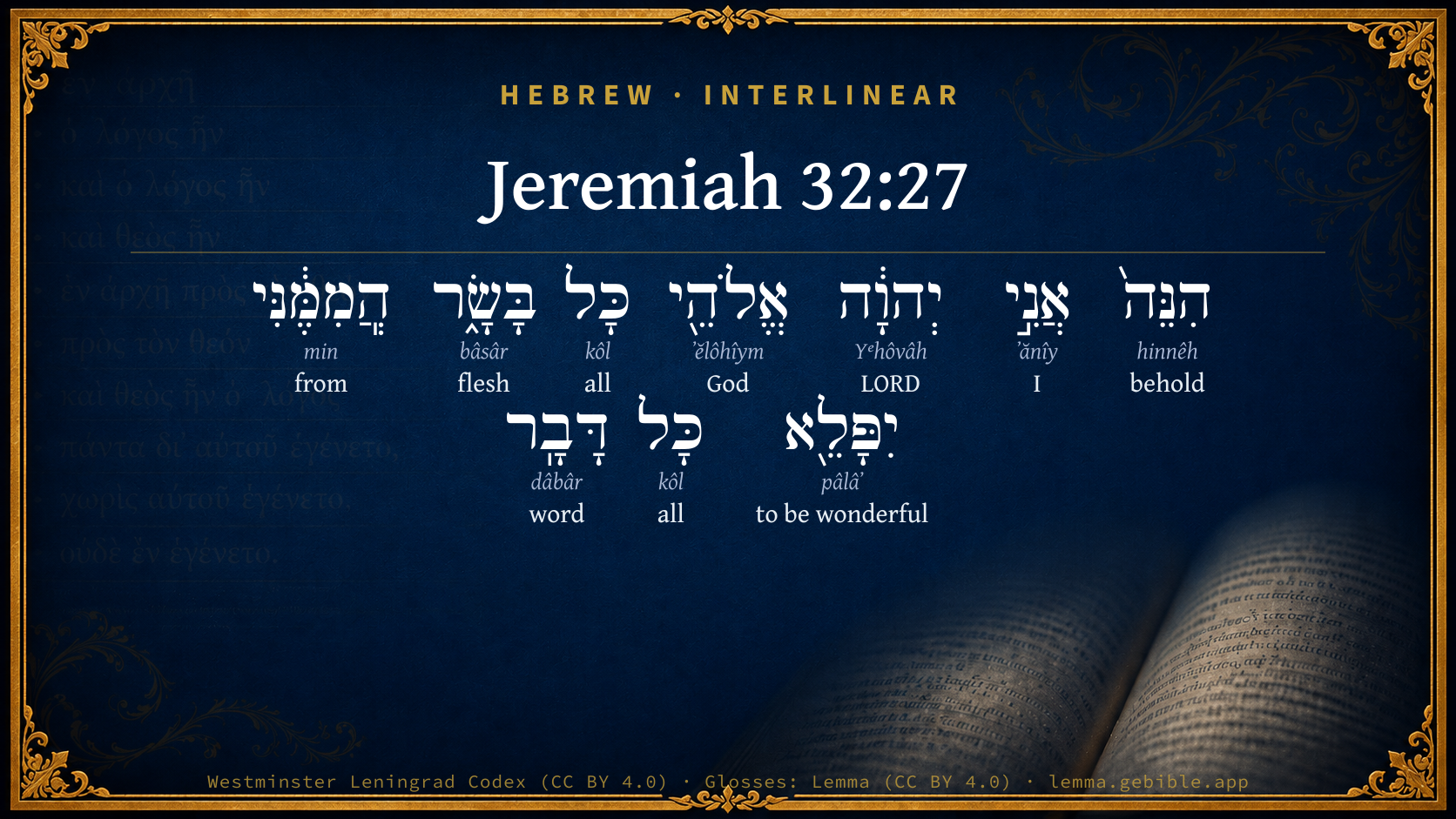
Jeremiah 32:27

Hebrew (Westminster Leningrad Codex) Jeremiah 32:27 appears in the Hebrew Old Testament. The text above is from the Westminster Leningrad Codex. Each word links to its Strong’s number, a concise gloss, and parsing drawn from the Open Scriptures Hebrew Bible morphology. Click any word for its full Brown-Driver-Briggs (BDB) entry.
Download image
Cite this verse

Jeremiah 32:27 (World English Bible). Public Domain. Lemma interlinear Bible study tool, https://lemma.gebible.app/v/jeremiah/32/27.

Show BibTeX & RIS
BibTeX
RIS
English Translation
Behold, I am Yahweh, the God of all flesh: is there anything too hard for me?
World English Bible · Public Domain
Download a study sheet

One document with this verse’s original text, its word-by-word gloss line, the meaning frame, cross-references with their text, attributed commentary, and full source and license credits — printable, and it pastes into notes with its structure intact.

This verse Autodidact and up

Study sheet (.html) Plain text (.txt)

A passage Seminary Student

Up to 50 verses in one chapter. A passage sheet keeps up to 6 commentary sources and 12 cross-references per verse, in the order this page ranks them, and says so on the sheet whenever that leaves anything out. Ask for a single verse and you get the Autodidact verse sheet above.

Everything on this page stays free to read, with no account — the sheet is a download of what is already on screen, not access to it.

Want to remove ads? Support Godless Engineer
Compare translations 3

The same verse in 3 English versions, stacked beneath the original-language interlinear above. Click any original word for its lexicon entry.

Each is an independent rendering of the whole verse — the interlinear is not word-aligned to these translations.

Highlighted words mark where these versions differ — a whole-verse word diff, not a word-by-word alignment.

  • World English Bible Public Domain
    Behold, I am Yahweh, the God of all flesh: is there anything too hard for me?
  • King James Version Public Domain
    Behold, I am the LORD, the God of all flesh: is there any thing too hard for me?
  • unfoldingWord Literal Text CC BY-SA 4.0
    “Look! I am Yahweh, God of all mankind. Is anything too difficult for me to do?

unfoldingWord Literal Text — © unfoldingWord, licensed CC BY-SA 4.0. Word-aligned USFM3 via Door43 (git.door43.org/unfoldingWord/en_ult).

Versions to compare (up to 4)

3 of 4 selected

Show all 18 translations

Every available English version of this verse, each an independent rendering of the whole verse.

  • World English Bible Public Domain
    Behold, I am Yahweh, the God of all flesh: is there anything too hard for me?
  • Berean Standard Bible Public Domain
    “Behold, I am the LORD, the God of all flesh. Is anything too difficult for Me?
  • Majority Standard Bible Public Domain
    “Behold, I am the LORD, the God of all flesh. Is anything too difficult for Me?
  • King James Version Public Domain
    Behold, I am the LORD, the God of all flesh: is there any thing too hard for me?
  • American Standard Version (1901) Public Domain
    Behold, I am Jehovah, the God of all flesh: is there anything too hard for me?
  • Revised Version (1885) Public Domain
    Behold, I am the LORD, the God of all flesh: is there any thing too hard for me?
  • Geneva Bible (1599) Public Domain
    Beholde, I am the LORD GOD of all flesh: is there any thing too hard for me?
  • Douay-Rheims (1899) Public Domain
    Behold I am the Lord the God of all flesh: shall any thing be hard for me?
  • Young's Literal Translation Public Domain
    `Lo, I `am' Jehovah, God of all flesh: For Me is anything too wonderful?
  • Literal Standard Version CC BY-SA 4.0
    “Behold, I [am] YHWH, God of all flesh: is anything too wonderful for Me?”
  • Unlocked Literal Bible CC BY-SA 4.0
    “Look! I am Yahweh, God of all mankind. Is anything too difficult for me to do?
  • unfoldingWord Literal Text CC BY-SA 4.0
    “Look! I am Yahweh, God of all mankind. Is anything too difficult for me to do?
  • Darby Bible Public Domain
    Behold, I am Jehovah, the God of all flesh: is there anything too hard for me?
  • World Messianic Bible Public Domain
    “Behold, I am the LORD, the God of all flesh. Is there anything too hard for me?
  • Webster's Bible Public Domain
    Behold, I am the LORD, the God of all flesh: is there any thing too hard for me?
  • Free Bible Version CC BY-SA 4.0
    Look! I am the Lord, the God of everyone. Is anything too hard for me to do?
  • Bible in Basic English Public Domain
    See, I am the Lord, the God of all flesh: is there anything so hard that I am unable to do it?
  • JPS Tanakh (1917) Public Domain
    'Behold, I am the LORD, the God of all flesh; is there any thing too hard for Me?

Literal Standard Version (2020), Covenant Press — licensed CC BY-SA 4.0. Text via the HelloAO Bible API (eBible.org). Unlocked Literal Bible (unfoldingWord) — licensed CC BY-SA 4.0. Text via the HelloAO Bible API (eBible.org). unfoldingWord Literal Text — © unfoldingWord, licensed CC BY-SA 4.0. Word-aligned USFM3 via Door43 (git.door43.org/unfoldingWord/en_ult). Free Bible Version, Dr. Jonathan Gallagher — licensed CC BY-SA 4.0. Text via the HelloAO Bible API (eBible.org).

Word by word

More ways to search: Search by grammar → Find every occurrence → Compare this word →

Practice this passage: Drill this verse → Learn its vocabulary →

יִפָּלֵ֖א
pâlâʼ
H6381
“to be wonderful”
Verb, Niphal, Imperfect, 3rd Person, Masculine, Singular
Part of Speech
Verb
Stem
Niphal
Form
Imperfect
Person
3rd Person
Gender
Masculine
Number
Singular
Full BDB Definition

Origin: a primitive root

TWOT: 1768

to be marvellous, be wonderful, be surpassing, be extraordinary, separate by distinguishing action - (Niphal) - to be beyond one's power, be difficult to do - to be difficult to understand - to be wonderful, be extraordinary - marvellous (participle) - (Piel) to separate (an offering) - (Hiphil) - to do extraordinary or hard or difficult thing - to make wonderful, do wondrously - (Hithpael) to show oneself wonderful or marvellous
  1. הִנֵּה֙ hinnêh H2009 “behold” Particle, Demonstrative
  2. אֲנִ֣י ʼănîy H589 “I” Pronoun, Personal, 1st Person, Common, Singular
  3. יְהוָ֔ה Yᵉhôvâh H3068 “LORD” Noun, Proper
  4. אֱלֹהֵ֖י ʼĕlôhîym H430 “God(s) of” Noun, Common, Masculine, Plural, Construct
  5. כָּל kôl H3605 “all of” Noun, Common, Masculine, Singular, Construct
  6. בָּשָׂ֑ר bâsâr H1320 “flesh” Noun, Common, Masculine, Singular, Absolute
  7. הֲֽמִמֶּ֔נִּי min H4480 “from · me” Particle, Interrogative + Preposition + Suffix, Personal, 1st Person, Common, Singular
  8. כָּל kôl H3605 “all of” Noun, Common, Masculine, Singular, Construct
  9. דָּבָֽר dâbâr H1697 “word” Noun, Common, Masculine, Singular, Absolute

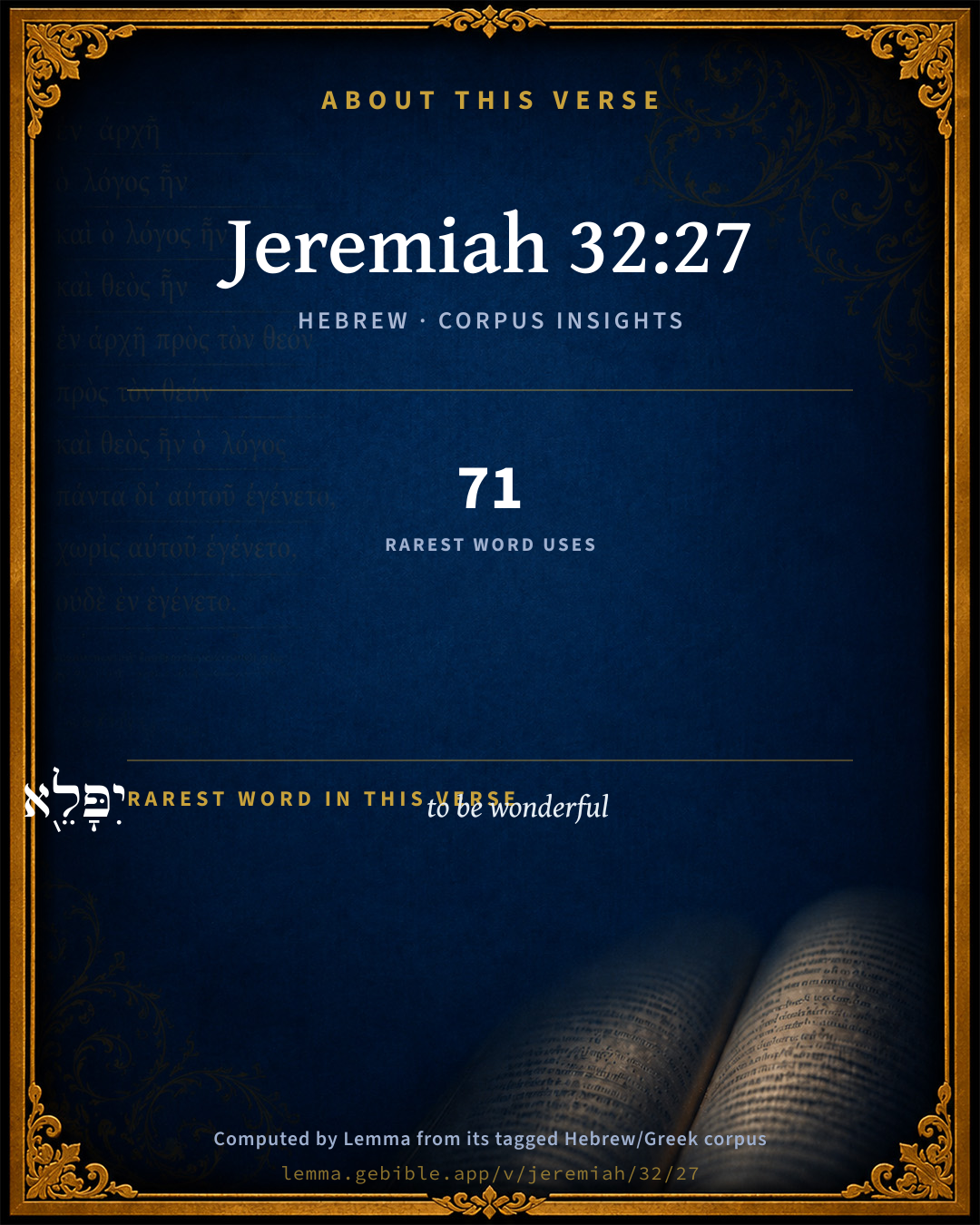
About this verse

These counts appear in no published source. They are computed here, from the morphology-tagged text and Lemma’s own curated glosses. What Lemma adds →

10
words
9
distinct lemmas
Prophets
section

Grammatical profile

  • 1 verb
  • 6 nouns
  • 1 pronoun
  • 1 preposition
  • 1 particle

Verb forms

  • יִפָּלֵ֖א Niphal · Imperfect

Repetition

A word recurs within this verse — often emphatic in Hebrew:

Cross-references

9

Topical passages linked to Jeremiah 32:27 in the Treasury of Scripture Knowledge — connected by theme and wording, ordered by reader-vote popularity; previews shown in the World English Bible.

  • Matthew 19:26 Looking at them, Jesus said, "With men this is impossible, but with God all things are possible."
  • Jeremiah 32:17 Ah Lord Yahweh! behold, you have made the heavens and the earth by your great power and by your outstretched arm; there is nothing too hard for you,
  • Isaiah 64:8 But now, Yahweh, you are our Father; we are the clay, and you our potter; and we all are the work of your hand.
  • Psalms 65:2 You who hear prayer, To you all men will come.
  • John 17:2 even as you gave him authority over all flesh, he will give eternal life to all whom you have given him.
  • Numbers 27:16 Let Yahweh, the God of the spirits of all flesh, appoint a man over the congregation,
  • Romans 3:29–30 Or is God the God of Jews only? Isn't he the God of Gentiles also? Yes, of Gentiles also,
  • Luke 3:6 All flesh will see God's salvation.'"
  • Numbers 16:22 They fell on their faces, and said, God, the God of the spirits of all flesh, shall one man sin, and will you be angry with all the congregation?

Cross-references courtesy of OpenBible.info (CC BY 4.0).

Hebrew and Greek witnesses Masoretic Hebrew ↔ Greek Septuagint

The same verse in the two great witnesses to the Old Testament, shown verse-for-verse.

These are two independent witnesses, not word-aligned to each other, and the Septuagint is shown in lemma (dictionary) form.

Hebrew Jeremiah 32:27 Masoretic · Westminster Leningrad Codex

הִנֵּה֙ אֲנִ֣י יְהוָ֔ה אֱלֹהֵ֖י כָּל בָּשָׂ֑ר הֲֽמִמֶּ֔נִּי יִפָּלֵ֖א כָּל דָּבָֽר

Behold, I am Yahweh, the God of all flesh: is there anything too hard for me?

World English Bible · Public Domain

Greek LXX Structure differs

In the Septuagint, Jeremiah is about an eighth shorter than the Hebrew and arranges its material differently — the Oracles Against the Nations (Hebrew chapters 46–51) appear in the middle of the Greek book, after 25:13. Because the chapter and verse boundaries do not line up, a verse-for-verse comparison with the Hebrew is not shown.

A verse-for-verse comparison isn’t shown here because the chapters and verses don’t line up. Switch to the LXX edition with the MT / LXX toggle above to read the Greek directly.

Hebrew: Westminster Leningrad Codex (CC BY 4.0). Greek: Septuagint (public domain); English from a public-domain English Septuagint. How the Septuagint differs from the Hebrew →

Targum (Aramaic paraphrase)

1

The Targum is the ancient Jewish Aramaic paraphrase of the Hebrew Scriptures — an interpretive translation, not the Hebrew text itself. Onkelos (literal) and Pseudo-Jonathan (expansive) render the Torah, and Jonathan the Prophets. Coverage is partial: where no permissively-licensed English translation exists for a verse, only the Aramaic is shown. This is verse-level text, not a word-by-word alignment to the Hebrew.

  1. Targum Jonathan Prophets (Joshua–Malachi)
    הָא אֲנָא יְיָ אֱלָהָא כָּל בִּשְׂרָא הֲמִן קָדָמַי יִתְכַּסֵי כָּל פִּתְגָם:

    (no public-domain English translation for this verse)

    Targum Jonathan — Aramaic: “Mikraot Gedolot” (public domain). English: “Sefaria Community Translation” (CC0 1.0 (public-domain dedication)); “London "Chaldee Paraphrase," 1871” (public domain). Text via Sefaria.

Commentary

Notes on Jeremiah 32:27 from classic Christian and Jewish commentators (each source and its license shown beneath its notes). The classic Christian expositions comment on the surrounding passage and are grouped to its opening verse, so a note may address several verses; the Jewish commentaries on the Tanakh (Rashi and others) are per-verse, so they appear only where the commentator wrote on this verse.

Lemma curates 59 commentaries, every one of them public domain or Creative Commons licensed, each selected and text-cleaned for this edition rather than reprinted as found. About our sources →

Trapp's Complete Commentary

John Trapp

Jer 32:27 Behold, I [am] the LORD, the God of all flesh: is there any thing too hard for me?

Ver. 27. Behold, I am the Lord, the God of all flesh.] Yea, of the "spirits of all flesh"; {Num 16:22} but what can weak flesh do against the Almighty?

Is there anything too hard for me?] See on Jer 32:15; Jer 32:17. Still God is careful to confirm and comfort his ministers, and here he doth Jeremiah much what in his own words.

John Trapp, A Commentary or Exposition upon All the Books of the Old and New Testament (1647–1656) — public domain. Text from a community e-Sword module.

Geneva Bible (1599)

Geneva Bible translators

That is, of every creature: who as they are his work, so doth he govern and guide them as pleaseth him, whereby he showeth that as he is the author of this their captivity for their sins, so will he for his mercies be their redeemer to restore them again to liberty.

Geneva Bible (1599) marginal notes — public domain. Text via Bolls.life.

Jamieson, Fausset & Brown

Robert Jamieson, A. R. Fausset & David Brown

Jehovah retorts Jeremiah's own words: I am indeed, as thou sayest (Jer 32:17), the God and Creator of "all flesh," and "nothing is too hard for Me"; thine own words ought to have taught thee that, though Judea and Jerusalem are given up to the Chaldeans now for the sins of the Jews, yet it will not be hard to Me, when I please, to restore the state so that houses and lands therein shall be possessed in safety (Jer 32:36-44).

Jamieson, Fausset & Brown — Commentary Critical and Explanatory on the Whole Bible (1871) — public domain (CC PDM 1.0). Text via the HelloAO Bible API.

John Calvin's Commentaries

We have already said that the verb פלא pela, admits of two meanings; it means to be hid and to be wonderful, and hence by a metaphor it means what is difficult and impossible. Many take it to mean here, that nothing escapes the observation of God. But as I have said in the last lecture, I am more inclined to refer it to God’s power, even that all things are in the hand and at the pleasure of God, so that there is no difficulty in his way. For whence comes to men so much anxiety, except that they are stopped by obstacles? but God can surmount all obstacles without any labor. That our minds then may not be perplexed, rightly is set before us the power of God.

And this meaning is most suitable to this passage: for Jeremiah, when that which seemed inconsistent occurred to him, was constrained to cast his anxiety as it were into the bosom of God. Then God, in order to relieve him, says that nothing is difficult to him, because he is the God of all flesh. Though by the words all flesh, the Scripture often means all kinds of animals, yet oftener the human race only. I do not, however, refinedly explain this passage, as though God did set the Gentiles in opposition to the Jews, and thus denied that he would be any longer the God of Abraham’s children, because he had repudiated them on account of their sins; but he says that he is in an especial manner the king of the whole earth, and rules over the whole human race. As God then, he says, is the God of all flesh, can anything be impssible to him?

John Calvin's Commentaries (1540-1563) — public domain. Text from the Calvin Translation Society English edition (1840s-50s) via the Christian Classics Ethereal Library (ccel.org). Calvin's coverage is partial (roughly two-thirds of the Bible); uncommented books and verses are honest gaps, never fabricated. The 19th-century editor's footnotes and remarks are omitted so the notes are faithfully Calvin's own voice.

Ellicott's Commentary for English Readers

(27) Is there any thing too hard for me?—The answer to the prayer is an echo of the prayer itself (Jer_32:17). The prophet is assured that he was not wrong when he cast himself, in the full confidence of faith, on the loving omnipotence of God. The words which he had used were more than a liturgical formula to one who had that confidence.

A Bible Commentary for English Readers, edited by Charles John Ellicott (1878–1897) — public domain. Text from a community e-Sword module.

John Gill's Exposition

Therefore thus saith the Lord, behold, I will give this city into the hand of the Chaldeans,.... As he had foretold by the prophet, and was just now going to be fulfilled. Here the Lord repeats and confirms the first of the two things which seemed contradictory; the destruction of the city by the Chaldeans, who were now besieging it, and into whose hands it would certainly come:

and into the hand of Nebuchadrezzar king of Babylon; who was now before it with his army:

and he shall take it; and become master of it: or, "I will give it to him, that he may take it" (f); which he could not do, notwithstanding his powerful army, had not the Lord delivered it into his hands.

(f) "ut capiat eam", Junius & Tremellius, Schmidt.

John Gill's Exposition of the Whole Bible (1746–1763) — public domain (CC PDM 1.0). Text via the HelloAO Bible API.

Matthew Poole's English Annotations

The Lord beginneth this revelation, for the prophet’s satisfaction, with the preface expressive of his power and universal dominion, from which Jeremiah might understand that he could do whatsoever he pleased, and man, that was but flesh, Gen 6:3, could not hinder his effecting what he designed to do. God is also the God of the spirits of all flesh, Num 16:22; but he expresseth man here only under the notion of flesh, as Gen 6:3, to denote his vileness and inconsiderableness as to any grappling with God, and encountering his purposes.

Matthew Poole's English Annotations on the Holy Bible (1683–1685) — public domain. Text from a community e-Sword/MySword module.

Whedon's Commentary on the Bible

Daniel D. Whedon

27. The God of all flesh — The supremacy and universality of the divine dominion is here, as everywhere, a ground condition of the Old Testament relations. See Num_16:22; Num_27:16.

Too hard — Literally, too wonderful.

Daniel D. Whedon (gen. ed.), Commentary on the Old and New Testaments (1874–1909) — public domain. Text from a community e-Sword module.

The Pulpit Commentary

The omnipotence of God.

I THE SOURCE OF THE OMNIPOTENCE OF GOD.

1. His essential being. He is the Lord, Jehovah, the Self-Existent. God is not only greater than all other existences, he differs from them in his essential being. He is eternal; they have come into being. He is self-contained; they are created.

2. God"s relation to all other existences. He is the God of all flesh. He is the First Cause, the Source of the first being of all things, and the ground of their continued being. But for him they could never have been and could not now endure. We human creatures, "flesh," may realize this especially in regard to ourselves. Therefore to us in particular God, who created us all, and in whom we all live and move and have our being, must be almighty.

II APPARENT LIMITATIONS TO THE OMNIPOTENCE OF GOD.

1. The character of God. We say that God cannot do wrong. But this simply means that his character is such that he never will do wrong. He is physically as able to do the actions which are wrong as those which are right. If he were not, there would be no goodness in his refraining, for purity is not impotence to do evil, but a will not to do it in face of the power to do it. Omnipotence is a physical characteristic. Goodness, the moral characteristic, does not destroy this by controlling the action of it. The power of the steam-engine is not lessened because the driver turns the steam on and off at will.

2. The free will of man. This introduces an unfathomable mystery, which no philosophy has solved or is ever likely to solve. But the mystery is more especially felt on our side. If God created us and gave to us free will, and, being omnipotent, can at any time destroy us and withdraw it, this must not be regarded as any real limitation to his power.

III HOW A CONSIDERATION OF THE OMNIPOTENCE OF GOD SHOULD AFFECT OUR CONDUCT. We are not called to worship mere power. To do so would be to renounce the rights of conscience. We worship God, not because he is almighty, but because he is supremely good and morally great. But starting from this position, we have to take account also of the omnipotence of God.

1. It shows the utter vanity of all resistance to the will of God. This is a most obvious inference? The more strange, then, that it is so little acted on. We need to feel it as well as to believe it.

2. It should lead us to trust that God will overcome difficulties which to us appear insuperable. The restoration of Israel appeared impossible; the salvation of the world seems too great and difficult to be realized; there are special difficulties in special cases, but some with all, so that we may exclaim, "Who then can be saved?" But if "with God all things are possible", (Mat_19:26) how can we fix any limit to the ultimate triumphs of redemption? "The mercy of the Lord endureth forever;" then God will always seek the recovery of his lost children. "Is anything too hard for me? Then, in spite of present unbelief, impenitence, wild wanderings further astray, may we not believe that he will find his children at last?

3. These considerations should lead us to seek the help of God"s strength in our weakness. How foolish for the sailors to weary themselves toiling in vain at their oars against the tide, when if they would spread their sails the strong wind would carry them swiftly on! How foolish of us to toil on only in our natural power and with mere earthly means, when there are heavenly influences of omnipotence ready to help us if we will seek them!

Truth confessed, but not realized.

"Is there anything too hard for the Lord?" In ver. 17 the prophet had confessed "nothing is too hard for thee," but it is evident that, though he thus confessed the blessed truth, he did not realize it so as to enjoy it and get the comfort of it (cf. homily on vers. 1-44). Now, there are many causes which hinder our realization of this truth which we nevertheless both confess and believe. But they may all be summed up under the three headings of trouble, guilt, and sin. It was the first of these, though not exclusively, which was clouding the prophet"s mind, and making even this axiom of Divine truth seem doubtful for the time. Glance at these causes of this sad questioning whether some things be not too hard for the Lord, and their several cures.

I GREAT TROUBLE. Cf. circumstances of the time and of prophet especially. Oh, what doubt and misgiving do the troubles of life, the terrible events, "the stings and arrows of outrageous fortune," cause to souls not a few! It was so here. Now, observe the antidote to this doubt. To strengthen his faith the prophet draws an argument from the creation. Then, with no resources from without, God formed the earth and the world. Then, when the material out of which the ordered universe should come had all to be brought into order, "the earth was without form and void, and darkness," etc. Then, when all was created, all had to be preserved and daily sustained. Let any one contemplate the proofs that these facts give of the existence, the power, the wisdom, and the beneficence of God, and the question, "Is anything too hard for thee?" can meet with but one answer. How can any doubt the Divine resources in view of the creating and sustaining providence of God.

II GUILT. If it be hard sometimes in the face of the calamities of life to realize the fulness of the Divine resources, it is harder still in the face of human guilt. Is there a God able and willing to supply my material and temporal need? is a question less difficult than that which asks whether there be a God able and willing to pardon my sin. For to minds not few nor feeble, the forgiveness of sin seems an insoluble problem. If the punishment of sin be righteous, and every witness affirms that it is, ought God to remit it? And if it be inevitable, the sure reaping of the previous sowing, can God remit it? Have we not something here that is too hard even for the Lord? If in all departments of nature, we everywhere see effects surely following their appropriate causes, and if spiritual death be the appropriate effect of sin, how can this cause and effect be severed any more than any other? True, the human will can step in and arrest or turn aside this or that effect; we see this perpetually. But here is a question, not of power, but of right, not in the sphere of the material, but of that which is moral. It is a case in which mere power goes for nothing. What, then, is to be done? The atonement of our Lord Jesus Christ solves the problem. He, in our humanity, offered to God for us that perfect sacrifice whereby all who claim their share in its benefits are pardoned, accepted, and saved. "God was in Christ, reconciling," etc. (2Co 5) It is everywhere recognized that a true confession of wrong done, and an earnest entreaty for forgiveness, should suffice to remove all wrath on account of such wrong from the heart of the offended one. That law which God enjoins upon us he observes himself. "The sacrifices of God are a broken spirit," etc. But such confession of human sin and intercession for its forgiveness Christ offered in humanity to God for us, and so God can be just and yet the Justifier of him who believeth in Jesus. Thus is this hard problem solved; the "Lamb of God taketh away the sin of the world." But there is

III SIN. Can God subdue that in the heart of a man? When we see the outrages, the duration, the strength of hold, the universality, the attractiveness, the prestige, and the love of sin, it does seem as if the subjugation of this was too hard even for the Lord. To turn back the tides, to reverse the law of gravity, to alter any other law of the universe, this were an easy task compared with the stupendous change which must be wrought in man before the love of sin can die out of him, and the love of God rule in its stead. What endeavours have been made! what schemes devised! what philosophies elaborated! but all in vain. Hence, despair for ourselves and for others too often predominates in our souls. Evil we are, and evil we must be. Who can bring a clean thing out of an unclean? Can a corrupt tree bring forth good fruit? But "there is nothing too hard for the Lord." The history of the Church of God proves that there is, in the regenerating, sanctifying Spirit of God, that power which is needed here. He is the renewing, transforming, sanctifying Spirit. Baptized with the Spirit, "I walk not after the flesh, but after the Spirit." "The law of the Spirit of life in Christ Jesus has made me free from the law of sin and death." May we more and more, as we may and should, in our own experience, prove this true. C.

The Pulpit Commentary (1880–1919), ed. H.D.M. Spence-Jones & Joseph S. Exell — public domain. Text from a community e-Sword module.

Rashi

Rabbi Shlomo Yitzchaki (Rashi)

Is...concealed from Me? Are future events concealed from Me?

Rashi on the Tanakh — English translations: “The Judaica Press complete Tanach with Rashi, translated by A. J. Rosenberg” (CC BY 4.0); “Pentateuch with Rashi's commentary by M. Rosenbaum and A.M. Silbermann, 1929-1934” (public domain); “The Metsudah Tanach series, Lakewood, N.J” (CC BY 4.0); and “The Book of Joshua, Metsudah Publications, 1997” (CC BY 4.0). Text via Sefaria.

Lesson kit

Teaching starters — assembled from the data on this page, not authored interpretation. Every prompt links to the verse data it draws on. Edit before teaching.

Jeremiah, in the Prophets, opens this verse with 10 words (9 distinct Hebrew lemmas). Its most distinctive word is pâlâʼ (“to be wonderful”). A historical commentator’s framing appears above. Read the whole chapter for the surrounding context.

Discussion questions

  1. How does “to be wonderful” (pâlâʼ) shape what this verse is saying?
  2. How does Matthew 19:26, which shares this passage’s theme, read alongside this verse?
  3. What does the repetition of “all” (2× in this one verse) do in this verse?
  4. The translations on this page render this verse differently — a whole-verse word diff, not a word-by-word alignment. What might account for the different wordings?
  5. «יִפָּלֵ֖א» is a Niphal Imperfect verb. How does that grammatical form shape the action described?
  6. Compare how Trapp's Complete Commentary and Geneva Bible (1599) read this verse. Where do they agree or differ?

Things to notice

Reading settings

Reading text

Shown beneath each verse's original-language words.

Old Testament
Old Testament edition

Read the OT as the Masoretic Hebrew (MT) or the Greek Septuagint (LXX).

English shown for the Greek Septuagint (in the Hebrew ↔ Greek comparison).

Comparing translations? Open the Compare panel on any verse page to stack up to four side by side.