
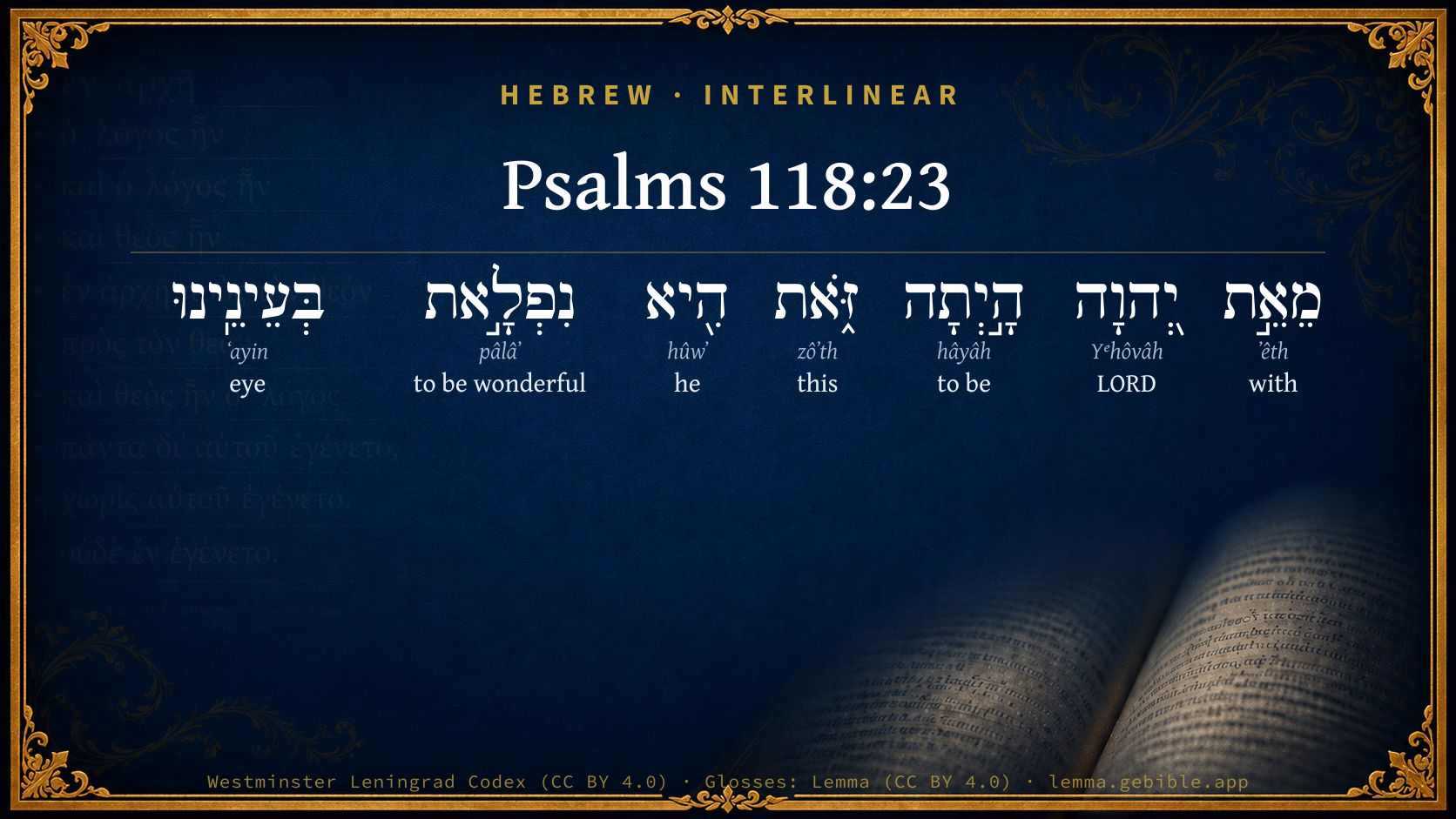
Psalms 118:23

Hebrew (Westminster Leningrad Codex) Psalms 118:23 appears in the Hebrew Old Testament. The text above is from the Westminster Leningrad Codex. Each word links to its Strong’s number, a concise gloss, and parsing drawn from the Open Scriptures Hebrew Bible morphology. Click any word for its full Brown-Driver-Briggs (BDB) entry.
Download image
Cite this verse

Psalms 118:23 (World English Bible). Public Domain. Lemma interlinear Bible study tool, https://lemma.gebible.app/v/psalms/118/23.

Show BibTeX & RIS
BibTeX
RIS
English Translation
This is Yahweh's doing. It is marvelous in our eyes.
World English Bible · Public Domain
Download a study sheet

One document with this verse’s original text, its word-by-word gloss line, the meaning frame, cross-references with their text, attributed commentary, and full source and license credits — printable, and it pastes into notes with its structure intact.

This verse Autodidact and up

Study sheet (.html) Plain text (.txt)

A passage Seminary Student

Up to 50 verses in one chapter. A passage sheet keeps up to 6 commentary sources and 12 cross-references per verse, in the order this page ranks them, and says so on the sheet whenever that leaves anything out. Ask for a single verse and you get the Autodidact verse sheet above.

Everything on this page stays free to read, with no account — the sheet is a download of what is already on screen, not access to it.

Want to remove ads? Support Godless Engineer
Compare translations 3

The same verse in 3 English versions, stacked beneath the original-language interlinear above. Click any original word for its lexicon entry.

Each is an independent rendering of the whole verse — the interlinear is not word-aligned to these translations.

Highlighted words mark where these versions differ — a whole-verse word diff, not a word-by-word alignment.

  • World English Bible Public Domain
    This is Yahweh's doing. It is marvelous in our eyes.
  • King James Version Public Domain
    This is the LORD's doing; it is marvellous in our eyes.
  • unfoldingWord Literal Text CC BY-SA 4.0
    This is from Yahweh; it is marvelous in our eyes.

unfoldingWord Literal Text — © unfoldingWord, licensed CC BY-SA 4.0. Word-aligned USFM3 via Door43 (git.door43.org/unfoldingWord/en_ult).

Versions to compare (up to 4)

3 of 4 selected

Show all 18 translations

Every available English version of this verse, each an independent rendering of the whole verse.

  • World English Bible Public Domain
    This is Yahweh's doing. It is marvelous in our eyes.
  • Berean Standard Bible Public Domain
    This is from the LORD, and it is marvelous in our eyes.
  • Majority Standard Bible Public Domain
    This is from the LORD, and it is marvelous in our eyes.
  • King James Version Public Domain
    This is the LORD's doing; it is marvellous in our eyes.
  • American Standard Version (1901) Public Domain
    This is Jehovah's doing; It is marvellous in our eyes.
  • Revised Version (1885) Public Domain
    This is the LORD’S doing; it is marvelous in our eyes.
  • Geneva Bible (1599) Public Domain
    This was the Lordes doing, and it is marueilous in our eyes.
  • Douay-Rheims (1899) Public Domain
    This is the Lord's doing: and it is wonderful in our eyes.
  • Young's Literal Translation Public Domain
    From Jehovah hath this been, It `is' wonderful in our eyes,
  • Literal Standard Version CC BY-SA 4.0
    This has been from YHWH, || It [is] wonderful in our eyes,
  • Unlocked Literal Bible CC BY-SA 4.0
    This is Yahweh's doing; it is marvelous in our eyes.
  • unfoldingWord Literal Text CC BY-SA 4.0
    This is from Yahweh; it is marvelous in our eyes.
  • Darby Bible Public Domain
    This is of Jehovah; it is wonderful in our eyes.
  • World Messianic Bible Public Domain
    This is the LORD’s doing. It is marvelous in our eyes.
  • Webster's Bible Public Domain
    This is the LORD'S doing; it is wonderful in our eyes.
  • Free Bible Version CC BY-SA 4.0
    The Lord has done this, and it looks wonderful to us!
  • Bible in Basic English Public Domain
    This is the Lord's doing; it is a wonder in our eyes.
  • JPS Tanakh (1917) Public Domain
    This is the LORD'S doing; it is marvellous in our eyes.

Literal Standard Version (2020), Covenant Press — licensed CC BY-SA 4.0. Text via the HelloAO Bible API (eBible.org). Unlocked Literal Bible (unfoldingWord) — licensed CC BY-SA 4.0. Text via the HelloAO Bible API (eBible.org). unfoldingWord Literal Text — © unfoldingWord, licensed CC BY-SA 4.0. Word-aligned USFM3 via Door43 (git.door43.org/unfoldingWord/en_ult). Free Bible Version, Dr. Jonathan Gallagher — licensed CC BY-SA 4.0. Text via the HelloAO Bible API (eBible.org).

Word by word

More ways to search: Search by grammar → Find every occurrence → Compare this word →

Practice this passage: Drill this verse → Learn its vocabulary →

נִפְלָ֣את
pâlâʼ
H6381
“being wonderful”
Verb, Niphal, Participle Active, Feminine, Singular, Absolute
Part of Speech
Verb
Stem
Niphal
Form
Participle Active
Gender
Feminine
Number
Singular
State
Absolute
Full BDB Definition

Origin: a primitive root

TWOT: 1768

to be marvellous, be wonderful, be surpassing, be extraordinary, separate by distinguishing action - (Niphal) - to be beyond one's power, be difficult to do - to be difficult to understand - to be wonderful, be extraordinary - marvellous (participle) - (Piel) to separate (an offering) - (Hiphil) - to do extraordinary or hard or difficult thing - to make wonderful, do wondrously - (Hithpael) to show oneself wonderful or marvellous
  1. מֵאֵ֣ת ʼêth H854 “from · with” Preposition + Preposition
  2. יְ֭הוָה Yᵉhôvâh H3068 “LORD” Noun, Proper
  3. הָ֣יְתָה hâyâh H1961 “to be” Verb, Qal, Perfect, 3rd Person, Feminine, Singular
  4. זֹּ֑את zôʼth H2063 “this” Pronoun, Demonstrative, Feminine, Singular
  5. הִ֖יא hûwʼ H1931 “he” Pronoun, Personal, 3rd Person, Feminine, Singular
  6. בְּעֵינֵֽינוּ ʻayin H5869 “in/at · eyes · our” Preposition + Noun, Common, Both, Dual, Construct + Suffix, Personal, 1st Person, Common, Plural

About this verse

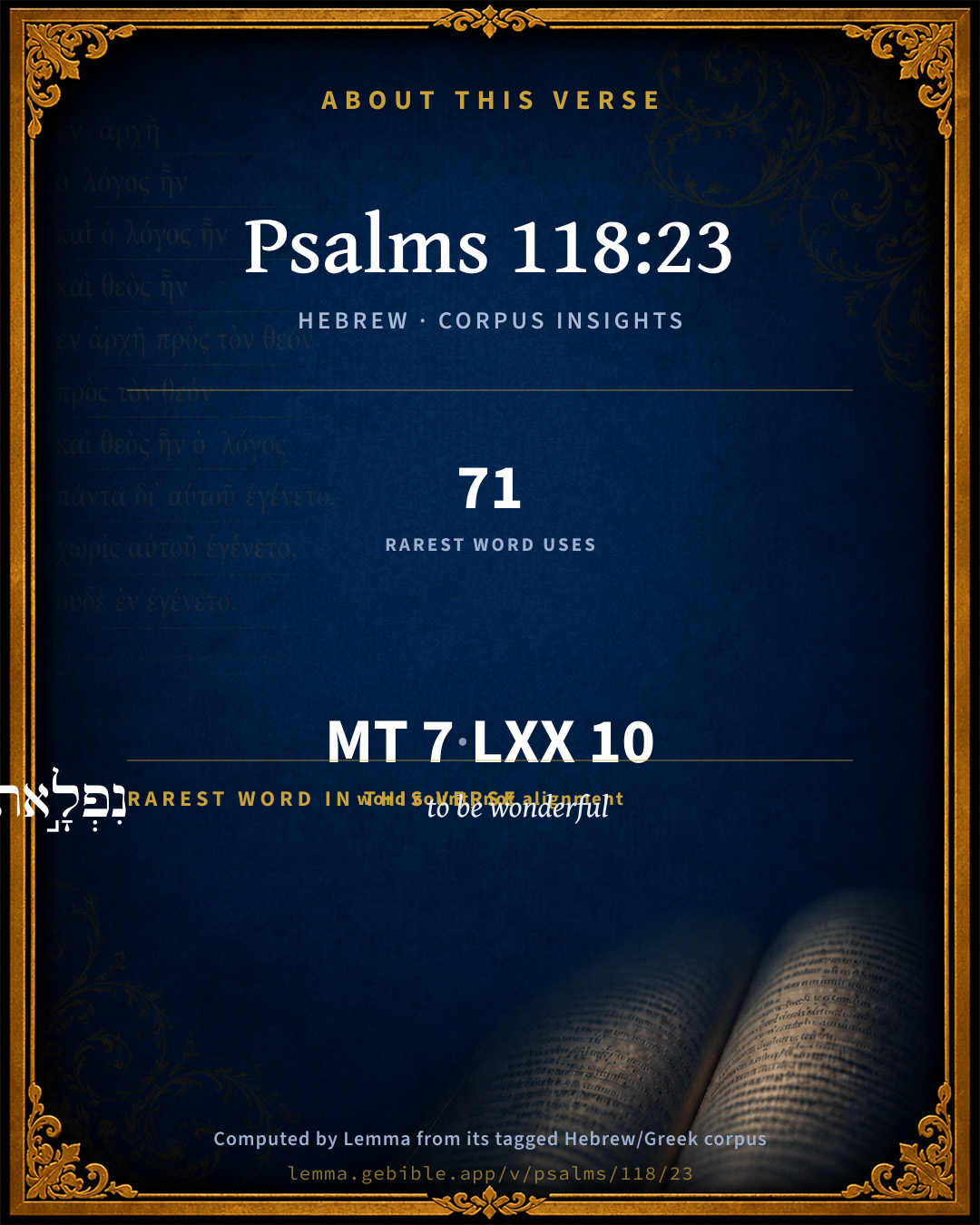
These counts appear in no published source. They are computed here, from the morphology-tagged text and Lemma’s own curated glosses. What Lemma adds →

7
words
7
distinct lemmas
Wisdom
section

Grammatical profile

  • 2 verbs
  • 2 nouns
  • 2 pronouns
  • 1 preposition

Verb forms

  • הָ֣יְתָה Qal · Perfect
  • נִפְלָ֣את Niphal · Participle Active

Hebrew & Septuagint length

In English translation the verse runs 10 words from the Hebrew and 14 from the Septuagint (LXX English) — closely comparable.

A rough comparison of the two English renderings, which tokenize alike — not a word-level alignment.

Word counts can differ between the Hebrew and the Greek without any difference in meaning — e.g. the Hebrew direct-object marker אֵת has no separate Greek word, and Greek often adds the article ὁ.

In the original languages it is 7 Hebrew tokens and 10 Greek tokens — but the two are counted differently (Hebrew bundles its prefixes and suffixes into one token; the Greek is in lemma form), so that isn’t a like-for-like length.

Cross-references

7

Topical passages linked to Psalms 118:23 in the Treasury of Scripture Knowledge — connected by theme and wording, ordered by reader-vote popularity; previews shown in the World English Bible.

  • Job 5:9 Who does great things that can't be fathomed, Marvelous things without number;
  • Acts 13:41 'Behold, you scoffers, and wonder, and perish; For I work a work in your days, A work which you will in no way believe, if one declares it to you.'"
  • Ephesians 1:19–22 and what is the exceeding greatness of his power toward us who believe, according to that working of the strength of his might
  • Acts 4:13 Now when they saw the boldness of Peter and John, and had perceived that they were unlearned and ignorant men, they marveled. They recognized that they had been with Jesus.
  • Acts 5:31–32 God exalted him with his right hand to be a Prince and a Savior, to give repentance to Israel, and remission of sins.
  • Acts 2:32–36 This Jesus God raised up, to which we all are witnesses.
  • Acts 3:14–15 But you denied the Holy and Righteous One, and asked for a murderer to be granted to you,

Cross-references courtesy of OpenBible.info (CC BY 4.0).

Hebrew and Greek witnesses Masoretic Hebrew ↔ Greek Septuagint

The same verse in the two great witnesses to the Old Testament, shown verse-for-verse.

You’re reading Greek Psalm 117 (Hebrew Psalm 118). The Septuagint counts the superscription, so verse numbers can differ from the Hebrew — chapter-level alignment, not verse-by-verse. Numbering follows Rahlfs.

These are two independent witnesses, not word-aligned to each other, and the Septuagint is shown in lemma (dictionary) form.

Hebrew Psalms 118:23 Masoretic · Westminster Leningrad Codex

מֵאֵ֣ת יְ֭הוָה הָ֣יְתָה זֹּ֑את הִ֖יא נִפְלָ֣את בְּעֵינֵֽינוּ

This is Yahweh's doing. It is marvelous in our eyes.

World English Bible · Public Domain

Greek LXX Greek Psalm 117:23 Septuagint · lemma form

παρά κύριος γίγνομαι οὗτος καί εἰμί θαυμαστός ἐν ὀφθαλμός ἐγώ

This has been done of the Lord; and it is wonderful in our eyes.

LXX2012 (modern English Septuagint) · Public Domain

Hebrew: Westminster Leningrad Codex (CC BY 4.0). Greek: Septuagint (public domain); English from LXX2012 (modern English Septuagint) (Public Domain). How the Septuagint differs from the Hebrew →

Commentary

Notes on Psalms 118:23 from classic Christian and Jewish commentators (each source and its license shown beneath its notes). The classic Christian expositions comment on the surrounding passage and are grouped to its opening verse, so a note may address several verses; the Jewish commentaries on the Tanakh (Rashi and others) are per-verse, so they appear only where the commentator wrote on this verse.

Lemma curates 59 commentaries, every one of them public domain or Creative Commons licensed, each selected and text-cleaned for this edition rather than reprinted as found. About our sources →

Trapp's Complete Commentary

John Trapp

Psa 118:23 This is the LORD’S doing; it [is] marvellous in our eyes.

Ver. 23. This is the Lord’s doing] That David should ever come to the kingdom, that Christ should so be raised from the lowest ebb of humiliation to the highest tide of exaltation, this is a wonder of wonders, a matchless miracle.

And it is marvellous in our eyes] As all God’s works are to those that have spiritual senses habitually exercised; but especially the great work of man’s redemption by Christ.

John Trapp, A Commentary or Exposition upon All the Books of the Old and New Testament (1647–1656) — public domain. Text from a community e-Sword module.

The Biblical Illustrator

Joseph S. Exell

Psa_118:23

This is the Lords doing; it is marvellous in our eyes.

The Lords doing

The following appear to me to be evident marks, or strong indications of an immediate work of Divine Providence.

1. When great and notable events are brought about by causes apparently inadequate to produce them,--by means that, to all human reason and appearance, are unable to attain their end.

2. When nature herself seems to arm in defence of, or in opposition to, any cause, by operating for, or against the same, in an extraordinary and unusual manner (Jos_10:13; Jdg_5:20; 1Sa_7:10).

3. When the hidden works of darkness are brought to light in some sudden, surprising, and unexpected manner, as if by accident (2Ki_5:20-27; Act_5:1-12; Mat_2:1-17; Est_6:7; Act_9:23-25; Act_23:12-25).

4. When some great and notable mischief is not only discovered and prevented, but likewise when it is returned upon the heads of its first contrivers. Pharaoh, Haman.

5. When great, good, and noble ends are brought about by wicked men quite contrary to their malevolent intentions (Exo_1:15; Exo_2:1-10).

6. When events are well timed and highly seasonable. Learn--

1. That with God nothing is impossible.

2. Wherein the spirit and power of thankfulness doth chiefly consist: it consists in the life of those who are truly thankful. (D. McIndoe.)

The Biblical Illustrator, edited by Joseph S. Exell (c. 1880s–1900s) — public domain. Text from a community e-Sword module.

Joseph Benson's Commentary

Psa 118:23. This is the Lord’s doing — This strange event is the work of God, a peculiar effect of his omnipotent wisdom, performed not only without the help, but against all the artifices and forces of man. This and the preceding verse are thus read by Dr. Waterland: The stone, &c., is made the head of the corner; by the Lord is it so made, and it is marvellous, &c. Mudge renders the latter verse, this is from the Lord; it was impossible in our eyes. “It was the Lord’s doing, they said; in their eyes it was a thing beyond all possibility of belief:” which is the force of the original. The exaltation of David from a sheepfold to a throne was wonderful, especially considering the opposition made against it by the princes and rulers of Judah and Israel: but much more astonishing was the exaltation of Christ. For “what can be more truly marvellous, than that a person, put to death as a malefactor, and laid in the grave, should from thence arise immortal, and become the head of an immortal society; should ascend into heaven, being vested with unlimited power, and crowned with ineffable glory; and should prepare a way for the sons of Adam to follow him into those mansions of eternal bliss?”

Joseph Benson's Commentary on the Old and New Testaments (1811–1818) — public domain. Text from a community e-Sword module.

J. A. Alexander on Psalms

Joseph Addison Alexander

23. (Psa 118:23) From Jehovah is this; it is wonderfully done in our eyes. This signal revolution in the condition of the chosen people is not the work of man but of God. From the Lord, i. e. proceeding from him as its author. Is this, literally has been, i.e. happened, come to pass. In the last clause it is said to be not merely wonderful, but wonderfully done, the Hebrew word being a passive participle, which strictly means distinguished, made to differ, made strange, strangely done. Its plural is continually used as a noun in application to God's wondrous works or doings. This, no less than the proverb to which it is attached, was as appropriate to the case of the Messiah as to that of his people, and is accordingly applied in the same manner by himself (Mat 21:42).

Joseph Addison Alexander, The Psalms Translated and Explained (1850) — public domain. Text from a community e-Sword module.

Adam Clarke's Commentary

Verse 23. See Clarke on Ps 118:22.

Adam Clarke's Commentary on the Bible (1810–1826) — public domain. Text from a community e-Sword/MySword module.

John Calvin's Commentaries

This, says he, is the doing of Jehovah “Go and quarrel with God, all ye that strenuously endeavor to eject me from my throne, to which I have not been elevated accidentally, or by human policy, but by the manifest power of God.” This he confirms by all being constrained to wonder at what had occurred as a thing incredible. Now, when God doeth marvellously, and in a manner that surpasses our comprehension, his power cannot fail to be so much the more apparent unto us. Should any prefer to interpret it thus:-Although this work may fill men with astonishment, yet that is no reason for rejecting it; he may do so. To me, however, it certainly appears more probable that David employs the term wonderful, that the haughtiness of man may submit to God, and that none may presume to breathe a whisper against him. The fitness of these things being applied to Christ will be more properly discussed when I come to consider the twenty-fifth verse.

John Calvin's Commentaries (1540-1563) — public domain. Text from the Calvin Translation Society English edition (1840s-50s) via the Christian Classics Ethereal Library (ccel.org). Calvin's coverage is partial (roughly two-thirds of the Bible); uncommented books and verses are honest gaps, never fabricated. The 19th-century editor's footnotes and remarks are omitted so the notes are faithfully Calvin's own voice.

Ellicott's Commentary for English Readers

(23) The Lord’s doing.—This change of destiny, which made Israel of sudden political importance, is to be ascribed to none but Jehovah Himself.

A Bible Commentary for English Readers, edited by Charles John Ellicott (1878–1897) — public domain. Text from a community e-Sword module.

The Cambridge Bible for Schools and Colleges

gen. ed. J. J. S. Perowne

23. This &c.] Lit. From Jehovah has this come to pass. The order of the words emphasises From Jehovah. Cp. Neh_6:16, “They perceived that it was from our God that this work was wrought.”

marvellous] Nothing less than a miracle, visibly attesting the providential care of Jehovah for His people. See note on Psa_71:17. The same word is used in Jer_32:17; Jer_32:27 with reference to the promised restoration of Israel from captivity. “There is nothing too hard (lit. wonderful) for thee.”

The Cambridge Bible for Schools and Colleges (gen. ed. J. J. S. Perowne; Cambridge University Press, 1878–1918) — public domain. Text from a community e-Sword module.

John Gill's Exposition

Blessed be he that cometh in the name of the Lord,.... These words were used by the multitude that followed Christ, as he went into Jerusalem, in order to eat his last passover, and suffer and die for his people, and are applied to him; as also by his disciples, who expressed them thus, "Blessed be the King that cometh", &c. Luk 19:38; the King Messiah, who came from heaven to earth, from his Father into this world, to save the chief of sinners; who now came to Jerusalem on that errand, and into the temple, as the proprietor of it; where he showed his power, and exercised his authority: he came not in his own name, but in his Father's name; and not to do his own will, but his; nor did he seek his own glory, but his Father's: he came as his servant to do his work; he came with a commission from him, by his order, and to obey his commands, which he did; he came with his full consent and will, and, as man and Mediator, was helped and assisted by him; and as such he is pronounced blessed: all blessing, happiness, and honour, are wished for him, and ascribed unto him, as his just due; being Lord and King, Saviour and Redeemer, of his people;

we have blessed you out of the house of the Lord; these are the words of the priests, one part of whose office it was to bless the people, Num 6:23; but these were not the chief priests of the Jews in Christ's time; for they were displeased with the multitude, and with the children in the temple, for crying "hosanna" to the son of David, and wishing well to him, Mat 21:15. But the disciples of Christ, or ministers of the Gospel, who blessed the people that blessed their Lord and Master; or wished well to them, and prayed for them that wished well to him. The sense is, either we who are of the house of the Lord bless you; we who stand there, and serve him, are rulers of the household of God, and stewards of the mysteries of grace: or we bless you, and pray for your welfare, who are of the household of faith; who are fellow citizens with the saints, and of the household of God: or we bless you with provisions out of the house of God; with the goodness and fatness of his house, the word and ordinances, by administering them to you: or we pray that the Lord would bless you out of Zion, or out of the highest heavens, where he is; even with all spiritual blessings, in heavenly places in Christ Jesus; see Psa 134:1. The Targum of this verse Psa 118:25, is,

"We beseech thee, O Lord, "save" now, said the builders; We beseech thee, O Lord, send now prosperity, said Jesse and his wife. Blessed be he that cometh in the name of the Lord, said the builders; Let us bless you out of the house of the sanctuary of the Lord, said David.''

John Gill's Exposition of the Whole Bible (1746–1763) — public domain (CC PDM 1.0). Text via the HelloAO Bible API.

Albert Barnes' Notes on the Bible

This is the Lord’s doing - Margin, as in Hebrew, “This is from the Lord.” That is, It is to be traced to the Lord alone. It is not the result of human wisdom or power. The deliverance from danger - the raising up from the low condition - the change by which he who was rejected was restored to his rightful place - all this was to be traced to God alone. So it was in the case of the psalmist; so it was in the case of the Redeemer. None but God could have made him who was rejected, despised, crucified, and laid in the grave, the Saviour of a world. The place which the once rejected Redeemer now bears in the church - the honors bestowed on him as the head of the church - the triumph of his gospel in the world - all prove that it is the work of God.

It is marvelous in our eyes - It is suited to excite wonder. It is not one of those things which are to be ranked with the common and well-known events that are easily explained, and that excite no wonder; it is one of those things which cannot be explained by any known law; which belong to the “supernatural;” which bear the marks of a direct divine interposition; which are suited to excite the admiration of mankind. Thus it was in the case of the psalmist; thus, pre-eminently, it was in the case of the Redeemer. No operation of natural laws will constitute a sufficient explanation of the latter. It is a matter for wonder, for rejoicing, and for praise, that one, despised, rejected, crucified, has been raised from the grave; that his religion has spread so far over the world; that it influences mankind as it does; and that he himself is exalted to a rank “far above all principality, and power, and might, and dominion, and every name that is named, not only in this world, but also in that which is to come.” Eph 1:21.

Albert Barnes' Notes on the Bible (1834–1885) — public domain. Text from a community e-Sword/MySword module.

Matthew Poole's English Annotations

This; this strange event; the feminine gender being put for the neuter, as it is in other places of Scripture.

The Lord’s doing; peculiarly an effect of his omnipotent wisdom; done not only without the help of man, but against all the artifices and forces of men.

Matthew Poole's English Annotations on the Holy Bible (1683–1685) — public domain. Text from a community e-Sword/MySword module.

The Treasury of David

Charles H. Spurgeon

Ver. 23. This is the LORD'S doing. The exalted position of Christ in his church is not the work of man, and does not depend for its continuation upon any builders or ministers; God himself has wrought the exaltation of our Lord Jesus. Considering the opposition which comes from the wisdom, the power, and the authority of this world, it is manifest that if the kingdom of Christ be indeed set up and maintained in the world it must be by supernatural power. Indeed, it is so even in the smallest detail. Every grain of true faith in this world is a divine creation, and every hour in which the true church subsists is a prolonged miracle. It is not the goodness of human nature, nor the force of reasoning, which exalts Christ, and builds up the church, but a power from above. This staggers the adversary, for he cannot understand what it is which baffles him: of the Holy Ghost He knows nothing.

It is marvellous in our eyes. We actually see it; it is not in our thoughts and hopes and prayers alone, but the astonishing work is actually before our eyes. Jesus reigns, his power is felt, and we perceive that it is so. Faith sees our great Master, far above all principality, and power, and might, and dominion, and every name that is named, not only in this world, but also in that which is to come; she sees and marvels. It never ceases to astonish us, as we see, even here below, God by means of weakness defeating power, by the simplicity of his word baffling the craft of men, and by the invisible influence of his Spirit exalting his Son in human hearts in the teeth of open and determined opposition. It is indeed "marvellous in our eyes, "as all God's works must be if men care to study them. In the Hebrew the passage reads, "It is wonderfully done": not only is the exaltation of Jesus of Nazareth itself wonderful, but the way in which it is brought about is marvellous: it is wonderfully done. The more we study the history of Christ and his church the more fully shall we agree with this declaration.

Psalms 118:24*

Charles H. Spurgeon's The Treasury of David (1869–1885) — public domain. Psalms only. Text from a community e-Sword/MySword module.

Whedon's Commentary on the Bible

Daniel D. Whedon

23. This is the Lord’s doing—The restoration of the Jews to their nationality was so marked as a divine interposition, that the heathen said, “Jehovah hath done great things for them.” See Psa_126:1-2. But the language is Messianic. Christ, the Stone which the builders disallowed, was exalted to be the “headstone of the corner” by the resurrection from the dead and the public investiture of the mediatorial government.

Daniel D. Whedon (gen. ed.), Commentary on the Old and New Testaments (1874–1909) — public domain. Text from a community e-Sword module.

The Pulpit Commentary

This is the Lord"s doing; it is marvelous in our eyes. This fresh elevation of Israel to importance especially to such great importance can only be attributed to the work of Divine providence. It is "the Lord"s doing literally, "from the Lord and is one of the most marvelous events of history.

The Pulpit Commentary (1880–1919), ed. H.D.M. Spence-Jones & Joseph S. Exell — public domain. Text from a community e-Sword module.

Rashi

Rabbi Shlomo Yitzchaki (Rashi)

This was from the Lord So will everyone say.

Rashi on the Tanakh — English translations: “The Judaica Press complete Tanach with Rashi, translated by A. J. Rosenberg” (CC BY 4.0); “Pentateuch with Rashi's commentary by M. Rosenbaum and A.M. Silbermann, 1929-1934” (public domain); “The Metsudah Tanach series, Lakewood, N.J” (CC BY 4.0); and “The Book of Joshua, Metsudah Publications, 1997” (CC BY 4.0). Text via Sefaria.

Lesson kit

Teaching starters — assembled from the data on this page, not authored interpretation. Every prompt links to the verse data it draws on. Edit before teaching.

Psalms, in the Wisdom, opens this verse with 7 words (7 distinct Hebrew lemmas). Its most distinctive word is pâlâʼ (“to be wonderful”). A historical commentator’s framing appears above. Read the whole chapter for the surrounding context.

Discussion questions

  1. How does “to be wonderful” (pâlâʼ) shape what this verse is saying?
  2. How does Job 5:9, which shares this passage’s theme, read alongside this verse?
  3. These translations render this verse differently; the difference is in the English rendering, not the original. What questions does that raise?
  4. «הָ֣יְתָה» is a Qal Perfect verb. How does that grammatical form shape the action described?
  5. Compare how Trapp's Complete Commentary and The Biblical Illustrator read this verse. Where do they agree or differ?

Things to notice

Reading settings

Reading text

Shown beneath each verse's original-language words.

Old Testament
Old Testament edition

Read the OT as the Masoretic Hebrew (MT) or the Greek Septuagint (LXX).

English shown for the Greek Septuagint (in the Hebrew ↔ Greek comparison).

Comparing translations? Open the Compare panel on any verse page to stack up to four side by side.