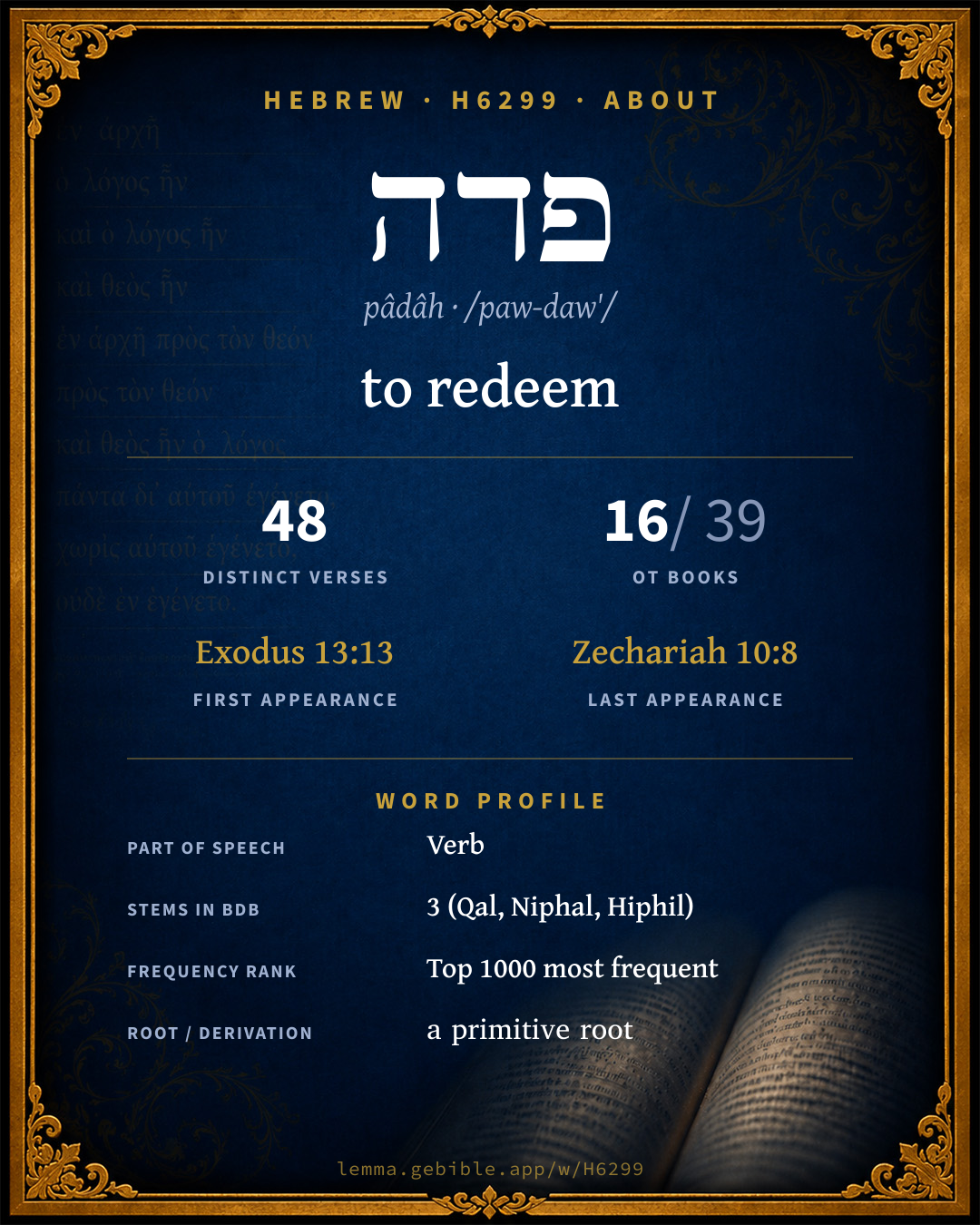
פָּדָה
to redeem
‘to redeem’ is one of 5 main senses fuller range ↓
Full lexicon entry — Brown-Driver-Briggs (BDB)
From Brown-Driver-Briggs (BDB)
Where this word appears
See every Qal verb in the Hebrew Bible →
Grammar key — what these labels mean
Part of speech
- Verb
- An action or state-of-being word.
Stem
- Qal
- The basic, simple active stem — the plain form of the verb (“he wrote”). Here: ‘for an assessed price Ex 13’
- Hophal
- The passive counterpart of the Hiphil (“he was caused to…”).
- Hiphil
- The causative active stem (“he caused / brought about”).
- Niphal
- Usually the simple passive or reflexive of the Qal (“he was written”).
Form
- Imperfect
- An incomplete, ongoing, or future action (“he will / would write”).
- Perfect
- A completed action or state — Hebrew marks aspect (completeness) more than strict tense (“he wrote”).
- Sequential Imperfect
- An imperfect with prefixed waw — the standard past-narrative form (waw-consecutive imperfect).
- Imperative
- A direct command (“write!”).
- Participle Passive
- A verbal adjective expressing action received (“written”).
- Infinitive Construct
- A bound verbal noun, frequently with prepositions (“to write / in writing”).
- Infinitive Absolute
- An unbound verbal noun, often intensifying or standing in for a finite verb.
- Participle Active
- A verbal adjective expressing ongoing or characteristic action (“writing / one who writes”).
- Sequential Perfect
- A perfect with prefixed waw continuing a preceding imperfect or command (waw-consecutive perfect).
State
- Construct
- A noun bound to a following noun in a possessive / “of” relationship (the construct chain).
- Absolute
- The independent form of a noun, not bound to a following word.
Person
- 2nd Person
- The one addressed (“you”).
- 3rd Person
- The one spoken about (“he / she / it / they”).
- 1st Person
- The speaker (“I / we”).
Gender
- Masculine
- Grammatically masculine.
- Common
- Either gender — not distinguished for this form.
- Feminine
- Grammatically feminine.
Number
- Singular
- One.
- Plural
- More than one (in Hebrew, generally three or more).
Grammatical forms 22 distinct
- Verb, Qal, Imperfect, 2nd Person, Masculine, Singular 10 times (17%)
- Verb, Qal, Perfect, 3rd Person, Masculine, Singular 8 times (14%)
- Verb, Qal, Perfect, 2nd Person, Masculine, Singular 7 times (12%)
- Verb, Qal, Imperative, 2nd Person, Masculine, Singular 5 times (8%)
- Verb, Qal, Sequential Imperfect, 3rd Person, Masculine, Singular 3 times (5%)
- Verb, Qal, Imperfect, 3rd Person, Masculine, Singular 3 times (5%)
- Verb, Qal, Imperfect, 1st Person, Common, Singular 3 times (5%)
- Verb, Qal, Perfect, 1st Person, Common, Singular 3 times (5%)
+14 more forms (17 occurrences)
Parsed forms decoded from the imported morphology (morphhb / Westminster Leningrad Codex — WLC text public domain, morphhb tagging CC BY 4.0), counted across 59 parsed occurrences — not distinct verses.
Every verse where H6299 appears — 48 distinct verses across 16 books. Click any verse to open its interlinear word-by-word view. Verse text shown in the World English Bible for context — . Each verse’s Hebrew form is shown with its reference; the English is not keyword-highlighted, since the data carries no word-level English alignment. Use “Compare translations” on any verse to read it across multiple English versions. This concordance covers the Hebrew Bible; Septuagint (Greek Old Testament) occurrences are not indexed here.
Exodus 4 verses
- Exodus 13:13 תִּפְדֶּ֣ה תִפְדֶּ֖ה תִּפְדֶּֽה Qal impf 2ms Qal impf 2ms Qal impf 2ms Every firstborn of a donkey you shall redeem with a lamb; and if you will not redeem it, then you shall break its neck; and you shall redeem all the firstborn of man among your sons.
- Exodus 13:15 אֶפְדֶּֽה Qal impf 1cs and it happened, when Pharaoh would hardly let us go, that Yahweh killed all the firstborn in the land of Egypt, both the firstborn of man, and the firstborn of animal. Therefore I sacrifice to Yahweh all that opens the womb, being males; but all the firstborn of my sons I redeem.'
- Exodus 21:8 וְ/הֶפְדָּ֑/הּ conj + Hiphil wpf 3ms + sfx pers 3fs If she doesn't please her master, who has married her to himself, then he shall let her be redeemed. He shall have no right to sell her to a foreign people, seeing he has dealt deceitfully with her.
- Exodus 34:20 תִּפְדֶּ֣ה תִפְדֶּ֖ה תִּפְדֶּ֔ה Qal impf 2ms Qal impf 2ms Qal impf 2ms The firstborn of a donkey you shall redeem with a lamb: and if you will not redeem it, then you shall break its neck. All the firstborn of your sons you shall redeem. No one shall appear before me empty.
Leviticus 3 verses
- Leviticus 19:20 וְ/הָפְדֵּה֙ נִפְדָּ֔תָה conj + Hophal inf.abs Niphal pf 3fs "'If a man lies carnally with a woman who is a slave girl, pledged to be married to another man, and not ransomed, or given her freedom; they shall be punished. They shall not be put to death, because she was not free.
- Leviticus 27:27 וּ/פָדָ֣ה conj + Qal wpf 3ms If it is an unclean animal, then he shall buy it back according to your valuation, and shall add to it the fifth part of it: or if it isn't redeemed, then it shall be sold according to your valuation.
- Leviticus 27:29 יִפָּדֶ֑ה Niphal impf 3ms "'No one devoted, who shall be devoted from among men, shall be ransomed; he shall surely be put to death.
Numbers 3 verses
- Numbers 18:15 פָּדֹ֣ה תִפְדֶּ֗ה תִּפְדֶּֽה Qal inf.abs Qal impf 2ms Qal impf 2ms Everything that opens the womb, of all flesh which they offer to Yahweh, both of man and animal shall be yours: nevertheless the firstborn of man shall you surely redeem, and the firstborn of unclean animals shall you redeem.
- Numbers 18:16 וּ/פְדוּיָ/ו֙ תִּפְדֶּ֔ה conj + Qal ptcp.pass ms cs + sfx pers 3ms Qal impf 2ms Those who are to be redeemed of them from a month old shall you redeem, according to your estimation, for the money of five shekels, after the shekel of the sanctuary (the same is twenty gerahs).
- Numbers 18:17 תִפְדֶּ֖ה Qal impf 2ms But the firstborn of a cow, or the firstborn of a sheep, or the firstborn of a goat, you shall not redeem; they are holy: you shall sprinkle their blood on the altar, and shall burn their fat for an offering made by fire, for a sweet savor to Yahweh.
Deuteronomy 6 verses
- Deuteronomy 7:8 וַֽ/יִּפְדְּ/ךָ֙ conj + Qal wimpf 3ms + sfx pers 2ms but because Yahweh loves you, and because he would keep the oath which he swore to your fathers, has Yahweh brought you out with a mighty hand, and redeemed you out of the house of bondage, from the hand of Pharaoh king of Egypt.
- Deuteronomy 9:26 פָּדִ֖יתָ Qal pf 2ms I prayed to Yahweh, and said, Lord Yahweh, don't destroy your people and your inheritance, that you have redeemed through your greatness, that you have brought forth out of Egypt with a mighty hand.
- Deuteronomy 13:5 וְ/הַ/פֹּֽדְ/ךָ֙ conj + ptcl def.art + Qal ptcp.act ms cs + sfx pers 2ms That prophet, or that dreamer of dreams, shall be put to death, because he has spoken rebellion against Yahweh your God, who brought you out of the land of Egypt, and redeemed you out of the house of bondage, to draw you aside out of the way which Yahweh your God commanded you to walk in. So shall you put away the evil from the midst of you.
- Deuteronomy 15:15 וַֽ/יִּפְדְּ/ךָ֖ conj + Qal wimpf 3ms + sfx pers 2ms You shall remember that you were a bondservant in the land of Egypt, and Yahweh your God redeemed you: therefore I command you this thing today.
- Deuteronomy 21:8 פָּדִ֨יתָ֙ Qal pf 2ms Forgive, Yahweh, your people Israel, whom you have redeemed, and don't allow innocent blood [to remain] in the midst of your people Israel. The blood shall be forgiven them.
- Deuteronomy 24:18 וַֽ/יִּפְדְּ/ךָ֛ conj + Qal wimpf 3ms + sfx pers 2ms but you shall remember that you were a bondservant in Egypt, and Yahweh your God redeemed you there: therefore I command you to do this thing.
1 Samuel 1 verse
2 Samuel 2 verses
- 2 Samuel 4:9 פָּדָ֥ה Qal pf 3ms David answered Rechab and Baanah his brother, the sons of Rimmon the Beerothite, and said to them, As Yahweh lives, who has redeemed my soul out of all adversity,
- 2 Samuel 7:23 לִ/פְדּֽוֹת פָּדִ֤יתָ prep + Qal inf.cs Qal pf 2ms What one nation in the earth is like your people, even like Israel, whom God went to redeem to himself for a people, and to make him a name, and to do great things for you, and awesome things for your land, before your people, whom you redeem to you out of Egypt, [from] the nations and their gods?
1 Kings 1 verse
1 Chronicles 1 verse
Nehemiah 1 verse
Job 3 verses
- Job 5:20 פָּֽדְ/ךָ֣ Qal pf 3ms + sfx pers 2ms In famine he will redeem you from death; In war, from the power of the sword.
- Job 6:23 תִּפְדּֽוּ/נִי Qal impf 2mp + sfx pers 1cs Or, 'Deliver me from the adversary's hand?' Or, 'Redeem me from the hand of the oppressors?'
- Job 33:28 פָּדָ֣ה Qal pf 3ms He has redeemed my soul from going into the pit, My life shall see the light.'
Psalms 13 verses
- Psalms 25:22 פְּדֵ֣ה Qal impv 2ms Redeem Israel, God, Out all of his troubles.
- Psalms 26:11 פְּדֵ֣/נִי Qal impv 2ms + sfx pers 1cs But as for me, I will walk in my integrity. Redeem me, and be merciful to me.
- Psalms 31:5 פָּדִ֖יתָה Qal pf 2ms Into your hand I commend my spirit. You redeem me, Yahweh, God of truth.
- Psalms 34:22 פּוֹדֶ֣ה Qal ptcp.act ms Yahweh redeems the soul of his servants. None of those who take refuge in him shall be condemned.
- Psalms 44:26 וּ֝/פְדֵ֗/נוּ conj + Qal impv 2ms + sfx pers 1cp Rise up to help us. Redeem us for your loving kindness' sake.
- Psalms 49:7 פָדֹ֣ה יִפְדֶּ֣ה Qal inf.abs Qal impf 3ms None of them can by any means redeem his brother, Nor give God a ransom for him.
- Psalms 49:15 יִפְדֶּ֣ה Qal impf 3ms But God will redeem my soul from the power of Sheol, For he will receive me. Selah.
- Psalms 55:18 פָּ֘דָ֤ה Qal pf 3ms He has redeemed my soul in peace from the battle that was against me, Although there are many who oppose me.
- Psalms 69:18 פְּדֵֽ/נִי Qal impv 2ms + sfx pers 1cs Draw near to my soul, and redeem it. Ransom me because of my enemies.
- Psalms 71:23 פָּדִֽיתָ Qal pf 2ms My lips shall shout for joy! My soul, which you have redeemed, sings praises to you!
- Psalms 78:42 פָּדָ֥/ם Qal pf 3ms + sfx pers 3mp They didn't remember his hand, Nor the day when he redeemed them from the adversary;
- Psalms 119:134 פְּ֭דֵ/נִי Qal impv 2ms + sfx pers 1cs Redeem me from the oppression of man, So I will observe your precepts.
- Psalms 130:8 יִפְדֶּ֣ה Qal impf 3ms He will redeem Israel from all their sins.
Isaiah 4 verses
- Isaiah 1:27 תִּפָּדֶ֑ה Niphal impf 3fs Zion shall be redeemed with justice, And her converts with righteousness.
- Isaiah 29:22 פָּדָ֖ה Qal pf 3ms Therefore thus says Yahweh, who redeemed Abraham, concerning the house of Jacob: Jacob shall not now be ashamed, neither shall his face now wax pale.
- Isaiah 35:10 וּ/פְדוּיֵ֨י conj + Qal ptcp.pass mp cs and the ransomed of Yahweh shall return, and come with singing to Zion; and everlasting joy shall be on their heads: they shall obtain gladness and joy, and sorrow and sighing shall flee away.
- Isaiah 51:11 וּ/פְדוּיֵ֨י conj + Qal ptcp.pass mp cs The ransomed of Yahweh shall return, and come with singing to Zion; and everlasting joy shall be on their heads: they shall obtain gladness and joy; [and] sorrow and sighing shall flee away.
Jeremiah 2 verses
Hosea 2 verses
- Hosea 7:13 אֶפְדֵּ֔/ם Qal impf 1cs + sfx pers 3mp Woe to them! For they have wandered from me. Destruction to them! For they have trespassed against me. Though I would redeem them, Yet they have spoken lies against me.
- Hosea 13:14 אֶפְדֵּ֔/ם Qal impf 1cs + sfx pers 3mp I will ransom them from the power of Sheol. I will redeem them from death! Death, where are your plagues? Sheol, where is your destruction? Compassion will be hidden from my eyes.
Micah 1 verse
Zechariah 1 verse
About this entry
At a glance — auto-summarized from this page’s data, not written by a person. Every figure links to its source below. This summary describes the numbers; it doesn’t interpret them.
פדה — transliterated pâdâh — is a Hebrew verb carrying the sense “to redeem.” Older and newer Bibles part ways — “redeem” in the King James Version, “redeemed you” (Berean Standard Bible) in modern versions. See the renderings breakdown. It appears 48 verses across 16 books of the Hebrew Bible, among its moderately common vocabulary. More than a quarter of its appearances fall in Psalms. The verb spans 3 stems, from Qal to Niphal. See the sense tree, 48-verse concordance, and the renderings breakdown below.
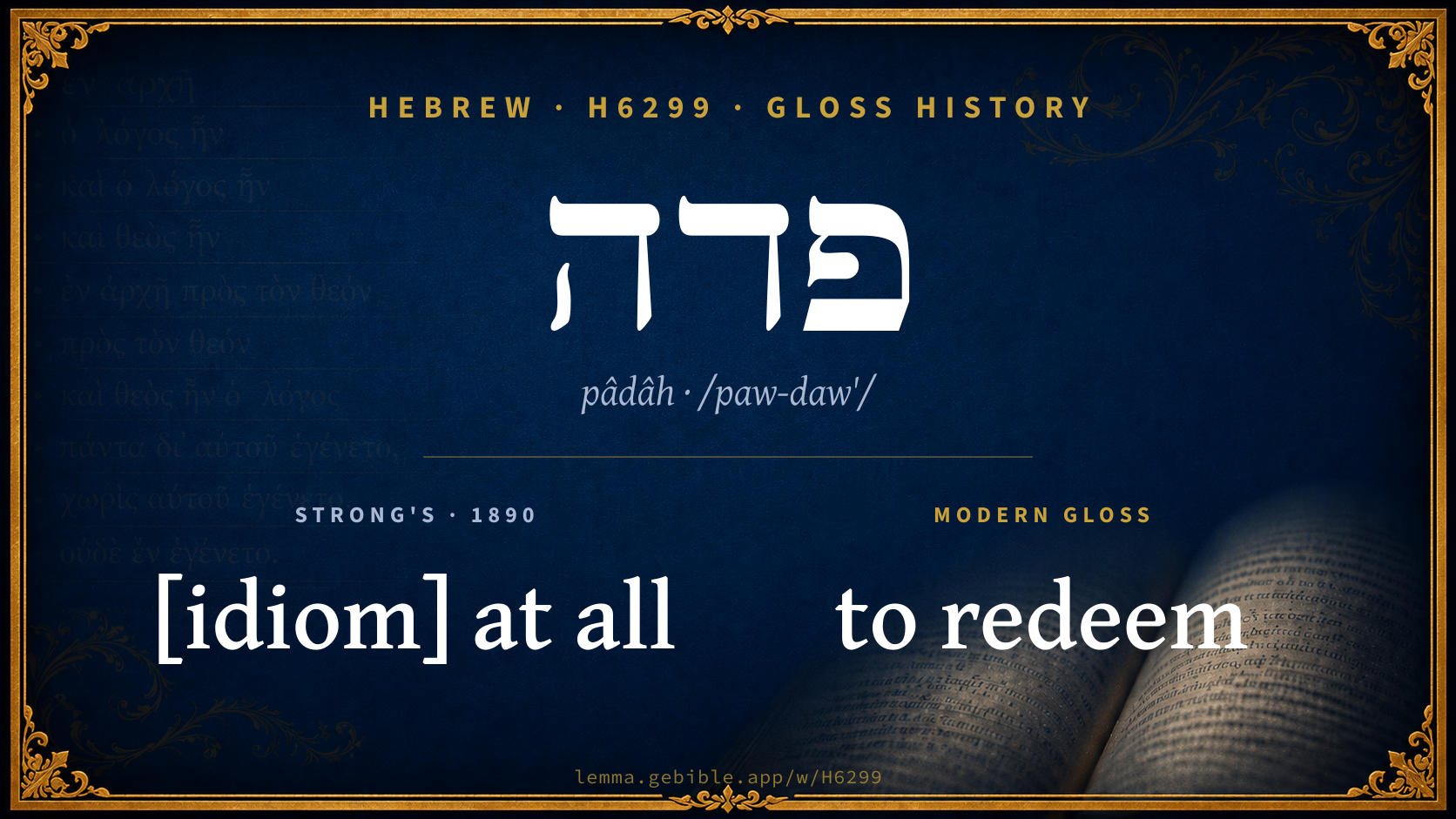
Gloss history
Strong's 1890 vs modern scholarship
About this word
Strong's H6299 catalogs a Hebrew word from the Hebrew Old Testament.
These counts are not copied from any lexicon or concordance. They are computed here, from the morphology-tagged Hebrew Old Testament. What Lemma adds →
- 48
- distinct verses
- The word appears in 48 distinct verses.
- 16 / 39
- OT books
- The word appears in 16 of 39 Old Testament books.
- #647
- by frequency
- Top 1000 most frequent Hebrew words (rank 647 of 8,640 Hebrew words by occurrence).
View all 48 occurrences in the concordance →
Most concentrated in
- Psalms 13 verses 27%
- Deuteronomy 6 verses 13%
- Exodus 4 verses 8%
By section of the Old Testament
By traditional corpus
Conventional, traditional groupings — biblical authorship is debated, so this is a traditional corpus grouping, not an authorship claim. Each share is this word’s portion of its verses in that division of the Hebrew canon. Each figure is a share of the word’s 48 distinct verses.
- Writings (Ketuvim) 18 verses · 38%
- Torah (Pentateuch) 16 verses · 33%
- Prophets (Nevi'im) 14 verses · 29%
How translations render this word
Counts come from each version’s own published word-to-Strong’s tagging or interlinear alignment — an approximate guide to how each version renders this word, not a word-level alignment the data otherwise carries. Because each total is that version’s own tagged count, the per-version totals vary from one another and need not match the appearance or distinct-verse counts above. These counts may also differ from a printed concordance because Lemma counts each distinctly tagged rendering and does not collapse phrase taggings into a single head-word total. This is a fixed set of word-tagged versions (KJV, ASV, BSB, ULT) and does not change with the reading translation you choose elsewhere. Each version’s license is shown beside its name below (and on Sources).
- King James Version: Redeem 7×, Redeemed 7×, Thou hast redeemed 6×
- American Standard Version: Redeemed 8×, Redeem 7×, Thou hast redeemed 4×
- Berean Standard Bible: Redeemed you 5×, Redeem 4×, You must redeem 4×
- unfoldingWord Literal Text: Redeem 6×, Redeemed you 4×, You have redeemed 4×
King James Version Public Domain
Renders H6299 across 59 tagged occurrences — most commonly:
Plus 23 renderings that appear only once — usually multi-word phrases or single function words the recovered tagging swept in, not distinct renderings.
American Standard Version Public Domain
Renders H6299 across 58 tagged occurrences — most commonly:
Plus 21 renderings that appear only once — usually multi-word phrases or single function words the recovered tagging swept in, not distinct renderings.
Berean Standard Bible Public Domain
Renders H6299 across 54 tagged occurrences — most commonly:
Plus 23 renderings that appear only once — usually multi-word phrases or single function words the recovered tagging swept in, not distinct renderings. Not rendered by a distinct English word in 5 further occurrences.
unfoldingWord Literal Text CC BY-SA 4.0
Renders H6299 across 69 tagged occurrences — most commonly:
Plus other, less common renderings. Plus 31 renderings that appear only once — usually multi-word phrases or single function words the recovered tagging swept in, not distinct renderings.
10 senses and sub-senses in the full BDB
Hebrew verbs can shift meaning by stem (binyan): Qal is the basic action, Niphal is often passive or reflexive, Piel often intensifies or makes it factitive, and Hiphil is typically causative. The senses below are grouped under the stem BDB assigns to each.
What do BDB’s symbols mean?
BDB uses these scholarly abbreviations:
| Symbol | Meaning |
|---|---|
| 𝔊 | the Septuagint (the ancient Greek translation, LXX) |
| 𝔙 | the Vulgate (the Latin translation) |
| 𝔖 | the Syriac version (the Peshitta) |
| 𝔗 | the Targum (the Aramaic translation) |
| ψ | the Psalms |
| √ | root (the underlying root or stem) |
| ‖ | parallel passage (a synonymous or contrasted parallel) |
| † | the dagger: every passage where the word occurs is cited |
The 10 senses and sub-senses the full Brown-Driver-Briggs lexicon distinguishes for this word, in lexicon order (not ranked by frequency), with BDB’s own verbatim wording and sub-sense lettering. Shown in Hebrew script with BDB’s own scholarly abbreviations. The condensed entry is in the Lexicon Entry tab. See also the Forms in the corpus table below.
Qal
- Pf. 3 ms. פָּדָה Lv 27:27 +; sf. פָּֽדְךָ Jb 5:20; 2 ms. פָּדִיתָ Dt 9:26 +, etc.; Impf. יִפְדֶּה ψ 49:8 +, etc.; Imv. פְּדֵה ψ 25:22; sf. פְּדֵנִי ψ 26:11 + 3 times; Inf. abs. פָּדֹה Nu 18:15 ψ 49:8; cstr. לִפְדּוֹת 2 S 7:23 = 1 Ch 17:2; Pt. act. פּוֹדֶה ψ 34:23; sf. פֹּדְךָ Dt 13:6; pass. pl. cstr. פְּדוּיֵי Is 35:10; 51:11 Nu 3:49; also abs. פְּדוּיִם Nu 3:51 (Qr; Kt פדים), cstr. פְּדוּיֵי v 46; sf. פְּדוּיָו Nu 18:16 (all n. abstr. according to Di Köii. 1, 138, v. פְּדוּיִם, פִּדְיֹם infr.);—ransom: e.g. Leviticus 27:27
- 1. for an assessed price Ex 13:13, 15; 34:20 (J), Lv 27:27 Nu 3:46, 48, 49, 51; 18:15, 16, 17 (P). e.g. Exodus 13:13
- 2. from violence and death 1 S 14:45 Jb 6:23 ψ 49:8. e.g. 1 Samuel 14:45
- 3. God subj. (underlying thought of payment):
- a. from Egypt, c. מִן, מִבֵּית עֲבָדִים Dt 7:8; 13:6 Mi 6:4; מִנִּי־צָר ψ 78:42; ממצרים 2 S 7:23 (but del. פָּדִיתָ GeiUrschr. 288 We Dr al.) = 1 Ch 17:21; מִשָּׁם Dt 24:18; abs. Dt 9:26; 15:15; 21:8 Ne 1:10. e.g. Deuteronomy 7:8
- b. from exile, Je 31:11 Zc 10:8; פְּדוּיֵי י׳ יְשֻׁבוּן Is 35:10 = 51:11. e.g. Jeremiah 31:11
- c. in gen. Ho 7:13; מִכֹּל צָרוֹתָיו ψ 25:22; מִכֹּל עֲוֹנוֹתָיו ψ 130:8. e.g. Hosea 7:13
- d. c. acc. individ. ψ 26:11; 31:6; 44:27; 69:19; Abraham Is 29:22; פ׳ נפשׁ ψ 34:23; 71:23; + מכל צרה 2 S 4:9 1 K 1:29; מֵעֲבֹר בַּשָּׁ֑חַת Jb 33:28; מִקְּרָב־לִי ψ 55:19; מִמָּוֶת Jb 5:20; מיד שׁאול ψ 49:16 Ho 13:14; מֵעשֶׁק אָדָם ψ 119:134; מִכַּף עָרִיצִים Je 15:21. e.g. Psalms 26:11
Niphal
- Pf. 3 fs. (+ Hoph. Inf. abs.) הָפְדֵּה לֹא נִפְדָּ֑תָה Lv 19:20 she hath not been at all ransomed (from bondage); Impf. יִפָּדֶה Lv 27:29 (from ban); 3 fs. צִיּוֹן בְּמִשְׁפָּט תִּפָּדֶ֑ה Is 1:27. e.g. Leviticus 19:20
Hiphil
- Pf. 3 ms. sf. וְהֶפְדָּהּ Ex 21:8 he shall let her be ransomed. Hiph. Inf. abs. v. Niph. e.g. Exodus 21:8
Senses from the full Brown-Driver-Briggs lexicon (Brown, Driver, Briggs; Oxford 1906 — public domain), digitized via Sefaria, supplemented by the OpenScriptures HebrewLexicon (CC BY 4.0). Full attribution on Sources.
Word origin
vb. ransom (NH in deriv.; Ph. in n.pr.; Assyrian padû, id., Arabic فَدَى; Ethiopic ፈደየ; Min. פדית redeemed or purchased land MordtBeitr. 23);—
— Brown-Driver-Briggs (Oxford 1906, public domain), digitized via Sefaria, supplemented by the OpenScriptures HebrewLexicon (CC BY 4.0). See Sources.
Origin: a primitive root
Jastrow Dictionary
A second Hebrew/Aramaic lexicon for comparison, covering Aramaic and post-biblical (Talmudic, Targumic, Midrashic) usage that the biblical-Hebrew BDB does not. Matched by lemma rather than by Strong’s number, so a lemma may carry more than one Jastrow headword (shown separately below), and the entries cover usage well beyond the Bible.
פָּדָה
- , v. פדי
פדה
- , Y. Sabb. I, 3ᵇ (פרה) פ׳ חד אפר, a corrupt., v. חוֹחָא
A Dictionary of the Targumim, the Talmud Babli and Yerushalmi, and the Midrashic Literature (Marcus Jastrow; London, Luzac, 1903) — Public Domain. Digitized via Sefaria. Digitized via Sefaria. Full attribution on Sources.
Forms in the corpus
The 48 distinct written forms H6299 takes in the Hebrew Bible, most frequent first — each parse links to that stem’s occurrences in the concordance. Hebrew forms include their vowel points and cantillation, so a single lemma takes many written forms.
Same root — word family
Other BDB entries built from the same root as H6299, grouped by Strong’s listed origin. These share a root / origin per the lexicon — not necessarily a shared meaning. Each links to that word’s own entry.
Derived from this word
Proper names from this root
People and places named from this root — a name, not an additional meaning of the word.
- יפדיה Yiphdᵉyâh H3301 Iphedeiah
- פדהאל Pᵉdahʼêl H6300 Pedahel
- פדהצור Pᵉdâhtsûwr H6301 Pedahzur
- פדון Pâdôwn H6303 Padon
- פדיה Pᵉdâyâh H6305 Pedaiah
Compare all same-root words → Showing 4 of 8 — not the complete family. 5 of the same-root words are proper names (people or places). They share a root, not necessarily a meaning.
Septuagint verse parallels
This word appears in 39 verses that also exist in the Greek Old Testament (Septuagint), out of the 48 Hebrew verses it occurs in. You can read those verses in Greek by switching the Old Testament edition to the Septuagint.
Read these verses in the Septuagint
- Exodus 13:13
- Leviticus 19:20
- Numbers 18:15
- Deuteronomy 7:8
- 1 Samuel 14:45
- 2 Samuel 4:9
- 1 Kings 1:29
- 1 Chronicles 17:21
- Job 5:20
- Psalms 26:11
- Isaiah 1:27
- Jeremiah 15:21
This is a verse-level parallel only — the same verses exist in both the Hebrew and Greek Old Testaments. No word-level Hebrew↔Greek correspondence is claimed: the data carries no such alignment, so no Greek word is shown as this Hebrew word’s translation. Coverage is not total — the Septuagint omits the deuterocanon and renumbers the Psalms, so some Hebrew verses have no direct Greek parallel.